Implications
From the animal welfare point of view, stunning techniques during slaughter should be efficient and reliable. Veterinary services need easy-to-do methods for inspection purposes, and in cattle slaughter heads of the slaughtered animals are easily inspected. The aim of this investigation was to investigate shooting precision during cattle slaughter. A total of 8879 skulls of cattle were investigated. Number, position and direction of shots differed widely. Therefore, daily and routine inspection of the heads after slaughter may improve shooting precision.
Introduction
The slaughter of farm animals for human consumption is one of the most sensitive points for animal welfare and for those humans who are continuously confronted with such situations. Before bleeding, the stunning of an animal provides instant unconsciousness, a state in which the animal remains up until its death (AHAW, 2004). For stunning of cattle, the captive bolt is the instrument of daily practice.
Ideally, the gun is placed on the forehead in order to target the brain stem and the bolt is then fired into the head. Immediate unconsciousness is considered to occur from the resulting damage to the brain stem. The operator may also shoot without contact of the muzzle of the gun to the forehead, depending on the individual situation. For placement, the Scientific Panel on Animal Health and Welfare (EU, 2004) refers to the following conditions: directed at right angles to the skull, the gun should be placed at the cross-over point of imaginary lines drawn between the base of the horns and the contralateral eyes and should be no further away than a 2-cm radius from this point. In contrast, Kaegi (Reference Kaegi1988) prefers placement to be slightly besides the midline in order to circumvent the heavy and bony structure along the midline of the forehead.
Effectively shot cattle collapse immediately. A spastic flexion of their hind limbs for approximately 5 s and blankly staring eyes without corneal reflex is noticed, plus a lack of breathing (Grandin, Reference Grandin2002).
However, a biased placement and direction of the shot may leave the animal sensitive to unacceptable pain. Ilgert (Reference Ilgert1985) has observed that a second shot is required in 44 out of 1100 cases. Such mis-stunnings might be attributable to inadequacies in the stunning-chute area, including poor head-restraint facilities, poor ergonomic design of the gun or a worn-out gun, inadequate storage of the cartridges or the inexperience of the operator (Grandin, Reference Grandin1998; Grandin, Reference Grandin2002; EU, 2004; Gregory et al., Reference Gregory, Lee and Widdicombe2007).
In this paper, the placement of the penetrative captive bolt stunner on the heads of cattle has been investigated. Heads have been scrutinised for the number of shots, the position of placement and the direction of the invading bolt into the skull.
Material and methods
Material
Skulls of cattle from two head deboning plants in northern Germany were investigated during 2003 and 2004 for shot quality after deboning and before the final rendering of the skulls. At the time of investigation, 10 to 12 abattoirs supplied plant 1 and 8 to 10 abattoirs supplied plant 2, with 20 000 to 22 000 cattle heads being deboned in plant 1 and about 8000 heads in plant 2 per week.
Skulls were chosen by convenience from the line after deboning and before rendering: 4592 skulls from plant 1 and 4287 from plant 2 were investigated. It was not possible to trace the skulls back to their abattoir of origin, and thus the type of the gun remained unknown, as was the handling of the operators in the individual case.
Methods
Precision of the shot
Precision was determined by the number of shots, the placement (position) of the gun and the direction (angle) of the shot.
Placement of the gun
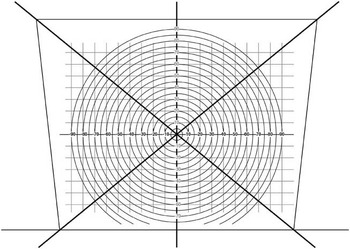
A transparent mask was prepared following the design of Ilgert (Reference Ilgert1985) with two lines arranged at an angle of 90° and with concentric circles at a distance of 5 mm from each other (Figure 1). The dimensions of the transparent mask were adapted to the forehead of adult cattle. The crossing point of the two lines was positioned on that point on the midline that was considered to be the most appropriate position for a shot (EU, 2004), the centre of the horn base and the centre of the contralateral eye were used as orientation points. The actual placement of the gun on top of the skull was then determined and recorded by measuring the distance from the identified ideal position in two directions, along the midline of the head and in the distance from the midline to the left or to the right.
Grid used to measure the placement of the hole made by the shot from the stunning gun.

The distance of the shot hole from the ideal position along the midline of the forehead (in mm) was called the ‘radius’ (distance). In the case of a placement rostral of the ideal position, the number was assigned a negative sign, and for the opposite case the number was positive.
The distance of the shot hole from the midline vertically to the left or right part of the forehead was called the ‘transversal distance’: Shot holes on the right side of the skull were given a negative sign and holes on the left a positive sign.
Direction of penetration (angle of the shot)
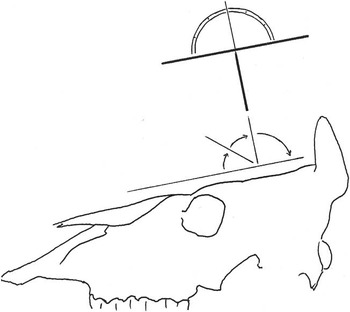
A goniometer was constructed (Schrohe, unpublished) in order to determine the direction of the penetrating bolt longitudinally and transversely through the forehead into the brain. Four metal rods of various diameters could be inserted into the goniometer, thus corresponding to the gauge of the individual shot holes.
For measurements, the rod was then passed through the hole of the lamina externa until it reached the hole in the lamina interna of the cavity. Being now fixed in this position, the rod indicated the direction (angle) of the shot and reflected it on the goniometer as grade, which was recorded twofold.
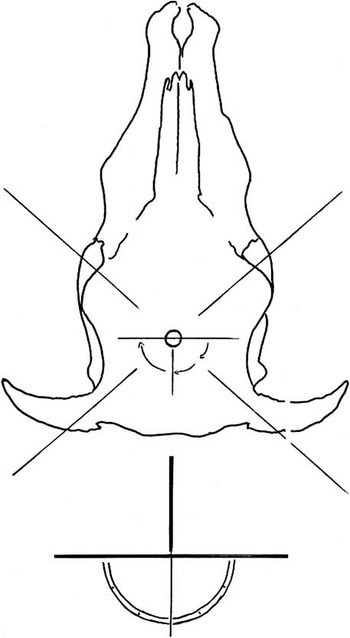
Two planes were identified (the midline and the transversal angle). In both cases, angles not at 90° indicated a deviation from the vertical shooting position; a vertical shot was represented by a 90° angle in both planes.
The midline angle (Figure 2): the first angle was placed in the midline plane. A small angle extending towards the rostrum reflected a shot into the base of the head; a 90° angle reflected a vertical shot and an angle extending towards 180° indicated a shot towards the rostrum.
Method used to measure the direction of the shot (midline angle).

The transverse angle (Figure 3): this plane enabled the identification of the shooting direction in the transverse plane. Looking in the same direction as the head, the angle extended towards the right side of the skull. Thus, recording an angle up to 90°, the bolt was shot from the right into the left part of the head. In the case of an angle from 90° to 180°, the direction of the shot was from the left into the right part of the head.
Method used to measure the direction of the shot (transverse angle).

Assessment
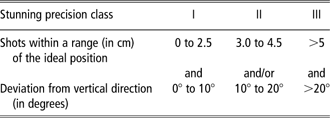
Results were attributed to three categories (Table 1):
Attribution of stunning precision class
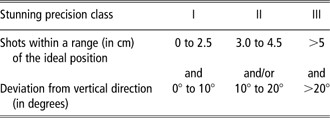
Shooting precision category I: shots were within a range of a maximum distance of 0 to 2.5 cm from the crossing point plus a maximum deviation of 0° to 10° from the vertical direction (90°) of the bolt. This combination was considered to have good precision and to hit the brain stem with high probability.
A shooting precision category III was designed, indicating shots of low precision with a range of >5.0 cm from the crossing point plus a deviation of >20° from the vertical direction of the bolt.
Between both of them, an intermediate range was left (shooting precision category II): shots were within a range of a maximum distance of 3.0 to 4.5 cm from the crossing point and/or a maximum deviation of 10° to 20° from the vertical direction of the bolt. This combination was assessed as being medium, that is, the shot was not as precise as that in category I.
Descriptive data analysis
Data were calculated with IBM SPSS Statistics 18.0, separately for the two cutting plants. The respective classes I to III (Table 1) were attributed to each individual skull.
Results
Plant 1
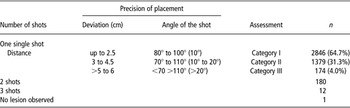
Of 4592 skulls, 4399 had a single shot hole. Of these, 64.7% were attributed to category I and 31.3% to category II. Finally, 4.0% of a total of 4592 skulls were beyond the range, which should be accepted in daily routine as based on assessments from the literature (Ilgert, Reference Ilgert1985; Kaegi, Reference Kaegi1988; Grandin, Reference Grandin2002; Hagen et al., Reference Hagen, Paulsen, Smulders and König2002) and indicating poor stunning precision. More than one shot hole was detected in 192 skulls, and one skull was found with no lesion.
In a total of 4592 skulls, 367 (7.8%) were attributed to category III (poor shooting precision) or exhibited more than one shot (Table 2).
Assignment of the shot holes to precision categories I, II, III (Plant 1)

Plant 2
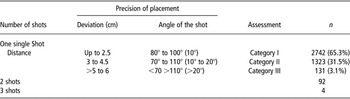
Of 4287 skulls, 4191 had a single shot hole. The shots in 65.3% of these one-shot skulls were attributed to category I, whereas 31.5% of these animals were shot with a category II precision and, finally, 3.1% of the shots were attributed to category III. Two holes were observed in 92 skulls and three holes in four skulls. In total, 227 skulls (5.3% of a total of 4287 skulls) were indicative of poor stunning precision (category III) or exhibited more than one shot hole (Table 3).
Assignment of the shot holes to precision categories I, II, III (Plant 2)

Discussion
In two cattle head deboning plants, a total of 8879 skulls were investigated for the precision of the stunning shot during slaughter. For this purpose, the number of shot holes, the precision of placement of the gun and the direction of the bolt into the brain cavity was measured. Placement of the gun was determined by measuring the distance from the optimum position in two dimensions, along the midline and in a transversal distance to it. The shooting direction was indicated by measuring the angle of the shot in midline and a transverse plane vertical to the midline.
For this investigation, deboning plants were visited; traces back to original abattoirs or even individual operators was not possible. However, in practice, the place of deboning is not suitable for control measures.
For assessment, an ideal shot was identified based on classifications of Kaegi (Reference Kaegi1988) and EU (2004) (Table 1). In addition, a poor shooting precision was identified based on the assessment of Ilgert (Reference Ilgert1985), Grandin (Reference Grandin2002) and Hagen et al. (Reference Hagen, Paulsen, Smulders and König2002), thus leaving an intermediate category II between both of them.
It is well known that non-penetrating captive bolt pistols also lead to unconsciousness by concussion (Palmer, Reference Palmer1982; Finnie, Reference Finnie1995; EU, 2004). In consequence, stunning efficacy does not depend entirely on placement of the gun or the direction of the shot. It is possible that a shot that was not in the ideal position or not at the ideal angle might in some circumstances induce unconsciousness as a result of concussion to the brain. Measurements of the distance from the ‘ideal position’ and the penetration angle of the bolt do not reflect the efficacy of stunning, as the design of this study did not allow to record any extent of consciousness of the animals.
Strictly said, we recorded the daily shooting operations by measuring the performance of the operators in the sense of an ideal shooting position and angle. However, from the anatomy of the skull, the probability of good efficacy should be higher when the gun is placed at the centre of the forehead, as the bolt will penetrate and damage the brain stem with high probability. Kaegi (Reference Kaegi1988) investigated the optimum position and angle of the gun on the forehead under observation of the animal's reactions, thus being able to control the shooting efficacy directly.
A second shot does not necessarily indicate that the animal was conscious of the situation, and thus suffered pain: the operator might have shot out of uncertainty or for confirmatory reasons. Accordingly, the American Meat Institute guidelines specify 95% of cattle stunned with a single shot (Grandin, Reference Grandin2002). FAO (2004) allows a maximum of second shots in 5% of the cases as well. In this paper, in both plants, a number of second or third shots were observed in 4.2% and 2.2%, respectively. More than one shot (or even none) should be considered a serious observation, and a skull with more than one shot hole cannot be regarded as representing an animal that has experienced a painless procedure.
Individual shots might differ within a certain range, and thus we have used categories (I, II, III) according to classifications previously used in other investigations.
For monitoring stunning efficacy, AHAW (2004) recommends the following:
• immediate collapse,
• immediate and sustained absence of rhythmic breathing,
• absence of righting reflexes,
• spasms in the muscles of back and legs,
• eyes not rotated,
• no reflex response to pricking and pinching,
• no vocalisation.
Recently, Gouveia et al. (Reference Gouveia, Ferreira, Roque da Costa, Vas-Pires and Martins da Costa2009) assessed stunning efficacy by means of clinical post-stun characteristics in cattle of various ages, sex and breed. Here, the precision of placement was not recorded. On the basis of these clinical indicators, the overall efficacy of stunning was 68.2%. Gregory et al. (Reference Gregory, Lee and Widdicombe2007) inspected 1608 cattle for shallow depth of concussion following captive bolt shooting. In all, 48.7% of all cattle were shot within 2-cm range of the ideal position, 68 out of 1608 animals were shot a second time. Of them, 37 did not collapse with the first shot, even though the bolt had penetrated the skin of the head.
In a survey of Grandin (Reference Grandin1998), personnel at four of the 11 visited abattoirs were able to render 95% to 100% of cattle insensible with one shot; at six abattoirs, more than 10% of cattle were insufficiently stunned at the first attempt. This author (Grandin, Reference Grandin1998; Grandin, Reference Grandin2002) refers to several reasons:
• poor stunner maintenance,
• poor ergonomic design,
• inexperience of the operator.
In both deboning plants of this paper, shooting precision differed. Shots failed in 7.8% and 5.3% of all cases in both plants, if referring to a stunning precision with more than one shot and with a shooting quality categorised as III (Table 1). Results of Gregory et al. (Reference Gregory, Lee and Widdicombe2007) indicate that the number of shots has animal welfare relevance.
Conclusions: need for daily measurements of the stunning efficacy
In addition, an imprecise use of the gun might impact unconsciousness (caused by concussion); however, measurement of the number of shots and of the precision of placement and direction may serve as an indirect control of stunning operations. It should be attributed to individuals by workshift, indicating daily performance of operators in the sense of the Standard Operation Procedures as indicated in the description of positioning the gun. In that sense, this paper indicates precise and less precise shots. A check should be made of all heads after the final operations at the abattoir, but before their removal to a deboning plant. Such routine checks as already indicated are possible without any immediate distraction of the person involved with the procedure. In addition, the operator should be observed as well: some operators may avoid shooting an animal a second time in order to reduce attention to their stunning performance. However, where the animal does not show immediate signs of a successful stun, an operator should be encouraged to immediately shoot the animal again.
Lack of precision may indicate a lack of training (i.e. information) or involve issues such as work pressure from the lairage; this calls for better management provision (hourly frequency, calming treatment, continuous flow of animals). Operators routinely producing shot holes exceeding certain limits should be sent on training courses.
One reason for shots being assessed as lower than category I might be the sudden up and down movement of the head during stunning (i.e. failures occurring in the restraint of the head or the restraint not being in place). Thus, restraint devices for the head of the animal during stunning are imperative.
With regard to gun maintenance, Grandin (Reference Grandin2002) has observed the best stunning efficacy in plants in which individuals can dedicate themselves to the maintenance of their guns for 30 to 60 min/day. Cartridges used must be appropriate to the type of the gun and the animal being stunned (FAO, 2004).
However, there are also situations where the animal is shot perfectly and does not become insensible. This can be because of ‘soft shots’, where the stunner does not hit with sufficient force (irregularity of the gun, damp gun powder or a less gun–cartridge combination; Gregory et al., Reference Gregory, Lee and Widdicombe2007).
Stunning efficacy is a crucial issue of surveillance by veterinary authorities during slaughter. Checks on such aspects should be routinely performed and the results should be recorded. Such records can be kept and may undergo reassessment in the light of new or changed insights into stunning efficacy.