INTRODUCTION
The over-exploitation of humpback whales (Megaptera noveaengliae) in the North Atlantic Ocean has been well documented, chiefly from analysis of whaling vessel logbooks (Smith & Reeves, Reference Smith and Reeves2003; Reeves et al., Reference Reeves, Smith, Josephson, Clapham and Woolmer2004) and reported landings (Brown, Reference Brown1976; Fairley, Reference Fairley1981). Waters to the west of Ireland, the so-called ‘Commodore Morris Ground’ were an important summer whaling ground during the 18th and 19th centuries (Reeves et al., Reference Reeves, Smith, Josephson, Clapham and Woolmer2004). By the time the first whaling stations were built in Ireland and the UK, catches of humpback whales were low compared with other species. Of the six species landed in Irish stations between 1908 and 1914, just six individuals, or less than 0.9% of the total catch comprised of humpback whales (Fairley, Reference Fairley1981). Due to insufficient records prior to whaling logbook data, it is not possible to say whether the low numbers caught were due to over-exploitation, or indeed if the area has been historically important for this species. A precautionary approach would be to presume the former. During visual surveys of the eastern North Atlantic in 1995, no humpback whales were recorded during 3061 km of search effort to the west and north of Ireland (Paxton et al., Reference Paxton, Burt, Hedley, Vikingsson, Gunnlaugsson and Desportes2009). A single humpback whale was recorded to the north-west of Ireland during visual surveys covering 2356 km between 1999 and 2001 (Ó'Cadhla et al., Reference Ó'Cadhla, Mackey, Aguilar de Soto, Rogan and Connolly2004). However an acoustic study showed that humpback whales still occur to the west of Ireland and the UK apparently using the shelf-edge as a migratory corridor (Charif et al., Reference Charif, Clapham and Clark2001). Extensive ship-based surveys of Irish inshore and offshore waters between 2005 and 2011 found that relative abundances of humpback whales are highest in the Celtic Sea and this species was rarely recorded in offshore waters to the north or west of Ireland (Wall et al., Reference Wall, Murray, O'Brien, Kavanagh, Wilson, Ryan, Glanville, Williams, Enlander, O'Connor, McGrath, Whooley and Berrow2013). In the coastal waters of southern Ireland, humpback whales are known to feed on sprat (Sprattus sprattus) and herring (Clupea harengus) (Ryan et al., Reference Ryan, Berrow, McHugh, O'Donnell, Trueman and O'Connor2014) occasionally in association with fin whales whose movements are apparently linked to those of spawning herring (Whooley et al., Reference Whooley, Berrow and Barnes2011; Harma et al., Reference Harma, Brophy, Minto and Clarke2012; Ryan et al., Reference Ryan, Berrow, McHugh, O'Donnell, Trueman and O'Connor2014).
It is not known whether these coastal waters comprise a primary feeding ground, a wintering ground for non-breeding humpback whales or merely a migratory corridor between high-latitude feeding grounds and low-latitude breeding grounds (e.g. Barco et al., Reference Barco, McLellan, Allen, Asmutis-Silvia, Mallon-Day, Meagher, Pabst, Robbins, Seton, Swingle, Weinrich and Clapham2002; Stevick et al., Reference Stevick, Allen, Bérubé, Clapham, Katona, Larsen, Lien, Mattila, Palsbøll and Robbins2003a). A peak in acoustic detections to the west of Ireland and the UK during March is difficult to reconcile with the known timing of migrations to the tropics for this species, suggesting that this area may provide an over-wintering ground for non-breeding whales (Charif et al., Reference Charif, Clapham and Clark2001). The affinity of humpback whales from this area to known North Atlantic breeding grounds (West Indies and Cape Verde) has yet to be determined. The trajectory of migrating humpback whales acoustically tracked to the west of Ireland and the UK suggested that they were bound for the West Indies rather than Cape Verde or indeed mainland West Africa (Charif et al., Reference Charif, Clapham and Clark2001). Patterns in the persistent organochlorine pollutant in blubber biopsies sampled in Irish and Cape Verdean waters were found to be markedly similar, but different from those from some western North Atlantic feeding grounds (Ryan et al., Reference Ryan, McHugh, Boyle, McGovern, Bérubé, Lopez-Suárez, Elfes, Boyd, Ylitalo and Van Blaricom2013). However, lack of samples from the West Indies precluded assignment of a breeding ground to whales sampled in Ireland. As such the breeding grounds for humpback whales found in Irish and UK waters are still unknown.
Humpback whales found elsewhere in the eastern North Atlantic such as Iceland and Norway comprise a mix of at least two separate breeding populations (Palsbøll et al., Reference Palsbøll, Allen, Berube, Clapham, Feddersen, Hammond, Hudson, Jørgensen, Katona and Larsen1997; Stevick et al., Reference Stevick, Øien and Mattila1999; Jann et al., Reference Jann, Allen, Carrillo, Hanquet, Katona, Martin, Reeves, Seton, Stevick and Wenzel2003; Wenzel et al., Reference Wenzel, Allen, Berrow, Hazevoet, Jann, Seton, Steiner, Stevick, Suárez and Whooley2009). Although they co-occur on common feeding grounds, persistent and maternally directed fidelity to separate breeding grounds has given rise to genetically distinct populations (Palsbøll et al., Reference Palsbøll, Clapham, Mattila, Larsen, Sears, Siegismund and Arctander1995). Hence, it is possible that whales found elsewhere in the eastern North Atlantic such as Ireland and the UK are from multiple breeding populations. Although a recovery in humpback whale populations has been documented in the western North Atlantic (Stevick et al., Reference Stevick, Allen, Clapham, Friday, Katona, Larsen, Lien, Mattila, Palsbøll and Sigurjónsson2003b), the same cannot be said for those found in Irish and UK waters and there are no abundance estimates for this species here. In an effort to address the aforementioned knowledge gaps on ecology, population connectivity and migration of humpback whales occurring in Irish waters, the Irish Whale and Dolphin Group (IWDG) commenced a long-term study of humpback whales in 1999. Using multiple datasets from both dedicated surveys and records submitted by the public, we present novel findings on humpback whales occurring in Irish and adjacent waters; an area where this species was almost extirpated a century ago. Specifically, we investigate the seasonality, fine-scale habitat use and long-distance movements of humpback whales in the region.
MATERIALS AND METHODS
Public sightings scheme
A public sightings scheme was established by the IWDG in 1991. Sightings were submitted by postcard or by telephone until 2003 when the scheme moved to an on-line recording system under the auspices of ISCOPE (Irish Scheme for Cetacean Observation and Public Education; Berrow et al., Reference Berrow, Whooley and Wall2006, Reference Berrow, Whooley, O'Connell and Wall2010). Through media, the internet and events, the IWDG has solicited sighting records and photographs from members of the public and the maritime community. All records were validated by the IWDG sightings coordinator (PW), against strict criteria based on reported diagnostic features. Only those sightings of humpback whales made by experienced observers, or those accompanied by photographs showing diagnostic features were considered for this study. All sightings that were reported by multiple observers within a 24 h period or within 5 km of each other were consolidated to avoid duplicate records. All validated records are freely available online (http://www.iwdg.ie) and include over 22,200 sighting records of 22 cetacean species since 1991. Some of these sightings are effort-related, whereby trained and experienced observers conducted timed watches (~100 min) during favourable weather conditions (Beaufort sea state <2 and visibility >10 km). Observers scanned the sea with both spotting scopes and binoculars of magnification >7 from an elevated headland. Relative abundances of humpback whales (individuals sighted per hour) were calculated using data collected between 2004 and 2013 from three sites (Slea Head, Co. Kerry; Galley Head, Co. Cork; Ram Head, Co. Waterford) with good seasonal coverage, i.e. a minimum of one timed watch per month per annum. In order to examine seasonal movements during the study period, data across all years were pooled.
IWDG began collecting images of humpback whales for identification by natural markings (i.e. photo-identification) in Irish waters in 1999. Photo-identification surveys were carried out by IWDG, during dedicated surveys of large whales and also on an ad hoc basis on platforms of opportunity such as whale-watching vessels, often in reaction to sighting reports. Images of both tail flukes and dorsal fins were submitted by members of the public and the maritime community to IWDG. All images were screened and classified according to image quality, following Whooley et al. (Reference Whooley, Berrow and Barnes2011). Images only with grade 1 (complete fluke or dorsal fin in focus, perpendicular and well lit) and grade 2 (complete fluke or dorsal fin slightly out of focus, not perfectly perpendicular but well lit) quality were considered in this study. Fluke images were lodged with the North Atlantic Humpback Whale Catalogue, at the College of the Atlantic, where experienced personnel assigned them a unique identification number. Two independent analysts systematically searched the catalogue for matches. A catalogue in northern Norway and photographs of an individual humpback whale recorded in the Netherlands were similarly compared (FB and WJS) for matches.
Temporal and spatial analysis
Seasonal trends in the geographic range of humpback whales were investigated firstly by mapping all sightings of humpback whales according to month. Next, using effort-related sightings data from three sites (Dingle, West Cork and Ardmore), the relative abundance of humpback whales was considered (individuals seen per hour) on a monthly basis between 2004 and 2013. Finally, for whales photo-identified on more than three occasions with records separated by at least 1 day, convex hulls were used to visualize the known ranges of individual whales. This provided a highly conservative geographic range for regularly photographed whales and provided insight into movements by individuals between apparently discrete feeding areas in the Celtic Sea.
RESULTS
Sightings
A total of 303 sightings of humpback whales were recorded between 1 January 1999 and 31 December 2013 (Figure 1). Mean group size of 1.7 (±1.0 SD) was consistent throughout the study period (r = 0.03, P < 0.02). Sightings were recorded from all around the Irish coast, but were particularly prevalent throughout the Celtic Sea and were rare off the north-west of Ireland. Humpback whales were occasionally reported from offshore waters shallower than 200 m in the Irish Sea, the Celtic Deep, the North Channel and on one occasion the Porcupine Bank (Figure 1). Sightings were recorded during all months of the year (Figure 1), with a maximum during November ( $\overline x $ = 3.9 ± 5.4 SD) and minimum during April (
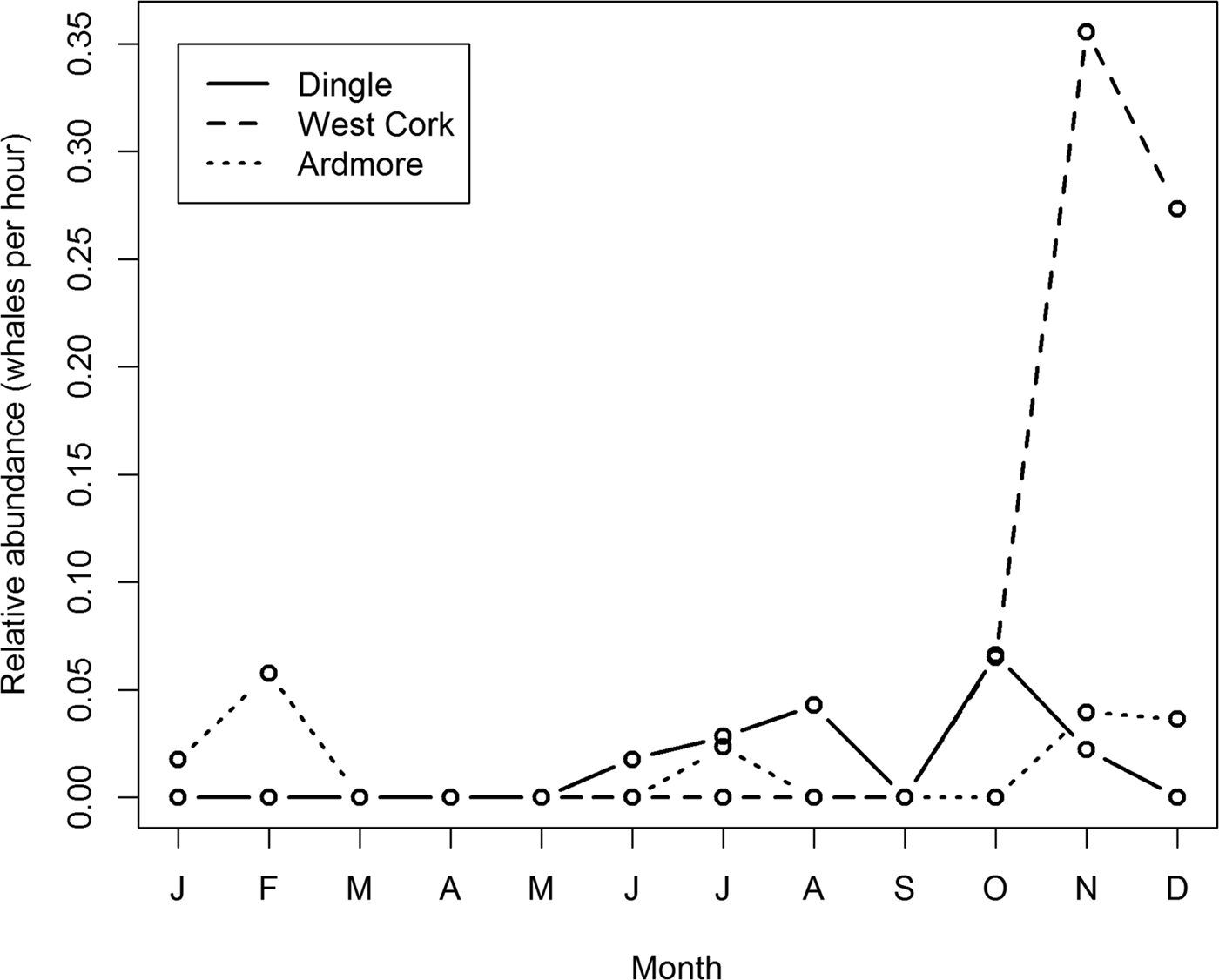
 $\overline x $ = 0.3 ± 1.1 SD). From the effort-related sighting data, a clear temporal trend was evident with an easterly bias, with the highest relative abundance recorded off West Cork (Figure 2). The relative abundance of humpback whales in the west (Dingle Peninsula) peaked during October (0.07 whales h−1), followed by West Cork during November (0.36 whales h−1) and Ardmore during February (0.06 whales h−1, Figure 2). These seasonal trends were also evident in non-effort related sighting data (Figure 1).
(A) Seasonal distribution of humpback whales in Irish waters, from the IWDG sightings database (both effort-based and non-effort-based sightings that were accompanied by photographs or recorded by experienced observers). Place names mentioned in the text are also shown. The colour of each point is graduated according to month of the year as shown in (B) the frequency of sightings per month for all 15 years combined.

The relative abundance of humpback whales observed in coastal waters of southern Ireland follows an easterly progression (see Figure 1 for locations). Relative abundances were calculated from timed (~100 min) effort-watches by trained and experienced observers at three headlands in the Celtic Sea (Slea Head, Galley Head and Ram Head), southern Ireland between 2004 and 2013.
Photo-identification
Of the total number of humpback whale sightings reported to IWDG, 176 (55.2%) were accompanied with photo-identification images of sufficient quality for reliably recognizing individual identity (i.e. grades 1 and 2). The majority of these images (121, or 68.7%) were from members of the public, while the remainder were from dedicated and opportunistic surveys carried out by IWDG personnel (55, or 31.2%). Fluke and dorsal fin photo-identification images were submitted to IWDG by 68 individuals from whale-watching, naval, search and rescue vessels and pleasure craft. Of the 28 catalogued individual humpback whales, six were known only from dorsal fin images and two of these individuals were known from images of only the right side. Although not corrected for effort, sightings of photo-identified whales were clustered in four areas (Dingle Peninsula, West Cork, Ardmore and Hook Head). The movements of 28 individually identified whales indicate connectivity between what appear to be discrete, preferred locations for humpback whales inshore in the Celtic Sea (Figure 3). However, the most regularly observed individuals appear to have a preference for the Dingle and West Cork sites (Figure 3A).
Known ranges of individual humpback whales photo-identified between 1999 and 2013. Ranges are presented as convex hulls between sampling locations, where each convex hull is an individual which was recorded on: (A) more than 10 occasions (N = 5); (B) between five and 10 occasions (N = 6); (C) between three and four occasions (N = 16). (D) two individuals were recorded in locations outside of Ireland.
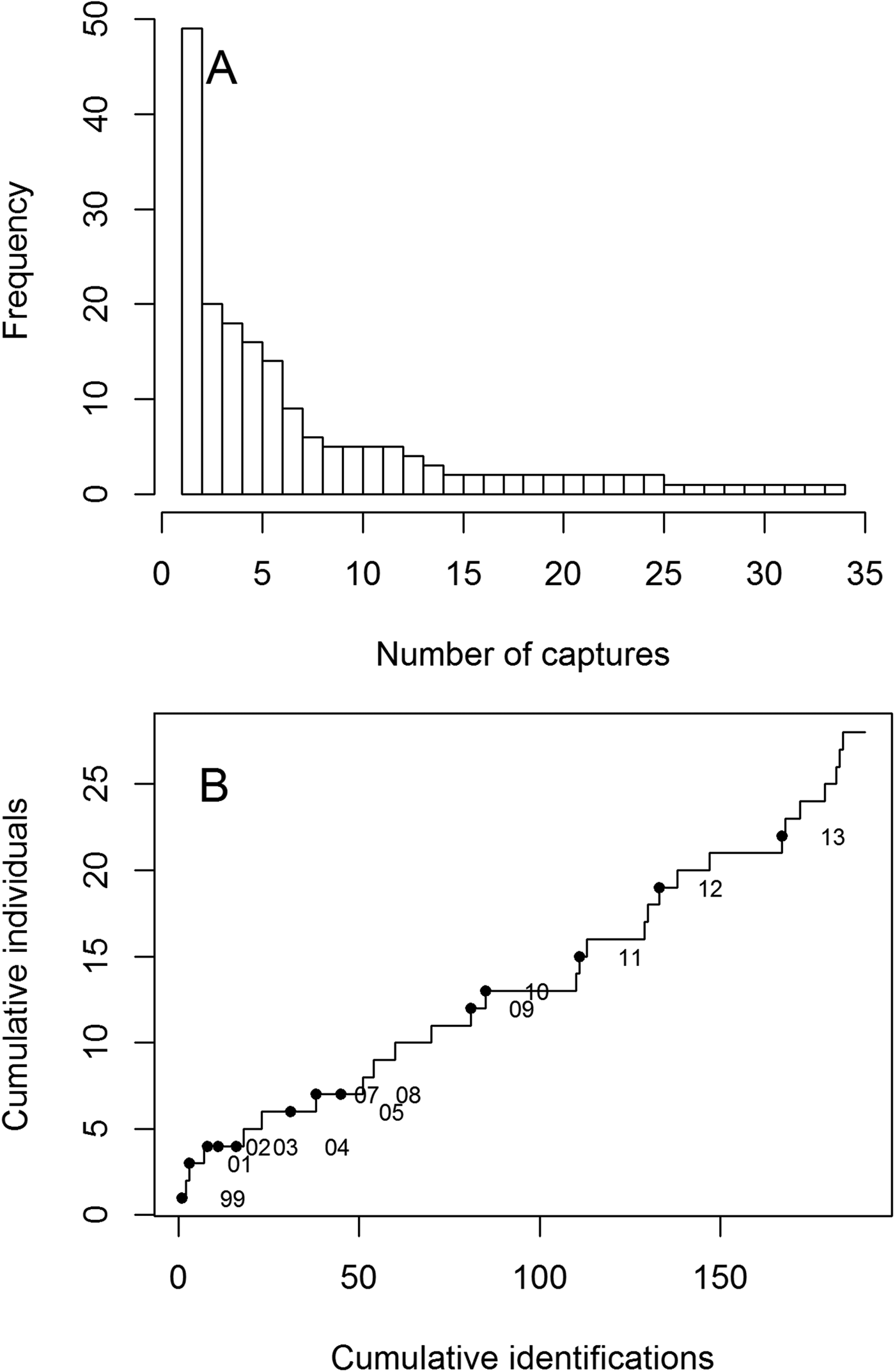
A comparison of tail fluke markings between the Irish catalogue and all available photograph collections (N = 8016 individuals) from all over the North Atlantic (USA, Canada, Iceland, West Greenland, Norway, Azores, Bermuda, Dominican Republic, Puerto Rico, Lesser Antilles and Cape Verde) and the Mediterranean Sea resulted in no matches. However two individuals were matched using dorsal fin markings. The whale assigned HBIRL7 was recorded on two occasions in Dutch waters (12 May and 16 November 2007) and once off West Cork, Ireland (28 September 2007) in the interim. Subsequent to the return trip from Ireland to the Netherlands, this whale was documented off Tromsø, Norway (17 November 2012) using tail fluke markings (Figure 3D). The second international match was individual HBIRL25 between Húsavík, Iceland (28 July 2013) and Blasket Islands, Dingle Peninsula, Ireland (14 September 2013). This individual travelled a minimum of 1740 km in 48 days (Figure 3D). No matches were made between Ireland and either West Indies or Cape Verde; the two known breeding grounds in the North Atlantic Ocean. Despite the fact that this study has been ongoing for 15 years, and that some individuals have been captured frequently (Figure 4A), the rate of discovery has not yet declined and has increased in recent years (Figure 4B). This is consistent with a net immigration of new individuals in the study area.
(A) The frequency distribution of captures (N = 180) of photo-identified humpback whales. (B) Discovery curve showing abbreviated year, indicating either immigration, or that the population has yet to be sampled thoroughly.
DISCUSSION
Following a prolonged period of over-exploitation resulting in historically low numbers by the early 20th century (Brown, Reference Brown1976; Fairley, Reference Fairley1981; Smith & Reeves, Reference Smith and Reeves2003), humpback whales are again seen regularly, if uncommonly, in Irish waters. Our results show that an apparently small group of humpback whales use southern Irish waters as a feeding ground throughout the year, with an easterly progression mirroring that of fin whales (Whooley et al., Reference Whooley, Berrow and Barnes2011). This is consistent with the hypothesis that humpback whales associate with and feed upon sprat and herring (Ryan et al., Reference Ryan, Berrow, McHugh, O'Donnell, Trueman and O'Connor2014). Findings from acoustic fisheries surveys show that herring densities in the Celtic Sea are highest inshore over discrete spawning grounds (Volkenandt et al., Reference Volkenandt, Berrow, O'Connor, Guarini and O'Donnell2014). Separate components of the Celtic Sea herring stock spawn at different times: first off West Cork during autumn, then off Ardmore during winter (Harma et al., Reference Harma, Brophy, Minto and Clarke2012; O'Sullivan et al., Reference O'Sullivan, O'Keefe, Berry, Tully and Clarke2013). The highest densities of spawning fish are found off West Cork during autumn (O'Sullivan et al., Reference O'Sullivan, O'Keefe, Berry, Tully and Clarke2013), which is spatially and temporally coincident with the highest relative abundance of humpback whales. The easterly movement of herring spawning events is similar to that of humpback whales reported herein (O'Sullivan et al., Reference O'Sullivan, O'Keefe, Berry, Tully and Clarke2013). Movements linked to prey coupled with autumn-dominated seasonality suggest that Irish waters comprise a feeding ground for humpback whales, rather than just a migration corridor or feeding location for those whales that over-winter at higher latitudes (e.g., Barco et al., Reference Barco, McLellan, Allen, Asmutis-Silvia, Mallon-Day, Meagher, Pabst, Robbins, Seton, Swingle, Weinrich and Clapham2002). Our results provide further support for the conclusion of Stevick et al. (Reference Stevick, Allen, Clapham, Katona, Larsen, Lien, Mattila, Palsbøll, Sears, Sigurjonsson, Smith, Vikingsson, Øien and Hammond2006) and numerous other studies that have linked humpback whale distribution in high latitudes to that of their prey. As such, the inclusion of energetic requirements of humpback whales into fisheries management is necessary, i.e. through an ecosystems approach to fisheries management (Link, Reference Link2002).
By analysing the movements and seasonality of individuals using photo-identification we have demonstrated that Irish waters comprise a seasonal feeding ground for humpback whales. Interestingly, humpbacks were recorded in the study area during all months of the year, albeit rarely during late spring which likely represents a small number of non-breeding individuals that do not migrate to low-latitude breeding grounds (cf. Barco et al., Reference Barco, McLellan, Allen, Asmutis-Silvia, Mallon-Day, Meagher, Pabst, Robbins, Seton, Swingle, Weinrich and Clapham2002). By tracking singing humpback whales using an acoustic array, Charif et al. (Reference Charif, Clapham and Clark2001) reported a peak in detections in the zones adjacent to our study area (C2 and D2 therein) during March. Our results identify March as the month with lowest number of sightings in inshore waters, however. This discrepancy may be due to the seasonal nature of singing by humpback whales, rendering them unavailable for acoustic detection during the non-breeding season.
When first photographed in Irish waters, one individual (HBIRL7) was considered to be sub-adult at ~6 m in length. To our knowledge, the documented movements presented for this individual (between the Netherlands, Ireland and Norway) are the most extensive for any humpback whale in European waters to date. Another individual (HBIRL25) recorded in Húsavík, Iceland on 28 July 2013 was recorded 48 days later off the Blasket Islands, Co. Kerry, Ireland on 14 September 2013. This whale had previously been photographed in Húsavík in 2011 by CS. These records corroborate those of Stevick et al. (Reference Stevick, Allen, Clapham, Katona, Larsen, Lien, Mattila, Palsbøll, Sears, Sigurjonsson, Smith, Vikingsson, Øien and Hammond2006) that long-distance movements between feeding areas occur in the eastern North Atlantic and indeed elsewhere (Zerbini et al., Reference Zerbini, Andriolo, Heide-Jørgensen, Pizzorno, Maia, VanBlaricom, DeMaster, Simões-Lopes, Moreira and Bethlem2006; Dalla Rosa et al., Reference Dalla Rosa, Secchi, Maia, Zerbini and Heide-Jørgensen2008). We have demonstrated that humpback whales move between Irish waters and those of Norway and Iceland; a finding which has implications for conservation and management given that both countries have whaling interests (although not currently directed at this species). There were no matches to known breeding grounds in the North Atlantic. As such, the breeding ground affinity of humpback whales that occur in Irish waters, and indeed those of most of western Europe remains unknown. An increase in the rate of discovery of photo-identified individuals (Figure 4) suggests that humpback whale occurrence in coastal waters of southern Ireland may be increasing.
This paper greatly improves the knowledge of humpback whales in Irish and indeed eastern North Atlantic waters. Systematic visual surveys are not feasible or effective ways to investigate a species which is found at low densities over large areas. Because of this, the role of the sighting network was crucial in gathering these data (Beck et al., Reference Beck, Foote, Kötter, Harries, Mandleberg, Stevick, Whooley and Durban2014; Cheney et al., Reference Cheney, Thompson, Ingram, Hammond, Stevick, Durban, Culloch, Elwen, Mandleberg and Janik2013). Because these data are collected by members of the public, validation of records and provision of timely feedback to those who contribute was essential. This is achieved through a regularly updated and user-friendly database which is available on the internet (http://www.iwdg.ie). A limitation of public sighting schemes is the often ad hoc nature of records, i.e. data that may not be effort-related. This makes for challenges in implementing rigorous experimental design and presents difficulties when attempting to estimate abundance using conventional mark–recapture methods. Although our dataset notionally lends itself to the spatially explicit Bayesian model averaging method presented by Durban et al. (Reference Durban, Elston, Ellifrit, Dickson, Hammond and Thompson2005), evidence of multiple and non-closed ‘populations’ violate the assumptions of such an approach. As such, we have not presented an abundance estimate for humpback whales in Irish waters, however the high capture probability (Figure 4) indicates either low abundance or high site fidelity to specific locations.
CONCLUSION
This study represents the first investigation of the distribution, seasonality and fidelity of humpback whales in Irish waters, and documentation of patterns of movement in European waters. Seasonal changes in the relative abundance of humpback whales in inshore waters of Celtic Sea suggest that they follow an easterly progression of spawning events of their known prey: herring and sprat. Some humpback whales photographed in Irish waters were recorded in northern Norway, Iceland and the Netherlands, indicating large-scale movements between feeding areas of the eastern North Atlantic. Our findings demonstrate the important role that public participation can have in assisting longitudinal studies of species that occur in low densities over large spatial scales. Such studies are essential for monitoring long-lived migratory species such as humpback whales, at a temporal scale that is biologically relevant. It is hoped that the continuation of these recording schemes and increased photo-identification matching efforts in the North Atlantic will eventually identify the breeding ground affinities of humpback whales that occur in Irish and adjacent waters. Addressing this knowledge gap should remain a research priority towards effective conservation and management of humpback whales throughout their range.
ACKNOWLEDGEMENTS
We are grateful to Andrew Malcolm, Anne Trimble, Mick O'Connell, Christopher O'Sullivan and all those who contributed sighting records and photo identification images to IWDG including personnel from the Irish Naval Service, Irish Air Corps Maritime Squadron and RV Celtic Explorer. Thanks to staff and volunteers at Allied Whale for catalogue matching. Thanks also to fellow researchers from all around the North Atlantic for submitting their records to Allied Whale.
FINANCIAL SUPPORT
Funding for IWDG sightings scheme and photo-identification project was provided by the Heritage Council, the Northern Ireland Environment Agency (formerly Environment and Heritage Service), the Marine Institute through the Marine Research Sub-Programme of the National Development Plan 2007–2013 (Grant Aid Agreement No. PBA/ME/07/005 (02)) and the National Parks and Wildlife Service of the Department of the Environment, Heritage and Local Government. We are also grateful to Inis Cologne for sponsorship and to Cork Whale Watch, Mick Sheeran (Blasket Island Marine Tours), Martin Colfer (South Coast Charter Angling) for providing platforms to carry out humpback whale research.