Polinsky and Scontras (Polinsky & Scontras), in their thought-provoking keynote article, bring together two perspectives on heritage languages, i.e., of theoretical linguistics and of psycholinguistics, and show how they interact and enrich each other. The authors list three causes of differences (transfer from the dominant language, attrition, divergent attainment) and outcomes (avoidance of ambiguity, resistance to irregularity, shrinkage of structure) of how the heritage languages differ from their baselines, but say that they do not know whether there is “agency on the part of heritage speakers” with regards to these outcomes. In this commentary, we provide psycholinguistic evidence that supports Polinsky and Scontras’ idea of how important it is for psycholinguistics and the linguistic theory of heritage languages to feed each other. We show that (a) heritage speakers’ processing can diverge from the baseline in online but not offline measures, (b) transfer from the dominant language does not always happen, and (c) heritage speakers can actively shape their processing that can contribute to heritage language restructuring in a chain reaction fashion.
We focus on processing of monoclausal wh-questions with varying word orders in heritage Russian. Simple Wh-questions are resilient in heritage languages, but become vulnerable at the syntax-pragmatics interface, as in the case of long-distance dependencies when the wh-word and its gap are separated by a clause boundary, or when non-canonical word order is used. The interface phenomena, as Polinsky and Scontras point out, are particularly vulnerable in heritage languages. Cuza (Reference Cuza2012) showed that Spanish heritage speakers do not produce the required subject-verb inversion in matrix questions in baseline Spanish. The same speakers also judge the embedded questions without the inversion as grammatical, which Cuza takes as evidence for transfer from the dominant English.
We conducted a Visual World eye-tracking experiment with monolingual Russian adults (N = 12, AgeM = 30) (Sekerina, Laurinavichyute & Dragoy, Reference Sekerina, Laurinavichyute, Dragoy, Carlson, Clifton and Fodor2019) and then compared their processing of monoclausal wh-questions with Russian heritage speakers (N = 24, AgeM = 19.4) who were equally distributed according to age of arrival: 8 were born in the U.S.A., 8 arrived before 6, and 8 between 7 and 13 years. The participants listened to 20 vignettes in Russian (1) while viewing the central fixation point (happy face) and four referent images in the corners (boy, girl, teacher, school).
(1) One day a girl and a boy were walking around the school. And suddenly the boy kissed the girl. The teacher was very surprised.
(2) SUBJ Wh-QUESTION + OBJ SCRAMB (≠ENGLISH WORD ORDER)
(3) OBJ Wh-QUESTION (=ENGLISH WORD ORDER)
The participants answered the experimental question (2) – (3) by clicking on the answer referent while their eye movements were recorded. There were two types of the experimental questions with different word orders – a SOV subject Wh-question with a scrambled object (2) absent in English, and an OSV object Wh-question (3) similar to English.
First, we found that despite the numeric difference in accuracy and reaction time of answering the question, there was no effect of the question type, nor did monolinguals and heritage speakers differ in offline measures (97% vs. 93%; 5144 ms vs. 5939 ms, respectively). Therefore, the heritage speakers were not at a disadvantage for the non-English SOV word order with the scrambled object in (2). This finding contrasts with Cuza's explanation that heritage speakers do not invert the subject and verb in Spanish questions because of transfer of SVO from English and supports Polinsky's (Reference Polinsky2018) results for the lack of word order transfer from English in processing of relative clauses in heritage Russian.
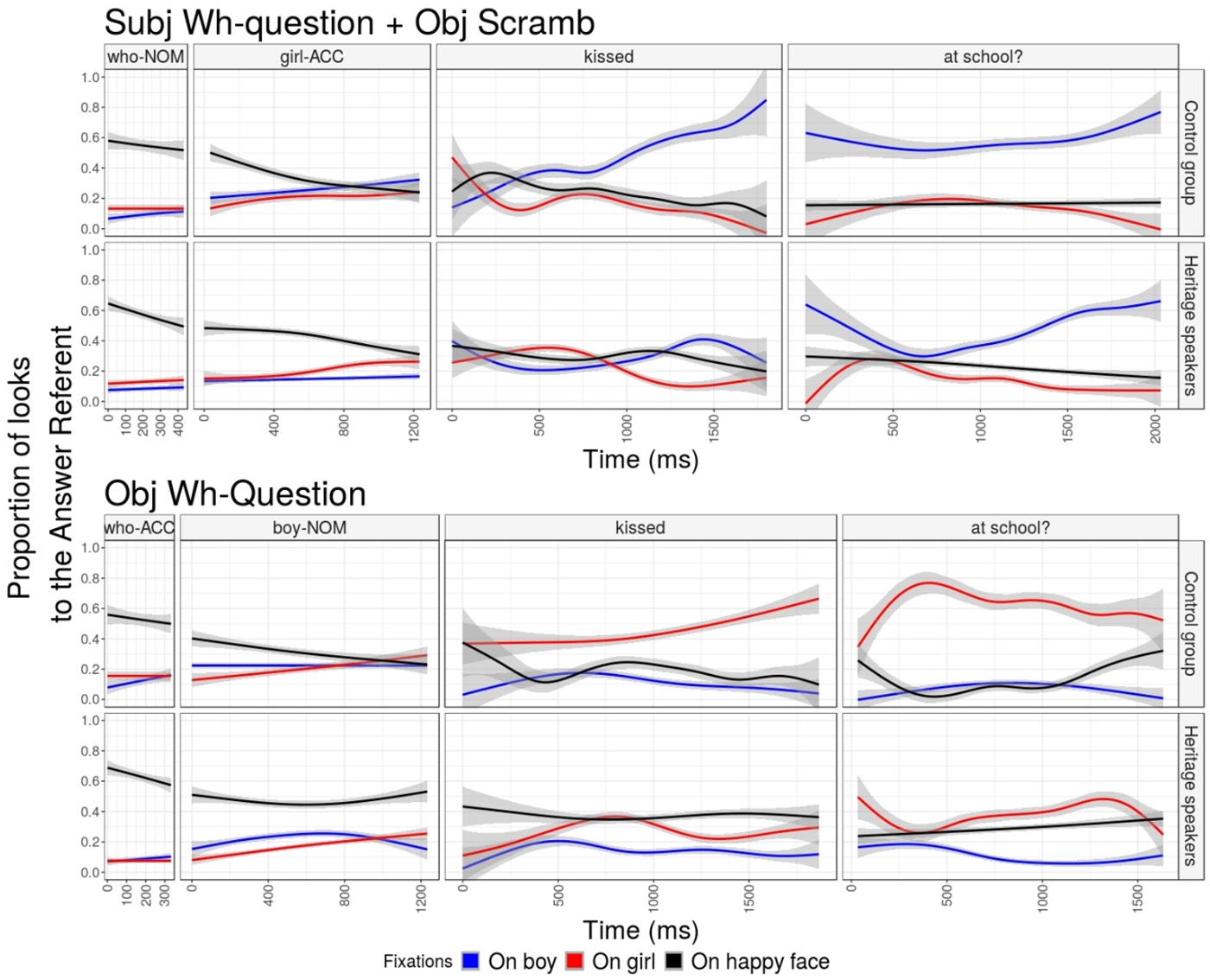
Second, the subtle, but statistically significant difference emerged in eye movements of the two groups (Figure 1).
Figure 1.Proportions of looks to the answer referent in Subj Wh-questions + Obj Scramb (2) and Obj Wh-questions (3).
The looks to the answer referent significantly increased with time at the verb (kissed) for the Subj Wh-question + Obj Scramb (2) condition [time x condition: β = 1.17, CI = 0.49–1.85, p = .001); importantly, the difference was much smaller for the heritage speakers [time x group: β = −0.57, CI = −0.91– −0.23, p = .001]. At the PP (at school), the heritage speakers caught up with the monolinguals and looked equally more to the answer referent.
We argued elsewhere (Sekerina et al., Reference Sekerina, Laurinavichyute, Dragoy, Carlson, Clifton and Fodor2019) that not only in the Subj Wh-question, but even in the Obj Wh-question condition, the monolinguals strategically adapted their eye movements, including anticipatory ones, to look for an answer to the question (pragmatic goal-directed processing of Salverda, Brown & Tanenhaus, Reference Salverda, Brown and Tanenhaus2011). Heritage speakers, on the contrary, actively avoided any immediate commitments to the answer referent reflecting their low confidence while processing in their heritage language. What did they look at instead? Тhey looked disproportionally long (38%) at the central fixation point (the happy face, black line in Figure 1, monolinguals: 27%) across the entire sentence. Thus, while the heritage speakers retained the wh-question formation in general (offline measures), there was a clear limitation of this knowledge in real-time processing. They did not commit to look for an answer the way the monolinguals did and strategically waited on the sidelines. We leave for the future the question of whether this behavior reflects their insufficient online resources while calculating even a short syntactic dependency or low confidence in processing in their heritage language.




 You have
Access
Polinsky and Scontras (Polinsky & Scontras), in their thought-provoking keynote article, bring together two perspectives on heritage languages, i.e., of theoretical linguistics and of psycholinguistics, and show how they interact and enrich each other. The authors list three causes of differences (transfer from the dominant language, attrition, divergent attainment) and outcomes (avoidance of ambiguity, resistance to irregularity, shrinkage of structure) of how the heritage languages differ from their baselines, but say that they do not know whether there is “agency on the part of heritage speakers” with regards to these outcomes. In this commentary, we provide psycholinguistic evidence that supports Polinsky and Scontras’ idea of how important it is for psycholinguistics and the linguistic theory of heritage languages to feed each other. We show that (a) heritage speakers’ processing can diverge from the baseline in online but not offline measures, (b) transfer from the dominant language does not always happen, and (c) heritage speakers can actively shape their processing that can contribute to heritage language restructuring in a chain reaction fashion.
We focus on processing of monoclausal wh-questions with varying word orders in heritage Russian. Simple Wh-questions are resilient in heritage languages, but become vulnerable at the syntax-pragmatics interface, as in the case of long-distance dependencies when the wh-word and its gap are separated by a clause boundary, or when non-canonical word order is used. The interface phenomena, as Polinsky and Scontras point out, are particularly vulnerable in heritage languages. Cuza (Reference Cuza2012) showed that Spanish heritage speakers do not produce the required subject-verb inversion in matrix questions in baseline Spanish. The same speakers also judge the embedded questions without the inversion as grammatical, which Cuza takes as evidence for transfer from the dominant English.
We conducted a Visual World eye-tracking experiment with monolingual Russian adults (N = 12, AgeM = 30) (Sekerina, Laurinavichyute & Dragoy, Reference Sekerina, Laurinavichyute, Dragoy, Carlson, Clifton and Fodor2019) and then compared their processing of monoclausal wh-questions with Russian heritage speakers (N = 24, AgeM = 19.4) who were equally distributed according to age of arrival: 8 were born in the U.S.A., 8 arrived before 6, and 8 between 7 and 13 years. The participants listened to 20 vignettes in Russian (1) while viewing the central fixation point (happy face) and four referent images in the corners (boy, girl, teacher, school).
(1) One day a girl and a boy were walking around the school. And suddenly the boy kissed the girl. The teacher was very surprised.
(2) SUBJ Wh-QUESTION + OBJ SCRAMB (≠ENGLISH WORD ORDER)
(3) OBJ Wh-QUESTION (=ENGLISH WORD ORDER)
The participants answered the experimental question (2) – (3) by clicking on the answer referent while their eye movements were recorded. There were two types of the experimental questions with different word orders – a SOV subject Wh-question with a scrambled object (2) absent in English, and an OSV object Wh-question (3) similar to English.
First, we found that despite the numeric difference in accuracy and reaction time of answering the question, there was no effect of the question type, nor did monolinguals and heritage speakers differ in offline measures (97% vs. 93%; 5144 ms vs. 5939 ms, respectively). Therefore, the heritage speakers were not at a disadvantage for the non-English SOV word order with the scrambled object in (2). This finding contrasts with Cuza's explanation that heritage speakers do not invert the subject and verb in Spanish questions because of transfer of SVO from English and supports Polinsky's (Reference Polinsky2018) results for the lack of word order transfer from English in processing of relative clauses in heritage Russian.
Second, the subtle, but statistically significant difference emerged in eye movements of the two groups (Figure 1).
Proportions of looks to the answer referent in Subj Wh-questions + Obj Scramb (2) and Obj Wh-questions (3).
The looks to the answer referent significantly increased with time at the verb (kissed) for the Subj Wh-question + Obj Scramb (2) condition [time x condition: β = 1.17, CI = 0.49–1.85, p = .001); importantly, the difference was much smaller for the heritage speakers [time x group: β = −0.57, CI = −0.91– −0.23, p = .001]. At the PP (at school), the heritage speakers caught up with the monolinguals and looked equally more to the answer referent.
We argued elsewhere (Sekerina et al., Reference Sekerina, Laurinavichyute, Dragoy, Carlson, Clifton and Fodor2019) that not only in the Subj Wh-question, but even in the Obj Wh-question condition, the monolinguals strategically adapted their eye movements, including anticipatory ones, to look for an answer to the question (pragmatic goal-directed processing of Salverda, Brown & Tanenhaus, Reference Salverda, Brown and Tanenhaus2011). Heritage speakers, on the contrary, actively avoided any immediate commitments to the answer referent reflecting their low confidence while processing in their heritage language. What did they look at instead? Тhey looked disproportionally long (38%) at the central fixation point (the happy face, black line in Figure 1, monolinguals: 27%) across the entire sentence. Thus, while the heritage speakers retained the wh-question formation in general (offline measures), there was a clear limitation of this knowledge in real-time processing. They did not commit to look for an answer the way the monolinguals did and strategically waited on the sidelines. We leave for the future the question of whether this behavior reflects their insufficient online resources while calculating even a short syntactic dependency or low confidence in processing in their heritage language.
Author ORCIDs
Irina A. Sekerina, 0000-0003-3859-3000; Anna K. Laurinavichyute, 0000-0002-3150-0206
Acknowledgements
This research was partially supported by the Сenter for Language and Brain NRU Higher School of Economics, RF Government grant, ag. № 14.641.31.0004. Irina Sekerina was also partially supported by the PSC-CUNY grant #61525-00-49.