Introduction
Inter-pregnancy interval (IPI) is defined as the time interval between a live birth and the estimated time of conception of the subsequent pregnancy. Definitions regarding short and long IPI vary between studies and have no standardization. However, short IPI is most often defined as shorter than 6 months, while long IPI is usually defined as over 60 months.Reference Shachar and Lyell1
Optimal IPI is often questioned. It may vary in different subgroups and depend on the outcome of the previous pregnancy. Several organizations recommend an IPI of 24–60 months after a live term birth.2 For specific subgroups, such as women after cesarean section, abortion, or stillbirth, different guidelines may apply.
Extreme IPIs, both short (<6 months) or long (>60 months), are known to be associated with higher incidence of perinatal complications, with potentially long-term consequences for both mother and offspring.Reference Conde-Agudelo, Rosas-Bermudez and Kafury-Goeta3–Reference Wainstock, Sergienko and Sheiner9 Adverse pregnancy outcomes associated with short IPIs include preterm delivery,Reference Conde-Agudelo, Rosas-Bermudez and Kafury-Goeta3 low birth weight,Reference Bakewell, Stockbauer and Schramm4,Reference Khoshnood, Lee and Wall5 perinatal death,Reference Cheslack-Postava, Liu and Bearman6 and birth defects (particularly cardiovascular).Reference Kwon, Lazo-Escalante, Villaran and Li7 In turn, long IPI has been associated with preeclampsiaReference Trogstad, Eskild, Magnus, Samuelsen and Nesheim8,Reference Wainstock, Sergienko and Sheiner9 and birth defects as well, primarily cardiovascular and central nervous system.Reference Kwon, Lazo-Escalante, Villaran and Li7
The long-term impact of IPI length on offspring health is less studied.Reference Smith, Pell and Dobbie10 In addition, the mechanisms by which extreme IPIs may lead to adverse offspring outcomes have not been fully elucidated. One of the theories involved is the “Maternal Depletion Syndrome” theory, related to depletion in both macro- and micro-nutrients (specifically folate depletion).Reference Smits and Essed11
While pregnancy and fetal complications related to extreme IPIs, such as preeclampsia, prematurity, low birth weight, and cardiovascular birth defects, have been inversely associated with later offspring health, it is difficult to distinguish between the different causes of the observed long-term negative impact.Reference Davis, Lazdam and Lewandowski12,Reference Nahum Sacks, Friger and Shoham-Vardi13 Relevant confounders, such as maternal age, parity, and the outcome of the previous pregnancy, must be considered.Reference Ratzon, Sheiner and Shoham-Vardi14 For instance, Lewandowski et al. have shown an increased left ventricular mass for preterm born offspring, which is a well-known independent predictor of cardiovascular morbidity and mortality in adulthood.Reference Lewandowski, Augustine and Lamata15
We opted to evaluate the impact of different IPI lengths on long-term cardiovascular morbidity of the offspring, while rigorously controlling for several important and clinically relevant confounders.
Methods
We conducted a retrospective non-selective population-based cohort study including all women who delivered between the years 1991 and 2014, at the Soroka University Medical Center (SUMC). As the sole hospital of the Negev region (southern Israel), SUMC serves the entire population of the region, which occupies approximately 1,272,100 inhabitants – 14.5% of Israel’s population and 65.5% of the country’s land.16 The study protocol was approved by the SUMC institutional review board (IRB # 0357-19-SOR), and informed consent was exempt due to the nature of the study design.
The primary objective of the study was to investigate the impact of IPI length on the risk of childhood cardiovascular-related hospitalizations in the offspring followed up to the age of 18 years. The primary exposure was short or long IPI. Short IPI was defined as <6 months, and long IPI was defined as longer than 60 months between consecutive pregnancies. Intermediate IPI, between 6 and 60 months, was considered the reference interval.
The study population consisted of all singleton live deliveries, in parturient with at least one previous birth, occurring during the study period. Primiparity, multiple gestations and fetuses with congenital malformations or chromosomal abnormalities were excluded. In addition, perinatal mortality cases (intrauterine, intra-partum or post-partum) and women lacking prenatal care (less than three visits to prenatal care facility during the pregnancy)Reference Abu-Ghanem, Sheiner and Sherf17 were excluded from the long-term analysis. Long-term cardiovascular morbidity of the offspring was evaluated via any cardiac-related hospitalizations of the offspring (up to the age of 18 years) at SUMC. All cardiac-related diagnoses obtained during hospitalizations of the offspring were predefined according to a set of ICD-9 codes detailed in the Supplementary Table. Follow-up time was defined as time to an event (cardiovascular-related hospitalization), or until censored. Offspring follow-up ended if any of the following occurred (whichever came first): the first cardiovascular diagnosis during hospitalization, death of the offspring (during hospitalization unrelated to a cardiovascular event), age of 18 years (which was calculated for each child based on date of birth), or on January 1, 2014.
Data were collected from two databases that were cross-linked and merged: the computerized hospitalization database of the SUMC (“Demog-ICD9”), and the computerized perinatal database of the Obstetrics and Gynecology department. The Demog-ICD9 database includes demographic information and ICD-9 codes for all medical diagnoses made during hospitalizations at the SUMC. The perinatal database consists of information recorded immediately following delivery by an obstetrician. Coding is performed after assessing medical prenatal care records as well as routine hospital documents. Experienced medical secretaries routinely review the information prior to entering it into the database to ensure maximal completeness and accuracy.
Statistical analysis
Statistical analysis was performed using SPSS (version 23.0) software. Assumptions were two sided with α = 0.016 (after Bonferroni correction) and β = 0.2. Initial analysis compared background, pregnancy and perinatal characteristics between the three study groups (short, intermediate, and long IPI), using the chi-square, and Student’s t-test for continuous variables.
Maternal and fetal background and perinatal characteristics were compared. These included: mean maternal age, parity, ethnicity, maternal smoking, hypertensive disorders (including chronic hypertension, gestational hypertension, and preeclampsia with or without severe features), diabetes mellitus (pre- or -gestational), infertility treatment (including in-vitro fertilization and ovulation induction), preterm delivery (<37 gestation weeks), mode of delivery, Apgar scores at 1- and 5-min, offspring gender, mean birth weight, low birth weight (<2500 grams), child age at diagnosis (years), and follow-up length time (years). In each study group, crude rates of cardiovascular-related hospitalizations of offspring were calculated. Kaplan–Meier survival curves were constructed, and the cumulative cardiovascular-related hospitalization incidence rate was compared between the three groups using the Cox–Mantel Log rank test.
In order to adjust for length of follow-up, a multivariable Cox regression analysis was performed. This regression model was used to establish an independent association between IPI length and total cardiovascular-related hospitalization incidences in the offspring, while controlling for potential confounders including: maternal age upon delivery, maternal hypertensive disorders, maternal diabetes mellitus, fertility treatment, cesarean delivery, and preterm delivery. In addition, we further controlled for other optional clinically relevant variables such as ethnicity, maternal smoking, and gestational age (in different combinations). The final model was selected based on the best model fit and lowest −2 log likelihood.
Results
During the study period, 161,793 singleton deliveries met the inclusion criteria. Of them, 14.1% (n = 22,851) occurred in parturient following a short IPI, 78.6% (n = 127,146) following an intermediate IPI, and 7.3% (n = 11,796) following a long IPI. Table 1 presents the baseline demographic characteristics, pregnancy course, and immediate perinatal outcomes in the two study groups. While mean maternal age was older among women with long IPI, parity order was lower, with lower rates of grand multiparity among women with long IPI. Rates of hypertensive disorders and diabetes mellitus (pre-gestational diabetes or gestational diabetes) were higher in the long IPI group (p < 0.001), as were the need for fertility treatments and cesarean delivery rates (p < 0.001). There was no significant difference in mean child age upon diagnosis between the different IPI groups (p = 0.105); however, the follow-up length time was significant shorter in the long IPI group (p < 0.001). Additionally, almost 20% (n = 27,520) of the observed children has reached 18 years of age.
Maternal characteristics, pregnancy course, and delivery outcome in the different study groups

Data are presented as % (n) or mean ± SD; significance was measured using Chi-squared and Mann–Whitney U tests.
* Including chronic hypertension, gestational hypertension, and preeclampsia with or without severe features.
** Including pre-gestational and gestational diabetes.
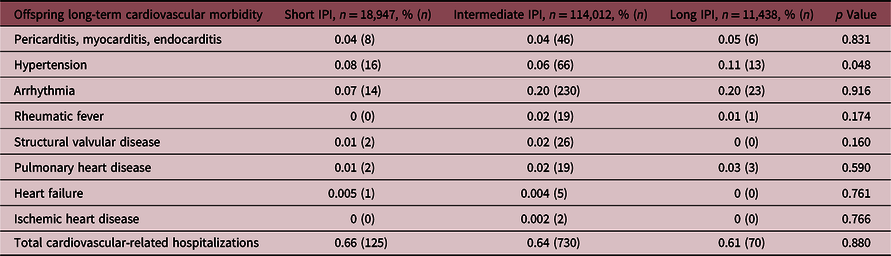
Hospitalizations of the offspring involving cardiovascular morbidity up to 18 years of age were recorded, with a total of 925 events (in different children) during the follow-up period, of them 62.4% (577) were Bedouin and 37.6% (348) Jewish (p − 0.004). Rates of different morbidity entities in the three groups are presented in Table 2, and specific diagnoses included in each category are detailed in the Supplemental table. Total pediatric cardiovascular-related hospitalizations were comparable between the groups (0.66% vs. 0.64% vs. 0.61%, for short, intermediate and long IPI, respectively, p = 0.880, Table 2).
Selected cardiovascular diagnoses stratified by inter-pregnancy interval (IPI) length

Not all cardiovascular morbidity types and cases are shown, but all are included in the total (last row). Significance for differences was measured using Chi-squared test.
The Kaplan–Meier survival analysis (Fig. 1) demonstrates a similar cumulative incidence of cardiovascular-related hospitalizations in the three different groups (log rank p = 0.684).
Kaplan–Meier survival curve demonstrating the cumulative incidence of cardiovascular hospitalizations in the different IPI groups (Log rank p = 0.684).

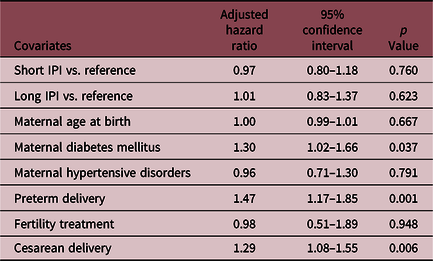
A Cox proportional hazards model was performed in order to establish an independent association between IPI length and childhood cardiovascular morbidity of the offspring. In the Cox regression model (Table 3), controlled for maternal age, diabetes mellitus, hypertensive disorders, fertility treatment, cesarean delivery, and preterm delivery, short and long IPI were not found to be independent risk factors for later pediatric cardiovascular-related hospitalizations in the offspring (adjusted HR 0.97, 95% CI 0.80–1.18; and adjusted HR 1.01, 95% CI 0.83–1.37, for short, and long IPI, respectively). This observation remained true (i.e. nonsignificant with no independent association) in further several multivariable analyses, controlled in different combinations for ethnicity, maternal smoking, and gestational age.
Cox multivariable analysis for the association between inter-pregnancy interval (IPI) length and long-term cardiovascular morbidity of offspring

Discussion
According to our data, which includes a large cohort of offspring with an extended follow-up period, extreme IPI length, in our population, does not appear to significantly impact later cardiovascular hospitalizations of offspring during childhood and adolescence.
The idea that maternal and perinatal factors play a role in the development of later childhood morbidity has been previously demonstrated. Several pathophysiological mechanisms may underline the possible pathways by which long IPI could contribute to the risk of offspring morbidity. First, according to the physiological regression hypothesis proposed by Zhu et al.,Reference Zhu, Rolfs, Nangle and Horan18 a previous pregnancy could cause time-limited anatomical and physiological adaptations of the reproductive system, providing an optimal environment for the healthy development of another fetus. The risk of complications during organ development could increase when such beneficial adaptation systems dissipate. Second, long IPI could be a consequence of infertility and intensive interventions, as observed in this study, which may share common risk factors for long-term offspring’s morbidity.Reference Imterat, Wainstock and Sheiner19–Reference Shachor, Wainstock, Sheiner and Harlev24 Third, increased risk of childhood cardiovascular morbidity could be a result of adverse pregnancy outcomes.Reference Scherrer, Rexhaj, Allemann, Sartori and Rimoldi25 Several previous studies have shown that extreme IPIs carry an increased risk for adverse perinatal outcomes such as preterm delivery and low birth weight.Reference Conde-Agudelo, Rosas-Bermudez and Kafury-Goeta3,Reference Zhu, Rolfs, Nangle and Horan18,Reference Grisaru-Granovsky, Gordon, Haklai, Samueloff and Schimmel26 Our study demonstrated a similar pattern with higher rates of hypertensive disorders including preeclampsia, diabetes mellitus (gestational and pre-gestational), preterm delivery, and low birth weight in the extreme IPI length groups. It has been well established that such perinatal complications constitute a major risk factor for long-term cardiovascular morbidity in offspring.Reference Lewandowski, Augustine and Lamata15,Reference Thompson, Carter and Edwards27 By increasing the short-term adverse perinatal outcomes, IPI may induce increased prevalence of risk factors for cardiovascular disease later in life. Finally, extreme IPI length is more likely to be associated with an unintended pregnancy, where a delay of behavioural changes, such as initiation of folic acid supplementation, cessation of smoking or alcohol avoidance, is more common and may harbor adverse long-term impact on offspring health.Reference Gipson, Koenig and Hindin28,Reference Cheng, Schwarz, Douglas and Horon29
Surprisingly, our study did not demonstrate a significant association between long IPI and long-term childhood cardiovascular hospitalizations. Lack of association might be due to the fact that some cardiovascular morbidity only manifest at ages older than 18 years. It is also possible that we missed a smaller effect due to insufficient statistical power or that the exclusion of women lacking prenatal care and fetuses with congenital malformations or chromosomal abnormalities annulled the effect. To fully understand the association between short and long IPI and its effects on offspring, further studies in children and adults should be done to establish whether the pathophysiology and natural influence of IPI affects other related diseases and to investigate whether outcomes differ between children and adults.
Our data, however, are reassuring. We could not isolate an independent signal of adverse impact of these extreme IPIs on later cardiovascular health of offspring.
Our study has several notable strengths. Unique to our study population, SUMC is the only tertiary medical center treating and providing comprehensive care for the entire population of the Negev region. This setting allows minimal loss of follow-up, thus true long-term follow-up of offspring morbidity. The long-term follow-up allowed us to closely examine any hospitalizations that occurred during childhood. In addition, our data set combines maternal, neonatal and long-term childhood data, enabling us the opportunity to examine the long-term outcomes of offspring with the ability to control for many parameters and potential confounders surrounding pregnancy and delivery. The large number of participants (n = 161,793) retrieved from the hospital database contributes to the study’s strength.
Nonetheless, the study possesses some limitations which need to be noted, mainly due to its retrospective design. Additionally, we focused on hospitalizations only, given the nature of our database. Hospitalizations for cardiovascular disease in young people are likely to poorly correlate with the actual burden of illness as most of these conditions are managed in outpatient or primary health care settings. This low ascertainment rate by hospitalizations is reflected in only 925 affected children of >161,000 births. Our results must thus be taken with caution. Importantly, this is true for all three study groups.
To the best of our knowledge, this is the first study to evaluate the impact of IPI length on the incidence of later cardiovascular morbidity of the offspring. Although our study could not demonstrate an independent association between extreme IPI and long-term pediatric cardiovascular morbidities in our population, we advise couples planning a consecutive pregnancy to consider potential risks associated with adverse pregnancy outcomes. Further research will elucidate other possible risks for mothers and offspring, following extreme IPIs.
Supplementary material
To view supplementary material for this article, please visit https://doi.org/10.1017/S2040174420001130
Acknowledgements
None.
Financial support
This research received no specific grant from any funding agency, commercial or not-for-profit sectors.
Conflict of Interest
None.