Despite substantial efforts into identifying malleable antecedents and risks, adolescent delinquency continues to pose a burden to society. One of the most widely studied and stable risk factors for adolescent delinquency is the peer environment. Two mechanisms have been proposed through which peers can have an effect on adolescent delinquency. Research has focused most prominently on deviant peers that provide a socialization context in which adolescents observe and are reinforced to engage in delinquent activities (e.g., Dishion & Tipsord, Reference Dishion and Tipsord2011; Dishion, Véronneau, & Myers, Reference Dishion, Véronneau and Myers2010). Equally important, however, is the quality of peer relationships for adolescent development. This mechanism has received less attention in the prediction of problem behavior. However, whereas negative experiences with peers, such as victimization, might elevate engagement in problem behavior (e.g., Hanish & Guerra, Reference Hanish and Guerra2002), positive experiences might buffer against involvement in delinquency (e.g., Sentse, Lindenberg, Omvlee, Ormel, & Veenstra, Reference Sentse, Lindenberg, Omvlee, Ormel and Veenstra2010).
It is notable that the effects of positive and negative peer relations are not uniformly strong across individuals, and it is possible that genetic effects moderate associations between peer relations and later outcomes (e.g., Brendgen et al., Reference Brendgen, Boivin, Vitaro, Girard, Dionne and Pérusse2008). Genetic moderation of environment-outcome associations can function in two ways. A dual-risk mechanism implies that individuals carrying particular genetic variants are more vulnerable to environmental risk than are others. In comparison, the differential susceptibility model suggests that genetic factors shape susceptibility not only to negative but also to positive environments (Belsky & Pluess, Reference Belsky and Pluess2009; Ellis, Boyce, Belsky, Bakermans-Kranenburg, & van IJzendoorn, Reference Ellis, Boyce, Belsky, Bakermans-Kranenburg and van IJzendoorn2011). Thus, to understand which mechanism is at work, not only risk but also favorable aspects of a particular environment should be taken into account. Positive and negative experiences with peers are by no means mutually exclusive (e.g., a young person may be victimized by a small number of peers but form caring, trusting, and warm relationships with others) or represent opposite ends on a continuum. That is, young people may not experience peer rejection, but the absence thereof does not mean that this adolescent experiences support and acceptance from peers. However, both aspects can be linked to later delinquency. In this study, we examine to what extent genetic effects moderate the impact of both negative (peer victimization) and positive (perceived social well-being in the classroom) peer experiences in early adolescence on delinquency in late adolescence.
Associations Between Relationships With Peers and Later Delinquency
Peer relationships are vital in adolescence and an important means to achieve social well-being (Ormel, Reference Ormel, Pulkkinen and Caspi2002). To be conducive to this goal, relationships need to be characterized by warmth, affection, and mutual caring. Failing to establish such relationships with peers might not only be maladaptive in the short run (e.g., being predictive of aggression; Boivin, Vitaro, & Poulin, Reference Boivin, Vitaro, Poulin, Tremblay, Hartup and Archer2005) but also can have long-term consequences including engagement in delinquent behavior (Laird, Jordan, Dodge, Pettit, & Bates, Reference Laird, Jordan, Dodge, Pettit and Bates2001). Further, studies into consequences of peer victimization lend impressive support for the risk posed by negative peer experiences. That is, being the target of peer victimization poses a risk of developing problems (Arsenault, Bowes, & Shakoor, Reference Arsenault, Bowes and Shakoor2010), including aggression and delinquency (Hanish & Guerra, Reference Hanish and Guerra2002; Hodges, Boivin, Vitaro, & Bukowski, Reference Hodges, Boivin, Vitaro and Bukowski1999; Ostrov, Reference Ostrov2010). Arguably, young people who are victimized are less well able to achieve social well-being through these relationships and may turn to other strategies. As suggested by Ormel (Reference Ormel, Pulkkinen and Caspi2002), status improvement as well as behavioral conformation are viable means to achieve social well-being. These mechanisms may involve delinquency, especially so in adolescence when delinquency to a certain extent contributes to status attainment and involves behaviors that may elicit confirmation from the peer group (e.g., Dijkstra et al., Reference Dijkstra, Lindenberg, Veenstra, Steglich, Isaacs and Card2010; Moffitt, Reference Moffitt1993).
However, peer relationships that are characterized by high levels of acceptance (e.g., Criss, Pettit, Bates, Dodge, & Lapp, Reference Criss, Pettit, Bates, Dodge and Lapp2002) and support (Parker, Rubin, Erath, Wojslawowicz, & Buskirk, Reference Parker, Rubin, Erath, Wojslawowicz, Buskirk, Cicchetti and Cohen2006) can promote positive development. Sentse et al. (Reference Sentse, Lindenberg, Omvlee, Ormel and Veenstra2010), for instance, showed that peer acceptance provided a buffer against internalizing and externalizing problems, even when controlling for adolescents' relationships with parents. Similarly, Criss et al. (Reference Criss, Pettit, Bates, Dodge and Lapp2002) suggested that peer relations that are high in acceptance moderate the effect of family adversity on externalizing behavior. In sum, there is little doubt that the qualities of young people's peer relations are important for adolescent development.
It is notable, though, that not all young people react to peer experiences in the same way, and individual factors that buffer or elevate effects of peer relationship quality are implied. To this end, previous studies on delinquency, externalizing, and antisocial behavior have focused on age (Hanish & Guerra, Reference Hanish and Guerra2002), gender (Khatri, Kupersmidt, & Patterson, Reference Khatri, Kupersmidt and Patterson2000), and temperament (Gardner, Dishion, & Connell, Reference Gardner, Dishion and Connell2008). Little is known, however, regarding moderation by specific genetic factors. Given the genetic component found for adolescent delinquency in behavioral genetic studies (e.g., Kendler & Prescott, Reference Kendler and Prescott2006) and support for a gene–environment interplay in the prediction of outcomes related to delinquency (Beaver, Wright, DeLisi, & Vaughn, Reference Beaver, Wright, DeLisi and Vaughn2008; Olsson et al., in press), it is somewhat surprising that candidate gene studies have not yet been employed to examine whether and which specific genetic variants may moderate the association between peer relationship factors and later delinquency.
Genetic Factors as Moderators on the Associations Between Peer Relations and Delinquency
Previous research has shown how an individual's genetic disposition can buffer the effect of negative peer experiences on emotional problems (Sugden et al., Reference Sugden, Arsenault, Harrington, Moffitt, Williams and Caspi2010) and depression (Benjet, Thompson, & Gotlib, Reference Benjet, Thompson and Gotlib2010), but much less is known about potential genetic moderation of the effect of peer relationship quality on later externalizing problems (for a review on the topic, see Brendgen, Reference Brendgen2012). Findings from quantitative genetic studies point at a nonnegligible genetic basis for delinquency and related psychopathologies (e.g., Kendler & Prescott, Reference Kendler and Prescott2006; Reiss, Neiderhiser, Hetherington, & Plomin, Reference Reiss, Neiderhiser, Hetherington and Plomin2000; Rodgers, Buster, & Rowe, Reference Rodgers, Buster and Rowe2001), suggesting that specific genes may play a role. Moreover, quantitative genetic studies suggest genetic moderation of peer environment effects (Brendgen, Reference Brendgen2012) although this approach does not determine the role of specific candidate genes. To this end, we examined the moderating function of dopamine receptor D4 (DRD4), a gene implied in cognition, action, motivation, and emotion through its effect on limbic brain regions.
DRD4 Polymorphism
Dopamine receptor activity in the brain is regulated by the DRD4 gene on chromosome 11p15.5, which contains a 48 base-pair variable number tandem repeat polymorphism. This polymorphism takes the form of a long (7-repeat [7r]) or short (4-repeat [4r]) allele, with the short allele being a more frequent variant (~64%) than the long variant (~20%; Oak, Oldenhof, & Van Tol, Reference Oak, Oldenhof and Van Tol2004). Less frequent variants range from 2 to 10 repeats, and research has shown that DRD4 is more potent in binding dopamine in the brain in the presence of the short polymorphism. Carriers of the DRD4 7r (minor) allele have a lower dopamine reception, leading to a blunted response to reward-related behaviors but also aggression (Couppis & Kennedy, Reference Couppis and Kennedy2008).
The DRD4 polymorphism has been associated with a multitude of psychopathological disorders, including attention-deficit/hyperactivity disorder (ADHD; Faraone, Doyle, Mick, & Biederman, Reference Faraone, Doyle, Mick and Biederman2001), mood disorders (López Léon et al., Reference López León, Croes, Sayed-Tabatabaei, Claes, Broeckhoven and van Duijn2005) and substance abuse (Ray et al., Reference Ray, Bryan, MacKillop, McGeary, Hesterberg and Hutchison2009). The majority of these studies identified the 7r allele as the risk variant. Some studies have also linked the DRD4 polymorphism to personality traits, including novelty and thrill seeking (Dmitrieva, Cheng, Greenberger, Oguneitan, & Ding, Reference Dmitrieva, Cheng, Greenberger, Oguneitan and Ding2011; but results remain inconclusive, see Munafó, Yalcin, Willis-Owen, & Flint, Reference Munafó, Yalcin, Willis-Owen and Flint2008; Schinka, Letsch, & Crawford, Reference Schinka, Letsch and Crawford2002). Finally, carriers of the 7r allele reported higher delinquency (Boutwell & Beaver, Reference Boutwell and Beaver2008).
In addition to direct effects, genotypic variance in DRD4 also moderated the effect of environmental risks on substance use (Olsson et al., in press; Park, Sher, Todorov, & Heath, Reference Park, Sher, Todorov and Heath2011, but see Creemers et al., Reference Creemers, Harakeh, Dick, Meyers, Vollebergh and Ormel2011, who did not find this effect) and internalizing and externalizing problems (Propper, Willoughby, Halpern, Carbone, & Cox, Reference Propper, Willoughby, Halpern, Carbone and Cox2007). Further, Bakermans-Kranenburg and van IJzendoorn (Reference Bakermans-Kranenburg and van IJzendoorn2006) found that preschool-age carriers of the DRD4 7r allele showed greater levels of externalizing problems in the presence of maternal insensitivity. The same group found in an experimental study that toddlers who carried the 7r allele also benefitted more than noncarriers from an intervention that targeted parental use of positive discipline (Bakermans-Kranenburg, van IJzendoorn, Pijlman, Mesman, & Juffer, Reference Bakermans-Kranenburg, van IJzendoorn, Pijlman, Mesman and Juffer2008), suggesting susceptibility to both negative and positive environments. Beaver et al. (Reference Beaver, Wright, DeLisi and Vaughn2008) reported that male carriers of the 7r allele benefitted most from the “marriage effect” on delinquency desistance; that is, they showed the strongest negative association between entering serious and lasting romantic relationships and desisting from criminal behavior.
In sum, research supports the notion of moderation of environmental factors on different forms of externalizing behavior by DRD4, but to our knowledge, no study has yet examined the interaction between DRD4 and measures of the peer environment in the prediction of adolescent delinquency. Moreover, only little is known about the role of DRD4 with regard to positive environmental aspects.
The Current Study
In this study we examined whether effects of positive and negative peer experiences on later delinquency vary as a function of the DRD4 polymorphism, thereby testing the diathesis–stress and differential susceptibility models. To obtain a valid and precise assessment of the environment, we employed measures of positive and negative dimensions of adolescent's peer environment in the classroom context, namely, peer victimization as a negative dimension and perceived social well-being (a measure of acceptance and support by classmates) as a positive dimension. Following on from recent findings regarding the moderating role of the DRD4 polymorphism on environment-outcome associations, we hypothesized that the association between qualities of the peer environment and later delinquency would be particularly pronounced for carriers of the DRD4 7r allele.
A diathesis–stress model would be supported if genetic variation places some adolescents at greater risk for delinquency in the presence of negative environmental conditions (peer victimization) while not differentiating in the presence of high levels of social well-being in the classroom. In other words, carrying the DRD4 7r allele would elevate the risk of delinquency when peer relations are negative but not protect against delinquency (i.e., lower the risk) when peer relationships are characterized by positivity.
In comparison, differential susceptibility would be present if adolescents with a specific genotype show increased delinquency in the presence of negative peer experiences but decreased levels in the absence thereof. In addition, carriers of specific genetic variants should not only be more affected by negative peer relationships (i.e., show higher levels of delinquency) but also more protected against delinquency in the presence of positive relationships. For the current study, this model implies that for carriers of the 7r allele and with high levels of victimization and low levels of social well-being in the classroom, the risk for delinquency will be increased but also that in the absence of negative and presence of positive peer relations, the risk for delinquency is attenuated.
We controlled for gender, prior delinquency, and socioeconomic status (SES) in all models. Both SES (e.g., Hay & Forrest, Reference Hay, Forrest and Savage2009) and gender (Junger-Tas, Ribeaud, & Cruyff, Reference Junger-Tas, Ribeaud and Cruyff2004) are associated with delinquency, and by controlling for prior delinquency levels, we were able to identify the actual increase that can be ascribed to peer environmental measures, genetic effects, and their interplay.
Method
Sample and participants
The present study includes data from four waves of the Tracking Adolescents' Individual Lives Survey (TRAILS). TRAILS is a prospective cohort study of Dutch adolescents, with bi- or triennial follow-up assessments. Data collection at the first assessment wave (Time 1 [T1]) took place in 2001 and 2002 (mean age = 11.1 years), the second wave (Time 2 [T2]) in 2003 and 2004 (mean age = 13.6 years), the third wave (Time 3 [T3]) in 2006 and 2007 (mean age = 16.3 years), and the fourth wave (Time 4 [T4]) in 2008–2010 (mean age = 19.1 years). The TRAILS target sample comprised young adolescents from five municipalities in the north of the Netherlands, including both urban and rural areas. Details about the study are published elsewhere (de Winter et al., Reference De Winter, Oldehinkel, Veenstra, Brunnekreef, Verhulst and Ormel2005; Huisman et al., Reference Huisman, Oldehinkel, de Winter, Minderaa, de Bildt and Huizink2008). Data from all four waves of TRAILS were used in the present study.
Measures
Adolescent delinquency
Adolescents reported on their involvement in delinquent behavior at all measurement times, using the delinquency subscale of the Achenbach Youth Self-Report questionnaire (Achenbach, Reference Achenbach1990). This subscale consists of 15 items and assesses a variety of delinquent behaviors including substance use (alcohol and illegal drugs), fire setting, theft, and rule breaking. We included assessments of T1 and T4 in the current study (both αs = 0.64). Delinquency at T4 served as the dependent variable in our analyses and was corrected for skew using square root transformation.
Peer environment
At T2, teachers reported on adolescents' level of peer victimization in the classroom using a 3-item scale that included items such as “student is target of gossip” and “student is excluded from activities” to measure relational forms of victimization in the classroom. This scale was developed specifically for TRAILS and represents a negative dimension of the peer environment. The internal consistency of this scale was high (α = 0.85). At T2, children also completed an adapted version of the Social Productions Functions Questionnaire (Ormel, Lindenberg, Steverink, & Vonkorff, Reference Ormel, Lindenberg, Steverink and Vonkorff1997) of which the 11-item social well-being in the classroom scale was used to assess a positive dimension of the peer environment. Social well-being in the classroom refers to several positive dimensions of peer relationships, including acceptance (“Most of my classmates like me the way I am” and “Most of my classmates enjoy being around me”), support (“Most of my classmates help me when there is a problem” and “Most of my classmates like it when I help them”), and trust (“I can trust most of my classmates” and “Most of my classmates take my feelings into account”). This scale was rated on a 5-point scale ranging from not at all to all the time. The internal consistency of the measure was good (α = 0.87).
SES
Information on both mothers' and fathers' educational and occupational levels were used as well as a combined indicator of family income. Educational level of parents was categorized in five categories. Occupational level was based on the International Standard Classification of Occupations (Ganzeboom & Treiman, Reference Ganzeboom and Treiman1996). Family income level was requested, with low family income defined as a monthly net family income of less than €1,135 per month, which approximately amounts to a welfare payment. SES was measured as the average of the five items (standardized). The SES scale captures 61.2% of the variance in the five items and has a high internal consistency (α = 0.84).
Genotyping of the DRD4 48 base pair direct repeat polymorphisms
A subsample of TRAILS was genotyped at T3 of the study. DNA was extracted from blood samples (n = 1,190) or buccal swaps (Cytobrush®; n = 275) using a manual salting out procedure as described by Miller, Dykes, and Polesky (Reference Miller, Dykes and Polesky1988). Genotyping was performed on the Golden Gate Illumina BeadStation 500 platform (Illumina Inc., San Diego, CA), according to the manufacturers protocol. We used an assay that was designed within the framework of various research questions of the TRAILS study. Call rate for DRD4 was 98%. After correction for non-Dutch ancestry (n = 162) and sibship within the sample (n = 27, there was some overlap between ancestry and sibship), the available sample size with information on DRD4 was n = 1,268. Genetic information was more often available from participants with higher SES (t = –10.37, p < .001), but no differences were detected for the main study variables. Allele frequencies for the DRD4 gene were in Hardy–Weinberg equilibrium (p = .56). DRD4 was coded in accordance with previous publications that also used the TRAILS sample (Creemers et al., Reference Creemers, Harakeh, Dick, Meyers, Vollebergh and Ormel2011), with 0 representing cases who carried no 7r allele (62.54%, n = 793) and 1 combining carries of one (32.73%, n = 415) or two (4.73%, n = 60) 7r alleles.
Analytic strategy
The subsequent analyses are based on cases for which genetic information was available (n = 1,268). To account for missing data in environmental measures and covariates, we used the multiple imputation procedure -mi impute- in Stata12 and based the imputation on a multivariate regression model. We imputed missing data for all covariates, predictor variables, and interaction effects and also included the dependent variable into the imputation model but only included cases into our analyses that had data on the outcome measure (von Hippel, Reference von Hippel2007). This procedure meant that data of n = 1,151 adolescents were included in our analyses (missing data on outcome measure n = 117). Subsequent models were estimated using the -mi estimate- command. For both victimization and social well-being, we estimated three regression models. The first model included covariates (gender, SES, and delinquency at T1). In the second model, we also tested the main effects of genotype and environmental measure on delinquency at T4. Finally, the third model included a product term between genotype and environmental measure to test the effect of the interaction between both on later delinquency. Environmental measures were mean-centered. Significant interaction effects were followed up using simple slopes to illustrate the direction of effects. Simple slopes were estimated by computing the same regression model as in Model 3 to account for covariates separately for 4r and 7r carriers. We further estimated three-way interaction effects including genotype, environmental measure, and gender to explore the possibility that genotype moderates the association between an environment and an outcome differently for boys and girls. Finally, given that controlling for baseline delinquency effectively measures the change in delinquency rather than delinquency in general, we also conducted all sets of regression analyses without entering T1 delinquency. The results are noted in the text.
Results
Descriptive statistics
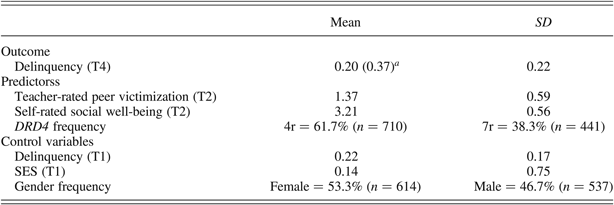
Descriptive statistics of all study variables are presented in Table 1. We examined correlations between genotype and environmental measures. Gene–environment correlations indicate that exposure to an environmental risk is influenced by genotype (e.g., risk for victimization would differ as a function of DRD4). Their occurrence needs to be ruled out prior to examining gene–environment interaction effects. No significant associations were found; that is, carriers and noncarriers of DRD4 7r allele did not differ in their experiences of peer victimization (t = 0.22, p = .83) or social well-being (t = –1.60, p = .11). Moreover, a comparison of DRD4 4r homozygotes and 7r allele carriers mean levels of control variables included in the regression models revealed no significant differences for prior delinquency, SES, or gender. We also tested for gender differences on environmental measures and found that girls reported higher social well-being (t = –3.74, p < .001). Girls were further less likely to engage in delinquency at both times (T1: t = 6.66, p < .001; T4: t = 5.41, p < .001).
Descriptive statistics of study measures

Note: The numbers in parentheses in row labels refer to measurement time. Coefficients are based on nonimputed data. T1, Time 1; T2, Time 2; T4, Time 4; SES, socioeconomic status; 4r, carrier of 4-repeat allele homozygous dopamine receptor D4 gene (DRD4) polymorphism; 7r, carrier of one or two 7-repeat alleles.
aThe mean of T4 delinquency after square root transformation.
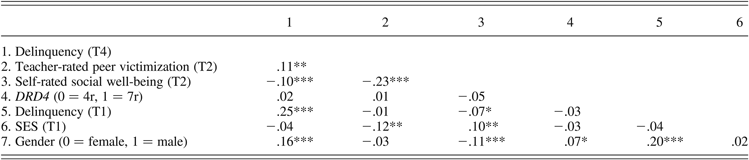
Table 2 depicts bivariate correlations between the study variables, including covariates. Delinquency was fairly stable over time, as shown by a significant association between assessments at T1 and T4. Delinquency at T4 was also linked to higher peer victimization and lower social well-being (both T2). Victimization by peers was negatively associated with social well-being. Finally, higher SES was linked to greater social well-being and lower levels of peer victimization.
Pairwise correlations between study measures
Note: The numbers in parantheses refer to measurement time. All coefficients are based on imputed data (n = 1,151). T1, Time 1; T2, Time 2; T4, Time 4; SES, socioeconomic status; 4r, carrier of 4-repeat allele homozygous dopamine receptor D4 gene (DRD4) polymorphism; 7r, carrier of one or two 7-repeat alleles.
*p < .05. **p < .01. ***p < .001.
Regression models
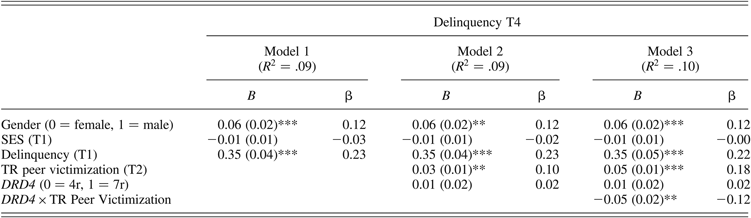
We initially computed separate models for teacher-rated peer victimization and social well-being (Table 3 and Table 4) followed by a model in which both environmental measures and their interactions with DRD4 were entered simultaneously to test unique effects of each measure on delinquency. We began by computing regressions in which only the control variables gender, SES, and delinquency at T1 functioned as predictors of delinquency at T4 (Model 1). These models were equivalent in all sets of regression analyses reported below. Delinquency in late childhood significantly predicted delinquency later on, as did gender, with boys being at greater risk. No significant prediction was found for SES.
Prediction of delinquency at T4 by DRD4 and teacher-rated peer victimization
Note: The numbers in parentheses in row labels refer to measurement time. The numbers in parentheses following unstandardized coefficients represent standard errors. All coefficients are based on imputed data (n = 1,151). T1, Time 1; T2, Time 2; T4, Time 4; TR, Teacher reported; SES, socioeconomic status; 4r, carrier of 4-repeat allele homozygous dopamine receptor D4 gene (DRD4) polymorphism; 7r, carrier of one or two 7-repeat alleles.
*p < .05. **p < .01. ***p < .001.
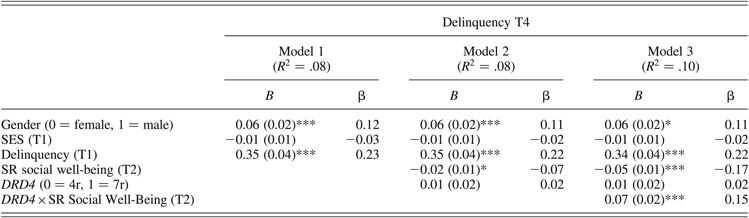
Prediction of delinquency at T4 by DRD4 and self-rated social well-being
Note: The numbers in parantheses in row labels refer to measurement time. The numbers in parantheses following unstandardized coefficients represent standard errors. All coefficients are based on imputed data (n = 1,151). T1, Time 1; T2, Time 2; T4, Time 4; SR, self-reported data; TR, teacher-reported data; SES, socioeconomic status; 4r, carrier of 4-repeat allele homozygous dopamine receptor D4 gene (DRD4) polymorphism; 7r, carrier of one or two 7-repeat alleles.
*p < .05. **p < .01. ***p < .001.
Peer Victimization × DRD4
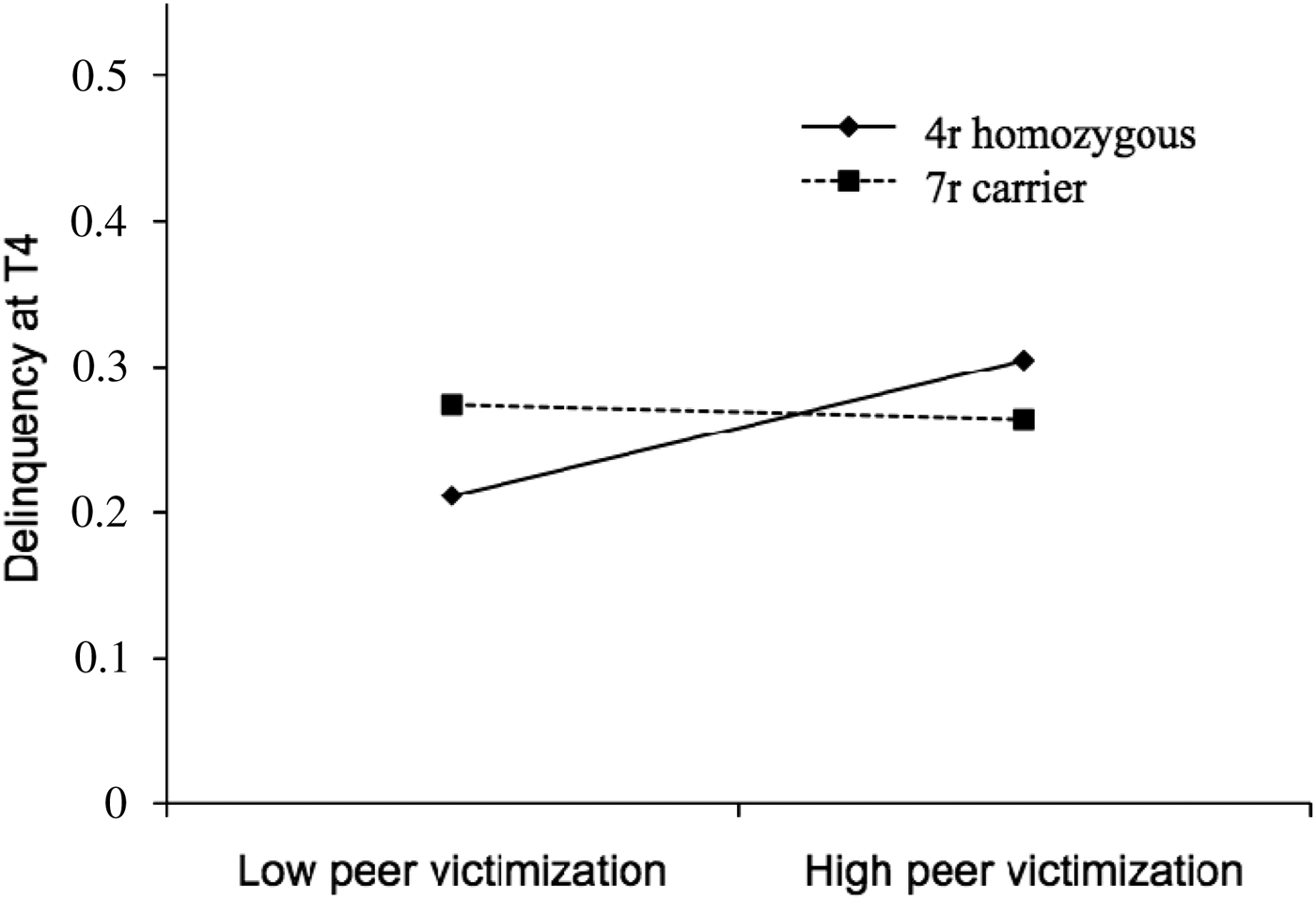
The results for this set of analyses are depicted in Table 3. Step 2 showed that higher levels of peer victimization were associated with an increase in delinquency, above and beyond baseline delinquency. No main effect of genotype was found. In the third step, the interaction term (i.e., the product between genotype and peer victimization) was added to the model (Model 3). All variables that predicted delinquency in Model 2 retained significance. In addition, the interaction between DRD4 and teacher-rated peer victimization reached statistical significance. Significant interaction effects were followed up using simple slopes to illustrate the direction of effects. Whereas the prediction of delinquency by peer victimization was significant for 4r carriers (β = 0.13, p < .01), this association was not found for 7r allele carriers (β = –0.03, p = .65; see Figure 1). When delinquency at T1 was omitted from the analyses, the significant main effects of peer victimization (β = 0.10, p = .006) and its interaction with DRD4 (β = –0.13, p = .002) were confirmed.
The prediction of delinquency (square root transformed scale) by peer victimization for the carrier of the 4-repeat (4r) allele homozygous dopamine receptor D4 gene polymorphism homozygotes and the carrier of one or two 7-repeat (7r) allele carriers. Low and high victimization represent 1 SD from the mean. The Y axis comprises values up to the 75th percentile of the sample. The values are based on imputed data. T4, Time 4.
Social Well-Being × DRD4
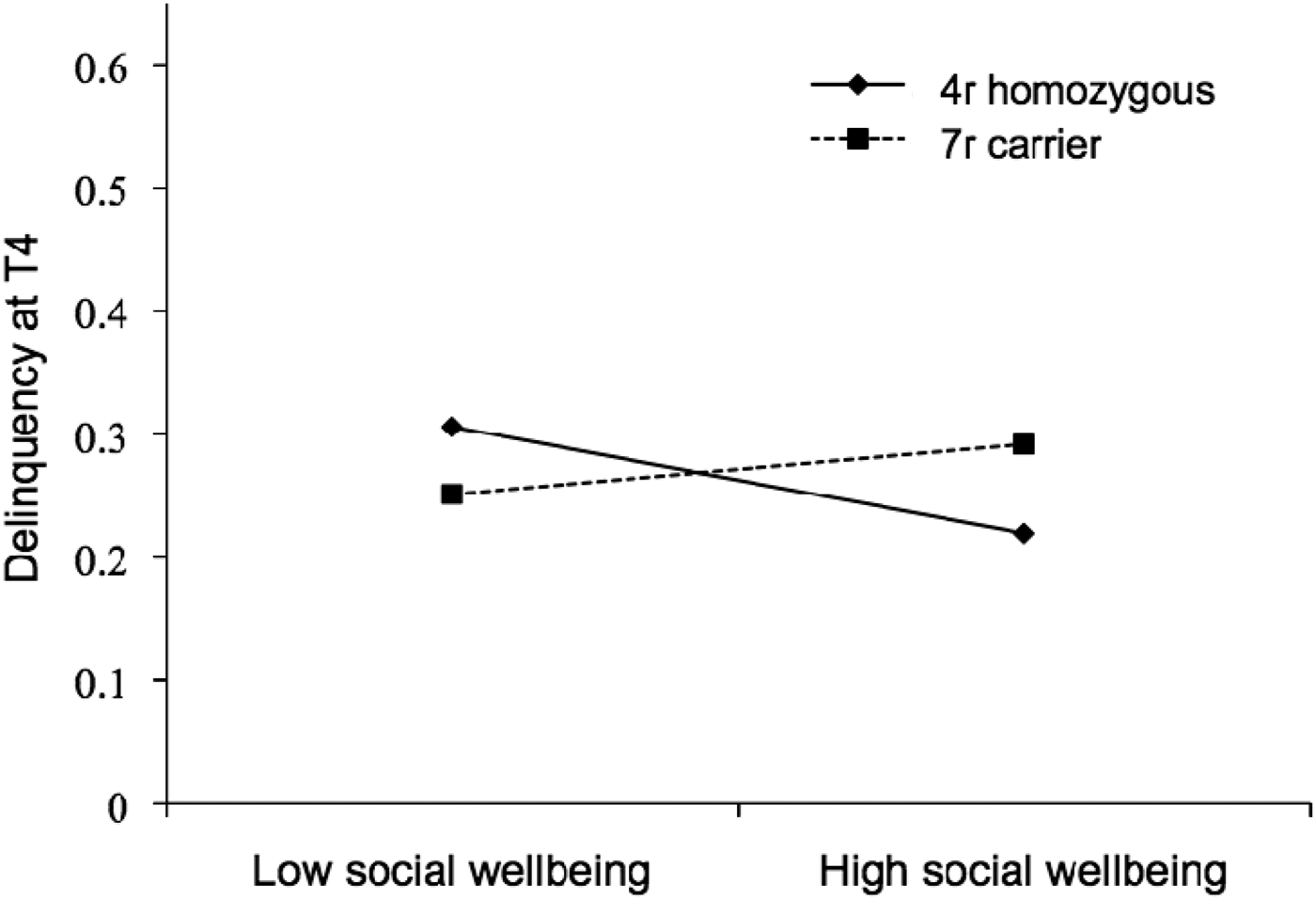
As demonstrated in Model 2 in Table 4, a main effect was yielded for self-rated social well-being: the higher adolescents perceived social well-being at T2, the lower levels of delinquency they showed at T4. No main effect of genotype was found. As shown in Model 3, the interaction between DRD4 and self-rated social well-being was significant. Again, we computed simple slopes to identify the direction of this effect. A stronger environment–outcome association was found for DRD4 4r homozygous carriers compared to 7r allele carriers (β = –0.17, p < .001 vs. β = 0.08, p = .08; see Figure 2). These results were confirmed when delinquency at T1 was omitted from the regression model (main effect of social well-being: β = –0.08, p = .004; interaction between social well-being and DRD4: β = 0.17, p < .001).
The prediction of delinquency (square root transformed scale) by social well-being for carrier of the 4-repeat (4r) allele homozygous dopamine receptor D4 gene polymorphism homozygotes and the carrier of one or two 7-repeat (7r) allele carriers. Low and high victimization represent 1 SD from the mean. The Y axis comprises values up to the 75th percentile of the sample. The values are based on imputed data. T4, Time 4.
Figures 1 and 2 display the interaction effects and suggest that carriers of the DRD4 4r homozygous variant were more susceptible to peer victimization and low levels of social well-being with regard to later delinquency, whereas peer victimization and social well-being were not linked to delinquency for carriers of the DRD4 7r allele. The plotted interactions include the majority of scores on environmental measures (mean ± 1 SD). Given that the slopes for 7r allele carriers and 4r homozygotes cross within that range, our results support the notion of differential susceptibility.
Because gender predicted delinquency, we examined whether gender also moderated the gene–environment interaction. To this end, we computed three-way interaction terms (Genotype × Environment × Gender) and added them to both models. None of the three-way interaction effects yielded statistical significance (not tabled but available from first author). Thus, the moderation of peer victimization and social well-being on later delinquency by DRD4 did not differ for girls and boys.
Simultaneous examination of peer victimization and social well-being
To examine whether peer victimization and social well-being represent unique negative and positive aspects of young adolescents' peer environment and as such exert different effects on later delinquency, we also computed a regression model in which both measures were entered simultaneously. Again, we first tested main effects and confirmed previous results: DRD4 did not predict later delinquency, but peer victimization was positively (β = 0.09, p = .013) and social well-being by trend negatively (β = –0.05, p = .078) associated with later delinquency. The interaction between peer victimization and DRD4 continued to significantly predict later delinquency (β = –0.09, p = .031) as did the interaction between social well-being and DRD4 (β = 0.14, p < .001).
Additional analyses
Stability of association between peer environment and delinquency
Neither peer victimization nor social well-being in the classroom are necessarily stable across adolescence. To examine whether our results could be confirmed using a peer measure assessed at a different time, we conducted a set of regression models using self-reported social well-being measured at T3. Both the main effect of social well-being (β = –0.09, p = .002) as well as its interaction with DRD4 (β = 0.10, p = .008) were confirmed using the T3 assessment. Simple slope analyses confirmed the direction of effects that were found when using T2 measures (4r homozygous: β = –0.14, p < .001; 7r allele carriers: β = 0.01, p = .946). Unfortunately, no T3 teacher report of peer victimization was available.
Peer nomination of victimization
At T2, the TRAILS study included an additional study of classroom peer relations on a subset of participants of the original sample. As part of this substudy, peer nominations on bullying and victimization were collected in classrooms with at least three TRAILS participants. Because of this strategy, the sample for which peer nominations and genetic information was available was considerably smaller (n = 627) than the one used in our previous analyses. Nonetheless, we also computed regression models using proportion scores of peer ratings of victimization (i.e., ratio of received “victim” nominations in relation to class size). These models confirmed the direction of effects from our results using teacher ratings albeit missing statistical significance (DRD4 × Peer-Rated Victimization, β = –0.08, p = .10), showing again that carriers of the 4r allele were more likely to increase their delinquency due to peer victimization in early adolescence. Details on all additional analyses are available from the first author.
Discussion
Our study is one of the first to examine genetic moderation of peer relationship effects on later delinquency. Similarly to recent studies on comparable environmental risks (Benjet et al., Reference Benjet, Thompson and Gotlib2010; Sugden et al., Reference Sugden, Arsenault, Harrington, Moffitt, Williams and Caspi2010) and outcomes (Latendresse et al., Reference Latendresse, Bates, Goodnight, Lansford, Budde and Goate2011; Lee, Reference Lee2011), we showed that variation in vulnerability to peer effects is partly due to variations in specific genes. We exploited a longitudinal, multireporter study to test these effects over time and controlled for baseline levels of delinquency and other known confounders. Our own replication of results regarding peer victimization using a related but conceptually different measure assessed from adolescents themselves (i.e., self-rated social well-being in the classroom as a measure of peer acceptance and support) as well as follow-up analyses using a subsample for which peer ratings of victimization were available gives us confidence in our findings despite contrasting our hypothesis regarding the direction of effects. Finally, our results support the notion of differential susceptibility to the environment because genetic variation not only increased risk in the presence of negative environmental conditions but also lowered the risk in the presence of favorable conditions in the peer environment. Ellis et al. (Reference Ellis, Boyce, Belsky, Bakermans-Kranenburg and van IJzendoorn2011) suggested that a differential susceptibility model is supported if “a cross-over interaction that covers both the positive and the negative aspects of the environment” (p. 22) is found. In addition, the regression slope for the group for which heightened susceptibility is found needs to be significantly different from zero and steeper than the slope for the group for which no heightened susceptibility is assumed. These conditions were met for both environmental measures in the current study.
We began by examining links between peer victimization and later delinquency and, in line with several previous studies (Hanish & Guerra, Reference Hanish and Guerra2002; Hodges et al., Reference Hodges, Boivin, Vitaro and Bukowski1999; Khatri et al., Reference Khatri, Kupersmidt and Patterson2000), yielded a modest but significant association. Although expected, it is notable that experiences with classroom peers in early adolescence are far-reaching enough to predict delinquency at age 19. As suggested previously, a potential mechanism for this association may be that victimized adolescents who do not feel accepted by their peers and cannot achieve social well-being through caring and affectionate relations with others might develop coping strategies that can be maladaptive and include internalizing and externalizing behaviors (Arseneault et al., 2010; Hanish & Guerra, Reference Hanish and Guerra2002). Moreover, behavioral confirmation and status attainment often go together with delinquency, especially in adolescence (Ormel, Reference Ormel, Pulkkinen and Caspi2002), and children and adolescents who are victimized may have fewer opportunities to develop appropriate social and interpersonal skills (Fox & Boulton, Reference Fox and Boulton2005) and may be at increased risk for affiliation with delinquent peers and their socializing influence (Rusby, Forrester, Biglan, & Metzler, Reference Rusby, Forrester, Biglan and Metzler2005). The association between peer victimization and delinquency was also shown (in reversed form) when adolescents rated their well-being in the classroom, again underlining the importance of supportive and accepting relationships for adaptive adolescent development and the detrimental effects of lacking positive relations with peers.
Experiencing social stress such as victimization and rejection by others has been related to a number of biological processes in studies on rodents and human subjects (Björkqvist, Reference Björkqvist2001), including alterations in epinephrine, norepinephrine, and dopamine activity. The implication of neurotransmitters in response to social stress as well as previous studies into the moderation of environmental effects on constructs related to delinquency (Olsson et al., in press; Park et al., Reference Park, Sher, Todorov and Heath2011; Propper et al., Reference Propper, Willoughby, Halpern, Carbone and Cox2007) led us to examine the effect of DRD4 on the association between peer environment and delinquency. DRD4 has been linked to a number of phenomena that show some overlap with delinquency (e.g., ADHD, Faraone et al., Reference Faraone, Doyle, Mick and Biederman2001; mood disorders, Ray et al., Reference Ray, Bryan, MacKillop, McGeary, Hesterberg and Hutchison2009; and criminality, Boutwell & Beaver, Reference Boutwell and Beaver2008). Based on findings from these studies, we expected that adolescents who carry the DRD4 7r allele would be more susceptible to negative and positive aspects of their peer environments than would be noncarriers of the allele. Our results, however, were not consistent with our prediction. This finding is fascinating for several reasons.
First, we suggest that our findings highlight the need for a developmental perspective in looking at the effect of genes on environmental risk. Specifically, we argue that our findings might differ from other studies into the DRD4 gene because our outcome variable concerns a stage in life (i.e., adolescence) that so far has only rarely been looked at in studies involving this polymorphism as moderator on environment–outcome associations. Exceptions to this were presented by Creemers et al. (Reference Creemers, Harakeh, Dick, Meyers, Vollebergh and Ormel2011), who did not replicate previous findings of an interaction between DRD4 and parenting in the prediction of adolescent substance use; Settle, Dawes, Christakis, and Fowler (Reference Settle, Dawes, Christakis and Fowler2010), who examined the interplay between DRD4 and friendships in the prediction of political ideology; and Stevens et al. (Reference Stevens, Kumsta, Kreppner, Brookes, Rutter and Sonuga-Barke2009), who examined moderation of severe deprivation in childhood on ADHD symptoms in adolescence by DRD4 but failed to find an effect. In contrast, Badcock and colleagues (Reference Badcock, Moore, Williamson, Berk, Williams and Bjerkeset2011) showed that the DRD4 polymorphism moderated the impact of maternal care on adolescent neuroticism.
Adolescence is a time of major developmental changes in brain physiology and functioning, including “re-organization” in neuronal structure (Wahlstrom, White, & Luciana, Reference Wahlstrom, White and Luciana2010). Taking together findings from developmental and social neuroscience, there is support for differences between adolescent and child or adult brain architecture and functioning. Several brain regions associated with social stress (e.g., victimization and lack of social well-being) undergo maturation processes and dopamine system activity changes (Brenhouse & Andersen, Reference Brenhouse and Andersen2011; Wahlstrom et al., Reference Wahlstrom, White and Luciana2010). Neuroimaging studies have shown age differences in neural activity to stimuli mirroring rejection (Lau et al., Reference Lau, Guyer, Tone, Jenness, Parrish and Pine2012; Masten et al., Reference Masten, Eisenberger, Borofksy, Pfeifer, McNealy and Mazziotta2009; Moor et al., Reference Moor, Güroğlu, Op de Macks, Rombouts, Van der Molen and Crone2012), with adolescents appearing to be particularly affected. Moreover, the DRD4 polymorphism has been associated with activity in the anterior cingulate cortex (Fan, Fossella, Sommer, Wu, & Posner, Reference Fan, Fossella, Sommer, Wu and Posner2003), one of the brain regions of interest in studies on neuropsychological effects of rejection and social exclusion (Masten et al., Reference Masten, Eisenberger, Borofksy, Pfeifer, McNealy and Mazziotta2009, Moor et al., Reference Moor, Güroğlu, Op de Macks, Rombouts, Van der Molen and Crone2012). It is possible that this association may work somewhat differently in adolescence compared to other life stages.
Second, revealing unexpected patterns for candidate genes as moderators of peer context measures is in line with Lee (Reference Lee2011), who examined the interaction of the monoamine oxidase A polymorphism and deviant peer affiliation. Monoamine oxidase A is implicated in the catabolism of several neurotransmitters in the brain, including serotonin and dopamine, has been associated with mental health outcomes (Kim-Cohen et al., Reference Kim-Cohen, Caspi, Taylor, Williams, Newcombe and Craig2006) and delinquency (Guo, Ou, Roettger, & Shih, Reference Guo, Ou, Roettger and Shih2008), and functions as a moderator on associations between environmental risk and delinquent and antisocial behavior. Most studies examining this polymorphism reported greater vulnerability for carriers of the short (less functional) allele, but Lee (Reference Lee2011) showed that carriers of the long (more functional) allele were more vulnerable to overt antisocial behavior in the presence of deviant peer affiliation. It is curious that our results are similar to Lee's finding that genetic moderation of peer environment effects contrasts findings from studies into other types of environment such as parenting (e.g., Bakermans-Kranenburg & van IJzendoorn, Reference Bakermans-Kranenburg and van IJzendoorn2006). Whereas it may be far-fetched to suggest that aspects of the peer environment interact with genetic factors in a different way than other environmental factors, more studies into genetic moderation of peer experiences are needed to elucidate whether environment-specific mechanisms may be at play.
These suggestions are tentative, but it should also be noted that our results are not the only ones to question a generic risk function of the 7r allele. Swanson et al. (Reference Swanson, Oosterlaan, Murias, Schuck, Flodman and Spence2000), for example, conducted a study on children with ADHD and found that carriers of the 7r allele were at reduced risk for cognitive abnormalities (while still showing behavioral symptoms) compared to carriers of the 4r homozygous variant. Similarly, DeYoung et al. (Reference DeYoung, Peterson, Séguin, Mejia, Pihl and Beitchman2006) showed that cognitive ability was associated with externalizing behavior only for individuals who did not carry the 7r allele. Carriers of one or two copies of the 7r allele did not show this association. Although this study differs in that it assessed cognitive ability rather than social–environmental dimensions as done in the current study, it shows how the effects of different variants of DRD4 vary by the context in which it is studied.
Third, studies on other candidate genes have shown repeatedly that describing a variant as conferring more or less risk may be misleading and neglecting the importance of the outcome measure. For instance, a common valine to methionine substitution in the catechol-O-methyltransferase gene results in three variants: valine/valine (val/val), valine/methionine (val/met), and methionine/methionine (met/met). Whereas carrying the valine allele is advantageous in dealing with aversive stimuli compared to the methionine allele, carrying the methionine allele has benefits for memory and attention compared to carrying the valine allele. As such, each allele is related to different phenotypes, and it is difficult to unequivocally predict the mechanism through which catechol-O-methyltransferase moderates environmental factors (Stein, Newman, Savitz, & Ramesar, Reference Stein, Newman, Savitz and Ramesar2006). Although this clear distinction has not been made with regard to the DRD4 genotype, future research needs to take into account that alleles may be differently related to outcomes.
In balance, examining common environmental factors such as relationship quality with peers furthers the field of gene–environment interaction research. Our study has shown that specific candidate genes not only moderate the impact of negative environments but also contribute to differential susceptibility to environmental pathogens that young people encounter almost normatively: about one in two adolescents reports some experience of victimization and one in four adolescents has been severely victimized (Card & Hodges, Reference Card and Hodges2008). The interpretation of our findings is to some extent speculative and requires not only replication in different samples but also additional studies into individual susceptibility to measures of the peer environment and into the gene–environmental interplay implied in the development of adolescent delinquency.
Limitations
Despite the insight into the interplay of environmental factors and DRD4 in the prediction of adolescent delinquency, our results need to be interpreted with several limitations in mind. For instance, we focused on DRD4 for reasons discussed above, but delinquency is a multifaceted and polygenic phenomenon. Moreover, main effects of peer victimization and social well-being in the classroom on delinquency were modest, but it should be noted that these measures were assessed with a time difference of approximately 6 years and spanning life stages with potentially very different sets of peer contexts (early adolescence vs. late adolescence/transition to early adulthood). Our findings only tell part of the story, which reflects the complex interplay of many genes and environmental factors in the development of adolescent delinquency. Many more biological, psychological, and social risks need to be considered in future studies. Further, we relied on teacher reports to assess peer victimization (but note that we also found support for the interaction effect to some degree using peer reports). In addition, the teachers were asked about relational forms of victimization only. Including accounts of physical victimization would have further improved our study.
Similarly, although adolescents may be the best source of information about delinquent involvement, self-reports in this area are not free of bias. Young people may over- or underreport their involvement, and official data or peer reports would be suitable instruments to increase the quality of such data. However, despite their shortcomings, Thornberry and Krohn (Reference Thornberry, Krohn and Duffee2000) suggested that self-reports are a valid way to assess adolescent delinquency. The outcome measure used in the current study is further limited with regard to its reliability (α = 0.64). It is likely that the variety of different behaviors that were assessed contributed to the less than ideal intercorrelations between items. In any case, using combined reports of different reporters would likely improve the reliability of this measure.
Finally, yielding results that contrast our hypothesis and some previous research meant that our interpretation of patterns and mechanisms is based on assumptions and may pose more questions than our study answered. Not only is replication of our results with a different sample necessary to exclude the possibility of chance findings, joining forces with (molecular) neuroscientists and employing novel methods of assessment (e.g., neuroimaging) are necessary to understand the interplay among environmental risks, genetic and neurological processes, and delinquency.
Notwithstanding these limitations, our study is one of the first to show that differences in susceptibility to the effects of peer relationship quality in adolescence are partly genetic. Our results not only suggest that experiences of the peer environment in the classroom are far-reaching and significantly predict later delinquency but also that this association is moderated by genotype. Although certainly a distant prospect, understanding biological risk for vulnerability may help inform approaches to prevention and intervention efforts. We were able to further illuminate the complex interplay of antecedents of adolescent development and showed that individual differences in genetic makeup partly explain why some young people are more affected by negative peer experiences than others. These same youths, however, are also at substantially reduced risk for delinquency in the presence of positive environment conditions. A detailed understanding of the mechanisms that elevate or hinder adolescent delinquency will ultimately help to support young people's social development.