Few could deny that increasing levels of crime and disorder within contemporary Britain are a cause for concern. The widespread riots of 2011 highlighted on a national stage the extent to which aspects of community cohesion within Britain had eroded. Racial tensions, sporadic acts of violence by young teenagers and increasing concern over gun crime are just a few of the issues demonstrating the underlying problems facing urban centres throughout the country. Such urban degeneration has often been attributed to a fundamental breakdown between the citizen and the state; for many sociologists and historians, the decline of the urban environment reflects a deterioration in the depth and quality of civil society and a weakening of social capital and civic participation.Footnote 1 Most recently, David Cameron's ‘Big Society’ agenda reiterated such concerns, placing a renewed emphasis on the need for citizens to engage actively with local voluntary and community organizations for the good of society as a whole.
Once perceived as a great nation of joiners, modern Britain is no longer regarded as a country dominated by local and national organizations, clubs and societies, boasting an environment of inclusion and participation.Footnote 2 Scholarly discourse has suggested that disintegration can be traced to the nineteenth century when the process of suburbanization separated and fractured communities irreconcilably. Dominated by elite inhabitants seeking a privatized lifestyle within a semi-rural location, it has been argued that the suburban ideal produced a middle-class society devoid of interest and participation in the twentieth century.Footnote 3 Such notions continue to permeate contemporary accounts, exemplified in 2006 by articles in the national press suggesting that the continued middle-class exodus from inner cities has increased the sense of racial segregation in modern Britain.Footnote 4 More recently, a study recorded in the Metro argued that city dwellers now know only eight of their neighbours by name.Footnote 5 Yet, contemporary research into both the process and history of suburbanization, and its connection to associational activity, reveal contrasting arguments in relation to suburbanization as separation. In 2006, a YouGov poll suggested membership levels in general had soared in Britain in recent years, with the average Briton a member of 17 organizations.Footnote 6 Such research raises interesting questions with regards to the stereotypical account of middle-class withdrawal and suburban detachment, providing considerable scope for the revision of accounts of twentieth-century British suburbanization and patterns of social engagement.
Suburbanization
The perception of the middle classes of the twentieth century as increasingly devoid of interest and participation in the city is a conceptual framework often associated with the process of suburbanization. During the Victorian era, suburban relocation had become so embedded in nineteenth-century culture that movement to the outer fringes was understood as a vital facet of middle-class identity. To reside in suburbia was not only a status symbol but a way of actualizing the middle-class ideology of separate spheres at home and work. In 1909, C.F.G. Masterman termed the urban middle classes residing on the fringes as ‘the suburbans’, suggesting they were a homogeneous civilization, living a detached and self-centred lifestyle at the urban periphery.Footnote 7 In more recent years, academics have also connected decentralization to the decline of social capital and civic engagement in America, further emphasizing the negative connotations so easily associated with suburban areas.Footnote 8
In contemporary society, suburbia can be deemed a particularly fluid concept with varying interpretations. By dictionary definition, the term refers to ‘a residential district situated on the outskirts of a city or town’.Footnote 9 Architectural historians suggest that the first set of detached or semi-detached homes built for single-family occupancy were recorded in 1794 at the Eyre Estate (St John's Wood, London), and the years that followed, particularly 1815–50, were ones of ‘conscious suburbanisation’.Footnote 10 Ultimately, suburbia allowed the urban middle classes physically to remove themselves from the social and physical problems of the city centre, particularly the slum areas that surrounded them on a daily basis. As H.J. Dyos asserted, a symbiotic relationship existed between the suburb and the slum: ‘The fact of the suburb influenced the environment of the slum; the threat of the slum entered the consciousness of the suburb.’Footnote 11 The process of suburbanization also allowed the city to become zoned with slums and factories and warehouses at the core, followed by respectable working-class housing and middle-class villas at the periphery.Footnote 12 Richard Rodger states: ‘Suburbs, then, were partly a product of increasing urban size; in the wake of industrialization the middle classes for the first time were sufficiently numerous to appear as a coherent entity rather than being confined, as previously, to a few streets or squares.’Footnote 13 By the twentieth century, the concept infiltrated many aspects of the urban environment, even becoming a template for sociologists like Ebenezer Howard. His utopian vision for the ‘Garden City’ sought to bring the suburban ideal to the urban masses, in the hope of transforming working-class housing conditions.Footnote 14 The impact of new technology, in particular mass transportation – initially the tramways and eventually the motor car – further accelerated the process of suburbanization and a sense of social segregation.Footnote 15 As a sizeable commute was made possible for the urban middle classes, suburban areas were increasingly constructed further and further away from the urban core. After World War II, state programmes of regeneration, alongside improvements in technology and transportation, further fuelled suburban development, creating what F.M.L. Thompson defines as ‘physically distinct dormitory towns, urbanised villages’.Footnote 16
Such negative depictions and harmful stereotypes of the suburban lifestyle permeated both historical literature and fictional novels throughout the twentieth century. Suburban enclaves have frequently been represented as sprawling artefacts of which few people are particularly fond, a physical expression of monotony exemplified through indistinguishable villas and a general wasteland of housing,Footnote 17 the portrayal of which was effectively captured in George Orwell's Coming Up for Air. Footnote 18 Beyond the physical stereotype, some scholars have also raised concerns about social cohesion in suburban settings, arguing that ‘suburbanites are becoming more and more atomised and therefore endangering the stability of the whole society’.Footnote 19 They are often characterized as symbols of a more closed society,Footnote 20 a deconstructive device particularly in the context of racial integration.Footnote 21 Yet, more recent revisions into the many elements that construct suburbia have begun to show the diversity of these urban settlements, suggesting scholars have often been too quick to lump all middle-class suburban areas together.Footnote 22 L.S. Bourne asserts that after years of relative neglect, the study of suburbia has begun to move back to centre stage,Footnote 23 as scholars attempt to readdress the often inaccurate yet powerful myths and stereotypes associated with suburbs.Footnote 24 In particular, American scholars such as Mary Corbin Sies have suggested that middle-class suburbs have been the most susceptible to stereotypical depictions. Suburbia did not necessarily mean detachment and research into American suburbanization has begun to show this.
Sociological research on American suburbanization has had an important place in the academic debate regarding the relationship between suburbia and the urban core, exemplified as early as the 1920s by the Chicago model of social segregation.Footnote 25 More recently, historians such as Corbin Sies, Todd Gardner, Richard Harris and Robert Lewis have begun to emphasize the diversity of American suburbs.Footnote 26 Gardner, for instance, has suggested that in America, suburbanization was a more complex process than the simple migration of affluent city dwellers to the urban periphery, concluding that in order to understand these complexities, researchers need to examine large and smaller metropolitan areas in a comparative context.Footnote 27 In addition, and with particular relevance to this article, Corbin Sies has suggested that much of our understanding of white, middle-class suburbia comes from prescriptive literature, advertising or reformers’ rhetoric, as opposed to data collected. Instead, she argues, ‘we need to understand not only who lived in a given urban or suburban neighbourhood, how it developed, and why it developed but also how constituents experienced life on the ground there’.Footnote 28 Such methodological approaches, however, have yet to permeate the study of suburbia outside North America, particularly in Europe. In their analysis of Holland, Tineke Lupi and Sako Musterd argue that much of our understanding of suburbanization has dealt disproportionately with the American experience.Footnote 29 Such concerns are comparable with the British experience. Whilst much has been written on British suburbanization in the nineteenth and early twentieth centuries, the post-war era remains crucially neglected. While Mark Clapson and J.W. Whitehand have addressed both post-war working-class suburbia and suburban morphology respectively,Footnote 30 the middle-class suburbs after 1950 remain under-researched, particularly in relation to the social interaction between suburbia and the urban core.
Associational activity and the urban middle classes
So how can British historians begin to revise the issue of suburbanization as detachment? What methods can be used to analyse the social behaviour of middle-class suburban residents during the twentieth century? And is it possible to address the types of issues that have been highlighted on the American, suburban agenda? As previously noted, when considering the historiography of suburbanization in Britain, the notion of geographical relocation to the urban periphery has become synonymous with a sense of middle-class identity. A further facet of this identity was a propensity to engage in urban affairs through the process of associational activity.
Historically, the urban middle-class elite was understood as a higher-status group at the head of urban society, a cohesive social group with leading social and political positions.Footnote 31 Simon Gunn suggests that whilst there were substantial differences of wealth within the middle classes – clerics and lawyers rarely matched the incomes of industrialists or bankers for instance – they were ‘increasingly integrated through education, intermarriage and leading roles in urban institutions, as well as participation in a common style of life in city and suburb’.Footnote 32 As an increasing proportion of the population began to inhabit urban areas between the years 1750 to 1850, scholars have identified the substantial economic, social and political resources marshalled by the middle classes in urban Britain.Footnote 33 The speed of industrialization left many towns and cities lacking formalized and representative local government, with municipal control residing in the hands of a self-constructed urban middle class.Footnote 34 Yet, towns and cities were substantially their creations, and in turn provided the theatre within which they extended, expressed and defended their power.Footnote 35 By 1835, however, the Municipal Corporations Act worked as a ‘spring board for future urban government’,Footnote 36 seeking to construct a more coherent form of municipal leadership. The middle classes sought to maintain their influence in newly formed local governments and, according to John Smith, in each city centre local government was dominated by men of substantial social and economic influence, keen to serve on local councils and shape the future of municipal leadership.Footnote 37 This was a reciprocal relationship, with newly constructed councils eager to embrace the knowledge and power of the urban middle classes.Footnote 38
Thus, during the nineteenth century, the upper middle classes remained at the helm of urban development and whilst much of this power was enacted through developing systems of local municipal control, networks of power and influence also existed outside council offices, in the dominant sphere of associational activity. Richard Sennett has argued that in the past, cultural form and institutional interaction helped citizens to make sense of the increasingly anonymous experience of social life in expanding cities and towns.Footnote 39 For the middle classes, participation in voluntary organizations provided an ideal outlet for the development of social networks and leisure pursuits. Formal association, as described by Peter Bailey, ultimately acted as a ‘moral umbrella’ for the middle classes,Footnote 40 reinforcing the awareness of collective class participation that made leisure activities self-validating.Footnote 41 Between the years 1780 and 1850, the expansion of industrial and urban populations was accompanied by the increased intensity of organizational activity.Footnote 42 R.J. Morris suggests that organizations were designed ‘to achieve their aims without reference to government aid or authority, and the leaders of the dominant voluntary societies felt they were engaged in the creation of a particular set of social relationships which were intended to provide stability and legitimacy for their own power and privilege’.Footnote 43 In short, the associational sphere provided an ideal medium for expressing leadership, a place where the middle classes could continue to make decisions behind closed doors and to their own agenda.Footnote 44
As the study of the middle classes moves into the twentieth century, however, interpretations have provided a more controversial account of decline and indifference. As the rapid process of suburbanization increased at an unprecedented rate throughout the twentieth century, scholars used the suburbanization concept to support the notion of a detached middle class. It has been argued that by the mid-twentieth century the division between work and leisure had become ‘not only temporal but spatial’ as the lure of suburbia, supported by the rapid increase in public transport and the ownership of motor cars, allowed the middle classes to commute between city work place and suburban home.Footnote 45 In general, middle-class suburbanization was perceived as the means through which the urban middle classes abandoned their responsibilities at the urban core. As early as 1909, it was suggested that the urban middle classes had completely withdrawn to privatized enclaves in the county and outer suburbs.Footnote 46 Historians such as John Garrard, Morris and Thompson have similarly argued that during the twentieth century the urban middle class were unable to take on leading roles in urban life, as their identity was no longer associated with the urban but rather the suburban. Seemingly, the middle classes had turned their backs on the urban communities they had done so much to create.Footnote 47
Research into the urban elite of the twentieth century however, remains limited and more recent studies by scholars such as Barry Doyle have challenged the existing interpretation of detached urban elites by the 1950s. In his study of Norwich between the years 1900 to 1935, Doyle disputes the assumption of withdrawal to a privatized lifestyle, arguing increasing middle-class interest and civic participation. Few historians have extended their analysis beyond World War I, but Doyle suggests that by doing so, regional variation becomes apparent. Within Norwich, the onset of suburbanization did not encourage the urban middle classes to abandon their responsibilities at the urban core as they continued to develop their connections with religious organizations, cultural associations and voluntary charitable groups.Footnote 48 Similarly, William Rubinstein and Richard Trainor suggest that the elites retained a ‘strong cultural and educational unity’,Footnote 49 whilst in his recent work on middle-class associationalism and culture, Mike Savage has shown the extent to which the urban context continues to stimulate involvement in voluntary activity.Footnote 50
Such conclusions complement Corbin Sies’ view in America that a new set of research priorities has the potential to reveal interesting analysis in terms of the impact of suburbanization on middle-class social networks during the twentieth century. However, whilst she emphasizes the importance of understanding life in suburbia itself, an analysis of the relationship between suburban areas and the urban core also has the potential to challenge stereotypical accounts of suburban detachment. Undoubtedly, as Gunn asserts, middle-class culture changed during the twentieth century with a declining sense of urban place as a specific element of middle-class identity, but to what extent did this diminish their roles in urban society, particularly the networks of social interaction generated at the urban core?Footnote 51 Despite a geographical withdrawal, did the middle classes continue to create social networks at the city centre through associational activity? Did the number of suburban members grow or decline as the twentieth century progressed? And to what extent did increasing geographical separation represent a total withdrawal from urban life? Through an analysis of middle-class, suburban participation in the voluntary sphere during the period 1950 to 2005, the rest of this article will begin to outline the ways in which a revision of twentieth-century British suburbia is possible. Through the use of modern analytical tools and techniques, and the examination of suburban areas in a spatial and cultural context, specific patterns of social engagement begin to emerge, challenging existing stereotypes and emphasizing the increasingly complex relationship between the urban and the suburban.Footnote 52
Associational participation
In order to consider how the process of suburbanization affected social engagement, an evaluation of local clubs and societies was undertaken in a specific case-study location. The city of Leicester was chosen due to its long association with voluntary activity and its unique demographic composition; in recent years, Leicester has become the focal point for consideration regarding the changing demographic structure of the United Kingdom. According to the Independent, the steady influx of ethnic minority groups to the city will ultimately result in Leicester becoming the first urban centre in Britain with a minority white population by 2019.Footnote 53
In terms of associational activity, scholars have concluded in their study of the city that, whilst the function of organizations in Leicester may have changed in the cultural shift of twentieth-century society, overall engagement did not. It has often been argued that the mid-century expansion of the functions of the state was a major factor in subverting earlier patterns of family and neighbourhood life, ‘eroding the intricate subsoil of spontaneous and self-regulating social groupings and networks’.Footnote 54 Seemingly, World War II consolidated the strength of the working classes, forcing the emergence of a state more committed to the development of the standard of working-class living, in turn creating a system that encroached upon the organizations and structures underpinning civil society.Footnote 55 However, an alternative interpretation of such changes suggests that the post-war period bred a new kind of associational activity. Jose Harris argues that post-war society ‘swept away some of the more undesirable features of pre-war society (snobbery, unemployment, malnutrition and the grosser forms of social inequality) whilst at the same time consolidating or revising many more positive aspects, such as free institutions, communitarian solidarity, neighbourliness and family life’.Footnote 56 In his study of Leicester, David Nash drew a similar conclusion, suggesting that groups within the city became active in new areas of cultural and associational life, based increasingly around hobbies and interests.Footnote 57 Such conclusions indicate that complete disinterest in associational activity did not necessarily represent the behaviour of Leicester citizens, but to what extent were the geographically withdrawn ‘suburbans’ connected to this thriving associational culture?
For America, Corbin Sies has emphasized the need to gain an understanding of the ‘flavour’ of cultural life in suburbia through ‘records generated by voluntary organizations, clubs, churches or officialdom; local newspapers, photographs, scrapbooks and memoirs; local histories; or oral histories’.Footnote 58 Whilst this article focuses specifically on the social and cultural connections between the suburbs and the urban core, as opposed to life in suburbia itself, the same types of records offer a valuable insight into suburban engagement. For example, the analysis of club minute books and membership records from voluntary organizations offer a unique insight into the number of members living in suburban areas and whether or not these numbers grew or declined in the period after 1950. Thus, through the analysis of membership records we are able to determine whether or not the notion of detachment was an accurate stereotype for the suburbs of Leicester.
In order to include as many organizations as possible within the study, a questionnaire was developed with the assumption that a wide spectrum of clubs and societies would be questioned about contemporary associational life, with a representative sample then chosen for further analysis. A list of organizations was obtained from the Leicestershire County Council infolinx website and in total 800 questionnaires were distributed, with a response rate of over 53 per cent.Footnote 59 The sample itself sought to include as many different types of organizations as possible whilst also taking into consideration issues such as gender and ethnic diversity in the selection process. In addition, all of the associations chosen for further analysis were able to demonstrate an active membership through different types of associational engagement, whether this was charitable activities, social events such as cheese and wine evenings or popular lecture programmes for members.Footnote 60 In this respect, the organizations were able to show that members, and in particular suburban members, were involved in a vibrant associational sphere.
When examining patterns of suburban engagement, it is perhaps important to first clarify our understanding of suburbia in terms of distance. In this context, a suburban area is defined as a location at the edge of the urban core, a semi-rural area that remains a commutable distance from the urban core and is predominantly inhabited by middle-class residents. Taking into consideration the distance between the core and the edge of the city at north, east, south and westerly points, the average distance of an outer suburb of Leicester was calculated at approximately three miles. It is worth noting, however, that satellite villages also accounted for a moderate proportion of total membership and were located outside the three mile radius. These areas are significant, as they show just how far social networks extended into rural areas. Additionally, despite their location beyond the urban boundary, they also retained many of the characteristics associated with suburban areas. For example, David Thorns suggests that the defining characteristics of suburbia should include its position as intermediate between the urban and rural; a commutable distance from town and city centres; and its dependence on the urban core for goods and services.Footnote 61 Each of these characteristics was applicable to the satellite villages considered within this study and have therefore been included within the research.Footnote 62
In terms of the spatial analysis conducted, postcodes from membership address books were examined using a ‘geo-coding process’, allowing individual addresses to be measured from a central point in the city centre.Footnote 63 In Leicester, a monument at the heart of the city was chosen; the Clock Tower. By compiling a comprehensive list of membership addresses in relation to their distance from the Clock Tower, it was possible to plot the suburban distribution of members. Table 1 reveals the data for the nine organizations examined within the city. The collated information has been divided into three categories: the mean average distance for each organization, taking all addresses into consideration; the average distance for each organization with distances of over 100 miles omitted; and the average distance for each organization with distances of over 50 miles omitted. These categories were designed to prevent relocated members distorting the data. For example, in the Leicestershire Archaeological and Historical Society one member is recorded as living in Australia. Clearly, such individuals were only affiliated to the organization and would not have been able to participate actively in monthly meetings or social gatherings. Thus, 100 miles and 50 miles were chosen as possible distances for those members wishing to commute and involve themselves actively within the associational sphere of both town and city.
Average residential distances of members in Leicester

Source: Data obtained from private archive collections, including address books and transaction papers for each organization.
Previously, a suburban area was classified as being approximately three miles from the urban core. Using the data obtained from addresses omitting distances only over 50 miles, it is evident that the majority of organizations had, on average, members who can be termed as ‘suburban’, with the furthest average distance being just over nine miles for the Leicester Society of Artists. This suggests that members generally resided at a commutable distance from the urban centre and were drawn from around the county. This is particularly significant when we consider that all the organizations examined, except the smaller community clubs in Oadby and Bradgate, were based in city-centre locations for weekly or monthly meetings and strongly identified themselves with the urban core. Thus, members regularly travelled from considerable distances to attend meetings or social functions that were based in the city centre, whether it be at the Leicester Guildhall in the case of the Leicestershire Archaeological and Historical Society or for lectures programme held at the University of Leicester for the Literary and Philosophical Society. Interestingly, whilst organizations such as Oadby Community Association and Bradgate Twinning Association had a more community-based identity and generally had meetings in their immediate vicinity, they still maintained important links with the city centre, regularly interacting with the city council on collaborative ventures. In this regard, all organizations identified within the study, and thus their suburban membership, were connected to life at the urban core in some way after 1950.Footnote 64
Presenting individual organizations as case-study examples provides an even clearer picture of suburban engagement. Using the Leicestershire Motor Club as an initial example, the geographical spread of membership shows the extent to which participants joined associations from residential locations at the urban fringe. In relation to the Club, a total of 265 addresses were plotted. The results showed that between the years 1950 to 1980, approximately 55 per cent of members resided in either suburbia, surrounding satellite villages or nearby towns. In terms of distance, the average member resided nearly four miles from the city centre. Whilst this qualified members to be termed ‘suburban’, this was not one of the greatest average distances calculated. However, on average, members did choose the suburban fringe as their residential location. Figure 1 shows a clustering of membership to be particularly evident in suburban areas such as Oadby, where 10 per cent of members resided, a significant proportion for a single suburban area when we consider Leicester itself only contained 44 per cent. The suburb of Oadby was a particularly significant area in the study as it boasted a successful community association (Oadby Community Association) but was also an area where city-based organizations regularly drew their highest proportion of members. Such examples clearly emphasize the complex nature of the relationship between the suburb and the city, with a number of residents engaged in activities in the suburbs themselves whilst others developed important social networks at the urban core.Footnote 65
Residential distribution of members of the Leicestershire Motor Club, cumulative membership, 1950-80 Source: Data obtained from Leicestershire Motor Car Club Address Book, ROLLR, DE 2172/31.

Similar patterns of residential dispersal were also evident, but in smaller numbers, in other suburban areas such as Wigston, Glenfield and Leicester Forest East. The geographical spread, however, was not confined to the suburbs with an increasing number pushing further into the countryside to satellite villages such as Kirby Muxloe to the west and Birstall to the north of the city; in total, members were dispersed in 31 different local towns and villages outside of Leicester. This varied residential distribution was not unique to the Motor Club but representative of a frequent pattern emerging in the analysis of the organizations based in the city. Such data emphasizes the extent to which members resided in satellite villages as well as suburban areas, ultimately pushing further and further into the rural landscape whilst returning to the city centre to participate in associational activity.
By examining the maps in conjunction with the 2001 census in Leicestershire, we are also able to clarify whether such participants could be deemed ‘middle class’. The census indicates that areas towards the south-east of the city – locations such as Oadby where members of the Leicestershire Motor Club were particularly concentrated – were the locations least densely inhabited by the unemployed and significantly populated by senior officials or those in a managerial profession. Additionally, they were occupied by the most educated element of the city, often a useful indicator in terms of class analysis. Such findings were representative of the other eight organizations examined within the study.Footnote 66 Thus, far from using suburban areas and satellite villages as a method of escape from their social contacts and civil obligations at the urban core, many middle-class suburban residents continued to cultivate important social networks through associational activity. By examining the spatial distribution of members, it is evident that associational participation continued to construct the types of social networks that dominated the middle-class experience in the nineteenth-century city.Footnote 67 As the American agenda has outlined, by analysing individual areas in greater detail, an alternative interpretation of suburban detachment and disinterest becomes clear. Far from endeavouring to sever ties by removing themselves to the urban fringe and beyond, organizations such as Leicestershire Motor Club reveal the extent to which ‘suburbans’ remained engaged with the urban core through subscription and affiliation.
Chronological analysis
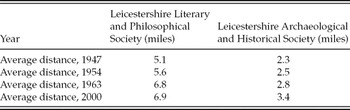
In each case studied, suburban participants made up a substantial percentage of the participatory rate, but another area of interest was whether or not this changed over time. Table 2 provides the average residential distance of members of two more organizations, the Leicester Archaeological and Historical Society and the Leicestershire Literary and Philosophical Society, in four separate time periods. The table provides the data for the organizations omitting all distances over 50 miles. In both organizations the average distance that a member lived from the urban core lengthened between 1947 and 2004, showing an increasing suburban commute. Additionally, in terms of our definition of a ‘suburb’ as three miles from the city centre, these results emphasize the importance of satellite villages and local towns when considering the residential location of members. Overall, their numbers account for an overwhelming share of membership numbers and show that in many cases, despite a desire to live increasing distances from the urban centre, residents often continued to cultivate existing or older connections with the urban core.
Average distance of organization members in Leicester, 1947–2000

Source: Data obtained from private archive collections, including address books and transaction papers for each organization.
These conclusions are supported visually by the geo-coded mapping of membership. Considering Figures 2 and 3 comparatively it becomes evident that a migration from the urban core continued throughout the twentieth century, with suburban participants increasingly pushing the urban boundary in their quest for the semi-rural ideal. Clearly, the middle classes had chosen to distance themselves geographically from the city centre, but the membership records of the Leicestershire Archaeological and Historical Society also show that relocation to suburbia did not necessarily mean they were devoid of interest in the city; seemingly, the suburbans were ‘semi-detached’, culturally and socially, with many still connected to the city centre, engaging in associational communities and contributing to the town and stock of social capital through civic engagement. The maps show that in 1947 approximately 45 per cent of the Archaeological and Historical Society already resided in an outer suburb, surrounding satellite village or nearby town; by 2004, it had grown to a 72 per cent share of the membership. Scholars have suggested that associational life has the power to envelop citizens with a sense of security that comes from community and belonging. In this way, participants form the organizational basis of a democratic culture and its social networks of communication. In short, ‘voluntary associations create the bonds of social solidarity that are the basis for civil society and democracy’.Footnote 68 Clearly, members of the Leicestershire Archaeological and Historical Society were prepared to travel considerable distances back to the urban core to belong to an organization which potentially had the power to create a sense of community and belonging. The increasing geographical spread of associational participants in terms of chronology was not unique to the Archaeological and Historical Society. For example, suburban membership in the Leicestershire Literary and Philosophical Society continued to influence the demographic makeup of the organization throughout the latter years of the twentieth century: in 1954, the percentage share of members residing in fringe areas or satellite villages totalled 17 per cent; by 2000, this number had increased to 47 per cent. Whilst the percentage of suburban participation was not as high as the Archaeological and Historical Society's share, the steady increase in ‘suburban’ interest was apparent. Comparatively, the geographical spread of membership within the county also mirrored the behaviour of the Archaeological and Historical Society with residential locations reaching as far as Hinckley and Melton Mowbray, distances of 15 and 18 miles respectively. Therefore, through the chronological analysis of two organizations in Leicester, it is apparent that both the plotted addresses and the quantitative data support the conclusion that suburban participation in associational life not only continued during the period 1950 to 2005 but increased considerably, pushing the urban boundary further into the rural fringes. Such conclusions support Trainor's perception of an ‘increasingly secure middle-class identity which had roots in social activity’ in the twentieth century.Footnote 69
Residential distribution of members of the Leicestershire Archaeological and Historical Society, 1947 Source: Data obtained from the transaction papers of the Leicestershire Archaeological and Historical Society (ROLLR).

Residential distribution of members of the Leicestershire Archaeological and Historical Society, 2004 Source: Data obtained from private archive collection of the Leicestershire Archaeological and Historical Society.

This article has attempted to survey the existing literature available on both the process of suburbanization in Britain and the portrayal of middle-class, suburban detachment. Through an understanding of the America research agenda, it has also attempted to provide an example of the ways in which our understanding of British suburbia post-1950 can be revised. Through the examination of associational activity – traditionally as closely connected to middle-class identity as suburbanization itself – an alternative interpretation of suburban participation becomes evident. Far from disconnecting with the urban core, the ‘suburbans’ in Leicester appeared to create a ‘semi-detached’ lifestyle; one that allowed them to embrace the tranquillity of suburban living whilst remaining connected to the city centre through the strong ties of social engagement.
How far their involvement contributed to an active civil society during the latter years of the twentieth century is, however, beyond the scope of this article.Footnote 70 Certainly, the wealth of records generated by local clubs and societies in Leicester suggests that the associational sphere remained an integral part of urban affairs at the turn of the twenty-first century. It is important to note, however, that the aim of the article is not to suggest that all middle-class ‘suburbans’ were actively engaged at the urban core; on the contrary, it suggests that an examination of various towns and cities is required in order to determine whether Leicester is the exception. In general, the suburban narrative in Britain requires more in-depth studies of different types of cities and towns, as well as suburban areas and, in this context, voluntary organizations. For example, does the size of a city, as well as its economic and social heritage, affect patterns of suburban engagement? And do similar types of networks exist within the New Towns of the post-war period? In addition, whilst this article has examined networks between the urban core and the suburbs, it also acknowledges the importance of analysing the numerous organizations within suburban locations themselves. In-depth oral history projects and longitudinal studies in particular have the potential to determine how suburban residents perceive notions of community and whether it is connected to the links constructed through associational activity or the bonds of neighbourhood. Only by adopting a revised approach to our understanding of the variations in suburban experience will we begin to appreciate the overall impact of suburbanization on contemporary patterns of social engagement. As Corbin Sies suggests, only by gaining a flavour of the cultural life of suburban residents will we begin to move away from the harmful stereotypes that have so far engulfed the suburban narrative.Footnote 71