According to the fundamental difference hypothesis (FDH; Bley-Vroman, Reference Bley-Vroman, Gass and Schachter1989, Reference Bley-Vroman1990), adult SLA differs from child first language (L1) acquisition in a number of respects. These differences are attributed to the nonavailability of domain-specific language acquisition mechanisms and Universal Grammar (UG) for adult second language (L2) learning, in contrast to child language acquisition. An implication of this approach is that the outcome of SLA, the interlanguage grammar, is not inevitably UG-constrained. However, recognizing that adult L2 learners are often successful in the acquisition of subtle properties underdetermined by the input and not explicitly taught (i.e., assumed to derive from UG), the FDH posits that this kind of knowledge must come from the L1. In other words, the native language exemplifies linguistic universals (by definition) and can be used, in some sense, to reconstruct some aspects of—or build a surrogate for—UG (Bley-Vroman, Reference Bley-Vroman, Gass and Schachter1989). Such reconstruction is necessarily restricted to “the most obvious large-scale characteristics of the native language” (Bley-Vroman, Reference Bley-Vroman, Gass and Schachter1989, p. 52).
In part as a response to this line of argument, researchers (e.g., White, Reference White1985, Reference White, Flynn and O’Neill1988) who sought to demonstrate that UG is in fact available (in addition to supporters of the FDH [e.g., Schachter, Reference Schachter, Gass and Schachter1989, Reference Schachter1990], who had the opposite goal in mind) conducted studies in which two conditions were held constant (White, Reference White1990): (a) The phenomenon under investigation constituted a learnability or poverty-of-the-stimulus problem in that it could not be readily induced from the L2 input or learned on the basis of instruction and thus motivated an explanation in terms of UG; (b) the universal principle under investigation did not operate in the L1, or the L1 and L2 differed with respect to parameter settings. Under these two conditions, the FDH predicts failure (i.e., principles of UG will be violated; L2 parameter settings will not be acquired), whereas proponents of UG access predict success (i.e., principles of UG will be observed; L2 parameter settings will be acquired).
Along these lines, constraints on wh-movement have frequently been adopted as a test case to verify whether interlanguage grammars are UG-constrained. Several L2 studies investigated knowledge of the subjacency condition (Chomsky, Reference Chomsky, Anderson and Kiparsky1973) in the interlanguage grammars of L2 learners whose L1s leave wh-phrases in their thematic position and thus apparently lack wh-movement. In other words, these learners could not rely on the L1 to construct adequate surrogates for the relevant UG constraints on wh-movement. Results in some cases suggest that adult L2 learners are quite inaccurate at rejecting subjacency violations, which supports claims for the nonavailability of UG—in other words, the FDH (e.g., Johnson & Newport, Reference Johnson and Newport1991; Schachter, Reference Schachter, Gass and Schachter1989, Reference Schachter1990)Footnote 1—whereas other studies report success as far as subjacency is concerned (e.g., White & Juffs, Reference White, Juffs, Flynn, Martohardjono and O’Neil1998).
In the debate for or against UG in SLA, arguments are dependent on the presumed nature of UG itself. Attempts to account adequately for subjacency effects mirror the development of linguistic thought over the years: Linguists originally identified a set of isolated conditions (Chomsky, Reference Chomsky1964; Ross, Reference Ross1967) and then moved toward a more unified and principled account (e.g., Uriagereka, Reference Uriagereka, Epstein and Hornstein1999). Such changes in linguistic theory may necessitate the revision of assumptions about the role of the L1 and what L2 learners can or cannot acquire. Here, we discuss changes in theoretical accounts of how wh-movement is constrained and implications of these changes for theories of SLA.
Discussion of the implications for L2 research of ongoing changes to linguistic theory is not new. Poverty-of-the-stimulus problems crucially motivate a role for UG and remain constant regardless of changes in the formulation of principles proposed to account for acquisition (e.g., Schwartz & Sprouse, Reference Schwartz, Sprouse and Archibald2000; White, Reference White, Eubank, Selinker and Sharwood Smith1995). This is the case for constraints on wh-movement. At the same time, several researchers (Dekydtspotter, Sprouse, & Anderson, Reference Dekydtspotter, Sprouse and Anderson1997; Hale, Reference Hale1996; White, Reference White, Eubank, Selinker and Sharwood Smith1995) have noted that, under Minimalism (Chomsky, Reference Chomsky1995), computational principles such as move and merge are assumed to be invariant (therefore, universal) and locality phenomena are exemplified in all languages, making it difficult—if not impossible—to disentangle L1 effects from UG effects. In the case of wh-movement, we will conclude that even when L2 learners are found to be successful in surmounting learnability problems, it may be impossible to determine whether such success is attributable to UG alone, to the L1 alone, or to some combination of the two. However, although the FDH and UG-access accounts seem to overlap in their attribution of a role to the L1, these approaches can be distinguished based on the nature of L1 transfer allowed by each.
ISLANDS VERSION 1: ISLANDS AND CONSTRAINTS
Wh-movement in English has long been observed not to be free but, rather, circumscribed or bounded (bounding theory; Chomsky, Reference Chomsky1981). Certain circumstances have been identified in which wh-movement can take place and others in which it is prohibited, as illustrated in (1)–(7). Examples (1b) and (2b) are grammatical: Wh-movement takes place from a matrix clause and an embedded clause, respectively. In contrast, the ungrammatical sentences in (3b)–(7b) involve extraction from a variety of embedded constituents, referred to as islands (Ross, Reference Ross1967).
(1) a. This girl danced with Mark.
b. Who did this girl dance with ?
(2) a. You said that this girl danced with Mark.
b. Who did you say that this girl danced with ?
(3) a. You wondered whether this girl danced with Mark.
b. *Who did you wonder whether this girl danced with ?
(4) a. You spread a rumor that this girl danced with Mark.
b. *Who did you spread a rumor that this girl danced with ?
(5) a. You met a girl that danced with Mark.
b. *Who did you meet a girl that danced with ?
(6) a. That this girl danced with Mark annoyed you.
b. *Who did that this girl danced with annoy you?
(7) a. You met this girl after she danced with Mark.
b. *Who did you meet this girl after she danced with ?
Acquisition of knowledge of this kind of ungrammaticality, it is assumed, constitutes a learnability problem: The relevant information is not available in the naturalistic input to which the language learner is exposed. L1 (or L2) learners will come across numerous examples of grammatical wh-movement and could reasonably infer (contrary to fact) that wh-movement is free. Instead, language acquirers must come to know that, in certain situations, movement is not possible.
Early explanations of learners’ avoidance of such ungrammaticality were couched in terms of built-in, or innate, principles: Universal constraints that the learner does not have to acquire assist in the acquisition of wh-movement. Proposed constraints included the following: (a) the wh-island constraint (Chomsky, Reference Chomsky1964), which prohibits the movement of wh-elements out of an embedded clause introduced by another wh-phrase, as illustrated in (3b); (b) the complex noun phrase (NP) constraint (Ross, Reference Ross1967), which bans extraction out of the sentential complements of nouns (Ns) or relative clauses, as illustrated in (4b) and (5b), respectively; (c) the subject condition (Chomsky, Reference Chomsky, Anderson and Kiparsky1973), which excludes extraction from a subject, as illustrated in (6b); and (d) the adjunct island condition (Huang, Reference Huang1982a), which prohibits extraction out of an adjunct phrase, as illustrated in (7b). The effect of these constraints is to stipulate that certain constituents form islands from which wh-phrases cannot escape. Such disparate constraints were brought together under the subjacency condition (Chomsky, Reference Chomsky, Anderson and Kiparsky1973), a simplified version of which is provided in (8). The rationale for this principle was to capture the different kinds of islands in a uniform way.
(8) The subjacency condition: A constituent may not move over more than one bounding category at a time.
Bounding nodes were originally proposed to be sentence (S) and NP (now inflection phrase [IP] and determiner phrase [DP], respectively). As an illustration of how the subjacency condition predicts the contrast between the grammatical sentence illustrated in (2b) and the ungrammatical sentence illustrated in (4b), these sentences are repeated in (9) with the relevant bracketing (with trace [t] marking the various positions of the wh-phrase in the course of the derivation). Crucially, long-distance movement must be cyclic; it takes place by means of a series of shorter, local movements. In (9a), wh-movement crosses just one bounding node (IP) at a time, and the sentence is permitted. In (9b), however, wh-movement crosses two bounding nodes—DP and IP—in its second submovement, which yields ungrammaticality. Similarly, the other ungrammatical cases involve movements that cross more than one bounding node at a time.Footnote 2
(9) a. Whoi did IP [you say CP[ tithat IP[this girl danced with ti]]]?
b. *Whoidid IP[you spread DP[a rumor CP[ tithat IP[this girl danced with ti]]]]?
L2 ACCOUNTS BASED ON EARLIER LINGUISTIC ACCOUNTS
Many of the earlier studies of UG principles in SLA adopted a version of the subjacency condition as their test case. These studies (Bley-Vroman, Felix, & Ioup, Reference Bley-Vroman, Felix and Ioup1988; Johnson & Newport, Reference Johnson and Newport1991; Li, Reference Li, Flynn, Martohardjono and O’Neil1998; Schachter, Reference Schachter, Gass and Schachter1989, Reference Schachter1990; White & Juffs, Reference White, Juffs, Flynn, Martohardjono and O’Neil1998) focused on the acquisition of English (a language with wh-movement) as the L2. The learners had L1s in which wh-questions are formed without wh-movement (i.e., wh-in-situ languages) such as Chinese, Japanese, or Korean. Examples of Chinese wh-questions are provided in (10). Due to the lack of wh-movement in such languages, subjacency does not operate because there is no movement to constrain.Footnote 3 In fact, the Chinese equivalents of many sentences that would be subjacency violations in English are grammatical, as illustrated in (10c).
(10) a. ni xihuan shei?
you like who
“Who do you like?” (Huang, Reference Huang1982b, p. 370)
b. Zhangsan xiangxin shei mai-le shu?
Zhangsan believe who buy-asp books
“Who does Zhangsan believe bought books?” (Huang, p. 371)
c. ni xiang-zhidao shei mai-le shenme?
you wonder who buy-asp what
“What is the thing such that you wonder who bought it?”
(cf. *“What do you wonder who bought?”) (Huang, p. 382)
Implicit in this choice of L1s is the assumption of a wh-movement parameter, in which the L2 (English) adopts the [+wh movement] value and the L1 (Chinese, Japanese, or Korean) adopts the [–wh movement] value (see Crain & Lillo-Martin, Reference Crain and Lillo-Martin1999). In Minimalist accounts (e.g., Chomsky, Reference Chomsky1995), this parameter takes the form of differences in the strength of a question (Q)-feature in complementizer (C) position. In [+wh movement] languages, the value of the Q-feature is strong, which triggers overt movement of the wh-phrase to the specifier of the complementizer phrase [Spec, CP] for feature-checking purposes. In [–wh movement] languages, the Q-feature is weak, which results in covert movement at logical form (LF).
Second language learners of English who are native speakers of wh-in-situ languages are faced with the same underdetermination problem as children who acquire English as a L1: The English input will include examples of grammatical cases of movement but no information about ungrammaticality.Footnote 4 L2 learners, then, have to acquire subtle phenomena (i.e., constraints on wh-movement) not obvious from the L2 input and not derivable from the L1, a situation that meets the two requirements for the evaluation of the FDH against the UG-access approach.Footnote 5
Although the exact formulation of the relevant constraint(s) has been constantly changing, the idea has always been that such a constraint should be universal, even though languages that lack wh-movement, such as Chinese, Japanese, or Korean, presumably do not make use of it. Consequently, if interlanguage grammars are constrained by UG, the effects of subjacency are predicted to be observed in the grammars of L2 learners acquiring a wh-movement language like English, regardless of whether their L1s employ wh-movement. L2 learners, then, should recognize the ungrammaticality of sentences that violate subjacency. In other words, if UG is still effective in SLA, once learners realize that the L2 employs wh-movement, they should be able to reject subjacency violations, in spite of the apparent learnability problem and the differences between the L1 and the L2 with respect to wh-constructions.
In contrast, according to the FDH, L2 learners whose L1 lacks wh-movement will not have access to UG (either directly or indirectly) and thus are expected to fail to observe constraints on wh-movement. In other words, subjacency violations should be accepted as grammatical by L2 learners, which would indicate that their grammars do not fall within the range determined by UG (i.e., that interlanguages are not natural languages).
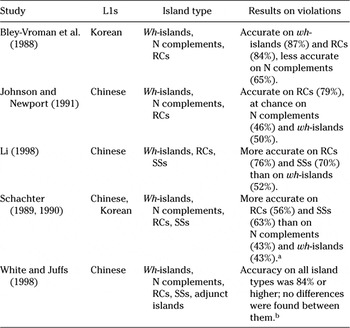
Earlier L2 studies that adopted this kind of logic and assumed this version of island constraints include Bley-Vroman et al. (Reference Bley-Vroman, Felix and Ioup1988), Johnson and Newport (Reference Johnson and Newport1991), Li (Reference Li, Flynn, Martohardjono and O’Neil1998),Footnote 6 Schachter (Reference Schachter, Gass and Schachter1989, Reference Schachter1990), and White and Juffs (Reference White, Juffs, Flynn, Martohardjono and O’Neil1998), among others.Footnote 7 These studies, summarized in Table 1, have several common themes: (a) They include L2 learners with wh-in-situ L1s;Footnote 8 (b) they investigate several of the island constraints subsumed under subjacency; and (c) they generally demonstrate that, overall, L2 performance on subjacency violations is less accurate than performance on equivalent grammatical sentences as well as less accurate than native-speaker performance, which arguably supports the FDH (but see Martohardjono, Reference Martohardjono1993). However, learners in these studies treat the various islands differently: It is not the case that all violations are recognized equally.
Comparison of previous L2 studies

Note
RC = relative clause; SS = sentential subject.
a These results are from the Korean subjects in the 1990 study.
b These results are from the group of Chinese speakers tested in China.
In sum, considerable variation is found in the degree of accuracy with which L2 learners recognize subjacency violations. However, this variation can, in part, be attributed to methodological differences.Footnote 9 On the basis of their results, Schachter (Reference Schachter, Gass and Schachter1989, Reference Schachter1990) and Johnson and Newport (Reference Johnson and Newport1991) concluded that adult L2 learners do not have (full) access to UG: Learners acquire wh-movement but fail to observe the constraints that govern it; that is, these results support the FDH. Bley-Vroman et al. (Reference Bley-Vroman, Felix and Ioup1988) were more cautious and argued that their learners performed at a level much higher than chance, which suggests, possibly, that UG operates in an attenuated form. In contrast, White and Juffs (Reference White, Juffs, Flynn, Martohardjono and O’Neil1998) and Li (Reference Li, Flynn, Martohardjono and O’Neil1998) argued that their results support the claim that interlanguage grammars are constrained by UG.
One line of response to results that report failure to reject violations (e.g., White, Reference White, Goodluck and Rochemont1992) has been to point out that learners may not have acquired wh-movement (yet). Before it can be determined whether island constraints are operative in the interlanguage grammar, it is necessary to establish that wh-movement has in fact been acquired; that is, the [±wh movement] parameter has to be reset before the principle can come into play. Most of the studies summarized in Table 1 were conducted under the assumption that the [+wh movement] value had been acquired; in some cases, grammatical wh-questions were included to establish this point. However, it is conceivable that learners might form English wh-questions without wh-movement. Two different analyses of this type have been proposed. One analysis suggested that L2 learners form wh-questions by means of topicalization of a wh-phrase, with the topic linked to a null pronoun, which conforms to the topicalization possibilities allowed by their L1s (Hawkins & Chan, Reference Hawkins and Chan1997; Martohardjono & Gair, Reference Martohardjono, Gair and Eckman1993; White, Reference White, Goodluck and Rochemont1992). An alternate analysis suggested that L2 learners form English wh-questions by means of scrambling, a possibility allowed in Japanese (Hawkins, Reference Hawkins2001, Reference Hawkins, Dekydtspotter, Sprouse and Liljestrand2005; Hawkins & Hattori, Reference Hawkins and Hattori2006).Footnote 10 The Japanese examples in (11) show the contrast between wh-in-situ, in which the wh-phrase nani “what” stays in its thematic position, and scrambling, as illustrated in (11a) and (11b), respectively. The fact that scrambling is not subject to subjacency explains why L2 learners produce what look like English wh-questions but fail to reject subjacency violations.Footnote 11
(11) a. John-ga kinou nani-o kaimashita ka?
John-nom yesterday what-acc buy-past q
“What did John buy yesterday?”
b. nani-o John-ga kinou kaimashita ka?
what-acc John-nom yesterday buy-past q
“What did John buy yesterday?” (Hawkins, Reference Hawkins, Dekydtspotter, Sprouse and Liljestrand2005, p. 130)
Umeda (Reference Umeda, Brugos, Clark-Cotton and Ha2005, Reference Umeda, Deen, Nomura, Schulz and Schwartz2006) argued against this approach through the investigation of related phenomena to determine whether L1 Japanese learners represent English wh-questions in terms of true wh-movement, topicalization, or scrambling. She looked at three phenomena associated with true wh-movement—namely, scope freezing, reconstruction, and weak crossover. Topicalization in Japanese does not show reconstruction or weak crossover effects, whereas scrambling does not show scope freezing or weak crossover. Umeda (Reference Umeda, Deen, Nomura, Schulz and Schwartz2006) found that L2 learners display knowledge of scope freezing, reconstruction, and weak crossover, which suggests true wh-movement. Moreover, Umeda (Reference Umeda, Brugos, Clark-Cotton and Ha2005) found that although a minority of learners exhibited behavior consistent with a topicalization analysis, no learners behaved in a manner consistent with scrambling.
Next, we will focus on the inconsistencies found across the different types of subjacency violations. Such inconsistencies are not predicted by either the FDH or the UG-access approach. Under the original formulation of subjacency, all violations should be treated in the same way. In other words, learners should either recognize all of the violations or none of them. These inconsistencies are better understood under subsequent formulations of island constraints.
ISLANDS VERSION 2: CONDITIONS ON EXTRACTION DOMAINS AND BARRIERS
The subjacency condition, as formulated by Chomsky (Reference Chomsky, Anderson and Kiparsky1973), turned out to be both too strong and too weak; for example, some sentences that should be ruled out are grammatical, and some sentences that are ungrammatical are not ruled out. In the case of (12a), the sentence is grammatical even though a DP and an IP have been crossed; in the case of (12b), the sentence is ungrammatical—involving extraction from an adjunct—but only one bounding node has been crossed (viz. the IP).
(12) a. [Which city]idid IP[you witness DP[the destruction of ti ]]?
b. *[Which city]idid IP[you visit Paris PP[before ti]]?
Furthermore, crosslinguistic differences were uncovered; for instance, extractions from wh-islands are acceptable in languages like Italian, French, and Hebrew. In consequence, it was proposed that there must be parametric differences in bounding nodes, with some languages having S’ (now CP) as a bounding node instead of S (or IP; Rizzi, Reference Rizzi1982; Sportiche, Reference Sportiche1981); alternatively, an extra landing site was proposed (Reinhart, Reference Reinhart, Belletti, Brandi and Rizzi1981). In short, the subjacency condition as formulated by Chomsky (Reference Chomsky, Anderson and Kiparsky1973) turned out to be far from universal; it held neither crosslinguistically nor for all extractions in English. As a result, revisions were proposed to account for island phenomena.
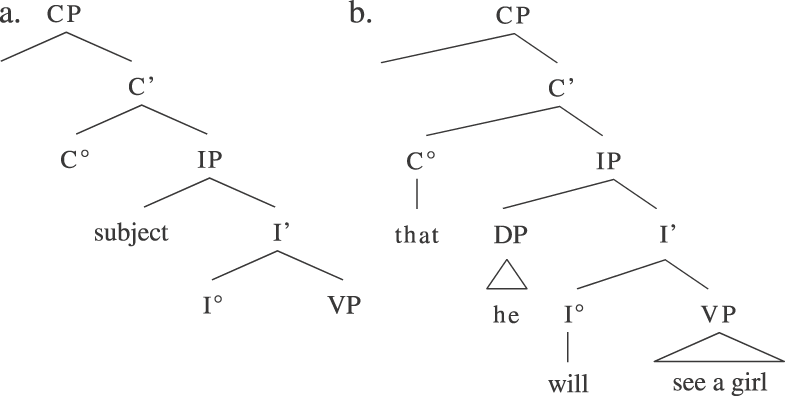
Another attempt to unify some of the original island constraints was the condition on extraction domains (CED) proposed by Huang (Reference Huang1982a; see also Cattell, Reference Cattell1976), which united the subject condition and the adjunct island condition, on the basis of the fact that subjects and adjuncts are not governed by lexical categories.Footnote 12 In brief, a lexical head governs a phrase if no maximal projection (i.e., phrasal node) intervenes between them. Accordingly, subjects, which occur as constituents in [Spec, IP], are not lexically governed because the CP normally blocks government by a lexical head from above, whereas the verb phrase (VP) blocks it from below, as illustrated in (13). Similarly, adjuncts are not lexically governed because they are adjoined; that is,
(13)

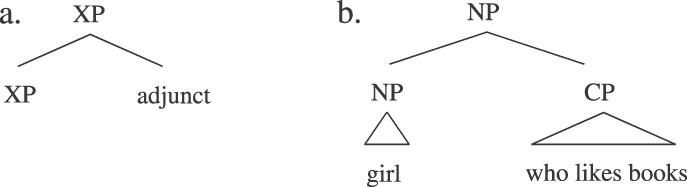
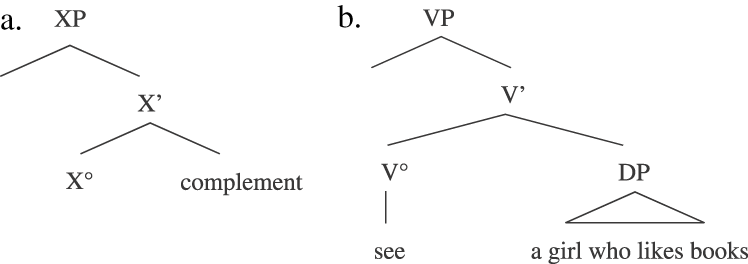
they are positioned between two layers of the same maximal projection, as illustrated in (14). In other words, the CED approach distinguishes between complements, which are necessarily governed by the lexical head that assigns them a thematic role (theta-marking), as illustrated in (15), and noncomplements, which are the only true islands. The trees in (13a), (14a), and (15a) show the relevant structural configurations; (13b), (14b), and (15b) illustrate how such configurations can be implemented.
(14)
(15)
Few L2 studies have been conducted with the CED as the principle under investigation (but see Martohardjono, Reference Martohardjono1993); however, many of Huang’s (Reference Huang1982a) insights were incorporated by Chomsky (Reference Chomsky1986a) into the Barriers framework.
The system described in Barriers (Chomsky, Reference Chomsky1986a) was one attempt to overcome some of the shortcomings of earlier formulations and to explain various different subtheories of grammar—such as the empty category principle (ECP) and subjacency—in the same way.Footnote 13 One consequence was a revised definition of subjacency, which involved barriers and blocking categories rather than bounding nodes and incorporated the notion of government as well as the idea of degrees of grammaticality. Barriers are relative rather than absolute, in contrast to bounding nodes. Every maximal projection is a potential barrier depending on the circumstances: To become an actual barrier, the maximal projection either must not be theta-governed (i.e., a blocking category) or must be the first maximal projection to dominate a blocking category (hence, a barrier by inheritance). A distinction was made between stronger and weaker islands, determined by the number of barriers that had to be crossed to escape from the island: Crossing one barrier gave rise to a weak subjacency violation, whereas crossing a barrier along with a violation of the ECP or crossing two barriers caused a greater reduction in acceptability, as in (16). Extractions out of subjects and adjuncts always result in strong violations, whereas weak islands are complements (of verbs [Vs] or Ns).
(16) a. Strong islands: subjects, adjuncts (including relative clauses)
b. Weak islands: wh-islands, N complementsFootnote 14
Under the Barriers system (Chomsky, Reference Chomsky1986a), the extraction in (12b), repeated in (17b), arguably crosses two barriers. The prepositional phrase (PP) before which city is an adjunct and thus a barrier; under the assumption that adjuncts are adjoined to VP, IP is the second barrier (by inheritance). In contrast, the extraction in (12a), repeated in (17a), does not cross any barrier because the NP the destruction of which city is theta-governed by the V witness.
(17) a. [Which city]idid IP[you witness DP[the destruction of ti ]]?
b. *[Which city]idid IP[you visit Paris PP[before ti]]?
This distinction between strong and weak islands allowed a fresh look at what might be expected in SLA given that L2 learners do not treat all subjacency violations alike. They are more accurate at recognizing some types of violations than others: For the most part, strong violations are recognized as such, whereas weak ones may not be. Johnson and Newport’s (Reference Johnson and Newport1991) L2 learners performed above chance on extractions out of relative clauses (which are strong violations) and at chance on extractions out of noun complements and wh-islands (which are weak violations). Although they were quite inaccurate overall, the L2 learners studied by Schachter (Reference Schachter, Gass and Schachter1989, Reference Schachter1990) were better at rejecting extractions out of relative clauses and subjects (i.e., strong violations) than out of noun complements and wh-islands (i.e., weak violations). Bley-Vroman et al.’s (1988) L2 learners were more accurate on ungrammatical extractions from relative clauses (i.e., strong violations) than from noun complements (i.e., weak violations). It is interesting to note that these learners were also accurate on wh-islands, which are weak violations. Li’s (Reference Li, Flynn, Martohardjono and O’Neil1998) L2 learners were more accurate on ungrammatical extractions from relative clauses and sentential subjects (i.e., strong violations) than from wh-islands (i.e., weak violations). In the case of White and Juff’s (1998) study, L2 learners generally performed more accurately than learners in the other studies: Almost all violations tested were strong. Additionally, Hawkins and Chan (Reference Hawkins and Chan1997) reported that their Chinese speakers were inaccurate on subjacency violations, although this can be explained by the fact that their test sentences were restricted to extractions out of wh-islands and noun complements (i.e., weak violations). Similarly, those sentences relevant to subjacency in the study by Hawkins and Hattori (Reference Hawkins and Hattori2006) involved wh-island violations only.
Indeed, Martohardjono (Reference Martohardjono1993) showed that L2 learners’ differential treatment of various types of ungrammatical extractions falls out from Chomsky’s (Reference Chomsky1986a) Barriers system. She argued that if L2 learners exhibit a higher rate of rejection for stronger violations than for weaker violations, such linguistic behavior must stem from their knowledge of the relevant UG principles. Martohardjono provided further support for the claim that L2 learners are more sensitive to strong violations (i.e., relative clauses, clausal adjuncts, sentential subjects) than weak (i.e., sentential complements of nouns, wh-islands). She tested L2 learners whose native languages differed with respect to syntactic movement: Indonesian (no syntactic movement, according to Martohardjono), Chinese (syntactic movement in relative clauses only, following Huang, Reference Huang1982a), and Italian (no wh-island effect).Footnote 15 Crucially, all L1 groups treated the two types of violations differentially, but, most importantly, Indonesian and Chinese speakers rejected strong violations 87% and 76% of the time, respectively, whereas the rejection rate for weak violations was significantly lower (42% and 38%, respectively).
As Schwartz and Sprouse (Reference Schwartz, Sprouse and Archibald2000) pointed out, this difference in degree of ungrammaticality constitutes a poverty-of-the-stimulus situation: Neither strong nor weak violations are heard in the input and neither kind is possible in the L1, yet learners showed sensitivity to this distinction. In other words, L2 learners’ superior performance on strong violations supports the claim for UG access and suggests sensitivity to degrees of grammaticality, as realized in terms of barriers. However, proponents of the FDH (e.g., Bley-Vroman, Reference Bley-Vroman, Gass and Schachter1989, Reference Bley-Vroman1990) might legitimately claim that L2 learners should perform better on weak violations than they actually do: After all, extraction from weak islands is still ungrammatical, although to a lesser extent than extraction from strong islands. If weak violations are prohibited by the same mechanisms as strong violations (although involving fewer barriers), the fact that so many L2 learners have problems in even identifying weak violations as ungrammatical would seem to be unexpected on a UG account. Next, we will suggest that an alternate formulation of island constraints makes better sense theoretically and provides better empirical coverage of the L2 data. This alternate formulation no longer covers some of the original constraints subsumed by subjacency, making it less surprising that many L2 learners fail to recognize certain sentence types as ungrammatical.
ISLANDS VERSION 3: MINIMALISM
The Barriers system (Chomsky, Reference Chomsky1986a) did not survive long, on theoretical grounds. In Chomsky’s (Reference Chomsky1995) words, this system lacked “the generality and clarity that we would hope to find in an explanatory theory of language” (p. 89). When the Barriers system was challenged by Minimalism (Chomsky, Reference Chomsky1995), the idea was that the highly articulated theoretical machinery associated with a “rich UG” (Bley-Vroman, this issue, p. 182) should be minimized as much as possible: Ideally, a principled explanation would be found for any previously stipulated components of UG. In particular, UG principles should not be formulated as arbitrary substantive statements but should be derived from general considerations of economy, interface conditions, and so forth. Although Chomsky’s approach (1986a) to island phenomena has been abandoned, insights about what L2 learners might be doing are, in our opinion, not necessarily lost.
Based, in part, on the CED (Huang, Reference Huang1982a), the formulation in (18) has been proposed as a universal constraint on extraction that prohibits movement out of noncomplements crosslinguistically (Horvath & Siloni, Reference Horvath, Siloni and Falk2003; Müller, Reference Müller2007; Nunes & Uriagereka, Reference Nunes and Uriagereka2000; Sabel, Reference Sabel2002). This formulation unifies the fact that subjects and adjuncts are universally islands (e.g., in contrast to wh-islands).Footnote 16
(18) Revised CED: Wh-movement cannot take place out of a structural noncomplement.Footnote 17
This revised constraint on extraction is very basic and relies only minimally on any particular theoretical assumption (e.g., government is not involved). UG-access models that assume the revised CED rather than the Barriers system (Chomsky, Reference Chomsky1986a) would still predict differential treatment of strong versus weak violations by L2 learners. However, weak violations will now have to stem from independent factors: Thus, poor performance on weak violations is not necessarily unexpected.
Because the revised CED is still an arbitrary substantive statement, we will briefly outline how this version of island constraints can be derived from more general principles and on more solid conceptual grounds, along the lines of Uriagereka’s (Reference Uriagereka, Epstein and Hornstein1999) multiple spell-out system. The starting point of the multiple spell-out system was a linearization requirement. Although the computational system requires hierarchical structure (visualized as trees in the linguistic tradition), human articulatory and auditory systems are unable to produce and perceive hierarchical relations; instead, these systems can only deal with linear sequences of words. Because the output of the grammar must interface with the articulatory and perceptual systems, hierarchical phrase structure has to be transformed into a flat sequence of terminal nodes (Nunes & Uriagereka, Reference Nunes and Uriagereka2000).
Another assumption is that derivation proceeds in a bottom-up fashion. In the case of complements, already-assembled constituents are merged with the heads that select them, which is illustrated in (19). Structure is built up recursively, so that a phrase (the NP girl) is first merged with its selecting head (the determiner [D] a) and is then completed into a new phrase (the DP a girl) that is subsequently merged with its selecting head (the V see), which is then completed into a yet larger phrase (the VP see a girl) and so forth. In contrast, subjects and adjuncts are phrases that are not selected by heads, and, therefore, they must be assembled in parallel with the pivotal complement structure, in order to be “plugged in” (Nunes & Uriagereka, Reference Nunes and Uriagereka2000, p. 23) later where they belong.
(19)
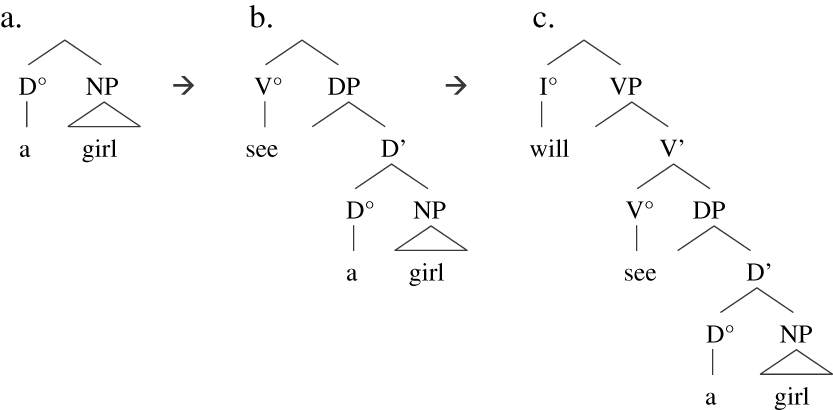
The late insertion of subjects and adjuncts makes their internal structure invisible to the computational system; that is, no phrase can be extracted out of a subject or an adjunct. Returning to linearization, once a phrase leaves its derivational workspace, it is transformed into a flat sequence of words: Because subjects and adjuncts get assembled separately from the rest of the structure (i.e., in a separate derivational workspace), they are necessarily linearized before they are merged into the main structure, as illustrated in (20). In consequence, the computational system can still see subjects and adjuncts and manipulate them if needed (e.g., subjects and adjuncts can be moved as chunks). Crucially, it cannot see into subjects and adjuncts: Once they have undergone linearization, the constituent parts of subjects and adjuncts are no longer there and thus cannot be extracted.
(20)

In short, strong islands are covered by the revised CED, itself derived from more general principles operative in every language. Crucially, the multiple spell-out system remains complex and exclusive to language, thus unable to be recovered by domain-general reconstruction restricted to “obvious large-scale characteristics” (Bley-Vroman, Reference Bley-Vroman, Gass and Schachter1989, p. 52). In other words, if native speakers of wh-in-situ languages respect the revised CED in the acquisition of a L2 that employs wh-movement, this suggests that SLA must indeed be “integrat[ed] into a specialized language faculty” (Bley-Vroman, this issue, p. 180).
In sum, the L2 data are largely consistent with the claim that L2 learners observe the revised CED: The ungrammaticality of weak islands is now assumed to be derived from independent factors. Hence, the fact that L2 learners do less well on weak island violations is not surprising.
WEAK ISLANDS
Islands not accounted for under Uriagereka’s (Reference Uriagereka, Epstein and Hornstein1999) multiple spell-out system (viz. wh-islands and clausal complements of nouns) must receive an alternate explanation. First, at least some (Stowell, Reference Stowell1981)—or perhaps all (Grimshaw, Reference Grimshaw1990)—clausal complements of nouns behave like adjuncts according to many diagnostics, so that their status (as either complements or adjuncts) is not obvious. Second, ungrammaticality of extraction out of wh-islands in English can be attributed to parametric variation related to either (un)availability of an extra landing site (Reinhart, Reference Reinhart, Belletti, Brandi and Rizzi1981) or the nature of an additional barrier (Chomsky, Reference Chomsky1986a, building on Rizzi, Reference Rizzi1982). At least in the case of wh-islands, determining the status of extractions out of weak islands appears to require actual input-driven learning of certain properties of the target grammar rather than reliance on principles already operative in the L1 or available through UG.
In the case of clausal complements extracted out of nouns, Chomsky (Reference Chomsky1986a), among others, noted that such extraction results in milder ungrammaticality compared with extraction out of relative clauses, as illustrated by the comparison of (21a) and (21b) with (21c).
(21) a. ?*Which book did John hear [a rumor [that you had read t]]?
b. ?Which book did John announce [a plan [(for you) to read t]]?
c. *Which book did John meet [a child [who read t]]? (Chomsky, Reference Chomsky1986a, p. 35)
Recall that relative clauses are not complements, but adjuncts that modify the head noun; hence, the ungrammaticality of (21c) is accounted for by either the Barriers framework (due to a strong island; Chomsky, Reference Chomsky1986a) or under the revised CED (as a noncomplement). The ungrammaticality of extraction from noun complements as illustrated in (21a) and (21b), in contrast, is not readily explained within the Barriers system because wh-movement out of a clausal complement to a noun crosses no barrier. In other words, such sentences should be fully grammatical, but this is not the case.
In an attempt to account for the intermediate status of such extractions, Chomsky (Reference Chomsky1986a) speculated that nouns never truly govern their complement position for several reasons. First, nouns assign an oblique inherent case (Chomsky, Reference Chomsky1986b), which results in the insertion of the dummy preposition of when the complement of the N is NP, as illustrated in (22). Although of-insertion does not occur with clausal complements, as illustrated in (23), there may still be something deficient about the intended government relation between the N and its designated complement. Second, deletion of the complementizer that, permitted in the case of complements of verbs, as illustrated in (24), is not licensed for sentential complements of nouns, as illustrated in (25), which suggests that N (in contrast to V) cannot properly govern a null C (Stowell, Reference Stowell1981).
(22) a. *the [destruction [the city]]
b. the [destruction [of the city]] (Chomsky, Reference Chomsky1986b, p. 200)
(23) a. Paul’s [explanation [that he was temporarily insane]].
b. *Paul’s [explanation of [that he was temporarily insane]]. (Stowell, p. 193)
(24) He claimed [(that) Bill had left the party].
(25) a. *I distrust the [claim [Bill had left the party]].
b. I distrust the [claim [that Bill had left the party]]. (Stowell, p. 398)
This failure of government explains why extraction is not possible: Complements of Ns have a different status from complements of other lexical categories and share with adjuncts the property of not being governed. At the same time, extraction out of N complements is not as bad as extraction out of relative clauses (which are true adjuncts), a fact that remains unexplained.
Related proposals are elaborated in Stowell (Reference Stowell1981) and Grimshaw (Reference Grimshaw1990). Stowell distinguished between finite complements of Ns, as illustrated in (21a), and infinitival complements, as illustrated in (21b), and argued that only infinitival complements are true complements.Footnote 18 Stowell suggested that finite CPs are modifiers, a claim independently motivated by the fact that Ns with such CPs are not generally eventive—compare claim, which takes a finite clause, with attempt, which takes an infinitival clause—and therefore have no theta-role to assign. This distinction between infinitival and finite N complements predicts that extraction out of infinitival complements is better than extraction out of finite CPs—a prediction that is supported, as can be seen in the comparison of (21a) and (21b). Nevertheless, extraction out of infinitival complements of Ns is not as good as extraction out of CP complements of Vs (a contrast that remains to be accounted for).
A somewhat different analysis was proposed by Grimshaw (Reference Grimshaw1990), who argued that neither infinitival nor finite N complements behave like true arguments. First, Ns are defective theta-markers, in that they can only transmit their theta-roles through prepositions (an option available for NP complements but not for CPs). Second, Ns that take CPs lack an aspectual dimension and thus act as result nominals (see Stowell, Reference Stowell1981, for finite clauses) or simple event nominals but not as complex event nominals.Footnote 19 Furthermore, clausal complements of Ns are never obligatory, although true (non-CP) complements of Ns become obligatory when the event reading is forced; as illustrated in (26).
(26) a. *The frequent expression is desirable.
b. The frequent expression of one’s feelings is desirable. (Grimshaw, p. 50)
Grimshaw suggested, in short, that CP complements of Ns are mixed in nature, in that they behave like modifiers but still respect selectional properties.
In sum, there appears to be a consensus that clausal complements of Ns are in some way special. Although the current generative framework does not offer a three-way distinction (complement, adjunct, and some other category), such a distinction might in fact be needed.Footnote 20 CP complements of Ns have a special status: They are neither true complements nor straightforward adjuncts. This explains why the revised CED, which makes crucial reference to noncomplements, neither fully bans movement in such cases nor readily allows it.
Second language learners’ depressed performance on extractions from N complements, then, may in fact reflect a sensitivity to their mixed status. Indeed, what is odd on this account is the overall tendency of native speakers to reject extractions out of clausal complements of Ns rather than showing the same ambivalence as L2 learners. However, some native speakers do accept such extractions to a certain degree; for example, Schachter (Reference Schachter, Gass and Schachter1989) noted that native speakers performed relatively poorly on the part of the test that involved N complements. Native controls reported by Martohardjono (Reference Martohardjono1993) as well as by Johnson and Newport (Reference Johnson and Newport1991) also showed a tendency to accept extractions from N complements.
Turning now to wh-islands, grammatical long-distance wh-movement is cyclical, proceeding by means of a series of local movements. In English, only [Spec, CP] is available as an intermediate landing site for the wh-phrase. This means that extraction of a wh-phrase like what out of an embedded question (a wh-island), as illustrated in (27), is not possible because it violates the cyclicity requirement, as the embedded [Spec, CP] is already occupied by to whom.
(27) *Whatidid you wonder CP[[to whom]kIP[John gave ti tk]]? (Chomsky, Reference Chomsky1986a, p. 36)
In contrast, if a language allows for more than one landing site, wh-movement out of an embedded question can take place cyclically, as has been argued for Hebrew by Reinhart (Reference Reinhart, Belletti, Brandi and Rizzi1981). The sentence in (28) is grammatical, in contrast to its English equivalent; the CP is arguably split into two layers, which allows the wh-phrase to escape.
(28) [eize sefer]ishaxaxta CP2[[mi-mi]kCP1[tiIP[ kibalta ti tk ]]]?
which book you forgot from whom you got
“Which book is such that you forgot from whom you got it?” (Reinhart, p. 533)
Italian also allows extraction out of wh-islands, although less freely than Hebrew. In particular, whereas Hebrew licenses extraction out of any number of embedded questions, Italian counterparts of such sentences are considerably degraded (Rizzi, Reference Rizzi1982). In brief, Reinhart (Reference Reinhart, Belletti, Brandi and Rizzi1981) captured this difference (and other points of divergence) between Hebrew and Italian with the proposal that languages differ in how many landing sites they permit; this difference must be acquired by learners.
This account differs from the explanation offered by Rizzi (Reference Rizzi1982), who advanced a parameterized formulation of subjacency. He proposed that, in Italian, CP rather than IP was a bounding node (in addition to DP). Chomsky (Reference Chomsky1986a) restated Rizzi’s parameterization analysis in terms of barriers; specifically, Chomsky proposed an additional inherent barrier (viz. the most deeply embedded tensed IP in English or CP in Italian).Footnote 21 What Chomsky intended to capture, in addition to parameterization, is the fact that extractions out of infinitival embedded questions like (29) are in fact acceptable for many speakers in English and thus cannot involve crossing more than one barrier (the CP, which is a barrier by inheritance). Note that this is reminiscent of the situation with clausal N complements, which are also weak islands and become even easier to extract from when movement takes place out of an infinitival embedded clause.
(29) ?Which car did John tell you [how to fix t]? (Chomsky, p. 37)
Interestingly, Chomsky (Reference Chomsky1986a) remarked that many native speakers of English show the Italian judgments and suggested that “this should not be surprising with regards to low-level parametric variation that receives little support in evidence available to the language learner” (p. 37). In other words, there might be too little positive evidence for even native English speakers to converge on what would count as representative of English grammar. Indeed, data from native speakers in Martohardjono (Reference Martohardjono1993) and Johnson and Newport (Reference Johnson and Newport1991), among others, reflected depressed performance on wh-island violations, which suggests that these violations are occasionally acceptable in English. The immediate corollary, then, is that it is inappropriate to interpret L2 learners’ failure to reject extractions out of wh-islands in English as evidence for a UG deficit. Given that L2 learners encounter even less positive evidence in the target language than L1 learners, if L1 learners cannot converge on the correct value when such low-level parametric variation is concerned, L2 learners’ failure to reject extractions out of wh-islands is irrelevant to the UG-access debate in SLA.
In sum, it appears that determining the status of extractions from wh-islands and clausal complements of Ns requires something that goes beyond the revised CED. On the assumption that UG constrains interlanguage grammars, the revised CED should be automatically available upon switching to the [+wh movement] value of the wh-movement parameter; therefore, L2 learners should be able to immediately recognize extractions out of noncomplements (i.e., subjects and adjuncts) as impossible. This is largely borne out: L2 learners are quite accurate on extractions out of noncomplements. However, L2 learners cannot be expected to be correspondingly accurate at recognizing milder violations (which involve clausal complements of Ns and wh-islands) because these milder violations are not straightforwardly ruled out by the same mechanism. Indeed, the fact that many L2 speakers perform largely at chance on weak violations only serves to highlight the fact that L2 learners are highly sensitive to what the target grammar (and UG) truly prohibits.
DISCUSSION: WHERE ARE WE NOW?
Changes to theoretical accounts of island effects have had consequences for theories of SLA and have affected the debate between the FDH and UG-access approaches. The original island constraints (Chomsky, Reference Chomsky1964, Reference Chomsky, Anderson and Kiparsky1973; Ross, Reference Ross1967) were brought together under subjacency, which defined islands in terms of bounding nodes. It is this account of islands that attracted a considerable amount of L2 research. Several researchers (e.g., Schachter, Reference Schachter, Gass and Schachter1989, Reference Schachter1990) have reported that L2 learners showed low accuracy, often at chance levels, on subjacency violations, failing to recognize them as ungrammatical. These researchers concluded that UG no longer constrains adult grammars, which supports the FDH.
What remained unexplained (although not necessarily unremarked) in these early accounts was that performance often differed on the various subtypes of violations; L2 learners demonstrated considerably greater accuracy in the recognition of violations that involved extraction out of adjuncts or subjects. As pointed out by Martohardjono (Reference Martohardjono1993), this phenomenon was amenable to an account in terms of Chomsky’s (Reference Chomsky1986a) Barriers system, which formalized the concept of degrees of grammaticality, depending on how many barriers had been crossed. With this system, empirical coverage improved: It became possible to account for the observation that L2 learners are more sensitive to strong islands, something that could not have been learned on the basis of L2 input or arrived at on the basis of the L1, which supported claims that interlanguages are UG-constrained. It is important to note that, under both subjacency and (to a lesser degree) the Barriers framework, constraints on extraction took the form of universals somehow inactive in wh-in-situ languages. L2 learners’ sensitivity to strong islands thus implicated UG access beyond the L1. However, this system was, in turn, superseded by accounts consistent with Minimalism, accounts that continue to emphasize the importance of subjects and adjuncts (i.e., noncomplements) as islands but that derive the effects from more general (although still domain-specific) computational principles.
Most of the principles previously assumed to constitute a rich UG will, ideally, turn out to be byproducts of more general computational (but nevertheless linguistic) mechanisms, which are active in every human language. If interlanguage grammars are constrained by such mechanisms, L2 learners’ sensitivity to strong islands (i.e., the revised CED) can indeed be accounted for in terms of transfer, albeit rather sophisticated transfer. Indeed, it no longer makes sense to test the FDH and UG-access models against each other by looking for some universal principle inactive in a particular L1 but active in the L2. Rather, it now appears to be impossible to distinguish between the effects of the L1 and of UG. In particular, Uriagereka’s (Reference Uriagereka, Epstein and Hornstein1999) multiple spell-out system must be operative in every language. All languages, including languages without wh-movement, have subjects and adjuncts. The general mechanism that renders subjects and adjuncts inaccessible to further internal manipulation, including extraction, will therefore be universal. What has to be acquired is the fact that closing off subjects and adjuncts affects wh-movement possibilities. Once native speakers of [–wh movement] languages reset the wh-movement parameter to [+wh movement], the differential treatment of ungrammatical extractions out of complements and noncomplements can be explained via a subtle form of L1 transfer: No wh-extraction is possible out of an already closed-off domain. However, crucially, this is not the same as the original FDH proposal that the L1 can be used to reconstruct UG. On the contrary, the principles that underlie constraints on movement are too linguistic in nature to allow domain-general reconstruction; rather, computations and mechanisms still active in the L1 are also relevant for the L2, so no reconstruction is even required.
In conclusion, the investigation of island effects has resulted in changes in what counts as universal, in theoretical accounts of the phenomena in question, and in what could be L1 based. Despite these changes, we are nevertheless dealing with the SLA of linguistic properties that constitute a poverty of the stimulus. The behavior of L2 learners in this domain is consistent with the claim that learners are restricted to grammars that fall within the range permitted by UG. In other words, changes in linguistic theory do not require the abandonment of the observation that L2 grammars are UG-constrained. However, assuming the operation of the same computational principles in the grammars of all languages, it is now a moot point as to whether it makes sense to look for a pure UG explanation (Dekydtspotter et al., Reference Dekydtspotter, Sprouse and Anderson1997; Hale, Reference Hale1996; White, Reference White, Eubank, Selinker and Sharwood Smith1995). Where does this leave the FDH? Is it indeed possible for L1 and L2 acquisition to be fundamentally different?