INTRODUCTION
How and how much humans can use the natural environment without threatening its underlying integrity is the most fundamental issue in environmental conservation. Leopold (Reference Leopold1933) wrote that the ‘oldest task in human history’ is ‘to live on a piece of land without spoiling it’. Human population has risen from 2 billion to nearly 7 billion since Leopold's time, adding increasing urgency to this issue. Reference points and related concepts, frameworks and terms have emerged as an important approach to defining, measuring and managing the sustainability of environmental resources (Gabriel & Mace Reference Gabriel and Mace1999). Reference points are thresholds at which management action is needed to avoid unsustainable use of the environment.
This paper suggests that formulation of reference points can and should be informed by societal values and norms. More specifically, five issues are addressed. First, the need for reference points is deeply embedded in the environmental literature: the foundational frameworks of common property resources, carrying capacity, ecosystem management and sustainability are used for illustration. Second, the environmental frameworks noted above suggest that formulation of reference points should include consideration of human values and engagement of society. Third, reference points can be informed by normative theory and methods, as developed in sociology. Fourth, reference points are analogous to standards as used in the field of protected area (PA) management, and resulting scientific and professional literature in this field can help inform the use of reference points in other fields of environmental management. Fifth, environmental management initiatives based on reference points are more likely to be supported if stakeholders have been engaged in formulation of reference points. The paper uses examples drawn from the fields of PA and fisheries management for illustration.
ENVIRONMENTAL FRAMEWORKS
The case for reference points can be read, at least between the lines, in the conservationist literature of more than a hundred years ago. For example, in 1864, Marsh described what are now termed the ecological impacts of economic development (Marsh Reference Marsh1864; Lowenthal & Cronon Reference Lowenthal and Cronon2000). This environmental history described the decline of civilizations as a result of the environmental degradation they caused, a fate they might have escaped had they appreciated and respected the need to limit their impacts in keeping with the contemporary concept of reference points. Pinchot represents another historical example of the ideas underlying reference points (Pinchot Reference Pinchot1910; Nash Reference Nash2001; Miller Reference Miller2004). Pinchot's early ideas about conservation of forests suggested that forests be harvested in keeping with the concept of ‘sustained yield’; this is a nascent example of the need for reference points, and an idea that continues to drive concern over the sustainability of PAs, all kinds of fish and wildlife management, and other fields of environmental practice.
In a more contemporary context, the environmental concepts and frameworks outlined in this paper also support, explicitly or implicitly, the need for reference points, and conversely, the way in which reference points can help make these frameworks operational. However, they offer another important perspective as well: the need for societal involvement in the formulation of reference points.
Common property resources
The concept of ‘common property resources’ or ‘the commons’ has contributed to contemporary understanding and application of environmental management. In a classic paper, Hardin (Reference Hardin1968) defined the commons as resources that are owned by the public at large, and suggested that these resources are inherently subject to overexploitation, because individual users gain the full benefits of their use but suffer only a fraction of the costs (impacts) they impose. The remedy to the ‘tragedy of the commons’ was, in Hardin's (Reference Hardin1968) words, ‘mutual coercion, mutually agreed upon’, namely limits on resource use to which most should agree and to which all must abide. The concept of common property resources suggests the need for reference points as markers of the limits of resource use and the important role of society in helping to define these trigger points. However, without the ‘mutual agreement’ derived from societal engagement, the ‘mutual coercion’ inherent in reference points and associated environmental management may not receive popular support, and this may undermine the effectiveness of environmental management initiatives.
Carrying capacity
The historic concept of ‘carrying capacity’ suggests that there are limits to the use of environmental resources, and this concept has been applied in a number of fields, including wildlife (Leopold Reference Leopold1933), range/grazing (Holechek et al. Reference Holechek, Piper and Herbel1998), fisheries (Beverton & Holt Reference Beverton and Holt1957), PAs (Wagar Reference Wagar1964; Manning Reference Manning2007), and even the ultimate population size of the Earth (Ehrlich Reference Ehrlich1968; Meadows et al. Reference Meadows, Randers and Behrens1972; Cohen Reference Cohen1995). Most discussions of carrying capacity date its ‘modern’ emergence to an essay published by Malthus (Reference Malthus1798) that hypothesized that human population tends to grow in an exponential fashion, but that food production is limited to arithmetic growth. In this way, the supply of food presents an ultimate limit to population growth. Malthus's (Reference Malthus1798) ideas about limits to population and economic growth have become foundational concepts of the contemporary environmental movement. Popular books, such as those of Ehrlich Reference Ehrlich1968), Meadows et al. (Reference Meadows, Randers and Behrens1972) and Cohen (Reference Cohen1995), are important manifestations of this idea.
In the context of humans, carrying capacity is now widely recognized as being strongly mediated by a number of social and institutional issues and associated questions (Daily & Ehrlich Reference Daily and Ehrlich1992; Cohen Reference Cohen1995, Reference Cohen1997; Seidl & Tisdell Reference Seidl and Tisdell1999; Davidson Reference Davidson2000; Read & LeBlanc Reference Read and LeBlanc2003; Monte-Luna et al. Reference Monte-Luna, Brook, Zetina-Rejon and Cruz-Escalona2004). In this sense, carrying capacity can be most appropriately interpreted as a normative or value-laden concept. For example, to consider the human carrying capacity of an area, it would be necessary to answer such questions as: What level of material well-being should be maintained? How should this material well-being be distributed among the population? What level of technology should be applied? What level of environmental protection should be achieved? What social and political institutions should be applied? What time period should be considered? (Cohen Reference Cohen1995, Reference Cohen1997).
Of course, human carrying capacity is not devoid of natural constraints, but these constraints must be considered in the context of human values and related choices. Thus, carrying capacity as applied to humans is less rigid, positivist, mechanistic and deterministic than traditional models that might be described as more purely ‘scientific’. Contemporary interpretation of carrying capacity suggests the need for reference points to mark the boundaries of human use of the environment, but also suggests that society should play a substantive role in formulation of reference points by addressing important value-laden issues.
Ecosystem management
The concept of ‘ecosystem management’ has also contributed to the contemporary approach to sustainability. Ecosystem management suggests that environmental management must address the integration of ecology and society (Agee & Johnson Reference Agee and Johnson1987; Society of American Foresters 1993; Grumbine Reference Grumbine1994; Endter-Wada et al. Reference Endter Wada, Blahna, Krannich and Brunson1998). The integrity of important ecological processes must be protected, but environmental resources must ultimately be managed for the benefits of society. Thus, ecosystem management has been defined as ‘regulating. . .ecosystem structure and function. . .to achieve socially desirable conditions’ (Agee & Johnson Reference Agee and Johnson1987) and ‘integrating. . .ecological relationships within a complex sociopolitical and values framework’ (Grumbine Reference Grumbine1994). To the extent that reference points might be an integral component of ecosystem management, formulation of reference points must be informed by human values, otherwise society is unlikely to support environmental management initiatives that are based on reference points.
Sustainability
Concern over human-caused impacts to the natural environment and the ability of the environment to support humans has morphed into the contemporary concept of sustainability. Though inherently difficult to define and measure, the most widely quoted definition states that ‘sustainable development is development that meets the needs of the present without compromising the ability of future generations to meet their own needs’ (WCED [World Commission on Environment and Development] 1987). Elaborations of sustainability suggest that it has three important dimensions (the three ‘e's’) that must be reconciled: the natural environment, economic demands, and social equity (Campbell Reference Campbell1996; Elkington Reference Elkington1997). As with other environmental frameworks, sustainability suggests the need for limits on resource use (limits which can be marked by reference points) and that these limits must be informed by an array of social issues
Environmental frameworks, reference points and society
Common property resources, carrying capacity, ecosystem management and sustainability are foundational frameworks of modern environmental management. As outlined above, there is a reinforcing relationship between these frameworks and reference points. Each framework suggests the need for limits on human use of the environment, limits that can be defined by reference points. In this way, reference points can help make these frameworks operational. However, there is an important social component of reference points, and this suggests that society must be involved in a substantive way in formulating reference points.
SOCIAL NORMS
Norms are a theoretical construct that have a long tradition, and are widely used in sociology and the social sciences more broadly (Vaske & Whittaker Reference Vaske, Whittaker, Manfredo, Vaske, Bruyere, Field and Brown2004; Manning Reference Manning2007). As the word suggests, norms represent what is considered ‘normal’ or generally accepted within a cultural context. For example, people in most Western societies pass one another on the right when they meet on sidewalks. In a more technical sense, norms are cultural rules that guide behaviour. Moreover, such behaviour is a function of a sense of obligation to abide by the norm and a belief that sanctions (rewards or punishments) may be forthcoming, depending on whether or not norms are followed (Grasmick et al. Reference Grasmick, Blackwell, Barsik and Mitchell1993; Heywood Reference Heywood2002; Vaske & Whittaker Reference Vaske, Whittaker, Manfredo, Vaske, Bruyere, Field and Brown2004). It is this sense of obligation and associated sanctions that make norms different from, and potentially more powerful than attitudes. Attitudes are positive or negative evaluations of behaviour, while norms define what behaviour should be. Sanctions associated with norms can range from informal and internally imposed (for example, feeling good or guilty) to formal and externally imposed (such as public recognition or being publicly ostracized). When norms apply to behaviours that are important to society and for which there is wide agreement, they can ultimately be codified into administrative rules and regulations, public policy or even law (for example, in most countries, vehicles must be driven on the right side of the road).
Normative theory has developed along three basic lines (Vaske & Whittaker Reference Vaske, Whittaker, Manfredo, Vaske, Bruyere, Field and Brown2004). One branch addresses the variables that activate norms or bring them into focus (Cialdini et al. Reference Cialdinio, Reno and Kallgren1990, Reference Cialdini, Kallgren and Reno1991). A second branch of theory deals with how completely attitudes and norms ultimately direct behaviour (Fishbein & Ajzen Reference Fishbein and Ajzen1975; Ajzen & Fishbien Reference Ajzen and Fishbein1980). A third branch of normative theory and methods, structural characteristics models, has special application to reference points and related concepts. This work has been based largely on development of the return potential model (Jackson Reference Jackson, Steiner and Fishbein1965). This theoretical and empirical approach has been used to help formulate indicators and standards to guide management of PAs (Vaske & Whitaker Reference Vaske, Whittaker, Manfredo, Vaske, Bruyere, Field and Brown2004; Manning Reference Manning2007). Indicators and standards in the field of PAs are analogous to reference points. Indicators are measurable manageable variables that help define the quality of park resources and the visitor experience, while standards define the minimum acceptable condition of indicator variables (Manning Reference Manning2011).
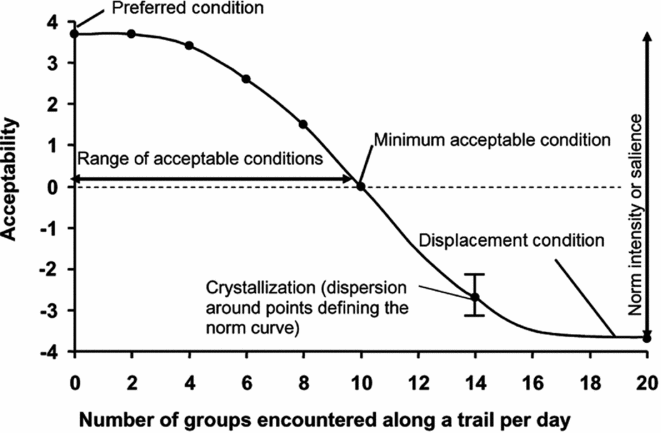
In the context of PAs, surveys are often conducted of stakeholders (park visitors, residents of surrounding communities, or the general public) to evaluate the acceptability of a range of conditions of park resources and the visitor experience. Resulting data are generally graphed so that conditions are displayed on the horizontal axis and evaluations are displayed on the vertical axis. The resulting line connecting the evaluation scores is called a norm curve (Fig. 1).
Norms often used to inform standards of quality in protected areas. Stakeholder group surveys may be used to evaluate the acceptability of a range of protected area resource conditions and the quality of the visitor experience. Collected data are generally graphed so that conditions are displayed along the horizontal axis and evaluations are displayed on the vertical axis. The resulting line connecting the aggregate evaluation scores is called a social norm curve. In this hypothetical case, a sample of park visitors have rated the acceptability (using a nine-point response scale) of encountering a range of other groups while hiking along a park trail.

Norms can be measured for both individuals (personal norms) and groups (social norms). As the terms suggest, personal norms are measures of the standards or evaluations of individuals, while social norms represent shared standards or the evaluations of a group. Social norms are measured by aggregating the evaluation data for members of a group by calculating mean and median values. The resulting line (Fig. 1) is often called a social norm curve. Structural characteristics models of norms can be especially useful in helping to formulate standards for PA management.
Application of normative theory and methods to PAs and natural resource management more broadly involves extension of normative theory and methods as originally conceived (Roggenbuck et al. Reference Roggenbuck, Williams, Bange and Dean1991; Shelby & Vaske Reference Shelby and Vaske1991; Vaske & Whittaker Reference Vaske, Whittaker, Manfredo, Vaske, Bruyere, Field and Brown2004). Many of these applications address resource and social conditions, not behaviour. Moreover, unlike behaviour, resource and social conditions do not appear to be subject to sanctions, nor do they entail an explicit notion of obligation on the part of individuals. However, visitor-caused impacts to PA resources and the quality of the recreation experience are a direct consequence of visitor behaviour. Moreover, the decision to manage such impacts in relation to socially acceptable levels represents institutional behaviour of management agencies. These agencies have an obligation to manage PAs to meet the needs of society, and these agencies are ultimately subject to sanctions (such as public disapproval or legal challenge) if they are perceived to fail to live up to this obligation.
Social norm curves have several potentially important features or characteristics that can contribute to their interpretation and usefulness (Fig. 1). First, all points along the curve above the neutral point on the acceptability scale, namely the point on the vertical axis where aggregate evaluation ratings fall out of the acceptable range and into the unacceptable range, define the range of acceptable conditions. All of the conditions represented in this range are judged to meet some aggregate level of acceptability. The optimum or preferred condition is defined by the highest point on the social norm curve. This is the condition that received the highest rating of acceptability from the sample as a whole. The minimum acceptable condition is defined as the point at which the social norm curve crosses the neutral point of the acceptability scale. This is the point at which aggregate ratings of the condition of the indicator variable fall out of the acceptable range and into the unacceptable range. Norm intensity or norm salience, namely the strength of respondents’ feelings about the importance of a potential indicator, is suggested by the amplitude of the curve or the distance of the social norm curve above and below the neutral point of the evaluation scale. The greater this distance, the more strongly respondents feel about the indicator or the condition being measured. High measures of norm intensity or salience suggest that a variable may be a good indicator because respondents feel it is important in defining the quality of PA resources or the recreation experience. Crystallization of the norm concerns the amount of agreement or consensus about the norm. It is usually measured by standard deviations or other measures of variance of the points that describe the social norm curve. The less variance or dispersion of data about those points, the more consensus there is about social norms.
Social norms have been used in the field of PAs to guide formulation of standards for both resource and experiential indicators (Manning Reference Manning2011). Examples of resource-related indicators include trail erosion, trampling of soil and vegetation at campsites, and number of social or visitor-caused trails, and examples of experiential indicators include number of encounters with other visitors and conflict between visitors. Where it is effective, questions about norms include visual simulations of a range of conditions for potential standards (such as campsite conditions or number of visitors at a PA attraction) (Manning & Freimund Reference Manning and Freimund2004). Social norms are also used in the broader field of environmental management, examples including wildlife management (Whittaker Reference Whittaker1997; Wittman et al. Reference Wittmann, Vaske, Manfredo and Zinn1998; Zinn et al. Reference Zinn, Manfredo, Vaske and Wittmann1998, Reference Zinn, Manfredo and Vaske2000), fire management (Bright et al. Reference Bright, Manfredo, Fishbein and Bath1993; Kneeshaw et al. Reference Kneeshaw, Vaske, Bright and Absher2004), minimum stream flow (Shelby & Whittaker Reference Shelby and Whittaker1995), and lake and watershed management (Smyth et al. Reference Smyth, Watzin and Manning2007).
SOCIAL NORMS, STANDARDS AND REFERENCE POINTS
As described in the previous section, social norms have helped inform standards in the field of PAs. The fundamental starting point for managing both PAs and many other environmental resources is the mandate for protection. For example, the 1916 Organic Act of the US National Park Service (NPS 1916) dictated that the agency should ‘conserve the scenery and the natural historic objects and the wildlife therein and to provide for the enjoyment of the same in such manner and by such means as will leave them unimpaired for the enjoyment of future generations’. Contemporary management of PAs includes protecting the quality of the visitor experience in addition to resources. In a parallel way, the 1966 Magnuson-Stevens Fishery Conservation and Management Act (NOAA [National Oceanic and Atmospheric Administration] 1966) included a mandate to stop overfishing and protect fish habitats (Hall & Mainprize Reference Hall and Mainprize2004). This may also help protect the quality of the fishing experience, be it recreational or commercial.
Management of PAs and fisheries also share a commitment to a rational, management-by-objectives approach to planning and management, in which benchmarks or thresholds (such as standards and reference points) serve as measures of performance and proxies for management objectives. The NPS developed and employs the Visitor Experience and Resource Protection framework, in which management objectives and associated indicators and standards are formulated, indicators are monitored and management actions implemented, to help ensure that standards are maintained (NPS 1997; Manning Reference Manning2001). In a similar way, the Food and Agriculture Organization (FAO) Code of Conduct for Responsible Fisheries states that ‘When. . .reference points are approached, measures should be taken to ensure that they will not be exceeded’ and that ‘If such reference points are exceeded, recovery plans should be implemented immediately to restore the stocks’ (FAO 1995; Gabriel & Mace Reference Gabriel and Mace1999). Moreover, Hall and Mainprice (Reference Hall and Mainprize2004), in their review of reference points applied to fisheries management, suggested that ‘management of any system requires measures of performance against targets’ and that ‘In fisheries, an analogous performance measurement framework has emerged’. They concluded that ‘reference points should act as predetermined benchmarks that, when reached, should trigger particular management attention and preferably predetermined actions’. Thus, benchmarks in the form of standards and reference points are the heart of rational planning and management in both PAs and fisheries.
There is growing sentiment that standards and reference points should be broadened to include a strong societal component. This has been adopted more readily in PA management, probably because PAs are considered to be fundamentally democratic institutions and public recreation is so integral to their purpose. As noted earlier, national parks are to be protected, but they must also provide for public enjoyment. Plans for national parks include the public in the planning process and include indicators and standards that help define the quality of PA resources and the visitor experience. Fisheries management is moving in this direction. For example, Hall and Mainprize (Reference Hall and Mainprize2004) argued that including a stronger societal element to benchmarks and related frameworks is ‘especially suited for opening a dialogue about ecosystem issues with stakeholders’ and that ‘many of the problems scientists are now asked to participate in solving defy the conventions of a standard western scientific question and cannot be separated from issues of values, equity, and social justice.’ Transparency of resource planning and management is a closely related issue requiring meaningful participation from stakeholders. With regard to conventional formulation of reference points based on ‘science’, Hilborn (Reference Hilborn2002) wrote that ‘Stakeholders, be they commercial fishermen or conservation groups, will not accept any process that involves this degree of arbitrariness’.
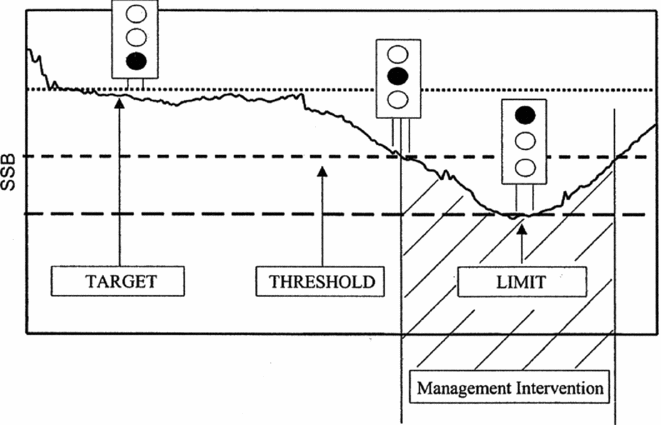
Management of PAs and fisheries both acknowledge a range of standards and reference points. In PA management for example, there may be an optimal or preferred standard, a minimum acceptable standard, and a displacement standard (Fig. 1), or the point at which many visitors would no longer come to a PA because it had been so badly degraded. A system of standards that ranges from green light (no management action is needed), to yellow light (indirect management actions such as visitor education should be implemented) to red light (management action is required, including the possibility of limiting public use) has been suggested in PA management (Whittaker et al. Reference Whittaker, Shelby, Manning, Cole and Haas2011). Fisheries management also uses a range of standards, including target reference points (desirable levels of fish stocks), threshold reference points (an early warning sign) and limit reference points (the point at which stock stress occurs) (Gabriel & Mace Reference Gabriel and Mace1999; Hall & Mainprize Reference Hall and Mainprize2004; Davies & Baum Reference Davies and Baum2012). This range of reference points is also sometimes described as a green, yellow and red light system (Fig. 2; Garcia Reference Garcia1995; Caddy Reference Caddy1998; Hall & Mainprize Reference Hall and Mainprize2004), and has a striking resemblance to the social norm curve (Fig. 1).
A range of reference points used in fisheries management (after Hall & Mainprize Reference Hall and Mainprize2004) illustrating the relationships among target, threshold and limit reference points as they are applied to measures of spawning stock biomass.
Similarities across PA and fisheries management suggest that social norms could and perhaps should be incorporated into formulation of reference points in fisheries and other fields of environmental management. Social norms: (1) suggest the societally-defined acceptable condition of environmental resources and what constitutes an appropriate level of resource protection, (2) serve as measurable proxies of management objectives and define thresholds of environmental and social conditions, both of which are needed in rational, management-by-objectives frameworks, (3) extend and complement ‘biological’ reference points as conventionally used in fisheries and broader environmental management, and (4) suggest an empirical range of reference points that can be tied to a corresponding range of management objectives.
A few examples help illustrate this discussion. First, from the field of PA management, a survey of visitors to Delicate Arch, the iconic attraction site in Arches National Park (Utah, USA), employed a series of visual simulations (computer-edited photographs) showing a range of visitor use levels (Manning et al. Reference Manning, Lime, Freimund and Pitt1996). A representative sample of visitors returning from their hike to the arch rated the acceptability of each study photograph. Mean acceptability ratings were plotted to derive a social norm curve (similar to that in Fig. 1). Average acceptability ratings fell out of the acceptable range and into the unacceptable range at when 30 people were at Delicate Arch at the same time, and this was the minimum acceptable standard (or reference point as used in fisheries management) that was adopted by the NPS (1995). The Park is now managed in such a way that the number of visitors at Delicate Arch rarely exceeds 30 people at once (this is done through limited parking capacity). This approach has also been used to address resource conditions in PAs. For example, surveys of visitors to Acadia National Park (Maine, USA) and Zion National Park (Utah, USA) have incorporated visual simulations of trails that show a range of recreation-related impacts (such as trail erosion and exposure of tree roots) (Manning et al. Reference Manning, Lawson, Newman, Budruk, Valliere, Laven, Bacon and Buckley2004; Manning Reference Manning2007). Social norm curves derived from visitor acceptability ratings indicate the point at which PA visitors notice and object to these impacts, and these points constitute standards (or reference points) by which visitors feel these PAs should be managed. Appropriate environmental management at these PAs includes regulation of the amount and type of use that is allowed on trails as a way of maintaining the environmental standards that have been set.
The field of fisheries management suggests alternative ways in which formulation of environmental reference points can incorporate social science and society. A representative sample of residents surrounding Lake Champlain in north-eastern USA were asked to rate the acceptability of a range of conditions for two indicators of quality for recreational fishing: number of fish that can be safely consumed per month (due to heavy metal accumulation) and number of sea lamprey wounds per fish caught (Smyth et al. Reference Smyth, Watzin and Manning2007). Resulting social norm curves are helping to guide fisheries management in this lake through formulation of fisheries-related standards/reference points and associated pollution and lamprey control programmes. In an alternative approach to reference points and associated fisheries management, clan chiefs in a region of the Indo-Pacific use catch rates and fish behaviour (flight from fishers) as indicator variables (Cinner et al. Reference Cinner, Marnane, McClanahan and Almany2006). When there is consensus among these community leaders that the condition of these indicators has declined to an unacceptable level (reached a reference point), selected areas of coral reefs are periodically closed to fishing. This system of fisheries management (formulation of de facto reference points and related environmental management) may be effective in maintaining sustainable fish stocks (Cinner et al. Reference Cinner, Marnane, McClanahan and Almany2006; Aswani & Sabetian Reference Aswani and Sabetian2009; Feary et al. Reference Feary, Cinner, Graham and Januchowski-Hartley2010).
INTEGRATING SOCIOLOGY AND ECOLOGY
The need to involve society in the consideration and formulation of environmental reference points is a manifestation of growing sentiment for integrating the natural and social sciences more broadly, though this is not without controversy and some resistance. For example, scholars in the 1990s advanced the idea that nature can be interpreted as a ‘social construction’ strongly influenced by human history, beliefs, traditions and values (Evernden Reference Evernden1992; Cronon Reference Cronon and Cronon1995; Taylor Reference Taylor2005). Cronon's (Reference Cronon and Cronon1995) critique of the conventional western notion of wilderness was especially powerful and encouraged modification of the concept of wildness to ‘stop being (just) out there and start being (also) in here’. Moreover, Cronon (Reference Cronon and Cronon1995) challenged the idea that there are places ‘untrammeled by man’ (a phrase taken from the US Wilderness Act) based on historical arguments that humans have been part of the landscape for millennia (as have human effects on it). Thus, the focus on preserving wilderness distracts from protecting elements of naturalness everywhere, even though many areas may not be ‘pristine’ by conventional western standards. These arguments suggest a strong integration of humans and the environment with potentially important management and policy implications. However, Cronon's (Reference Cronon and Cronon1995) thesis was challenged in some quarters, partly in response to his controversial use of wilderness (an iconic symbol of the modern environmental movement) as an example (Soule Reference Soule, Soule and Lease1995; Cohen Reference Cohen1996; Dunlap Reference Dunlap1996; Hays Reference Hays1996; Crist Reference Crist2004).
A more recent manifestation of the dynamic and varied relationship between humans and nature is the fundamental question of what is natural, especially given modern anthropogenic planetary influences. An early marker of this issue was that of McKibben (Reference McKibben1989), who used the issue of global climate change to raise the prospect of humans replacing nature as the dominant planetary force. Cole and Yung (Reference Cole and Yung2010) concluded that ‘natural is a commonly used word with multiple meanings’ and that ‘changes in science and society and the globalization of human influence have eroded the adequacy of naturalness as a guiding concept for protected area stewardship’. Harmon (Reference Harmon2010) suggested that the management implications of this dilemma are that ‘we can resist change via ecological restoration, accept change and allow matters to drift as they might, or guide change through the proactive transformation of conditions in protected areas’. Natural scientists can help inform these types of choices that Harmon outlined, but they are ultimately societal choices. Moreover, they are choices (inherently embedded in reference points) that might legitimately vary from resource to resource, place to place, and community to community, and that must ultimately reflect social norms.
How and how much of the environment could be used may depend on humans as much as nature. It would be foolish to deny that there are inherent limitations in the ability of the natural environment to support human use. But within these broad constraints there are many choices to be made depending on historical perspective, societal values, environmental ethics and other cultural considerations. Biology, ecology and the other natural sciences offer vital information that must help inform these choices, but it seems presumptive to deny that these are ultimately human choices (for better or for worse). When it comes to defining sustainability and advancing other important environmental frameworks, there is hard work to do to integrate sociology and ecology. The study of social norms and their application to reference points may be a good model.
Development and application of the kind of information represented by social norms is a first step in moving toward integration of society and environment, as manifested in this case by sociology and ecology. Social norms help quantify public environmental values in ways that can be readily incorporated in empirically-based decision making and they can be especially powerful when they are derived from representative samples of stakeholder groups and the public at large. Information from the disciplines of sociology and ecology must ultimately be weighed within appropriate planning and decision making processes such as environmental impact statements and the broader political process. However, these processes must be participatory and transparent, open to knowledge derived from ecology, sociology and other fields of study, and represent the long-term interests of both the environment and society.
Much environmental management is aimed at regulating human use of natural resources. Examples include limiting recreational use of PAs and limits on recreational and commercial fish harvesting. These types of limits are guided by standards/reference points and related markers of environmental conditions. Hardin (Reference Hardin1968) likened this approach to environmental management as ‘coercion’: limits and related regulation of human behaviour. While he believed this approach was necessary to avoid the tragedy of the commons, he cautioned that ‘The only kind of coercion I recommend is mutual coercion, mutually agreed upon by the majority of people affected’. In other words, society must be engaged in formulation of reference points or environmental management initiatives based on reference points are unlikely to be supported by the public.
CONCLUSION
Reference points are a contemporary approach to defining sustainability. However, the environmental literature suggests that reference points should be informed by societal values and norms. Examples from PA and fisheries management offer a model of how sociology and ecology might be integrated to protect the ecological integrity of vital natural resources while serving the needs of society.