Introduction
For the past several decades, psychopharmacology has been facing a divergence of demand and supply for treatment alternatives in major depression: While the prevalence and the socioeconomic burden of affective disorders are on the rise globally, only 1 out of 3 patients affected with major depression achieves remission in acute treatment with antidepressants. Although there are many efficacious antidepressants available, a substantial number of patients fails to remit even after several consecutive treatment trials.Reference Rush, Trivedi and Wisniewski 1 Pharmacokinetic testing may be a promising tool for identifying which patient will or will not benefit from a given treatment. Pharmacokinetics comprise mechanisms that control for the absorption, distribution, metabolism, and excretion of a substance.Reference Narasimhan and Lohoff 2 One important pharmacokinetic candidate gene for antidepressant treatment response is ABCB1, also known as the multidrug resistance gene MDR1. The gene product of ABCB1, the P-glycoprotein (P-gp), is a custodian molecule of endothelial cell barriers that can bind to a variety of substances, including psychotropic drugs and other medications. Brain penetration of substrates of the P-gp is partly regulated via this binding mechanism. The P-gp belongs to the ATP-binding cassette (ABC) family of transporter molecules, which require hydrolysis of ATP to actively transport their substrates via extra- and intracellular membranes. The P-gp is expressed in cell membranes including the luminal membrane of brain capillary endothelial cells of the blood–brain barrier, where it is responsible for transporting its substrates directly back into the blood circuit, thus keeping the brain concentrations of these substances low.Reference Horstmann and Binder 3 Animal studies have indicated that many antidepressants are significant substrates of P-gp. Accordingly, Uhr etal.Reference Uhr, Grauer and Holsboer 4 showed that, compared to wild-type mice, mice with a genetic knockout of the P-gp expressing genes ABCB1A and ABCB1B (which are the homologue genes to human ABCB1) had higher brain concentrations of subcutaneously injected substrates of the P-gp (doxepin, venlafaxine, paroxetine) while there were no differences after injection of the nonsubstrate mirtazapine. Results of these studies suggest that the bioavailability in the central nervous system of antidepressants with substrate properties is controlled by P-gp.
Clinical evidence on the ability of the ABCB1 gene to predict the response to antidepressants with substrate properties of the P-gp is partly ambiguous. While several clinical studies found significant associations of variations within the ABCB1 gene, plasma concentration of antidepressants, and/or treatment outcome,Reference Fukui, Suzuki and Sawamura 5 – Reference Singh, Bousman, Ng, Byron and Berk 14 some others reported no association.Reference Laika, Leucht and Steimer 15 – Reference Uher, Perroud and Ng 21 This pilot study is based on our previous findings,Reference Uhr, Tontsch and Namendorf 6 which showed that, among depressed inpatients at the hospital of the Max Planck Institute of Psychiatry (MPI-P), specific sequence variations of the ABCB1 gene significantly influenced the treatment success with antidepressants that are substrates of the P-gp. This was not the case for patients treated with nonsubstrates, confirming the specificity of the pharmacogenetic effect. In this study, patients carrying the rare allele [C-allele at the single nucleotide polymorphism (SNP) rs2032583 or the T allele at SNP rs2235015, in the following labeled as the C/T carriers or favorable genotype] had significantly higher remission rates when treated with substrates of P-gp (citalopram, paroxetine, amitriptyline, venlafaxine) than patients carrying 2 copies of the other allele at the respective SNP (TT at rs2032583, GG at rs2235015, in the following labeled as the TT/GG genotype or unfavorable genotype). Overall, C/T carriers had a 7.7 times higher probability to remit after a 5-week treatment with an antidepressant with substrate properties compared to the remaining patients with other genetic variants. There was no effect of genotype on response rate among patients treated with a P-gp nonsubstrate. Sarginson etal.Reference Sarginson, Lazzeroni and Ryan 10 replicated these results in geriatric depression. This study also demonstrated an effect of the ABCB1 SNP rs2032583 on the response rate only in patients treated with paroxetine, a P-gp substrate, and not in patients treated with the nonsubstrate mirtazapine.
These findings suggest that specific genetic variants in the ABCB1 gene influence the clinical efficacy of antidepressants whose brain penetrance is regulated via P-gp. Consequently, knowing a patient's genotype could facilitate the choice of an optimal antidepressant treatment strategy and thus lead to more rapid treatment success.Reference Holsboer 22 However, further information is needed in order to determine the optimal genotype-dependent treatment. For instance, patients with the favorable genotype for the P-gp substrate treatment could immediately be treated with a substrate, while patients with the unfavorable genotype might benefit more from a treatment with a nonsubstrate or an increase in substrate dose. Based on these considerations and our previous findings, genotyping of the ABCB1 gene was implemented as a diagnostic tool into the psychiatric hospital of the MPI-P.
In this pilot study, we aimed to examine the impact of ABCB1 genotyping as a diagnostic tool on clinical decisions, and the clinical utility of ABCB1 genotyping in the treatment of depressed patients. More specifically, we set out to evaluate which treatment strategy would be most beneficial for patients with the unfavorable TT/GG genotype. Different treatment strategies were tested: the increase in substrate dose, switching to a nonsubstrate (eg, mirtazapine), and switching to an antidepressant with yet unknown substrate properties and augmentation. We hypothesized that the ABCB1 gene test would lead to an improvement of outcome by allowing physicians in charge to adapt their treatment to a patient's genotype. We further assumed that patients with the unfavorable genotype have a higher P-gp activity impeding brain penetrance of P-gp substrates, and thus, would especially benefit from an increase in P-gp substrate dose and from a switch to a nonsubstrate. More specifically, increasing the substrate dose and switching to a nonsubstrate were hypothesized to be accompanied by a reduction of depression symptoms and by a shorter duration of the hospital stay.
Methods
Sample description
Both the study and the matched control sample were retrospectively selected from the Munich Antidepressant Response Signature (MARS) project. The MARS project (http://www.mars-depression.de) is a naturalistic study designed to identify factors that help to predict and improve treatment response in affective disorders.Reference Hennings, Owashi and Binder 23 , Reference Ising, Lucae and Binder 24 Caucasian patients who have at least a moderate depressive episode (HAM-D ≥ 14) at admission to the hospital of the MPI-P (Munich, Germany) and do not suffer from a severe neurological disorder or from severe medical conditions are eligible for MARS. Antidepressant medication was given according to the attending physician's instructions with weekly routine assessments of plasma medication levels to allow dosage adjustments in case of high or low rates of drug metabolism. The severity of depression was assessed weekly until discharge by trained clinical raters using the 21-item Hamilton Depression Rating Scale (HAM-D). The study was approved by the local Ethics Committee of the Ludwig Maximilian University, Munich, Germany, and was carried out in accordance with the latest version of the Declaration of Helsinki. Written informed consent was obtained from all subjects. For a more detailed description of the MARS study see Hennings etal.Reference Hennings, Owashi and Binder 23 and Ising etal.Reference Ising, Lucae and Binder 24
In 2008, the ABCB1 genotyping was implemented into the psychiatric hospital of the MPI-P according to the findings from Uhr etal.Reference Uhr, Tontsch and Namendorf 6 in order to test its usefulness for antidepressant treatment planning under routine conditions. Selection criteria for the study sample (N = 58, 44.8% males) were as follows: (1) the participation in the MARS project, (2) an admission to the hospital of the MPI-P after ABCB1 testing had been incorporated as a diagnostic tool, and (3) the provision of a written and informed consent allowing the attending physician to access a patient's test result. Patients agreed to ABCB1 genotype testing during their hospital stay after having been informed of the usefulness and limits of ABCB1 testing by their attending physician. On average, the sample was 48.53 years old (SD = 15.19, age range: 25–78 years). Half of them (50%, N = 29) were married, and the other half was either single (27.6%, N = 16), separated (13.8%, N = 8), or widowed (6.9%, N = 4), and 1 patient had missing data on marital status.
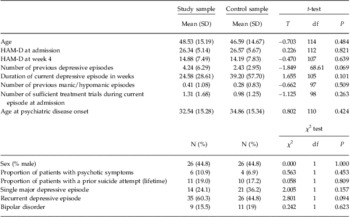
In order to determine whether the observed changes in therapeutic strategies were a consequence of the ABCB1 test result or reflected typical adaptations at a given treatment stage, a control sample (N = 58; 44.8% males) was matched for age, gender, bipolarity, and HAM-D score (at admission and treatment week 4). The control sample was drawn from MARS patients who were treated in the hospital of the MPI-P before ABCB1 genotyping was used as a diagnostic tool and incorporated into depression treatment. The patients’ ABCB1 SNPs were genotyped in the context of a genome-wide study after they had left the hospital. Thus, the control sample consisted of MARS patients whose ABCB1 test result was unknown during their hospital stay and could not influence treatment decisions. The control sample was also used for the evaluation of the clinical utility of ABCB1 testing. For this purpose, we compared differences in HAM-D scores and remission rates (defined as a HAM-D score < 10) at discharge among patients with and without ABCB1 testing during their hospital stay. The mean age of the control sample was 46.59 years (SD = 14.67, age range: 24 to 80 years), and their marital status was as follows: married: 36.2% (N = 21), single: 27.6% (N = 16), separated: 12.1% (N = 7), or widowed: 1.7% (N = 1). Further demographic and clinical characteristics of the study and the control sample are shown in Table 1.
Demographic and clinical characteristics of study sample and control sample
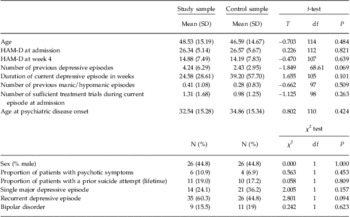
Note: SD, standard deviation; HAM-D, Hamilton Depression score.
ABCB1 genotyping and handling of the ABCB1 test result
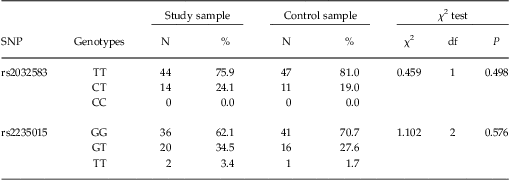
In the study sample, EDTA blood (15 mL) was drawn from each patient and sent to the laboratory of the Pharmacokinetics and CSF Analysis Laboratory of the MPI-P. DNA was extracted from fresh blood using the Puregene whole blood DNA-extraction kit (Gentra Systems Inc., Minneapolis, MN, USA). The ABCB1 SNPs rs2032583 and rs2235015 were genotyped by using real-time PCR and subsequent melting curve analysis, which was performed with a Lightcycler 480 Genotyping Master (Roche Applied Science, Mannheim, Germany). In the study sample, genotype distribution of the 2 SNPs did not deviate from Hardy–Weinberg equilibrium (HWE) (Table 2),Reference Wigginton, Cutler and Abecasis 25 and the 2 SNPs were in moderate linkage disequilibrium (r2 = 0.42, computed with Haploview 4.2Reference Barrett, Fry, Maller and Daly 26 ). The genotype test results were then sent back to the attending physicians and added to the patients’ medical records. Clinical case conferences were used to provide physicians with the necessary background information to be able to translate the ABCB1 test result into clinical practice. In addition, the 1-page test result letter contained a brief explanation of the P-gp function at the blood–brain barrier, an interpretation of the respective test result, and treatment recommendations according to the findings from Uhr etal.Reference Uhr, Tontsch and Namendorf 6 Treatment recommendations were as follows: (1) For a patient carrying 2 T alleles of SNP rs2032583 and 2 G alleles of SNP rs2235015: pay attention to a sufficient dosing of the substrate medication or change to an antidepressant that is not a substrate of the P-gp; (2) for a patient carrying at least 1 C allele of SNP rs2032583 and at least 1 T allele of SNP rs2235015: use antidepressants that are substrates of P-gp and pay attention to side effects; (3) for a patient with an ambiguous result (TT for SNP rs2032583 and at least 1 T for SNP rs2235015 or at least 1 C for SNP rs2032583 and GG for SNP rs2235015): no treatment recommendation was given because the test result could not be interpreted in terms of a low or high probability of remission under substrate medication. The letter did not contain a list of antidepressants that are substrates or nonsubstrates of P-gp. Regarding the study sample, the blood sampling for the ABCB1 test took place on average in the 3rd treatment week (mean = 2.55, SD = 3.14). The time interval between blood withdrawal and receipt of the genotype results generally took 1 week. Thus, in the current study, the physicians received the ABCB1 test result approximately in the 4th treatment week.
Information on tested ABCB1 SNPs

Note: SNP, single nucleotide polymorphism.
a Positions according to the February 2009 Human Reference Sequence (UCSC genome build version hg19; http://genome.ucsc.edu).
b p-values of the test for Hardy–Weinberg equilibrium (HWE) deviation, exact test.Reference Wigginton, Cutler and Abecasis 25
c Minor allele frequency.
The ABCB1 genotypes of the control sample were extracted from a high-throughput genotyping screen using Illumina Human610-quad arrays after the patients had left the hospital. In the control sample, genotype distribution of the 2 SNPs did not deviate from HWE, and the 2 SNPs were in moderate linkage disequilibrium (r2 = 0.44, computed with Haploview 4.2Reference Barrett, Fry, Maller and Daly 26 ) (Table 2).
Measures
The classification of antidepressant drugs into substrates or nonsubstrates of P-gp was carried out on the basis of results from preclinical experiments that measured cerebral drug concentrations in ABCB1A and ABCB1B double knockout mice:
-
1. The following antidepressants were allocated to the category substrate: amitriptyline oxide and amitriptyline,Reference Uhr, Steckler, Yassouridis and Holsboer 27 , Reference Uhr, Grauer, Yassouridis and Ebinger 28 nortriptyline,Reference Uhr, Grauer, Yassouridis and Ebinger 28 trimipramine,Reference Uhr and Grauer 29 doxepin,Reference Uhr, Grauer and Holsboer 4 citalopram,Reference Uhr and Grauer 29 paroxetine,Reference Uhr, Grauer and Holsboer 4 sertraline,Reference Wang, Zhu and Gibson 30 escitalopram (personal communication with M. Uhr, March 1, 2011), and venlafaxine.Reference Uhr, Grauer and Holsboer 4
-
2. The group of nonsubstrates comprised 3 antidepressants: fluoxetine,Reference Uhr, Steckler, Yassouridis and Holsboer 27 mirtazapine,Reference Uhr, Grauer and Holsboer 4 and bupropion.Reference Wang, Zhu and Gibson 30
-
3. Prescribed antidepressants whose P-gp substrate properties have not been tested in appropriate animal models at the time of the study were summarized as other antidepressants with unknown substrate properties [eg, monoamine oxidase (MAO) inhibitors, reboxetine, imipramine, trazodone, etc].
-
4. Antipsychotics and mood stabilizers that were added as a second drug to an antidepressant therapy in order to augment the efficacy of the antidepressant were categorized as augmentation (eg, lithium, lamotrigine, quetiapine, olanzapine).
The physician's treatment decisions in response to the ABCB1 test result were retrospectively retrieved from a patient's medical reports. Increase in substrate dose was defined as the highest dose of a substrate medication within the first 5 weeks after the receipt of the test result divided by the dose of the substrate medication given in the week of the blood sampling. For the treatment strategies switching to a nonsubstrate, switching to another antidepressant, and augmentation, we summed up the number of nonsubstrates, other antidepressants, or augmentation substances that were newly added by the physician within the first 5 weeks after the receipt of the ABCB1 test result. Substances that were administered before the receipt of the ABCB1 test and that were continued afterward were not taken into account. For example, the variable switching to a nonsubstrate contained the number of nonsubstrate antidepressants that were newly prescribed after receipt of the test result.
Statistical analysis
PASW Statistics for Windows (version 18.0, SPSS, Chicago, IL, USA) was used for all statistical analyses. P-values <0.05 for all tests were considered as significant, with 1-sided testing in the case of directed hypotheses. Demographics, clinical characteristics, treatment outcome variables, and treatment strategies were compared using Student's t-tests for independent samples in the case of mean differences and Pearson's χ 2 in the case of proportion differences. Spearman's rank correlations (Rho) were used for analyzing the association of treatment strategies and clinical outcome variables.
Results
ABCB1 genotype distribution
Table 3 shows the genotype distribution of the 2 ABCB1 SNPs for the study sample and the control group. The genotype distribution did not significantly differ between the study sample and the control sample [rs2032583: χ 2 (1, N = 116) = 0.459, p = 0.498; rs2235015: χ2 (2, N = 116) = 1.102, p = 0.576].
Genotype distribution in study sample and control sample

Note: SNP, single nucleotide polymorphism.
There was no gender difference in genotype frequencies within the study sample [rs2032583: χ2 (1, N = 58) =0.620, p = 0.431; rs2235015: χ2 (2, N = 58) = 2.652, p = 0.266] nor within the control group [rs2032583: χ2 (1, N = 58) = 0.518, p = 0.472; rs2235015: χ2 (2, N = 58) =2.633, p = 0.268].
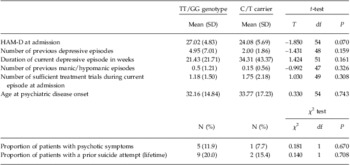
For the following analyses of the study sample, patients carrying the TT genotype at SNP rs2032583 or the GG genotype at SNP rs2235015 (N = 45) were assigned to the TT/GG genotype, and the remaining patients (N = 13) were assigned to the minor allele C/T carriers according to the findings from Uhr etal.Reference Uhr, Tontsch and Namendorf 6 Patients with the TT/GG genotype tended to have higher HAM-D scores at admission (mean = 27.02, SD = 4.83) than C/T carriers [mean = 24.08, SD = 5.69; t(54) = –1.850, p = 0.070]. There were no statistically significant differences in other clinical characteristics between the TT/GG genotype and the C/T carrier (Table 4).
Clinical characteristics of the study sample according to ABCB1 genotype group
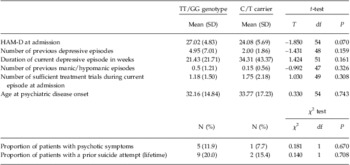
Note: SD, standard deviation; HAM-D, Hamilton Depression score.
Impact of ABCB1 test on clinical decisions
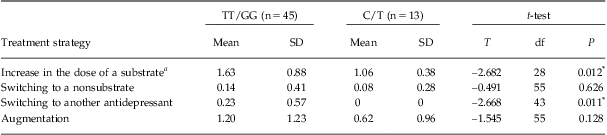
After the receipt of the ABCB1 test results, the medication with antidepressants with proven substrate properties was significantly more increased in patients with TT/GG genotype (1.63-fold) than in the remaining group [t(28) = –2.682, p = 0.012], as indicated in Table 5. In patients with the TT/GG genotype, the medication was more often switched to an antidepressant whose substrate properties are not yet evidenced [t(43) = –2.668, p = 0.011]. The receipt of the ABCB1 test result did not influence the treatment with nonsubstrates of P-gp. Both genotype groups received the same number of nonsubstrates in the weeks after testing [t(55) = –0.491, p = 0.626]. In order to determine whether changes in treatment strategies were a consequence of receiving the ABCB1 test result, a comparison of treatment strategies between patients with known and patients with unknown ABCB1 test result during hospital stay (n = 58) was conducted. Since the ABCB1 test result was obtained on average in the 4th treatment week in our study sample, we tested differences in treatment choices after the 4th treatment week between the 2 groups. Analyses revealed that the observed treatment changes happened in response to receiving the test result and did not reflect treatment changes that typically occur at a given time. For example, switching to an antidepressant with yet unknown substrate properties was by trend more often observed among patients with the TT/GG genotype with ABCB1 genotyping during the hospital stay (mean = 0.23, SD = 0.57) than among those whose ABCB1 genotype was unknown during the treatment period [mean = 0.6, SD = 0.247; t(58.037) = –1.767, p = 0.082]. The augmentation strategy was more often applied in patients whose genotype results were known (mean = 1.20, SD = 1.268) compared to those with an unknown test result [mean = 0.36, SD = 0.673; t(64.487) = –3.921, p = 0.000].
Differences in choice of treatment strategies after the receipt of the ABCB1 test result between patients carrying the unfavorable genotype in regard to the response to antidepressant substrates of the P-gp (TT/GG group) and those carrying the favorable genotype (C/T carriers)

Note: SD, standard deviation.
a Analyses are based on a smaller case number (TT/GG group genotype: n = 28; C/T carriers: n = 8).
*Significant (p < 0.05).
Clinical utility of ABCB1 genotyping
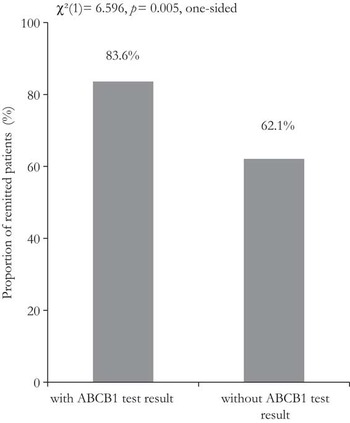
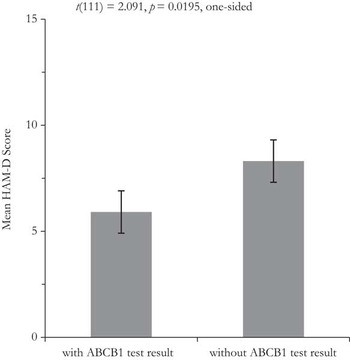
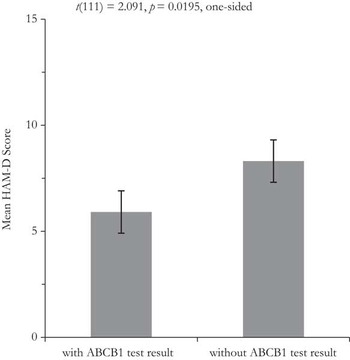
Patients whose ABCB1 test result was received during hospital stay were more likely to be remitted at discharge compared with patients whose test results were unknown at the time of treatment [χ2(1) = 6.596, p = 0.005, 1-sided] (Figure 1) and had lower HAM-D scores at discharge [t(111) = 2.091, p = 0.0195, 1-sided] (Figure 2). The study sample and control sample did not differ in HAM-D scores at admission [study group: mean = 26.34, SD = 5.14 vs. control group: mean = 26.57, SD = 5.67; t(112) = 0.226, p = 0.821], HAM-D scores at week 4 (physicians received the ABCB1 test result approximately in the 4th treatment week) [study group: mean = 14.88, SD = 7.49 vs. control group: mean = 14.19, SD = 7.83; t(107) = –0.470, p = 0.639] or in any other clinical characteristic, as shown in Table 1 (range of p-values: 0.069–1.000).
Remission rates in patients whose ABCB1 genotype test result was available during hospital stay (N = 55) and of patients whose test result was unknown (N = 58). Due to missing data, case numbers deviate from the total sample size.

Hamilton Depression scores at discharge of patients whose ABCB1 genotype test result was available during hospital stay (N = 55) and of patients whose test result was unknown (N = 58). Due to missing data, case numbers deviate from the total sample size.
Genotype-dependent treatment strategies
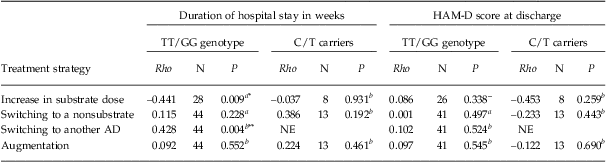
In a next step, we tested which of the chosen treatment strategies were the most beneficial ones for the C/T carriers and the TT/GG genotype. As shown in Table 6, we observed a significant negative association between increase in dose of substrate medication and duration of the hospital stay [rho(28) = –0.441, p = 0.009, 1-sided]. An increase in the dose of an antidepressant with P-gp substrate properties in patients with the TT/GG genotype was associated with a shorter stay at the psychiatric hospital. More specifically, patients with the TT/GG genotype had a reduction of hospital stay of 4.7 weeks if their substrate dose was increased by more than 1.5 after the receipt of the genotype test result. Patients who received a dose increase by more than 1.5 had an average hospital stay duration of 10.30 weeks (SD = 7.34), and patients whose dose was increased by less than 1.5 stayed 15.01 weeks (SD = 9.68) at the hospital. This difference tended to be significant [t(30) = 1.412, p = 0.084, 1-sided]. The switch to another antidepressant was accompanied by longer treatment duration [rho(44) = 0.428, p = 0.004, 2-sided]. There were no associations between increase in substrate dose and HAM-D score at discharge [rho(26) = 0.086, p = 0.338, 1-sided] or other clinical outcome parameters. There were no significant associations of any of the treatment strategies with any clinical outcome variable in the C/T carriers.
Spearman's rank correlations (Rho) between specific treatment strategies and clinical outcome in patients with the TT/GG genotype and C/T carriers

Note: AD, antidepressant; HAM-D, Hamilton Depression score; NE, not estimable due to empty cells.
a 1-sided testing.
b 2-sided testing.
**Significant (p < 0.01).
*Significant (p < 0.05).
Discussion
To our knowledge, this is the first study to investigate the translation of ABCB1 genotyping into clinical practice. We aimed to evaluate whether embedding the ABCB1 genotyping as a diagnostic tool had an influence on treatment choice and in turn on treatment success.
First of all, we investigated whether ABCB1 genotyping had an influence on treatment choice. The present data demonstrated that knowing a patient's ABCB1 genotype did influence clinical decisions. It was shown that after receipt of the ABCB1 test result, the dose of the administered substrate medication was considerably increased in patients for whom the test result indicated an unfavorable response under substrate treatment, compared to patients for whom the test predicted a favorable outcome. Interestingly, for patients with the unfavorable genotype, physicians preferred switching to an antidepressant with unknown substrate properties over switching to a nonsubstrate. This may be due to the fact that only a small number of nonsubstrates are currently available. Mirtazapine and fluoxetine, for instance, are some of the few antidepressants with proven nonsubstrate status. However, these drugs are not suitable for every patient. It is well known that mirtazapine leads to a number of undesired side effects such a weight gainReference Chiu and Li 31 , Reference Roose 32 and transient sedation.Reference Roose 32 Regarding fluoxetine, the prolonged half-life period of 2 to 4 days is often problematic. A wash-out period should take up to 5 weeks before a MAO inhibitor can be administered in order to limit the risk of a serotonergic syndrome.Reference Gury and Cousin 33 Therefore, and because the variety of nonsubstrates is limited, physicians may have preferred applying other treatment strategies after being informed of a patient's ABCB1 genotype. By comparing the treatment course of patients who did receive genotype testing during their hospital stay and patients who did not, we could demonstrate that the change of treatment strategy was in fact due to the receipt of the ABCB1 test result and did not reflect treatment changes that typically occur at a given treatment stage. In a previous study, Jürgens etal.Reference Jürgens, Jacobsen and Rasmussen 34 assessed whether genotyping of the 2 drug metabolizing enzymes CYP2D6 and CYP2C19 could help to facilitate clinical decisions and would in turn lead to an implementation in a psychiatric setting. The authors failed to report a successful adoption of the gene test into the clinical decision-making process, possibly because of an insufficient knowledge transfer between gene laboratories and clinicians, and also due to the limited impact of cytochrome P450 genotypes on the outcome of psychiatric treatments. Unlike the implementation of CYP genotyping, the translation of ABCB1 genotyping into clinical practice at the MPI-P was more successful. The finding of Uhr etal.,Reference Uhr, Tontsch and Namendorf 6 who is also a senior physician at the MPI-P, led to the introduction of ABCB1 genotyping into clinical routine and was thoroughly communicated to the clinicians of the MPI-P via treatment conferences and meetings. In addition to the ABCB1 test result, a precise genotype-dependent treatment recommendation was enclosed and was sent to the attending physicians without any detour (for a more detailed description see the Methods section). A well-synchronized workflow of laboratory and hospital seems to be a major factor in the process of translating genotyping into daily clinical practice.
The second aim of this study was to examine whether ABCB1 genotyping had a positive influence on clinical treatment outcome. We hypothesized that knowing a patient's ABCB1 genotype would enable the physicians to better adapt the treatment, which in turn would lead to a better therapeutic outcome. It was shown that patients whose genotype result was available during their hospital stay had higher remission rates and lower HAM-D scores at the time of discharge from hospital. Thus, embedding ABCB1 test results in clinical practice led to better treatment outcome.
A further aim of this study was to determine the best treatment strategy for patients who carry the unfavorable genotype compared to patients who carry the favorable genotype. We hypothesized that patients with the unfavorable genotype that impedes brain penetrance would especially benefit from an increase in P-gp substrate dose and from a switch to a nonsubstrate. In addition, we expected differences between the individual treatment strategies in terms of clinical outcome variables. Regarding the increase in substrate dose, we assumed that both clinical outcome measures—HAM-D score and duration of hospital stay—would be reduced. Indeed, patients with the unfavorable genotype had a reduction of the hospital stay by 4.7 weeks when the substrate dose was increased. This finding is in line with a previous study by Singh etal.Reference Singh, Bousman, Ng, Byron and Berk 14 The authors investigated whether polymorphisms in the ABCB1 gene could predict the antidepressant dose that was needed for remission. The findings showed that patients carrying the TT genotype at rs1045642 were more likely to remit under the treatment of venlafaxine compared to C-carriers. In turn, C-carriers at the ABCB1 SNP rs1045642 needed a 2.0-fold greater escitalopram dose to remit. Our findings are consistent with the findings of Singh etal.Reference Singh, Bousman, Ng, Byron and Berk 14 although better clinical outcome under increase of substrate dose was restricted to the treatment outcome variable duration of hospital stay in patients carrying the unfavorable genotype. There was no association with HAM-D score at the time of discharge from hospital. Nevertheless, a reduction of hospitalization length could be interpreted as an indicator for reduced time to stabilization and becomes increasingly important as the economic pressure on our health system mounts. Regarding augmentation strategy, we did not observe any association with treatment outcome in the unfavorable genotype. This could be due to the fact that most of the prescribed drugs for the purpose of augmentation have not been analyzed for their substrate properties. It cannot be excluded that some of these drugs have P-gp-modulating or -inhibiting properties, leading to a reduction of P-gp function.Reference O'Brien, Clarke and Fitzgerald 35 Regarding the switch to a nonsubstrate, we expected a reduction of depression score and a shorter duration of hospital stay. While switching to a nonsubstrate was not associated with any clinical outcome, the switch to another antidepressant with unknown substrate properties led to a longer duration of the hospital stay. This could be due to the fact that the interruption of a treatment and the introduction of a new one take more time. HAM-D scores at discharge from hospital were not influenced by the switch to another antidepressant. The fact that there was no significant association of any of the treatment strategies with any clinical outcome in the remaining group assumed favorable for treatment outcome may be due to the small case number, but suggests that this group might sufficiently benefit from a substrate treatment within the standard dose range.
Several limitations to this study need to be addressed. First, the relatively small sample size in this study limits the generalizability of our findings. The results will therefore have to be confirmed in future studies and should additionally be examined with larger sample sizes. A second limitation is that the administration of other medication possibly modulating P-gp activity was not taken into account. For example, certain cardiovascular drugs, such as verapamil or amiodarone, inhibit P-gp activity, but there are also psychotropic drugs that have been proven to be P-gp inhibitors. Risperidone, for instance, was found to inhibit P-gp in an in vitro study,Reference Zhu, Wang and Markowitz 36 although Feng etal.Reference Feng, Mills and Davidson 37 classified risperidone only as a weak inhibitor. P-gp inhibitors have been shown to interfere with the substrate or nucleotide-binding step, thereby blocking P-gp translocation.Reference Colabufo, Berardi and Cantore 38 Moreover, the SNPs we tested are intronic, and thus they do not directly affect the composition of the P-gp. Nevertheless, our findings suggest that both SNPs play an important role in regulating the access of antidepressants into the brain. Further studies are required to evaluate the exact pathways of these effects, which could be related to regulatory elements altered by the SNPs or to functional variants that are in linkage disequilibrium with the identified SNPs. Finally, in a complex disease like major depression, there are multiple genetic loci that do not stand by themselves but interact in complex and yet unknown ways. Variants in the ABCB1 gene might interact with other genetic variants, thus influencing treatment outcome. For instance, drug metabolizing enzymes regulating liver metabolism might add to interindividual variability in antidepressant treatment response. A clinical trial by Mrazek etal.Reference Mrazek, Biernacka and O'Kane 39 examined the association of CYP2C19 and response to citalopram. They found that poor CYP2 metabolizers were more likely to experience remission. Therefore, when analyzing the influence of the P-glycoprotein on antidepressant treatment outcome, the role of metabolizing enzymes should be taken into account. To date there is only 1 study that has investigated the association between cytochrome P450 and ABCB1 genetic variants, albeit suggesting that the prediction of treatment outcome cannot be improved by the simultaneous consideration of ABCB1 genotype and CYP2D6 metabolizer phenotype.Reference Gex-Fabry, Eap and Oneda 7 Regarding potential pharmacogenetic influences apart from the investigated ABCB1 variants, we cannot exclude that other genetic variants, such as HTR2A,Reference Horstmann, Lucae and Menke 40 , Reference Lucae, Ising and Horstmann 41 5-HTTLPR,Reference Porcelli, Fabbri and Serretti 42 GRIK4,Reference Paddock, Laje and Charney 43 or FKBP5,Reference Binder, Salyakina and Lichtner 44 may have contributed to the observed findings.
Conclusion
This study provides an important exploratory view on the clinical application and utility of ABCB1 genotyping in antidepressant treatment. The implementation of ABCB1 genotyping into the routine diagnostics influenced clinical decisions and ultimately led to an improvement of treatment outcome. These preliminary results underline the clinical utility of pharmacogenetic testing and suggest that the treatment of major depression can be optimized by the application of gene tests and biomarkers.Reference Holsboer 22 This is important because, to date, the diagnostics and treatment recommendations of mental disorders purely rely on a prevailing consensus of symptom categorization that may be subject to change in the future. Therefore, we are in need of objective laboratory tests that remain stable over time and that help to define subpopulations of patients who will especially benefit from a given treatment.
In order to overcome the limitations of this pilot study and to validate the above reported associations of ABCB1 genotype and treatment outcome, the efficacy of specific ABCB1 genotype-dependent treatment strategies is currently tested in a controlled prospective clinical study.
Disclosures
Barbara Breitenstein has the following disclosures: HMNC GmbH employee, salary. Sandra Scheuer has the following disclosures: HMNC GmbH employee, salary. Manfred Uhr and Florian Holsboer hold 2 patents for the prediction of antidepressant treatment response by the ABCB1 gene (WO 2005/108605: Polymorphisms in ABCB1 associated with a lack of clinical response to medicaments; WO 2008/151803: New polymorphisms in ABCB1 associated with a lack of clinical response to medicaments). The remaining authors have nothing to disclose.