Introduction
While descriptions of “men's and women's language” (Furfey Reference Furfey1944:218) in Native American languages are often cited in sociolinguistics textbooks and anthropological linguistics surveys, no attempt to systematize these patterns of gender indexicality has really been attempted since Haas (Reference Haas1944; but see Bodine Reference Bodine, Thorne and Henley1975 and Silverstein Reference Silverstein, Mertz and Parmentier1985). If anything, since Haas's publication on Koasati, the scholarly attitude towards gender indexicality in the indigenous languages of the Americas has become increasingly skeptical. Haas's own findings have been called into question by Kimball (Reference Kimball1987) (but see Saville-Troike Reference Saville-Troike1988), who suggests that status rather than gender was the key social parameter determining variation in the verb endings that were for Haas (Reference Haas1944:142) the stuff of “men's and women's speech in Koasati.” Taylor (Reference Taylor1982) has shown that Atsina (aka Gros Ventre) men used the “women's speech” described by Flannery (Reference Flannery1946:133) to speak to outsiders, based on analogies to child language acquisition: just as children were first spoken to with, and first produced, women's forms, so too would outsiders be better able to understand them than the men's forms. Meanwhile, Luthin (cited in Mithun Reference Mithun1999:278) has recovered conventional tropes in oratory and in-law speech that deviate from the standard patterns determined relative to speaker and addressee gender that Sapir described for Yana. Arguing perhaps most forcefully against the existence of “genderlects” (cf. McConnell-Ginet Reference McConnell-Ginet and Newmeyer1988), Trechter has criticized what she calls “categorical gender myths in Native America” (Reference Trechter1995:5). Through in-depth transcript analysis complemented by ethnographic interviews, she shows that different illocutionary force operators in Lakhota, though typified as the provenance of male or female speakers exclusively, are actually used by both sexes depending upon contextual factors and in order to indicate different degrees of epistemic force and affective solidarity, among other contextually sensitive shades of meaning. So it is that a growing consensus of opinion now sees those sociolinguistic entities, rather unfortunately baptized as “men's and women's languages” in earlier ethnographic writing, as actually consisting of social indexical contrasts, which, though emically typified as strictly gendered in usage, vary quite a bit over these social domains in actual practice.
Given this drift in scholarship it is perhaps unwise of me to swim against the current and attempt to continue Haas's typological project. I do not do so in rejection of the findings of more contemporary literature but rather in the hopes of complementing them. Recent scholarship has importantly shown that the norms and stereotypes of gender indexicality diverge, often quite radically, from actual discursive practice. Nevertheless, as I hope to show, there are rather distinctive similarities in gendered speech practices that can be traced between different descriptions of gender indexicality in the Americas, patterns that cannot be brushed off as either the projections of a European “linguistic exoticism” (Trechter Reference Trechter, Bucholtz, Liang and Sutton1999, quoted in Hall Reference Hall, Holmes and Meyerhoff2003:355) or of overzealous gender language ideologies operating in these communities. It is quite clear that in some cases—though both male and female speakers always had mastery over both sets of forms—gender indexicals were (and still are in Karajá (Ribeiro Reference Ribeiro2006), Chiquitano (Galeote Reference Galeote Tormo1993), and Cocama) both ubiquitous and stable in their rule-governed occurrence in discursive practice. Additionally, descriptions make clear that they were overt (i.e. grammaticalized) and fully subject to metalinguistic awareness. That is, it is clear that gender indexicality was categorical in the sense of Silverstein (Reference Silverstein, Mertz and Parmentier1985:234). Formal similarities in the patterning of gender indexicality across a number of cases reveals a close relationship between language ideology and language structure (ibid.), as gender indexicality has become incorporated into grammatical categories used in human reference. Given these patterns of grammaticalization (which I focus on below), I am of the opinion that gender indexicality in the Native Americas is not simply the artifact of exoticizing New World explorers and ethnographers but rather a robust typological trait with a consistent if sparse distribution across North and South America. If we accept the existence of grammaticalized gender indexicality then its almost unique presence in the Americas is an ethnolinguistic fact that begs an explanation. This study, which suggests an explanation for this fact, may be seen as an attempt to “save the phenomenon” of gender indexicality in the Americas.
Gender in the typology of social indexicality
In his seminal works on pragmatics Stephen Levinson (Reference Levinson and Chiarello1978, Reference Levinson1983) uses the term social deixis to denote grammaticalized social indexicals. In this work he has consistently distinguished two categories of social deixis (or social indexicality),Footnote 1 the relational and the absolute. Relational social indexicality indicates a social characteristic stipulated of an interactional role dyad (typically along the speaker-addressee, speaker-referent, or speaker-bystander axes; Comrie Reference Comrie1976), while an absolute social indexical presupposes a social characteristic of an entity in one interactional role. Levinson's work, and that of most other scholars who write on social pragmatics, has focused almost exclusively on the relational type. This is understandable. Grammaticalized relational social indexicality is much more prevalent typologically than absolute social indexicality, being the basis of systems of pronominal politeness (the union of the speaker-addressee and speaker-referent axes), honorific registers and speech-level systems (most often the speaker-referent axis but sometimes, as with Javanese, instantiated along the speaker-addressee axis) and avoidance registers (the speaker-bystander axis) (Comrie Reference Comrie1976; Levinson Reference Levinson1983; Errington Reference Errington1988; Agha Reference Agha1998). Research on the topic has led to a profound understanding of the common patterns underlying systems of honorification (Agha Reference Agha1998). Despite much growth in our understanding of the cross-linguistic patterning of the relational type, however, Levinson's absolute social deixis has remained largely untouched as a subject of study. An aim of this article is to show how the patterning of the absolute type diverges from that of the relational type. I take as my example the case of categorical nonreferential gender indexicality (what McConnell-Ginet (Reference McConnell-Ginet and Newmeyer1988) calls gender deixis).
This choice is not arbitrary. Indeed, in illustrating the absolute type, the example that Levinson (Reference Levinson and Chiarello1978, Reference Levinson1983) returns to is that of gender indexicality. Gender, as a relatively perduring characteristic of social personhood, would seem to be a good candidate for absolute indexicality. Relational attributes, like relative status, characterize the relationship between a role dyad. Minimally, they have two indexical foci. The type of social information conveyed by the relational and absolute nonreferential indexicals can be thought of as distributed over two-places and one-place, respectively. In order to interpret the information encoded in relational types one must attend to both elements of the role dyad (e.g. speaker + addressee, speaker + bystander). The information conveyed by absolute indexes, by contrast, is interpreted only with respect to one indexical focus. To be sure, we always need to know the origo of any index—typically the identity of the speaker of the utterance—in order to know who or what is its focus. What distinguishes relational and absolute types is how the information (or schema) conveyed by the index is distributed over its origo and focus. In the absolute type—like addressee-gender indexing in historical Island-Carib—the information is exclusively presupposed of its indexical focus. In the relational type—like addressee deference in pronominal address and reference of the European T-V type (Brown & Gilman Reference Brown, Gilman and Sebeok1960)—the information is understood as entailing a certain role relationship between the indexical origo (speaker) and focus (addressee); both are foci of the indexical schema.
In his discussion of absolute social deixis, Levinson (Reference Levinson and Chiarello1978) references Haas's descriptions of gender indexicality in Tunica and Koasati, but gives only a one paragraph description. The lack of examples here belies the paucity of examples where grammaticalized markers specifically and differentially, but nonreferentially, index some social feature in an absolute nonrelational manner. The most robust set of cases are indeed the Native American cases of what McConnell-Ginet calls gender deixis (Reference McConnell-Ginet and Newmeyer1988:80). As we discuss below, in these cases social gender is the indexical schema presupposed of an individual occupying a particular interactional role or, understood as a relational schema, presupposed of a role dyad.
In the study of gender indexicality Haas (Reference Haas1944) stands as the lone scholar (with the exception of the little-known Balmori (Reference Balmori1967)) who has attempted to systematize and typologize the set of known cases, almost all of which are to be found in the Native Americas. As a student of Sapir, Haas was well aware of the Yana case (Sapir Reference Sapir and Mandelbaum1929) before she discovered and documented gender indexicality in the languages of the Southeast.Footnote 2 Haas drew on her knowledge of Southeastern patterns of gender indexicality to develop a typology of such systems. The social gender of the individuals occupying the interactional roles of speaker and addressee are the only two variables necessary for generating the three types of gender indexicality represented in the typology (Haas Reference Haas1944:147). We can illustrate these three types by means of some examples. In some of the Muskogean languages (Koasati, Hitchiti, and Creek) there were two sets of verbal suffixes. One set of verbal suffixes presupposed that the speaker was a woman while another set presupposed that the speaker was a man. The differentiation of gender registers in these cases depends only upon the social gender of the speaker—thus the men's and women's speech registers in Koasati are speaker-focal gender-indexicals, Haas's Type I. In the historical pattern described for Island-Carib (Arawak), different registers—consisting alternatively of Arawak and Carib contact-derived lexical repertoires—indexically presupposed the social gender of addressee (Hoff Reference Hoff, Bakker and Mous1994:164). These registers thus served as addressee-focal indexes, Haas's Type II. In Yana, where the register that a man employs presupposes the social gender of his addressee, both the gender of the speaker and the gender of the addressee must be taken into account. Thus men's speech in Yana is a mixed speaker- and addressee-focal gender-indexical, Haas's Type III.Footnote 3
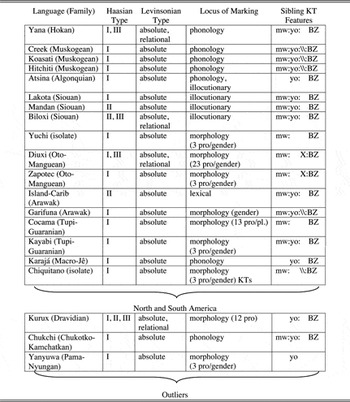
By putting Haas's typology of men's and women's speech differences within the larger comparative framework of social indexicality we can bring out the underlying parameters of its organization and point to areas where we might expect further elaboration of these gender signaling systems. Note that only Haas's Type III represents a case of relational social indexicality, since in these cases indexicals are only interpretable relative to both the gender of speaker and addressee. Types I and II are both absolute systems where the index employed exclusively presupposes the social gender of an individual or individuals occupying only one particular interactional role. Surveying cases of grammaticalized gender indexicality we can see that this relational type, Type III, is exceedingly rare, and where it does occur it always occurs alongside the absolute type (see Table 1).
Global distribution of grammaticalized gender indexicality.a

a Table 1 is a display of only the nonreferential cases of gender indexicality (see the main text for a discussion of gender deixis). The Haasian types are: Type I, speaker-focal; Type II, addressee-focal; Type III, mixed speaker-addressee focal (which is her only type that corresponds with Levinson's relational type of social indexicality). Within the category of morphology: Pro = pronominal paradigm, with the numbers (1, 2, 3) indicating in which persons distinctions are made; Pl = plural marker; and KTs = kin terms. Gender indicates that nonreferential gender indexicality occurs in categories of semantic gender. (Only Garifuna is a system of both semantic and formal gender.) The semantic features of the sibling terms of each of the languages in the sample (relevant to an argument made later in the article) are given in the rightmost column. The diacritics there are: ‘m’ or ‘w’ for male or female propositus; ‘y’ or ‘o’ for alter younger or older than propositus; ‘//’ or ‘X’ for parallel-sex or cross-sex of propositus and alter; and ‘B’ or ‘Z’ for male or female alter. Kinship data are taken from Dziebel (Reference Dziebel2007) and accompanying spreadsheets. Data for Chiquitano come from Galeote (Reference Galeote Tormo1993).
We can see from Table 1 that grammaticalized gender indexicality almost always appears as a type of absolute social indexicality. Why?
The tendencies of grammaticalized gender indexicals to be associated with an absolute, nonrelational, indexical schema is clearly related to the kind of classificatory information conveyed by the index. An index not only picks out some contextually relevant semiotic object, it also classifies it in some manner. Pronouns pick out speech participants, that is, speakers and addressees. Spatial deictics pick out regions in space as proximal or distal in relation to the deictic origo. This classificatory aspect of the sign is analytically distinct from the function of the sign as an index that picks out what I have been calling its focus or foci. This classificatory component of the meaning of nonreferential indexicals, such as gender indexicals, corresponds to the denotational schema of referential indexes, like pronouns and spatial deictics (Agha Reference Agha1996:649). For referential indexes these properly semantic features denote characteristics of their referents. Nonreferential indexes may involve similarly categorical interpretations. But because they categorize an indexical focus or indexical foci that are not referred to or denoted by the forms in question these schemata are nondenotational.Footnote 4 I refer to these as indexical schemata. Social gender is one such potential nondenotational indexical schema that may be conventionally understood to presuppose characteristics of an indexed person.
In order to understand why honorifics tend to be two-place indexical relations while grammaticalized gender indexicals tend to be one-place indexicals we need to look at the difference between the two types of nondenotational schemata at work in these types of social indexicality. Following Agha (Reference Agha1993:133) we might observe that “deference entitlement, namely the interaction-specific comportment of an individual toward some alter… is, minimally, a dyadic (otherwise, polyadic) concept establishing the relationship of a given interactionally positioned individual to some other(s).” Deference is paid to someone (the “focus of deference”) by another (the “origo of deference”). Honorifics have this minimally dyadic structure because the schema signaled through their use is an inherently relational one. Social gender, by contrast, is a schema of a different kind.
Social gender is not generally apprehended by folk consciousness, like deference is, as a relationship between two individuals. On the contrary, social gender appears as a relatively perduring (as opposed to evanescent) aspect of social identity (as opposed to social relationship) constant across and within interactions. Social gender as it is indexed within systems of categorical gender indexicality tends to be a highly presupposable and discrete aspect of social identity (in marked contrast to forms of gender performativity; see the last section of this article). To be sure, there may be changes in the social gender presupposed by either semantic gender features, gender deictics, or nonreferential gender indexicals. For instance, change in use of 3rd person masculine/feminine singular anaphors has become a rite of passage in transgender-becoming in the Anglophone world. Gender indexicals may presuppose a certain life stage or gender status, and in this manner the forms used to index a particular individual may change over time. Yanyuwa men were expected to use the appropriate noun-class markers indexical of male speakers only after passing through initiation rituals that also involved the acquisition of a secret men's speech register (Bradley Reference Bradley1988). The use of these forms presupposed the speaker's status as an adult male. In some dialects of Polish, women are referred to, and cross-referenced by, feminine gender markers only after marriage (Corbett Reference Corbett1991), while in the Iduna language, spoken in Papua New Guinea, “a woman who is a mother is addressed, responds and is referred to in the plural” (Huckett Reference Huckett and Healey1974:75). Marital status in Polish and motherhood in Iduna have become aspects of social gender, or gender statuses, presupposed in the semantic features used to refer to women. As we can see, though the forms used to index or denote the social gender of an individual may change over the course of his or her lifetime, these changes still presuppose relatively perduring and permanent gender statuses.
Where gender indexicals or semantic gender markers specifically index or denote gender features their use tends to be relatively stable and uniform across and within discursive events rather in contradistinction to the interactionally emergent and evanescent variability characteristic of honorifics. Indeed, similar considerations to these have been used to explain why sex-based semantic gender, especially of human nouns (e.g. in rational gender systems), is so rarely morphologically marked on noun stems. Kibort & Corbett (Reference Kibort and Corbett2008) argue that the fixity of the feature of gender with relation to the denotation of such words accounts for the fact that gender is typically a covert category only revealed in agreement. To sum up, the fact that social gender is a relatively stable characteristic of participants, both within interactions and across them, is a strong motivation for the tendency observed above, namely for gender to be indexed absolutely, rather than relationally.
Gender in discourse, denotation, and deixis
If we extend Haas's typology of gender indexicality to all possible combinations, both absolute and relational, for our triad of interactional roles—speaker, addressee, and referent—then we generate a matrix of the kind illustrated in Table 2.
Haas's types of gender indexing mapped onto Levinson's two-place (relational) and one-place (absolute) kinds of social indexicality.

aTypes *IV and *V are not discussed in Haas (Reference Haas1944). They are marked with asterisks because they are unattested.
Being a two-place indexical relation, relational types cannot have the same interactional role as both origo and focus. For this reason I have left the speaker-speaker slot blank. Excluding the impossible speaker-speaker axis we can see that Haas's typology fills up all of the slots for the interactional roles of speaker and addressee. We have absolute types for both, like the speaker-focal phonological markers of Karajá (Fortune & Fortune Reference Fortune and Fortune1975) and the addressee-focal lexical registers of historical Island-Carib (Hoff Reference Hoff, Bakker and Mous1994). The speaker-addressee relational type is also attested, though rare. Systems like Dravidian Kurux pronominal cross-referencing and Yana men's register pattern relationally along this axis. But what about the referent-focal types? What accounts for their absence? If gender indexicality tends, as I have argued, to index absolutely then the gaping hole in the Haasian paradigm, when we compare it to the relational types found in honorific systems, is the lack of any purely referent-focal absolute gender indexicality (a would be *Type IV).
But what would a *Type IV system look like? Well, if in Type I systems the gender indexing form shifts depending upon the gender of the speaker, and if in Type II the gender indexing form shifts depending upon the gender of the addressee, then in a *Type IV system the gender indexing form would shift depending upon the gender of the referent. Different forms would mark the different social genders of different referents. But of course, this is very close to what happens in a strictly semantic (as opposed to formal) system of gender agreement. Indeed so-called “rational” systems of “sex-based” gender assignment, like those found in southern Dravidian languages—which assign nouns denoting males to one class, nouns denoting females to another, and the remainder to a neuter class—closely approximate the stipulated *Type IV. Now clearly a system of semantic gender—no matter how tight the correlation between lexical features of nouns and the characterizable properties of their prototypical referents—is neither a system of gender indexicality nor of gender deixis as such, since it crucially depends upon agreement. Nevertheless, rational gender—where there is the tightest relationship between real-world social gender and semantic gender categorization of human nouns—represents the most indexical-like system for coding referent gender.
The reason that a system of absolute referent-focal gender indexicality is unattested is because it could not fulfill the condition for nonreferential indexicals—that the nonreferential indexical foci and referred-to denotata of a form be nonidentical (see n. 4). Where the gender schema associated with a form is always and only presupposed of the referred-to denotata of that form, we are dealing with a denotational, rather than an (nonreferentially) indexical, schema. We are, that is, dealing with a system of “sex-based” semantic gender.
The absence of referent-focal gender indexicality (*Type IV) in Table 2 can thus be understood to be filled in by systems of semantic gender, only here in the domain of symbolic denotation rather than on the plane of nonreferential discourse indexicality. But while referent-focal gender indexicality would seem always to “fall into denotation” in the 3rd person (i.e. its structural position being filled by systems of sex-based semantic gender), it is attested in cases where the referent is either the addressee or, which is more rare, the speaker. Such systems of true gender deixis (i.e. referential gender indexicality) are by far most prevalent in Afroasiatic languages. Readers are probably most familiar with Arabic and Hebrew, but there are widespread cases of gender in 2nd person pronouns (and sometimes nonsingular 1st person pronouns) throughout Africa (Plank & Schellinger Reference Plank and Schellinger1997). Here, as with cases of semantic gender, gender features are denotational, characterizing the focus of the pronominal index. Notably, all of these cases of gender marking in addressee-reference pattern with semantic gender systems in 3rd person reference and predication.
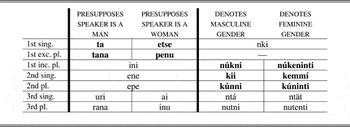
Examples of gender in 2nd person pronouns, as in Amharic and Berber, are relatively well known. Less well known, however, is a set of complementary cases, much smaller but nevertheless remarkable, where gender is only marked in speaker reference. These cases are, to my knowledge, limited to the Americas. Importantly, the Native American languages that exhibit gender deixis are either plausibly related to, or themselves have, grammaticalized systems of nonreferential gender indexicality. In Cocama (Tupi-Guarani), 1st singular and exclusive, but no 2nd or 3rd person, pronominals can be analyzed as denoting gender (Faust Reference Faust1963). This gender deixis in speaker reference needs to be understood, however, within the broader context of gender indexing in the language. Cocama is characterized by a system of speaker-focal gender indexicality instantiated in pronouns, demonstratives and plural markers. All pronouns that do not include addressee in their reference—1st singular, 1st exclusive plural, 3rd singular and 3rd plural but not 1st inclusive, 2nd singular or 2nd plural—have variants that presuppose speaker-gender.Footnote 5 So, for instance, the two 3rd singular pronouns in Cocama shown in Table 3, uri and ai, do not denote different genders but index different social genders—male and female, respectively—of speaker. As we can see in Table 3, gender deixis in Cocama is really just the special case where speaker reference and the broader system of speaker-focal gender indexicality overlap. It is precisely complimentary with gender deixis in Afroasiatic languages where it is limited to deictics that minimally refer to someone other than (or in addition to) the speaker (Plank & Schellinger Reference Plank and Schellinger1997:65).
Comparison of pronominal paradigms of Cocama (Tupi-Guarani) on the left, and Ntifa-Berber (Afroasiatic) on the right.a

a In Cocama pronominal forms are suppletive for person and number categories by presupposed social gender of speaker (an indexical schema). In Ntifa, gender is a properly semantic feature (a denotational schema). The table illustrates the complementarity of gender deictic forms (highlighted in bold) between speaker-focal gender indexical New World systems, where they occur in forms that do not refer to addressee, and Old World semantic gender systems, where they are localized in forms that minimally refer to someone other than speaker. Data for Cocama and Ntifa-Berber are from Faust (Reference Faust1963:116) and Plank & Schellinger (Reference Plank and Schellinger1997:65), respectively.
Note that if we were to take a purely referential perspective on Cocama it would be a clear violation of Greenberg's Universal #44: “If a language has gender distinctions in the first person, it always has gender distinctions in the second or third person, or in both” (Greenberg Reference Greenberg and Greenberg1963:96). Indeed, Rikbaktsa, a Macro-Jê language of South America, has been cited as a problematic case for Greenberg's person, number, gender universals (Plank & Schellinger Reference Plank and Schellinger1997:82). Like Cocama, it has gender in 1st person singular pronouns. But here again there is evidence—if only anecdotal—that speaker gender is systematically indexed in the language (Arruda Reference Arruda1998). As we can see, these cases should not cause us too much concern from a typological perspective, for in truth they are not aberrant systems of semantic gender but rather protrusions of nonreferential gender indexicality into the domain of reference. To take just one last case, clear evidence is present that the lone gender distinction in Mataco (aka Wichí), again in 1st person singular pronouns, was the last vestige of a system of nonreferential gender indexicality. Hunt (Reference Hunt1940:81) describes a historical pattern of men's and women's speech differences for Mataco, showing that the paradigm of pronouns—differentiated by speaker, not referent, gender—is becoming analogically reanalyzed as a system of deference indexicality, with forms which index women speakers coming to be reanalyzed as honorific pronouns. The gender distinction only remains in the 1st person singular pronoun, with the clearly morphologically related set of alternative forms now being understood as honorific pronouns appropriate for use outside of the local kin group.Footnote 6
To review, we may note with Silverstein (Reference Silverstein, Mertz and Parmentier1985:233) that the marking of true, speech-participant indexing pronouns with gender consists in “mixing the plane of reference-and-predication with the plane of discourse-indexicals.” But as we have seen not all such cases of gender deixis are equal. Afroasiatic cases clearly pattern with gender as a feature of reference-and-predication (i.e. with gender as a denotational schema), while the cases from the Americas pattern with gender as a feature of nonreferential discourse indexicality (i.e. with gender as an indexical schema). These divergences between Old World and New World patterns are paralleled in their different loci of marking. Reference-and-predication spurred gender marking is alter-focal (as most semantically rich denotation is), found in 2nd person pronouns. Meanwhile discourse-indexical motivated forms are ego-focal (as most absolute social indexicality tends to be), and found in 1st person marking.
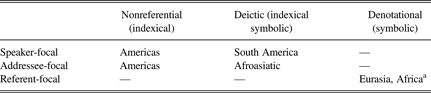
Taken together, we see that there is an interestingly complementary global distribution of gender as it is marked in discourse and denotation. Systems of semantic gender, but even more so the formal assignment systems which arise through them, are much more widespread in Africa and Eurasia than in the Americas (Corbett Reference Corbett, Haspelmath, Dryer, Gil and Comrie2005). This is correlated with the gender deixis in 2nd person and nonsingular 1st person pronouns commonly found in Afroasiatic languages. By contrast, grammaticalized gender indexicality is almost completely restricted to the Americas. In our sample of twenty-one languages with categorical, or near-categorical, nonreferential gender indexicality, eighteen are cases from the Americas. Additionally, gender deixis in 1st person singular pronouns is most commonly found in the Americas, as we would expect given the prevalence of speaker-focal gender indexicality in this region. This global distribution of gender marking in discourse indexicality, denotation, and deixis is represented in schematic form in Table 4.
Global distribution of gender marking in nonreferential absolute discourse indexicality, gender deixis, and sex-based semantic gender denotation.
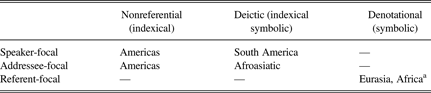
aWhile sex-based semantic and formal gender systems are found all over the world, they are most prevalent in Eurasia and Africa (Corbett Reference Corbett, Haspelmath, Dryer, Gil and Comrie2005).
So why is nonreferential gender indexicality so prevalent in the Americas? What accounts for this near-exclusive geographic distribution? The answer, I think, can be found in kinship terminologies.
Absolute gender indexicality in the Native Americas is characterized by an elaboration of ego-focal indexicality. One of the only other linguistic domains—pragmatic or semantic—where we see this kind of elaboration of ego-focal features is in kinship terminologies (terminology follows Heath, Merlan, & Rumsey Reference Heath, Merlan; and Rumsey1982). Kinship terms are inherently two-place predicates relating some “ego” or “propositus” to an “alter” or “referent.” We can illustrate this for the maximally unmarked—and therefore most elaborated—set of terms within kinship terminologies: zero-generation sibling terms. The English kin term sister specifies a two-place relation [sibling(x,y) & F(y)] where x is the propositus of the kin term and y the referent. These are reciprocal relations. If y is the “sister” of x, then x is the “sibling” of y. The reason that the reciprocal term, sibling, is of a higher taxonomic order than the term sister, is because the latter encodes only the feminine gender of the referent (i.e. F(y)). Indeed, the European type of sibling terms, one of the simplest types, encodes only one semantic feature, an absolute gender feature for referent. These are two term systems (i.e. Z,B).
The vast majority of sibling terminologies are composed of different combinations of up to four semantic features: (i) absolute gender of referent (i.e. Z,B); (ii) absolute gender of propositus (i.e. m,w); (iii) relational gender (parallel- or cross-sex) of propositus and referent (i.e. \\, X), which is the union of features (i) and (ii); and (iv), relational age of propositus and referent (i.e. y,o).Footnote 7 The eight-term set of sibling terms—wyB, woB, myZ, moZ, moB, myB, woZ, wyZ—is the most complexly differentiated possibility (i.e. 23, that is, two variants for each of the three features: absolute gender of alter, absolute gender of propositus, and relative age). Murdock (Reference Murdock1968:4), in his survey of sibling terminologies, calls this combination of all three features the Siouan pattern.
If we look at gender marking in sibling sets it is the absolute gender of propositus that is the most typologically rare feature, while absolute gender of referent is the most common (e.g. Z,B is common but *mSib,*wSib never occurs). We can understand this distribution as motivated by the tendency for semantic features to apply to the referred-to denotatum of an expression type; denotational schemata tend towards being referent-focal. Absolute gender of referent is the most purely referent-focal attribute, applying to the alter with minimal appeal to the features of the propositus. Relational features like relative age and relative gender have a less purely referent-focus, but still rely for their specification upon properties that categorize the denotatum. Absolute gender of propositus is the only feature in whose application the referent is completely out of focus. For this reason it is the typologically most marked feature, typically occurring only in the most complexly differentiated sibling systems.
The typological rarity of propositus-gender marking is reflected in the fact that the complexly differentiated Siouan type sibling terminology systems, the systems that most robustly encode it, are largely restricted to the Americas. Dziebel (Reference Dziebel2007:268–72, 297–307), in his comprehensive survey of over 2,500 kin terminologies, has exhaustively demonstrated the unique complexity of Native American sibling term sets, among other features. He shows that Murdock's Siouan type marking is found in twenty-one language families in the Americas, while in the Old World it is “restricted to the Pacific Rim populations and several Sino-Tibetan groups” (Dziebel Reference Dziebel2007:269). The most typologically restricted (or marked) feature in these highly differentiated sibling terminologies is the feature of propositus gender. In the Old World, gender is most frequently represented by features relating propositus and referent gender (i.e. parallel, \\, or cross-sex, X), as in Austronesian terminologies when they encode gender at all, or by representing the absolute gender of the referent, as is overwhelmingly the case in Eurasian sibling terminologies. (African terminologies often do not mark gender at all in sibling sets.) The prevalence of propositus gender marking in the Americas is complemented by “self-reciprocal” cross-generational terms (Dziebel Reference Dziebel2007). These are cases where ego and alter refer to one another using the same kin term. So, for instance, in Yana, the term, t‘ugu-na(si), used for FF is also used for mSC (Sapir Reference Sapir1918:156, 170). Note that the descending generation usage encodes propositus gender, deriving it, as it were, by inverting the features of the ascending generation term. Overall, we see a much higher prevalence of propositus gender marking in the Americas than in any other region in the world.
This feature—absolute gender of propositus—has clear parallels to the nonreferential indexing of speaker gender. Indeed, kinship terms that encode absolute gender of propositus have often been described as encoding the “sex of speaker” (e.g. Murdock Reference Murdock1968). In this connection, kinship terms have been invoked as a site of gender differentiation in language (Balmori Reference Balmori1967; Coates Reference Coates1986). Nevertheless, the two kinds of features—the one a denotational schema and the other a nonreferential indexical one—are distinct. As anyone familiar with a language that encodes such features in its kinship terminology knows, it is not with respect to the speaker that absolute or relative gender or relative age are reckoned. Rather, it is with respect to the propositus of the kin term. To take an example from a language that I am familiar with, in Nheengatú (Tupi-Guarani) there are two terms for sister: -yamu wZ and senjira mZ. These two forms are not isosemantic. They differ in the denotation of propositus gender. Both male and female speakers will use the same forms to denote the same ego-alter relationships (e.g. both male and female speakers would refer to John's sister as João-r-enjira and to Mary's sister as Maria-yamu).
The reason that propositus gender has been erroneously categorized as a marker of speaker gender is because in certain construction types, like 1st person possessor constructions and vocative address, the propositus of the kinship term and the speaker are one and the same. Just as gender deixis involves the “mixing” of discourse indexicality with sex-based semantic gender denotation, in these construction types the propositus-gender feature of the kin terminology performs the same function as a discourse indexical of speaker gender. Ethnographers and linguists have likely confused the properly denotational, propositus-gender features of kinship terminologies for nonreferential speaker-focal gender indexicals because such vocative and 1st person possessor constructions are often very ubiquitous, especially in small-scale kinship-based societies. There is quite a bit of evidence, however, that ethnographers are not alone in conflating propositus gender and speaker gender.
When we look at the list of gender-indexing languages in Table 1 we can see that of the Native American cases all but Atsina (which was spoken in proximity to Siouan languages) and Karajá (a Macro-Jê language related to Rikbatska which does encode propositus gender in kin terms and which also exhibits speaker-focal gender indexicality) encode propositus gender (i.e. “m,w”) in their sibling terminologies (consult the rightmost column of Table 1). The correlation between propositus-gender marking and the nonreferential indexing of speaker gender in these languages is remarkable and suggests historical relationships between these two phenomena. Indeed, excluding language isolates, the sample of Native American cases represents eight language families, five of which (Algonquian, Siouan, Arawak, Tupi-Guarani, and Sapir's contested Hokan grouping) exhibit the maximally differentiated Siouan-type sibling terms. It appears that just as linguists and ethnographers have erroneously described propositus-gender specific forms as speaker-gender indexical variants, so too have speakers of some of these languages functionally reanalyzed them in this manner as well.
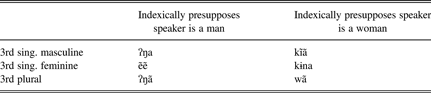
Understanding the broad strokes of this correlation between propositus gender in kin terminologies and gender indexicality, let us look at some historical clues that offer further evidence for this connection. In Kayabi, 3rd person possessive and independent pronominals used in human reference have separate speaker-indexing forms for 3rd singular masculine, 3rd singular feminine, and 3rd plural forms (see Table 5; Dobson Reference Dobson1997:14, 64).
Kayabi 3rd person pronouns (Dobson Reference Dobson1997:14, 64; transliterated into the IPA).
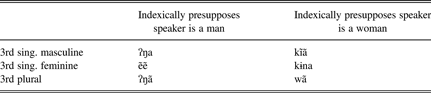
It is intriguing that gender indexicality in Kayabi is limited to the set of 3rd person pronominals used in human reference. (As I discuss below, this is actually quite a typologically robust pattern.) This exhibits structural parallels to the lexicalized marking of both propositus and referent (i.e. possessor and possessum) gender in Kayabi kin terms. There are six sibling terms in Kayabi; reki'it moB, rikiet woZ, rewiret myB, kipi'it wyZ, kiwit wB, and renit mZ. Note that the stem-initial segment of the wB (kiwit) and wyZ (kipi'it) terms distinguishes them from the other sibling terms that all bear the root-initial r- marking used for inalienable marking in other Tupi-Guaranian languages. As we can see in the Kayabi pronominal paradigms listed in Table 5, k- is also the distinctive theme for 3rd person singular forms indexical of women speakers. The structural parallels combined with the phonological similarities between feminine propositus-marked kin terms and forms indexical of women speakers suggest that root-initial k- may have been reanalyzed as an index of female speaker. Denotational of propositus gender in inherently two-place kin terms, it may have become indexical of speaker in one-place anaphoric and pronominal reference.
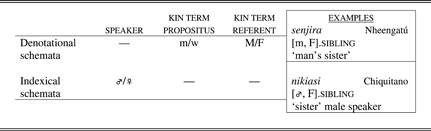
While the Kayabi example is suggestive, the dynamic connections between kin-term semantics and gender indexicality can be seen more directly in Chiquitano.Footnote 8 In Chiquitano, variant semantic gender markers used in determiners, possessive morphology, and on human nouns index speaker gender (Adam & Henry Reference Adam and Henry1880; Galeote Reference Galeote Tormo1993). Masculine gender is only marked in men's speech while no sex-based gender distinction is made in women's speech. Outside of this site of marking the only other site of gender indexicality is in the kin terminology. Rather than the typical American pattern of kin terms that differentiate propositus gender, in Chiquitano numerous kin terms are suppletive by speaker gender. Thus, with the exception of some affinal categories, there are separate speaker-gender indexing terms for almost all kin term types (e.g. the use of yobo for ‘uncle’ presupposes that the speaker is a man while the use of taita presupposes a woman speaker).Footnote 9 This rank shifting of propositus-gender marking into a speaker-gender index has led to an elaboration of possessive morphology. In the language as it is spoken today propositus gender is marked in the possessor morphology while speaker gender is lexicalized. This double marking of gender—one feature being denotational the other indexical—suggests a renovation of kin-term semantics subsequent to the reanalysis of lexically inherent propositus gender as a speaker-gender indexical. The manner in which Chiquitano kin terms have replaced the denotation of propositus gender with the indexing of speaker gender can be seen in Table 6, where the composition of Chiquitano and Nheengatú sibling terms are compared.
The semantics and pragmatics of lexicalized gender marking in kin terms with special reference to Chiquitano.a
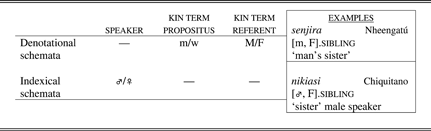
a An example of propositus-gender denotation, a characteristic feature of Native American kin terminologies, is given from Nheengatú (Tupi-Guarani). As the Chiquitano example illustrates, rather than denote propositus gender, Chiquitano kin terms index speaker gender.
These complex interrelationships in Native American languages between kin-term semantics and gender indexicality suggest a historical relationship, if not through direct morphological transfer then more purely analogical in kind.Footnote 10 Without knowing the formal mechanisms at work in the historical development of these cases, we cannot be certain about the direction of causality. However, the fact that elaborate Siouan-type kin-term semantics are much more prevalent than systems of gender indexicality strongly suggests that the latter are derived from the former, though clearly these two domains can have reciprocal effects on one another as the typological uniqueness of the Chiquitano kin terminology illustrates.
Further evidence for structural analogies, if not historical relationships, between kin term semantics and gender indexicality in the Americas is found in the locus of gender indexical marking in a number of languages. We have already seen that in Kayabi and Chiquitano speaker-focal gender indexicals only occur in forms used for human reference (3rd person pronominals, determiners, human nouns, etc.). There is actually quite a large sample of cases like these, including Yuchi (Wolff Reference Wolff1948), Diuxi Mixtec (Kuiper & Pickett Reference Kuiper and Pickett1974), Texmelucan Zapotec (Marlett Reference Marlett1993), and Cocama, where gender indexing typically occurs in forms used in specifically human reference. Thus, in Yuchi, Chiquitano, Mixtec, and Zapotec different forms indexical of speaker gender are used in 3rd person human masculine and human feminine pronominal paradigms, while in Cocama (where there is no semantic gender) different forms are used in demonstratives and 3rd person singular and plural pronouns.
This special kind of speaker-focal gender indexicality, instantiated in forms used for human reference, forms a class distinct from more run-of-the-mill speaker-gender indexicality like that in Koasati or Karajá. Indeed, these cases point to the fact that there are two quite separate types of absolute speaker-focal gender indexicality. Koasati and Karajá, along with Yana, Chukchi, and the Muskogean cases, form a set of speaker-focal systems instantiated in (morpho)phonemic alternates, like verb final particles in Koasati, intervocalic k in Karajá, and ʃ in Chukchi. These are the cases that are best known from the literature, largely because Chukchi, Koasati, and Yana are of this type, and it was descriptions of these by Bogoras (Reference Bogoras and Boas1922), Haas (Reference Haas1944), and Sapir (Reference Sapir and Mandelbaum1929) that largely defined the parameters of gender indexicality within the American descriptivist tradition. But in addition to the set of contrasts instantiated by phonological variants, there is a second kind of speaker-focal gender indexicality that is actually more frequently attested than the first. In the second type speaker-focal distinctions are marked in grammatical categories—most often person-marking categories and nominal categories (i.e. gender and number). These alternates occur in form types typically employed in acts of human reference. Spread over different culture areas and language families in the Americas—from Yuchi in the southeastern United States to Tupian languages in lowland Amazonia—this type is remarkably robust.
This second type of speaker-focal gender indexicality again evidences structural parallels between speaker indexing and propositus denotation. As with propositus gender in kin terms, speaker gender is only indexed when some human referent is being denoted. In fact, returning to our matrix of possible types of gender indexicality (see Table 2 above), we can see that this instantiation of speaker-gender indexicality in human referring expression types comes perhaps closest to the unattested speaker-referent relational gender indexicality, a would-be Type *V (i.e. to something akin to referent-focal honorifics). In actuality, however, these are absolute gender indexicals, their gender schemata being exclusive presupposed of the interactional role of speaker. Like relational indexicals, Kayabi (see Table 5) or Cocama (see Table 3) 3rd person pronouns have a two-place structure, only each of the two places is dedicated to a distinct semiotic function—the first being a discourse indexical and the second a semantic characterization of the referred-to denotatum. Thus the Cocama forms uri and ai—3rd singular pronouns which presuppose male and female speakers, respectively—could be represented as two-place predicates—[♂, 3rd singular] and [♀, 3rd singular], respectively—where the first place is dedicated to indexing speaker gender and the second to encoding the person and number features of the denotatum (note the parallels to the two-place predicate structure of kin terms as represented in Table 6).
Let me include one last note on the speaker focality of Native American gender indexicality. While gender indexicality may have addressee, rather than speaker, as its indexical focus—as it does in Yana, Biloxi, and Island Carib—this occurs only rarely. This follows from an important consideration that offers further support for the idea that kinship semantics served as the historical source of these gender indexical patterns. Vocative kin term usage—where the speaker is the would-be possessor or propositus—is the unmarked kin term construction type. But it is also in these 1st person propositus construction types that gender denotation is functionally equivalent to gender indexicality (i.e. is gender-deictic), and thus susceptible to reanalysis as a nonreferential gender indexical.
Note that the hypothesized relationship between kin terms and gender indexicals crucially involves all three of the levels of gender marking that we have been discussing: semantic gender in kin-term denotation, gender deixis in vocative kin-term use, and discourse indexing of speech participant social gender in nonreferential indexicals. It is those kin-term construction types—the deictic, unmarked, 1st person possessor constructions—where the speech participant role of speaker is referentially indexed at the plane of denotation, which crucially serve as the locus of analogical transfer of gender as a denotational schema of reference and predication into gender as an indexical schema of discourse indexicality. The functional parallels between kin-term semantics and gender indexicality in the Americas suggest interesting connections. Hopefully future research by interested scholars will be able to recover the formal mechanisms (perhaps involving possessive morphology) whereby propositus gender could have been grammaticalized as discourse indexicality for some of the cases described above.
Of gender indexicality: Categorical and performative
As the connections between kin term semantics and gender indexicality illustrate, it is not the development of social gender as a semantic feature or indexical schema that is novel in Native American gender indexicality, but its transposition from the plane of denotation into the plane of discourse indexicality. As we have seen, the linkages between gender marking in denotation and discourse are both typological and diachronic. We saw the typological connections when looking at the complementarities between Old World sex-based semantic gender marking and New World gender indexicality and the diachronic ones in the development of discourse-level gender indexicality out of gender denotation in kin-term semantics. These affinities between denoting and indexing gender should serve to reframe our understanding of so-called “men's and women's languages.”
The categorical patterning of Native American gender indexing contrasts—categorical, that is, like the denotational categories they are derived from—likely fostered the tendency of earlier scholars to describe Native American gender registers as “men's languages” and “women's languages” (Chamberlain Reference Chamberlain1912; Furfey Reference Furfey1944), giving the impression that women and men spoke distinct, perhaps mutually unintelligible, linguistic codes in these “primitive” societies.Footnote 11 These earlier descriptions had the ironic effect of representing such presupposing gender indexicality as its opposite. That is, it led some to misrecognize presupposing gender indexicality in Karajá or Koasati or Yana as a highly restricted and rigidly policed system of what we would now call gender performativity (cf. Hall Reference Hall, Holmes and Meyerhoff2003). This was despite the fact that authors consistently noted that forms were not “exclusively” produced by only male or only female speakers.
The gender essentializing dimensions of earlier descriptions likely undergirds the healthy skepticism that some contemporary scholarship has had towards the question of gendered speech in the Americas. Trechter has argued on analogy from her Lakhota materials that “it is unlikely that ‘sex exclusive’ gender systems as previously defined operate in any language” (Reference Trechter1995:5). The evidence that Trechter brings to bear in calling into question the existence of “categorical gender deixis” (ibid.) is variability, with respect to speaker gender, in the use of illocutionary force operators in Lakhota, which had been treated in the literature as encoding precisely this variable.Footnote 12 The locus of gender marking in Lakhota is in inherently performative linguistic categories like speech act or illocutionary force operators, operators that additionally “serve to express the affective force or the speaker's emotional state” (Trechter Reference Trechter1995:7).Footnote 13 Within Silverstein's (Reference Silverstein, Mertz and Parmentier1985:234) typology, it would seem that these should not be classified as “categorical gender-indexicals,” because the principle (i.e. first-order) indexical function of these forms is not the indexing of speech-participant gender but rather the marking of illocutionary force. Gender performativity often intersects in important ways with other speech-act utterance types, like “politeness” in the formulation of “mands” (Lakoff Reference Lakoff2004 for English, Ochs [Keenan] Reference Ochs [Keenan], Bauman and Sherzer1974 for Malagasy, Brown Reference Brown, McConnell-Ginet, Borker and Furman1980 for Maya), where stereotypes about what kinds of persons “appropriately” perform which kinds of speech acts lead to their becoming gendered. The Lakhota case looks similar to the kind of gender stereotyping concerning the use of honorific pronouns and illocutionary force operators frequently noted for Japanese and Korean (see also Silverstein Reference Silverstein, Mertz and Parmentier1985:236–37 on gender stereotypes in Thai deference indexicality, in which being, for example, overly deferential engenders speakers in culturally specific ways). But as we can see in Table 1, it is only in the Siouan languages that speaker gender is presupposed in speech-act performative utterance types, everywhere else the locus of marking is quite different. It is, therefore, far from clear that the existence of “categorical gender deixis” should be excluded by the Siouan sample alone.
The arguments of Trechter (Reference Trechter1995) and Hall (Reference Hall, Holmes and Meyerhoff2003), which question the very possibility of categorical gender indexicality, propose a particular view of the relationship of language to social life. The argument holds that if gender indexicality is categorical—that is, if men and women do in fact ubiquitously use the forms indexical of their presupposed social genders—that this must imply a rigid ideological, or social structural, division of social genders (see especially Hall's (Reference Hall, Holmes and Meyerhoff2003) reading of the earlier ethnographic literature along these lines). Arguing against an “exoticizing” reading of gender relations in other societies therefore involves arguing against categorical gender indexicality.
Note, however, that this argument involves a theory of language as well as an approach to gendered social relations. If we can accept the idea of categorical gender in denotation (i.e. semantic gender), or even in gender deictic reference (like Hebrew 2nd person pronouns), then why should categorical gender indexicality outside the domain of reference and predication necessarily push the bounds of credulity. Scandals over the epicene pronoun notwithstanding, when we hear that a language employs a categorical distinction of semantic gender we don't ask: What is the policing mechanism that coerces speakers into obeying this distinction? Reference and denotation, here, have a special claim to the categorical, while social indexicality is always already a site of performative contestation. Ironically, this undifferentiated performativist perspective on gender indexicality inadvertently mirrors the earlier tendency of explorers and ethnographers to presume that there must be an elaborate social mechanism, some form of policing or elaborated stereotypes of gender identity, lurking behind gender indexicals. We should resist this instinct to look for necessary social correlates.
This article offers evidence in support of the claim that a number of cases of gender indexicality in Native American languages are indeed categorical. The remarkable similarities in formal patterning across cases are suggestive in this regard, but so too are the underlying uniformities and historical conjunctures between the categorical and properly symbolic, denotational patterning of gender in kin-term semantics, on the one hand, and the inherently indexical, nonreferential marking of gender in discourse, on the other. In addition to these interconnections between gender in denotation and gender in discourse, there is another factor that should also dissuade us from a performativist reading of gender indexicality in these languages: the eminent quotability of all variants of gender indexicals by all speakers, regardless of gender. In all of the cases listed in Table 1 (with the possible exception of Siouan cases other than Lakhota, for which I do not have the relevant data), gender indexicals appropriate to represented, rather than actual, speaker are used in reported speech constructions. This transposibility of indexical defaults points to the affinities between such gender indexicals and deictics, since the latter can also be recentered to the narrated event in direct reported speech.
In direct reported speech constructions the indexical defaults of gender indexicals are recentered to the narrated speech event, just as spatial, temporal, or personal deictics are cross-linguistically. The fact that native informants, explorers, ethnographers, linguists, missionaries, and all others who have communicated firsthand knowledge of these gender indexical register formations have all noted this phenomenon makes such quotability almost rise to the status of a diagnostic of highly presupposing, categorical gender indexicality. (The relevant descriptions can be found in Adam & Henry Reference Adam and Henry1880:5 for Chiquitano; Bogoras Reference Bogoras and Boas1922:665 and Dunn Reference Dunn2000:312 for Chukchi; Sapir Reference Sapir and Mandelbaum1929/1963:206–7 for Yana; Haas Reference Haas1944:145 for Koasati; Fortune & Fortune Reference Fortune and Fortune1975:115 for Karajá; Trechter Reference Trechter1995:13–14 for Lakhota; and Dobson Reference Dobson1997:14 for Kayabi.)
We can see how such indexical transposition works in discourse by looking at a reported speech construction where more than one speaker gender is indexed in the same turn of speaking. Take the following example from Kayabi (from Dobson Reference Dobson1997:14).
(1) ko - pe kĩã oì eʔi ẽẽ
garden-locativehe/♀ 3rd.go 3rd.sayshe/♂
‘“He went to the garden,” she said.’
The denotational gloss of this sentence erases the nonreferential indexical presuppositions morphologically encoded in it. In addition to the denotational meaning of the sentence we can also know, for instance, that the (actual) speaker of the utterance is indexically presupposed to be a man because of the use of the 3rd singular feminine pronoun ẽẽ for the subject of the matrix verb of speaking. While this form denotes a notionally human feminine subject, it nonreferentially presupposes that the speaker is a man. (I follow Ribeiro's (Reference Ribeiro2006) convention of using the male and female symbols, ♂ and ♀, for nonreferential speaker-gender indexicals.) At the same time, we can see that the pronoun, kĩã used to denote a notionally masculine human subject in the reported speech construction, “agrees” with the matrix subject by presupposing a woman as the (represented) speaker of that reported utterance.
As we can see, in direct reported speech constructions, and just as with deictics, the indexical defaults of gender indexicals are recentered to the narrated speech event. This suggests the presupposing and categorical nature of such indexicals precisely because it means that these forms do not enjoin the same kind of avoidance practices characteristically found in the orbit of heightened gender performativity. Much as with verbal taboos, shibboleths of stigmatized gender identities are often unmentionable by those seeking to perform dominant or normative gender identities. Note the anxieties surrounding the voicing of “gay speech” in the studied performance of heteronormative identities in the United States. Note the felt need to parodically flag such represented speech, when it does occur, with exaggerated paralinguistic features. The heightened performative efficacy of such semiotic forms means that their social indexical entailments cannot be neatly contained so as to effect only the construal of their Goffmanian “authors” but may figurate the gendered identities of the “animators” of such speech as well. Avoidance practices and performativity go hand in hand. For the grammaticalized gender indexicals that I have been discussing, there is no evidence in the ethnolinguistic record of these kinds of avoidances. On the contrary, in these languages, quotation using the gender indexicals appropriate to represented speaker is more akin to the use of logophoric pronouns than the use of essentialized performatives of identity. Such quotability underscores the stable, even categorical, values of gender indexicals in these languages.
Conclusion
I have tried in this article to “save the phenomenon” of gender indexicality in the Americas by placing it within a typological framework that brings out similarities between cases and suggests an underlying unity across instances. Rather than understanding the nonreferential indexing of, especially speaker gender, in the Americas as some exotic phenomenon, we should understand it as actually quite continuous with the denotation of social gender. Gender, as it becomes presupposed through denotation or categorical discourse indexicality, is apprehended quite in distinction to its performative instantiation in other cases, as a relatively perduring aspect of social personhood. This perduring quality of social gender as an indexicable schema or attribute constrains the patterning of gender indexical systems. It is for this reason that gender indexicality tends to be instantiated as a form of absolute social indexicality.
Nonreferential indexicality of the type that Sapir (Reference Sapir1915, Reference Sapir and Mandelbaum1929/1963) looked at in his descriptions of “Abnormal types of speech in Nootka” and male and female forms of speech in Yana—which Haas generalized in her typology of gender indexicality (1944) and Silverstein incorporated into his theory of semiotic functionalism (1976)—can be very systematic and structured in its patterning. We already have had good indications of this for relational social indexicality, from Errington's (Reference Errington1988) meticulous description of Javanese speech levels to Agha's systematization of honorific registers (1998). It is my hope that this comparative treatment of gender indexicality in the Native Americas helps to fill out this picture for the case of absolute social indexicality.