Introduction
Exclusive breastfeeding for a minimum of 6 months is considered essential to maintain a healthy nutritional status of newborns/infants.Reference Amaral, dos Santos Sales and Pinto1 Interruption of breastfeeding has become common in Brazil. Approximately, 35% of the infants are weaned before the age of 6 months, and this has been touted as a major factor responsible for the increasing incidence of cardiometabolic diseases, chronic noncommunicable diseases, and other changes during adulthood.Reference Prado, Fabbro and Ferreira2
Fetal development may be influenced by different stimuli during the perinatal period, a phenomenon known as fetal programming.Reference Xavier, Scomparin and Ribeiro3 This programming, triggered by nutritional or hormonal changes, influences important stages of fetal development by promoting changes in the organ structure, cell numbers, gene expression, metabolic differentiation, and vascularization.Reference Souza and Taralli4
Researchers have suggested that the implementation of healthy eating can minimize the damage caused by the early weaning of infants, such as through the use of functional foods with antioxidant, neuroprotective, and anti-inflammatory properties.Reference Hahn, Baierle and Charão5–Reference Rassaf, Rammos and Hendgen-Cotta7 Cocoa is one of the best known functional foods, thanks to its properties. Different studies have shown its effectiveness in the maintenance of blood flow, improving blood circulation, decreasing the adipose tissue, and in the treatment of gastrointestinal, respiratory, and mental health disorders. Most importantly, cocoa is considered effective in preventing the development of cardiovascular diseases, mainly due to its high content of polyphenols, including epicatechin, catechin proanthocyanidins, and flavonoids.Reference Gu, Hurst and Stuart8
Very little is known about the effects of cocoa on the organs of the urogenital system, especially on those of reproduction, such as the testicles. High-fat diet administration in the mother during the critical developmental periods of pregnancy and/or lactation is known to negatively impact the gonad histoarchitecture and sperm parameters: viability, motility, and concentration.Reference Campos-Silva, Costa and Sampaio9 However, it is not known if early weaning can negatively affect the structure of the testes and if the bioactive compounds in cocoa can preserve the morphology of this organ. This study aims to study the effects of maternal and postnatal supplementation of cocoa powder on the testicular morphology of early weaned adult rats.
Method
Animals and nutritional treatment
Animal care and use protocols were approved by the Ethical Animal Committees of Federal Fluminense University (CEUA/UFF 1032/2018) and adhered with the National Institute of Health Guide for the Care and Use of Laboratory Animals.Reference Albus10 Female Wistar rats from the Experimental Nutrition Laboratory of Federal Fluminense University (3 months of age) were mated and then individually housed in cages with food (standard chow or cocoa powder-supplemented chow), and tap water was provided ad libitum. The animals were maintained in a temperature- and light-controlled environment (24°C ± 2°C, 12 h light, 12 h dark, lights on at 07:00 am). After birth, litter numbers were adjusted for optimal lactotrophic performance (n = 6 male pups/mother)Reference Langley-Evans, Phillips and Benediktsson11, and at weaning, the animals were randomly separated into four experimental groups (n = 6 males/group) according to perinatal and postweaning feeding: control (C) group – offspring of mothers fed standard diet, weaned at 21 d, and received the same diet in the postnatal life; cocoa control (CCa) group – offspring of mothers fed standard diet supplemented with 10% cocoa powder, weaned at 21 d, and given the same diet in the postnatal life; early weaning (EW) group – offspring of mothers fed standard diet, weaned at 18 d, and given the same diet in the postnatal life; and cocoa early weaning (EWCa) group – offspring of mothers fed standard diet supplemented with 10% cocoa powder, weaned at 18 d, and given the same diet in the postnatal life. The diet supplemented with cocoa powder was handled in the laboratory with the following components: 90 g of standard diet (NUVILAB®, Curitiba, Brazil) and 10 g of cocoa powder (Armazém®, Rio de Janeiro, Brazil), with a total calorie content of 296.4 kcal/100 g. The animals were followed up to 3 months of age. The literature shows that the increase of 10% of cocoa powder in the diets is within the standards used in animals.Reference Álvarez-Cilleros, Ramos and López-Oliva12,Reference Álvarez-Cilleros, López-Oliva and Martín13
Dietary intake, body weight, and blood glucose
Food intake and body mass were determined daily and weekly, respectively. To determine weight gain, the weight of the animals shortly after early weaning was subtracted from the final weight at the age of 90 d. For serum glucose analysis, the animals were maintained at an 8-h fasting period, and blood glucose concentrations were measured using a glucometer (Accu Check, Roche, SP, Brazil). Blood samples were taken from the tail vein of the rats.
Euthanasia and organ collection
At euthanasia, the animals were deprived of food for a period of 8 h and anesthetized with an intraperitoneal injection of xylazine (0.1 mg/kg) and ketamine (0.8 mg/kg). Blood was collected by cardiac puncture (right atrium) and centrifuged at 3500 rpm and 4°C for 15 min to obtain the serum (SIGMA® 4K15 centrifuge, Germany), which was frozen at −80°C for future analysis of total cholesterol (TC) (Monoreagent Cholesterol – K083; Bioclin®), high-density lipoprotein cholesterol (HDL-c) (Direct HDL – K071; Bioclin®), and triacylglycerol (TAG) (Triglycerides Monoreagent – K117; Bioclin®). For the determination of the low-density lipoprotein cholesterol (LDL-c) fraction, Friedewald equation (LDL = TC – HDL – (TAG/5) was used.Reference Friedewald, Levy and Fredrickson14
Subsequently, the testicles were dissected, weighed on an analytical balance (Sartorius TE214S, Chicago, IL, USA), and fixed in Bouin for 24 h. The male gonad was then cleaved and fixed again (4% buffered formalin in phosphate buffer of pH 7.2) for a period of 48 h. In addition, the retroperitoneal, epididymal, and brown fats were excised, weighed separately with the same scale, and fixed in buffered formalin.
Body composition evaluation
After anesthesia, the animals underwent dual-energy X-ray absorptiometry (DXA) using the GE Lunar DXA 200, 368 instrument (Lunar, WI, USA) with specific software (Bis 2008, version 12.20 GE Healthcare, Milwaukee, WI, USA). Total body mass (g), lean mass (g), fat mass (g), body fat percentage (%), lean body mass (g), trunk fat mass (g), body fat percentage trunk (%), and bone analysis [bone mineral density (g/cm2), bone mineral content (g), and bone area (cm2)] were measured for each animal. The assessment was blind, as the DXA technician was unaware of the experimental protocol.
Testicular morphometry
The seminiferous tubule diameter and the seminiferous epithelium height were determined by morphometry using the Image J® Software (Image Processing and Analysis in Java, Bethesda, MD, USA). Briefly, 25 microscopic fields were analyzed per animal, making up 125 seminiferous tubules, according to techniques previously described.Reference Ribeiro, De Souza and Medeiros15,Reference De Souza, Silva and Cortez16 Surface density (Sv; proper tunic, seminiferous epithelium, tubular lumen, and stroma) was estimated by point count: Sv = Pp/Pt, where Pp is the number of points that touch the structure and Pt is the number of total points of the test system.Reference De Souza, Silva and Cortez16 Sertoli and Leydig cells were counted directly through J® Software using the cell counter tool, at 600× magnification.Reference Shekarforoush, Ebrahimi and Hoseini17–Reference Kotsampasi, Balaskas, Papadomichelakis and Chadio19
Statistical analysis
All data were tested for normal distribution curve and homogeneity of variance using the Kolmogorov–Smirnov test, with one-way analysis of variance and Bonferroni post hoc test. For parameters that did not reach normal distribution, the Kruskal–Wallis test with Dunn post hoc test was used (GraphPad Prism version 5.03 for Windows; GraphPad Software, San Diego, CA, USA). Results are presented as mean ± standard deviation (SD). P ≤ 0.05 was considered statistically significant.
Results
Dietary intake, body weight, blood glucose, and adipose tissue compartment
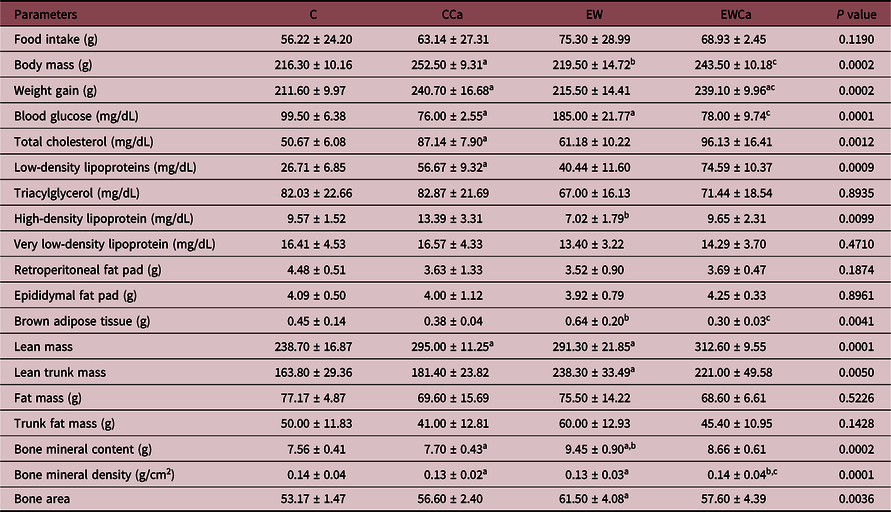
Data are shown in Table 1. The CCa group showed a 16% higher increase in body mass in comparison with its C group (P < 0.005) and a 15% higher increase in comparison with the EW group (P < 0.005), while the EWCa group showed a 10% higher increase in body mass in comparison with the EW group (P < 0.005). Corroborating these results, the CCa and EWCa groups showed a significantly higher weight gain of 13% compared with the C group (P < 0.005). The EWCa group showed a 10% higher weight gain in comparison with the EW group (P < 0.005). However, dietary intake (in weight) did not differ between the experimental groups.
Body composition, biometric, and biochemical parameters of 3-month old male rats

C, control; CCa, cocoa control; EW, early weaning; EWCa, early weaning treated with cocoa powder.
Note: Data presented as mean ± SD. Differences were tested by one-way analysis of variance and Bonferroni post hoc test, P < 0.05.
a When different from C.
b When different from CCa.
c When different from EW.
Regarding serum glucose, the animals in the EW group were hyperglycemic, with 86% (P < 0.0001), in comparison with the C group. In contrast, dietary supplementation with cocoa powder reduced the glycemia in groups CCa (24% lower serum glucose) and EWCa (58% lower serum glucose) compared to their respective C groups (P < 0.0001).
Brown adipose tissue reserves were lower in the CCa (↓ 69%) and EWCa (↓ 53%) groups in comparison with the EW (P < 0.005) group. The other fat deposits (retroperitoneal and epididymal) were similar between the groups.
Serum biochemistry
In the biochemical analyses, the CCa group showed a significant increase in TC (↑ 71%) and LDL-c (↑ 112%) levels in comparison with the C group. HDL-c was different between the CCa and EW groups, which are not comparable. However, serum TAG and very low-density lipoprotein values did not differ between the groups (Table 1).
Body composition
The CCa and EW groups showed an increase in lean mass in comparison with the C group (↑ 24% and ↑ 30%, respectively). The EW group also showed an increase in lean trunk mass (↑ 45%) in comparison with the C group. However, no differences between the groups were observed in the percentage of fat mass (g) and trunk fat mass (g).
The CCa and EW groups showed a reduction in bone mineral density in comparison with the C group (↓ 6% for both). Only the EW group showed an increase in bone mineral content (↑ 24%) and bone area (↑ 15%) in comparison with the C group.
Testicular morphology
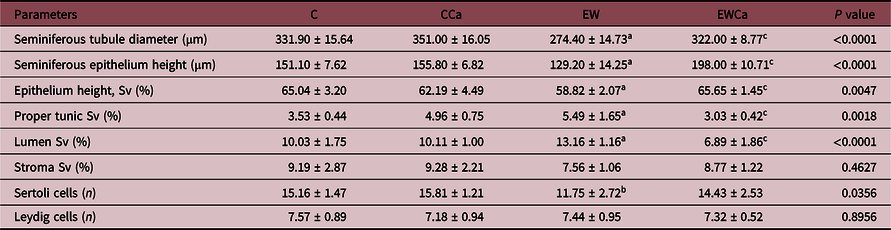
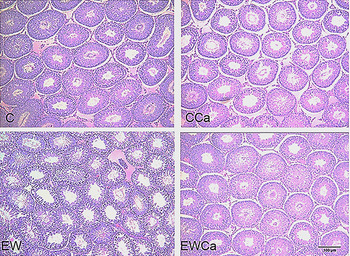
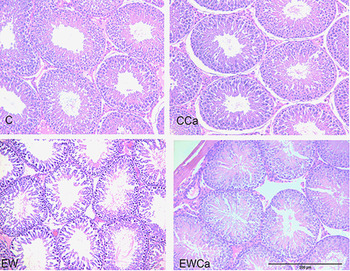
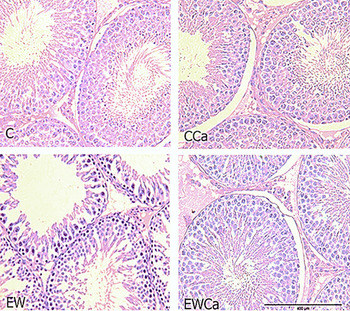
Early weaning was observed to reduce the seminiferous tubule diameter (↓ 17%) and the height of the seminiferous epithelium (↓ 15%) in the EW group, in comparison with the C group, while cocoa powder supplementation led to an increase in these parameters in the EWCa group (↑ 17%, P < 0.0001; ↑ 53%, P < 0.005, respectively) in comparison with the EW group (Table 2; Figs. 1 and 2).
Histomorphometric parameters of animals’ testicle at 3 months old

C, control; CCa, control diet treated with cocoa powder; EW, early weaning; EWCa, early weaning treated with cocoa powder; Sv, surface density.
Note: Data presented as mean ± SD. Differences were tested by one-way analysis of variance and Bonferroni post hoc test, P < 0.05.
a When different from C.
b When different from CCa.
c When different from EW.
Photomicrographs showing the seminiferous tubule diameter (100×; Hematoxylin & Eosin, Philadelphia, PA, USA) in animals at 3 months of age. C (control diet), EW (early weaning), CCa (control diet treated with cocoa powder), and EWCa (early weaning treated with cocoa powder). The seminiferous tubule diameter was smaller in the EW group in comparison with C group, which may affect sperm production. As shown in the image, treatment with cocoa powder attenuated this parameter.

Photomicrographs showing the seminiferous epithelium height (200×; Hematoxylin & Eosin) in animals at the age of 3 months. C (control diet), EW (early weaning), CCa (control diet treated with cocoa powder), and EWCa (early weaning treated with cocoa powder). Similar to the seminiferous tubule diameter, the seminiferous epithelium height was smaller in EW in comparison with the C group. As shown in the image, cocoa powder treatment attenuated this parameter.

In terms of the Sv of the tubular compartment (Table 2; Fig. 3), early weaning caused a 10% reduction in the seminiferous tubule epithelium Sv compared to the C group (P < 0.005), while cocoa powder supplementation in EWCa increased this parameter by 11%, when compared with the EW group (P < 0.005).
Photomicrographs showing surface density (Sv) (epithelium, lumen , proper tunic, and stroma) of tubular compartment (400×; Hematoxylin & Eosin) in animals at the age of 3 months. C (control diet), EW (early weaning), CCa (control diet treated with cocoa powder), and EWCa (early weaning treated with cocoa powder). The Sv of the seminiferous tubule epithelium was lower in the EW group. As shown in the image, treatment with cocoa powder increased this parameter. Conversely, early weaning increased the surface densities of the lumen and the proper tunic, but cocoa powder administration attenuated this parameter. Stroma Sv was similar between the experimental groups.

The lumen Sv increased in the EW group (↑ 31%) in comparison with the C group (P < 0.005), but cocoa treatment led to a 48% decrease in this parameter in comparison with EW (P < 0.0001). The EW group showed a 55% increase in the proper tunic Sv in comparison with the C group (P < 0.005), while the EWCa showed a 45% lower value in comparison with the EW group (P < 0.005). The Sv of the stroma in the interstitial compartment was similar among the studied groups. As for the Leydig cells, there was no significant difference between the groups. However, Sertoli cells showed a statistical difference between the CCa and EW groups (↓ 25%; Table 2).
Discussion
This study showed that maternal and postnatal cocoa powder supplementation increases body mass and causes weight gain while reduces serum glucose, TC, LDL-c, and bone mineral content in Wistar rats. In addition, it improves preservation of the testicular parenchyma, particularly in early weaned animals.
The effect of cocoa on body mass has been debated. It has been suggested that the flavonoids and catechins in cocoa lead to an increase in the muscle biogenesis and synthesis, resulting in an increased muscle mass and, consequently, increased body mass.Reference Greenberg and Buijsse20–Reference Yoshioka, Yamashita and Kishida23 Our observations of a higher lean mass in the cocoa-supplemented rats in this study corroborate these findings.
We also observed that the animals that were weaned early presented with hyperglycemia, which was partially abrogated by the use of cocoa powder, as evident from the decreased serum glucose levels, thereby corroborating the findings of other authors. A number of studies have demonstrated the effects of early weaning on blood glucose levels in rats, mainly related to decreased T-cell counts and increased inflammatory cytokines, including interferon, interleukin-4, and interleukin-10, contributing to the development of autoimmune diabetes.Reference Brugman, Visser and Hillebrands24 However, this study demonstrates that a cocoa-rich diet is helpful in the regulation of blood glucose levels, improved glycemic control, and better insulin sensitivity. Such an effect could be the result of soluble fibers as well as flavonoids found in cocoa.Reference Sánchez, Moulay and Muguerza25,Reference Álvarez-Cilleros, López-Oliva and Goya26 In addition, cocoa is rich in a number of saturated fatty acids, including palmitic acid and stearic acid, which may have contributed to increased serum TC and LDL-c levels.Reference Mustiga, Morrissey and Stack27–Reference Ooi, Watts and Ng29
A very interesting observation in the study is that the animals of the EW group showed an improved bone mineral content and bone area. Another study has shown that animals weaned on the 18th d of lactation show similar characteristics when compared with those weaned at the correct time (21 d).Reference de Albuquerque Maia, Lisboa and de Oliveira30 Based on these observations, we believe that the early weaned animals could have had increased levels of leptin, a bone hormone that can stimulate the production of osteoblastic maturation markers such as alkaline phosphatase, osteocalcin, and type I collagen.Reference de Albuquerque Maia, Lisboa and de Oliveira30 However, we did not perform an analysis of leptin in the serum, or that of the constituents of leptin-signaling pathways in the bones, which could be a limitation of this study.
The supplementation with theobromine (the compound present in Theobroma cacao) has beneficial effects on the bone health of rats (longer and thicker femurs and better tibial trabecular parameters).Reference Clough, Ylostalo and Browder31,Reference Seem, Yuan and Tou32 However, our study showed no significant difference in the bone mineral content and the bone area of animals supplemented with cocoa powder, suggesting the need for further studies to clarify the effects of cocoa administration on bone parameters.
Cocoa powder supplementation improved the seminiferous tubule diameter and the seminiferous epithelium height of testicular cells, parameters that were found to be negatively affected by early weaning. These changes occurred regardless of the variation in the number of Leydig and Sertoli cells. The fact that we did not study these animals in later life and did not measure serum testosterone levels is another important limitation of the study. What we can say is that the lower activity of the enzymes, superoxide dismutase and malondialdehyde, is suspected to be the result of oxidative stress generated by early weening.Reference Kanter, Aktas and Erboga33 The hyperglycemia noticed in the early weaned animals can induce the production of free radicals, which are harmful for the plasma membrane integrity, thus impairing the histoarchitecture and functionality of the testes.Reference Rashid and Sil34
We also observed that cocoa powder supplementation increased the Sv of the epithelium in the EWCa group, in comparison with the EW group. The nutritional composition of cocoa, rich in polyphenols and micronutrients such as vitamin C (both antioxidants), may explain its protective effect on male gonads. Different studies have shown that antioxidant intake minimizes testicular damage induced by oxidative stress and that vitamin C may be protective for testicular morphology and functionality.Reference Kanter, Aktas and Erboga33,Reference Rashid and Sil34 Similarly, flavonoids and procyanidins (epicatechin, catechin, and procyanidins) present in cocoa suppress the expression of enzymes involved in oxidative damage to the testes, such as 8OH2 dG (8-hydroxy-2-deoxyguanosine), thereby preserving testicular morphology.Reference Azari, Gholipour and Kheirandish35
Observations made in this study suggest that early weaning can alter the testicular histoarchitecture, which can impair sperm production in adulthood. Therefore, cocoa powder supplementation could be effective in the protection of testicular morphology, and consequently, ensuring the reproductive health during adulthood.
Acknowledgments
The authors would like to thank Matheus Naus for his technical assistance. This research did not receive any specific grant from funding agencies in the public, commercial, or not-for-profit sectors.
Financial Support
This research received no specific grant from any funding agency, commercial or not-for-profit sectors.
Conflicts of Interest
None.