Introduction
Although cognitive ability has a heritable component, environmental influences are also likely to play a substantial role. Nutritional status in utero, for which birth weight is often used as an indicator, is one such environmental influence that may affect brain development,Reference Morgane, Austin-La France and Bronzino 1 However, as birth weight also has a considerable heritable component, any association with birth weight may be equally mediated by genetic factors.Reference Boomsma, van Beijsterveldt, Rietveld, Bartels and van Baal 2
Very low birth weight babies are known to be less well developed in terms of cognitive function in childhood,Reference Drillien 3 – Reference Orchinik, Taylor and Espy 6 and early adulthood.Reference Richards, Hardy, Kuh and Wadsworth 5 , Reference Richards, Hardy, Kuh and Wadsworth 7 – Reference Pyhälä, Lahti and Heinonen 10 An association between birth weight and later cognition, even within the normal birth weight range in term births, has been seen in some studies,Reference Shenkin, Starr and Deary 11 – Reference Erickson, Kritz-Silverstein, Wingard and Barrett-Connor 15 but not in others.Reference Shenkin, Starr and Pattie 16 – Reference Costa, Kale and Luiz 18
Height in adulthood has been consistently related to cognition in adulthood.Reference Richards, Hardy, Kuh and Wadsworth 7 , Reference Tuvemo, Jonsson and Persson 19 – Reference Laitala, Hjelmborg and Koskenvuo 21 Less is known regarding the relationship between cognition and height in early adulthood, although height in childhood has been shown to be positively associated with cognitive ability.Reference Richards, Hardy, Kuh and Wadsworth 7 , Reference Pearce, Deary, Young and Parker 17 , Reference Daniels and Adair 22 However, it is unclear whether such a relationship persists, or whether it diminishes with age. Obesity has been associated with cognitive function at a range of ages,Reference Smith, Hay, Campbell and Trollor 23 although the association may have a bi-directional component, particularly in later life. Childhood malnutrition has also been linked to poorer cognition.Reference Liu, Raine, Venables, Dalais and Mednick 24
The vast majority of the studies linking either birth weight or height with cognition have been in developed countries, so it is unclear if the same findings would be seen in other, less developed, settings. Although Australia is a developed country, it includes a disadvantaged Aboriginal Australian population. Australian Aborigines have low birth weight rates more than double those of the non-Aboriginal population (13% compared with 6%). 25 With such high rates of adverse fetal growth, it is important to study whether the links between birth weight and later cognition are seen in this population. Moreover, traditional cognitive assessment tools are mostly inappropriate for populations such as Indigenous Australians, as they tend to rely heavily on the use of both spoken and written English language and unfamiliar concepts.
This study, using prospectively recorded data from the Australian Aboriginal birth cohort study,Reference Sayers, Mackerras and Singh 26 investigated the relationships between cognitive function in early adulthood and birth weight and contemporary height.
Materials and methods
Participants in this study were members of the Australian Aboriginal birth cohort. To be eligible for this cohort, a baby had to be a singleton born at Royal Darwin Hospital between January 1987 and March 1990 to a mother self-identified and recorded as Aboriginal in the Delivery Suite Register. This resulted in 686 Aboriginal babies (of the 1238 eligible babies) being recruited.Reference Sayers, Mackerras and Singh 26 There were no significant differences in the mean birth weight, low birth weight rates or sex ratio between those recruited and those not.Reference Sayers, Mackerras and Singh 26 At the time of recruitment, the Royal Darwin Hospital was the routine place of delivery for 98% of Aboriginal mothers within the local health region of 120,000 km2, and the tertiary referral hospital for high risk deliveries transferred in utero from a sparsely populated vast area covering 2 million km2 of northern Australia. Hence the cohort consists of both routine deliveries and also those deliveries resulting from the high risk in uteri referrals.
Information on a number of factors, including birth weight, gestational age, maternal age, growth, residential status (as a surrogate for socio-economic status), and cognition was recorded prospectively for study members. Measures of weight, length and head circumference were taken at birth. Gestational age was estimated within 4 days of birth by the same neonatal paediatrician using the Dubowitz scoring system,Reference Dubowitz, Dubowitz and Goldberg 27 previously evaluated for Aboriginal babies.Reference Sayers and Powers 28
Along with the continuous measure, birth weight was categorized into two groups for size; <2.5 and >2.5 kg and a further two groups for fetal growth restriction; <10th percentile or not, using post-natal gestational age estimations and an Australian-based reference standard contemporary with the time of recruitment.Reference Sayers, Mackerras, Halpin and Singh 29
Residence, at the time of follow up, was defined as remote (residence in defined remote Aboriginal communities) or non-remote (residence within the twin cities of Darwin and Palmerston, the greater Darwin area and smaller rural towns).
Measures of adult height, weight, age and cognition were taken between December 2005 and January 2008. Participants were measured while wearing light clothing and no shoes. Weight was measured, once, to the nearest 0.1 kg using a digital electronic scale (model TBF-521; Tanita Corp, Arlington Heights, IL), and height to the nearest millimetre with a portable wall-mounted stadiometer. Body mass index (BMI) was calculated from height and weight. Height from this period was standardized using the Centers for Disease Control and Prevention (CDC) 2000 growth reference.Reference Kuczmarski, Ogden and Grummer-Strawn 30 Standardised training was given to all assessors of height and weight. Maternal age was collected from the hospital birth records at the time of recruitment of the baby into the study.
Cognitive assessment
Cognitive function was assessed using the CogState computerized cognitive test battery (CogState Ltd, Melbourne, Australia, www.cogstate.com). CogState is a non-verbal, computerized, cognitive assessment developed for the assessment of diverse groups,Reference Cairney and Maruff 31 and previously shown to be valid in terms of reliability and minimal practice effects in a sample of Indigenous Australian adolescents.Reference Dingwall, Lewis, Maruff and Cairney 32 The battery in this study consisted of three tasks that are based on playing cards displayed on a computer screen. By using playing cards, it is independent of language, culture and socio-economic background. The tasks were as follows:
-
(1) Simple reaction time (SRT): This is a measure of psychomotor speed in which one playing card is shown face down on the computer screen, with an instruction to press the ‘yes’ key as quickly as possible whenever the card is turned face up. This is repeated 35 times, randomly. A lower score reflects better performance.
-
(2) Choice reaction time (CRT): This measures CRT and decision making attention. A face-down playing card is displayed on the screen. When the card is flipped over, if it is red, the participant should press the ‘yes’ key, and if it is not red, then the participant should press the ‘no’ key. This is repeated 30 times, again randomly. A lower score reflects better performance.
-
(3) WM: This measures primarily WM, but also psychomotor speed and visual attention. Each time a card is revealed, the participant must decide whether he/she has been shown that card before in this task and respond by pressing the ‘yes’ or ‘no’ key. The participant should, therefore, try to remember all the cards that are presented in this task. The procedure is repeated 30 times, again randomly. A higher score reflects better performance
The tasks within the CogState battery were always tested in the order in which they are listed above. The overall duration for the battery to be completed was between 7 and 10 min.
Statistical analysis
Sex differences in cognition (SRT, CRT, WM) were tested using the Wilcoxon rank sum test. Associations between cognition and explanatory variables were estimated using linear regression. Regression coefficients are presented with accompanying 95% confidence intervals. Gestational age, birth weight, age, heights, BMI and maternal age were treated as continuous variables. Residential status sex, low birth weight and fetal growth restriction were treated as categorical variables. Cohort members with missing data were included in all analyses for which they contributed complete data (i.e. complete data for all variables included in a particular model). Multiple adjusted models were formed to ensure that the various measures of birth size and fetal growth were not included in the same models. All statistical analyses were done using the Stata statistical software package, version 12.0 (StataCorp, College Station, TX).
Results
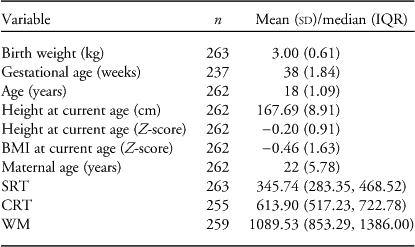
During data collection between 2005 and 2008, 263, 255 and 259 study members took part in the SRT, CRT and WM tasks, receptively (Table 1). Of those that took part in the cognition testing, 46% were male (54% female) and 74% were remote residents. Despite small differences in the participation numbers between the different cognitive tests, means and standard deviations/medians and inter-quartile ranges were the same across variables investigated, therefore descriptive statistics are shown for the maximum sample available in Table 1.
Descriptive statistics, continuous variables

IQR, inter-quartile range; BMI, body mass index; SRT, simple reaction time; CRT, choice reaction time; WM, working memory.
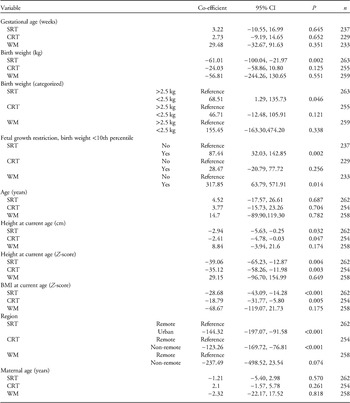
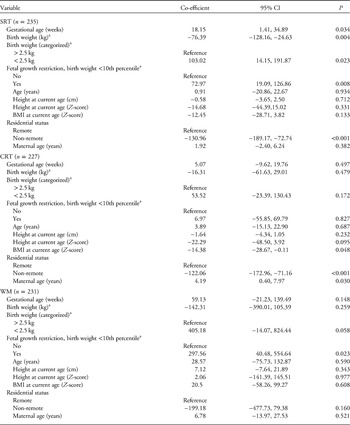
No difference in any of the cognitive outcome variables (SRT, CRT and WM) was seen between males and females (P=0.424, 0.826, 0.552, respectively). A significant negative association between SRT and birth weight was seen (Table 2) which remained, with greater magnitude, after adjustment for gestational age, maternal age and residential status (Table 3). This significant negative association also remained when birth weight was categorized, above and below 2.5 kg (P=0.046, adjusted P=0.023) with low birth weight associated with longer reaction times. There were neither significant associations between gestational age and cognition, nor any association with birth weight and the remaining tests. Having had fetal growth restriction was significantly associated with longer SRT (P=0.002, adjusted P=0.008). However, having had fetal growth restriction was also associated with a greater proportion of correct responses to the WM task (i.e. better WM) (P=0.014, adjusted P=0.023). There were 28 individuals born pre-term (i.e. <37 weeks gestation) that completed the CogState battery. Being born premature was not significantly associated with any of the cognitive tests.
Univariate linear regression results

SRT, simple reaction time; CRT, choice reaction time; WM, working memory.
Results of the adjusted linear regression models for the three cognitive outcomes

SRT, simple reaction time; BMI, body mass index; CRT, choice reaction time; WM, working memory.
a Birth weight was not included as an adjustment for birth size or fetal growth-related variables. These early growth data were also not included within the same models, with only birth weight (kg) used as an adjustment factor for the non-fetal growth related variables.
Age of the participants undertaking cognitive assessments ranged from 17 to 19 years (Table 1) and no significant associations were seen between age and any of the outcomes. Maternal age, at the date of birth of the participants, ranged from 18 to 26 years and also showed no significant associations with any of the outcomes.
Both contemporary height measures (raw and Z-score) showed significant, negative, associations with both SRT and CRT (Table 2). However, neither remained significant after adjustment for gestational age, maternal age and residential status (Table 3). BMI (Z-score) was significantly negatively associated with SRT and CRT, but not with WM. After adjustment for gestational age, maternal age and residential status, the remaining association with CRT showed a decrease in reaction time with increasing BMI Z-score.
Those with non-remote residential status performed significantly better in SRT and CRT than those with remote residence. While a borderline significant result with WM (with a reduced proportion of correct responses in the WM task among urban participants), this was not significant in the adjusted model.
Models were valid in terms of adhering to the assumptions underlying linear regression and no outliers were detected.
Discussion
In this cohort of Indigenous Australians, a significant association was seen between birth weight and SRT in early adulthood, but not with the other two cognitive measures. Urban residents had significantly lower SRT and CRT than their remote counterparts. Contemporary BMI and maternal age were associated with CRT, while only fetal growth restriction was associated with WM. No associations were seen with contemporary height.
Our finding of a negative association between birth weight and SRT is consistent with previous studies that have shown associations between low birth weight and cognition in early adulthood.Reference Richards, Hardy, Kuh and Wadsworth 5 , Reference Richards, Hardy, Kuh and Wadsworth 7 – Reference Erickson, Kritz-Silverstein, Wingard and Barrett-Connor 15 Specifically to reaction times, Strang-Karlsson et al.’s study of the Helsinki birth cohort showed that adults who were born at very low birth weights had slower reaction times than control adults.Reference Strang-Karlsson, Andersson and Paile-Hyvärinen 9 However, while our findings are consistent for SRT this appears to be the first time this has been shown in the whole birth weight range of a population, Strang-Karlsson et al. also showed associations with other cognitive outcomes from the CogState battery, including CRT and WM, with worse performance in those born at very low birth weights.Reference Strang-Karlsson, Andersson and Paile-Hyvärinen 9 A study of neuromotor function also found lower SRT in children (5–7 years old) who had been very low birth weight babies, although this was a cycling-based test, rather than the card-based test used in this study.Reference Keller, Ayub, Saigal and Bar-Or 33 The finding of greater WM in those with fetal growth restriction was in the opposite direction to that expected, and to that reported by Strang-Karlsson et al. Reference Strang-Karlsson, Andersson and Paile-Hyvärinen 9 While this may reflect a difference in the study populations included, or relate to an unmeasured exposure or compensatory mechanism during the prenatal or post-natal period, it may also be due to residual confounding or chance.
While previous studies have shown associations between height in adulthood and cognition in adulthoodReference Richards, Hardy, Kuh and Wadsworth 7 , Reference Tuvemo, Jonsson and Persson 19 – Reference Laitala, Hjelmborg and Koskenvuo 21 and between height in childhood and cognitive ability,Reference Richards, Hardy, Kuh and Wadsworth 7 , Reference Pearce, Deary, Young and Parker 17 , Reference Daniels and Adair 22 no such associations were seen in this study. No previous associations appear to have been reported between adult height and any of the three specific cognitive outcomes in this study.
A number of previous studies have shown a stronger effect of socio-economic status on childhood cognition than that seen for birth weight.Reference Shenkin, Starr and Pattie 16 , Reference Somerfelt, Andersson and Sonnander 34 – Reference Jefferis, Power and Hertzman 35 There is no measure of socio-economic status available for the Australian Aboriginal population. However, the residential status of remote and non-remote recorded at the time of follow-up, can be used as proxy for socio-economic status with the presumption of being more disadvantaged with a residential status of remote. Those with a non-remote residence had lower simple and CRT when compared with those in a remote residence. This may reflect such factors as schooling and exposure to computers which are greater with a non-remote residence and less likely to reflect nutritional status which would be expected to operate in the opposite direction.
Obesity has been associated with cognitive function at a range of ages,Reference Smith, Hay, Campbell and Trollor 23 although the association may have a bi-directional component. In contrast, we found a negative association between contemporary BMI and CRT. Given that the mean BMI Z-score was nearly half a standard deviation below zero, this does not reflect a likely influence of obesity or overweight, of which there were few in this population. Instead, better cognitive performance in terms of CRT in those with higher BMI is likely to reflect nutritional status being better in those in the normal BMI range, and that underweight can be associated with cognition as well as overweight.Reference Liu, Raine, Venables, Dalais and Mednick 24
Strengths and weaknesses
The main strength of this study is that prospectively collected data on early life experience, including fetal growth, gestational age and maternal age, could be analysed, in relation to three cognitive outcomes variables, alongside later measures of adult height and residential status in an Australian Aboriginal population. Rather than using the cognitive assessment methods often used in populations in developed countries, we used the CogState battery, which is much more appropriate and less to prone to bias in this population. To our knowledge, no other study has used the CogState battery to assess associations between early growth and later cognition over the entire birth weight range.
It has also been proposed that genetic factors and parental education levels may mediate the relationship between birth weight and cognitive ability.Reference Boomsma, van Beijsterveldt, Rietveld, Bartels and van Baal 2 , Reference Gorman 36 Maternal education and duration of breastfeeding have been linked with cognition.Reference Oddy, Kendall and Blair 37 We were unable to take account of these possible confounding factors in this investigation. However, for breastfeeding, as the vast majority of Aboriginal infants were breastfed, 38 this is unlikely to have introduced much in the way of confounding. Similarly data were not available for maternal height or BMI.
Although a postnatal classification of fetal growth restriction may not be ideal, it was necessary in this study as 70% of mothers did not know their last menstrual period and only 7% of mothers had a dating ultrasound before 14 weeks.Reference Sayers and Powers 28 The Dubowitz scoring system used has been evaluated previously and, was found to provide valid estimates of gestational age in Aboriginal neonates.Reference Sayers and Powers 28 The use of the CDC growth reference fits the CDC view that only set of growth charts is needed to cover all racial and ethnic groups and is supported by research evidence from a number of studies, including one in the Canadian Aboriginal population. 39 While the high breastfeeding rates in the Aboriginal population may make using the CDC references difficult in early life, this is less of an issue for the heights measured at the same as the cognitive assessments.
We were not able to control for the presence of colour-blindness or other problems with vision or with fine motor skills. However, there are likely to be few participants with conditions severe enough to impact on performance in the CogState battery, and such individuals would be unlikely to take part in the battery (or give a very low score, which we did not see). We were also unable to assess changes in nutritional status in childhood and how that would relate to changes in neurodevelopmental outcomes.
Different findings in terms of associations with the three cognitive outcome variables may reflect an issue with the sample size in this population, in that additional significant findings may have been seen with a larger sample. However, it may also reflect true differences in which factors influence different aspects of cognition, or differences between the way factors influence cognition in this population compared with other populations. In particular, the inconsistent findings for early growth are mirrored by the findings for residential status, with both fetal growth restriction and remote residence associated with greater WM.
Conclusion
In this cohort of Indigenous Australians, significant associations were seen between a range of factors and cognition in early adulthood. However, the associations differed depending on the outcome measure, but included birth weight inversely associated with SRT and fetal growth restriction associated with greater WM. Reactions times differed between non-remote and remote-based participants, suggesting that aspects of life, possibly related to socio-economic status play a role in influencing this aspect of cognitive function. No associations were seen with contemporary height. These results suggest that fetal growth may be more important than the factors influencing post-natal growth in terms of cognition in early adulthood in this population, but may be inconsistent between different cognitive outcomes. Further research is required to identify whether similar associations are seen in other, similar, populations, and to assess why differences in cognitive outcome measures are seen.
Acknowledgements
The authors thank the dedicated ABC research team who traced participants and collected the data. They thank Dr Sheree Cairney for helping the study to access and use the CogState battery. They also thank the young adults belonging to the cohort for their co-operation and all the individuals who helped in the urban and rural locations.
Financial Support
This work was supported by the National Health and Medical Research Council of Australia, the Channel 7 Children’s Research Foundation of South Australia, the National Heart Foundation and a Northern Territory Government Research and Innovation Grant. MSP and KDM’s collaboration with this study was funded by a Royal Society Travel Exchange Award.
Conflicts of Interest
None.
Ethical Standards
The Human Research Ethics Committee of the NT Department of Health & Families and Menzies School of Health Research, including the Aboriginal Ethical Sub-committee which has the power of veto, approved the study. Written consent was obtained in the form of an itemized consent with participant allowed to refuse individual procedures.