Many sequential bilingual children in the United States learn a first language (L1) at home and begin to learn English as a second language (L2) upon entering preschool or kindergarten. In these cases, L1 acquisition occurs in the early stages of brain development, whereas L2 learning occurs at a relatively advanced cognitive state (e.g., MacWhinney, Reference MacWhinney, Kroll and DeGroot2005). Because of different ages and contexts of language learning, sequential bilingual children provide a unique window to investigate experience and age-related factors for language development as well as cross-linguistic interactions in a within-subjects design (Kohnert, Kan, & Conboy, in press).
The purpose of this study is to investigate linguistic cues to meaning in Vietnamese and in English among typically developing sequential bilingual children. Vietnamese and English are highly contrastive languages (for a cross-linguistic comparison; see Tang, Reference Tang2006). Vietnamese is an isolating Asian language that uses tone to distinguish meaning between words, whereas English is an inflected Indo-European language that uses bounded morphemes to express plurality (e.g., -s in cats), possession (Jack’s), and verb tense (walked). Although these two languages share some speech sounds and some general types of permissible word ordering in sentences, there are no shared cognates or other grammatical markers (Tang, Reference Tang2006). Based on 2000 US Census data, the number of children learning these two languages has been growing, with over 1.1 million Vietnamese living in the United States and nearly 27% under the age of 18 (Reeves & Bennett, Reference Reeves and Bennett2004). No studies are available on Vietnamese sentence interpretation among monolingual or bilingual populations. In this study, we examine how children who speak Vietnamese (L1) and English (L2) use cues from their typologically different languages to process meaning at the sentence level. We begin with a review of the most relevant bilingual and developmental sentence interpretation literature, followed by a description of cue selection for the study of Vietnamese sentence interpretation.
THE COMPETITION MODEL (CM) AND PATTERNS OF CUE USE IN SENTENCE INTERPRETATION BY BILINGUAL ADULTS
According to the CM (Bates & MacWhinney, Reference Bates, MacWhinney, Wanner and Gleitman1982, Reference Bates, MacWhinney, MacWhinney and Bates1989), the strength of a linguistic cue is determined by its frequency and reliability in a given language. When two or more cues have been experimentally pitted against each other, the “winning” cue provides information about how listeners extract meaning based on statistical information from the target language (Bates & MacWhinney, Reference Bates, MacWhinney, MacWhinney and Bates1989). On experimental sentence interpretation tasks, English speakers rely heavily on word order cues. In canonical sentences, that is, sentence structures characteristic of the English language such as noun–verb–noun (NVN), monolingual English speakers consistently choose the first noun as the agent or “doer,” which reflects the highly frequent and reliable subject–verb–object (SVO) word order in English (e.g., Bates, McNew, MacWhinney, Devescovi, & Smith, Reference Bates, McNew, MacWhinney, Devescovi and Smith1982). In contrast, word order has been found to be a relatively weak cue in Chinese, a language that allows for much greater variation of word order within a sentence (Sun & Givón, Reference Sun and Givón1985). Instead, animacy has been found to be a stronger cue to meaning for Chinese adults (Liu, Bates, & Li, Reference Liu, Bates and Li1992; Miao, Reference Miao1981; Su, Reference Su2001). With a sentence such as “The ball hits the boy,” a native Chinese listener would most likely choose “boy” as the agent instead of “the ball” because of a preference for the animate noun (living thing) as the initiator of the action. For the same sentence, a native English speaker is expected to choose “ball” as the doer, relying on word order as the most robust cue to agency.
Although originally developed for the cross-linguistic investigation of sentence processing, the CM has been applied to bilingual populations to determine if and how language-specific cues converge or compete within individual speakers. Within the CM, there are four potential patterns of cue use for bilingual listeners (Kilborn & Ito, Reference Kilborn, Ito, MacWhinney and Bates1989). First, L1 cues may be applied to the L2, a pattern known as forward transfer. Second, L2 cues may supplant original sentence processing strategies used in the L1, a pattern referred to as backward transfer. Third, an amalgamation, or combination of L1 and L2 cues, may be used to interpret meaning in both languages. Fourth, language-specific cues may be applied exclusively to each language in ways similar to monolingual speakers of the L1 and L2. Varying degrees of empirical support for each of these four patterns have been found in studies with bilinguals who differed in the two languages learned, the age at which this learning took place, and level of proficiency attained in the L2, or maintained in the L1.
Forward transfer, in which L1 strategies are applied to the relatively newer language, is the most common pattern found among adult L2 learners (e.g., Liu et al., Reference Liu, Bates and Li1992; Su, Reference Su2001). For speakers of Chinese (L1) and English (L2), forward transfer is manifested as the use of animacy (L1 cue) to process sentences in the L2. Liu and colleagues (Reference Liu, Bates and Li1992) investigated sentence interpretation among subgroups of Chinese–English bilingual adults who learned English (L2) before age 4, during childhood (ages 6–10), adolescence (12–16 years) and adulthood (after age 20). Based on their findings, the only subgroup that exhibited forward transfer was the adult L2 learner group. Similarly, Su (Reference Su2001) found that Chinese adult L2 learners with beginning, intermediate, and advanced levels of English exhibited forward transfer to varying degrees in processing sentences in their L2. Presumably, greater experience and proficiency in the L1 serves as a reference point for interpreting the relatively newer language by adult learners. Forward transfer has also been observed in other language domains including phonology and syntax (for a review, see MacWhinney, Reference MacWhinney, Kroll and DeGroot2005).
At one time it was thought that the L1 in older language learners was essentially crystallized and impervious to the influence of experience in another language (e.g., for a review, see Long, Reference Long1990). As such, it was largely predicted that cross-language transfer would be unidirectional, with the L1 affecting the L2 but not the reverse. This does not appear to be the case. Adult learners who have varying L2 proficiencies may also exhibit some backward transfer, with the more recently acquired L2 affecting sentence interpretation in the L1 (e.g., Dussias & Sagarra, Reference Dussias and Sagarra2007). Su (Reference Su2001) compared Chinese adults with beginning, intermediate, and advanced levels of English to monolingual Chinese controls. Chinese adults with beginning English skills did not differ from L1 monolingual controls and relied heavily on animacy to interpret Chinese sentences (≥84% of total variance). However, Chinese adults with intermediate and advanced levels of English relied on animacy as well as word order cues to process sentences in Chinese, with word order accounting for 52 and 63% of total variance for intermediate and advanced English groups, respectively. Although Chinese adults with strong English skills did not use word order to the same degree as monolingual English controls (for whom word order accounted for 99% of total variance), it was apparent that their English (L2) skills influenced sentence processing in their L1, Chinese.
Patterns of cue use are not as straightforward among bilingual adults who learned the L2 at earlier ages. Liu and colleagues (Reference Liu, Bates and Li1992) found that Chinese speakers who learned English (L2) during childhood or adolescence did not exhibit forward transfer. Subgroups who learned English (L2) as infants (0–4 years), children (6–10 years), and teenagers (12–16 years) performed the same as monolingual English controls in processing sentences in English. For these three subgroups, Chinese (L1) did not seem to impact English (L2) sentence interpretation. Subgroups that learned English (L2) during adolescence (ages 12–16) and childhood (ages 6–10) showed degrees of differentiation in their cue use across languages relying more on word order in English and animacy in Chinese. The subgroup who learned English (L2) in very early childhood (ages 0–4) did not differentiate between languages, but instead used word order, a cue most consistent with English, to process both languages. Liu and colleagues (Reference Liu, Bates and Li1992) reported this pattern as complete backward transfer because English cues (L2) completely supplanted Chinese (L1) cues that were purportedly present before L2 acquisition. Consistent with their experimental performance, the group that learned English before age 4 self-reported that English was their dominant language even though it was chronologically their L2. Thus, it seemed that for this group, their dominance or greater proficiency in English was reflected in their reliance on word order for interpreting both Chinese and English sentences.
Hernandez, Bates, and Avila (Reference Hernandez, Bates and Avila1994) conducted a sentence interpretation study that included bilingual Spanish–English adults who, on average, learned English (L2) upon entering kindergarten (age 5). Three cues were investigated: word order, NV agreement, and animacy. They found that monolingual English controls heavily relied on word order (82% of total variance), followed by agreement (14%) and animacy (1%), whereas monolingual Spanish controls relied more on NV agreement (67%) followed by animacy (28%) and word order (<1%). The bilingual group showed partial differentiation of cue use across languages with relatively greater use of word order in English and agreement in Spanish. However, the bilingual group did not use word order in English to the same degree as the monolingual English group (59% vs. 82%), but they used relatively more agreement and word order cues in Spanish compared to monolingual Spanish speakers (77% and 10%, respectively, vs. 67% and <1%, respectively). Unlike Spanish monolinguals, animacy was not a strong cue for Spanish within the bilingual group (<5%). Overall, proficient bilingual adults who learned the L2 in childhood appeared to be somewhere “in between” monolingual peers in terms of the cues they used to interpret sentences (Hernandez et al., Reference Hernandez, Bates and Avila1994). No studies on sentence interpretation have found complete differentiation of strategies between the L1 and the L2 for proficient bilinguals, providing empirical support for the argument that a bilingual is not the simple equivalent of two monolinguals (Grosjean, Reference Grosjean1989). Instead, bilingual adults present complex patterns of cue use based on age of L2 acquisition, contexts of L2 learning, and L1 maintenance.
We found no studies that used direct or objective measures of language performance to examine potential relationships between L1–L2 proficiency and the preferred cues when interpreting sentences. The few studies that have examined how language ability may impact sentence interpretation have used subjective or self-report measures. Liu and colleagues (Reference Liu, Bates and Li1992) used a questionnaire to obtain information on age of L2 acquisition, years of exposure, language proficiency, and usage. Proficiency was indexed by self-reported ratings on speaking, listening, reading, and writing in Chinese and in English, and usage was separated by language and reported across contexts of family, outside the family, and self (e.g., dreaming, swearing, adding/subtracting). Liu and colleagues (Reference Liu, Bates and Li1992) found that age of L2 acquisition, language proficiency, and language usage were all related, in somewhat different ways, to patterns of cue use for sentence interpretation. Acquisition of the L2 during childhood or adolescence was associated with backward transfer, whereas forward transfer was a hallmark of adult L2 learners. Higher Chinese language proficiency related to higher occurrence of forward transfer and less occurrence of differentiation of cue use between languages. English language proficiency was not significantly related to patterns of cue use, but use of English within the family related to patterns of backward transfer and differentiation.
Hernandez and colleagues (Reference Hernandez, Bates and Avila1994) used the same questionnaire from Liu et al. (Reference Liu, Bates and Li1992) for Spanish–English bilinguals. Because the bilingual group was relatively homogenous in age of L2 acquisition (on average at 5 years), this factor was not included in the analysis. Based on a series of correlational analyses, Hernandez et al. (Reference Hernandez, Bates and Avila1994) found that Spanish–English bilinguals who performed less like monolingual English controls tended to report higher levels of Spanish and higher frequency of Spanish use. Conversely, bilinguals who appeared more like monolingual English controls tended to use less Spanish and have lower levels of Spanish skill, although this relationship did not reach statistical significance. In general, these analyses suggest that age of L2 acquisition, language proficiency, and language use are pertinent factors related to strategy use for sentence interpretation.
Self-reported measures of language proficiency are frequently used in the adult L2 literature. Self-rated measures of language proficiency have not been used with young children, perhaps because early elementary school-aged children have been found to rate themselves higher compared to direct measures or teacher/parent report in other developmental areas such as self-concept (Eccles, Wigfield, Harold, & Blumenfeld, Reference Eccles, Wigfield, Harold and Blumenfeld1993; Davis-Kean & Sandler, Reference Davis-Kean and Sandler2001) and intelligence (Stipek & Mac Iver, Reference Stipek and Mac Iver1989). For present purposes, we used direct measures of selected aspects of L1 and L2 ability to index proficiency in bilingual children.
SENTENCE INTERPRETATION BY CHILDREN
Numerous developmental studies have examined sentence interpretation in different languages including Chinese (Miao, Chen, & Yin, Reference Miao, Chen and Yin1984), Spanish (Reyes, Reference Reyes2003), Dutch (McDonald, Reference McDonald1986), Hungarian (MacWhinney, Pleh, & Bates, Reference MacWhinney, Pleh and Bates1985), English (Bates et al. Reference Bates, MacWhinney, Caselli, Devescovi, Natale and Venza1984), and Italian (Bates et al., Reference Bates, MacWhinney, Caselli, Devescovi, Natale and Venza1984; Devescovi, D'Amico, & Gentille, Reference Devescovi, D'Amico and Gentille1999). Studies have mostly supported the prediction based on the CM that the sequence of development primarily depends on cue validity: the most frequent and reliable cue in the ambient language will be a child's first acquired cue (Bates & MacWhinney, Reference Bates, MacWhinney, MacWhinney and Bates1989). Bates et al. (Reference Bates, MacWhinney, Caselli, Devescovi, Natale and Venza1984) compared the development of sentence interpretation cues among English- and Italian-speaking children, ages 2, 3, 4, and 5, and adults. Three cues were investigated: word order, animacy, and contrastive stress. English and Italian consist of similar variations for word order; but in English the word order consistently indicates the actor and agent of a sentence, whereas in Italian there may be multiple interpretations for a given word order. Consistent with characteristics of each language, researchers found that English speakers relied on word order more than any other cue at every age, but word order was not a strong cue for Italian speakers, who relied relatively more on animacy at every age (Bates et al., Reference Bates, MacWhinney, Caselli, Devescovi, Natale and Venza1984). There were, however, developmental differences in cue choice for noncanonical sentences.
In a subsequent study of Italian children, Devescovi, D'Amico, and Gentille (Reference Devescovi, D'Amico and Gentille1999) included NV agreement as a linguistic cue. They found that although younger Italian children, aged 5 to 10, primarily relied on animacy, Italian adults overwhelmingly relied on agreement. Developmental changes in cue preference have been found across languages similar to Italian such as French (Kail, Reference Kail, MacWhinney and Bates1989) and Spanish (Reyes, Reference Reyes2003) as well as typologically distant languages such as Chinese (Miao et al., Reference Miao, Chen and Yin1984). Miao and colleagues (Reference Miao, Chen and Yin1984) investigated the use of animacy and word order cues in Chinese speakers, ages 4, 5, 7, 10, and 13, and adult. As with previous studies (Liu et al., Reference Liu, Bates and Li1992; Miao, Reference Miao1981; Su, Reference Su2001), Chinese adults relied heavily on animacy. However, children ages 5 to 7 relied relatively more on word order (Miao et al., Reference Miao, Chen and Yin1984). Cognitive or linguistic constraints (associated with age and language ability) may account for developmental differences observed in cross-linguistic studies. Sequential bilingual children serve as a unique window into examining within-speaker relationships between age and language proficiency because acquisition for each language begins at a different age of development.
In contrast to cross-linguistic studies with monolingual children, there is little information on how cues compete, separate, or converge within developing bilinguals. We have found only a single study on this topic, which, according to the authors, was the first to investigate sentence interpretation for both languages in developing bilingual children. Using a cross-sectional design, Reyes and Hernandez (Reference Reyes and Hernandez2006) examined online sentence interpretation in Spanish and English with participants ranging from 5 years of age to college age. Participants primarily consisted of sequential bilingual learners living in a southwestern state of the United States who spoke Spanish (L1) at home and learned English (L2) beginning with school attendance at approximately 5 years of age. Based on previous monolingual developmental studies of Spanish (Reyes, Reference Reyes2003) and English (Bates et al., Reference Bates, MacWhinney, Caselli, Devescovi, Natale and Venza1984), two prominent cues were investigated: NV agreement for Spanish (L1) and word order for English (L2). For present purposes, we focus on choice data for the youngest two groups. The 5- to 7-year-old group used a complete amalgamation of cues, relying on both word order and NV agreement to interpret sentences in Spanish and English; the 8- to 10-year-old group showed slight differentiation between languages when word order was canonical in Spanish and noncanonical in English (i.e., VNN). It was unclear if this interesting shift in patterns was due to cognitive maturation, changes in language proficiency, or both. Although expressive and receptive vocabulary measures were reported as eligibility criteria, potential relationships between language proficiency and sentence processing were not examined.
POTENTIAL CUES TO MEANING IN VIETNAMESE: ANIMACY AND WORD ORDER
Although there are no studies of strategies used to interpret sentences in Vietnamese, previous studies in Chinese serve to guide our methodology, because of the typological closeness of these two languages (for a review, see Alves, Reference Alves and Thurgood1999). Similar to Chinese, Vietnamese is a tonal isolating language that uses a unique group of words, commonly referred to as classifiers, that describe a quality of the noun it precedes (Tang, Reference Tang2006; see Cao, Reference Cao1988, for a discussion of the role of classifiers in Vietnamese). Two common classifiers in Vietnamese are con and cái, which indicate an animate or living thing versus an inanimate or nonliving thing (Nguyen, Reference Nguyen1957). For example, “bear” is translated as con gấu, and “chair” is translated as cái ghế. The classifiers con and cái occur quite frequently, ranking among the top 150 words used in the Corpora of Vietnamese Texts (CVT; Pham, Kohnert, & Carney, Reference Pham, Kohnert and Carney2008). The CVT is a large language corpus consisting of over one million words collected from Vietnamese newspaper articles and children's literature. High frequency of occurrence for con and cái suggested animacy as a potentially strong cue in Vietnamese.
Similar to Chinese, multiple word orders are allowed in Vietnamese sentences including SVO, sentences beginning with the object (OSV), and sentences with omitted subjects (VO; Nguyen, Reference Nguyen1997). As a gross measure of how frequently these types of word order are used, we collected a sample of 1,000 sentences from the CVT. Most of the sample consisted of sentences with SVO word order (~65%). However, an estimated 27% of the sample consisted of sentences with VO word order, and 9% consisted of OSV word order. Findings from this sample of the CVT suggest that multiple types of word order occur regularly in Vietnamese, at least in written texts. More importantly, the large percentage of sentences without a subject (27% of the sample) suggests that Vietnamese speakers may not heavily rely on a first noun or word order strategy to interpret meaning at the sentence level. We hypothesized that word order would be a relatively weaker cue to meaning in Vietnamese, particularly in comparison to animacy, which is explicitly available through the use of the terms con and cái. In this study, we empirically investigate the relative strength of animacy and word order in Vietnamese and English using sentences in which these cues alternately converge or compete with each other.
RESEARCH QUESTIONS
We investigated sentence processing in both languages of 6- to 8-year-old sequential bilingual children learning Vietnamese (L1) and English (L2). There were three research questions:
1. Do children who have experience with Vietnamese and English use the same cues to interpret sentences in English as their monolingual English-speaking chronological age peers?
2. Do bilingual children use distinct language-specific cues to interpret Vietnamese and English sentences?
3. Are there differences within the bilingual group in terms of preferred cues and, if so, are these individual differences associated with age or proficiency in the L1 or L2?
Based on previous findings with English-only speaking children and adults (Bates et al., Reference Bates, MacWhinney, Wanner and Gleitman1982, Reference Bates, MacWhinney, MacWhinney and Bates1989), we anticipated that the monolingual English group would rely heavily on word order cues to interpret sentences, whereas the bilingual group would be influenced by animacy cues when processing English sentences, reflecting their experience with Vietnamese. We also hypothesized that bilingual participants would demonstrate patterns of amalgamation when interpreting sentences in Vietnamese as well as English (Hernandez et al., Reference Hernandez, Bates and Avila1994; Liu et al., Reference Liu, Bates and Li1992; Reyes & Hernandez, Reference Reyes and Hernandez2006), although the degree of amalgamation versus other strategies (e.g., transfer or differentiation) could be mediated by participants’ age or proficiency in the L1 and L2. Previous studies demonstrated developmental effects in strategy use during sentence interpretation in children learning English, Chinese, and Spanish (Bates et al., Reference Bates, MacWhinney, Caselli, Devescovi, Natale and Venza1984; Miao et al., Reference Miao, Chen and Yin1984; Reyes, Reference Reyes2003) as well as in Spanish–English speakers (Reyes & Hernandez, Reference Reyes and Hernandez2006). Studies with bilingual adults indicated associations between reported levels of proficiency or use in the L1 or L2 and cue use when interpreting sentences (Hernandez et al., Reference Hernandez, Bates and Avila1994; Liu et al., Reference Liu, Bates and Li1992). These studies found that increased L1 proficiency was positively related to L1 cue use. It was also possible that age could be differentially associated with either Vietnamese or English, given the shift in relative levels of L1–L2 proficiencies found in other studies investigating sequential Spanish–English bilinguals at similar ages with similar levels of experiences in their two languages (e.g., Kohnert, Reference Kohnert2002; Kohnert, Bates, & Hernandez, Reference Kohnert, Bates and Hernandez1999; Reyes & Hernandez, Reference Reyes and Hernandez2006; for a review, see Kohnert, Reference Kohnert2008).
METHOD
Participants
A total of 46 children, ages 6 to 8, participated in this study. Children were divided into two groups: a Vietnamese–English bilingual (Bi-VE) group (n = 23) and a monolingual English-only (EO) comparison group (n = 23). For the Bi-VE group, the mean age was 7 years, 0 months (7;0; SD = 6 months, range = 6;5–8;0). Bilingual children in this study spoke primarily Vietnamese (L1) at home and began systematic exposure to English (L2) in kindergarten. Overall, children self-reported speaking Vietnamese to their parents and both Vietnamese and English with siblings and friends. They attended a school in which 25% of the student body was Vietnamese American. The primary language of instruction was English (L2) with 90 min/day of Vietnamese language and literacy instruction. For the EO group, the mean age was 7;1 (SD = 9 months, range = 6;0–8;7). Each group consisted of 10 boys and 13 girls. The age difference between groups was not significant.
All participants in both Bi-VE and EO groups performed within age-expected limits on the Test of Nonverbal Intelligence, Third Edition (Brown, Sherbenou, & Johnsen, Reference Brown, Sherbenou and Johnsen1997). Although this test was not standardized on bilingual populations, it has been a valid indicator of nonverbal cognitive skills in other studies of bilingual school-age children (e.g., Windsor & Kohnert, Reference Windsor and Kohnert2004). All participants attended first or second grade in regular education classrooms. There was no parent or teacher concern about language, learning, or development for any participants in either group. Children in the EO group scored within age-expected limits on standardized language measures including language production and comprehension subtests of the Clinical Evaluation of Language Fundamentals, Fourth Edition (Semel, Wiig, & Secord, Reference Semel, Wiig and Secord2003).
There are no standardized language assessments available for Vietnamese–English bilinguals. To rule out language impairment in the Bi-VE group, we measured each language using a battery of comprehension and production tasks developed as part of a larger longitudinal study (Pham & Kohnert, Reference Pham and Kohnert2007, Reference Pham and Kohnert2010). Inclusionary criteria for this study required that each participant score within 1.5 SD of the larger group mean in at least one language across measures. Of these measures, scores on the expressive vocabulary tasks in Vietnamese and English were used as an index of proficiency in each language.
Expressive vocabulary was measured in English and Vietnamese for the Bi-VE group using picture-naming tasks. As individual pictures of objects or actions appeared on a computer screen, participants named the item as quickly as possible. The order of items was randomized and different for each language. Word frequency was equated across languages using language corpora data for English (Szekely, Jacobsen, & D'Amico et al., Reference Szekely, Jacobsen, D'Amico, Devescovi, Andonova and Herron2004) and Vietnamese (Pham et al., Reference Pham, Kohnert and Carney2008). These English and Vietnamese words were matched with black and white line drawings from the International Picture Naming Project database (Szekely et al., Reference Szekely, Jacobsen, D'Amico, Devescovi, Andonova and Herron2004). These pictures did not overlap with pictures included in the experimental sentence interpretation task. Accuracy (out of 80 items) and response times were recorded for each language. Only raw accuracy scores were included here as an index of language proficiency. Responses were considered correct if they were the target vocabulary word or a synonym (e.g., “look” or “see,” “plate” or “dish”). Incorrect responses included no responses, a noun response for a target action verb (e.g., “monster” for “scare”), or responses that were a superordinate category name for the target vocabulary (e.g., “bug” for “spider”).
Experimental sentence interpretation task
The experimental task was modeled after previous sentence interpretation paradigms developed in Chinese and English (e.g., Liu et al., Reference Liu, Bates and Li1992; Su, Reference Su2001). For each language, there were nine different sentence types, each with nine exemplars for a total of 54 sentences in English and 54 in Vietnamese. Each sentence consisted of two nouns and one transitive verb. There were three types of word order (NVN, NNV, VNN) and three orders for animate (A) and inanimate (I) nouns (AA, AI, IA) to combine for nine sentence types: AVA, AVI, IVA, AAV, AIV, IAV, VAA, VAI, and VIA. A complete list of stimuli in English and Vietnamese is shown in Appendix A. Twenty-seven of 54 items were borrowed from Su (Reference Su2001). To increase the number of exemplars for each sentence type (from three to six), the 27 remaining items were created from a random selection of common objects, animals, and action verbs from a word list generated by Liu et al. (Reference Liu, Bates and Li1992), which was used to construct previous sentence interpretation tasks. Because of the random selection of words, there did not appear to be a difference in plausibility between canonical and noncanonical sentences. Task stimuli were direct translations across languages. Sentences were digitally audiorecorded in a neutral tone of voice by the first author who is fluent in Vietnamese and English. The order of sentences was randomized and different for each language. Separate CDs were created for Vietnamese and English with each sentence on a single track. For each item, there were two pictures to represent the two nouns in each sentence to facilitate item comprehension, maintain children's attention and minimize working memory demands. Pictures consisted of black and white line drawings from the International Picture Naming Project (Szekely et al., Reference Szekely, Jacobsen, D'Amico, Devescovi, Andonova and Herron2004). Pictures were presented vertically, alternating top and bottom positions for the first noun to avoid a pointing bias for one location.
Procedures
Children were tested individually in a quiet room. For bilingual participants, task administration was separated by language and examiner, counterbalanced across participants with at least 2 days between Vietnamese and English sessions. Children used headphones to listen to a CD with instructions and three practice items. Instructions were based on a previous study on Chinese sentence interpretation (Liu et al., Reference Liu, Bates and Li1992) and modified to instruct children to point to the picture (rather than say the noun) that did the action in each sentence. Specifically, children saw two pictures at the same time. They heard a sentence containing two nouns and one verb (see Appendix A) and were asked to point to “which one did it?” Children were able to repeat practice items when needed. Criterion performance on training items was reached prior to administration of the experimental task. Test items were only repeated when a child reported that s/he did not hear the item. When necessary, the examiner paused the CD to wait for a response. As one example in English, the children heard “The balloon pulls the monkey” and pointed to either the picture of “balloon” or “monkey” to indicate which one did the action of “pulls.”
Analysis
Participant responses or “choice data” indicate a strategy preference for interpreting the meaning of sentences (vs. accuracy). Consistent with previous studies on sentence interpretation (e.g., Liu et al., Reference Liu, Bates and Li1992; Su, Reference Su2001), dependent variables were the percent of first noun choice for each of the nine sentence types. A first noun response was scored as 1 and a second noun response was scored as 0. A score of 100% means a complete preference for the first noun as agent, and 0% reflects a complete preference for the second noun.
All analyses were conducted using SPSS 14.0 statistical software package (SPSS, 2005). We first conducted a between-group comparison in English using a 2 × 3 × 3 (Group × Word Order × Animacy) analysis of variance (ANOVA) with Group (Bi-VE or EO) as the between-subjects factor and Word Order (NVN, VNN, NNV) and Animacy (AA, AI, IA) as within-subject factors. The significance level was set at .05 for all effects and interactions. Effect sizes were manually calculated for all significant comparisons using eta-squared coefficients (η2 = SSeffect/SStotal) to measure the proportion of total variance accounted for by individual effects (Cohen, Reference Cohen1973, Reference Cohen1988; Pierce, Block, Aguinis, Reference Pierce, Block and Aguinis2004). We chose to manually calculate classical eta-squared values instead of reporting partial eta-squared values generated by SPSS because eta-squared coefficients have the same denominator (SStotal) and can therefore be directly compared to other eta-squared coefficients (Pierce et al., Reference Pierce, Block and Aguinis2004). A significant effect with a corresponding η2 value of 0.03 may be interpreted as accounting for 3% of the total variance of the model. Conventionally, η2 values of 0.01–0.03 are considered small, 0.04–0.06 are considered medium, and 0.07–0.14 are considered large (Cohen, Reference Cohen1988).
To examine whether the bilingual group used the same set of cues to process sentences across languages, we conducted a complete within-subjects 2 × 3 × 3 (Language × Word Order × Animacy) ANOVA. Consistent with between-group analyses, the significance level was set at .05 and effect sizes for significant effects were measured using classical eta-squared coefficients (Cohen, Reference Cohen1973, Reference Cohen1988). To compare the strengths of animacy and word order cues between groups as well as across languages within the bilingual group, we conducted separate 3 × 3 (Word Order × Animacy) ANOVAs for the EO group and for each language of the Bi-VE group to calculate experimental variance, an eta coefficient (SSeffect/SStotal). Previous studies on sentence interpretation used a coefficient with total sums of squares for effects as the denominator, that is, total variance (SStotal_effects) included the variances of each effect and the interaction: SStotal_effects = SSword_order + SSanimacy + SSinteraction (cf. Liu et al., Reference Liu, Bates and Li1992; Su, Reference Su2001). In contrast, we included proportions of error variance (SSerror) in the denominator to calculate total variance (SStotal = SSword_order + SSanimacy + SSinteraction + SSerror), a more conservative measure of experimental variance attributable to individual effects and interactions and consistent with classical eta-squared coefficient calculations (Cohen, Reference Cohen1973, Reference Cohen1988). In addition, we calculated eta-squared coefficients using the total variance for effects (SSeffect/SStotal effects) when needed to make comparisons to previous studies (cf. Liu et al., Reference Liu, Bates and Li1992; Su, Reference Su2001).
As a complement to group-level analyses, we conducted individual analyses to further investigate variation in sentence processing among bilingual participants. Separate 3 × 3 ANOVA (Word Order × Animacy) for each language of each individual child were conducted to calculate the distinct proportions of total variance that was accounted for by animacy and word order cues for each language. Consistent with individual participant analyses conducted in previous studies on bilingual sentence interpretation (cf. Liu et al., Reference Liu, Bates and Li1992: Su, Reference Su2001), eta coefficients were calculated (SScue/SStotal) to measure relative cue strength for each language. Bivariate correlations were conducted for animacy cue use, word order cue use, L1 and L2 proficiencies, and age to examine potential relationships among cue use on the sentence interpretation task, developmental effects, and language skill. Given that unidirectional relationships between language proficiency, age, and cue use were of key interest, one-tailed tests were conducted with the significance level set at .05.
RESULTS
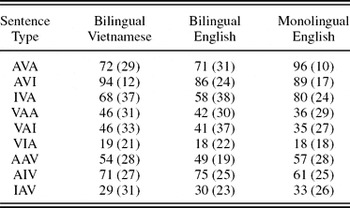
Table 1 displays means and standard deviations for choice data for each of the nine sentence types. Recall that 100% indicates a complete preference for first noun as the agent and 0% indicates a complete preference for the second noun. In English, choice data ranged from a low of 18% on VIA sentences for both Bi-VE and EO groups to a high of 86% on English AVI sentences for Bi-VE and 96% on AVA for EO. Within the Bi-VE group, choice data rankings were similar in English and Vietnamese across sentence types. We investigated the potential statistical significance of similarities and differences in choice data, first between groups in English, then within the Bi-VE group comparing Vietnamese and English.
First noun choice for bilingual and monolingual groups

Note: Group means (standard deviations) for percent choice of first noun as the agent for each of the nine sentence types. One hundred percent indicates a complete preference for the first noun: 0% indicates a complete preference for the second noun. A, animate; V, verb; I, inanimate.
Between-group comparison for English
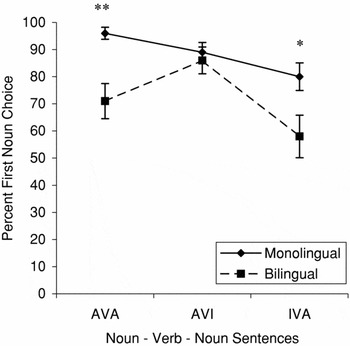
The results of a 2 × 3 × 3 (Group × Word Order × Animacy) ANOVA showed significant differences between monolingual and bilingual groups. Although there was no main effect for group (p = .24), there was an interaction between group and animacy, F (2, 43) = 3.88, p = .028, η2 = 0.01, and between Group and word order that approached statistical significance, F (2, 43) = 2.74, p = .076, η2 = 0.02. There was also a three-way interaction between group, animacy, and word order, F (4, 41) = 3.02, p = .028, η2 = 0.004. These findings indicate that the two groups differed in English sentence processing based on animacy, word order, and a combination of the two cues. When controlling for the three types of word order (NVN, NNV, VNN), pairwise comparisons revealed a group difference in the AA noun condition (p < .02, η2 = 0.11). This large effect size suggested that the groups clearly differed in their responses: the EO group chose the first noun more often than the Bi-VE group when both nouns were animate. Across the three noun animacy conditions (AA, IA, and AI), there was a group difference in the NVN word order (p < .009, η2 = 0.15). This effect was also considered large: the EO group chose the first noun more often than the Bi-VE group. Figure 1 illustrates this interaction on sentences with canonical word order (AVA, AVI, IVA). When cues of word order and animacy converged on the first noun (e.g., AVI), both groups chose the first noun an average of 86% or more of the time. When cues competed (e.g., IVA), the EO group continued to rely on word order and chose the preverbal (first) noun 80% of the time whereas the Bi-VE group seemed to be influenced by animacy and showed a relatively higher preference for the second (animate) noun as agent (58%). When the animacy cue was ambiguous (e.g., AVA), the EO group continued to rely heavily on word order (96%) and the Bi-VE group chose the first noun less often (71%).
The bilingual versus monolingual performance on canonical word order. A, animate; V, verb; I, inanimate. *p < .05. **p < .01.

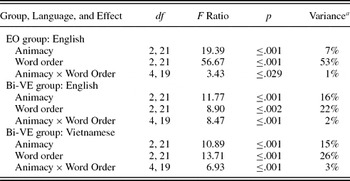
Separate 3 × 3 ANOVA were conducted for each group, and experimental variance for each effect was calculated (SSeffect/SStotal). As shown in Table 2, the EO group relied relatively more on word order (53% of total variance) with minimal attention to the cue of animacy (7% of variance). Word order accounted for 87% of total variance attributed to effects, consistent with earlier studies of English sentence interpretation (e.g., Bates et al., Reference Bates, MacWhinney, Caselli, Devescovi, Natale and Venza1984). In contrast, the Bi-VE group relied on cues of word order (22% of total variance) as well as animacy (16% of total variance) to interpret sentences in English.
Analysis of variance results for bilingual and monolingual groups

Note: Bi-VE, bilingual Vietnamese–English; EO, English only.
aEquivalent to a classical eta-squared coefficient (Cohen Reference Cohen1973, Reference Cohen1988), variance was calculated by dividing the sums of squares of the effect by the total sums of squares.
Within-group comparison: Vietnamese versus English
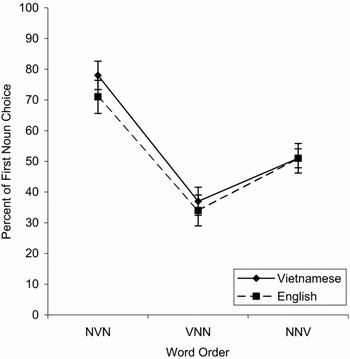
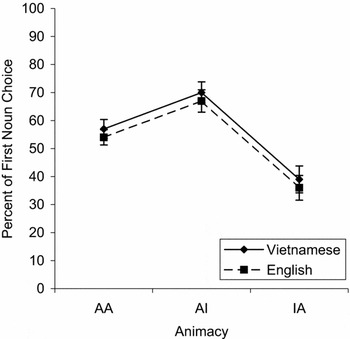
Based on a 2 × 3 × 3 (Language × Word Order × Animacy) ANOVA, there was no main effect for language (p = .33), no two-way interactions involving language (Language × Animacy, p = .55; Language × Word Order, p = .99), and no three-way interaction (p = .39). Figures 2 and 3 display Bi-VE cross-linguistic performance for word order and animacy. These results indicated that the bilingual group did not differentiate their cue use across languages. A 3 × 3 ANOVA for Vietnamese was conducted to examine the relative strength of cues used in each language within the bilingual group. (Bi-VE performance in English was calculated previously in the between-group comparison.) As shown in Table 2, this group used a combination of word order and animacy (26% and 15% of total variance, respectively) with word order being the relatively stronger cue in Vietnamese and English.
The bilingual performance for word order across languages. N, noun; V, verb.

The bilingual performance for animacy across languages. A, animate; I, inanimate.

Individual variation within the Bi-VE group
As shown in Table 1, there was considerable variability in performance on some sentence types. For example, for IAV standard deviation exceeded the mean group percent in both Vietnamese and English. To examine whether this observed variability was due to random error or systematic variation, we calculated the Cronbach alpha values for each sentence type to measure internal consistency among bilingual responses. By convention, Cronbach α values between 0.6 and 0.7 are considered acceptable and values ≥0.8 are considered high (Cronbach, Reference Cronbach1951). Given that the bilingual group was found to use the same set of cues across both languages (see within-group analysis), alpha values were based on the bilingual children's responses for each sentence type collapsed across languages (12 items each): AVA (0.840), AVI (0.699), IVA (0.916), VAA (0.813), VAI (0.875), VIA (0.736), AAV (0.395), AIV (0.607), and IAV (0.736). Based on conventional standards (Cronbach, Reference Cronbach1951), responses to eight of the nine sentence types are considered internally reliable. Poor internal consistency for the AAV sentences may be related to its noncanonical sentence structure and ambiguity in animacy cues.
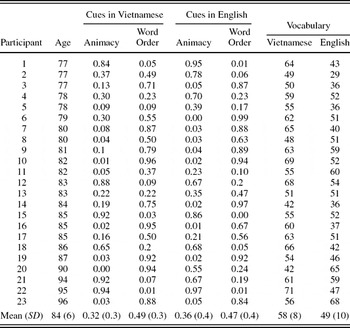
To further investigate individual variation within the Bi-VE group, we calculated relative cue strength (SSEffect/SSTotal) for animacy and word order in each language for each participant. Animacy strength is inversely related to word order strength within each language as proportion of variance is based on the total amount of variance associated with animacy, word order, and the interaction. Table 3 displays relative strength of animacy and word order for each language of each participant.
Participant variables: Age, cue use, and vocabulary scores in Vietnamese and English

Note: Individual participant results within the bilingual group (n = 23). Ages are in months. Relative cue strengths (SScue/SStotal) are shown for animacy and word order in each language. Proficiency is indexed by raw accuracy scores on a picture naming task (maximum = 80).
There was wide variation in relative cue strength ranging from nearly complete reliance on animacy with participant 22 (0.94 and 0.97 in Vietnamese and English, respectively) to a nearly complete reliance on word order with participant 19 (0.92 in both Vietnamese and English).
Of the 23 bilingual participants, 7 (30%) showed a clear reliance on a single cue (i.e., 84% or greater proportion of variance) when processing sentences in both Vietnamese and English: 3 (Participants 1, 15, and 22) primarily relied on animacy and 4 (Participants 7, 10, 19, and 23) primarily relied on word order in both languages. Nine of 23 participants (39%) appeared to use a combination or amalgamation of cues for both languages. Among the 9 participants that showed patterns of amalgamation, 2 (Participants 12, 18) used relatively more animacy cues, 5 (Participants 3, 8, 9, 14, and 16) used relatively more word order cues across languages, and 2 (Participants 13 and 17) did not show a preference for either cue. Finally, 7 of 23 (30%) appeared to use differing patterns of cue use for each language: 3 (Participants 2, 4, and 5) used a relatively balanced amount of cues for Vietnamese but used relatively more animacy cues in English, 2 (Participants 11 and 20) used relatively more word order cues in Vietnamese and more animacy cues in English, 1 (Participant 6) used more word order cues across languages with a larger proportion of word order in English, and 1 (Participant 21) used more animacy across languages with a larger proportion of animacy in Vietnamese. We return to these individual results, particularly the unanticipated use of animacy cues in English, in the discussion.
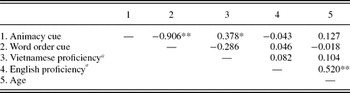
Bivariate correlations were conducted to examine potential relationships between sentence processing, age, and expressive vocabulary scores on the picture naming task in the L1 and L2. Participant ages and scores on the expressive vocabulary measure in Vietnamese and English are shown in Table 3. For Vietnamese, the group mean for vocabulary was 58 (SD = 8); for English, the group mean was 49 (SD = 10). As shown in Table 4, there was a positive relationship between L1 proficiency and animacy cue use (r = .378, p < .05) indicating that higher L1 proficiency was associated with a greater use of animacy cues across languages. Animacy and word order cue use were not related to L2 proficiency or age. Age was positively correlated with English proficiency (r = .52, p < .01) but not Vietnamese proficiency (r = .10), a result that has been found in previous studies with other developing bilingual groups (e.g., Kan & Kohnert, Reference Kan and Kohnert2005).
Bivariate correlations between cue use and language proficiency for bilingual Vietnamese–English group

aIndexed by the productive vocabulary task.
*p < .05 (one tailed). **p < .01 (one tailed).
DISCUSSION
We investigated sequential bilinguals’ use of animacy and word order cues during sentence interpretation tasks administered in Vietnamese (L1) and English (L2). First we examined potential similarities and differences in cues to meaning by these English L2 learners compared to English-only speaking same-age peers. We then used a within-group comparison to determine if bilingual children relied on similar cues to meaning to identify the agent in Vietnamese and English sentences. Finally, we investigated individual variation in sentence processing strategies within the bilingual group as a function of age and expressive vocabulary scores in Vietnamese and English, used here as a measure of language proficiency. Combined results clearly illustrate cross-linguistic interactions in typically developing bilinguals, with cues to meaning converging and colliding in individual children.
Consistent with previous studies, EO speaking participants overwhelmingly relied on word order as a cue to meaning (53% of total variance, 87% of variance for effects), with animacy used as a minor secondary strategy (7% of total variance, 11% of variance for effects). They chose the first noun as agent over 80% of the time for canonical sentences and an average of 30–51% of the time for noncanonical sentences (see Table 1). Although these findings differed slightly from those reported for monolingual English adults where first noun choice was over 90% for canonical sentences and 15% or below for noncanonical sentences (Bates et al., Reference Bates, McNew, MacWhinney, Devescovi and Smith1982), they were consistent with developmental studies of young monolingual English children that found relatively higher rates of first noun choice in noncanonical sentences (~50%) and a small but significant amount of variance accounted for by animacy (6%; Bates et al., Reference Bates, MacWhinney, Caselli, Devescovi, Natale and Venza1984). Similar to findings with younger English-speaking children (Bates et al., Reference Bates, MacWhinney, Caselli, Devescovi, Natale and Venza1984), the use of animacy by EO children in this study may suggest a developmental effect or a gradual tuning process particularly for noncanonical or less frequent word orders.
As anticipated, the bilingual group did not process English sentences in the same way as the EO group. Bilingual participants used both word order and animacy cues (22% and 16% of respective total variance) to identify the agent in English sentences. This relatively high use of animacy in English is above and beyond variance attributable to development, as controlled for by the EO group. This greater reliance on animacy is most likely because of children's consistent experience with Vietnamese (L1). Methodologically, we presumed animacy to be an important cue to meaning in Vietnamese, although we were unable to empirically verify this by including a monolingual–L1 comparison group. We hypothesized that animacy was a robust cue to meaning in Vietnamese based on its similarities to Chinese (Aviles, Reference Alves and Thurgood1999). Previous studies have clearly demonstrated the semantic significance of animacy for Chinese speakers during sentence processing tasks (Liu et al., Reference Liu, Bates and Li1992; Su, Reference Su2001). The significance of animacy was reinforced by frequency and distributional characteristics found in Vietnamese corpora data (Pham et al., Reference Pham, Kohnert and Carney2008). A partial analysis of these corpora also revealed multiple sentence types suggesting that word order is a relatively weak cue in Vietnamese. Based on these combined sources of information, we are confident that animacy is a strong cue to meaning in Vietnamese and word order is not. Future studies on monolingual Vietnamese populations from Vietnam would further contribute to our understanding of language-specific cues to meaning.
Consistent with our prediction, the bilingual group appeared to use an amalgamation or combination of L1 and L2 cues to identify the “doer” of different actions in both Vietnamese and English. Across languages, word order was the relatively stronger cue accounting for 22% or greater of total variance, whereas animacy accounted for 15% or greater of total variance. This pattern of amalgamation is consistent with previous studies of adult L2 learners with high proficiency levels in the L2 (Su, Reference Su2001), bilingual adults who learned their L2 during childhood (Liu et al., Reference Liu, Bates and Li1992), and developing bilingual children of similar ages (Reyes & Hernandez, Reference Reyes and Hernandez2006).
Within the bilingual group, there was also considerable variation in cue choice. Although amalgamation was the most common pattern, a closer look within the bilingual group revealed the presence of forward transfer (using animacy as a cue to English [L2]), backward transfer (relying on word order to interpret Vietnamese [L1]), as well as cue separation (in which a child used different cues for the L1 and L2; Table 3). This within-group variation is consistent with what has been found previously with adults. For example, Hernandez and colleagues (Reference Hernandez, Bates and Avila1994) found that out of 45 Spanish–English bilingual adults with similar language histories and proficiencies, 36 (80%) demonstrated patterns of amalgamation and 9 demonstrated some degree of differentiation in cue use between languages. Of the 36 individuals who amalgamated cues, 17 combined L1 and L2 cues equally, 17 used relatively more L2 cues, and 2 used relatively more L1 cues.
It is interesting that, of the five Vietnamese–English bilingual children in this study who relied on different cues in each language, four did so in precisely the opposite way of what is predicted based on cross-linguistic research within the CM. That is, although these children used two separate sets of cues, they applied them in the reverse pattern of what is predicted for monolingual speakers of Vietnamese and English: animacy was the preferred cue in English, and word order was preferred in Vietnamese. It may be that this reversal of processing strategies reflects a particular developmental stage, with the reorganization and separation of cues according to typological and distributional characteristics of each language coming with additional experience in Vietnamese and English. Longitudinal studies are needed to investigate this hypothesis. At the very least, results from the individual data illustrate the number of potential paths typical sequential language learners travel on the way to bilingual proficiency (cf. Kilborn & Ito, Reference Kilborn, Ito, MacWhinney and Bates1989; for a discussion, see Kohnert, Reference Kohnert2008).
We were also interested in identifying potential relationships between cognitive maturation (indicated by age), proficiency in the L1 and L2 (using expressive vocabulary scores) and the cues bilingual children relied on when processing sentences in Vietnamese and English. Correlational analyses revealed a significant positive association between Vietnamese (L1) proficiency and the animacy cue (r = .38). In contrast, there was no evidence for an association between English (L2) proficiency and a reliance on word order (r = .05). Age did not correspond to either animacy or word order cues. The relatively restricted age range of participants (6–8 years) may have limited our ability to detect developmental effects. In contrast, age was positively correlated with English (L2) proficiency (r = .52, p < .01) but not Vietnamese (L1) proficiency (r = .10), a result that has been found in previous studies with other developing bilingual groups (e.g., Kan & Kohnert, Reference Kan and Kohnert2005). This may reflect rapid growth in the school and community language alongside a relative stabilization of the L1, at least as measured by expressive vocabulary. Overall, results of the correlational analysis suggest that performance on language processing tasks are best considered in terms of the child's language experiences, independent measures of L1–L2 proficiency, and age. It can be expected that the extent to which these factors affect task performance will be different for the L1 and L2. Also, we used a measure of expressive vocabulary specifically developed for bilingual Vietnamese–English learners as a rough proxy for overall proficiency in participants’ L1 and L2. This is clearly only a first step. Future investigations employing multiple measures of language outcomes in the L1 and L2, at different developmental stages, will be needed to investigate causal factors underlying changes in cue use.
In summary, bilingual participants did not look like their monolingual English peers when processing sentences in English. Overall, this typically developing group of 6- to 8-year-old Vietnamese–English bilinguals amalgamated or blended L1 and L2 cues when interpreting sentences in both languages. At the same time, individual differences in choice data for interpreting sentences, even within this relatively homogenous bilingual group, were striking. Sequential bilingual children's performance on sentence interpretation tasks in the L1 and L2 seemed to be a product of exogenous factors—the typological and distributional characteristics of the languages in their environments—as well as endogenous factors, including developmental stage and language proficiency. Further investigation is needed to more precisely define the ways in which these factors come together in developing bilinguals and to determine if the relative strengths of cues to meaning shift across age and experience.
APPENDIX A
The entire list of experimental stimuli

Note: Twenty-seven of the items are from Su (Reference Su2001). The remaining sentences are composed of words found in Liu, Bates, and Li (Reference Liu, Bates and Li1992). A, animate; I, inanimate.
ACKNOWLEDGMENTS
Portions of this study were presented in a poster session at the 2008 Symposium on Research for Child Language Disorders in Madison, Wisconsin. Funding for this project was provided by National Institute of Child Health and Human Development Grant 1F31-HD-05–5113-01A1 (to G.P.). Additional funding was provided by the College of Liberal Arts Student Dissertation Research Activity Award to Giang Pham and by the Center for Cognitive and Social Processes in Language, University of Minnesota, codirected by Kathryn Kohnert. We are grateful to the children who participated in the study and the staff at Hillcrest Foreign Language Academy, especially Hai Anh Nguyen, Robin Matthes, and Linda Tacomis. We thank Tien Pham and Kimson Nguyen for assistance with data collection, Kelann Lobitz for data entry, and Edward Carney for technical assistance.