Accurate measurement of the predominant milk conjugated linoleic acid (CLA) isomer, cis-9 trans-11 is an important requirement for validating feeding regimes to increase the beneficial fatty acid profile for human consumption. High methylation temperatures (60°C +), old reagents (water contamination) and acidic conditions have been shown to cause loss of this particular CLA isomer (Christie, Reference Christie and Christie1993; Kramer & Zhou, Reference Kramer and Zhou2001; Nuernberg et al. Reference Nuernberg, Dannenberger, Ender and Nuernberg2007). This study investigated the evolution of the artefact isomer trans-9 trans-11 from the cis-9 trans-11 isomer under four methylation regimes and how it could be avoided by a rapid base methylation of milk fat. This will help increase the accuracy of CLA measurements in milk.
The four techniques used for the conversion of milk fat into fatty acid methyl esters (FAME) for analysis of CLA content by gas liquid chromatography were either: (i) acidic methylation (AM); (ii) acidic and basic bimethylation with fresh reagents (FBM); (iii) acidic and basic bimethylation with pre-prepared reagents (PBM) and (iv) basic methylation (BM).
Materials and Methods
Six high CLA milk samples were supplied by the organic milk suppliers co-operative (OMSCo, Worle, Somerset, UK). Each methylation regime was chosen as a commonly used procedure to methylate milk fat and were carried out on each milk sample twice over two periods (n=12 per methylation regime): (i) acidic methylation (AM) based on the procedure of Sukhija & Palmquist (Reference Sukhija and Palmquist1988) – 1 ml freeze-dried milk resuspended in 2 ml toluene containing 0·4 mg C23:0/ml as an internal standard. The methylation mixture and conditions consisted of 3 ml of a mixture of freshly made acetyl chloride to ten parts methanol at 70°C for 2 h; (ii) fresh bimethylation (FBM) based on the procedure of Kramer & Zhou (Reference Kramer and Zhou2001) – 1 ml freeze-dried milk resuspended in 1 ml n-heptane containing 1 mg C23:0. The methylation mixture and conditions consisted of 4 ml NaOH in methanol (0·5 mol/l, 15 min) followed by 4 ml HCl in methanol (1·4 mol/l, 1 h) both incubated at 50°C with all reagents freshly made; (iii) pre-prepared bimethylation (PBM) – same as FBM but with all reagents made up 14 d before and kept at room temperature in a glass stoppered bottle; (iv) base methylation (BM) 1 ml freeze-dried milk resuspended in 1 ml n-heptane containing 1 mg C23:0. The methylation mixture and conditions consisted 4 ml NaOH in methanol (0·5 mol/l, 15 min) at 50°C.
To confirm the effects of methylation on CLA isomers, two known certified standards were methylated in triplicate using the AM, BM and FBM procedures (PBM was shown to act the same as FBM and so is not reported): (i) free fatty acid (FFA) CLA standard (10-1823-90, CLA 9c, 11tr 90%, FFA, Larodan Fine Chemicals, Malmo, Sweden); (ii) triacylglycerol (TAG) CLA standard (33-1823-90, CLA 9c, 11tr-Triglyceride, 90%, Larodan Fine Chemicals, Malmo, Sweden).
Fatty acid methyl esters (FAME) were analysed by gas liquid chromatography on a CP-Select chemically bonded for FAME column (100 m×0·25 mm ID, Varian Inc, California, USA.) with split injection (30:1) and He as the carrier gas. Detection temperature was set at 255°C and injection temperature at 250°C. The temperature profile of the oven was 70°C for 1 min which then increased by 5 deg C/min to 100°C this was held for 2 min and then increased by 10 deg C/min to 175°C held for 34 min and then increased by 4 deg C/min to 225°C and held for 29 min (Lee et al. Reference Lee, Tweed, Moloney and Scollan2005). Line pressure was maintained at 40 psi for the first 52·5 min of the run and then increased by 0·5 psi/min to 45 psi and then held for the remainder of the run (29·5 min). Identification of CLA isomers was performed using a commercially available CLA methyl ester standard (O-5632, Sigma-Aldrich, St Louis, Missouri, USA) and quantified using the internal standard.
Period was found not to be significant and so data was analysed using a general ANOVA with methylation regime as the treatment effect and blocking according to period (Payne et al. Reference Payne, Murray, Harding, Baird and Soutar2002).
Results and Discussion
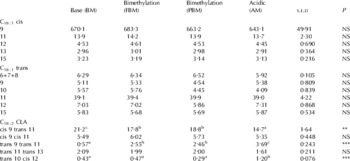
Total fatty acids (35·5 mg/ml) and all individual fatty acids other than CLA were not significantly different between methylation regimes (data not shown). Concentrations of C18:1 and CLA isomers in the milk samples methylated by the four regimes are shown in Table 1. Total CLA was not different across methylation regimes (0·30 mg/ml). Age of reagents and hence propensity for water contamination did not seem to affect loss of cis-9 trans-11 in milk fat (FBM v. PBM). CLA cis-9 trans-11 was higher (P<0·01) with the BM methylation than the other regimes and lowest with AM with both bimethylations intermediate. The inverse relationship was shown with trans-9 trans-11, with higher (P<0·001) amounts with the AM methylation than the other regimes, intermediate amounts with the bimethylations and lowest with BM as also reported by Nuernberg et al. (Reference Nuernberg, Dannenberger, Ender and Nuernberg2007) with muscle lipid. AM also resulted in higher (P<0·001) amounts of trans-10 cis-12 than the other methylation regimes.
C18:1 and CLA isomers in milk fat (mg/100 ml) methylated by the four regimes

abc Figures with different superscript within rows are significantly different; s.e.d., standard error of the difference; NS, not significant; **P<0·01; ***P<0·001
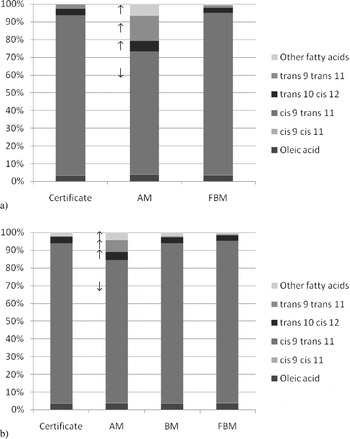
Methylations of the FFA and TAG CLA standards compared with the certified content of each standard are shown in Fig. 1. For the FFA standard BM was shown, as previously reported (Christie, Reference Christie and Christie1993), to be unable to methylate FFA and is not reported. For the other two methylation regimes with the FFA standard, FBM compared favourably to the certified content, whereas AM reduced (P<0·05) cis-9 trans-11 content (0·77×) and increased (P<0·05) trans-9 trans-11 (5·76×), trans-10 cis-12 (1·55×) and the other fatty acids group. For the TAG standard, BM and FBM both compared favourably with the certified content but again AM showed a reduced (P<0·05) cis-9 trans-11 content (0·89×) and increased trans-9 trans-11 (6·72×), trans-10 cis-12 (1·15×) and the other fatty acids group but to a lesser numerical extent than with the FFA standard.
Comparison of methylation procedures (AM, acidic methylation; BM, base methylation; FBM, fresh bimethylation) against the certified content of two standards: (a) free fatty acid CLA standard; (b) triacylglycerol CLA standard. ↑ increase of isomer compared with certificate (P<0·001); ↓ decrease of isomer compared with certificate (P<0·001). Other fatty acids refers to a mixture of C16:0 (<0·1%, FFA and TAG) C18:0 (<0·1%, FFA and TAG) and unidentified CLA (<0·1 and 1·4%, for FFA and TAG, respectively) in the certified standards and only the quantified fatty acids in the standards are reported for each methylation with all other fatty acids reported collectively.

The results indicate that AM resulted in a partial conversion of cis-9 trans-11 to trans-9 trans-11 but also elevated trans-10 cis-12 and the other fatty acids group. Methylation of the TAG CLA standard by BM and FBM produced similar CLA profiles whilst FBM with milk fat resulted in higher levels of trans-9 trans-11 and lower levels of cis-9 trans-11 than BM. This difference between methylation of TAG standards and milk fat is difficult to explain but may be related to the low levels (<2%) of FFA in the milk fat. The existence of low levels of FFA in milk fat may also explain the greater increase of trans-10 cis-12 by AM when methylating the FFA standard and milk fat than when methylating the TAG standard. This effect on trans-10 cis-12 and the greater numerical elevation of trans-9 trans-11 in the FFA standard over the TAG standard suggests that CLA as FFA are more susceptible to acidic isomerisation than esterified CLA. Although BM has been shown to be ineffective in the methylation of FFA (Christie, Reference Christie and Christie1993) the triacylglycerol nature (>98%, Gunstone, Reference Gunstone and Gunstone1999) of milk fat results in a rapid base methylation being as effective as an acidic methylation or bimethylation for total fatty acid recovery of milk fat whilst avoiding conversion of cis-9 trans-11 to trans-9 trans-11 CLA and also the appearance of trans-10 cis-12 and other fatty acids (CLA isomers) potentially as isomerisation artefacts from cis-9 trans-11 or other fatty acids during acidic methylation.