Implications
After sexual maturity, mounting and agonistic behaviours may affect animal welfare in entire pigs due to stress and wounds. Previous studies reported immunocastration to be effective in reducing aggressiveness and skin lesions in male pigs. This study assessed the effect of immunocastration on heavy female pigs and found a reduction in aggressive interactions, haptoglobin, serum cortisol and back lesions at given points in time throughout fattening. Immunocastration had no significant effect on growth rate, backfat thickness and feed efficiency. This supports immunocastration as an animal welfare tool to reduce aggressiveness in heavy female pigs, but not to improve slaughter performance.
Introduction
Both entire male and female pigs can have harmful sexual behaviours towards their penmates, with the former exhibiting these behaviours more frequently (Rydhmer et al., Reference Rydhmer, Zamaratskaia, Andersson, Algers, Guillemet and Lundstrom2006). Mounting, for instance, may become an animal welfare issue when increasing the risk of injuries and skin lesions. High levels of aggression and mounting behaviours can cause stress, fear and harm, not only to the receiver, but to all pigs in the pen (Rydhmer et al., Reference Rydhmer, Zamaratskaia, Andersson, Algers, Guillemet and Lundstrom2006, Reference Rydhmer, Lundström and Andersson2010). A study with 408 pigs up to 116 kg of individual live body weight confirmed that aggression towards penmates was positively associated with individual growth rate, and in 15% of entire male pigs and 6% of entire female pigs there were health problems involving lameness or injured legs and feet (Rydhmer et al., Reference Rydhmer, Zamaratskaia, Andersson, Algers, Guillemet and Lundstrom2006). Fredriksen and Hexeberg (Reference Fredriksen and Hexeberg2009) quantified the frequency of aggressive interactions in entire male and female pigs at the end of fattening and found them to occur more often in the males (i.e. 2.6 v. 1 events/pig per h). They also found an increase in aggressive interactions in response to the removal of a penmate in both genders, but more pronounced in males. Higher aggressiveness in male pigs is consistent with the results of Salmon and Edwards (Reference Salmon and Edwards2006). Conversely, Thomsen et al. (Reference Thomsen, Bonde, Kongsted and Rousing2012) did not observe any difference in severity of aggressive behaviours and skin lesions between males and females in organic production, although mounting frequency was 0.3 pig/h in males and 0.01 pig/h in females.
In light male pigs, some studies have examined the effects of immunocastration on behaviour (Albrecht, Reference Albrecht2013). This procedure is characterized by two intramuscular injections (V1 and V2) of immunovaccine which induces a self-immune response against GnRH and a block of sexual activity (Albrecht, Reference Albrecht2013). After the second injection, immunocastrated male pigs showed less aggressive, mounting and sexual behaviours, which were performed at comparable levels with barrows and females and differed significantly from entire males (Rydhmer et al., Reference Rydhmer, Lundström and Andersson2010). As no studies have investigated the effect of immunocastration on behaviour of heavy female pigs, which are usually slaughtered over 170 kg for dry-cured pork products, this study aimed to compare the behaviour and welfare of entire v. immunocastrated heavy female pigs.
Material and methods
Animals
In a conventional fattening unit, 56 commercial crossbred female pigs of 15 weeks of age were randomly assigned to four fully-slatted floor pens (6.5×2.4 m) with a linear trough (6.5×0.3 m). As manipulable material, a wood stump and a metal chain were provided to each pen. Animals were fed with four liquid meals (at 0700, 1030, 1400 and 1800 h). The feeding plan used was formulated according to the nutritional requirements for heavy pigs in terms of composition and amount delivered (further details on diet composition are available in Scollo et al., Reference Scollo, Di Martino, Bonfanti, Stefani, Schiavon, Marangon and Gottardo2013). Information was collected regarding the dry matter content provided to each pen per day. All the animals were weighed at the beginning and at the end of the finishing period; average daily gain and feed efficiency were subsequently calculated. Animals were transported to the abattoir at 36 weeks of age (180±10 kg) on the same day at 0600 to 0700 h and slaughtered between 0800 and 0900 h. Pen groups were not mixed during transportation and at lairage. The slaughtering plant provided the data regarding lean meat percentage and backfat thickness for each animal. Backfat was evaluated by probing all left sides with an ultrasound Hennessy Grading Probe (Hennessy Grading Systems, Auckland, New Zealand) 70 mm from the midline between the third and fourth last ribs; lean meat percentage was calculated using the formula authorized by the European Commission for grading pig carcasses in Italy (Commission Implementing Decision 2014/38/EU; European Commission, 2014).
Experimental procedure
The immunization protocol was chosen in accordance with Dalmau et al. (Reference Dalmau, Velarde, Rodríguez, Pedernera, Llonch, Fàbrega, Casal, Maianu, Gispert, King, Slootmans, Thomas and Mombarg2015) and consisted of three intramuscular injections of Vacsincel (Zoetis, Madrid, Spain) at 16, 20 and 32 weeks of age to all animals from two pens (VG). Animals from the other two pens were used as a control group (CG). A blood sample was collected from all animals at 20, 24, 28 and 32 weeks of age. Blood was collected in the morning (0900 to 1000 h) from the jugular vein using 4-ml sterile vacuum tubes (Vacutest Kima srl, Arzergrande, PD, Italy). A further blood sample was collected at the time of slaughtering from the jugular incision (without needle). Samples were stored at +4°C during transportation to the laboratory, centrifuged at 2400×g for 10 min at +20°C, and stored at −20°C before analysis.
Laboratory analyses
Haptoglobin concentration was determined using a colorimetric assay (Phase Haptoglobin, Tridelta Development Ltd, Maynooth, County Kildare, Ireland). The albumin/globulin ratio was calculated by determining the concentration of different protein fractions through serum electrophoresis with a Hydrasis LC semi-automated analyser (Sebia, Lisses, EVRY Cedex, France) on 0.8% agarose gel (Hydragel 30 Protein; Sebia, Norcross, GA, USA). Serum cortisol concentration was determined by an immunologic chemiluminescent kit (LKCO1; Medical System, Genoa, Italy) applied to the Immulite One automated analyser (Immulite One; Medical System).
Progesterone was determined by liquid chromatography/tandem MS after a Solid Phase Extraction (SPE) clean up step. The procedure used was a modified method of McDonald et al. (Reference McDonald, Malone and McBride2010). Serum (1 ml) was diluted with 5 ml 4% phosphoric acid and after shaking (20 min in mechanical shaker), the solution was applied to a SPE cartridge (OASIS strong anion exchange MAX 6 ml, 150 mg). Purified extracts were separated by rp-HPLC using an Accucore C18 column (10 mm×2.1 mm, 2.7 µm) from Superchrom (Milan, Italy). Analysis was achieved using a Prominence HPLC system (Shimadzu, Kyoto, Japan) interfaced to an API 4000 triple quadrupole mass spectrometer with a turbo ion spray source (AB SCIEX, Framingham, MA, USA).
GnRH-antibody titre was determined by means of ELISA test, with the method previously described by Claus et al. (Reference Claus, Lacorn, Danowski, Pearce and Bauer2007), partially modified. GnRH (Bachem, Weil am Rhein, Germany) was dissolved in phosphate buffered saline (PBS) at the concentration of 1 mg/ml and subsequently diluted 10 ng/ml in 0.1 M carbonate buffer (pH 9.6). GnRH solution was coupled into Thermo Scientific Nunc Immobilizer Amino surface microtiterplates (Thermo Fisher Scientific, Waltham, MA, USA), 100 μl/well. The plates were left at 37°C for 1 h under shaking, then emptied and blocked with testing buffer (0.12 M NaCl, 0.02 M Na2PO4, 0.01 M ethylenediaminetetraacetic acid, 0.1% hydrolyzed gelatine, 0,05% Tween 20, 0005% chlorhexidine gluconate; pH 7.2) overnight at 4°C. Plates were washed with PBS containing 0.05% Tween 20 for three times. Serum samples were diluted 1 : 200 in testing buffer, 100 μl/well were added in the plates and allowed to react for 2 h at 37°C. Before each of the following steps, washing cycles were performed as described above. Goat anti-swine biotinylated IgG, 100 μl/well (Sigma Aldrich, Saint Louis, MO, USA) were added at the dilution of 1 : 10 000 and incubated for 1 h at 37°C. Streptavidin- HRP conjugate (Dako, Hamburg, Germany) was diluted 1 : 5000 in testing buffer then added 100 μl/well and incubated for15 min at 37°C in the dark. To develop colour reaction, tetramethylbenzidine/H2O2 in a citric acid buffer was used and allowed to react for 20 min in the dark. The reaction was stopped with 2 M H2SO4 and the optical density was read with the spectrophotometer at 450 nm. No cut-off was established, the titre was characterized quantitatively to observe the antibody trend during time.
Behaviour and skin lesions
The behaviour was evaluated at 18, 23, 28, 33, 36 weeks of age according with the states and events described in the Supplementary Table S1 (modified ethogram from Thomsen et al., Reference Thomsen, Bonde, Kongsted and Rousing2012; Hintze et al., Reference Hintze, Scott, Turner, Meddle and D’Eath2013; Di Martino et al., Reference Di Martino, Scollo, Gottardo, Stefani, Schiavon, Capello, Marangon and Bonfanti2015). In each session, all animals were individually recognizable by means of coloured numbers sprayed on the back and were observed for 2 uninterrupted hours in the morning (between 1100 and 1300 h). This timeframe was chosen because in previous field studies on this production sector (Scollo et al., Reference Scollo, Di Martino, Bonfanti, Stefani, Schiavon, Marangon and Gottardo2013; Di Martino et al., Reference Di Martino, Scollo, Gottardo, Stefani, Schiavon, Capello, Marangon and Bonfanti2015) it was found that the interval between the two meals in the morning is characterized by the highest level of activity, that is it is more likely for aggression and active behaviours to occur. During each scan (at 2 min intervals), the number of animals per pen that were lying inactive or exploring (licking, suckling, rooting, biting or chewing) different substrates/objects (metal chain or wood stump) was recorded, while the number of events was individually recorded by continuous behaviour sampling techniques (Martin and Bateson, Reference Martin and Bateson2007). The skin lesions were evaluated at 18, 23, 28 and 33 weeks of age on front, back and ears according with the method proposed by the Welfare quality Protocol (Welfare Quality, 2009), and the number of lesions in each area was reported.
Evaluations at the abattoir
At slaughter, the ovaries from all animals were collected, fixed in 10% neutral buffered formalin and paraffin embedded according to routine procedures for histopathological examination. Before fixation, both ovaries for each animal were weighed. Representative sections of each sample were stained with haematoxylin–eosin for histological examination. For each animal the longer axis of the ovary was measured considering the cortical and medulla thickness. In addition, the stage of follicles development and the presence of corpora lutea were considered. The maximum follicle size in each animal was measured. Gastric score and lung score were attributed according with the method proposed by of Di Martino et al. (Reference Di Martino, Capello, Scollo, Gottardo, Stefani, Rampin, Schiavon, Marangon and Bonfanti2013) and Scollo et al. (Reference Scollo, Gottardo, Contiero, Mazzoni, Leneveu and Edwards2017), respectively. Gastric score for the pars oesophagea ranged from 0 to 3: 0=normal (pearly white); 1=hyperkeratosis (yellow); 2=mucosal erosions; and 3=severe ulcer. The lung score ranged from 0 to 24, based on the percentage area affected by pneumonic lesions in each lobe excepting the accessory one (not assessed). All experimental procedures and animal care were performed in accordance with Italian legislation on the protection of animals used for experimental and other scientific purposes (LD-116, 27 January 1992, actually repealed by LD-26, 4 March 2014). This study was approved by the IZSVe Ethical Committee (CE.IZSVE.07/2014).
Statistical analysis
Descriptive statistics (means, standard deviations, medians and ranges) of behaviours, skin lesions and physiological parameters were computed. Count data (behaviours, skin lesions) followed a Poisson distribution; lung score and stomach score were non-normally distributed. All continuous data (average daily gain, carcass weight, backfat thickness, lean tissue, ovarian weight and length, follicle size and blood values) were normally distributed. The Mann-Whitney test was used to examine differences between immunocastrated v. entire pigs in lung score, stomach score, skin lesions at the abattoir (front, back, ear). t Test was used to examine differences between immunocastrated v. entire pigs in normally distributed variables collected at the abattoir. Mixed-effects linear or Poisson regression models were used to examine differences by treatment (independent variable) in all variables collected on farm (continuous and counts, respectively – dependent variables), accounting for the repeated measurements as fixed effect and with a random effect at the level of pen. The animal was the statistical unit. All statistical analyses were performed by using STATA 11.2 (StataCorp, College Station, TX, USA).
Results
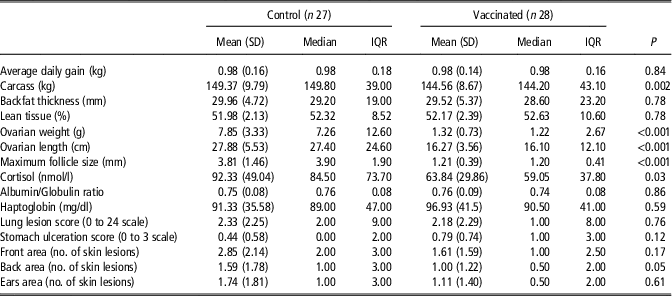
Overall, animals from both treatment and control groups presented no health problems during fattening and were sent to slaughter for human consumption. However, at week 20 of age, one pig from CG died: necropsy evidenced a fatal intestinal torsion. Results of slaughter and growth performances are reported in Table 1. Average gain/feed ratio was 340 g/kg (SD: 20) in both groups. A picture of ovaries from VG and CG is provided as the Supplementary Figure S1. In both groups, the cortex of the ovaries showed follicles in different stages of development: primordial, primary, secondary and tertiary follicles and mature follicle (i.e. Graafian follicle). The corpora lutea were present in 19 pigs of CG, while in VG they were observed only in two subjects. Mature follicles in VG appeared histologically smaller (size range: 0.4 to 1.7 mm) compared with CG (size range: 2.2to 7.2 mm) and not macroscopically visible. The mean maximum follicle size in VG was significantly smaller than in CG (P<0.001) (Table 1). A picture of histological section of ovary from CG and VG is provided as the Supplementary Figure S2 and S3, respectively.
Effect of vaccination against GnRH in heavy female pigs on production data and physiological parameters collected at the time of slaughter (36 weeks of age)

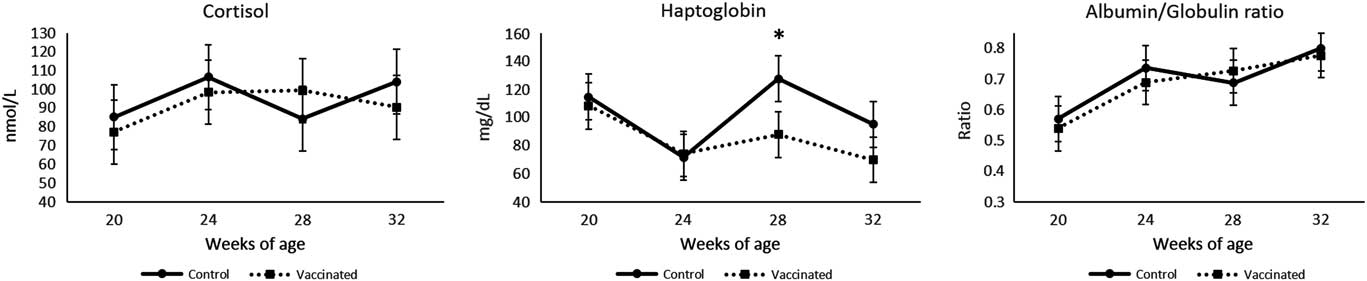
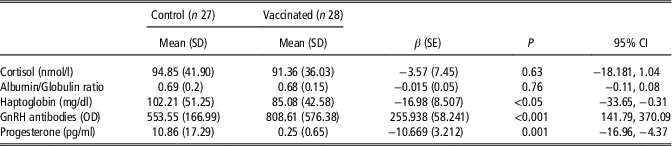
Results of the vaccination against GnRH on most relevant behaviours, skin lesions and physiological parameters collected during fattening are given in Figures 1 to 3 and Table 2, respectively. GnRH antibodies were significantly higher (P<0.05) in VG at 24 weeks of age (i.e. 4 weeks after the second injection). An increase in progesterone level was evident in CG from week 32 to 36 (i.e. up to 65.4 pg/ml), while being very low at weeks 20 to 28 (i.e. 0.2±1.5 pg/ml). Neither inactive nor positive social behaviours showed any difference by treatment (P=0.766 and P=0.795, respectively). Aggressive interactions were significantly higher in CG at 33 and 36 weeks of age (P<0.05). CG had also more front lesions at 28 weeks, but less at 30 weeks (P<0.001 and P=0.018, respectively). At 28 weeks of age, CG showed a tendency (P=0.07) to a higher number of back lesions and a higher level of haptoglobin (P=0.001). Most investigated behaviours were performed at a very low frequency. In particular, sexual mounting was observed at a frequency of 0.01 v. 0.03 events/pigper h in VG and CG, respectively. Non-sexual mounting was observed at a frequency of 0.41 v. 0.32 events/pigper h in VG and CG, respectively. The complete descriptive statistics for all behaviours is given as the Supplementary Table S2.
Effect of vaccination against GnRH in heavy female pigs on the frequency of inactive behaviour and number of positive social contacts and conflicts (n/pig in a 2 h period). Results are expressed as mean and 95% confidence intervals. * Significant difference (P<0.05).

Effect of vaccination against GnRH in heavy female pigs on the frequency of skin lesions (front, back and ear regions). Results are expressed as mean and 95% confidence intervals. * Significant difference (P<0.05).

Effect of vaccination against GnRH in heavy female pigs on the levels of physiological parameters (serum cortisol, haptoglobin and albumin/globulin ratio). Results are expressed as mean and 95% confidence intervals. * Significant difference (P<0.05).

Results of the linear mixed models to test the effect of vaccination against GnRH in heavy female pigs on serum and physiological parameters collected during fattening (20 to 36 weeks of age)

CI=confidence intervals.
β: regression coefficient. P value is referred to the overall effect of treatment deviation.
Discussion
The consequences for animal welfare of surgical castration and immunocastration have previously been investigated in male pigs and most studies concur with an overall reduction of aggressive and mounting behaviours (Cronin et al., Reference Cronin, Dunshea, Butler, McCauley, Barnett and Hemsworth2003; Rydhmer et al., Reference Rydhmer, Zamaratskaia, Andersson, Algers, Guillemet and Lundstrom2006 and Reference Rydhmer, Lundström and Andersson2010; Zamaratskaia et al., Reference Zamaratskaia, Rydhmer, Andersson, Chen, Lowagie, Andersson and Lundström2008; Brewster and Nevel, Reference Brewster and Nevel2013). Rydhmer et al. (Reference Rydhmer, Zamaratskaia, Andersson, Algers, Guillemet and Lundstrom2006) also reported a higher frequency of non-violent social interactions in entire v. castrated male pigs and a tendency towards significance of lower resting. To the best of our knowledge, this is the first study reporting behavioural effects of immunocastration in heavy female pigs. Irrespective of the treatment, we observed a marked increase in resting (up to 70% to 80%) at the end of the fattening period, which is in accordance with previous findings on heavy pigs (Scollo et al., Reference Scollo, Di Martino, Bonfanti, Stefani, Schiavon, Marangon and Gottardo2013; Di Martino et al., Reference Di Martino, Scollo, Gottardo, Stefani, Schiavon, Capello, Marangon and Bonfanti2015). We also observed an intensive period of fighting among penmates, which is typically observed after the mixing of unfamiliar groups from the weaner phase, followed by a progressive decrease in conflicts (Rydhmer et al., Reference Rydhmer, Zamaratskaia, Andersson, Algers, Guillemet and Lundstrom2006; Scollo et al., Reference Scollo, Di Martino, Bonfanti, Stefani, Schiavon, Marangon and Gottardo2013; Di Martino et al., Reference Di Martino, Scollo, Gottardo, Stefani, Schiavon, Capello, Marangon and Bonfanti2015). However, at 33 and 36 weeks of age a significant high frequency of aggressive interactions in entire v. immunocastrated pigs was observed along with a tendency towards a higher frequency of social interactions at 28 and 36 weeks of age, which is in accordance to what has been previously observed in male pigs. Yet, this different behavioural aspect did not suffice in producing a significant difference in skin lesions and in haematological markers during fattening. This may suggest a lower impact of sexual behaviour in heavy female pigs’ welfare compared with males’. On the other hand, these results should be confirmed by further research in different environmental conditions, also in view of a possible limitation in the present study due to the small number of pens available and the specific timeframe of observation.
Front lesions presented a fluctuating trend in the two groups. However, entire pigs at 28 weeks showed a tendency to higher back lesions, which were associated with a significantly higher haptoglobin level. Serum haptoglobin is a positive acute phase protein, which was previously applied as a sensitive health/welfare indicator in pigs (Petersen et al., Reference Petersen, Nielsen and Heegard2004). Albumin/globulin ratio and general animal good health did not support the hypothesis of a disease or any specific health/welfare impairment; therefore, this finding could be related to a higher frequency of aggressive interactions and skin lesions. On the other hand, a connection between haptoglobin and female sexual hormones cannot be completely excluded, as previous studies found low levels in boars compared with sows (Richter, Reference Richter1974; Lipperheide et al., Reference Lipperheide, Diepers, Lampreave, Alava and Petersen1998) and in barrows compared with entire females (Scollo et al., Reference Scollo, Di Martino, Bonfanti, Stefani, Schiavon, Marangon and Gottardo2013). Interestingly, at slaughter (i.e. in response to a significant stress due to loading, transportation and unloading) entire pigs had a higher level of cortisol and skin lesions on the back. This difference may suggest that the rearing conditions (in particular the feeding programme characterized by four daily meals instead of the two conventionally provided) maximized motivation to feed and rest, whereas the effect of immunocastration became more evident (e.g. quietness during loading, transportation and at lairage) in response to a challenging condition.
Immunocastration protocol was applied in accordance with Dalmau et al. (Reference Dalmau, Velarde, Rodríguez, Pedernera, Llonch, Fàbrega, Casal, Maianu, Gispert, King, Slootmans, Thomas and Mombarg2015), and as expected, antibodies were detected 2 weeks after the second injection at a significantly higher level in comparison to the baseline. Macroscopic examination of ovaries with no visible follicles and the significant lower progesterone level (as found by Dalmau et al., Reference Dalmau, Velarde, Rodríguez, Pedernera, Llonch, Fàbrega, Casal, Maianu, Gispert, King, Slootmans, Thomas and Mombarg2015) indicated that the experimental treatments were properly administered. On the other hand, histologically, ovaries from immunized pigs presented follicular activity, and even corpora lutea in two subjects. To our knowledge, this is the first study that evaluated ovarian histology in immunocastrated gilts. Indeed, previous studies (Zeng et al, Reference Zeng, Turkstra, Tsigos, Meloen, Liu, Chen, Schaaper, Oonk, Guo and van de Wiel2002; Dalmau et al., Reference Dalmau, Velarde, Rodríguez, Pedernera, Llonch, Fàbrega, Casal, Maianu, Gispert, King, Slootmans, Thomas and Mombarg2015) only reported the absence of macroscopically visible follicles. Zeng et al. (Reference Zeng, Turkstra, Tsigos, Meloen, Liu, Chen, Schaaper, Oonk, Guo and van de Wiel2002) also reported to non-respondents characterized by follicular activity, corpora lutea and ovaries not macroscopically different (in weight and shape) from entire pigs. Dalmau et al. (Reference Dalmau, Velarde, Rodríguez, Pedernera, Llonch, Fàbrega, Casal, Maianu, Gispert, King, Slootmans, Thomas and Mombarg2015) reported the presence of only one immunized subject (out of 36 treated) with visible mature follicles (i.e. 8 to 11 mm of diameter) in Iberian pigs. Altogether these data indicate that in most treated animals, immunocastration blocks ovulation (i.e. oestrus), while enabling some follicular maturation not macroscopically visible.
Animals from both groups reached the requested slaughtering weight within the expected timeframe for this production system (i.e., a minimum of 36 weeks and 160 kg live weight) with mortality close to zero and excellent slaughter performances. In particular, no significant differences were found regarding average daily gain, backfat thickness and lean tissue. These results are in accordance with Martinez-Macipe et al. (Reference Martinez-Macipe, Rodriguez, Izquierdo, Gispert, Manteca, Mainau, Hernández, Claret, Guerrero and Dalmau2016), who found no differences in meat quality of entire v. vaccinated Iberian pigs reared in free-ranging conditions. On the other hand, previous studies in intensive conditions found a higher backfat thickness in immunized v. entire Iberian (heavy) female pigs (Gamero-Negrón et al., Reference Gamero-Negrón, Del Pulgar, Ventanas and García2015; Daza et al., Reference Daza, Latorre, Olivares and Bote2016) and in light Belgian female pigs (Van den Broeke et al., Reference Van den Broeke, Leen, Aluwé, Ampe, Van Meensel and Millet2016). These conflicting results may be attributed to the different production systems, genetics and feeding programs and seem to support a low impact of oestrus cycles on agonistic interactions and locomotory behaviour (with subsequent extra energy demand and lower growth) in the intensive Italian production.
In conclusion, the results of this study indicate a slightly negative impact of sexual maturity on the welfare of heavy female pigs, supporting the use of immunocastration as a tool for reducing aggressiveness when necessary (e.g. in farms with reportedly high levels of aggression among penmates) or in outdoor production systems. In Italy, traditional outdoor swine rearing for traditional specialities of cured cuts (as described in Negrato et al., Reference Negrato, Di Martino, Vascellari, Radaelli, Capello, Pascoli, Bertotto and Bonfanti2013) is growing in importance, following consumers’ expectations about safeguarding traditional gastronomic specialities and promotion of animal-friendly products. In such circumstances, gilts in heat may attract wild boars, with subsequent risk of farrowing rather unmanageable litters, as well as having to face possible damages, animals’ breakaways and spread of diseases, as reported in Spain for pigs reared for Iberian ham production (Martinez-Macipe et al., Reference Martinez-Macipe, Rodriguez, Izquierdo, Gispert, Manteca, Mainau, Hernández, Claret, Guerrero and Dalmau2016).
Acknowledgements
This study was funded by the Italian Ministry of Health, Rome, Italy (Project RC IZSVe 10/13; B22I14000200001). Additionally the authors extend the thanks to Laura Bottaro and Raffaella Gorgi for their contribution to progesterone analyses and to Dr Markus Lacorn for his technical assistance for the ELISA measurements.
Supplementary material
To view supplementary material for this article, please visit https://doi.org/10.1017/S1751731117003135