

So far, this book has been about the various political dynamics that take place in or over the Arctic. However, as has been alluded to throughout this book, if we really want to unpack Arctic ‘geopolitics’, it does not suffice to only look at intra-regional dynamics or the Arctic’s role in global power struggles. Keeping an eye on one or both of these dimensions might prove to be analytically neat and provide explanations with some level of generalisability. However, there is explicit analytical value in further unpacking empirical complexity. By looking at the domestic level, and two Arctic states in particular, it is easier to analyse security dynamics and practices in more depth. Thus, this chapter will make use of Norway – a small Nordic NATO country which is also a neighbour to Russia in the Arctic – and the USA – a global superpower also neighbouring Russia in the Arctic – to showcase the relevance of looking at national policies, interests, and practices when we talk about Arctic security and geopolitics.
Norway’s Arctic Context
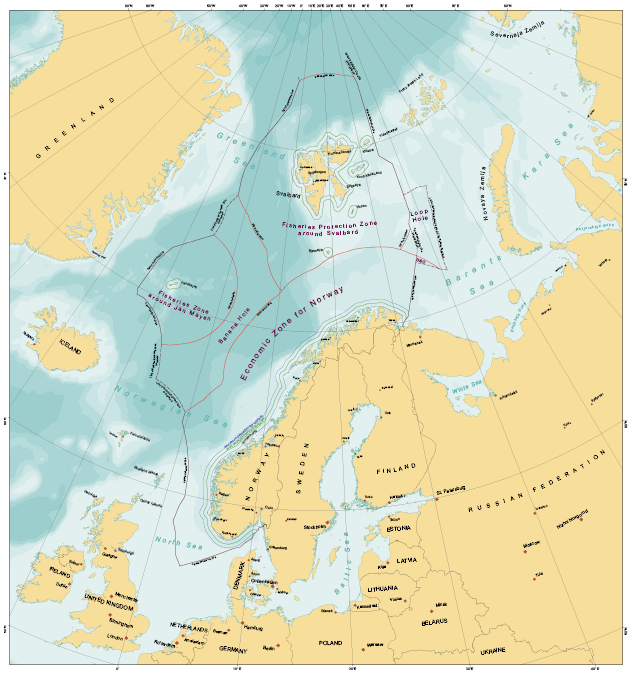
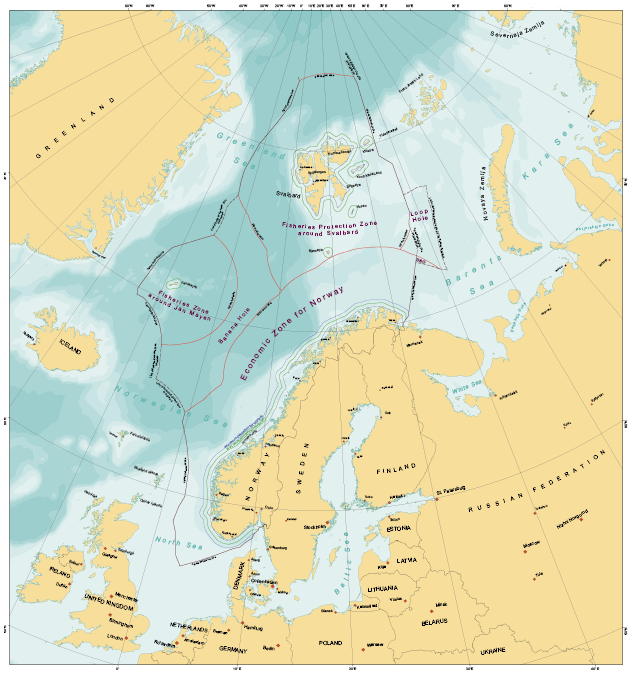
In a Norwegian context, the Arctic is not a far-removed or remote part of the country. In fact, the Norwegian Arctic makes up one-third of Norway’s land area, is home to almost 9 per cent of the population (albeit this figure is declining), and comprises as much as 80 per cent of Norway’s maritime domain. The Norwegian definition of the Arctic includes everything north of the Arctic Circle (66°34N). In Norway – a unitary state structure – this includes Nordland, Troms, and Finnmark counties, the Svalbard archipelago, and the island of Jan Mayen (see Figure 5.1), with approximately 480,000 inhabitants. This includes the Sami – the Indigenous Peoples of Norway – who primarily reside in the North. The Sami have their own Parliament, located in Karasjok, which has some political and administrative responsibilities. The population of almost half a million in the Norwegian Arctic alone is relatively high compared to the North American Arctic, although it is sparsely populated by European standards.
Map of Norway including Svalbard and Jan Mayen, outlining Norway’s maritime zones.
Note that a distinction is made between the ‘High North’ and the ‘Arctic’ here. The High North (nordområdene in Norwegian) has, in many contexts, been used by Norway over the last decades to denote the immediate areas in the North that are part of, or are adjacent to, Norway. This encompasses the Barents Sea region, including Svalbard, but not the entire Polar region. The Arctic, on the other hand, is used as a term for the entire circumpolar region, or the entire area north of the Arctic Circle.
Fundamentally, the High North is central to Norway’s security considerations, the primary one being its shared land and sea border with Russia. Since the end of World War II, Norwegian security policy has concentrated on managing its relationship with its eastern neighbour. In what is generally termed an asymmetric relationship, Norway endeavoured to balance its military inferiority to the USSR/Russia through its membership in NATO (founding member in 1949) and a bilateral relationship with the USA (Tamnes Reference Tamnes and Kraska2011, Reference Tamnes1997).
The Svalbard Archipelago
A special note on the Svalbard archipelago is needed due to its unique status and the fact that currently this is probably one of the primary geopolitical dimensions in the Norwegian Arctic. Uninhabited and remote (see Figure 5.1), without any permanent occupancy, after periods in the seventeenth and eighteenth centuries with economic activity focused mainly on fisheries, whaling, and trapping, the nineteenth century saw an increase in both scientific and touristic expeditions to Svalbard to document and map this area, still referred to as ‘terra nullius’ (no man’s land) (The National Archives of Norway 2020). In the late nineteenth and early twentieth centuries, promising discoveries of coal were made and mines were opened. This spurred further interest in establishing an administration for the archipelago.
Norway – being the closest state to the islands and having a considerable economic presence there – was keen to have the sovereignty issue settled and initiated several international discussions. From around 1890, the question of Svalbard and Norway’s economic and strategic presence there gained attention in Norwegian politics (Arlov Reference Arlov2003: 239). Moreover, as Norway obtained full independence from Sweden in 1905, it was keen to consolidate its territory and near-abroad positioning.Footnote 1 Prior to World War I, various governance models were discussed, culminating in three international conferences in 1910, 1912, and 1914 (Arlov Reference Arlov2003: 285). Then, during the peace conference in Paris 1919–1920, the matter of Svalbard was revisited and finally settled with the Treaty of February 1920 (here called the Svalbard Treaty, to avoid confusion, although the Treaty does not have any official name). The Treaty affirmed Norway’s increasing demands for sovereignty over the archipelago (Svalbard Treaty Reference Treaty1920).
A key objective of the Treaty was, after assigning Norway ‘full and absolute sovereignty’ (Art. 1) (Svalbard Treaty Reference Treaty1920), to secure the economic interests of nationals from other states (Ulfstein Reference Ulfstein1995). This was done by including provisions that nationals of all parties to the Treaty ‘shall enjoy equally the rights of fishing and hunting’ (Art. 2) and ‘shall have equal liberty of access and entry’ (Art. 3) in certain defined areas of activity. Norway may not treat other nationals less favourably than its own citizens, and taxes levied in the Treaty area can be used solely for local purposes (Art. 8). Moreover, the islands cannot be used for ‘warlike purposes’, and Norway committed ‘not to create nor to allow the establishment of any naval base in the territories specified in Article 1 and not to construct any fortification in the said territories’ (Art. 9).Footnote 2
Due to the ongoing Russian civil war, the Bolshevik leadership was not recognised by most other states and was not present during the Treaty negotiations. However, the Treaty expressly granted Russian nationals and companies the same rights as nationals of the High Contracting Parties ‘Until the recognition by the High Contracting Parties of a Russian Government shall permit Russia to adhere to the present Treaty’ (Art. 10). One question at the time was whether Soviet Russia would challenge the Treaty, given their geographic proximity to the area and claims of historic use (Arlov Reference Arlov2003: 385–87; Tamnes Reference Tamnes1991; Todorov Reference Todorov2020a). Following the signing of the Treaty in 1920, the Russian government protested to ensure Russian interests were safeguarded. In 1924, however, the Soviet government recognised Norwegian sovereignty over the archipelago unconditionally and it acceded to the Treaty in 1935. This was in return for Norwegian de jure recognition of the Soviet government the same year (Holtsmark Reference Holtsmark1993: 14). The Treaty came into force in 1925, after Norway had implemented relevant domestic legislation and Japan – as the last of the original nine signatories – had ratified the Treaty.Footnote 3 Norway, as the sovereign, then changed the name of the archipelago to Svalbard. The Treaty has been acceded to by more than forty states (Norwegian Ministry of Justice and Public Security 2024: 14).
Svalbard saw some military activity during World War II, its inhabitants were evacuated and thereafter the Germans bombed and occupied the islands, before it was retaken by allied forces (Arlov Reference Arlov2003; Skogrand Reference Skogrand2004; Dean and Lackenbauer Reference Dean and Lackenbauer2017). The islands’ strategic value was primarily linked to the ability to gather weather data crucial for operations in the North Atlantic. At the end of World War II, in November 1944, Soviet officials attempted to gain special status on Svalbard, with a proposal made by the USSR’s foreign minister, Vyacheslav Molotov, to Norway’s foreign minister, Trygve Lie, that the Svalbard Treaty should be scrapped in favour of a bilateral arrangement, and Bjørnøya – a small island halfway between Svalbard and the Norwegian mainland – should be Soviet territory (Holtsmark Reference Holtsmark1993: 50–76).Footnote 4 This suggestion was eventually rejected by Norway in 1947, after several years of discussions during the post-World War II turmoil (Arlov Reference Arlov2003: 394–96).
However, the Soviet, later Russian, sentiment that Svalbard issues should be settled bilaterally between Norway and the USSR/Russia has remained, with statements and overtures by the Russian foreign ministry at various times. Norway has continued to reject these. As stated by both Norway’s foreign and justice ministers in response to Russian suggestions of a bilateral dialogue of Svalbard issues in 2020: ‘Svalbard is part of Norway. It is not natural that we consult with other countries about how we exercise authority in our own areas’ (Søreide and Mæland Reference Søreide and Mæland2020).Footnote 5
International economic interest in Svalbard had faded before World War II, and after the war, only Norwegian and Soviet mining companies conducted economic activities there. Consecutive Norwegian governments have sought to maintain the Norwegian population on the islands, predominantly by subsidising coal mining with the state-owned company Store Norske Spitsbergen Kulkompani and supporting the largest community, Longyearbyen (Pedersen Reference Pedersen2017). Similarly, governments in Moscow have worked to maintain a small Soviet population through the state-owned mining company Trust Arktikugol, in the settlements of Barentsburg, Pyramiden, and Grumant – of which only the coal mine in Barentsburg is active today. The Cold War saw different periods of both strategic concern and economic interest in the archipelago, as one of the few places where Soviets and Westerners had the opportunity to interact (J. H. Jørgensen Reference Jørgensen2013; Bykova Reference Bykova2023). By 1990, the 2,407 Soviets on Svalbard outnumbered the 1,125 Norwegians nearly 2.5 to 1 (Bykova Reference Bykova2019).
By January 2024, the total population of Svalbard, spread across seven locations, was 2,993 (Norwegian Ministry of Justice and Public Security 2024: 11).Footnote 6 The largest settlement Longyearbyen had a population of 2,600; 36 per cent are not Norwegian citizens and come from more than fifty countries (Norwegian Ministry of Justice and Public Security 2022b: 7, 41). Ny-Ålesund had a population of forty-four scientists, whereas the population in Barentsburg has been steadily declining and was 354 as of 2024. Pyramiden – abandoned in 1998 – is an open-air museum with a population of twelve (Norwegian Ministry of Justice and Public Security 2024: 10), although the Russian state-owned company Trust Arktikugol launched ambitious plans to revive the former settlement with tourism and research activities in 2023 (Edvardsen Reference Edvardsen2023b, Reference Edvardsen2023a).
National Priorities and Policy Entrepreneurs
Looking at the Arctic – or High North – in general, it has been Norway’s foremost priority in its foreign and security policies since the early 2000s. We can divide Norwegian High North policy – with particular regard to foreign and security affairs – into three pillars (Østhagen Reference Østhagen2021a). The first pillar deals with resource extraction and economic potential. The Arctic moved to the forefront of Norwegian policymaking through a series of studies and parliamentary reports from 2003 to 2005 that highlighted the development potential of the region (Norwegian Ministry of Foreign Affairs 2005; Orheim et al. Reference Orheim, Broch, Forsell, Kristoffersen, Stordal, Broderstad and Hansson2003; Brunstad et al. Reference Brunstad, Magnus, Swanson, Hønneland and Øverland2004; ECON 2005). This interest was particularly spurred by economic pursuits in the Barents Sea from the petroleum sector, as fields further south in the North Sea were depleting.
The first High North policy document – Opportunities and Challenges in the North – was released in 2005 by the conservative coalition government (Norwegian Ministry of Foreign Affairs 2005) and bears the stamp of optimism around business development and oil and gas extraction. Still, it was the ‘red–green’ coalition government led by Jens Stoltenberg that took office a few months later that elevated the northern area’s portfolio to Norway’s ‘most important strategic focus area’.Footnote 7 Foreign Minister Gahr Støre in particular led the government’s High North drive (L. C. Jensen and Hønneland Reference Jensen and Hønneland2011).
The second pillar deals with cooperation in the North, with an emphasis on both the bilateral relationship with Russia and multilateral forums, especially the Arctic Council.Footnote 8 During the Stoltenberg government, the elevation of the High North was part of the Norwegian Foreign Ministry’s deliberate focus on circumpolar cooperation, which was designed to counterbalance the bellicose statements concerning the potential for conflict in the North (L. C. Jensen and Hønneland Reference Jensen and Hønneland2011; Grindheim Reference Grindheim2009). In both the foreign and domestic media, Foreign Minister Gahr Støre and Prime Minister Stoltenberg frequently stressed the region’s uniqueness as an area for cooperation (Gahr Støre Reference Støre2011; Moe, Fjærtoft, and Øverland Reference Moe, Fjærtoft and Øverland2011; Gahr Støre Reference Støre2012). Notably, when the Russian scientist and parliamentarian Chilingarov planted a flag on the North Pole seabed in 2007 and helped draw worldwide attention to the region, Gahr Støre used the opportunity to emphasise multilateral cooperation (Grindheim Reference Grindheim2009: 6–10).
Moreover, Norway was pursuing diplomatic and multilateral efforts to help ensure so-called low tension in the High North (Stephen and Knecht Reference Stephen and Knecht2017). To this end, Norway promoted the inclusion of other non-Arctic actors, such as the EU and China, in Arctic discussions (Offerdal Reference Offerdal2010; Wegge Reference Wegge2012), while also emphasising the primacy of Northern countries when dealing with Arctic issues. The emergence of the Arctic Council in the wake of the Cold War as the primary forum for regional affairs in the Arctic plays into this setting (Rottem Reference Rottem2017), as Norway worked to get the secretariat permanently located in the northern city of Tromsø (Graczyk and Rottem Reference Rottem2020).
The political focus on the High North from around 2005 also emphasised the need to build a pragmatic bilateral relationship with Russia to deal with cross-border issues, from trade to fish stocks, and to improve people-to-people cooperation at the local and regional levels, especially within the framework of the Barents Cooperation (Hønneland and Rowe Reference Hønneland and Rowe2010; Leland et al. Reference Leland, Hoel, Aalto, Blakkisrud and Smith2008; Onsager and Stuvøy Reference Onsager and Stuvøy2022; Haugseth Reference Haugseth2017).
A high point in this work came in 2010, when Norway and Russia agreed on a maritime border in the Barents Sea after almost four decades of disagreement and uncertainty (Gahr Støre Reference Støre2010a). In 1957, Norway and the then-USSR delimited the first Arctic maritime boundary from the terminus of the two countries’ land boundary on the coast for 24.35 NM through the Varangerfjord (Norway–Soviet Union 1957). However, a maritime boundary dispute arose in the 1960s when both Norway and the Soviet Union drew on the 1958 Geneva Convention to claim continental shelf rights beyond that point (Henriksen and Ulfstein Reference Henriksen and Ulfstein2011).
Then, the dispute escalated in 1977, when both countries asserted 200-NM EEZs encompassing both water column and seabed resources. In 1978, an agreement concerning the disputed areas, the Grey Zone Agreement, was signed and it was renewed annually until 2010 (Riste Reference Riste2005: 200). It recognised the rights of Norway and the USSR/Russia to fisheries in the area without tackling the boundary dispute as such (Stabrun Reference Stabrun2009). A breakthrough occurred at the beginning of the 2000s. First, in 2007, the two countries reached an agreement essentially replacing the 1957 Varangerfjord treaty, extending the delimitation line to 39.41 NM (Russia–Norway 2007). However, further north, in the Barents Sea and Arctic Ocean, overlapping claims to continental shelf encompassing an area of approximately 175,000 km2 remained (Moe, Fjærtoft, and Øverland Reference Moe, Fjærtoft and Øverland2011). At the core of the dispute was Norway’s preference for a median-line solution versus Russia’s preference for a sector line.
The breakthrough came in 2010 when the two countries committed to an all-purpose boundary being drawn (Norway–Russian Federation 2010; Norwegian Government 2010). The agreement contained provisions aimed at continued cooperation over fisheries (Henriksen and Ulfstein Reference Henriksen and Ulfstein2011: 1); provisions on the co-management of any hydrocarbons that straddle the boundary were also made (Byers Reference Byers2013: 43–44; Fjærtoft et al. Reference Fjærtoft, Arild, Smirnova and Cherepovitsyn2018). Moe, Fjærtoft, and Øverland (Reference Moe, Fjærtoft and Øverland2011), as well as Holsbø (Reference Holsbø2011) and Solstad (Reference Solstad2012), held that Russia’s desire to affirm the primacy of the Law of the Sea regime and also ‘tidy up its spatial fringes’ help to explain the 2010 agreement beyond economic interests.
Indeed, Russia has benefitted greatly from the right of every state to an EEZ because of its extremely long coastline that predominantly exists in the Arctic. As already outlined in Chapter 3, Russia’s foreign minister, Lavrov, and his Norwegian counterpart, Gahr Støre, subsequently co-authored an op-ed in the Canadian newspaper Globe and Mail, in which they asked Canada to take note of the following: ‘if there is one lesson that the biting cold and the dark winters of the Arctic should teach us, it is that no one survives alone out there for long’ (Lavrov and Gahr Støre Reference Lavrov and Gahr Støre2010).
This message could be considered equally applicable to Norway’s efforts to keep its allies engaged in Northern affairs. The third pillar in Norwegian Nordic policy also deals with Russia but from a security and defence perspective. Concerns related to Russia never completely disappeared after the Cold War but were seen as less pressing in the early 2000s. From the 1990s to 2005 (when the first High North report was released), and to a large extent from 2005 to 2007, traditional security aspects were almost absent in High North politics (Norwegian Ministry of Foreign Affairs 2006, 2009).
While cooperation was still highlighted in Norwegian foreign policy in general and High North policy in particular, there was a clear shift in Norwegian security and defence policy in 2007 and 2008. This shift primarily occurred because Russia, from the mid 2000s, under President Putin, began to strengthen its military activity in the North and especially on the Kola Peninsula (Hilde Reference Hilde, Tamnes and Offerdal2014; L. C. Jensen Reference Jensen2014).
With the renewal of the Russian Northern Fleet and especially the resumption of bomber flights resembling patterns during the Cold War, Norway was (again) faced with a more challenging security policy situation in the North. At the same time as the second Stoltenberg government continued to emphasise the need for good neighbourly relations with Russia, it also took the decision to modernise the Norwegian military (e.g., Håkenstad and Bogen Reference Håkenstad and Bogen2015).Footnote 9 In this context, it is important to point out that a close bilateral relationship with the USA has been one of the main components of Norwegian foreign and security policy and also features in this new security policy situation since the turn of the millennium (Hilde Reference Hilde2019).
In the same period, Norway launched a new multinational military exercise every second year, from 2006, named Cold Response. Initially, the focus was on engaging allies in cold weather operations and shifting some of the alliance’s focus northwards – albeit without antagonising Russia and leading to further High North tension (Depledge Reference Depledge2020: 295). Here, the Norwegian work to secure NATO’s and allies’ attention regarding Norwegian concerns in the North is central, through amongst other things the ‘Core Area initiative’ launched by Norway in NATO in 2008 (Haraldstad Reference Haraldstad2014). The proposal gained support from other allies in NATO as well as the USA and the UK – which had initially been sceptical because of the ongoing operations in Iraq and Afghanistan (Hilde and Widerberg Reference Hilde and Widerberg2010; Depledge Reference Depledge2020: 296). Norwegian efforts to increase the relevance of Nordic Defence Cooperation emerged around the same time, although these efforts varied and at times floundered, as the Nordic countries have had diverging security approaches and organisational memberships (Saxi Reference Saxi2019).
Russia was the obvious reason for Norwegian concerns, although not all the other Arctic NATO countries perceived this so clearly (e.g., Østhagen, Sharp, and Hilde Reference Østhagen, Sharp and Hilde2018). At the same time, the Norwegian side continued to emphasise that the Norwegian policy was related to ‘deterrence and reassurance’ with self-imposed restrictions to not allow nuclear weapons or other countries’ military bases on Norwegian soil and not conduct military exercises too close to Russia to avoid unnecessary provocation (e.g., Holst Reference Holst1966; Søreide Reference Søreide2017; Oma Reference Oma2021).
How to Manage Russia
A recalibration of Arctic expectations occurred in Norway in 2014. The drop in the price of oil and natural gas, combined with the dramatic events in Ukraine in spring 2014, were key reasons for this shift. Starting in 2014, as NATO gradually returned to emphasising collective defence at home, Norwegian security and defence policy became more detached from its High North policy as it shifted towards more traditional Cold War issues and geography (Norwegian Ministry of Defence 2015). The Norwegian authorities began to openly refer to Russia as a possible threat that should be deterred – a shift that was in many ways a return to a ‘normality’ in Norway–Russia relations (Rowe Reference Rowe and Sven2015).
In terms of security, the traditional – for Norway – defence issues related to geography and Russia in the North became more explicitly pronounced, while joint exercises with Russia and forums to discuss Arctic security policy challenges were cancelled. In 2015, the Norwegian Chief of Defence, Haakon Bruun-Hansen, went out forcefully in the media to point out the ‘new’ threat from Russia and the necessity of increasing the defence budget (Higraff et al. Reference Higraff, Hansen, Skille and Veum2015; NTB 2015). At the same time, a review of the Norwegian National Intelligence Service’s threat assessments shows how the descriptions of Russia gradually change after 2014, albeit not with immediate effect. In February 2015, the assessment points out that ‘Despite the significant military and security policy changes in 2014, the Norwegian Intelligence Service maintains its assessment that Russia in the current situation does not pose any military threat to Norway’ (Etteretningstjenesten 2021: 16). In 2016 and 2017, the threat assessment regarding the northern regions was summarised by saying that ‘Russia is particularly concerned with the Arctic and the northern regions in light of the area’s untapped resources and military strategic importance. This has led to increased military investment in the North, primarily of a defensive nature against threats from the north’ (Etteretningstjenesten 2016: 25, 2017: 28).Footnote 10
In this context, the Norwegian minister of defence, Ine Eriksen Søreide, was clear that Norway was in a new security situation. In February 2015, less than a year after the Russian annexation of Crimea, she stated in an interview with CNN (Krever Reference Krever2015): ‘We are faced with a different Russia. I want to warn against the fact that some people see this as something that is going to pass. The situation has changed. And it has changed profoundly. There is no going back to some sort of normality or some sort of back to normal business. Because that normality does not exist.’
At the same time, instead of promoting NATO’s involvement in the ‘Arctic’, Norway highlighted maritime security issues in the North Atlantic/Barents Sea (Østhagen, Sharp, and Hilde Reference Østhagen, Sharp and Hilde2018). In a longer article published by the US National Defense University, Søreide emphasised the threat posed by Russian nuclear submarines with ballistic missiles to the USA and its allies, and it explained Norway’s desire for a maritime presence and ability to use force in the northern regions (Søreide Reference Søreide2016: 56). Although both cooperation with Russia and the desire to preserve peaceful conditions in the Arctic are mentioned, the message is clear: ‘We would like to see a more frequent presence of allied forces in the North, training and taking part in exercises’ (Søreide Reference Søreide2016: 54). In autumn 2016, Ash Carter became the first US Secretary of Defense to visit Norway in eleven years (Skeie and Pettersen Reference Skeie and Mørch Pettersen2016), which included a trip to the Arctic city of Bodø to discuss the security policy significance of the High North (US Department of Defense 2016).
As a response to the requests from Norway, as well as concern over Russian and, to some extent, Chinese interests in the Arctic, the USA and the UK, amongst others, showed an increasing involvement in the North through exercises and military operations in the North Atlantic. In 2016, following a request from the USA, a rotating presence of the Marine Corps in Norway was established (Hilde Reference Hilde2019: 68). In the aftermath of that decision, Søreide was criticised in the Arctic newspaper Nordlys for having deviated from Norway’s balancing policy in its search for allied commitment in the northern regions, to which she herself gave a response emphasising the need for cooperation with allies in the North (Søreide Reference Søreide2017). Norwegian Prime Minister Erna Solberg’s trip to the USA in 2016 and subsequent meeting with President Barack Obama was also clear about the Norwegian request: ‘From the podium, Solberg asked for continued attention to the High North, as well as the Nordic relationship with Russia. Norwegian authorities want, amongst other things, an increased maritime presence from NATO in the north’ (NTB 2016).Footnote 11
As a result of the security situation with Russia after 2014, Norwegian security and defence policy gradually became more detached from the Norwegian High North policy. This mirrors the development in general across Arctic region-building efforts, as described in Chapter 3. The High North initiative consisted, to a greater extent, of foreign policy attempts to preserve forms of cooperation in the North in areas such as environmental cooperation and fisheries management, not least within the framework of the Barents Cooperation and the Arctic Council (Rottem Reference Rottem2017; Onsager and Stuvøy Reference Onsager and Stuvøy2022). In addition, a greater domestic political focus existed on regional instruments for economic development in the three northernmost counties – Nordland, Troms, and Finnmark – after oil and gas projects did not materialise as expected (Pedersen Reference Pedersen2018).
In 2018, the new security picture in the North is also clearer, as stated by Norway’s Intelligence Service: ‘Russia is increasingly making its mark, and these areas have been central to Russia’s military modernisation programme. Norway notices this through increased Russian activity, and it may move towards a new military normalcy in the north’ (Etteretningstjenesten 2018: 24). In 2020 and 2021, the Intelligence Service’s description of possible aggressive Russian behaviour and risks for Norway became even clearer in what is deemed a tense relationship: ‘A direct consequence of the military modernisation is that Russia’s ability and willingness to use military power as a foreign policy tool has increased’ (Etteretningstjenesten 2020: 43). And: ‘The Arctic and the northern regions have increasingly become an area of focus and investment for certain parts of the Russian Special Forces. In Norway, military infrastructure and allied military presence, as well as civil infrastructure that supports allied reinforcement, will be relevant targets in a conflict situation’ (Etteretningstjenesten 2020: 66).Footnote 12
In the same period, the effects of Norway’s request for attention to the North become clear along two axes. First, operational interest in the Arctic and the North Atlantic from allies becomes more obvious in terms of presence. In addition to the rotating forces, the USA demonstrates its commitment to the defence of NATO’s ‘northern flank’ through exercise activity and military operations (Depledge Reference Depledge2020; Depledge and Østhagen Reference Depledge and Østhagen2021). As mentioned in Chapter 4, the largest military exercise in Norway after the end of the Cold War – the NATO-led exercise Trident Juncture – was held in autumn 2018. Also, in 2020, American interest in the High North culminated with the US Navy carrying out so-called maritime security operations in the Barents Sea together with the British Navy (in May) and with the British, Norwegian, and Danish Navies (in September), which led to claims of a ‘dangerous game’ in the Arctic (Sevunts Reference Sevunts2020). In 2020 and 2021, American Seawolf-class nuclear-powered submarines marked a presence outside Tromsø, and in 2021, American B-1 bombers operated in the Nordic region from Ørland air station. This eventually led to a debate about local interests in the use of Tønsnes harbour outside Tromsø for submarine landings (Mortensen and Tønset Reference Mortensen and Egil Tønset2021; Sveen Reference Sveen2021) and Norway’s role in a possible conflict in the North (Påsche Reference Påsche2021).
In the summer of 2018, US Defense Minister James Mattis visited Norway, and then Norwegian Minister of Foreign Affairs Søreide stated that (Grønningsæter Reference Grønningsæter2018): ‘The Americans are clear that our investment in and organization of the Armed Forces is the right way to go. They see the same strategic picture as us. There has been too little attention to the North Atlantic in NATO, but both we and the US are happy that more is going in that direction.’
At the same time, in Norway, work was underway on a new additional agreement with the USA to regulate the American military presence in Norway. The agreement was presented in April 2021 and joined the debate about the government’s balancing act between the desire for an American presence to deter Russia and at the same time to maintain stability (Bye Reference Bye2021), calm, and – so as far as possible – Norwegian control in the northern areas (see especially Heier Reference Heier2021). In the wake of these debates about the USA and the High North, the Norwegian government also stated more clearly that the goal was to ‘coordinate allied activity in the North’ to avoid misunderstandings and unintentional escalation (A. B. Johnsen and Bringedal Reference Johnsen and Bringedal2021).
Svalbard Geopolitics
One particular dimension here is (again) the Norwegian archipelago of Svalbard. In tandem with increased interest in Arctic affairs, this northern archipelago, closer to the North Pole than to its capital, Oslo, has received considerable scholarly and journalistic attention for more than a decade. Increased Russian military activity in the European Arctic since around 2006 again made discussions of Svalbard’s geostrategic location relevant, mirroring those during the Cold War (see Chapter 4). The argument put forth was that the archipelago’s proximity to the Russian Northern Fleet located at Severomorsk on the Kola Peninsula and Svalbard’s strategic position as a potential location for anti-access and area denial operations in the Barents Sea and the North Atlantic remain the primary rationales for Russian security interests (Åtland and Pedersen Reference Åtland and Pedersen2009; Wither Reference Wither2018; Olsen Reference Olsen2017). The concern (again) was that Svalbard could become subject to Russian attempts at control if a full-scale conflict between NATO and Russia were to erupt (Nilsen Reference Nilsen2017; Stormark Reference Stormark2017; Baudu Reference Baudu2023; Boulègue Reference Boulègue2022).
However, scholars have questioned whether Svalbard truly holds such a strategic position – both during the Cold War and today (Holtsmark Reference Holtsmark1993: 3). As Rolf Tamnes (Reference Tamnes, Dahl and Jensen2020) points out, holding Svalbard territory would not provide any significant advantage; moreover, even in the case of an outright NATO–Russia war, such an operation would be costly and relatively disadvantageous. Rather, the objective would be to deny the counterpart the use of the islands for strategic or operational purposes – again referring to the position of Svalbard as the location from which Russia and/or NATO can control and deny access in the North Atlantic. This was the central component of the USSR’s ‘bastion’ defence concept (Breemer Reference Breemer1989; Gjelsten Reference Gjelsten2013: 1, 16); it is still thought to be a pillar of Russia’s defence strategy today (Olsen Reference Olsen2017; Forsvarskommisjonen av 2021: 146).
Another thorn in the side concerning Svalbard concerns the maritime zones. The Svalbard Treaty itself refers only to ‘territorial waters’ (Svalbard Treaty Reference Treaty1920), initially four and today twelve nautical miles from the baseline.Footnote 13 There is, however, a dispute concerning whether the 200 nautical mile zone and the continental shelf around the islands are covered by the provisions in the 1920 Treaty.Footnote 14 Although claiming to have a right to establish an exclusive economic zone around Svalbard, Norway has yet to do so (D. H. Anderson Reference Anderson2009; Tiller and Nyman Reference Tiller and Nyman2017). In 1976, Norway established its EEZ in the Barents Sea, a year later it decided to establish a Fisheries Protection Zone (FPZ) around Svalbard for the conservation and management of living marine resources (Churchill and Ulfstein Reference Churchill and Ulfstein1992; Norwegian Ministry of Justice and Public Security 2016). This avoided potential challenges from other interested parties to the Norwegian claim, leaving Norway to protect and manage what is the main nursery of Northeast Arctic cod stock – the largest cod stock in the world (Ø. Jensen Reference Jensen2014a).
The other treaty signatories have so far acquiesced, although Iceland and Russia, and to some extent Spain and the UK, have been particularly outspoken in their criticism of what they perceive to be discrimination by Norway against their fishing vessels in the area.Footnote 15 For Russia, which is cooperating with Norway in the co-management of five shared fish stocks in the Barents Sea, the issue has primarily been that the Norwegian Coast Guard has inspected and arrested Russian fishing vessels. The Soviet Union and later Russia have argued that Norway had no right to take such a measure unilaterally and that Russia should have been consulted about any such regime. Although for all practical purposes, Russia has acquiesced in the Norwegian regulatory and enforcement regime in the FPZ as it has been in Russia’s own interest to manage fish stocks sustainably and get a share of the quota (Jørgensen and Østhagen Reference Jørgensen and Østhagen2020; Østhagen Reference Østhagen2018).
Subsequently, the position – albeit rather ambiguously specified by Russian officials – seems to be that the area is international waters, where only flag states have jurisdiction over vessels (A.-K. Jørgensen and Østhagen Reference Jørgensen and Østhagen2020; J. H. Jørgensen Reference Jørgensen2010). The continental shelf, on the other hand, Russia has argued, is covered by Treaty provisions (Østhagen, Jørgensen, and Moe Reference Moe, Dahl and Jensen2020; Todorov Reference Todorov2020a), albeit restricted by the so-called Svalbard box (i.e., the coordinates set out in the Treaty that creates a box that includes both the land area of Svalbard and parts of the maritime domain surrounding it).Footnote 16
With the establishment of the co-management regime between Norway and Russia concerning transboundary fish stocks in the Barents Sea, the issue of quota distribution in the FPZ became less acute (Hønneland Reference Hønneland2014), and it has historically been fishers from Iceland and Spain that have mounted the largest challenge to the FPZ itself (Østhagen and Raspotnik Reference Østhagen2019; Skram Reference Skram2017). For all practical purposes, the fisheries co-management regime between Norway and Russia that was established in the 1970s makes the question of the Treaty’s applicability to the maritime zone less relevant for fisheries relations between the two states, as the whole Barents Sea (including the Norwegian EEZ, the Russian EEZ, and the FPZ) is seen as one zonal area for fisheries (Hønneland Reference Hønneland2012a; Hønneland and Jørgensen Reference Hønneland, Jørgensen, Heier and Kjølberg2015).
Shelf matters, however, are a different story, and Russia has protested against the possible opening of the shelf for oil and gas activity by the Norwegian government (Bolongaro Reference Bolongaro2017; Tamnes Reference Tamnes, Dahl and Jensen2020; Churchill and Ulfstein Reference Churchill, Ulfstein, Dahl and Jensen2020). At the same time, Russia has shown an interest in keeping this dispute from escalating, due to what is generally thought to be viewed in Moscow as the beneficial current setup (Todorov Reference Todorov2020a; Østhagen, Jørgensen, and Moe Reference Moe, Dahl and Jensen2020; Tiller and Nyman Reference Tiller and Nyman2015; Tiller Reference Tiller2009).
Great Power Interests and Regional Balancing
A second axis of development in the High North’s security environment from around 2018, which does not necessarily coincide with Norwegian interests, is that the symbolic value of the Arctic and the High North is put into a great power perspective. Where the first wave of international Arctic enthusiasm in 2005–2008 was characterised by misconceptions about an imminent ‘resource race’ in this ‘new’ region (see Exner-Pirot Reference Exner-Pirot2018), from 2018 there were other drivers of international attention, namely Russia’s military threat and rivalry with China (as outlined in Chapter 4).
The Arctic was then portrayed as the new arena for rivalry and possible conflict in a multipolar world order (Østhagen and Rottem Reference Østhagen, Vigeland Rottem and Østhagen2023), where the Norwegian High North played a prominent role as a front line between NATO and Russia. Although great power politics has undoubtedly become more prevalent in the northern regions in recent years both in the form of rhetoric and in the form of military activity, such conclusions are too simple and do not capture the nuances of security policy dynamics in the North (Moe, Østhagen, and Rottem Reference Moe, Østhagen and Vigeland Rottem2022).
To contend with such simplifications, Norwegian foreign ministers have had to carry out the ‘art of balancing’ that has been firmly in the job description since the end of World War II (see, e.g., Skogrand and Tamnes Reference Skogrand and Tamnes2001), with an emphasis on the desire to preserve the High North as a low-tension area. This ‘balancing act’ has largely been used to describe Norway’s strategic approach to defence policy in a trade-off between deterrence and reassurance towards Russia (for the first time, see Holst Reference Holst1966; see also Bjur, Hilde, and Eggen Reference Bjur, Hilde and Eggen2020). However, in an Arctic and Norwegian context with regard to foreign policy, this term can also be used in a broader sense to denote a balance not only between defence policy considerations but also between defence policy and foreign and High North policy.
Indeed, Norway’s foreign policy is more complex than an either/or description of balancing and the NATO–Russia relationship does not set the whole frame for Norwegian foreign and security policy. Norway’s bilateral relationships, especially linked to the Barents Cooperation and practical forms of functional relations, are examples of activities that are not necessarily characterised by, or that are attempted to be shielded from, systemic power balance and global tensions (Østhagen and Rottem Reference Østhagen, Vigeland Rottem and Østhagen2023). Local and national interests are also relevant here, such as the interests in trade across the border between Eastern Finnmark and Murmansk. It is also obvious that historical conditions, identity, and the effect of Norway–Russia cooperation for three decades after the fall of the Soviet Union are relevant dimensions (L. C. Jensen Reference Jensen2017; Onsager and Stuvøy Reference Onsager and Stuvøy2022). As Steinveg and Medby (Reference Steinveg and Medby2020) point out, the narrative of cooperation and low tension in the North has been important for the Ministry of Foreign Affairs’ development of a High North policy.
In addition to the deterrence that Norway has had as its main focus in the North in line with increased Russian military activity, Norwegian foreign ministers since Jonas Gahr Støre have emphasised two things to keep the northern areas as a region defined as ‘High North, low tension’: counteract notions of a race or new cold war in the North and further develop local and so-called soft cooperation with Russia (Østhagen Reference Østhagen2021a). Therefore, a large part of the work with the High North for Norway has been dedicated to communicating the political and legal situation in the Norwegian High North and explaining that Norway cooperates with Russia in a number of areas despite tension in other areas (see The Arctic ‘Story’ section in Chapter 3).Footnote 17
We also see signs in the period 2019–2022 that the relationship with Russia was entering a new phase or a new ‘normal state’ (Rowe Reference Rowe2018), characterised by both political and military tension at the same time as cooperation and dialogue resumed in some areas. In 2019, Prime Minister Solberg met Russian President Putin for the first time since 2014, together with Søreide at the Arctic Forum conference in St Petersburg (Lohne, Myrvang, and Oddstad Reference Lohne, Myrvang and Oddstad2019). Six months later, Russian Foreign Minister Lavrov was in the town of Kirkenes together with Søreide and Solberg as well as Norwegian King Harald for the 75th anniversary of the liberation of Eastern Finnmark by the USSR. During the same period, Norway and Russia negotiated an addendum to the Incidents at Sea Agreement from 1990 to prevent dangerous incidents at sea (Bjur, Hilde, and Eggen Reference Bjur, Hilde and Eggen2020).
In the period 2019–2021, Norway also held the chair of the Barents Council. As highlighted by then Foreign Minister Søreide regarding the value of cooperation with Russia in this format: ‘Cooperation across borders in the north, where regional actors and Indigenous Peoples contribute actively, has, now as before, great importance for trust-building and is an important peace-building function’ (Søreide Reference Søreide2020: 458). And ‘[in] a time of increased geopolitical tension and closed borders as a result of the pandemic, we must protect the forms of cooperation we have in order to maintain trust and cooperation with our neighbouring countries’ (Solvik Reference Solvik2021). Onsager and Stuvøy (Reference Onsager and Stuvøy2022) show how local actors in the Barents region in particular have in many contexts had a vested interest in highlighting the Barents Cooperation as an additional dimension to Norwegian foreign policy in the North.
At the same time, the relationship with Russia has several dimensions to it. Norway had to deal with the particularly difficult Frode Berg case after a retired Norwegian border inspector was arrested in Moscow in December 2017 on charges of espionage. It took almost two years before Berg was returned to Norway. Moreover, in connection with the centenary of the Svalbard Treaty in 2020, Russia breathed life into a dispute about who has the right to what in the maritime zone around the Svalbard archipelago. Simultaneously, Russia invited Norway to bilateral consultations over Svalbard (Ministry of Foreign Affairs of the Russian Federation 2020) – something they know is in direct conflict with Norwegian Svalbard policy (Moe and Jensen Reference Moe and Jensen2020: 516).
In November 2020, the government launched yet another High North policy. This document built on the earlier mix of regional and economic development priorities as well as more general foreign policy ambitions. Norwegian High North policy – as a specific portfolio under the Ministry of Foreign Affairs – gradually turned more towards ‘soft’ security issues and regional development. Other involved ministries, such as the Ministry of Local Government and Modernization and the Ministry of Trade, Industry and Fisheries, were gradually given a greater role in policy development (Pedersen and Skagestad Reference Pedersen and Gunnar Skagestad2020). This High North policy, even more explicitly than in previous iterations, focuses on how value creation and regional growth in the North is a goal in itself, which in turn will support not only the local and national economy but also the foreign and security policy goals of Norway (Utenriksdepartementet 2020).
A slight shift occurred less than a year later, when a Labour-party-led coalition took office in the autumn of 2021 – after eight years of a conservative-led government. The new government pledged that they would work to ensure ‘low tension’ in the Arctic by considering establishing new structures for security policy dialogue in the North (Norwegian Government 2021: 79), as well as engaging in bilateral cooperation with Russia on ‘low-level’ issues such as forestry and research to improve bilateral relations. We must also read this as hopes for improving the rather strained security environment in the High North region in 2020–2021. However, these hopes were dashed only a few months later when Russia invaded Ukraine in February 2022.
‘High North, Low Tension’ No More
What this previous section has outlined is how Norway – perhaps aptly exemplified by the differences in rhetoric and tone from Ine Eriksen Søreide as first defence minister, and then foreign minister – has continually had to balance between maintaining cooperative and functional dialogue with Russia, while at the same time increasingly engaging allies to deal with fears of Russian military expansionism in the same area. Russia’s full-scale invasion of Ukraine in 2022, however, changed some things in the Norwegian High North.
Ideas concerning an expansion of collaboration or cooperation with Russia, mused by the Norwegian government in office from October 2021, were shelved. The belief that regional cooperation and local dialogue can create peace, or at least stability, was – and still is – being questioned. Instead, emphasis has been placed on continued allied engagement in the North through military exercises and statements about the importance of the Arctic in order to deter Russian general aggression. As already outlined in Chapters 3 and 4, cooperative structures such as the Barents Cooperation were placed on hold and eventually Russia left it, while increased military activity in the North Atlantic and Barents Sea through exercises and signalling expanded after 2022.
At the same time, Norway maintained bilateral mechanisms to deal with co-management of the shared fish stocks in the Barents Sea, emergency preparedness and response in the border region at sea, and dialogue in Svalbard, where 300–400 Russians citizens live as they can according to the 1920 Svalbard Treaty. The ongoing cooperation in managing shared fish stocks has indirectly led to Russian trawlers being exempted from the Norwegian port ban on Russian vessels, allowing them to deliver catch to three Norwegian ports, highlighting the complexity of sharing borders – and resources – with Russia, as well as the sometimes-perceived necessity of having to engage and coordinate with Russia on certain issues. This policy has faced criticism from some Western allies and domestic actors (Klausen, Wilhelms, and Fjørtoft Reference Klausen, Wilhelms and Fjørtoft2022).
From the Norwegian government’s perspective, keeping ports open to Russian vessels was based on the need to be a predictable neighbour (to maintain low tension), as well as the importance of sustainably managing some of the world’s largest fish stocks (Hønneland Reference Hønneland2024). However, this arrangement has also had security implications for Norway, as there were several reports of Russian trawlers engaging in surveillance and intelligence activities while docked, further complicating the situation (B. M. Pettersen et al. Reference Pettersen, Eriksen, Gulldahl, Fredriksen, Koppergård, Norstrøm and Ursin2023). By 2025, as Norway decided to evict two Russian companies operating vessels in the Norwegian EEZ due to fears over espionage and hybrid activity, Russian officials were threatening to cancel fisheries cooperation with Norway in the Barents Sea (Hønneland and Jørgensen Reference Hønneland and Jørgensen2025) – highlighting the increasing sensitivity of fisheries relations in the High North.
In light of events after 2022, a few questions have arisen for Norway: How much influence can Norway have in one way or the other on maintaining the North as a low-tension area? Has the extended balancing vis-à-vis Russia there had any effect? Russia’s invasion of Ukraine and the subsequent tension in the northern regions have been linked to everything from cable cutting outside Svalbard to imminent Russian exercise activity (Fredriksen et al. Reference Fredriksen, Pettersen, Hesla, Eriksen and Gulldahl2022; Nilsen Reference Nilsen2022), perhaps showing the limitations in Norway’s ability to reduce tension in the High North. At the same time, the need for tension-reducing measures has never been greater in recent times for Norway. Moreover, unity in NATO, deterrence of Russia in Europe, and China’s global role continue to be on the agenda as they have been since 2014, but now with more acuteness. Therefore, security policy in the High North has become even more important for Norway and also NATO.
Moreover, by 2025, it seemed to become clear that great power rivalry increasingly defines international politics, with the role of traditional power considerations dictating not only policy responses in Moscow and Beijing, but also Washington, DC under the second Trump administration. The fear has been that Trump’s statements questioning everything from NATO to free trade are leading to the demise of the so-called liberal world order. Spheres of interest and geopolitics are also back on the international agenda to an extent not seen since before the end of the Cold War. So this is what this book in essence is about, namely ‘regionalisation’; that economic and security policy developments are defined within the geographical framework of specific regions.
As already outlined in this chapter, Norway stands in the middle of this in an Arctic context, given its centrality in the part of the Arctic that is subject to most interest from and activity by great powers. There is thus a marked difference between Northern and Southern Norway, both politically and symbolically. In the High North, Norway is a regional power. This is supported by the Norwegian capacities in the North related to everything from infrastructure and business activity to universities and defence. Svalbard is the crown jewel of Norway in the Arctic. At the same time, Norwegian interests are being challenged, as the Arctic and the High North have become, and will increasingly be, an arena for power projection, geoeconomics, and symbolism.
In response, in August 2025, the Norwegian government presented a new High North strategy, entitled Norway in the North: High North Policy in a New Reality (Regjeringen 2025a). Everything from health to foreign policy must be stitched together by the two ministries – the Ministry of Local Government and Regional Development and the Ministry of Foreign Affairs – that coordinate Norway’s High North initiative. It is, however, in the description of the Armed Forces in Northern Norway and the upcoming investments there that the strategy is most concrete, which also reflects the security policy situation in the North (and in Europe in general).
Several elements further underscore the focus on security issues and concerns, such as decisions about a new fibre cable to Svalbard and Jan Mayen, the location of NATO’s new centre for air operations outside Bodø, and the comprehensive plans for the Armed Forces including a ‘Finnmark Brigade’ and a task force in the Home Guard in Troms. The language of the strategy is also more security-oriented than in previous years, as it underscores that:Footnote 18
– ‘Norway should be a leader in the alliance in terms of knowledge of Russian and Chinese activity in our immediate areas, and should contribute actively to NATO processes with our expertise’ (Regjeringen 2025b);
– Norway ‘should reduce the risk of conflict and misunderstandings that could lead to escalation and increased tension, and we should contribute to allied understanding of conditions that are particularly important for Norway’ (Regjeringen 2025b);
– ‘In order to safeguard central Norwegian interests and contribute to stability and security in the High North, we still need contact with Russian civil and military authorities in areas such as border administration, search and rescue cooperation and fisheries management cooperation in the Barents Sea’ (Regjeringen 2025b);
– ‘Norway shall have a restrictive attitude towards Chinese activity in the High North’ (Regjeringen 2025b).
Whether these measures are sufficient to reverse a trend where the population (both total and relative to the rest of Norway) is declining, is difficult to say (Østhagen Reference Østhagen2025a). In the part of the strategy to address demographics in the form of education, business, and health, great ambitions and goals are mentioned. However, it is unclear what the result of these goals will be or whether they will be followed up. As Arne O. Holm points out (2025), many of the promises lack a price tag. The most obvious change is the formulation that Norway should have a restrictive attitude towards Chinese activity in the North. This is not surprising in itself, given concerns related to everything from Chinese research activity in Svalbard to possible investments in critical infrastructure in Northern Norway. What is new is that it is formulated so bluntly.
It is natural that it is defence and various instruments for regional development and societal structures that are emphasised in Norway’s High North strategy, given the security policy upheavals that are taking place in the North in relation to Russia. At the same time, there is a larger geopolitical backdrop – as the strategy also points out with regard to ‘a sharp increase in global interest’ – which will increasingly come to define Norway’s room for manoeuvre in the High North. In the strategy, the focus on the research project Arctic Ocean 2050 is one example of a measure to deal with this: both because it is a core interest for Norway and because Norwegian research communities must be world leaders in what is happening in its immediate geographic vicinity. In essence then, the division between traditional security and defence interests and foreign policy ones, which already started to appear around 2007 and became pronounced after 2014, is now less apparent. Defence and security issues and interests now also dominate the traditionally ‘softer’ High North policy of Norway.
In sum, it is clear that for Norway, the High North (or its part of the Arctic) is not just a resource base, or a defence region where Russia must be contained and population decline managed. The High North has also become a geopolitical arena and resource for Norway in the face of a shift in international politics. The examination here of Norway’s approach to Arctic geopolitics underscores a multifaceted strategy embedded in security, economic priorities, and diplomatic balancing. As this chapter of the book has elaborated, Norway navigates the complex interplay of regional (Arctic), global, and national developments in the Arctic by continuously adapting its policies in response to shifting geopolitical dynamics.
The strategic emphasis on the High North aligns with national interests and reflects Norway’s pursuit of maintaining stability in an increasingly volatile security region. This is further reinforced by Norway’s emphasis on regional cooperation, especially marked by initiatives within the Arctic Council and bilateral agreements with Russia. However, the reigniting of tensions with Russia from 2014 signals a realignment wherein security concerns about military investments and regional stability take precedence. Simultaneously, Norway’s focus on maintaining cooperative conduits, such as fisheries management with Russia, exemplifies an approach to preventing escalations.
This highlights how Norway’s security practices are oriented not towards the whole Arctic ‘region’ or, for that matter, all of ‘Europe’. There is little that links Norway’s security considerations with those of Greece, or Canada, or even the security milieu in the Pacific. Instead, the focus as showcased in this chapter is on a much smaller immediate geographic vicinity, linked to the Russian border and maritime domain in the High North and the Barents Sea. Still, as Norway continues to advocate for low tension in the High North, the overarching narrative of cooperation and geopolitical balancing remains a central theme, linking the immediate northern space of this one Arctic country with wider regional and global geopolitical developments.

 Open access