INTRODUCTION
The snake eel and worm eel family Ophichthidae (Anguilliformes: Pisces) comprises 16 genera and 24 species in Indian waters (Talwar, Reference Talwar1991; Remadevi & Ravichandran, Reference Remadevi and Ravichandran1997; Castle & McCosker, Reference Castle and McCosker1999). The subfamily Ophichthinae (snake eels) is characterized by a typical finless hard pointed tail-tip. Ten genera of this subfamily are known to inhabit the Indian coast. During the study of the ichthyofaunal diversity of the Kalpakkam coast, the authors came across an interesting snake eel belonging to a different genus hitherto not reported from the Indian coast. Seven specimens were collected from the cooling water system of the Madras Atomic Power Station (MAPS) located near Kalpakkam, east coast of India (12°33′N 80°11′E) during July 2008. The cooling water is drawn through a tunnel located 50 m below the seabed and screens are located at the intake for preventing entry of macro-organisms into the cooling system. One specimen was preserved for characterization. The specimen was deposited with the Zoological Survey of India, Kolkata (Catalogue no. F-10574/2, 1 ex., 1020 mm TL).
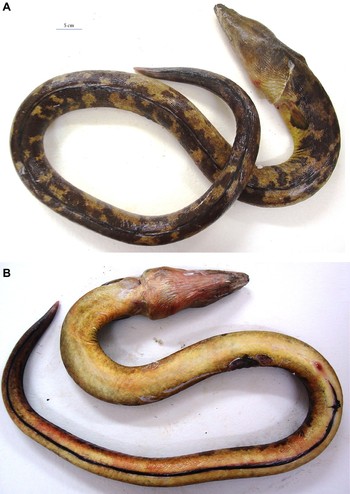
The specimen exhibited a combination of characters, viz., hard, pointed tail-tip with dorsal and anal fins ending before tail-tip; well developed pectoral fins; both upper and lower lip fringed with a series of small barbels (cirri); canine-like teeth on jaws and vomer; dorsal fin begins well behind pectoral fin tip and tail about half of total length. The above morphometric and meristic characters of this specimen agree well with Smith & McCosker (Reference Smith, McCosker, Carpenter and Niem1999) and McCosker & Randall (Reference McCosker and Randall2001), and hence assigned to the genus Brachysomophis Kaup, 1856. The species was identified as Brachysomophis cirrocheilos (Bleeker, 1857), the stargazer snake eel (Figure 1A, B) based on the description below with measurements given in parentheses.
(A) Brachysomophis cirrocheilos (Bleeker), entire fish (dorsal view); (B) ventral view of B. cirrocheilos (Bleeker).

DESCRIPTION
This eel has a moderately robust, elongated snake-like body. Body is scaleless; triangular in cross-section at trunk region while round shape behind vent and gradually tapering to a hard, pointed tail. The tail (525 mm) constitutes 51.5% and head (128 mm) 12.5% of total length. Body depth at anus (31 mm) is about 33 times the total length. Snout (14 mm) is short and flattened, which was about 9.2 times the head length. Anterior nostril was like a short tube and posterior nostril opens downward on edge of upper lip anterior to orbit. Eyes (7 mm) were small; centre of eye in anterior third of upper jaw and looking somewhat upwards. Top of head is flat from middle of head to snout tip. Branchiostegal rays were numerous, and overlapping was also observed along the mid-ventral line, forming a basket-like structure.
Cleft of mouth was very wide, reaching well behind hind border of eye. Both the lips fringed with a series of small cirri. Upper jaw length (52 mm) was about 2.5 times the head length. Lower jaw was longer, extending beyond snout tip. Teeth on jaws were conical, canine-like and spaced; a single row on lower jaw and two rows on upper jaw with a gap in between. Outer row of maxillary teeth was not visible when mouth was closed. Vomerine teeth were larger than jaw teeth; there were six canines on vomer, the first four close together. Tongue was not free. Head pores faintly visible; free sensory neuromasts were visible on nape, as a series of pores across head at level behind cleft of mouth (usually not visible in most specimens). Lateral line pores not apparent. Gill openings were relatively low and wide. Vertical fins were well developed. Dorsal fin originated well behind pectoral fin tips. Pre-dorsal distance (203 mm) was about one-fifth of total length. Dorsal and anal fins ended a short distance before tail-tip. Pectoral fin (26 mm) was well developed and its length was 20.3% of head length. Pectoral fin base was restricted to upper half of gill opening which was almost half of fin length. Pelvic fin was absent. Caudal fin was absent. Vertebral formula was found to be 18/59/138.
Colour of dorsal side was pale brownish-yellow with irregular dark brown patches or smudges on back and sides. Ventral side was creamy white. Fins were dark.
DISCUSSION
The genus Brachysomophis comprises seven species (McCosker & Randall, Reference McCosker and Randall2001). Except for B. porphyreus, all other species of this genus differ from this species in having a relatively short tail, which is equal to or less than the length of head and body combined (usually less than 50% of total length). Brachysomophis porphyreus is characterized by the presence of minute barbels which are almost not visible in large specimens. Outer maxillary teeth are exposed when jaw is closed. The dorsal side of the body is uniformly brownish purple with no dark smudges. From the distribution point of view, one species is restricted to the Atlantic Ocean, four are found in the western Pacific Ocean and only two are widespread in the Indo-West Pacific.
The only other species known to inhabit the Indian Ocean region is B. crocodilinus, which differs in having a short tail, short snout, short pectoral fin (10% of head) and a different colour pattern. Generally, dark patch or smudges are absent; dorsal side is brown, with a lighter shade below and on fins. Small dark spots are present irregularly on the flank between the lateral line and dorsal fin of large specimens.
Brachysomophis cirrocheilos is known to be distributed in the Indo-West Pacific region from the Red Sea and East Africa to Japan, Taiwan, New Guinea, Indonesia and Australia. It was reported from Sri Lanka in 1929 (Deraniyagala, Reference Deraniyagala1929) as well as recently in 2001 (McCosker & Randall, Reference McCosker and Randall2001). However, there is no record of its occurrence along the Indian sub-continental coastal waters. This report forms the first record of its occurrence from Indian waters.
This eel is known to occur in shallow sandy and muddy substratum, in coastal marine waters near coral reefs at depths of up to 38 m. It usually burrows into the sand with its tail first until only its eyes and the top of its snout or head are visible. It is nocturnal. Like other snake eels, due to their nocturnal habit even the common ones are rarely seen. It feeds on small fish and crustaceans. It is harmless. Reports from other countries show that it is usually caught by trawl or by hook-and-line. It is not known to be edible.
ACKNOWLEDGEMENTS
The first and third authors are grateful to the Director of IGCAR for constant encouragement and support. Also they are grateful to the Station Director of MAPS for giving the necessary permission. The second author is thankful to the Director of the Zoological Survey of India (ZSI), Kolkata and to the Officer-in-Charges, Marine Fish Section, ZSI, Kolkata for permission and constant encouragement.