Implications
The livestock sector needs to improve its sustainability in a challenging context. Agroecology is a promising option, but its underlying principles need to be translated into more practical advice to favour their application on commercial farms. We present a multicriteria approach to develop an agroecological diagnostic tool applied to mountain dairy farms, and propose a structured list of sub-principles, state variables and criteria on the basis of practices to be complied with to ensure agroecological production.
Introduction
Livestock production systems have been facing more and more criticism for their ecological footprint. A major example is the report ‘Livestock’s long shadow’ published by the Food and Agriculture Organization (Steinfeld et al., Reference Steinfeld, Gerber, Wassenaar, Castel, Rosales and Cd2006), which blames the livestock sector for 18% of anthropogenic greenhouse gas emissions, increased competition for resources and biodiversity losses. Livestock production systems are thus vigorously criticized for being unsustainable and need to be redesigned. A promising option would be to apply agroecological principles to agroecosystem management (Altieri, Reference Altieri2002; Gliessman, Reference Gliessman2007), including for animal production systems (Dumont et al., Reference Dumont, Fortun-Lamothe, Jouven, Thomas and Tichit2013). Societal concern for this challenging issue is rising in both science (INRA, 2012; Tscharntke et al., Reference Tscharntke, Clough, Wanger, Jackson, Motzke, Perfecto, Vandermeer and Whitbread2012; von Keyserlingk et al., Reference von Keyserlingk, Martin, Kebreab, Knowlton, Grant, Stephenson, Sniffen, Harner, Wright and Smith2013) and policymaking (http://www.livestockdialogue.org/).
Altieri (Reference Altieri1995, Reference Altieri2002) defines agroecology as a ‘discipline that provides the basic ecological principles for how to study, design and manage agroecosystems that are both productive and natural resource conserving, and that are also culturally sensitive, socially just and economically viable’. An agroecosystem is a community of organisms (plants and animals) that interact with their environment, both physical and chemical, impacted and modified by human action so as to produce goods (Gliessman, Reference Gliessman1998). This definition illustrates the need to consider each animal production system within its environment. Agroecology can thus be seen as a way to improve the sustainability of agroecosystems, on the basis of the application of scientific knowledge favouring ecological processes to limit their negative impact on the environment. It relies on the holistic study of agroecosystems, combining environmental and human elements (Altieri, Reference Altieri2002). Here, we place our specific contribution at the interface between production level and environmental footprint of animal production systems, which includes the different non-provisioning ecosystem services (i.e. regulating, supporting and cultural) sensu Díaz et al. (Reference Díaz, Tilman, Fargione, Chapin, Dirzo, Kitzberger, Gemmill, Zobel, Vila, Mitchell, Wilby, Daily, Galetti, Laurance, Pretty, Naylor, Power, Harvell, Potts, Kremen, Griswold and Eardley2005) and Rodríguez-Ortega et al. (Reference Rodríguez-Ortega, Oteros-Rozas, Ripoll-Bosch, Tichit, Martín-López and Bernues2014).
Dumont et al. (Reference Dumont, Fortun-Lamothe, Jouven, Thomas and Tichit2013) have proposed five principles to adapt the agroecological concept to animal production systems, thus illustrating its multidimensionality: (i) adopting management practices aiming to improve animal health, (ii) decreasing the inputs needed for production, (iii) decreasing pollution by optimizing the metabolic functioning of farming systems, (iv) enhancing diversity within animal production systems to strengthen their resilience and (v) preserving biological diversity in agroecosystems by adapting management practices. These principles are generic for all animal production systems, and form the starting point of this work.
To encourage farmers to apply agroecological principles, these need to be translated into practical advice, adapted to the needs and context of each farmer (Altieri, Reference Altieri2002). Here, we present a procedure for the collaborative construction of an agroecological diagnostic grid of dairy systems, with a focus on mountain farming. We describe how the agroecological criteria were identified and organized to form the architecture of the evaluation model. Our end purpose is to create an agroecological diagnostic tool that underlines the strengths and weaknesses of each farm and thus help to recommend appropriate practices. This tool would thus make the agroecological concept more concrete for dairy systems by illustrating its principles through practices, and then assessing farms through the application thereof.
The multicriteria evaluation process adopted
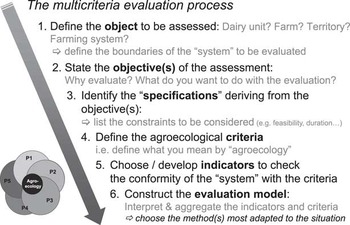
Agroecology is a multidimensional concept, but it is questionable whether following agroecological principles can simultaneously improve all its different dimensions. For instance, in the example of self-sufficient low-input dairy systems illustrated by Dumont et al. (Reference Dumont, Fortun-Lamothe, Jouven, Thomas and Tichit2013), maximizing grazing is recommended to follow the agroecological principle ‘reducing inputs needed for production’. This practice proved beneficial for many environmental aspects, while increasing the farmers’ gross profit margin (Moreau et al., Reference Moreau, Ruiz, Mabon, Raimbault, Durand, Delaby, Devienne and Vertès2012). Spring calving may be a solution as it matches the high animal needs with high grass availability periods according to the fourth principle. However, this practice may prove detrimental to animal health (first principle) by increasing the risk for hypocalcaemia and hypomagnesaemia, and thereby risk for milk fever and grass tetany (Suttle, Reference Suttle2010). In almost all farms, we will have to face such trade-offs. Thus, any agroecological assessment will have to rely on a multricriteria evaluation process, simultaneously considering all relevant aspects, so as to be sure not to leave out an important one that could modify the conclusion. To produce an agroecological assessment of mountain dairy systems, we followed a procedure in six steps (Figure 1), adapted from a study by Botreau (Reference Botreau2012). Here, we report on how we dealt with the first four steps of this multicriteria assessment process, up to the definition of agroecological criteria, thus describing the specific methodology we developed. We then discuss implications for the remaining two steps.
The six steps of the multicriteria evaluation process (adapted from Botreau, Reference Botreau2012), applied to the assessment of the agroecological concept on dairy farms.

Step 1: definition of the object to be assessed
The first element to be defined is the object we want to assess. In our study, we decided to focus on the agroecological evaluation at farm scale, as it represents the basic decision level and economic unit at which farmers produce goods and other ecosystem services. Although the procedure we defined aims to be generic for all dairy farms, indicators and criteria to check the compliance of the farm with agroecological principles have to be adapted to the farm context. Here, we focus on mountain farms on the basis of the use of semi-natural grassland, in which the main income comes from the dairy cattle unit. It includes not only the dairy unit, but also secondary units (e.g. crops or another animal-based or animal-related unit) and its immediate human and landscape environment.
When defining the assessment scale at farm level, we do not limit the evaluation to the impacts ‘on the farm’. Some agroecological principles have an impact at a larger scale. For instance, the fact to decrease pollution by optimizing the functioning of farming systems (Principle 3) also has an impact at watershed scale (e.g. for eutrophication) and at global scale (e.g. for greenhouse gases emissions). Similarly, the impact of preserving biological diversity (Principle 5) is not limited to the farm, as pollinators and birds fly over farm boundaries. Thus, even if the assessment is at the farm level, externalities produced by mountainous dairy farms at a larger scale are to be considered by the agroecological evaluation tool.
In Europe (Commission Regulation EC1257/1999), ‘mountain’ areas are officially defined as characterized by significant handicaps owing to harsh climatic conditions linked to altitude, leading to a reduced vegetative period, and/or to the presence of steep slopes where mechanization is hardly possible. Mountain areas represent the fifth of Europe’s usable agriculture area, where 9.5% of total cow milk is being produced (Santini et al., Reference Santini, Guri, Gomez and Paloma2013). The mountain dairy farms are characterized by high use of grasslands (58% of the UAA in mountain areas dedicated to permanent grasslands v. only 33% at EU level, Santini et al., Reference Santini, Guri, Gomez and Paloma2013) and the production of high-quality products under protected designation of origin (PDO) labels (e.g. 55% of French PDO cheeses are made of milk from mountain areas, Reuillon et al., Reference Reuillon, Dervillé, Crouzet, Forray and Perrot2012). Thus, these systems are important both economically and environmentally with a strong link to ‘terroirs’ (Casabianca et al., Reference Casabianca, Sylvander, Noël, Béranger, Coulon, Roncin, Flutet and Giraud2011).
Step 2: definition of our objectives with reference to multicriteria problematics
In this study, we set out to develop an agroecological diagnostic tool focusing on environmental issues, while maintaining production levels. Once developed, the targeted users could be the farmers and animal production advisors. In decision mathematics, four types of multicriteria problematics (sensu Roy, Reference Roy1996) can be identified, depending on the purpose of the assessment model. The first one is the description of the agroecological characteristics of the systems to be assessed, which implies a case-by-case interpretation. The remaining three imply an aggregation of the pool of information, resulting in the choice of the best alternative, the sorting of alternatives depending on norms or the ranking of alternatives from best to worst (Roy, Reference Roy1996). Here, we aim to go further than the description by addressing a sorting problem to state, in a standardized way, whether the farm considered fulfils agroecological principles or not. We therefore need to define and organize the set of agroecological criteria on which the overall decision will be taken.
Step 3: identification of the specifications from the objectives of the assessment
As we want the tool to be used on farms to produce a diagnosis, some constraints have to be considered when designing the tool, for instance, the choice of indicators. Harrington (Reference Harrington1992) identified two categories of indicators based on either ‘state variables’ (descriptors of the results) or ‘control variables’ (descriptors of the means used). To make the data collection easier (in terms of both costs and time required), we decided to focus on practices only, that is, on control variables. However, this choice implies having knowledge about the expected impact of practices on state variables. Ultimately, the agroecological diagnostic tool will require a few hours with the farmer, who answers a questionnaire based on his/her practices. This will have an impact on the choice of criteria (Step 4) and on the choice of indicators to check the compliance of the farm with the criteria (Step 5). In addition, to help making the diagnostic tool ‘trustworthy’ from the users’ point of view, that is an essential characteristic for a tool to be used, the evaluation process should be as transparent as possible. Thus, the way the collected information is used (i.e. interpreted in terms of agroecological performance and aggregated when necessary) to produce the overall evaluation should be written in a clear way, so that an advisor can explain farmers their strengths (to be maintained) and weaknesses (to be corrected). This will have a direct impact on the construction of the evaluation model (Step 6), for instance, in the choice of the methods to be used to compile the information.
Agroecology relies by definition on the interactions of the agroecosystem (in our case the mountain dairy farm) with its environment. However, each farm is characterized by its own specific landscape, fauna and flora, pedoclimatic conditions, farmers’ network and organization of the local dairy sector. Thus, each agroecological design is site specific (Altieri, Reference Altieri2002). We opted to maintain our objective of producing as generic a tool as possible, but including site-specific indicators (e.g. recommending use of wind energy is only relevant for a farm where it is possible to install a wind turbine), which enables us to increment the tool with indicators or criteria that were not initially listed because they are not common. Our diagnostic tool will thus not be tightly set; hence, its application will require a trained advisor, able to include farm-specific, relevant practices in the tool.
Step 4: definition of the set of agroecological criteria
Proposing an assessment model for a multidimensional concept such as ‘agroecology’ requires defining a set of criteria to support the overall evaluation. A criterion is defined as a particular point of view from which alternatives (here mountain farms) characterized by a set of attributes are compared (Bouyssou, Reference Bouyssou1990; Roy, Reference Roy1996). An attribute is a simple characteristic or sign that allows the discrimination of alternatives. A criterion establishes a preference judgement related to the decision (Roy, Reference Roy1996).
The definition of the set of criteria to be considered and their construction has to meet some practical requirements and possess certain technical properties (Bouyssou, Reference Bouyssou1990). It should be legible and operational. Legibility is ensured if the number of criteria is small enough to allow assessment of inter-criteria information. At each level of the construction process, it is considered that the number of criteria should not exceed 12, owing to the cognitive limits of the human brain when asked to gather multiple items of information (Miller, Reference Miller1956; Bouyssou, Reference Bouyssou1990). To be operational, the set of criteria should be understood and acceptable by all stakeholders (in our case farmers and advisors).
Among its technical properties, the set of criteria must also be exhaustive, minimal, monotonic and independent. To be exhaustive, the set of criteria must contain all relevant points of view. To be minimal, it must avoid any redundant or irrelevant points of view (in relation to the object of the assessment, in our case agroecology). To avoid double-counting some elements, choices may have to be made on the position of a given criterion in the hierarchical structure of the model or on its construction by refining indicators (e.g. in Botreau et al., Reference Botreau, Veissier, Butterworth, Bracke and Keeling2007). Monotonicity implies constructing the assessment model so that the partial preferences (at criterion level) are consistent with the overall judgement made on the alternative. For instance, if an alternative A is globally preferred to B, and if an alternative C is as good as A on all the criteria, then alternative C must also be preferred to B. Finally, the criteria should be independent of each other when they are interpreted, that is, the interpretation from one criterion should not depend on the value of another criterion.
Experts’ consultation procedure
The definition of criteria was made by experts following two rounds of consultation. A first group of five scientists (the authors of the paper) was selected. They were either experts in mountain dairy systems, in the effects of pasture management on environment (mainly biodiversity) or in the design of multicriteria evaluation tools. We decided to maintain a limited number of experts to favour exchanges and discussions in group working sessions. In addition to their skills and knowledge, these experts were chosen according to practical reasons such as their geographical proximity allowing their physical presence during working sessions. Fifteen 3-h sessions enabled us to define the working framework (how to go from the five principles, as defined by Dumont et al. Reference Dumont, Fortun-Lamothe, Jouven, Thomas and Tichit2013, generic for all types of farming systems, to a list of agroecological criteria?) and establish the structure of the evaluation model with a first set of criteria. We used a brainstorming process, moderated by the expert in multicriteria evaluation to ensure the consistency of the set of criteria with the required properties. During these group sessions we sought a consensus. Thus, they formed a collaborative learning process, characterized by convergence on shared meanings and knowledge, leading to an increase in common knowledge (Roschelle, Reference Roschelle1992; Jeong and Chi, Reference Jeong and Chi2007). Principle by principle, this first set of criteria underwent a second round of consultation. We identified targeted experts for each principle (e.g. three veterinarians, including one specialized in alternative treatments, were identified for Principle 1). We ran individual consultations of these experts to complete or correct the first set of criteria. Finally, we consulted experts from very different spheres from researchers to vets.
Agroecological criteria matrices
For each agroecological principle, we defined a set of criteria adapted to mountain dairy systems.
A structure in five matrices
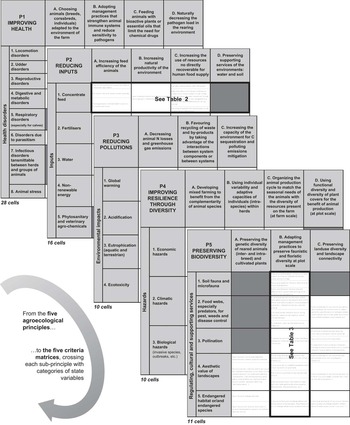
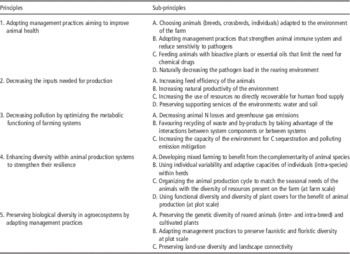
We followed a hierarchical approach (as suggested by Bouyssou, Reference Bouyssou1990; Saaty and Vargas, Reference Saaty and Vargas2012). The five principles proposed by Dumont et al. (Reference Dumont, Fortun-Lamothe, Jouven, Thomas and Tichit2013) formed the upper level of the set of agroecological criteria. For each principle, Dumont et al. (Reference Dumont, Fortun-Lamothe, Jouven, Thomas and Tichit2013) identified several possible actions, which we used to subdivide each principle into three to four generic sub-principles (Table 1). For each principle, we then identified the relevant categories of state variables, on which agroecological criteria, based on recommended practices, should have a positive impact on dairy systems. For Principle 1 ‘Improving animal health’, we considered different categories of health disorders and an additional category dedicated to animal stress. We split Principle 2 ‘Reducing inputs needed for production’ into the main inputs used on farms. For Principle 3 ‘Reducing pollutions’, we identified the different categories of environmental impacts of livestock farming, from global (greenhouse gas emissions) to more local impacts (eutrophication, acidification, ecotoxicity). We split Principle 4 ‘Improving resilience through diversity’ into economic, climatic and biological hazards. Finally, for Principle 5 ‘Preserving biodiversity’, we identified the non-provisioning services that a farming system may provide. Biodiversity was considered for its role in maintenance of soil fertility, biological control and pollination (regulating services). Landscapes were considered for their aesthetic, recreation (cultural) and habitat (supporting) values. All these state variables are specific to dairy systems and are detailed in Figure 2. For instance, we decided to consider udder disorders in Principle 1, being important for dairy systems but irrelevant to other livestock systems.
Structure of the five criteria matrices built on the crossing of agroecological sub-principles with categories of state variables.

Agroecological principles and sub-principles to ensure sustainable animal production (adapted from Dumont et al., Reference Dumont, Fortun-Lamothe, Jouven, Thomas and Tichit2013)

By crossing sub-principles and categories of state variables, we designed a criteria structure in five matrices, one per principle (Figure 2). All the matrices present a common structure with the sub-principles in columns and the categories of state variables in rows. Not all the cells are necessarily relevant as shown in the examples that follow, and some could be merged to avoid double-counting, if practices compliant with agroecological principles were the same. Finally, 75 cells are relevant for mountain dairy systems, including 28 for Principle 1, 16 for Principle 2, 10 for Principle 3, 10 for Principle 4 and 11 for Principle 5.
Within each cell, several criteria were defined during the first round of consultation, then completed during the second round. Here, one row, one column and an example of two merged cells will be detailed to illustrate how we identified criteria. To ensure the legibility and operationality of the set of criteria (and thus the practicability of the construction of the evaluation tool), we decided to limit at four the number of criteria per cell.
Example 1: reducing use of concentrates (first row of the second matrix ‘Reducing inputs’)
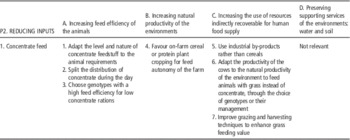
We analysed agroecological practices that can limit the use of concentrate feed, one important category of inputs. For instance, in France in 2011, the conventional mountain dairy systems were the largest concentrate feed consumers (in comparison with lowland, organic and non-specialized systems) with on average 249 g/l of produced milk, representing a cost of 73€/1000 l (Caillaud et al., Reference Caillaud, Fagon and Seegers2013). This stresses the need to cut them by increasing animal feed efficiency, and making the best use of the supporting services provided by grasslands. We identified a total of seven criteria related to three sub-principles, listed in Table 2. The fourth sub-principle was considered as non-relevant, because the preservation of the water and soil is not a strategy applicable to reduce concentrate feeds in mountain dairy systems.
Recommended management practices for decreasing the concentrate feed needed for production (first line of the second matrix)

Sub-principle ‘Increasing feed efficiency of the animals’
Criterion 1: The easiest way to increase feed efficiency of a dairy cow is to feed it with a diet balanced in energy and nitrogen corresponding to its requirements (Agabriel et al., Reference Agabriel, Pomiès, Nozière and Faverdin2010). The diets fed to mountain dairy herds are often based on fresh or preserved grass (hay or silage); when harvested in good conditions at an optimal stage, they cover most of the nitrogen requirements of the animals, but must be complemented with energy-rich feedstuffs for the most productive cows. With low-quality hay or silage, supplementing cows with a protein-rich feedstuff is sometimes necessary. In all cases, knowing the fodder (composition of the grassland, grass phenological stage at grazing or harvesting, harvesting conditions, preservation mode, etc.) allows the use of the available references (Baumont et al., Reference Baumont, Dulphy, Sauvant, Tran, Meschy, Aufrère, Peyraud and Champciaux2010) that precisely estimate its feeding value (intake and content in energy, nitrogen and minerals). This allows selection of the amount and nature of concentrate feedstuff that must be added for an optimal functioning of the rumen microbial ecosystem. A concomitant supply of both nitrogen and energy to the rumen microbes is required via the choice of the appropriate energy-rich concentrate providing the amount of degradable starch-matching degradability in the rumen of the fodder proteins (Charbonneau et al., Reference Charbonneau, Chouinard, Allard, Lapierre and Pellerin2006). This precision feeding strategy can be implemented by a fractioned supplementation of appropriate concentrates for each cow (e.g. using an automatic concentrate feeder) or, in the case of total mixed rations, by managing the herd in homogeneous groups based on their physiological status or milk yield.
Criterion 2: Similarly, in the case of diets rich in concentrate high in fermentable carbohydrates, mixing forage and concentrates or splitting up the concentrate distribution into even amounts during the day (with an automatic concentrate feeding station) averts rumen pH depression and subsequent acidosis (Krause and Oetzel, Reference Krause and Oetzel2006), indirectly responsible for many health disorders.
Criterion 3: The farmers may also favour the choice of genotypes (breed, strain and format) best fitted to grassland-based diets with a low amount of concentrates (Horan et al., Reference Horan, Dillon, Faverdin, Delaby, Buckley and Rath2005; Hofstetter et al., Reference Hofstetter, Burgos, Petermann, Munger, Blum, Thomet, Menzi, Kohler and Kunz2011), that is, genotypes able to meet their requirements by developing specific adaptations, both behavioural (land exploration, selective intake) and physiological, to maintain milk production and reproductive efficiency under harsh feeding conditions (Blanc et al., Reference Blanc, Bocquier, Agabriel, D’hour and Chilliard2006). In the future, progress in genomic selection should help in choosing cows adapted to mountain grass-based diets, by a direct selection on traits related to digestive efficiency (Veerkamp et al., Reference Veerkamp, Calus and de Haas2012).
Sub-principle ‘Increasing natural productivity of the environment’
Criterion 4: Growing corn is generally impossible in mountains because of the harsh climate, and therefore dairy cows are complemented with concentrates that are usually purchased outside the farm. It seems possible to enhance the natural productivity of mountain farms to reach feed autonomy by developing new cropping techniques or growing new wheat, barley and triticale varieties, or mixtures of cereals with protein crops suitable for mountain climate and soils (Daudet, Reference Daudet2005).
Sub-principle ‘Increasing the use of resources non-directly recoverable for human food supply’
Criterion 5: Rather than buying cereals for animals that compete with human foods, the farmers may also buy industrial by-products that cannot be used by humans, for example, distiller grains, pulp or bran. With a wide variety of composition (Baumont et al., Reference Baumont, Dulphy, Sauvant, Tran, Meschy, Aufrère, Peyraud and Champciaux2010), their feeding values are often useful for balancing the diet of moderately producing cows.
Criterion 6: As grass is the main production in mountain areas, not competing with human feeding, farmers may also choose breeds with a lower milk yield than Holstein cows that can be fed with grass forages only. In the case of high-yielding cows, farmers may also shorten the periods when the animals have high needs by milking the cows only once a day from calving, to reduce the lactation peak (Rémond et al., Reference Rémond, Aubailly, Chilliard, Dupont, Pomiès and Petit2002) or by extending the interval between calving (Auldist et al., Reference Auldist, O'Brien, Cole, Macmillan and Grainger2007). In addition, grouping the calving in spring allows the production of most milk at pasture, which requires less concentrate for a similar milk yield, as the feeding value of grazed swards is always higher than that of the corresponding preserved forage.
Criterion 7: Finally, the improvement of grass utilization by an early turn-out to pasture (Kennedy et al., Reference Kennedy, O’Donovan, Murphy, Delaby and O’Mara2005) or rotational grazing, early cutting associated with barn drying, silage or wrapped bales provides higher quality forage that can lower the need for complementation.
Example 2: adapting management practices to preserve biodiversity at plot scale (second column of the fifth matrix ‘Preserving biodiversity’).
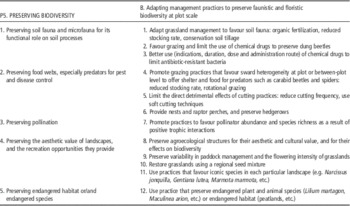
We analysed agroecological practices that can help preserve the biological diversity of agro-ecosystems. Grassland management plays a key role, because modifications of fertilization, grazing, cutting and tillage practices affect soil organisms, plants, insects and birds. We identified a total of 12 criteria related to five categories of state variables listed in Table 3.
Recommended management practices for preserving biological diversity at plot scale (second column of the fifth matrix)

State variable ‘Preserving soil fauna and microfauna for its functional role on soil processes’
Criterion 1: Belowground fauna contributes to important ecosystem services in grassland soils, such as decomposition of dead organic matter, nutrient mineralization, primary production and seedling establishment. Trampling of pastures has detrimental effects on Acari, Collembola and nematodes (Schon et al., Reference Schon, Mackay and Minor2012), whereas conservation tillage (Chan, Reference Chan2001) and organic fertilizer benefit decomposers (van Eekeren et al., Reference van Eekeren, de Boer, Bloem, Schouten, Rutgers, de Goede and Brussaard2009). The adoption of alternative production management, for example, lenient stocking rate, conservation tillage and organic fertilization may thus have an important role to play in ecological functioning of grassland soils.
Criterion 2: Coprophagous insects double the rate of dung degradation. Meanwhile, they help to incorporate organic matter in the soil, increase soil microfauna density and reduce infestation by gastrointestinal parasites (Bloor et al., Reference Bloor, Jay-Robert, Le Morvan and Fleurance2012). While the use of anthelmintics such as ivermectin has low-to-moderate effects on soil organisms: microbial biomass, nematodes, earthworms and so on (Forster et al., Reference Forster, Boxall, Coors, Jensen, Liebig, Pope, Moser and Rombke2011), these drugs have clearly adverse effects on dung beetles (Iwasa et al., Reference Iwasa, Maruo, Ueda and Yamashita2007). Alternative chemical anthelmintic agents with a narrow spectrum of activity pose no risk to insect dung fauna when used as recommended (Skripsky and Hoffmann, Reference Skripsky and Hoffmann2010); they must be used as a priority.
Criterion 3: Better use of antibiotics and anthelmintics is of major importance to avert possibilities for pathogens to adapt and become resistant, as soil bacteria seem to be swapping antibiotic-resistant genes with other more dangerous bacteria.
State variable ‘Preserving food webs, especially predators for pest and disease control’
Criterion 4: The role of spiders and carnivore carabid beetles as natural enemies of invertebrate pests in agroecosystems are well documented in biological control strategies. Lenient grazing intensity allows the creation of sward mosaics of short and tall grass patches, which provide a greater number of shelters and important food resources for grassland arthropods (Dumont et al., Reference Dumont, Farruggia, Garel, Bachelard, Boitier and Frain2009).
Criterion 5: Increased cutting frequency decreases invertebrate diversity because it does not allow species that are demanding in terms of structural composition of the vegetation, such as spiders, to settle (Jeanneret et al., Reference Jeanneret, Baumgartner, Freiermuth and Gaillard2006). Cutting technique is another important point to consider, a mower with a tall cutter bar being less detrimental to a wide range of animals species than rotary mowers or grinding techniques (Oppermann and Krismann, Reference Oppermann and Krismann2001).
Criterion 6: Finally, an alternative environmental strategy to control rodents is to provide nests and raptor perches, and to preserve hedgerows, which increase predator density (Paz et al., Reference Paz, Jareno, Arroyo, Vinuela, Arroyo, Mougeot, Jose Luque-Larena and Antonio Fargallo2013).
State variable ‘Preserving pollination’
Criterion 7: Many studies show that pollinators are highly sensitive to the abundance of flowering plants as foraging resources. Lenient stocking rates are assumed to benefit plant diversity and especially flowering plants (Dumont et al., Reference Dumont, Farruggia, Garel, Bachelard, Boitier and Frain2009). Milchunas et al. (Reference Milchunas, Sala and Lauenroth1988) predicted a bell-shaped relationship between grazing intensity and plant diversity: high stocking rates favour competitive grasses with high leaf-growth rate and white clover, whereas at the other end of the gradient very low grazing intensities enhance dominance of tall grasses that exert competition for light on small-sized species. Besides the reduction of stocking rate, practices that favour flowering intensity, for example, excluding animals from pastures at flowering peak (Farruggia et al., Reference Farruggia, Dumont, Scohier, Leroy, Pradel and Garel2012), late grazing (Sjödin, Reference Sjödin2007), preserving legume-rich grasslands (Goulson et al., Reference Goulson, Hanley, Darvill, Ellis and Knight2005) and introducing wildflower margin strips at the edge of arable fields (Aviron et al., Reference Aviron, Herzog, Klaus, Schupbach and Jeanneret2011), benefit biodiversity, as plants that are allowed to flower provide important resources for nectar- and pollen-feeding guilds of invertebrates.
State variable ‘Preserving the aesthetic value of landscapes, and the recreation opportunities they provide’
Criterion 8: Hedgerows, isolated trees, stone walls and high pasture chalets not only have an aesthetic and cultural value in some upland landscapes, but they also provide benefits, both direct (habitat) and indirect (landscape connectivity).
Criterion 9: Combining different management practices in terms of grazing intensity and cutting frequency can improve biodiversity at the farm scale. The interaction between the diverse management practices shapes the relationship between the ecological and productive performance of the system (Tichit et al., Reference Tichit, Puillet, Sabatier and Teillard2011). In less intensive systems, extensively managed areas and agroecological structures act as dispersal sources and ecological corridors. The choice of these areas for conciliating multiple performance criteria should thus take into account not only their biodiversity potential, but also their distribution.
Criterion 10: If the species pool is low at the landscape scale, restoration of semi-natural grasslands can be achieved using a regional seed mixture; it can bring a rapid improvement in grassland biodiversity, but this is unlikely to provide habitats for ecological specialists (Pywell et al., Reference Pywell, Bullock, Tallowin, Walker, Warman and Masters2007).
Criterion 11: Grassland management practices should also be adapted to the biological requirements of some particular iconic species that contribute to the cultural heritage and reinforce the aesthetic and recreational value of landscapes (Harrison et al., Reference Harrison, Vandewalle, Sykes, Berry, Bugter, de Bello, Feld, Grandin, Harrington, Haslett, Jongman, Luck, da Silva, Moora, Settele, Sousa and Zobel2010).
State variable ‘Preserving endangered habitat or/and endangered species’
Criterion 12: The remarkable habitat farming areas or species are subject to a regulatory classification. The presence of these habitats or species is an important asset for the biodiversity of the area (Kruk et al., Reference Kruk, Noordervliet and ter Keurs1996). Farmers should respect some management specifications (e.g. no spring grazing), which maintain the integrity of the habitats and allow these species to complete their full biological cycle.
Example 3: decreasing animal losses to limit eutrophication and acidification risk (merging two cells in the first column of the third matrix ‘Reducing pollutions’).
In dairy farms, eutrophication (mainly owing to nitrate leaching) and acidification (mainly derived from ammonia emissions) are the consequence of an inefficient regulation of nitrogen fluxes at the farm scale. Mitigation of these impacts through the reduction in animal losses can thereby be achieved by the same farming practices, which justifies merging two cells from column A in the third matrix. Reducing N excretion in urine and faeces by dairy cows requires increasing N body retention and thus examining the nutritional and animal factors that influence the efficiency of N utilization. We identified three criteria related to the main strategies that can be implemented for increasing N body retention and reducing nitrate leaching from pastures: (1) providing animals a diet with an optimal N content and form, (2) choosing high-yielding cows and increasing the length of their productive life and (3) extending the grazing season.
Criterion 1: Martineau et al. (Reference Martineau, Sauvant, Ouellet, Cortes, Vernet, Ortigues-Marty and Lapierre2011) propose 14% of crude protein in the whole diet of dairy cows as a target permitting an optimal rumen functioning, thus reducing N losses. Balancing and synchronizing the ruminal carbohydrate and N supply and increasing the proportion of rumen undegradable protein in the diet are further ways of reducing N losses in urine. As vegetative grass is particularly unbalanced (i.e. too rich in N relative to carbohydrates) in spring and autumn, cow supplementation with appropriate levels of cereals can increase N retention as it allows increasing the efficiency of microbial protein synthesis (Hoover and Stokes, Reference Hoover and Stokes1991). Feeding animals with sainfoin also can be used to alter the form of excreted N (i.e. urine v. faeces) owing to its high proportion of condensed tannins; such feeding strategy can potentially reduce environmental N pollution without affecting body N retention (Theodoridou et al., Reference Theodoridou, Aufrère, Andueza, Pourrat, Le Morvan, Stringano, Mueller-Harvey and Baumont2010)
Criterion 2: A second lever is based on the increase of cow production during their productive life as it dilutes the low nitrogen efficiency of animal maintenance and body accretion in the high N efficiency of milk production. It can be achieved not only by choosing high-yielding cows but also by increasing the length of their productive life, for example, by reducing the age at first calving or extending the cows’ career (Dollé et al., Reference Dollé, Delaby, Plantureux, Moreau, Amiaud, Charpiot, Manneville, Chanseaume, Chambaut and Al2013; Nguyen et al., Reference Nguyen, Doreau, Corson, Eugene, Delaby, Chesneau, Gallard and van der Werf2013). Extended lactation could also be a viable alternative to culling non-pregnant high-yielding cows (Butler et al., Reference Butler, Shalloo and Murphy2010) and may also be sensible for efficient N utilization at lifetime scale.
Criterion 3: Finally, a third strategy to reduce ammonia losses at the farm scale is to extend the grazing season. It decreases barn manure that produce ammonia and nitrates to the benefit of urine and faeces directly emitted on growing grass that can uptake nitrogen from urine and thus mitigate gaseous N emissions and leaching (Bolan et al., Reference Bolan, Saggar, Luo, Bhandral and Singh2004).
Discussion and perspectives
Agroecological principles in livestock farming systems need to be made more concrete to favour their application by farmers. Here, we propose a methodology to run a diagnosis of the farms, suited to all dairy systems, and list the agroecological criteria adapted to the mountain context and based on farmers’ practices. Five matrices, one for each of the agroecological principles proposed by Dumont et al. (Reference Dumont, Fortun-Lamothe, Jouven, Thomas and Tichit2013), were thus designed, and organized (Figure 2) into sub-principles (columns) and categories of state variables (rows).
Although we decided to base the diagnostic tool solely on practices (partly to ease data collection), this crossing of principles with state variables allows us to ensure that all the important categories of impacts are considered, while also linking practices (control variable) and results in terms of impact reduction (state variables), as proposed by Harrington (Reference Harrington1992).
This matrix structure can be used for all dairy systems. However, the criteria are specific to the mountain context, as agroecological practices have to be adapted to local conditions (Altieri, Reference Altieri2002). The final diagnostic tool will thus be dedicated to mountain dairy systems, but the methodology proposed is generic and transferable to other dairy systems (intensive off-land farms or grass-based systems in lowlands). We consider that proposing a fully generic agroecological diagnostic tool would be unhelpful (because it would propose practices that are not relevant to some dairy farms) and unrealistic (because it is impossible to consider the whole range of situations). In addition, a fully generic tool based on practices would be constrained by the fact that the effects of management practices within a system probably have a narrower range than the effect of some structural properties of the system (e.g. pasture biodiversity is usually greater in upland areas than in fertilized lowlands), so that it would be less sensitive to the strengths and weaknesses of each farm.
We also decided to conduct our diagnosis at farm scale, focusing on the dairy unit in the case of mixed farms. Within the farm, criteria can cope with possible synergies between production units. We also considered synergies with the direct environment of the farm, in both its environmental and its socio-economic dimensions. For instance, the fourth criterion of the input reduction principle (Table 2) is based on crop production on the farm (i.e. mixed farming), which depends on the possibilities offered by the environment. However, we do not consider the practices strictly linked to the other units of the farm (e.g. crop management or other livestock production). We are thus aware that additional information would be needed to propose a diagnostic tool at the whole farm scale, especially in case of mixed farming. More largely, even if we propose to evaluate the contribution of the farm (or dairy unit) to a larger scale (e.g. in Principle 5), we do not intend to evaluate agroecological management at the landscape scale.
Despite these limitations, we can propose a set of criteria hierarchically organized in principles and sub-principles, and within each sub-principle in categories of state variables (cells level), and finally in criteria (with an upper limit of four criteria per cell). This organization ensures the legibility of the set of criteria. Its operability will have to be tested by presenting the tool to a pool of farmers and farming advisors, which could entail some final readjustments. We sought to be as exhaustive as possible in the definition of the criteria. However, to cope with the necessary adaptation of the criteria to the local conditions, we decided to create an expandable tool that leaves advisors room to add-on practices that were not initially considered, under conditions to be defined in the construction of the evaluation model (Step 6 of the procedure). To ensure that the set of criteria is minimal, monotonic and independent, we made some choices during the organization of the architecture of the evaluation model. Thus, at the sub-criteria level, we decided to group some cells of the matrices as some practices could have the same effect on two or more categories of state variables. As detailed in Example 3, we merged some cells when the recommended practices act similarly on different state variables. We also limited possible redundancies by clearly specifying the scale considered in some sub-principles. For instance, in the fourth matrix focusing on the improvement of resilience based on diversity, the benefits of forage diversity were considered at the farm scale (complementarity of practices and grassland types) in sub-principle C, and at the plot scale (plant functional types) in sub-principle D. We sometimes debated the position of some criteria within the matrix or between matrices. For instance, in the second and third criteria of the management for biodiversity sub-principle (Table 3), we considered including better use of veterinary drugs to preserve soil microfauna. Such practices would also limit ecotoxicity (fourth line of matrix 3), and the use of chemical inputs (fifth line of matrix 2). During the final step of the evaluation process, we will thus have to account for the fact that the same practices are counted several times, for instance, by weighing them appropriately during aggregation.
The next step in the construction of this diagnostic tool will be to define for each criterion the indicators to be collected during the farm visit (Step 5). The evaluation model per se (i.e. the formalized judgement procedure; Step 6) will then be constructed. The choices presented here (Steps 1 to 4) will impact on these last two steps that are still in progress. Choices made in Step 3, especially on the applicability of the diagnostic tool, will clearly have an impact on the choice/development of indicators in Step 5. We want a tool to be implemented on commercial farms within a reasonable time lapse. To match this requirement, the indicators will be mostly declarative or qualitative, that is, without measurements on the farm. For instance, quantifying the floristic diversity on a farm is extremely time-consuming, and requires some specific skills. It would probably be replaced by declarative answers of the farmer on a list of practices that are known to benefit the floristic diversity of grasslands, and maybe some very simple assessment of plant diversity in some plots based on visual estimates of flower cover or flower colours, or according to regional typologies (http://www.prairies-aoc.net). Using such qualitative and/or declarative indicators would also make the farmer being involved in the agroecological diagnosis on his/her farm. We attempt to carry out this diagnosis within two half-days, thus giving the opportunity to the farmer to seek for additional information between the two meetings. With 75 cells and a maximum of four criteria per cell, we plan to ask the farmer a maximum of 200 questions, which should fit within a two half-days survey.
The choices made in Steps 1 to 4 will also impact the construction of the evaluation tool in Step 6. For instance, basing the diagnosis on practices is assumed to make farmer advising easier, by underlying the strengths and weaknesses of each farm. However, it may also make indicator interpretation more difficult. To produce a value judgement (interpretation) on the indicators, references are indeed needed on the impact of practices on which the indicators rely, and on the results for corresponding categories of state variables. To obtain such references, it is possible to use quantified data from the literature. For instance, Franzen and Nilsson (Reference Franzen and Nilsson2008) reported that 20% to 50% of semi-natural farmland left ungrazed between May and July could compensate for intense grazing applied on parts of the remaining farm area, which could provide a quantitative basis for interpreting the ninth criterion of Table 3. Concerning the aggregation of the criteria, we will also have to deal with the fact that we decided to leave the tool open so as to account for innovative practices, adapted to local conditions. As there may be less evidence of the efficiency of some of these practices, it is likely that we will not assign them the same relative weight in Step 6, compared with widespread and scientifically validated practices. In addition, we will have to propose methodological solutions to allow including the elements that were not originally listed. The question of the compensations among criteria will also have to be addressed, especially for practices that have antagonistic effects on different principles. For instance, the seventh criterion of the input reduction principle (Table 2) encourages early cuts to improve forage quality, although this can have a detrimental effect on predators, pollinators and endangered species, as stressed by recommended practices in Criteria 4, 7 and 12 for biodiversity preservation in Table 3. Similarly, the input reduction principle aims to limit the use of concentrate feed, whereas supplementation with cereals can increase N retention when cows graze on N-rich regrowths as mentioned in our third example dealing with the reduction of pollutions. It is finally noteworthy that the number of criteria is not balanced between the five principles, as there are only 10 relevant cells for Principles 3 and 4, v. 28 for Principle 1. In Step 6, the aggregation will necessarily readjust the relative importance of the five agroecological principles.
A last point to be discussed is the implication of experts for the definition of criteria (Step 4), the choice/development of indicators to assess these criteria (Step 5), and their interpretation and aggregation to produce an overall evaluation tool (Step 6). These experts may differ from one step to another, or from one principle or sub-principle to another. We first selected a limited number of experts chosen for their general knowledge of mountain dairy systems; however, right from the second round of consultation in Step 4, we identified targeted experts for some of the principles (e.g. a veterinarian specialized in alternative treatments). It is likely that some additional experts will be involved in Steps 5 and 6, for assessing the specificities of contrasting contexts (e.g. pedoclimatic conditions), to transfer this evaluation tool from one mountainous region to another. Adaptation of this tool to more intensive dairy systems will also require modifying the criteria and the indicators, and thus revising the interpretation and aggregation process (relative importance of the criteria and compensation management).
Conclusion
This practical tool focuses on the agroecological principles that can be applied, not only to reduce the negative impacts of agriculture but also to favour positive externalities of mountain dairy systems. Even if the proposed set of criteria is relevant for mountain dairy farms, the general procedure we followed is more generic and could be applied to other animal production systems. As illustrated here, the choices we made in the first four steps of the construction will have an impact on the choice of the indicators and their interpretation (Step 5), and the final aggregation (Step 6). To ensure the acceptability of recommended agroecological practices by farmers, we must consider their consequences on economic (e.g. farmer income and its resilience) and social variables (both for the farmer, e.g. workload, and the society, e.g. conservation of the patrimonial value of the region or animal welfare), as suggested by Dumont et al. (Reference Dumont, Fortun-Lamothe, Jouven, Thomas and Tichit2013). Although we do not claim to produce a sustainability diagnosis, it would be relevant to pursue this work with further considerations of the economic and social implications of encouraging agroecological practices (von Keyserlingk et al., Reference von Keyserlingk, Martin, Kebreab, Knowlton, Grant, Stephenson, Sniffen, Harner, Wright and Smith2013; Rodríguez-Ortega et al., Reference Rodríguez-Ortega, Oteros-Rozas, Ripoll-Bosch, Tichit, Martín-López and Bernues2014).
Acknowledgements
The authors thank the experts involved in the second round of consultation: Michel Doreau and Christian Ducrot (INRA), Laurent Alves de Oliveira and Loïc Commun (VetAgro Sup), and Gilles Grosmond (field veterinarian).