INTRODUCTION
In the last few decades, coral recruitment has been the object of several studies worldwide (Glassom et al., Reference Glassom, Celliers and Schleyer2006). Patterns emerging from these studies include global aspects, recruitment rates having been shown to vary across latitudes (Hughes et al., Reference Hughes, Baird, Dinsdale, Harriott, Moltschaniwskyj, Pratchett, Tanner and Willis2002), as well as regional aspects, with local variations across depths or substrate features (Glassom et al., Reference Glassom, Zakai and Chadwick-Furman2004). Knowledge about coral recruitment patterns is crucial because the future state of a reef may be better estimated according to ecological processes, such as recruitment rates, rather than to the patterns of abundance of its adult coral assemblages (Hughes et al., Reference Hughes, Baird, Dinsdale, Moltschaniwskyj, Pratchett, Tanner and Willis1999). Processes that give rise to a stable coral reef community are larval settlement, subsequent survival (recruitment) and growth (Artzy-Randrup et al., Reference Artzy-Randrup, Olinky and Stone2007; Ritson-Williams et al., Reference Ritson-Williams, Arnold, Fogarty, Steneck, Vermeij, Paul, Lang, Macintyre and Rutzler2009). Post-settlement processes determine much of the coral demography (Vermeij & Sandin, Reference Vermeij and Sandin2008). For corals, these processes depend on the size of colonies rather than their age (Hughes & Jackson, Reference Hughes and Jackson1980). Moreover, the earliest life stages of corals are characterized by low survival, which increases with colony size (Vermeij & Sandin, Reference Vermeij and Sandin2008). Thus, the rates of both early post-settlement selection and growth strongly influence the local abundance of corals and the resilience of a coral community (Ritson-Williams et al., Reference Ritson-Williams, Arnold, Fogarty, Steneck, Vermeij, Paul, Lang, Macintyre and Rutzler2009). For these reasons, several theoretical studies have already attempted to build size-structure models for coral population dynamics (Artzy-Randrup et al., Reference Artzy-Randrup, Olinky and Stone2007).
Recruitment in the Maldives (Indian Ocean) has been intensively studied after the 1998 bleaching event and the following mass mortality (Bianchi et al., Reference Bianchi, Morri, Pichon, Benzoni, Colantoni, Baldelli, Sandrini, Suzuki, Nakamori, Hidaka, Kayanne, Casareto, Nadaoka, Yamano and Tsuchiya2006a, Reference Bianchi, Pichon, Morri, Colantoni, Benzoni, Baldelli and Sandrinib, and references therein). Within the frame of these studies, in this paper we report abundance and size-patterns of juvenile corals in the Maldives, eight and nine years after the coral mass mortality event. Moreover, we propose a new index to assess recruitment success, testing it through reef typologies, time and depth.
MATERIALS AND METHODS
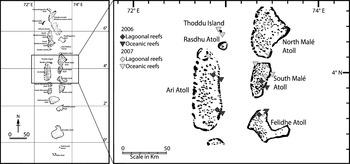
Data were collected in the central atolls of the Maldives (North and South Malé, Felidhe, Ari and Thoddu) during two scientific cruises, in 2006 and 2007—16 sites (eight along the outer side of the atoll rim and eight within the atoll) were chosen randomly with casual numbers within a list of sites with similar oceanographic features (bathymetry, currents and distance from the atoll passes) and far from human disturbances such as touristic dive sites and resorts. Data collection was carried out by SCUBA diving in the selected sites stratified into three depths (5–6 m, 10–12 m and 16–18 m) and two reef typologies, distinct both geomorphologically and ecologically (Lasagna et al., Reference Lasagna, Albertelli, Colantoni, Morri and Bianchi2010a): oceanic reefs, along the outer side of the atoll rim, and lagoonal reefs, within the atoll (Figure 1).
Study area and sites where data collection was carried out.

Only coral colonies with diameter smaller than 15 cm were taken into account. All of them can be defined as juvenile corals, but we followed Bianchi et al. (Reference Bianchi, Morri, Pichon, Benzoni, Colantoni, Baldelli, Sandrini, Suzuki, Nakamori, Hidaka, Kayanne, Casareto, Nadaoka, Yamano and Tsuchiya2006a, Reference Bianchi, Pichon, Morri, Colantoni, Benzoni, Baldelli and Sandrinib) in calling ‘recruits’ (R) the colonies smaller than 5 cm in diameter, whereas the term ‘juveniles’ (J) was reserved for colonies ranging between 5 and 15 cm. Although very artificial, those definitions of recruits and juveniles serve practical purposes for fieldwork and monitoring, and are consistent with literature information on the relationship between coral colony size and reproductive condition (Rinkevich & Loya, Reference Rinkevich and Loya1979; Kojis & Quinn, Reference Kojis and Quinn1981; Babcock, Reference Babcock1984; Chornesky & Peters, Reference Chornesky and Peters1987; Sakai, Reference Sakai1998). The term ‘recruits’ is here used in a broad sense to indicate small corals with approximately circular outlines (which are characteristic of colonies originating from larval settlement rather than asexual proliferation) and presumably still immature, as most corals are not known to sexually reproduce at that size (Carpenter & Edmunds, Reference Carpenter and Edmunds2006). Conversely, our use of the term ‘juveniles’ indicates corals that are still small-sized but potentially sexually mature (Harrison & Wallace, Reference Harrison, Wallace and Dubinsky1990; Fan & Dai, Reference Fan and Dai1995, Reference Fan and Dai1998; Sakai, Reference Sakai1998). Given that corals ‘lie about their age’ (Hughes & Jackson, Reference Hughes and Jackson1980), care was taken in the field to count obviously young colonies only, avoiding those colonies that appeared to be small because of the fission of older and larger corals.
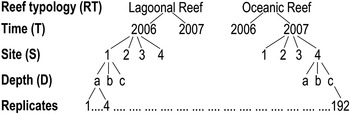
Coral abundance and size data were visually assessed using 0.72 m2 quadrats (folding plastic frames of 0.6 m × 1.2 m) randomly placed at the three depths. The quadrat size chosen was a compromise between the best size to include the microscale spatial variability of coral abundance and manoeuvrability underwater. Each quadrat served as a statistical replicate for the determination of the abundance of ‘recruits’ and ‘juveniles’, which was subsequently extrapolated to 1 m2 with a simple proportion. Within each quadrat, the substratum was inspected carefully, parting away macroalgae and sediment to detect small coral colonies (Carpenter & Edmunds, Reference Carpenter and Edmunds2006). At each depth, four replicates were performed, totalling 192 quadrats. The experimental design is reported in Figure 2.
Mixed sampling design used in this study. Letters identify the three depths considered (a, 5–6 m; b, 10–12 m; c, 16–18 m), while numbers refer to sites. Depths are orthogonal to sites, which are nested within reef typologies and time. Time is orthogonal to reef typology. Four replicates were collected at each depth.

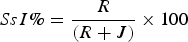
The size-structure index (SsI%) was calculated as the percentage of ‘recruits’ (R) out of the total juvenile hard corals (R + J):
Differences among abundance data and among SsI% values were analysed by 4-way analysis of variance with ‘reef typology’ (RT) as fixed factor; ‘time’ (T) as random and crossed factor; ‘site’ (S) as random and nested factor within ‘reef typology’ and ‘time’; ‘depth’ (D) as fixed and crossed factor (Figure 2). Homogeneity of variance was tested by Cochran's C-test. The Student–Newman–Keuls (SNK) test was applied a posteriori to detect significant differences.
RESULTS
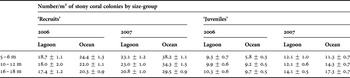
Abundance of coral colonies varied according to depth, site, time and reef typology. Highest densities of ‘recruits’ were found in 2007 in oceanic shallow reefs with a mean value of 38.2 m−2, while lowest densities were recorded in 2006 in the lagoonal deep reefs, with a mean value of 17.4 m−2. ‘Juveniles’ were less abundant, with means ranging between 5.8 m−2 in 2006 in the oceanic shallow reefs and 17.3 m−2 in 2007 in the oceanic deep reefs (Table 1). Although means showed a trend according to depth, time and reef typology, analysis of variance indicated no significant differences.
Densities of coral colonies according to size-group (±SE).

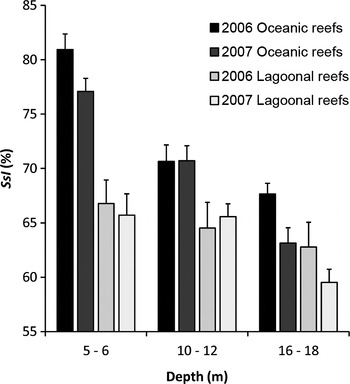
SsI% values ranged between 60% and 81%, with an overall mean of 68%: the lowest values were found in deep lagoonal reefs, while the highest were found in shallow oceanic reefs. With increasing depth, mean values of SsI% decreased, from 81% (5–6 m) to 63% (16–18 m) in oceanic reefs and from 67% (5–6 m) to 60% (16–18 m) in lagoonal reefs (Figure 3).
Mean values (±SE) of the size-structure index (SsI%) according to reef typology (oceanic and lagoonal reefs) and the three depths, in 2006 and 2007.

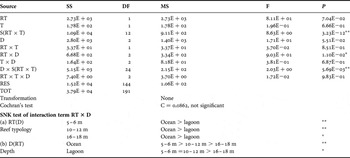
No significant differences in SsI% values were found between reef typologies, time and depth (RT × T × D). Conversely, the interaction term D × S(RT × T) was significant (P < 0.01), suggesting that there was a high local variability. The interaction RT × D was also significant (P < 0.05). The SNK test showed that at the three depths, SsI% values were higher in oceanic reefs than in lagoonal reefs. In oceanic reefs, significant differences were found at the three depths with the highest value at 4–5 m depth and the lowest at 16–18 m. In lagoonal reefs the lowest values were at 16–18 m depth and the highest at 4–6 and 10–12 m depth, with no significant differences between the two latter depths (Table 2).
Results of 4-way analysis of variance on the size-structure index values. Asterisks indicate: *, P < 0.05; **, P < 0.01. SNK, Student–Newman–Keuls test.

DISCUSSION
Mean values of ‘recruits’ and ‘juveniles’ showed a trend according to depth, time and reef typology, but no significant differences were found, because of the high variability at site level. Densities of ‘recruits’ were higher than values reported by Bianchi et al. (Reference Bianchi, Morri, Pichon, Benzoni, Colantoni, Baldelli, Sandrini, Suzuki, Nakamori, Hidaka, Kayanne, Casareto, Nadaoka, Yamano and Tsuchiya2006a, Reference Bianchi, Pichon, Morri, Colantoni, Benzoni, Baldelli and Sandrinib) with similar methods, and pointed to the continuous recovery of the Maldivian reefs, in which densities of recently settled colonies returned to levels similar to those reported in 1999 by McClanahan (Reference McClanahan2000).
The age of coral colonies we observed is unknown, but can be roughly estimated by dividing the diameter by the average growth rate. The relation between age and size should not be generalized, as published growth rates of juvenile corals are variable (Edmunds, Reference Edmunds2000). In general, however, they are similar among sites and genera (Glassom & Chadwick, Reference Glassom and Chadwick2006) and colonies classified as ‘recruits’ in the present study were probably less than one year old, especially in the case of branching corals.
The size-structure index (SsI%) indirectly evaluates colonization and post-settlement success. The example presented in this paper lumps all species together, as the analysis of individual species was beyond the scope of our study. However, many field studies have been able to distinguish recruits and juveniles by families or even species (Bak & Engel, Reference Bak and Engel1979; Harriott & Banks, Reference Harriott and Banks1995; Mumby et al., Reference Mumby, Harborne, Williams, Kappel, Brumbaugh, Micheli, Holmes, Dahlgren, Paris and Blackwell2007), similarly to what is more easily accomplished in the laboratory with the small colonies collected on settlement plates (Rogers et al., Reference Rogers, Fitz, Gilnack, Beets and Hardin1984; English et al., Reference English, Wilkinson and Baker1997; Mundy, Reference Mundy2000). SsI% could therefore be applied to studies of individual taxa, if required.
A high percentage of ‘recruits’ (high value of the index) can result from high recruitment rate and/or strong post-settlement mortality, which deprives the community of ‘juveniles’. In contrast, a low percentage of colonies smaller than 5 cm (low value of the index) suggest reduced recruitment and/or high survival rate during growth (Sammarco, Reference Sammarco1991).
Distinguishing between the two possibilities requires data on juvenile coral mortality that are difficult to obtain in the field; however, high values of the index coupled with high absolute numbers of colonies smaller than 5 cm may be considered as indicative of high recruitment. In our study, the SsI% suggested that oceanic reefs were a more suitable environment for the settlement of small corals than the lagoonal reefs at any depth. The high abundance of ‘recruits’ at the oceanic shallow reef can be explained by a larger availability of bare substrate caused by physical disturbance (Lasagna et al., Reference Lasagna, Albertelli, Colantoni, Morri and Bianchi2010a) or by grazing, which removes macroalgae from the coral rock (Mumby et al., Reference Mumby, Harborne, Williams, Kappel, Brumbaugh, Micheli, Holmes, Dahlgren, Paris and Blackwell2007). On the contrary, ‘juveniles’ were scarce on oceanic reefs: predation and wave disturbance can be responsible for high juvenile mortality and/or limited growth there (Lasagna et al., Reference Lasagna, Albertelli, Giovannetti, Grondona, Milani, Morri and Bianchi2008).
As the depositional energy decreases from the atoll margin towards the centre (Gischler, Reference Gischler2006), the physical environment of lagoonal reefs should be limiting for coral recruitment because of the higher sedimentation rate (Miller et al., Reference Miller, Weil and Szmant2000). In lagoonal reefs, a greater proportion of ‘juveniles’ was observed: the higher structural complexity of these reefs provided by the reappearance of large corals, such as tabular Acropora (Lasagna et al., Reference Lasagna, Albertelli, Morri and Bianchi2010b), might contribute to lower juvenile mortality by offering ‘nooks and crannies’ where small and vulnerable coral colonies can find refuge (Miller et al., Reference Miller, Weil and Szmant2000).
Notwithstanding the high local variability and differences in the percentage of recruits between the two reef typologies, densities of colonies <5 cm and SsI% values indicated a juvenile coral assemblage with a high percentage and a high density of recently settled colonies both in oceanic and lagoonal reefs, suggesting a sustained recovery of Maldivian reefs after the dramatic coral mass mortality event of 1998. Monitoring coral percentage cover alone, as traditionally done, may hardly detect changes of reef health over short time scales. On the other hand, the mere abundance of juveniles may not be informative about coral community trend: reduced abundance of juveniles, for instance, is not necessarily followed by a visible decline in live percentage cover, since the latter mostly depends on the abundance of colonies in the largest size-classes (Guzner et al., Reference Guzner, Novoplansky and Chadwick2007). Bleaching events such as the one that occurred in 1998 are expected to increase in the decades to come and could have serious implications for the persistence of coral communities (McClanahan et al., Reference McClanahan, Ateweberhan, Graham, Wilson, Ruiz Sebastián, Guillaume and Bruggemann2007). As a consequence, understanding variability in hard coral recruitment and post-settlement success in the years following these and other disturbances is a key concern (Mumby, Reference Mumby1999).
The index we propose is a tool for identifying those reef areas that are more likely to recover thanks to higher recruitment and survival rates, and for determining priority areas for conservation. Focusing on the dynamics of the juvenile corals, SsI% provides information on recovery potential that can be effectively integrated with coral cover estimation and biodiversity inventories (Bianchi et al., Reference Bianchi, Morri, Pichon, Benzoni, Colantoni, Baldelli, Sandrini, Suzuki, Nakamori, Hidaka, Kayanne, Casareto, Nadaoka, Yamano and Tsuchiya2006a, Reference Bianchi, Pichon, Morri, Colantoni, Benzoni, Baldelli and Sandrinib; Pichon & Benzoni, Reference Pichon and Benzoni2007) for monitoring coral reefs after disturbances.
ACKNOWLEDGEMENTS
Albatros Top Boat (Verbania and Malé) organized our scientific cruises in the Maldives: we especially thank M. Sandrini and D. Telli for their support.