Introduction
What's the zeitgeist in Harajuku? What's the colour story for next season's housewares? How does that new technotextile drape? Has ‘homedulgence’ peaked? For design students and professionals, questions like these are common. When directed to librarians, where should we look for answers? Here we discuss how the forecasting industry emerged to predict (and set) design trends and how its documentation functions in today's library collections.
History
Described by one practitioner as ‘the archaeology of the future,’Footnote 1 trend forecasting began as decentralized, competitive diffusion of design ideas, techniques and materials from cultural power centres into the global marketplace. Its history has roughly two phases. The first, from the 1850s to the beginning of World War II, revolves around Paris as the world's fashion centre, the concurrent organization of related sectors (such as colour) and the cultivation of communications media to disseminate industry developments. The second, post-war phase involves the globalization of fashion, manufacturing and communications media, and the professionalization of forecasting.Footnote 2 Throughout is an exquisite and largely unexamined relationship between determination and dissemination, or ‘mediation,’ as Maillet terms it.Footnote 3 In this model producers (designers, manufacturers) coordinate to determine outcomes for each season, while agents for dissemination (journalists, copyists, marketers) competitively distribute this information. The history of forecasting can be seen as a gradual merging of these forces into the thoroughly integrated—if opaque—process reflected in today's services.
The lavish productions we think of today as trend books also originate in manufacturers' sample books and trade catalogues dating to the 1700s.Footnote 4 Then, Pouillard asserts, ‘coordination of fabrics and colour samples began during the 19th century among French fabric industrialists. In particular, it developed with the specially skilled échantilloniers (from échantillon, or sample), travelling salesmen who offered new fabrics to couturiers and manufacturers.’ These ‘coherent scrapbooks [were] structured in collections of coordinated colour, textures, and patterns. Coordination became an aesthetic staple in the profession.’Footnote 5
Such coordination influenced regional practices. As one source notes, ‘These early colour cards did not forecast colour as much as show what colours were in vogue among the Paris dressmakers, and they had a great influence on the US ready-to-wear market. American manufacturers of fabrics, threads, leather, and millinery supplies began to match their dye lots to these Parisian shade cards.’Footnote 6 As a result, groups such as the Color Association of the United States (CAUS, established in 1915 as the Textile Color Card Association or TCCA) have come to influence colour trends throughout the design industry.
In the French context, coordination extended to regulation as professional associations, most notably the Chambre Syndicale de la Haute Couture, founded under a different name in 1868,Footnote 7 emerged to set standards and limit competition. In that environment, the drive by foreign department stores to adapt couture to domestic mass production set up the conditions in which reporting, sketching, and eventually forecasting would thrive.
This tension between openness and exclusivity is also reflected in a long-standing role of journalism in fashion discourse, especially in women's magazines.Footnote 8 Maillet suggests it is no accident that first press agency, founded by Charles-Louis Havas in the early 1800s,Footnote 9 emerged from the same environment as the early sketch services.Footnote 10 By the 1920s, New York department stores were cultivating relationships with Paris-based journalists,Footnote 11 and as we will see, several forecasting service founders began as journalists and press agents.
Among forecasting forerunners Maillert identifies Jean Claude Vosges, who began conveying sketches and samples from Paris to clients in the town of Sainte-Marie-aux-Mines. That such a service was viable in 1835, even before the 1858 establishment of the first fashion house (Worth) attests to the city's centrality. By the end of the century, firms such as Heirs of Berlioz, Homo et Cie. and the New Textiles Corporation emerged as competitors.Footnote 12
By the 1920s, with fashion production cycles firmly established in Paris and with department stores operating as the retail powerhouses in world cities, reporting services proliferated. For example, Evans quotes American Vogue managing editor Edna Woolman Chase's recollection that the ‘instant the collections have taken place, and days before the buyers' purchases can reach the United States by ship or even plane, an admirably drawn, accurately documented portfolio of all the best French models is on the desk of almost every Seventh Avenue manufacturer. It is an international spy system to turn the military green with envy.'Footnote 13
Such practices lead to professionalization with the emergence of stylistes in this period and bureaux de style following World War II. Styliste refers to foreign and domestic department store buyers stationed in Paris, whose mission was to identify, communicate and interpret trends for the store. This practice developed into in-house consulting departments that came to be known as bureaux de style.
In the U.S., for example, one Taube Coller Davis single-handedly professionalized forecasting by dispensing fashion intelligence for a fee. Miss Tobé (as she became known) started her career as a Paris trend-spotter for the department store Franklin Simon, becoming a newspaper columnist and then founding the Tobé Report, which originated as press-release-like missives in 1927 and continues to this day in multimedia form.Footnote 14
By the late 1950s, European agencies came to the fore as key stylistes founded independent bureaux. Among the first French stylistes Pouillard names Ghislaine de Polignac (beginning in 1952 at Galeries Lafayette) and Jacqueline Benard (in 1958 she founded one of the first bureaux de style at Le Printemps.)Footnote 15 Other consulting firms formed in this period include Relations Textiles (founded 1957 by Claude de Coux), L'Agence de style (1960, by journalist and press agent Maïmé Arnodin), Promostyl (1966, Françoise Vincent-Ricard)Footnote 16 and Peclers Paris (1970, Dominque Peclers of Le Printemps).Footnote 17
By end of the 20th century, just as the fashion industry as a whole decentralized and globalized, forecasting followed suit. Yet just as in the early days of wired reports and stylistes, individuals (also mostly women) emerged as self-proclaimed ‘futurists.’ These include Faith Popcorn of BrainReserveFootnote 18 and Li Edelkoort, founder of Trend Union (which recently declared that fashion itself is obsolete).Footnote 19
Today, the thorough institutionalization of forecasting is reflected in a proliferation of textbooks on the subject, complete with theoretical invocations and quasi-scientific methods, yet close reading indicates that the relationship between determination and diffusion is becoming ever more opaque. This absence of critical discourse on the process represents an opportunity for librarians.
In summary, the history of forecasting is the story of professionalization, over the course of a century, of a mediating force between the determination and diffusion of design industry trends, with forecasting agencies playing an increasingly influential role. Next we examine the role of libraries in this process, with one forecasting collection as a case study.
Forecasting in the library Context
The Gladys Marcus Library at the Fashion Institute of Technology (FIT) in New York City supports a curriculum that includes undergraduate majors in fashion design, styling, business management and marketing. The library has been collecting print forecasts since the 1970s and subscribing to online forecast services since the 1990s, resulting in a collection with thousands of items published by over 200 companies. Forecast titles predict future trends in colour, menswear, womenswear, childrenswear, accessories, beachwear, beauty, leather, outerwear, prints and patterns, lingerie, knitwear, sportswear, footwear and interiors as well as provide runway and retail reports.
The presentation of print forecast content varies. Colour and material is typically displayed using swatches of fabric or threads. Garments are presented through fashion photography, illustrations, runway shots and flats (technical fashion drawings). Moodboards made of images from art, fashion and elements from interior, natural and urban environments create the forecast's atmosphere. Text is usually limited to an introductory summary, catchy titles, brief captions and occasionally bullet points. The language (typically English) combines fashion industry jargon with evocative statements meant to conjure the tone and feel of the forecast.
Donations from individuals and companies have been key to the library's acquisitions. The library began subscribing to forecasting services in 1978 but thanks to donations, the collection goes back to the late 19th century. Nigel French Enterprises was the first forecasting service acquired by the library (the collection now includes over 500 titles published 1975–1994). They were donated by a faculty member in the Fashion Business Management department (then called Fashion Merchandising Management), an appropriate connection since the services are used in both the design and business side of the fashion industry.Footnote 20 Nigel French Enterprises was a London based consulting service for retailers that published reports on runway collections, industry trade shows and retail and styling trends from fashion capitals in Europe, the United States and Japan.Footnote 21 Colour, silhouette, and fabric forecasts (and confirmation of past forecasts) were produced alongside the reports. Dozens of titles were published each year.Footnote 22
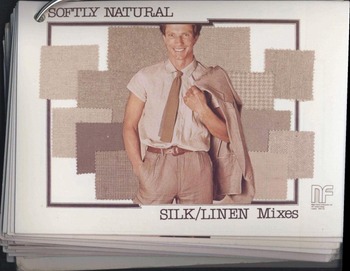
The physical format of each Nigel French title varies in size, paper type, and binding. For example, Menswear Directions and Womenswear Styling Forecast (Spring/Summer 1979) are printed on 4 × 6-inch photo paper joined together with an O ring and are comprised of moodboards with images from fashion photography, colour drawings, and photographed fabric samples (Fig. 1). Many titles also include fabric and thread samples, photos, drawings and flats.
‘Softly natural: silk/linen mixes' from Nigel French menswear directions Spring/Summer 1979. Gladys Marcus Library, Fashion Institute of Technology, New York, NY.

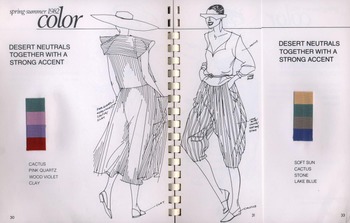
IM International was the second forecasting service acquired,Footnote 23 numbering 316 titles published from 1969–1988. IM International was a forecasting and consulting business based in New York and London (it closed in 1988, an announcement in Women's Wear Daily (WWD) notes that Nigel French Enterprises would provide forecasting services for subscribers).Footnote 24 It includes forecast newsletters, runway reports, designer blueprints (flats and sketches), shopping guides, fabric samples, retail reports, colour reports and forecasts of themes and complete looks for lingerie, juniors, activewear, womenswear and menswear as well as colour and fabric forecasts (see Fig. 2 and Fig. 3).
Spread featuring Junior contemporary garments from IM International shopping sketchbook, July 1982. Gladys Marcus Library, Fashion Institute of Technology, New York, NY.

‘Desert neutrals together with a strong accent' from IM International color, Spring/Summer 1982. Gladys Marcus Library, Fashion Institute of Technology, New York, NY.

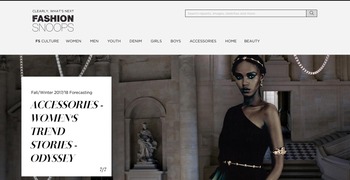
The library currently subscribes to six online services: WGSN Fashion, WGSN Lifestyle & Interiors, Fashion Snoops, Trend Council, Peclers(+) and Doneger Creative Services (Peclers and Doneger are also received in print). In addition to forecasts of womenswear, menswear, youth, accessories, denim and beauty, the online services include coverage of street style, runway shows, consumer trends and buying habits, technological innovations as well as art, music and popular culture. Digital content is updated regularly (daily on WGSN and Fashion Snoops) and it is the preferred method of access by FIT students (Fig. 4).
Fashion Snoops. Accessed August 8, 2016. http://www.fashionsnoops.com/

The US$40,000 yearly budget for forecast materials has remained flat for a decade, so much care goes into acquisitions decisions.Footnote 25 Faculty members have input into acquisitions but this feedback is useful only up to a point because faculty either request all on offer or represent a prohibitively costly niche market. What is undeniable is how important both students and faculty find the services in general. In a 2010 survey of faculty and students asked to rank selected forecasts, many participants commented on the importance of forecasting resources. One faculty member wrote, ‘These forecasts are very positive and effective teaching tools. They also keep me up-to-date and on top of my creative game which makes me a much better teacher.’ Another stated, ‘FIT is a fashion school. We MUST have fashion forecasting services. If we do not continue to have these services for our students’ educations, we should just shut our doors. It is a ‘no brainer’. Student comments were equally passionate, ‘Without these sources the validity of FIT courses would suffer.’
Initially forecasts were uncatalogued and kept at the reference desk. As the collection grew, current titles remained at the reference desk and older volumes were housed in the periodicals unit. Soon the collection was moved to the vertical file unit, and in the 1990s retailer Mildred Custin donated funds that allowed for a dedicated Forecast Reading Room there.Footnote 26 When the room was re-designated as a library classroom, the forecast collection and a viewing area returned to the periodicals unit.
In 2015 the library was awarded a grant from the New York State Education Department to ‘improve stewardship and increase access to a major collection of printed fashion forecasts through archival processing, cataloguing, and rehousing.’Footnote 27 The grant focused on the ‘historic’ forecast collection (1950–2015). As a result, 4,864 pieces were preserved and rehoused in archival boxes and the 624 linear feet of materials were consolidated into specific shelving, organized by forecast service name and date. Now 205 forecast services comprising 65,000 items are fully catalogued visible in OCLC.Footnote 28 Title level records include Library of Congress subject headings, a note indicating the inclusion of samples and a summary.Footnote 29 A finding aid to each forecast title was also created to increase discover-ability. Finding aids, links to the forecast catalogue record and information on access are all available in a LibGuide.Footnote 30
Forecasts have traditionally been the library's most restricted collection. Since tuition for a continuing education course at FIT in the 1980s was much cheaper than a subscription to the forecast services, initially access to current forecasts was limited to FIT faculty and full time students ('current' is actually 2–3 seasons into the future. For example, as of Summer 2016 the current forecasts are F/W 16/17 to F/W 18.)Footnote 31 Now full access to print and online historic and current forecasts is available to all current FIT students (full and part-time), faculty and staff. Outside researchers are limited to the historic print forecasts (four seasons or more in the past). Forecasts are viewable by appointment only.
The forecast collection has spurred collaboration between library staff and classroom faculty including co-organized panels, joint conference presentations and regularly scheduled library instruction.Footnote 32 In the 1980s, librarians began including forecasts in library tours and instruction sessions for students in surface design, packaging design, photography and business courses. A typical session would highlight resources covering the past (items from special collections and archives), present (books and periodicals) and the future (forecasts). By the 1990s, sessions were developed to focus entirely on forecasts.Footnote 33 Today a typical forecasting session covers print and online services as well as magazines.Footnote 34 Forecast instruction is provided for design, styling, marketing and continuing education classes including those attended by junior high and high school students. While some faculty conduct forecast instruction sessions on their own, a majority are taught by a librarian. Librarians explain what a forecasting service is and how it is used in the fashion industry (classroom instructors are always encouraged to contribute their expertise). Concepts relevant to information and visual literacy are emphasized, such as How is authority determined? Where is evidence of the forecaster's research? Where and how are forecasts verified and validated? How is information presented based on the audience?
A frequent assignment asks students to develop a seasonal forecast. To that end librarians offer suggestions for original research using information from forecast databases as well as historic and current magazines, artist monographs and exhibition catalogues. Although students tend to rely primarily on online forecasts to complete their projects, library sessions include print forecasts (often at the request of the classroom instructor) because they offer a more tactile experience, exemplify the variety of ways in which a trend story can be told and represent colour more accurately than the online services (which are viewed on uncalibrated computers). In 2015, the library conducted 63 forecast instruction sessions, with 49 taught by librarians and 14 by faculty.
One course at FIT focuses entirely on forecasting: Fashion Forecasting for Merchandisers, developed and taught by Prof. Nancy Ostroff, Associate Professor and Assistant Chair of the Fashion Business Management Department. Learning outcomes include describing the role of forecasting within the context of the fashion industry, identifying traditional and nontraditional resources to research a trend and exploring and applying a variety of forecasting methods.Footnote 35 The reading list includes a textbook on forecasting as well as newspapers (such as The New York Times and Wall Street Journal), blogs, trade publications (such as WWD) and books on history of fashion and apparel product development. Students are taught to critically assess forecast source material in order to ‘evaluate the significance of a trend within the context of line development,’ to examine past and current forecasts for substantiation and to seek data supporting a trend argument.Footnote 36 Students also learn industry terminology and as a final project they present a forecasted trend.
For the Spring 2016 presentations students used online forecasting services, fashion blogs and fashion magazines among several other kinds of source material. These included media related to celebrity and street style, new consumer technologies, environmentalism and gender fluidity. None of the students used print forecasts, and comparison of reproduction policies makes clear why: while online forecasts allow easy download of high resolution images, print forecast policies are highly restrictive. Since faculty still request that their students use print forecast materials during instruction sessions, the library continues to collect them.
Conclusion
Quite simply, the forecast for forecast publishing is digital. While subscription services now compete with fashion bloggers and Instagrammers to document, critique and predict trends, established forecasters continue to wield authority.
In the process, traditional forecasters like Fashion Snoops and WGSN are reinventing themselves by incorporating social media, video and music into their sites. At the same time, given the visual and physical nature of design, we predict that analogue forecasts will continue to be valuable to researchers.
Just as forecasting emerged as a mediating force between industry coordination in exquisite tension with public demand, by collecting and disseminating forecasting materials librarians enable diverse researchers to look backward in order to move forward. In this way, we are integral to the archaeology of the future.