INTRODUCTION
Poor insight (poor awareness of illness) is commonly reported in schizophrenia. Its clinical significance is well established in terms of treatment adherence (Kemp & David, Reference Kemp and David1996), symptom severity (Mintz et al., Reference Mintz, Dobson and Romney2003), and poorer global functioning (Pyne et al., Reference Pyne, Bean and Sullivan2001). The relationship between insight and outcome is not unidirectional, however; better insight has also been associated with more severe depressive symptoms and increased suicide rates (Crumlish et al., Reference Crumlish, Whitty, Kamali, Clarke, Browne, McTigue, Lane, Kinsella, Larkin and O’Callaghan2005).
The relationship between poor insight and neuropsychological impairment has been widely investigated. The results of a recent, large meta-analysis (Aleman et al., Reference Aleman, Agrawal, Morgan and David2006) suggest that for schizophrenia, poor insight is most highly associated with a general decline in neuropsychological function, while for psychosis in general (including bipolar disorder), this association appeared to be more specific to “executive” measures. The association with general cognitive decline in schizophrenia is further supported by several studies published since this meta-analysis (Donohoe et al., Reference Donohoe, Corvin and Robertson2006; Mutsatsa et al., Reference Mutsatsa, Joyce, Hutton and Barnes2006; Ritisner & Blumenkrantz, Reference Ritsner and Blumenkrantz2007), although not all (Cuesta et al., Reference Cuesta, Peralta, Zarzuela and Zandio2006).
The test of executive function that has been most widely used in relation to insight in schizophrenia has been the Wisconsin Card Sort test (WCST). WCST performance is often described as indexing attentional flexibility, and Drake & Lewis (Reference Drake and Lewis2003) have suggested that it is this component of executive function that is most important for maintaining an “abstract representation” of health-relevant experiences, as required for illness awareness. However, WCST is likely to index more general cognitive decline in schizophrenia (Laws, Reference Laws1999), including several executive subcomponents such as attentional flexibility, working memory, and inhibitory control. We previously investigated whether any of these executive subcomponents was especially important to insight and found that working memory capacity rather than attentional flexibility was most strongly associated with insight (Donohoe et al., Reference Donohoe, Corvin and Robertson2006). A further question arising from this “neuropsychological” hypothesis of insight is whether illness awareness is related to other aspects of self-awareness such as cognitive self-monitoring and awareness of cognitive errors (Aleman et al., Reference Aleman, Agrawal, Morgan and David2006); this remains unclear.
In this study, we measured “cognitive self-awareness” based on the similarity between subjective (self-reported) cognitive deficits and objective cognitive deficits (neuropsychological performance). We hypothesized that if “clinical” insight overlaps with “cognitive” insight, then patients showing good clinical symptom awareness would also show good awareness of their cognitive performance. We similarly hypothesized that cognitive self-rating and actual neuropsychological performance would only correlate among those with good clinical insight and not in those with poor clinical insight.
METHODS
Participants
Fifty-one clinically stable patients with a diagnosis of schizophrenia participated in the study. Patients were recruited through two urban outpatient clinics (the Southern Health Board in Cork and the St. John of God Cluain Mhuire service in Dublin), and all provided written informed consent. Inclusion criteria required that participants be aged 18–65 years, with no history of comorbid psychiatric disorder, substance abuse in the preceding 6 months, or prior head injury with loss of consciousness. Diagnosis was confirmed using the Structured Clinical Interview for DSM-IV Axis 1 Diagnoses (First et al., Reference First, Spitzer, Gibbon and Williams1996) and symptom severity using the Schedule for the assessment of positive symptoms (SAPS) and Schedule for the assessment of negative symptoms (SANS) (Andreasen, Reference Andreasen1984a, Reference Andreasen1984b).
Patients’ performance on each of the measures included in the study was compared to a sample of 54 healthy participants, matched for age and gender, recruited on the basis of responses to local media advertisements. Control participants were only included if they were aged between 18 and 65 years and satisfied, based on clinical interview, the criteria of having no history of major mental health problems, intellectual disability or acquired brain injury, and no history of substance misuse in the preceding 6 months based on self-report. All participant data were collected in accordance with the ethics approval granted by the relevant ethics committee at each site for this study.
Neuropsychological Measures
Neuropsychological tasks were selected to provide verbal and nonverbal indices of the main areas of cognition reported as impaired in schizophrenia, including general cognitive function, episodic memory, working memory, and attentional control. Current general cognitive function was measured using the Wechsler Adult Intelligence test–third edition (WAIS-III; Wechsler, Reference Wechsler1997). Episodic memory was assessed using the logical memory subtest and faces subtest from the Wechsler Memory Scale–third edition (WMS-III; Wechsler, Reference Wechsler2001). Working memory was assessed using the WMS-III Letter Number Sequencing task and the Spatial Working Memory Task from the Cantab Battery (Cambridge Cognition Ltd, 2002). Attentional control was assessed using the Cantab IDED task and the Sustained Attention to Response Task(Robertson et al, Reference Robertson, Manly, Andrade, Baddeley and Yiend1997; see O’Grada et al., Reference O’Gráda, Barry, McGlade, Behan, Haq, Hayden, O’Donoghue, Peel, Morris, O’Callaghan, Gill, Corvin, Dinan and Donohoe2008 for a full description).
Insight Measures
Clinical insight was measured using the Schedule for Assessment of Insight (SAI), which assesses insight on the basis of a semistructured interview (David, Reference David1990). Because this study was based on a well outpatient cohort, many of whom were expected to show intact insight, patients were categorized into two groups on a median-based cutoff score of 12. This yielded a “high” or “intact” group (those who scored 13–14 on the SAI) versus an impaired group (those who scored between 0 and 12).
Cognitive insight was measured in terms of the relationship between patients’ self-reported errors during everyday activities using the Cognitive Failures Questionnaire (CFQ; Broadbent et al., Reference Broadbent, Cooper, FitzGerald and Parkes1982) and their actual cognitive task performance. The CFQ consists of 25 items, which index daily cognitive failures (e.g., forgetting names, confusing left and right), rated using a 5-point Likert scale (0 = never, 4 = very often) to indicate awareness of mistakes in the past 6 months. Higher scores are reported to negatively correlate with objective measures of cognitive performance, for example, on measures of attention (Manly et al., Reference Manly, Robertson, Galloway and Hawkins1999). Total scores vary from 0 to 100: scores below 50 indicate awareness of only occasional cognitive difficulties and scores above 50 indicate more frequent cognitive difficulties.
RESULTS
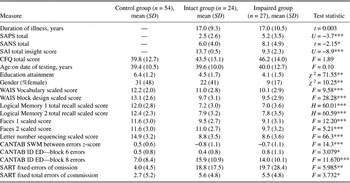
Both intact and impaired clinical insight groups performed significantly below the healthy comparison group on all neuropsychological tests and on educational attainments (Table 1). As general ability in healthy controls was higher than expected, we reran this analysis covarying for WAIS-III block design scores; with the exception of visual memory, all case–control group differences remained significant. Intact and impaired clinical insight groups differed on gender, with impaired insight group containing significantly fewer females by comparison with the intact insight group (Fischer’s exact test: −3.56; p = .0004). Patients with intact clinical insight did not differ significantly from those at statistical or even trend level on neurocognitive variables (lowest p value = .17). The range of CFQ scores was comparable for the impaired and intact clinical insight groups (impaired group: range 15–84; SD = 13.1; intact group: range 16–66; SD = 13.1). As a chronic patient group, many patients were being prescribed more than one antipsychotic; there was no difference in numbers in each group being prescribed typical versus atypical antipsychotics (p > .05), or in the total medication dosage prescribed (Table 1).
Mean score on demographic, clinical, and neuropsychological measures for patients and controls

* p < .05.
** p < .01.
*** p < .001.
Note. CFQ, Cognitive Failures Questionnaire; SAI, Schedule for Assessment of Insight; SART, Sustained Attention to Response Task; SWM, Spatial Working Memory Task.
Despite being impaired on most cognitive tasks by comparison with healthy participants, patients subjectively reported only slightly more cognitive difficulties on the CFQ than controls (controls’ mean CFQ = 39.8 (SD = 12.7); patients’ mean CFQ = 44.0 (SD = 12.8); t(1,104) = 1.8; p = .074). Two thirds (65.8%) of the patients who demonstrated impairments in one of more areas of cognitive function (defined in this study as performing less than 1 SD below published norms on both tests of any of the cognitive functions assessed) subjectively recognized moderate to frequent cognitive difficulties based on the CFQ. This compared with none of the patients who were without cognitive impairment, and only one participant from the healthy comparison group scoring above this mark (see Table 1 for clinical and cognitive mean scores for each group).
Do the Same Patients Show Both Good Clinical Insight and Good Cognitive Insight?
To investigate the overlap between cognitive awareness and clinical awareness, we compared clinical insight scores between patients who had cognitive deficits and were aware of them and patients who had cognitive deficits but were not aware of these. For this purpose, those with cognitive deficits (defined above) were described as showing awareness if they scored above a cutoff 50 on the CFQ, that is, if they reported more than just “occasional errors” as defined by the CFQ. This resulted in an intact cognitive insight group (n = 32) and an impaired cognitive insight group (n = 20).
We did not observe differences between groups either on the basis of total insight scores (t = 0.913; p = .37) or SAI subscale scores (SAI treatment compliance: t = 1.15; p = .26; SAI recognition of mental illness: t = 1.09; p = .28; SAI accurately relabeling of symptoms: t = .08; p = .93). Similarly, when patients were categorized as showing either intact insight (an SAI total score of 13 or 14; n = 24) or impaired insight (an SAI total score of 12 or below; n = 27), there was no difference in the numbers of patients showing awareness of cognitive deficits between the two groups (χχ 2 = 0.432; p = .552).
Is the Correlation Between Cognitive Task Performance and Self-Rated Performance Associated With Clinical Insight?
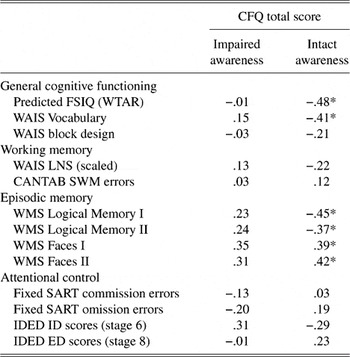
We next sought to investigate the overlap between cognitive and clinical awareness by investigating the correlation between CFQ scores and cognitive task performance separately for patients rated as having intact clinical insight and patients with impaired clinical insight (based on the cutoff of 12 on the SAI already described). For the patients with impaired clinical insight, no correlation was observed between actual cognitive performance and patients’ own CFQ ratings. By contrast, for patients with intact clinical insight, their CFQ scores correlated with several indices of both general cognitive ability and memory function (Table 2).
Correlation between CFQ scores and actual cognitive performance for patients with impaired and intact clinical insight

* p < .05 level.
Note. CFQ, Cognitive Failures Questionnaire; SART, Sustained Attention to Response Task; SWM, Spatial Working Memory Task; WTAR, Wechsler Test of Adult Reading.
We also conducted a hierarchical regression analysis, with CFQ scores entered as the dependent variable and neuropsychological performance (based on one measure of each cognitive function: Vocabulary, Facial recognition, Letter number sequence) as independent variable. Scores on WMS-III Facial recognition and Letter number sequencing accounted for a significant percentage of variance in both the full sample (24.2%; F = 7.68; df = 2,48; p = .001) and the intact clinical insight group (46.9%; F = 8.53; df = 2,30; p < .0001) but not the impaired clinical insight group (p > .05).
DISCUSSION
This study investigated the overlap between clinical and cognitive insight in a sample of chronic but stable outpatients with schizophrenia. Forty-seven percent of patients were rated as showing impaired clinical insight on the SAI. Based on a discrepancy between CFQ rating and actual cognitive deficits, 33% of patients showed poor insight into their cognitive difficulties. Patients lacking clinical insight did not necessarily also lack cognitive insight; however, self-rating of cognitive difficulties only correlated with actual cognitive performance within the intact clinical insight group.
These data highlight both overlap and independence between the concepts of clinical and cognitive insight. One interpretation of these findings is that while good clinical insight is required before a correlation between cognitive self-ratings and actual cognitive performance becomes apparent, cognitive self-awareness is not sufficient for clinical insight. This accords well with the accumulated evidence in schizophrenia, suggesting that many additional noncognitive factors determine clinical insight, including positive symptom severity and psychological defense mechanisms concerning illness representations (Lysaker & Buck, Reference Lysaker and Buck2007; Lysaker et al., Reference Lysaker, Carcione, Dimaggio, Johannesen, Nicolò, Procacci and Semerari2005). For example, while evidence of a relationship between insight and gender has been equivocal in schizophrenia, in our study, significantly more females were categorized as showing intact clinical insight than impaired, possibly reflecting the apparently more benign course of illness in females (Grossman et al., Reference Grossman, Harrow, Rosen, Faull and Strauss2008).
Although not a hypothesis of our study, the clinically intact insight group showed a relationship between higher subjective cognitive failures’ ratings and better visual memory recognition. These findings may relate to a similarity between visual recognition and error recognition either cognitively or neuroanatomically. Further study of this finding will be required before a more definitive interpretation of this result can be made.
Potential criticism of this study include the fact that cognitive insight ratings were based on discrepancies between patients’ self-report and their actual performance rather than the more traditionally used discrepancy between patients’ self-report and either the report of a caregiver or of a treating physician. We preferred the self-reported/actual performance discrepancy because of the evidence that both doctors’ and caregivers’ ratings are inaccurate (Harvey et al., Reference Harvey, Serper, White, Parrella, McGurk, Moriarty, Bowie, Vadhan, Friedman and Davis2001; Moritz et al., Reference Moritz, Ferahli and Naber2004; Sanjuán et al., Reference Sanjuán, Aguilar, Olivares, Ros, Montejo, Mayoral, Gonzalez-Torres and Bousoño2006). A second issue is that concordance between patient’s self-rating and objective neuropsychological tests is potentially bidirectional in that some patients with intact neuropsychological performance may overestimate their cognitive failures: further study in a larger sample that could consider this issue in a three-group comparison of an intact cognitive insight V underestimation of cognitive deficits V overestimation of cognitive deficits is warranted.
In conclusion, this study represents a novel attempt to investigate overlap between the construct of clinical insight and cognitive insight and extends current knowledge on the overlap, but nonidentity, between these two constructs.
ACKNOWLEDGMENTS
Sincere thanks to all the participants in this study and to the clinical staff who facilitated this participation. This study was carried out with the generous support of grants from the Wellcome Trust (M.G., A.P.C.), the Higher Education Authority (M.G.), Science Foundation Ireland (G.D.), and National Alliance for Research on Schizophrenia and Depression (NARSAD). None of the authors have any financial or other relationships that could be interpreted as a conflict of interest in relation to this manuscript.