Introduction
Nitrogen oxides (NOx) are common and extremely harmful atmospheric pollutants, including NO, NO2, N2O, N2O3, and N2O4, in which the contribution of NO and NO2 accounts for more than 90% of the total amount of NOx [Reference Blanco, Avila, Suárez, Yates, Martin, Marzo and Knapp1, Reference Forzatti2, Reference Li, Chang, Ma, Hao and Yang3, Reference Cai, Hu, Li, Shi and Zhang4]. As an air pollutant, NOx cause serious harm not only to human health and safety, but also to the ecosystem. NO2 in the air easily combines with water vapor to form liquid nitric acid and then falls to the ground in the form of rainwater, thus causing a series of problems such as acidification of water, death of vegetation, corrosion of buildings, and aging of rubber products [Reference O’Malley, Hitchcock, Sarwar, Silverwood, Hindocha, Catlow, York and Collier5, Reference Guo, Liang, Yang, Liu, Huang and Kang6, Reference Jiang, Wang, Wang, Chen and Zhang7].
In recent years, the selective catalytic reduction (SCR) of NOx by NH3 (NH3-SCR) has been considered the most efficient technique to remove NOx from coal-fired flue gas [Reference Yao, Kong, Yu, Li, Yang and Dong8]. The main principle of NH3-SCR of NOx is to use NH3 or CO(NH2)2 as a reductant to react selectively with NO under the action of catalyst. The conversion of NOx to N2 at low temperatures is achieved via redox reaction on the surface of the catalyst. Because the process has many advantages such as high denitration efficiency, low activation temperature and low cost, it has become the main strategy for denitration in the world. At present, the catalysts applied in the SCR denitration process mainly use V2O5–WO3 as the main active component, and TiO2 is used as the carrier. These catalysts present the advantages of high denitration efficiency, strong N2 selectivity, high stability and superior sulfur (SO2) performance. Therefore, it has become the mainstream catalyst in the field of power plant flue gas denitration [Reference Ettireddy, Ettireddy, Mamedov, Boolchand and Smirniotis9]. However, with the development of denitration processes and the improvement in environmental protection requirements, the disadvantages of conventional V2O5–WO3/TiO2 becomes more and more obvious. For example, the activity is reduced generally in the denitration process due to particles and SO2 in the flue gas at higher reaction temperatures (300–450 °C). It is preferred to install the desulfurization and dedusting device before the denitration section, which causes the temperature of the flue gas to drop to 100–300 °C after passing through the desulfurization and dedusting device, while the conventional V2O5–WO3/TiO2 catalyst has a lower denitration efficiency in this temperature range [Reference Tang, Xu, Shi, Qiu and Fan10]. These catalysts use TiO2 as the carrier whose mechanical properties and shaping properties are relatively poor. It is primarily loaded with extruding cordierite, stainless steel or glass fiber sheet and a binder such as polyvinyl alcohol to form a honeycomb monolithic catalyst [Reference Kröcher and Elsener11]. Studies report that alkali oxides and salts are one of the main reasons leading to the decrease in the SCR activity [Reference Chen, Li and Ge12, Reference Wan, Duan, Li, Chen, He and Hao13, Reference Castellino, Jensen, Johnsson and Fehrmann14, Reference Zheng, Jensen, Johnsson and Thogersen15]. The deactivation of V2O5–WO3/TiO2 catalysts is usually caused by the neutralization of the Brønsted acid sites, the decrease in surface chemisorption oxygen, and the decreased reducibility of vanadium species [Reference Kong, Liu, Zhou, Jiang, Tian, Yang, Ren and Li16]. Therefore, the development of low-temperature catalysts with excellent denitration performance within 100–300 °C and better alkali metal resistance has become the focus of research at this stage.
Recently, composite metal oxides, which are usually selected from two or three metal salts, and prepared by a coprecipitation method or complexing method with citric acid, have attracted widespread attention. Research has shown that the active metal component in composite metal oxide prepared by the above methods is more uniformly contacted than those of the supported metal catalysts prepared by the conventional impregnation method. The metal oxide solid solution is easily formed in the preparation process, which promotes a synergistic effect between the metal components, and thus gives the metal oxide catalyst better low-temperature NH3-SCR activity [Reference Gao, Tang, Yi, Zhao, Wang, Shi and Meng17, Reference Zamudio, Russo and Fino18]. Chen [Reference Liu, Zhu, Li, Ma and Woo19] et al. prepared Ni–Mn spinel metal oxide by the combustion method with citric acid. It was found from X-ray diffraction (XRD) that the calcined Mn–Ni composite metal oxide mainly formed NiMn2O4 spinel. Activity tests showed that the composite metal oxide can achieve 95% NOx conversion at 150 °C. Meng [Reference Wei, Liu, Su, Sun and Zhao20] et al. prepared Mn–Co composite metal oxides by coprecipitation using MnSO4 and Co(NO3)2·6H2O as raw materials and Na2CO3 as the precipitant. Meanwhile, CoOx@MnOx catalyst was prepared by a stepwise deposition method as a comparison. Co3Mn7Ox prepared by coprecipitation exhibited better SCR performance and can achieve ≈92% NO conversion at 150 °C, and the anti-SO2 performance of the catalyst was notably increased. Fang [Reference Yang, Qi, Xiong, Dang, Liao, Wong and Li21] et al. prepared Mn–Fe–Cr ternary composite metal oxide nanoparticles by coprecipitating Mn(NO3)2, ZrOCO3, and Fe(NO3)3 with ammonia. XRD showed that the components in the composite existed in an amorphous form, and the composite oxide could achieve 100% NOx conversion at 200–360 °C. The composite metal oxide catalysts exhibit excellent low-temperature SCR performance. Ying [Reference Ying, Hao and Rui22] et al. found that the introduction of the Ti component in the NH3-SCR catalyst can improve the reactivity and selectivity of the catalyst, and it is a substance with potential for applications. However, in the actual denitration application, these catalysts suffer the disadvantages of requiring a large amount of raw materials in the preparation process and difficulty in shaping, which seriously affect the application of the composite metal catalysts.
Attapulgite (ATP) is a layered chain of magnesium–aluminum silicate clay minerals with abundant reserves in nature. ATP itself has rich pores and displays excellent adsorption properties and a large specific surface area [Reference Liu, Kang, Mu and Wang23]. ATP has good plasticity, so as a catalyst carrier, it is beneficial to the formation of the catalyst shapes, and it can replace carbon materials such as carbon nanotubes and activated carbon to some extent [Reference Zhou, Huang, Xie, Luo, Yao, Li and Zuo24, Reference Luo, Zhou, Xie, Wu, Yao, Li, Zuo and Liu25].
To improve the shortcomings of the above composite metal catalysts, ATP was combined effectively with the composite metal catalyst, such as MnFeOx/ATP, MnCrOx/ATP, and MnTiOx/ATP, by coprecipitation. The denitration performance of NH3-SCR at low temperatures and N2 selectivity of the as-prepared catalysts were compared and screened. In consideration of excellent denitration performance of MnFeOx/ATP and better N2 selectivity of MnTiOx/ATP, the composite catalyst (MnFeTiOx/ATP) was prepared to carry out measurements of denitration performance, N2 selectivity, and alkali resistance. The results showed that MnFeTiOx/ATP exhibited better NOx conversion and higher N2 selectivity as well as excellent potassium resistance than the traditional V–W–Ti catalyst.
Results and discussion
Characterization and NH3-SCR activity of Mn-based/ATP catalysts
XRD patterns
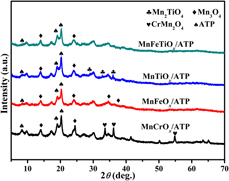
The XRD patterns of MnFeOx/ATP, MnCrOx/ATP, MnTiOx/ATP, and MnFeTiOx/ATP are presented in Fig. 1. All catalysts present a weak diffraction peak at 2θ of around 8.5°, which is attributed to the characteristic diffraction peak of ATP. For MnFeOx/ATP, the peaks with 2θ value of 34.2°, 36.1°,14.3°, and 24.4° reveal the main crystalline structure of Mn3O4 (JCPDS No. 24-0734, JCPDS No. 75-1560) [Reference Liu, Shan, Lian, Xie, Yang and He26]. The characteristic peaks at 2θ of 28.8°, 32.3°, and 36.08° can be indexed to the main crystalline structure of Mn2TiO4 for MnTiOx/ATP (JCPDS No. 74-2290). As for the MnCrOx/ATP, the faint peaks at 2θ of 34.4°, 35.6°, and 36.1° are in agreement with the main crystalline structure of CrMn2O4. When Ti was mixed with the MnFeOx/ATP, the diffraction peaks of MnFeTiOx/ATP become apparently weak and characteristic peaks of TiOx were not detected. This suggests that Ti is doped into crystal lattice of MnFeOx and dispersed well, thus lowering the crystallinity of the original MnFeOx and weakening of the characteristic diffraction peak [Reference Shan, Liu, He, Shi and Zhang27]. According to the literature [Reference Qiu, Pang, Zhang, Meng, Zhu and Ouyang28], the lower catalyst crystallinity is more favorable for the NH3-SCR denitration reaction at low temperatures.
XRD patterns of Mn-based/ATP catalysts.

NH3-SCR activity
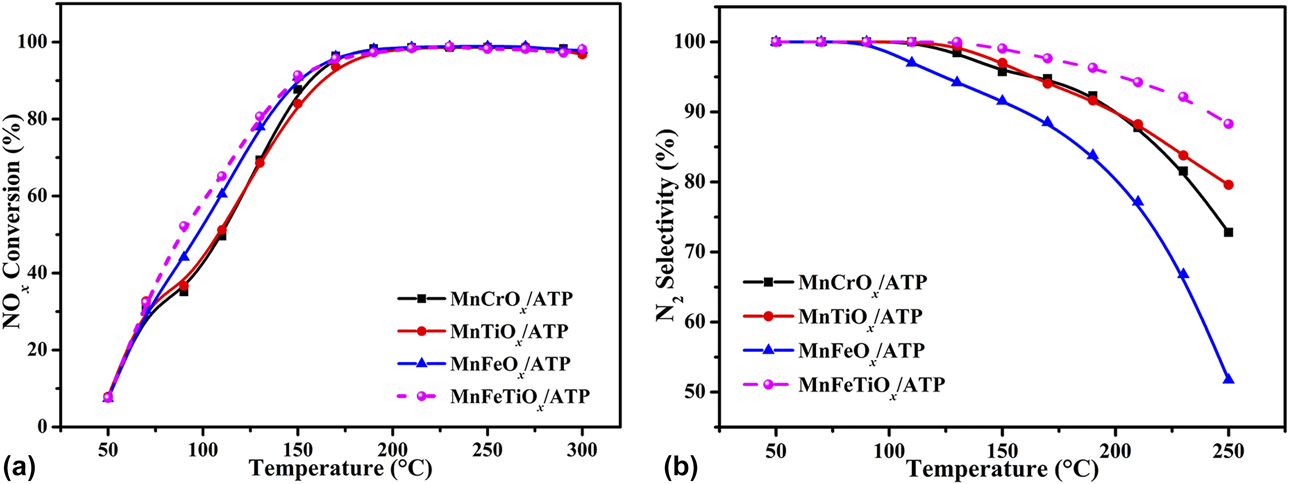
The SCR activities of different samples are presented in Fig. 2(a). Firstly, the activity and N2 selectivity in the range of 50–250 °C for as-prepared MnFeOx/ATP, MnCrOx/ATP, MnTiOx/ATP, and MnFeTiOx/ATP catalysts were investigated. All Mn(n)Ox/ATP catalysts present a gradual increase in activity and can achieve a NOx conversion rate of more than 90% at 170 °C. Compared with MnCrOx/ATP and MnTiOx/ATP, MnFeOx/ATP exhibits excellent denitration performance at low temperatures, especially below 150 °C; it can achieve an NOx conversion rate of 91% at 150 °C. In contrast, the NOx conversion rates of MnCrOx/ATP and MnTiOx/ATP increase slowly between 50 and 100 °C and reach only 85% and 88% conversion at 150 °C, respectively. The activities below 150 °C of the three catalysts are ranked as MnFeOx/ATP > MnCrOx/ATP > MnTiOx/ATP.
(a) NOx conversion and (b) N2 selectivity of Mn-based/ATP catalysts.

The three as-prepared catalysts were subjected to an N2 selectivity test to investigate the amount of N2O formed during the reaction as shown in Fig. 2(b). With a gradual increase in reaction temperature, the N2 selectivity of the three catalysts showed a downward trend; especially after 100 °C, the N2 selectivity of MnFeOx/ATP decreases distinctly. The selectivities of MnCrOx/ATP and MnTiOx/ATP below 200 °C were similar. But above 200 °C, the selectivity decreases. The results suggest that as the reaction temperature increases, the proportion of side reactions of the catalyst increases gradually and the amount of N2O generated in the product also increases. The N2 selectivity order of the samples is MnTiOx/ATP > MnCrOx/ATP > MnFeOx/ATP.
In view of the best NOx conversion rate for MnFeOx/ATP and excellent N2 selectivity for MnTiOx/ATP among the three catalysts, composite MnFeTiOx/ATP catalyst was synthesized by coprecipitation. The NOx conversion rate and N2 selectivity of MnFeTiOx/ATP were measured to verify its denitration performance. It can be observed from Fig. 2(a) that the NOx conversion rate of MnFeTiOx/ATP increased by about 3% below 150 °C as compared to MnFeOx/ATP. Meanwhile, the N2 selectivity of MnFeTiOx/ATP was about 7% higher than that of MnTiOx/ATP as shown in Fig. 2(b). The N2 selectivity was >88% over the entire temperature range, indicating that the addition of Ti greatly enhances the N2 selectivity of the catalyst. Yang [Reference Yang, Qi, Xiong, Dang, Liao, Wong and Li21] et al. impregnated MnO2 on the surface of Fe–Ti oxide and then prepared low-temperature denitration catalyst 10% Mn/Fe–Ti oxide by calcination. The Fe–Ti oxide was found to produce less than 15 ppm of N2O throughout the test. The reaction mechanism of the catalyst was investigated by in situ infrared spectroscopy. It was discovered that due to the strong oxidizing property of Mn4+, NH3 adsorbed on the surface of the catalyst was easily oxidized to –NH during the denitration reaction of NH3-SCR, and then N2O was decomposed by the Eley–Rideal mechanism. On the surface of 10% Mn/Fe–Ti oxide, the lower resistivity of the Fe–Ti composite metal oxide facilitates electron migration on the surface. Therefore, during the reaction, the –NH2 can be preferentially adsorbed on the surface of Fe–Ti oxide, thereby reducing the transitional oxidation of Mn4+ to –NH2 and greatly improving the N2 selectivity of the catalyst. XRD results show that MnFeTiOx/ATP in the present study mainly exists in the form of spinel, which is more favorable for the N2 selectivity. Therefore, the addition of Ti can not only improve the low-temperature NOx conversion rate of the catalyst, but also reduce the formation of N2O, so that the MnFeTiOx/ATP catalyst maintains excellent NOx conversion rate and N2 selectivity throughout the denitration process.
H2-TPR analysis
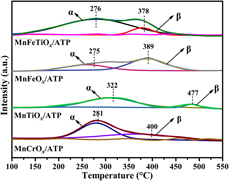
It is well known that the redox performance of the catalyst itself plays a crucial role in the NH3-SCR denitration reaction. Therefore, H2-TPR characterization of the as-prepared MnCrOx/ATP, MnTiOx/ATP, MnFeOx/ATP, and MnFeTiOx/ATP catalysts was carried out to further investigate the effect of Fe, Ti, and Cr on the reduction performance of the catalyst. It can be observed from Fig. 3 that all the catalysts present two distinct H2 desorption peaks in the temperature range of 100–550 °C. MnCrOx/ATP shows two reduction peaks at 281 and 400 °C: the peak at 281 °C is ascribed to the reduction of MnO2 to Mn2O3 in the presence of CrOx, and the one at 407 °C is attributed to the reduction of Cr6+ in the catalyst under H2 conditions [Reference Słoczyński, Janas, Machej, Rynkowski and Stoch29]. For MnTiOx/ATP, two H2 desorption peaks also appeared at 322 and 477 °C as the reduction temperature increased. The broad reduction peak at 322 °C is attributed to the gradual reduction of MnO2 to Mn2O3, Mn2O3, and Mn3O4, and the weak peak at 477 °C is ascribed to the reduction of Mn3O4 to MnO [Reference Gao, Shi, Fan, Yu, Chen, Li and Niu30, Reference Putluru, Schill, Jensen, Siret, Tabaries and Fehrmann31]. What’s more, the first desorption peak of MnFeOx/ATP appearing at about 275 °C is imputed to the reduction of MnO2 to Mn2O3 in the presence of Fe in accordance with the study of Li [Reference Li, Li, Wang, Hua, Zhang, Shi and Zhan32] et al. The second peak of MnFeOx/ATP (about 363 °C) may be due to the reduction of subsequent manganese oxide phases with iron oxide.
H2-TPR profiles of Mn-based/ATP catalysts.

Additionally, it is generally believed that the temperature of the catalyst reduction peak represents the strength of its reduction performance. The MnFeOx/ATP catalyst has the lowest reduction temperature as a whole relative to MnCrOx/ATP and MnTiOx/ATP. Combining the electronegativity of the three materials, Fe(1.8) > Cr(1.6) > Ti(1.5), it is proved that the Fe element possesses stronger electron-withdrawing ability and improves the reduction performance of MnFeOx/ATP at low temperatures. Besides, it can be observed from Table SI that MnFeOx/ATP and MnCrOx/ATP have a larger desorption area than MnTiOx/ATP, indicating that MnFeOx/ATP and MnCrOx/ATP can provide more reduction sites during the SCR reaction, which makes the catalyst possess better denitration performance at low temperatures [Reference Chen, Guo, Wang, Pan, Wang, Yang, Lu and Wang33]. Moreover, with the addition of Ti, the peak position of MnFeTiOx/ATP does not a large shift, but is evidently larger as compared to MnFeOx/ATP, implying that the addition of titanium can notably improve the redox performance of the catalyst and refresh its own denitration performance.
Characterization and potassium resistance of different MnFe-based catalysts
TEM images
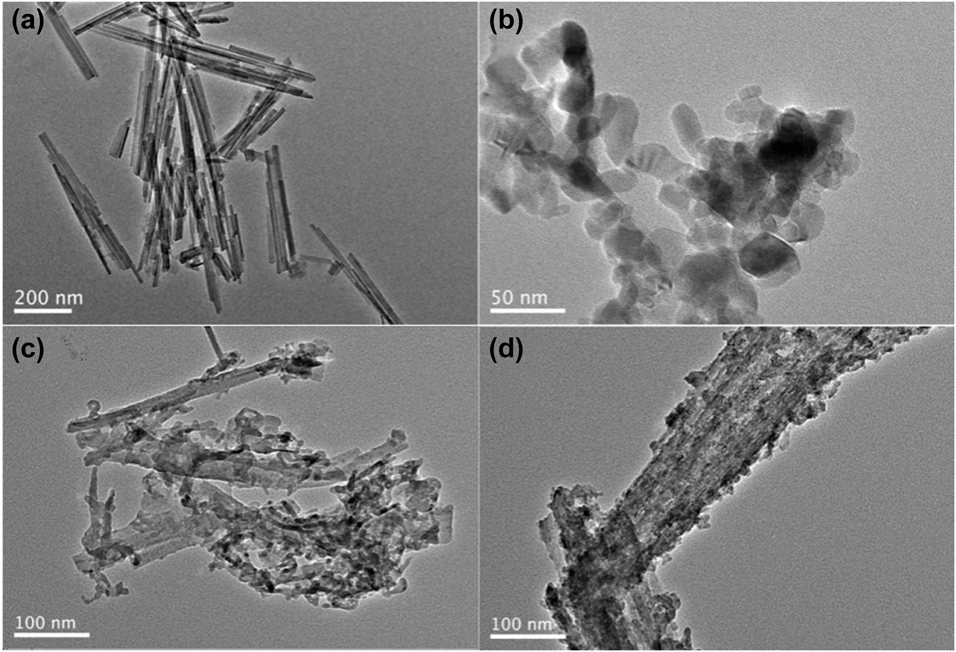
Transmission electron microscopy (TEM) images of ATP, MnFeTiOx, MnFeOx/ATP, and MnFeTiOx/ATP are presented in Fig. 4. Figure 4(a) is a typical TEM of pure ATP; it presents a fibrous rod-like structure with a clear flat surface. The rods are interlaced with a diameter of 50–100 nm. Figure 4(b) displays the TEM graph of MnFeTiOx. As can be seen, the MnFeTiOx has a granular morphology after calcination, and the particle diameter is between 20 and 40 nm. No TiOx or FeOx particles are found on the catalyst surface, which proves that the composite prepared by the coprecipitation method interacts under high-temperature calcination to form a composite metal oxide. This is in good agreement with the results of the XRD measurements. Figure 4(c) shows a TEM image of ATP loaded with MnFeOx. Many fine crystal particles appear on the columnar ATP surface, and the particles are uniformly distributed with a diameter of about 5 nm, which can increase the specific surface area of the catalyst. Besides, in Fig. 4(d), after surface loading of the active component, the original rod-like ATP surface is coated with a number of fine MnFeTiOx particles with a diameter of about 12 nm, which are more uniform than the pure MnFeTiOx. This is primarily due to the abundant porosity on the surface of the ATP clay, which reduces the aggregation of the metal oxide active component, and uniform coating on the surface of the support. At the same time, some species in the crystal growth environment play important roles; the impurity/additive would possibly interact with faces with some atomic configurations to change surface relative stability [Reference Liu, Jiang, Fan, Lu and Gao34]. The incorporation of the titanium component also changes the crystal form and stability of the composite metal oxide of the catalyst, making it an amorphous nanoparticle and thus increasing NH3-SCR activity.
TEM images of the catalysts: (a) ATP, (b) MnFeTiOx, (c) MnFeOx/ATP, and (d) MnFeTiOx/ATP.

XPS analysis
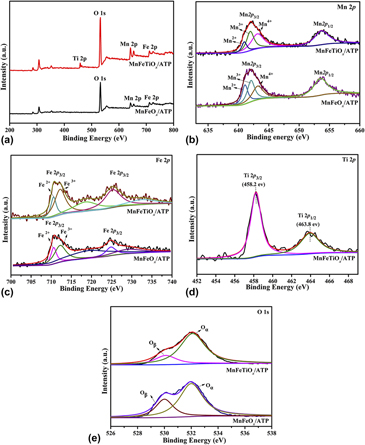
To further analyze the surface composition of the catalysts and the valence of the element, X-ray photoelectron spectroscopy (XPS) of representative MnFeOx/ATP and MnFeTiOx/ATP catalysts was performed, and the results are shown in Fig. 5. Figure 5(a) illustrates a full spectrum analysis of XPS. It can be noted that the MnFeOx/ATP has characteristic peaks in the range of 525.08–545.08 eV, 632.08–660.08 eV, and 700.08–740.08 eV, which are assigned to the spectra of O 1s, Mn 2p, and Fe 2p of the catalyst, respectively. After Ti is introduced into MnFeOx/ATP, the XPS spectrum shows a characteristic diffraction peak of Ti 2p in the range of 448.08–475.08 eV without the above diffraction peaks. It can be found from Table SII that the atomic concentration ratios (%) of Mn, Fe, Ti, and O elements on the surface of MnFeTiOx/ATP are 7.30:4.88:3.03:73.01, which is consistent with the ratio of raw materials added during the preparation process. Mn 2p spectrum is presented in Fig. 5(b). The XPS spectrum of Mn displays two distinct characteristic peaks near the binding energy of 642.0 eV and 654.0 eV, which are attributed to the Mn 2p 3/2 and Mn 2p 1/2 orbitals, respectively. Through the peak separation treatment, the Mn 2p 3/2 orbitals are divided into three characteristic peaks at a binding energy of 640.8 eV, 642.3 eV, and 644.1 eV respectively, corresponding to the binding energy of Mn2+, Mn3+, and Mn4+ [Reference Fang, Xie, Mei, Zhang, He, Liu and Li35]. Furthermore, the proportion of Mn4+ in the catalyst was calculated according to the peak area, and the results are displayed in Table SII. Mn4+ content in MnFeTiOx/ATP is markedly increased to 34.8% from the initial 22.5%. Compared with Mn2+ and Mn3+, Mn4+ is more active in the low-temperature denitration reaction, and it is prone to redox reaction at low temperatures, which is beneficial to the improvement of low-temperature activity. Figure 5(c) is an XPS spectra of Fe 2p. The Fe 2p spectra form two characteristic peaks at a binding energy of 712.1 eV and 725.4 eV respectively, corresponding to the Fe 2p 3/2 and Fe 2p 1/2 orbitals. The peak of the binding energy near 710.5 eV is attributed to Fe2+, and the peak near 712.1 eV is mainly assigned to the Fe3+ [Reference Guo, Li, Sun, Liu, Wang, Pan, Liu, Liu and Sun36]. It is generally believed that the electron jump cycle between Fe3+ and Fe2+ in Fe-based catalysts plays a crucial role in NH3-SCR denitration. It is evident from Table SII that after the addition of Ti, the ratio of Fe3+ to Fe2+ in the catalyst increases. According to Cai [Reference Cai, Liu, Zha, Li, Shi and Zhang37] et al., Fe3+can promote electron transport between other active components during the NH3-SCR reaction, and thus has superior low-temperature denitration performance. MnFeTiOx/ATP has rich Fe3+ components, and so it will be more conducive to the denitration reaction. Figure 5(d) shows the spectral peak of the Ti 2p. The characteristic peak of 458.2 eV is indexed to the Ti 2p 3/2 orbital, and the peak at 463.8 eV belongs to the Ti 2p 1/2 orbital, which is usually attributed to the Ti3+ and Ti4+ components. Xu [Reference Xu, Su, Cao, Li, Yang, Luo, Street, Jiao and Ca38] et al. found that the high reductive nature of Ti helps to improve the efficiency of NH3-SCR denitration, especially the redox reaction cycle between Ti4+ and Ti3+, which is another reason for the high SCR performance under low-temperature conditions. What’s more, it was found that in the low-temperature SCR denitration reaction, Ti element in the catalyst can react with Mn element in the redox reaction, and the reaction equation is as follows [Reference Chen, Li, Li, Yuan, Niu and Zhu39].
 $${\rm{M}}{{\rm{n}}^{4 + }} + {\rm{T}}{{\rm{i}}^{3 + }} \rightleftharpoons {\rm{M}}{{\rm{n}}^{3 + }} + {\rm{T}}{{\rm{i}}^{4 + }}\quad ,$$
 $${\rm{F}}{{\rm{e}}^{3 + }} + {\rm{T}}{{\rm{i}}^{3 + }} \rightleftharpoons {\rm{F}}{{\rm{e}}^{2 + }} + {\rm{T}}{{\rm{i}}^{4 + }}\quad .$$
XPS spectra of MnFeOx/ATP and MnFeTiOx/ATP (a), Mn 2p (b), Fe 2p (c), O 1s (d), Ti 2p (e) species.

The surface of MnFeTiOx/ATP catalyst has rich Ti3+ and Ti4+ components, which is beneficial to accelerating the redox reaction process of Mn and Fe components in the catalyst, thereby improving the performance of NH3-SCR denitration reaction.
Figure 5(e) presents the XPS characteristic peak of the O 1s orbital of the sample. According to analysis of data, the characteristic peak of O 1s can be divided into two shoulder peaks at 529.9 and 532.1 eV, the characteristic peak labeled as Oα with a binding energy between 529.2 and 530.3 eV is attributed to the lattice oxygen component, and the characteristic peak labeled as Oβ with a binding energy between 531.3 and 532.3 eV is ascribed to the surface adsorbed oxygen component [Reference Shu, Sun, Quan and Chen40]. It can be noticed from Table SII that the proportion of Oα on the surface of MnFeOx/ATP is about 70.21%. After coprecipitation with Ti, the proportion of adsorbed oxygen Oα on the catalyst surface increases to 78.87%, indicating that the addition of Ti can increase the content of adsorbed oxygen on the catalyst surface. According to previous studies [Reference Huang, Xie, Zhou, Xia, Luo, Yao and Li41, Reference Huang, Xie, Wu, Xu, Luo, Xia, Yao and Li42], the presence of a large amount of chemically adsorbed oxygen facilitates the conversion of NO to NO2, and the production of NO2 component can rapidly react with O2 and reducing gases in the flue gas at a low temperature. It is evident that the addition of Ti can increase not only the content of Mn4+ and Fe3+ but also the ratio of adsorbed oxygen on the surface of the catalyst. The presence of a large number of highly active species will be more favorable for the low-temperature denitration reaction. This also explains the excellent low-temperature activity of MnFeTiOx/ATP.
Potassium resistance
In the denitration system of a coal-fired power plant, the flue gas emitted after combustion contains a large amount of dust particles except the NOx component. These dust particles contain a mass of alkali metal and alkaline earth metal components, such as K, Na, Ca, As, etc., which are easily adsorbed on the surface of the catalyst during the denitration reaction, causing poisoning of the catalyst and reducing denitration performance of the catalyst. In particular, potassium has the most serious effect on the catalyst, and the toxic mechanism is also the most harmful. Guo [Reference Guo, Wang, Pan and Zhen43] et al. used sodium nitrate and potassium nitrate as raw materials to control the molar ratio of Na/K to Mn which was 1:2 in Na–Mn/TiO2 and K–Mn/TiO2 catalysts. It was found that the Mn/TiO2 loaded with K (K–Mn/TiO2) was more deactivated than sodium, and only about 38% of the NO conversion was achieved over the entire test temperature range. Kamata [Reference Kamata, Takahashi and Odenbrand44] et al. prepared a series of K–V2O5–WO3/TiO2 denitration catalysts with different loadings to investigate the effects of different proportions of potassium on the denitrification performance of V-based catalysts. The results show that only 1.0 wt% of K2O loading can cause the catalyst to be completely deactivated at temperatures ranging from 250 to 400 °C.
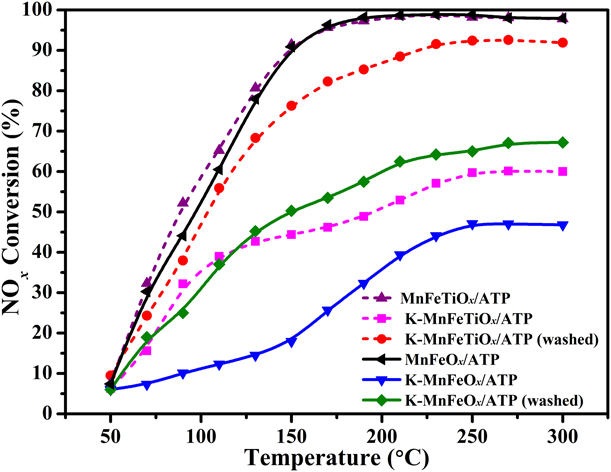
Based on the study, K:(Mn + Fe + Ti) molar ratio of 1:1 was controlled to prepare K–MnFeTiOx/ATP by the impregnation method and used to investigate the potassium resistance of the catalyst. The results are shown in Fig. 6. It can be seen that the catalytic performance decreases obviously when MnFeTiOx/ATP is immersed in potassium nitrate. However, the NOx conversion rate of about 57% can still be achieved below 230 °C, and its activity is evidently higher than the conventional V–W–Ti catalyst and MnFeOx/ATP catalyst.
Potassium resistance test of different catalysts.

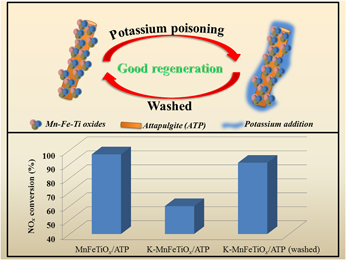
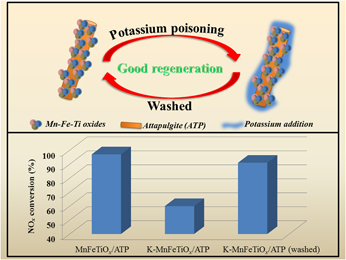
To investigate the regeneration performance of the MnFeTiOx/ATP catalyst, the poisoned K–MnFeTiOx/ATP was washed with deionized water and then subjected to repeated performance tests. As a result, the denitration performance of the washed catalyst is visibly improved after washing; especially after 150 °C, it increases about 37% and can reach a NOx conversion rate of nearly 90% at 210 °C. Moreover, the recovery of denitration performance of the K–MnFeTiOx/ATP (washed) is superior to that of the K–MnFeOx/ATP (washed). Hence, the MnFeTiOx/ATP catalyst prepared in this work has excellent K resistance and regeneration performance. The fabrication process and testing results of K–MnFeTiOx/ATP are displayed in Scheme 1.
Schematic diagram for the fabrication process and testing results of K–MnFeTiOx/ATP.

NH3-TPD analysis
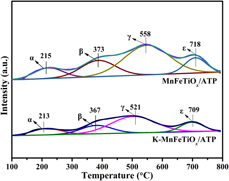
To investigate the effect of potassium on the surface acidity of MnFeTiOx/ATP, NH3-TPD was carried out and the results are shown in Fig. 7. The two catalysts display four NH3 desorption peaks in the temperature range of 100–800 °C. The desorption peaks (ε) within a temperature range of 700–720 °C can be derived from NH3 components which are combined on the surface of crystal water between ATP layers. According to the literature [Reference Jiang, Deng, Zhang and Wu45], the NH3 desorption peak at low temperatures is usually attributed to the desorption peak of NH4+ adsorbed at the Brønsted acid site. The peak at high temperatures is attributed to the desorption from combination between the coordinated NH3 molecule and the strong Lewis acid site [Reference Roy, Viswanath, Hegde and Madras46]. Thus, the NH3 desorption peak at 200–220 °C is ascribed to the Brønsted weak acid site. The desorption peak between 350 and 380 °C is attributed to the medium strong acid site. The desorption peak between 500 and 580 °C corresponds to the Lewis strong acid site [Reference Yao, Kong, Yu, Li, Yang and Dong8], which is denoted as α, β, and γ, respectively. The area of each desorption peak was calculated so as to compare the acidity changes of the catalyst surface (Table SIII). Compared with MnFeTiOx/ATP, the number of surface acid sites of K–MnFeTiOx/ATP decreases significantly over the entire temperature range, especially in the mid- and low-temperature ranges. Furthermore, it can be found that after the surface loading of potassium component, the NH3 desorption peak temperature of the catalyst generally shows a tendency to move toward the low-temperature region. Thus, the loading of potassium not only reduces the number of acid sites on the surface of the catalyst, but also causes a decrease in acid strength. The decrease in surface acidity and acid strength will undoubtedly lead to a decrease in the amount of surface NH3 adsorption, and reduced activity.
NH3-TPD patterns of MnFeTiOx/ATP and K–MnFeTiOx/ATP.

BET analysis
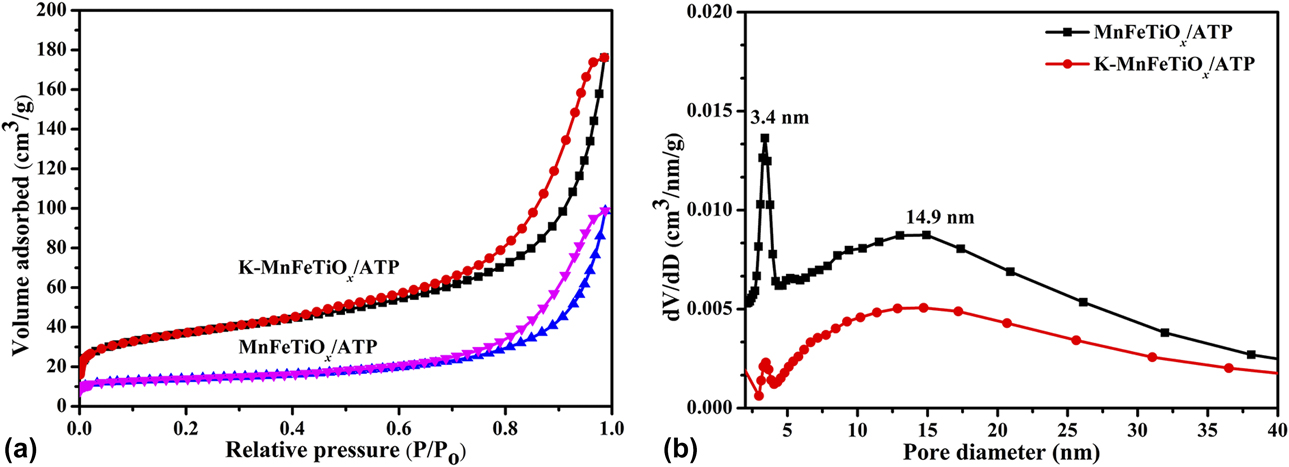
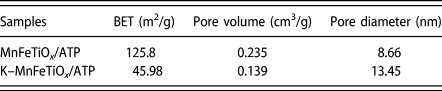
It is generally believed that the alkali metal poisoning of the catalyst is mainly derived from two aspects of physical poisoning and chemical poisoning [Reference Zheng, Jensen and Johnsson47]. Physical poisoning is mainly caused by the deposition of dust particles from alkali metal in the flue gas on the surface of the catalyst, which can block the pores of the catalyst and thus decrease the specific surface area of the catalyst. The reaction site and the active component of the gas on the surface of the catalyst are reduced, thus causing a decrease in the denitration performance of the catalyst. Chemical poisoning is caused by the combination of the alkali metal adsorbed on the surface of the catalyst and the acidic sites of the active component during the reaction, which reduces the amount of total acid on the surface of the catalyst, thereby causing poisoning of the catalyst. Chemical poisoning is more serious for catalyst deactivation than physical poisoning [Reference Kustov, Rasmussen, Fehrmann and Simonsen48]. N2 adsorption and desorption were performed on the catalysts to detect their specific surface area and pore change. It can be seen that both catalysts exhibit type IV adsorption isotherms and H3 type hysteresis loops [Fig. 8(a)], which proves the existence of mesoporous structure on the catalyst surface [Reference Wang, Wang, Kang and Wang49]. It can be seen from Fig. 8(b) that the adsorption amount of K–MnFeTiOx/ATP at the pore size of 3.4 and 14.9 nm is obviously decreased due to the addition of potassium. Meanwhile, it can be noticed from Table I that the BET specific surface area of the catalyst K–MnFeTiOx/ATP decreased sharply from the original 125.8 to 45.98 m2/g after the catalyst was poisoned. The decrease in specific surface area undoubtedly leads to a decrease in surface reaction sites and a decrease in adsorption performance, thus reducing the denitration performance of the catalyst, which is in line with the activity test of the above catalyst.
(a) Nitrogen adsorption–desorption isotherm and (b) pore size distribution of samples.

BET specific area, pore volume, and pore diameter of MnFeTiOx/ATP and K–MnFeTiOx/ATP.

SO2 resistance and stability test
There is generally agreement that the formation of ammonium sulfate and metal sulfate over the traditional V–W–Ti catalyst in the presence of SO2 result in an obvious deactivation of the catalyst [Reference Zhou, Huang, Xie, Luo, Yao, Li and Zuo24]. Although the catalyst has excellent potassium resistance, the sulfur resistance of the catalyst is still one of the main properties to be evaluated for the NH3-SCR catalyst. Fig. S1 shows the influence of SO2 on the NOx conservation over MnFeTiOx/ATP at 300 °C before and after washing. Before the injection of SO2 gas, the MnFeTiOx/ATP exhibits a high conversion rate of 97%. When 200 ppm SO2 was added, NOx conversion has only a slight decrease in the MnFeTiOx/ATP and maintains over 80%. When SO2 is stopped, the catalytic activity of MnFeTiOx/ATP restores to 93%, and the MnFeTiOx/ATP (washed) also shows a similar trend; it can still reach a 75% conversion rate during the whole reaction period. Furthermore, the stability was evaluated in Fig. S2. It could be noted that MnFeTiOx/ATP has a good stability before and after washing via the stability test of 10 h although the activity of the MnFeTiOx/ATP catalyst decreases slightly after washing.
Conclusions
A series of Mn-based/ATP catalysts were successfully synthesized by the coprecipitation method for NH3-SCR. The ternary MnFeTiOx/ATP catalysts presented better NOx conversion and higher N2 selectivity than all other catalysts. NOx conversion of 91% at 150 °C and N2 selectivity of 88% at 250 °C could be achieved. It is evident from XRD and XPS results that the addition of Ti not only reduced the crystallinity of MnFeOx/ATP, but also increased the content of Mn4+ and surface-adsorbed oxygen on the catalyst. The potassium resistance test of MnFeTiOx/ATP illustrated that K decreased the denitration performance by 37%, but after washing, the activity of the catalysts was remarkably restored and can be restored to nearly 90% NOx conversion at 210 °C. The as-prepared ternary MnFeTiOx/ATP catalyst exhibited excellent potassium resistance and regeneration performance for NH3-SCR at the low temperatures.
Experimental
Materials and reagents
Manganese acetate, titanium sulfate, chromium nitrate, potassium nitrate, ferric nitrate, and ammonia solution were purchased from Sinopharm Chemical Reagent Co., Ltd. (Shanghai, China). Attapulgite was provided by Jiangsu Nanda Zijin Technology Group Co., Ltd. (Changzhou, China). All reagents were of analytical grade and were used without further purification. Attapulgite raw material purity was 99% and did not need further purification.
Preparation of Mn-based/ATP
First, 4 g of ATP raw material was dispersed in 50 mL of deionized water under ultrasonic treatment to obtain ATP dispersion. Then, 0.6 g of C4H6MnO4, 0.49 g of Fe(NO3)2·9H2O and 0.29 g of Ti(SO4)2 were added to the ATP slurry with continuous stirring. Then, ammonia solution was added into the suspension under vigorous stirring until the pH reached ≈10. After stirring for 3 h at 80 °C, the suspension was filtered, washed with deionized water, and dried at 80 °C for 6 h. The resulting sample was then calcined at 400 °C under static air in a muffle furnace for 3 h to obtain MnFeTiOx/ATP. For comparison, MnFeOx/ATP, MnCrOx/ATP, and MnTiOx/ATP of the same metal in concentration were prepared in the same way as MnFeTiOx/ATP.
Preparation of K–MnFeTiOx/ATP
To investigate the effect of alkali metal on the properties of MnFeTiOx/ATP catalyst, K–MnFeTiOx/ATP was prepared by the traditional impregnation method. The molar ratio of K to (Mn + Fe + Ti) was controlled at 1:1. First, 0.41 g of KNO3 was dissolved in 50 mL of deionized water, sonicated to completely dissolve, and then 1.0 g of MnFeTiOx/ATP was added to the above solution. After stirring, it was dried at 80 °C in an oven and then calcined at 400 °C for 3 h to obtain K–MnFeTiOx/ATP. To detect the catalyst regeneration ability, washing was used to regenerate the poisoned catalyst. 1.0 g of the tested catalyst (K–MnFeTiOx/ATP) was soaked in 60 mL of deionized water for about 3 h, and the supernatant was removed by filtration and then dried at 60 °C to acquire K–MnFeTiOx/ATP (washed).
Catalyst characterization
The crystal structure of the catalysts was analyzed by the X-ray diffraction (XRD), with a Cu anode (D/Max 2500 PC, Rigaku Corporation, Akishima City, Tokyo, Japan), at a scanning angle of 2–80°, at a sweep rate of 3°/min, and with Cu Kα of 40 kV, 40 mA. The surface morphology of the catalysts was observed by transmission electron microscopy (TEM) (JEM-2100, JEOL, Tokyo, Japan), operating at 200 kV. The surface composition and elemental state of the catalysts were tested by X-ray photoelectron spectroscopy (XPS), using Al Kα radiation (Thermo ESCALAB 250, Thermo Fisher Scientific, Waltham, Massachusetts). The specific surface area and pore structure of the catalysts were recorded by an automatic volumetric apparatus, following standard Brunauer–Emmett–Teller (BET) theory; the pore volume was obtained from the N2 desorption isotherm using Barrett–Joyner–Halenda (BJH) equations (ASAP2010C, Micromeritics manufacturers, Norcross, Georgia). The total acidity and the acid distribution of the catalysts were measured by temperature-programmed desorption by ammonia (NH3-TPD), which uses a TP5080 auto-adsorption apparatus (XQ, Tianjin, China). Approximately 100 mg of the sample was pretreated with high-purity N2 for 30 min at 250 °C, then cooled to 100 °C, and treated with high-purity NH3 (30 mL/min) for 1 h. Then, the surface physical adsorption NH3 was removed by purging with N2 at the same temperature for 30 min, and the sample was gradually heated to 800 °C at a heating rate of 10 °C/min, and the desorption signal of the sample was recorded using a TCD detector. The redox capability of the catalysts was detected by temperature-programmed reduction by hydrogen (H2-TPR), using a TP5080 auto-adsorption apparatus (XQ, Tianjin, China). Approximately 100 mg of the sample was pretreated with high-purity N2 for 30 min at 250 °C and then cooled to room temperature; after the baseline was leveled, the gas was switched to H2–N2 gas mixture (H2 mole fraction 10%), and the temperature was gradually increased to 800 °C at a heating rate of 10 °C/min, and the desorption signal of the sample was recorded.
Catalytic activity measurements
The NH3-SCR activity of the catalyst was tested using an SCR-photocatalytic dual-purpose fixed-bed reactor (PFD-5000, Huasi Instrument Co., Ltd., Hunan, China); the device was mainly composed of a gas distribution system, a reaction system, and an analysis system. In the SCR activity test, firstly, about 3 mL (∼0.6 g) of the catalyst was placed in a fixed-bed quartz tube reactor, and the inlet gas flow rate was accurately controlled by a high-precision mass flow meter, with N2 as the carrier gas; the gas composition was: [NO] = 1000 ppm, [NH3] = 1000 ppm, SO2 = 200 ppm (when used), [O2] = 3 vol%, and the gas hourly space velocity (GHSV) was approximately 45,000 h−1. Before the reaction, the catalyst was rested at room temperature for 30 min to ensure saturation of the catalyst adsorption. After the purge was completed, the concentrations of the inlet NOx and outlet NOx were detected by a NO/NO2/NOx analyzer (KM9106, Kane International Ltd., Welwyn Garden City, U.K.), which were recorded as [NOx]in and [NOx]out. At the same time, the N2O concentration in the catalyst reaction process was detected online by a N2O gas analyzer (G200, Viasensor, Shenzhen, China) to calculate the N2 selectivity of the catalyst. The NOx conversion and N2 selectivity were calculated according to the following formulas:
 $${\rm{N}}{{\rm{O}}_x}\;{\rm{conversation}}\;\left( \% \right) = {{{{\left[ {{\rm{N}}{{\rm{O}}_x}} \right]}_{{\rm{in}}}} - {{\left[ {{\rm{N}}{{\rm{O}}_x}} \right]}_{{\rm{out}}}}} \over {{{\left[ {{\rm{N}}{{\rm{O}}_x}} \right]}_{{\rm{in}}}}}} \times 100\% \quad ,$$
 $${{\rm{N}}_2}\;{\rm{selectivity}}\;\left( \% \right) = {{{{\left[ {{\rm{NO}}} \right]}_{{\rm{in}}}} + {{\left[ {{\rm{N}}{{\rm{H}}_3}} \right]}_{{\rm{in}}}} - {{\left[ {{\rm{N}}{{\rm{O}}_2}} \right]}_{{\rm{out}}}} - 2\left[ {{{\rm{N}}_2}{\rm{O}}} \right]} \over {{{\left[ {{\rm{NO}}} \right]}_{{\rm{in}}}} + {{\left[ {{\rm{N}}{{\rm{H}}_3}} \right]}_{{\rm{in}}}}}} \times 100\% \quad .$$
Supplementary material
To view supplementary material for this article, please visit https://doi.org/10.1557/jmr.2019.31.
Acknowledgments
This work was supported by Social Development Fund of Jiangsu Province (BE2016654, CE20165022) and Advance Catalysis and Green Manufacturing Collaborative Innovation Center, Changzhou University (TAPP NO: PPZY2015B145).