INTRODUCTION
Spiritual well-being (SWB) is an essential aspect of terminally ill patients' quality of life (QoL) (Delgado-Guay et al., Reference Delgado-Guay, Hui and Parsons2011; Kandasamy et al., Reference Kandasamy, Chaturvedi and Desai2011; Zimmermann et al., Reference Zimmermann, Burman and Swami2011; Vallurupalli et al., Reference Vallurupalli, Lauderdale and Balboni2012). It has been conceptualized in a two-dimensional framework: vertical and horizontal (Paloutzian & Ellison, Reference Paloutzian, Ellison, Peplau and Perlman1982; Paloutzian et al., Reference Paloutzian, Bufford, Wildman and Cobb2012). The vertical dimension, called “religious well-being” (RWB), represents the connection between individuals and God/higher power, and the horizontal dimension, called “existential well-being” (EWB), represents individuals' subjective feelings of satisfaction with life and with the purpose of life (Paloutzian & Ellison, Reference Paloutzian, Ellison, Peplau and Perlman1982).
Religion and spirituality are parallel in scope, with religion reflecting the public side and spirituality the private face of a single process (Zimmermann et al., Reference Zimmermann, Burman and Swami2011; Miller, Reference Miller2012). Spirituality and religion are important in helping people cope with adversity, especially a terminal cancer diagnosis. Indeed, these spiritual factors have been significantly associated with terminally ill cancer patients' treatment choices and coping (True et al., Reference True, Phipps and Braitman2005; Steinhauser et al., Reference Steinhauser, Voils and Clipp2006; Phelps et al., Reference Phelps, Maciejewski and Nilsson2009). Religion helps terminally ill patients and their families cope when facing loss of control (e.g., transferring control to God, telling oneself that God will guide one's life) and the loss of life (e.g., patients will return to heaven, where they will have no pain and eventually rejoin their loved ones) (Daaleman & VandeCreek, Reference Daaleman and VandeCreek2000; Koenig, Reference Koenig2002).
Despite these benefits, religious beliefs can also bring psychological pressure to bear when patients approach death (Nelson et al., Reference Nelson, Rosenfeld and Breitbart2002). They might experience anger toward God and feel that He did not protect them. In fact, He has subjected them to grief and discomfort—even consigned them to hell (Exline et al., Reference Exline, Park and Smyth2011). Nonreligious patients at the end of life also need help in searching for meaning and purpose in life, receiving love and support, perceiving hope, forgiving others, and being forgiven (Koenig, Reference Koenig2002). In order to preserve patients' SWB, healthcare providers must first consider their spiritual needs.
Enhancing a terminally ill cancer patient's SWB not only improves overall QoL (Fisch et al., Reference Fisch, Titzer and Kristeller2003; Tang et al., Reference Tang, Lo and Kuo2004a ) but also decreases the number of suicide attempts, alleviates psychological pressure, and moderates death anxiety (Fehring et al., Reference Fehring, Miller and Shaw1997; Kandasamy et al., Reference Kandasamy, Chaturvedi and Desai2011); reduces depression (Nelson et al., Reference Nelson, Rosenfeld and Breitbart2002); and minimizes feelings of hopelessness (Fehring et al., Reference Fehring, Miller and Shaw1997). Indeed, SWB and hope have been significantly and positively correlated (r = 0.75; p < 0.01) in elderly cancer patients, suggesting that cancer patients' expectations for the future can be enhanced by properly assisting them to find meaning in life (Fisch et al., Reference Fisch, Titzer and Kristeller2003; Tang et al., Reference Tang, Lo and Kuo2004a ; Kandasamy et al., Reference Kandasamy, Chaturvedi and Desai2011; Pearce et al., Reference Pearce, Coan and Herndon2012).
Since assessing SWB, an essential part of terminally ill patients' QoL, requires a validated instrument and none such is available in Taiwan, we chose to work with the Spiritual Well-Being Scale (SWBS) (Paloutzian & Ellison, Reference Paloutzian, Ellison, Peplau and Perlman1982), which we translated (with the authors' permission) into Mandarin Chinese (resulting in the SWBS–M). Therefore, our study aimed to validate the SWBS–M by testing its psychometric properties. In particular, we asked the following questions: (1) What is the internal consistency and reliability of the overall SWBS–M scale and its subscales? (2) What is the factor structure of the SWBS–M? (3) Do terminally ill patients with better SWB have a better QoL? and (4) Do terminally ill patients with less pain experience better SWB?
METHODS
Subjects and Setting
For this cross-sectional study, cancer patients were recruited by purposive sampling from the oncology wards and hospice units of five teaching hospitals in Taiwan. Patients were selected if they (1) were hospitalized cancer patients with a terminal diagnosis, (2) could express their own ideas verbally or in writing, and (3) agreed to participate in the study. Of the 359 terminally ill cancer patients who participated in our study during the two-year period of data collection, 116 (32%) did not complete the study because they felt too weak.
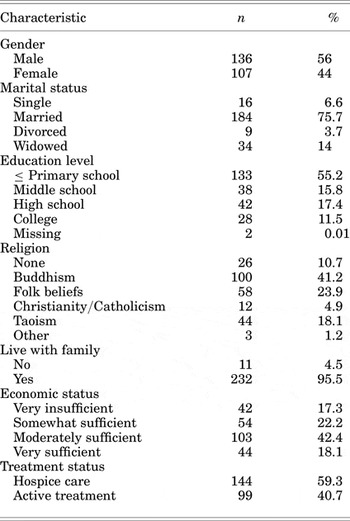
The 243 participants who completed the study were on average 58.6 years of age (SD = 15.21, range = 16–92), with the majority being male (59%) and married (75.7%), and the largest proportion having less than an elementary school education (55.2%) (Table 1). Most participants lived with their family (95.5%) and had religious beliefs (89.3%), with the largest proportion being Buddhists (41.2%). The largest proportion perceived their economic status as moderately sufficient (42.4%), and the majority decided to remain in hospice care (59.3%) (Table 1).
Participant characteristics (N = 243)

Procedure
After this study was approved by the institutional review boards at each study site, the researchers explained the purpose of the study to staff nurses at their monthly meetings, who helped the researchers to identify potential subjects. If potential subjects were interested in knowing more about the study, the researchers visited them and explained its purpose and procedure. Consenting subjects answered the questions at their own discretion or with the help of the researchers, depending on their physical status and reading ability. For illiterate participants or those requiring assistance, a researcher read scale items and wrote down the answers. The average data-collection session time was 62.7 minutes. Some participants (42%) needed to arrange for another visit in order to complete data collection.
Ethical Considerations
The study protocol was approved by the institutional review boards at the study hospitals. The researchers explained the study purpose to potential subjects. Enrollment was not begun until potential subjects had signed an informed consent. They were assured that they could withdraw from the study at any point in time, and that nonparticipation would not affect their rights to receive treatment and care at any of the study sites. The data were collected anonymously using blinded codes and were employed solely for academic purposes.
Measures
The data were collected on terminally ill cancer patients' SWB, QoL, and pain level using the SWBS–M, the McGill Quality of Life Questionnaire (Cohen et al., Reference Cohen, Mount and Tomas1996), and the American Pain Society Patient Outcome Questionnaire (McNeill et al., Reference McNeill, Sherwood and Starck1998), respectively. These scales are described in detail below.
Spiritual Well-Being Scale–Mandarin Version
The original 20-item SWBS, designed to measure SWB, has two subscales: religious well-being (RWB) and existential well-being (EWB) (Paloutzian & Ellison, Reference Paloutzian, Ellison, Peplau and Perlman1982; Paloutzian et al., Reference Paloutzian, Bufford, Wildman and Cobb2012). The items are brief and easy to understand, and responses are scored on a 6-point Likert-type scale. Total scores can range from 20 to 120, with higher scores indicating a stronger sense of SWB. Although the original SWBS was tested in theological college students (Paloutzian & Ellison, Reference Paloutzian, Ellison, Peplau and Perlman1982), it has been used in more than 300 published articles (Paloutzian et al., Reference Paloutzian, Bufford, Wildman and Cobb2012) on chronically ill patients (Riley et al., Reference Riley, Perna and Tate1998), cancer patients (Fehring et al., Reference Fehring, Miller and Shaw1997), terminally ill patients (Kuuppelomaki, Reference Kuuppelomaki2001; Tang et al., Reference Tang, Aaronson and Forbes2004b ), and primary caretakers of terminally ill patients (Tang et al., Reference Tang, Tang and Kao2009). This scale has been translated into many different languages and used extensively across many countries (Paloutzian et al., Reference Paloutzian, Bufford, Wildman and Cobb2012). Thus, its validity has been confirmed.
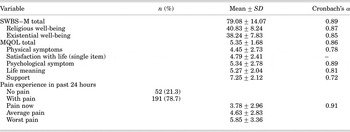
The internal consistency (Cronbach's α) of the overall SWBS was 0.82–0.99, 0.82–0.99 for the RWB and 0.73–0.98 for the EWB (Bufford et al., Reference Bufford, Paloutzian and Ellison1991). With respect to construct validity, SWBS scores were negatively correlated with depression scores (Finocchiaro et al., Reference Finocchiaro, Roth and Connelly2014), and positively correlated with sleep quality scores (Eslami et al., Reference Eslami, Rabiei and Khayri2014), psychosocial adjustment (Li et al., Reference Li, Rew and Hwang2012), and QoL (Finocchiaro et al., Reference Finocchiaro, Roth and Connelly2014). Since the scale has been used widely, norms are available (Bufford et al., Reference Bufford, Paloutzian and Ellison1991). However, most of the populations in which the SWBS has been tested were Western (Genia, Reference Genia2001; Miller et al., Reference Miller, Gridley and Fleming2001), Christian (Genia, Reference Genia2001), and comprised of healthy adults (Paloutzian & Ellison, Reference Paloutzian, Ellison, Peplau and Perlman1982; Genia, Reference Genia2001; Miller et al., Reference Miller, Gridley and Fleming2001; You & Yoo, Reference You and Yoo2015; Musa, Reference Musa2016). The results of these studies established norms that are not necessarily applicable to Chinese Buddhists and Taoists, especially terminally ill patients. In our study, Cronbach's α for the total SWBS–M was 0.89, 0.87 for the RWB, and 0.85 for the EWB (Table 1).
McGill Quality of Life Questionnaire (MQoL)
The MQoL was developed to measure overall QoL for patients with a life-threatening illness (Cohen et al., Reference Cohen, Mount and Tomas1996). It has three parts with 16 closed-ended items that are rated over the previous 2 days from 0 to 10, and 1 open-ended part that patients fill in. A higher score indicates better QoL. The MQoL has five subscales: physical symptoms, physical comfort, mental symptoms, SWB, and social well-being. It has demonstrated good internal consistency and reliability in terminally ill patients (Hu et al., Reference Hu, Dai and Berry2003; Bentur & Resnizky, Reference Bentur and Resnizky2005; Lua et al., Reference Lua, Salek and Finlay2005). In our study, the values of α for the total MQoL and its subscales were 0.86 and 0.89–0.72, respectively (Table 1).
American Pain Society Patient Outcome Questionnaire (APS–POQ)
To ease the data-collection burden of terminally ill Taiwanese cancer patients, their current pain level was assessed using only four items from the nine-item APS–POQ (McNeill et al., Reference McNeill, Sherwood and Starck1998). These were: (1) did you experience pain during the past 24 hours? (yes/no); (2) current level of pain, (3) worst pain intensity during the past 24 hours, and (4) average degree of pain over the past 24 hours. The latter three items were rated between 0 and 10, with higher scores indicating greater pain intensity (Tang et al., Reference Tang, Aaronson and Forbes2004b ; Reference Tang, Tang and Kao2009). In our study, the internal reliability (α) for these three items was 0.91 (Table 1).
Statistical Analysis
SWBS–M scores for negatively worded items (items 1, 2, 5, 6, 9, 12, 13, 16 and 18) were reversed, and participants' characteristics and SWB total and subscale scores were analyzed by descriptive statistics. The factor structure of the SWBS–M was analyzed by exploratory factor analysis (EFA), which we conducted using principal component analysis with oblimin rotation from SPSS. An oblimin rotation allows the natural relationships between/among factors to emerge and correlations to be computed (Green & Salkind, Reference Green and Salkind2013; Tabachnick & Fidell, Reference Tabachnick and Fidell2013). To determine the factorial structure of the SWBS–M, a scree plot and eigenvalues were employed (Patil et al., Reference Patil, Singh and Mishra2008; Green & Salkind, Reference Green and Salkind2013). The internal consistency and reliability of the SWBS–M was determined using α. Correlations of SWBS–M total and subscale scores with MQoL scores were analyzed using Pearson's correlation coefficient. The differences in SWBS–M scores for patient groups based on their report of being free of pain or having pain were analyzed suing an independent t test. Finally, stepwise regression was employed to determine the unique contribution of the SWBS–M on the MQoL.
RESULTS
Mean SWBS–M and MQoL Scores
The means and standard deviations of participants' SWBS–M and MQoL scores were 79.08 ± 14.07 and 5.27 ± 1.68, respectively. Although 78.7% of patients experienced pain during the previous 24 hours, their average pain level was 4.63 (SD = 2.83) (Table 2), demonstrating a moderate level of pain (National Health Research Institutes, 2007). The SWB, RWB, and EWB scores of participants from different study sites did not differ significantly (data not shown).
Descriptive analysis of study variables (N = 243)

SWBS–M = Spiritual Well-Being Scale–Mandarin version; MQoL = McGill Quality of Life Questionnaire; SD = standard deviation.
Factor Analysis for the SWBS–M
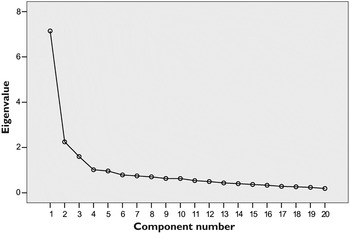
To determine the factorial structure of the SWBS–M, we first utilized principal component analysis to extract factors, the number of which depended on each factor's eigenvalue. In general, an eigenvalue needs to be >1 to be considered a factor (Green & Salkind, Reference Green and Salkind2013). In our analysis, four factors had an eigenvalue greater than 1, as confirmed by the scree plot depicted in Figure 1.
Scree plot.

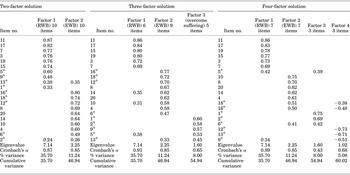
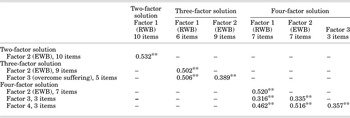
Because the SWBS has been found to have two-factor (Ellison, Reference Ellison1983; Genia, Reference Genia2001; Gow et al., Reference Gow, Watson and Whiteman2011; Musa & Pevalin, Reference Musa and Pevalin2012; Musa, Reference Musa2016), three-factor (Scott et al., Reference Scott, Agresti and Fitchett1998; Miller et al., Reference Miller, Gridley and Fleming2001; Gow et al., Reference Gow, Watson and Whiteman2011; Musa & Pevalin, Reference Musa and Pevalin2012; You & Yoo, Reference You and Yoo2015; Musa, Reference Musa2016), and four-factor (Su, Reference Su2002) structures, we also forced two-, three-, and four-factor solutions by oblimin rotation (Table 3). In the two-factor model, factor 1 items were from the original RWB, while the factor 2 items were those from the original EWB. Items 13 and 2 cross-loaded (0.38 vs. 0.35 and 0.24 vs. 0.26, respectively), but item 2 was not suitable because its item loading was <0.30 (Comrey & Lee, Reference Comrey and Lee2016). These two factors explained 46.94% of total variance in the SWBS–M. In the three-factor model, factor 1 items were positively worded items from the original RWB, while factor 2 items were those of the original EWB except for item 2. Items 14 and 10 cross-loaded. The factor 3 items were negatively worded items from the original RWB and item 2. These three factors explained 54.94% of total variance in the SWBS–M. In the four-factor model, the factor 1 items were positively worded items from the original RWB plus one negatively worded item (item 5), which cross-loaded onto factor 3 (0.42 vs. 0.39). The factor 2 items were items from the original EWB except for items 2, 6, and 12. Items 16 and 18 cross-loaded onto factor 4. The factor 3 items were items 1, 2, and 6, which were all negatively worded, with item 6 cross-loading onto factor 2 (0.41 vs. 0.42). The factor 4 items were items 12, 13, and 9, all of which were negatively worded, with item 9 cross-loading onto factor 1. These four factors explained 60.02% of total variance on the SWBS–M. The actual eigenvalues, α, and percentage of variance explained by each factor are shown in Table 3. The correlation between the RWB and EWB factors (subscales) for the two-factor solution was 0.532 (p < 0.01). The correlations among factors in the three- and four-factor solutions are presented in Table 4.
Rotated factor structure of different solutions for the Spiritual Well-Being Scale–Mandarin version (N = 243)

RWB = religious well-being; EWB = existential well-being.
Loadings <0.30 not shown, except for two-factor solution.
* Negatively worded item.
Pearson's correlations among factors in different solutions (N = 243)

** p < 0.01 (two-tailed).
SWBS–M Reliability and Validity
The internal consistency and reliability (α) of the total SWBS–M was 0.89 (Table 2), with its two, three, and four subscales having reliability ranges of 0.85–0.87, 0.65–0.91, and 0.43–0.89, respectively (Table 3). Because the two-factor model is the best model in our study, the following analysis of validity testing was based on the two-factor solution.
The validity of the SWBS–M was determined by correlation analysis of its scores with MQoL scores. We found a medium correlation between scores for total SWBS–M and MQoL (r = 0.48, p < 0.01), indicating good validity. Moreover, the correlations between RWB and MQoL scores as well as EWB and MQoL scores were 0.268 and 0.587 (p < 0.01), respectively. The SWB of patients who experienced pain during the previous 24 hours was lower than that of patients who had not (t = –3.67, p < 0.001). Cohen's d (0.56) was calculated and showed a medium effect (Table 5). Since QoL is the major outcome for end-of-life care (Stewart et al., Reference Stewart, Teno and Patrick1999; Kaasa & Håvard Loge, Reference Kaasa, Håvard Loge and Cherny2015), we did a stepwise regression analysis using average pain and SWB as the independent variables and QoL as the dependent variable. When SWB was entered last into the regression model, it contributed an additional 14% to the variance in terms of QoL (ΔR 2 = 0.14, p of ΔR 2 < 0.001), demonstrating the unique contribution of SWB to terminally ill patients' QoL (Table 6).
Differential analysis of pain experiences and SWBS–M scores of terminally ill patients (N = 243)

SWBS–M = Spiritual Well-Being Scale–Mandarin version; SD = standard deviation.
Stepwise regression on quality of life (N = 243)

SWB = spiritual well-being.
DISCUSSION
Our terminally ill Taiwanese cancer patients' mean and SD for their SWBS–M, RWB, and EWB scores were 79.08 ± 14.07, 40.83 ± 8.24, and 38.24 ± 7.83, respectively, which are difficult to compare with relevant studies due to differences in participants' cultural background, ethnicity, and religion. Of the three psychometric studies on the SWBS from Asian countries (Su, Reference Su2002; You & Yoo, Reference You and Yoo2015; Musa, Reference Musa2016), two tested the SWBS in healthy adults (You & Yoo, Reference You and Yoo2015) and in university students (Musa, Reference Musa2016), whose SWBS scores were unsurprisingly higher than those of our terminal cancer patients. The third study was a master's thesis on Taiwanese lung cancer patients (Su, Reference Su2002).
Among Western-based psychometric studies on the SWBS in cancer populations, SWBS scores (including RWB and EWB scores) were higher for U.S. cancer patients (Mickley et al., Reference Mickley, Soeken and Belcher1992; Fehring et al., Reference Fehring, Miller and Shaw1997) than for our Taiwanese sample. This difference might be related to disease severity and religion. Our sample comprised 100% terminal cancer patients, while U.S. terminal cancer patients accounted for only 21% (Mickley et al., Reference Mickley, Soeken and Belcher1992) and 52% (Fehring et al., Reference Fehring, Miller and Shaw1997) of their samples. Having a higher cancer stage has been related to lower SWBS scores and a diminished purpose in life (Schnoll et al., Reference Schnoll, Harlow and Brower2000). Among our participants, 59.3% were Buddhist or Taoist, whereas 88.6% of participants in one U.S. study were Protestant or Catholic (Mickley et al., Reference Mickley, Soeken and Belcher1992). Christians believe that repenting before death can lead to eternal life (Luke 23:33–43), whereas Asian Buddhists and Taoists believe that all misdeeds committed in life deserve punishment after death. Thus, these deep-rooted Buddhist and Taoist beliefs may cause patients to suffer more as they face death and struggle with the thought of punishment for their sins.
To date, we have found only two Asian-based studies that employed the SWBS to measure SWB in cancer patients (Su, Reference Su2002; Li et al., Reference Li, Rew and Hwang2012). Both were also conducted in Taiwan, so their participants and ours had similar religious beliefs, but different SWBS scores. The patients in one study had lung cancer (N = 91) (Su, Reference Su2002), and patients in the other had undergone a colostomy after colon cancer surgery (N = 45) (Li et al., Reference Li, Rew and Hwang2012). The SWB and EWB scores (SWB = 84.43 ± 21.04; EWB = 42.33 ± 12.45) of the colostomy patients (Li et al., Reference Li, Rew and Hwang2012) were significantly higher than those of our terminal cancer patients (t = 2.148–2.896, p = 0.03–0.004). This difference was likely due to the fact that 77.8% of their subjects rated their disease as not severe or a little severe (Li et al., Reference Li, Rew and Hwang2012), which may have led to their having a better prognosis and physical status than our subjects.
On the other hand, the SWB, RWB, and EWB scores (SWB = 69.98 ± 10.54; RWB = 35.01 ± 6.98; EWB = 34.97 ± 5.88) of lung cancer patients (Su, Reference Su2002) were significantly lower than those of our patients (t = 3.602–5.955, p < 0.001). Although 65.5% of these lung cancer patients had terminal-stage disease, 70% of them still insisted on receiving chemoradiotherapy while none received hospice care. These patients' poor cancer prognosis, the side effects of treatment, and the lack of hospice care might have been negatively associated with their SWB. Among our terminally ill patients, 59.3% chose to receive hospice care, which focuses on patients' physical, spiritual, and social well-being. Our participants' better SWBS–M scores might have been associated with the quality of hospice care in Taiwan, which is ranked sixth globally and first in Asia (Murray et al., Reference Murray, Line and Pellerey2015a ). However, during our two-year data-collection process, 116 participants (32%) did not complete the study because of being too weak, suggesting that they experienced more pain and physical discomfort. Thus, the overall mean SWBS–M score might have been even lower if these participants had finished the study.
Although our findings from factor analysis showed that a four-factor structure explained most of the variance (60.02%) in the SWBS–M, closer examination of the data showed that five items (5, 18, 16, 6, and 9) cross-loaded onto two factors, and one factor (factor 3) had low reliability (α = 0.43). These issues and the principle of parsimony in the structure of the questionnaire led us to conclude that the two- and three-factor models were more appropriate. However, comparison of the two- and three-factor solutions shows that the two-factor solution fit with the underlying theory, matched the principle of parsimony, had good internal consistency and reliability (α = 0.85–0.87), had less cross-loading (Table 3), and had a high correlation between factors (r = 0.532) (Table 4). Therefore, we conclude that the two-factor model is a better solution than the three-factor model.
The factor structure of the SWBS has been extensively studied by EFA and/or confirmatory factor analysis (CFA) in both Western (Ellison, Reference Ellison1983; Ledbetter et al., Reference Ledbetter, Smith and Fischer1991; Miller et al., Reference Miller, Fleming and Brown-Anderson1998; Genia, Reference Genia2001; Utsey et al., Reference Utsey, Lee and Bolden2005) and Asian (Su, Reference Su2002; Musa & Pevalin, Reference Musa and Pevalin2012; You & Yoo, Reference You and Yoo2015; Musa, Reference Musa2016) countries. The factorial structure of the SWBS remains unstable, especially in hospitalized populations (Paloutzian et al., Reference Paloutzian, Bufford, Wildman and Cobb2012). The SWBS has been found to have a two-factor (Ellison, Reference Ellison1983; Genia, Reference Genia2001; Gow et al., Reference Gow, Watson and Whiteman2011; Musa & Pevalin, Reference Musa and Pevalin2012; Musa, Reference Musa2016), three-factor (Scott et al., Reference Scott, Agresti and Fitchett1998; Miller et al., Reference Miller, Gridley and Fleming2001; Gow et al., Reference Gow, Watson and Whiteman2011; Musa & Pevalin, Reference Musa and Pevalin2012; You & Yoo, Reference You and Yoo2015; Musa, Reference Musa2016), four-factor (Su, Reference Su2002), or five-factor (Miller et al., Reference Miller, Gridley and Fleming2001) structure. These different factorial structures may not reflect substantive constructs as they may have been due to variance from such methodological artifacts as complex/ambiguous item wording that can be interpreted differently by religious and nonreligious persons (Murray et al., Reference Murray, Johnson and Gow2015b ).
Although our analysis supports a two-factor model, the original developers of the SWBS remind us that different factor structures may be clinically revealing and useful, especially in hospitalized subjects (Paloutzian et al., Reference Paloutzian, Bufford, Wildman and Cobb2012). Therefore, we carefully examined our findings with the three-factor model and found some interesting results. First, our third factor (overcoming suffering) was formed by extracting only negatively worded RWB items, almost identical to previous results for three-factor structures for the SWBS (Scott et al., Reference Scott, Agresti and Fitchett1998; You & Yoo, Reference You and Yoo2015), based on three different samples: our terminally ill Taiwanese cancer patients, healthy South Korean adults who were 71% Protestant (You & Yoo, Reference You and Yoo2015), and psychiatric inpatients from the United States (Scott et al., Reference Scott, Agresti and Fitchett1998). Although our factor 3 (overcoming suffering) subscale had an internal reliability (α) of only 0.65, it was close to the acceptable level of 0.70. Second, 83.2% of our participants had religious beliefs (Buddhism, folk beliefs, and Taoism), and their SWB, RWB, and EWB scores did not differ significantly across study sites in Taiwan, thereby decreasing the possibility of the methodological artifacts mentioned by Murray et al. (Reference Murray, Johnson and Gow2015b ).
The beliefs of our Taoist and Buddhist participants differ from the Christian belief that repentance before death can lead to eternal life (Luke 23:33–43). Taoists and Buddhists believe that all the sins of this life call for punishment after death. Chinese Buddhists believe in the 18 levels of hell, where they will suffer for wrongs committed in life. These deeply rooted religious and cultural beliefs may lead to suffering that cancer patients need to overcome as they face death and dying.
Third, our study was based on a large sample of terminally ill patients. Most previous studies using EFA to determine SWBS structure involved healthy adults and postgraduates (Ellison, Reference Ellison1983; Miller et al., Reference Miller, Fleming and Brown-Anderson1998; Genia, Reference Genia2001; Musa & Pevalin, Reference Musa and Pevalin2012; You & Yoo, Reference You and Yoo2015) or healthy older adults (Gow et al., Reference Gow, Watson and Whiteman2011). Only three studies found two-, three-, and four-factor models when testing patients after cardiac surgery (Musa & Pevalin, Reference Musa and Pevalin2012), psychiatric inpatients (Scott et al., Reference Scott, Agresti and Fitchett1998), and lung cancer patients (Su, Reference Su2002). In addition, two studies using CFA on the SWBS failed to find a model fit to their data (Ledbetter et al., Reference Ledbetter, Smith and Fischer1991; Utsey et al., Reference Utsey, Lee and Bolden2005), leading them to conclude that the SWBS had an unstable factor structure.
We suggest that the unstable SWBS factor structure is related to inadequate sample size. Valid results on factor analysis have been suggested with small samples if the variables had high communality (>0.60), the factor/variable ratio was high, the loading was high (>0.50), and there was better model fit (Zhao, Reference Zhao2008), but these design aspects are not supported by the literature on SWBS factor structure. Thus, we can only determine an adequate sample size for factor analysis using the general rule of thumb (5–10 subjects per item) recommended by statistical experts (Costello & Osborne, Reference Costello and Osborne2005; Watson & Thompson, Reference Watson and Thompson2006; Field, Reference Field2009; Coakes, Reference Coakes2013). Since the SWBS has 20 items, at least 100 to 200 subjects are required for factor analysis. Therefore, one reason for the instability of the SWBS factor structure might be an insufficient sample size in some studies (N = 63–97) (Miller et al., Reference Miller, Fleming and Brown-Anderson1998; Su, Reference Su2002; Musa & Pevalin, Reference Musa and Pevalin2012).
Fourth, the SWBS has been found to have a ceiling effect, that is, a phenomenon whereby subjects score almost at or near the top of an instrument's range (Ledbetter et al., Reference Ledbetter, Smith and Fischer1991; Genia, Reference Genia2001; Paloutzian et al., Reference Paloutzian, Bufford, Wildman and Cobb2012). This effect acts against the assumption of normality for conducting a factor analysis (Coakes, Reference Coakes2013) and will threaten construct validity (Ledbetter et al., Reference Ledbetter, Smith and Fischer1991). The ceiling effect for the SWBS is usually found in religiously conservative samples, with a high grouping on the RWB subscale (Paloutzian et al., Reference Paloutzian, Bufford, Wildman and Cobb2012), suggesting that the SWBS should be tested in non-Christian populations (Ledbetter et al., Reference Ledbetter, Smith and Fischer1991; Miller et al., Reference Miller, Gridley and Fleming2001). Among our sample of terminal Taiwanese cancer patients who were mostly Buddhist and Taoist, we did not find a ceiling effect for the SWBS–M. We suggest testing the SWBS in different groups, checking its factor structure with EFA and CFA, and comparing the results in patients with those with healthy adults, which may help solidify the connection between the theoretical and operational definitions of SWB.
The mean SWBS–M score of patients who experienced pain during the previous 24 hours was lower than that of patients without pain (t = –3.67, p < 0.001), suggesting that patients without pain had better SWB than patients with pain (84.95 ± 12.90 vs. 77.39 ± 13.97). This result is consistent with findings in elderly cancer patients in the United States (Fehring et al., Reference Fehring, Miller and Shaw1997; Cheng & Lee, Reference Cheng and Lee2011). Pain is not only associated with the quality of patients' interactions with others, but also with how they think about their own life. As a result, most terminally ill patients have been shown to have low levels of SWB (McClain-Jacobson et al., Reference McClain-Jacobson, Rosenfeld and Kosinski2004; Ando et al., Reference Ando, Tsuda and Morita2007; Pearce et al., Reference Pearce, Coan and Herndon2012) as measured using instruments other than the SWBS.
Our findings indicate that terminally ill patients' higher SWB is associated with better QoL (r = 0.48, p < 0.01), echoing previous findings in advanced cancer patients (Fisch et al., Reference Fisch, Titzer and Kristeller2003; Tang et al., Reference Tang, Lo and Kuo2004a ; Delgado-Guay et al., Reference Delgado-Guay, Hui and Parsons2011; Kandasamy et al., Reference Kandasamy, Chaturvedi and Desai2011; Vallurupalli et al., Reference Vallurupalli, Lauderdale and Balboni2012) and supporting the importance of the relationship between SWB and QoL in hospice patients, since QoL is the major outcome for end-of-life care (Stewart et al., Reference Stewart, Teno and Patrick1999; Kaasa & Håvard Loge, Reference Kaasa, Håvard Loge and Cherny2015). Our findings indicate that SWB is a significant predictor of QoL (ΔR 2 = 0.14, p < 0.001), demonstrating its unique contribution to terminally ill patients' QoL (Table 6). Unfortunately, only 9–44.6% of patients worldwide are lucky enough to receive hospice care during their final journey, mainly in Japan, Taiwan, and the United States (National Hospice and Palliative Care Organization, 2012; Tsuneto, Reference Tsuneto2013; Ministry of Health and Welfare, 2014). Therefore, the caring ideals of hospice should be extended to acute and chronic hospital wards as well as intensive care units. In addition, we recommend that healthcare providers be educated and trained to regularly assess SWB and provide spiritual support for terminally ill patients. However, although the SWBS–M has only 20 questions, it is not easy for terminally ill cancer patients to complete it. Our participants took on average 32 minutes to finish the SWBS–M. Thus, practitioners working with terminally ill patients might use a specific item (e.g., the driving item) from each subscale to assess patient SWB.
The generalizability of findings from our multicenter research is likely stronger than that of a single-site study. Nonetheless, we note some limitations. First, we used a cross-sectional design, precluding inference of causal relationships. Second, patients' pain levels when responding to questionnaires was much lower than either their average or worst pain. Evidently, data were gathered at a “good” time in terms of their pain at that moment. Furthermore, the 32% of participants who did not complete the study might have had higher pain levels. These issues might have negatively affected the internal validity of our study.
CONCLUSIONS
The SWBS has been widely applied to different groups in Western countries but has seldom been used in Asia. We discovered through EFA and testing in terminally ill Taiwanese cancer patients that the SWBS–M has a two-factor structure that explains 46.94% of total variance in the SWBS–M. The overall reliability of the scale is 0.89, and the reliabilities of its subscales are in the range of 0.85 to 0.87, supporting its good reliability and validity. Psychometric testing of the SWBS–M should be confirmed in different Chinese populations to establish norms for the Asia-Pacific region.
ACKNOWLEDGMENTS
This work was supported by a grant from the Chang Gung Medical Center in Linkou, Taiwan (no. CMRPD32009).
CONFLICTS OF INTEREST
The authors hereby state that they have no conflicts of interest to declare.