

Introduction: discussions in Xi o Bàz border town, Yúnnán, China
After an hour in a local minibus on a winding gravel road from the regional head town of M Guān, in Yúnnán, China, we arrived in the small border town of Xio Bàz
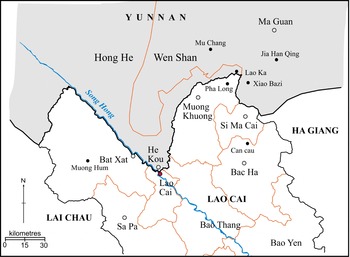
 on a misty, grey day (see Figure 1). We made this trip because in the nearby Si Ma Cai market in Lào Cai province, Vietnam, I had met many traders from Xio Bàz, many of whom were Han Chinese who could speak excellent Hmong. This fact had completely surprised my Hmong research assistant in Vietnam, who had repeatedly exclaimed ‘but Kinh [lowland Vietnamese] people never learn Hmong!’ In Xio Bàz, not quite knowing what to do next as the heavy fog swirled around us, we soon met Wei, a Han Chinese man, who was very curious to know why on earth there were foreigners in his town on such a miserable day, or, indeed, on any day. Wěi had lived in Xio Bàz, about six kilometres from the Vietnam border, all his life, and quickly invited us back to his house on the main street for a chat with him and his friends. A cross-border smuggler for twenty years until 2000, to my surprise he soon started to detail the tricks of the trade. What do people from this town usually take across the border to sell in Vietnam? ‘Oh mainly cigarettes, batteries, matches, textiles, medicine, flashlights, those sorts of things.’ Where would you cross the border and what happens if you’re caught? ‘We crossed at the local checkpoint, and if we were caught [with trade goods] then the police would take our goods and we would try to run like crazy and hide.’ Which market in Vietnam did you go to? ‘Si Ma Cai, my uncle lives there, so that was easiest, and it’s close’. Knowing that there was a large buffalo market in the vicinity of Xio Bàz I asked about the cross-border trade of these precious beasts of burden used by ethnic minorities for ploughing rice and corn fields on both sides of the border. Wěi recalled that, until two years earlier, most of the buffalo trade went from China to Vietnam, but now people from Vietnam, mainly ethnic minorities, brought buffalo to China to sell. This correlated exactly with what Hmong buffalo traders had told me earlier the same week in Cán C
 u market, in Lào Cai province, where one buffalo trader, Lue, had cut short our conversation to head over to China before dusk via a ‘secret route’.
Border markets, border towns, and other locations referred to in this article within the south-west China/northern Vietnam borderlands. Orange lines are district boundaries.

As we spoke, I recognized that Wěi’s story encapsulated many aspects of the notable cross-border trade in this region. Not only is there an important small-scale trade across the China–Vietnam border that has fluctuated over time and through degrees of legality; but individuals of numerous ethnic minority groups, as well as Vietnamese (Kinh) and Han Chinese, undertake such trade for a variety of products, from buffalos to embroidery braid, cardamom to rice seeds. In addition, these borderland residents have relatives, friends, and acquaintances on either side of the borderline and regard the line itself as an artificial separation of their centuries-old trade and social networks.
In pre-colonial times, highland frontier regions across mainland Southeast Asia were often considered buffer zones and it was rare that precise territorial limits were deemed necessary.Footnote 1 In the process of fashioning modern state borders, however, the historic homelands of many ethnic groups in northern Vietnam and south-west China became politically divided. This has resulted in the official separation of kin and long-time neighbours into different, and at times antagonistic, polities.Footnote 2 Both Vietnam and China have since undergone profound transformations through deflecting European colonial advances, revolutionary wars, and socialist rule, while economic liberalization policies in both countries have further transformed the role of the state in the uplands.Footnote 3 In addition, the 1979 border war between China and Vietnam, and the subsequent official border closure, impacted (formal) local population movements and trade for almost a decade. Only in 1988 did both states officially re-open the border, followed soon after by the 1991 normalization of Sino-Vietnamese relations.Footnote 4
For the socialist states of Vietnam and China, national borders are important symbols of state control over territory, people, and trade. While processes of market liberalization and globalization have helped shape trade patterns across borders, they have done little to prove the assertion that we live in a borderless world – far from it in these two cases. Both states have reasserted, time and again, control over their borderlines, albeit with wavering concern over border trade practices.Footnote 5 ‘Borderline citizens’ therefore navigate fluctuations in state power, while also negotiating trade opportunities and kinship ties that go beyond nation-state boundaries.
In the northern Vietnam/south-west China borderlands, these borderline citizens include but are certainly not limited to sizeable ethnic ‘minority’ groups such as the Hmong, who number approximately 800,000 individuals in Vietnam and over 2.5 million in China (where they are categorized within the broader Miao language sub-branch of the Miao-Yao language family).Footnote 6 Also resident in these uplands are members of the Dao group, who number approximately 620,000 in Vietnam and 2.6 million in China, where they are known as Yao. The Tày, who are the most numerous ethnic minority in Vietnam (1.5 million), are grouped under the broader heading of Zhuang in China (over 16 million). At the time of the last census for which data are currently available (1999), the upland ethnic minority populations in the Vietnam provinces that border China were (before Đi n Biên province was created): Lai Châu (488,488), Lào Cai (397,475), Hà Giang (529,551), Cao B
 ng (467, 379), and L
 ng Son (587, 718). In China, the ethnic minority population in Yúnnán in 2000 was approximately 14.3 million, while in Gungxī (Guangxi Zhuang Autonomous Region) the ethnic minority population was approximately 17.5 million. Due to complex histories of migration, trade, peace, and hostilities, this segment of ‘Zomia’ (or the more specifically defined Southeast Asian Massif) is a kaleidoscope of ethnic groups.
In Vietnam to this day, such upland ethnic minorities are not well understood among the lowland Vietnamese majority, often being depicted as ‘backwards’ or ‘lazy’.Footnote 7 These perceptions have been preserved through time, as Kinh lowlanders invest great importance in recollecting and commemorating the past, while only a limited number of minority cultures have indigenous written archives. Differences between upland ethnic minorities and lowland Kinh are essentialized by the state, reflected in present-day development policies.Footnote 8 In China, the standard Han approach has been to consider centre/borderland relations as ‘de haut en bas [top down], with the borderlands being inferior, benighted places, their darkness lit by the distant rays of the brilliant centre’.Footnote 9 People living in China’s borderlands are not only numerical minorities but are considered different, strange, and exotic; less culturally evolved than Han.Footnote 10
In this article, I investigate what the Sino-Vietnamese border means for these borderland residents through a historical and contemporary account of border negotiations and trade. After situating this border in its historical context, my emphasis is on the everyday processes by which local borderland residents deal with this political boundary as they create and diversify their livelihoods.Footnote 11 I attempt to expose the artificial nature of this border, its porosity, and the means by which local residents – ‘borderline citizens’ in both the spatial and metaphorical use of the term – negotiate its being. It becomes clear that for some, both historically and today, the borderline creates opportunities as supply and demand for goods wax and wane in either neighbouring country. For others, the border creates challenges to be negotiated for trade opportunities and officials who need to be avoided. For some younger upland residents in Vietnam, the border has become a rather terrifying linear entity, across which they fear being smuggled and sold.
So how do I engage with debates on Zomia in this article? My aim here is to explore the degree to which borders are artificial divides in these transnational highlands and how local borderland inhabitants negotiate or indeed ignore the borderline between upland northern Vietnam and south-west China to make a living. I argue that their trading-scape is not bound by the political border, relying instead on cross-border cultural links, social relations such as kinship and marriage, cross-border mobility, and economic exchanges.Footnote 12 I therefore agree with Willem van Schendel that we need to move beyond approaches that see the uplands in this region divided by traditional area study approaches that place inhabitants of Vietnam in Southeast Asia studies and their close neighbours in China/East Asia studies. This is nonsensical when studying non-state aligned ethnic groups such as the Hmong/Miao and Dao/Yao in these borderlands. Concurrently I build upon James C. Scott’s arguments that highland residents have circumnavigated state obstacles when necessary to meet with those who demand their goods elsewhere. I demonstrate how, through time, as control over this borderline has fluctuated, local inhabitants have shown great ingenuity and resourcefulness, and have flexed their agency to uphold cross-border trade flows and information exchanges. The zones of movement and trade of local residents are not nation-state bound but must be considered and understood to be part and parcel of a broader social space.Footnote 13 Although the Chinese and Vietnamese states have tightened their control over these borderlands in recent years, I argue that local ways of negotiating such control and upholding cross-border livelihoods are remaining resolute and robust.
In a social space where the dynamics of everyday life are affected by the existence of a borderline, this line fosters highly pragmatic means for local residents to negotiate state policies through overt or covert approaches.Footnote 14 Indeed, perhaps we can go so far as to think of political borderlines as bridges: points of interaction and spheres of interface rather than barriers.Footnote 15 Let us turn to the history of these specific borderlands to find out.
The final stages of the imperial era in Vietnam
There is scant information available on the northern Vietnam uplands, their ethnic minority inhabitants, and their cross-border trade before the late 1800s.Footnote 16 Lowland Vietnamese had relatively limited interest in these upland areas at this time, instead securing their authority over southern territories to assert the country’s independence from China, as well as emphasizing the development of lowland wet-rice agriculture.Footnote 17 Nevertheless, a stable border with China was considered important so as to avoid potential border disputes and the risk of trade disruptions.Footnote 18 Consequently, it appears to be more the political borderline rather than the borderlands in these uplands that concerned the imperial court. Meanwhile, in China, located in a sort of void between more established polities such as the Dai Lue west, the Yi north, the Zhuang east, and the Thái west, those inhabitants living in the borderlands near the Yuan Jiang (Red River) were considered ‘barbarian’ or ‘man’: namely, ethnic minority groups not yet civilized and in need of being brought under the control of the Chinese empire – borderline citizens.Footnote 19
In 1802, Emperor Gia Long, from his political court in Huê, central Vietnam, secured his power over the northern reaches of today’s Vietnam (later to be called Tonkin by the French), while the Emperor’s domain remained in a tributary relationship with China.Footnote 20 The northern Vietnam uplands were under the more direct administration of the Vietnamese Ministry of the Armies (Binh Bô), but it was only those ethnic minority groups living close to the Red River Delta who were heavily controlled and taxed. Those in more remote northern mountainous areas were generally left alone and only occasionally did highland leaders pay tribute to Huê.Footnote 21
Regardless of the Binh Bô, these areas were subject to looting from roaming bands based in Yúnnán and Gungxī, and in the second half of the nineteenth century a number of troops from runaway armies resisting the Chinese state, such as the Black, Yellow, and Red Flags based in southern China, entered Vietnam. The imperial court in Huê initially welcomed such groups, partly because of the court’s concern over French troops arriving in northern Vietnam and the work of French missionaries.Footnote 22 These bands took control over a number of northern Vietnam upland trade routes, but ethnic minorities, except for some of the more established Tai-speaking groups, were seldom targeted, their trade considered insignificant in comparison to the long-haul trade between Yúnnán and the Red River Delta by Han Chinese and Kinh. It has been established that a large number of ethnic minorities, such as Hmong, arrived in Vietnam around the 1860s as members of these bands, settling on unclaimed land.Footnote 23
The French were primarily interested in this upland region because of the potential to reach Yúnnán via the Red River, bypassing treaty ports in Chinese coastal provinces. The rivers that flow from the northern mountain ranges had long been used as trade routes by local inhabitants, sustaining trade between Yúnnán and Guangxī and the Red River Delta. French explorers such as Francis Garnier and Ernest Doudart de Lagrée in the 1860s and Emile Rocher in the 1870s participated in voyages through the region, hopeful of finding new trade routes; however, the Black Flags remained a major obstacle.Footnote 24 Indeed, the Vietnamese court held little control over these upland areas, in part due to a strong distaste on the part of military officers to be based in the highlands. Poisson notes that both the Vietnamese court and, subsequently, French colonial authorities had significant difficulties finding officials to be stationed in such frontier regions; hence local hereditary chiefs were relied upon for border defence and administration.Footnote 25
French colonial rule in the Vietnam uplands
Whether French colonial control can be considered the beginnings of a global–local nexus on the Vietnam–China border depends on how globalization is conceived: as a contemporary process, an era since the 1960s in which global connections have become increasingly possible, or as an ongoing process, consolidated in part by colonial expansion into the developing world.Footnote 26 Regardless of theoretical positioning, what occurred in the highlands during French colonial control resulted not only in the consolidation of the borderline between China and Vietnam, but also in greater control by French colonial forces over commodity production, transportation, and taxation of goods such as opium, with which borderland residents were directly involved.
In August 1883, the Huê government signed the rather harshly worded Harmand treaty with the French, turning Tonkin and Annam into French protectorates.Footnote 27 Chinese opposition, as Vietnam’s overlord, soon led to an undeclared war between France and China, initiated towards the end of 1883. After a number of military successes for the French, the Manzú (Manchu) empress Cíxi Tàihòu (Dowager Cixi) was persuaded to make an agreement. The Tiānjīn (Tientsin) Accord (also known as the Li-Fournier Convention) was signed in May 1884. Directly relevant to this borderland study is the provision that Chinese garrisons in Tonkin would withdraw to the border, and that China would permit the free traffic of goods between northern Vietnam and China to be overseen by a commercial and customs treaty.Footnote 28 This Accord, however, did not outline the timeline for a Chinese withdrawal, leading to troop clashes that, in turn, sparked the outbreak of the Sino-French War in August 1884.Footnote 29 With the signing of a peace treaty nearly a year later, by the end of June 1885 Chinese troops had left Tonkin, along with most of the Black Flags.
It was not until this colonial period that the border was tightly delineated, even though early definitions of the approximate China–Vietnam border can be traced back to 240 CE.Footnote 30 In 1887, Chinese and French authorities concluded the Sino-French Convention on the Delimitation of the Frontier, followed in 1895 by the signing of the Supplement to the Convention. In accordance with these documents, over 300 border markers were erected.Footnote 31 In the late 1890s, the construction of the railway from H i Phòng through Lào Cai to Kūnmíng, completed in 1910, sped up the arrival of French and Kinh in the northern highland region. However, even under French control a posting to these borderlands was still considered something of a punishment for colonial officers, as well as for Vietnamese officials under their command.Footnote 32 By 1924, the French officer Maurice Abadie described the borderline as ‘purely conventional. On both sides of this border are regions offering the same physical characteristics and on which tribes are settled that are in all respects identical’, highlighting how this sharp political division had sliced through a broader social and ethnic space.Footnote 33
What, then, were the everyday practices of making do in these borderlands at the start of the twentieth century for local residents? Colonial archival military reports can provide some insight, otherwise difficult to access nowadays via oral histories with elderly upland residents. During the colonial era, what is today’s Lào Cai province in Vietnam was roughly equal to the 4th Territoire militaire or 4th military territory of Tonkin. This was a specific form of military administration of border territory used throughout the Sino-Lao-Vietnamese borderlands, officially promulgated in 1891 and implemented in the following years.Footnote 34 Within this territory, the borderlands in the M ng Kh
 ng area to the east of the Red River (see Figure 1), were effectively ruled by the French military from 1893.Footnote 35 An 1898 military report from that sector reveals much about the colonial borderlands, their inhabitants, their relationships with other ethnic groups, and cross-border trade. The establishment of a French colonial military station near the present-day town of Mng Khng was accepted by local ethnic minority inhabitants, but, further to the north, in the Pha Long region, a band of Chinese remained in operation, at times plundering local villages.Footnote 36 From 1894 to 1895 the region was reported to be relatively quiet, but Chinese ‘bands’ still held power in some valleys near Pha Long and in the town itself. By November 1895 the French had succeeded in taking over Pha Long and started to build a military station there, and by 1897 local inhabitants who had fled to China because of such battles were returning to their villages on the Vietnamese side of the border.
In Bát Xát, to the west of the Red River, the situation concerning cross-border banditry appears to have been very similar, with incursions of gangs from China being suppressed periodically by the French military stationed in the area. Ethnic minority residents were certainly considered untrustworthy ‘borderline citizens’ by French officials, as noted in an 1898 military report of the Bát Xát region, quoting a previous report:
For the most part, the inhabitants have a sense of freedom that they would not hesitate to pass on to China if we were to take anything from them – either by making them take part in coolie duty, or by making them buy essential items from us; we must therefore let this region be in its own way, and simply require the maintenance of the road used by the reconnaissance (December 11–20 1888).Footnote 37
In French military discussions the border was of prime importance. For example, in Mng Khng sector, the route from present-day Pha Long in Vietnam over the border to the Chinese border town of Lo K was a priority, along with the upland–lowland route from Pha Long through Mng Khng to Lào Cai, the main artery for people and goods to and from the lowlands.Footnote 38 In Yúnnán at this time, the prefecture bordering Lào Cai was called Kai-Hoa by the French, which in turn was subdivided into sub-prefectures, districts, and cantons, and local inhabitants were taxed according to this geographical hierarchy. The cross-border Pha Long–Lo K route is described as being very busy and ‘destined for a great future if, as predicted, our transactions with China increase in importance’.Footnote 39 We will return to this route when discussing current day textile trader border crossings.
During this early French colonial period in the northern Vietnamese highlands, local cross-border trade was substantial. French military records list China-sourced horseshoes, nails, women’s silver jewellery (as well as raw materials for ethnic minorities to make their own jewellery, such as iron and silver), wire, needles, and medicine. Heading towards China in return were items such as salt from Vietnam’s coastal regions, a commodity priced 50% higher as soon as it crossed the border, where it was taxed at the Chinese customs station of Ho-Khéou (modern Hé Kǒu). In highland marketplaces, salt was traded for money (French colonial piastres) or opium, as well as being smuggled across the border: ‘the smuggling of salt is practised fairly easily since the Chinese customs officers are willing to encourage it in order to increase their resources’.Footnote 40 A trade in Fokienia hodginsii (Fujian cypress) from Vietnam also existed. This highly sought-after, rot-resistant wood, was a commodity used in China and upland Vietnam to make coffins. A quarter of a century later, Colonel Abadie would also note that Chinese border populations ‘pay a high price’ for this commodity.Footnote 41
In the late 1880s, Vietnam border markets were well attended by traders from China, and the circular trade routes that highland ethnic minority residents talk of today among a number of upland markets in both Vietnam and China were already in place. At that time, in Vietnam borderland markets such as Bát Xát, Mng Khng, and Pha Long, ethnic minorities displayed poultry, eggs, fruit, and rice wine to sell or barter with inhabitants crossing from Yúnnán, in return for the manufactured goods already listed. Transport across the border was on foot, often with the help of small packhorses.Footnote 42 There was also an important cross-border trade in pigs that Chinese traders purchased for breeding from ethnic minorities in Vietnam; these traders further benefited from ‘frequent relations with the inhabitants to make large purchases of chicken, and to buy most of the planks for coffins made by the Méos of Muong-Hum and Trinh-Thuong’.Footnote 43
At this time, official, local-level, cross-border relations in both the east and west of the 4th Territoire militaire were reported to be friendly, with French documents noting that ‘relations with Chinese border authorities are very cordial and frequent visits are often exchanged’.Footnote 44 In Bát Xát sector, the border crossing was seen by the French military to play an important political role, being ‘well positioned to allow its commander to maintain cordial relations with our neighbours’.Footnote 45
In 1924, the French colonel Maurice Abadie wrote more generally of northern Vietnam highland trade that ‘Chinese peddlers and merchants frequently make up caravans of pack-saddle horses for transporting their merchandise: salt, opium, medicinal plants, rice, maize, European products, and so forth’.Footnote 46 Elderly Hmong in Vietnam who can remember the French colonial presence in the uplands have also recalled that this period was one in which movement across the border was relatively easy, with those living in Vietnam able to visit family members in China. Interviews with elderly Kinh residents in Sa Pa town, Lào Cai province, have also disclosed that Chinese goods were readily available in the town in two shops owned by Chinese merchants until 1945/46, with people frequently moving across the border for trade.Footnote 47 By the outbreak of the First Indochina War in 1946, the Vietnam–Yúnnán uplands had clearly been a cohesive trading-scape for generations.
The First Indochina War (1946–54)
The First Indochina War between French colonial forces and nationalist and communist forces in Vietnam, Laos, and Cambodia broke out in late 1946.Footnote 48 Goscha, in his review of trade relationships with China between 1945 and 1950 – the initial years of the Democratic Republic of Vietnam (DRV) and, from 1949, of the People’s Republic of China – describes the establishment by the DRV of a Bureau of External Trade (BET) in February 1947 to oversee foreign commerce.Footnote 49 This Bureau operated mainly in the north of Tonkin, in Cao Bng province, opposite Gungxī, but also had agencies in Lào Cai further to the west. It relied heavily on Chinese traders crossing the border and ancient Chinese trade routes, and Goscha notes that ‘the BET’s main purchases included military garments, petroleum products, medicines, explosives, arms, and powders. In exchange, it exported opium, gold, tin, wolfram, and possibly a little rice’.Footnote 50 It is unclear how much of this trade occurred across the north-west highland border, though much of the opium would have come from this region.
The French colonial forces in Tonkin were well aware of the importance to the DRV of these trade passages. By late 1947, they had worked to secure control of the main trade routes along the northern border, although clandestine trade persisted for goods such as opium, medicine, and chemicals. As the First Indochina War continued, in 1950 the People’s Republic of China became the first country to recognize the DRV, and China became a major supplier of military and economic aid for the DRV’s activities against the French.Footnote 51 China actively assisted the DRV during a border campaign in the summer and autumn of 1950, with the aim of driving out French forces who occupied the border areas in northern Vietnam. The border with China was then officially re-opened, trade was encouraged, and the DRV reduced taxes that the French had established.Footnote 52 These trade relations were formalized by the signing of a trade protocol in 1952, furthered by a ‘Protocol on small-scale border trade’ signed in 1954. The latter established trade offices in China’s border counties and Vietnam’s border provinces.
Elderly ethnic minority interviewees in northern Vietnam recalled that, during the war against the French, they continued to have free access across the border using mountain routes, Vietnam’s state forces being far more concerned with the French threat than with small-scale cross-border trade. Hmong interviewees suggested that ‘the Chinese welcomed people from Vietnam because the Chinese and the Vietnamese worked together to defeat the French’.Footnote 53
The Second Indochina War (1955–75)Footnote 54
During the Second Indochina War, leaders from China and Vietnam agreed to respect the borderline shaped during the French colonial period in Vietnam, albeit with minor, local differences of opinion over specific locations.Footnote 55 From 1954 to 1960, dedicated local border markets for small-scale trade were established. However, Womack notes that these withered in size during the 1960s.Footnote 56 Chinese traders were allowed to travel up to ten kilometres within Vietnam and to purchase up to 30 rénmínbì worth of goods during each visit. Kuah Khun Eng notes that this trade was primarily to overcome local shortages and to sell other agricultural surpluses.Footnote 57 However, larger-scale trade of manufactured goods to Vietnam and raw materials to China also occurred, as the result of both a lack of border control and corrupt officials.
During this period, much as during the First Indochina War, the Vietnamese state was far more concerned with fighting in the lowlands than with Vietnam–China border trade by local residents. A Vietnamese official interviewed by Schoenberger at the Mng Khng border crossing noted that, during this period, ‘there were no procedures to cross the border because the state did not have the resources to control the border seriously’.Footnote 58
The Sino-Vietnamese War (1979–89)
Not long after the end of the Second Indochina War, the border between Vietnam and China became the venue for a conflict rooted in, among other causes, China’s displeasure over Vietnam’s invasion of Cambodia to uproot the Khmer Rouge regime, Vietnam’s treatment of Chinese nationals within Vietnam, and soured relations due to Vietnam’s leanings towards the Soviet Union for political and military direction.Footnote 59 Local border incidents began to occur along the Sino-Vietnamese border and, by 1978, tensions had risen such that both sides began to militarize the border.Footnote 60 It became heavily land-mined, so much so that a local Chinese official declared that the border was ‘the world’s largest minefield, with the largest number of mines, greatest variety of mines, in the most diverse topography’.Footnote 61 Opportunities for redrawing the border at this time were not overlooked and Nguyen Manh Hung reports that, leading up to and during the Sino-Vietnamese war, Chinese and Vietnamese often attempted to shift the large stone pillars that had marked the borderline for nearly a century.Footnote 62
On 17 February 1979, Chinese troops crossed into Vietnam at twenty-six different points, resulting in notable local devastation. In the highlands, the main thrust of Chinese force was focused on Lào Cai town, in Lào Cai province, and Dông Dang, in Lng Son province. Although Vietnamese resistance was stronger than Chinese forces had anticipated, after renewed efforts the Chinese penetrated forty kilometres into Vietnam, and much infrastructure and housing were destroyed.Footnote 63
The main thrust of the war, brief but intense, dramatically altered the ability of local residents to move across the borderline. Cross-border trade was considerably reduced and ‘the hostile relationship between the two countries prevented all but the most furtive and small-scale border activities’.Footnote 64 Elderly borderland ethnic minority residents have explained that this period was marked by hunger and poverty in northern Vietnam. Families reverted to subsistence means, including turning to the forest for food such as roots, mushrooms, and insects, as well as for shelter from the military presence in the region.Footnote 65 Concurrently, elderly Kinh residents have recounted how the majority of Kinh residents from Sa Pa town walked for five to six days to Yên Bái, south of Lào Cai province, to evade Chinese forces, staying there for nearly two months before it was considered safe enough to return home.Footnote 66
By the mid 1980s, Chinese shelling across the border had become ritualized and then slowly diminished. Ethnic minority individuals on either side began to cross the border again in order to purchase goods and to visit relatives, often on ‘secret paths’ at night.Footnote 67 Womack similarly notes that, during this period, ‘trade gradually began to re-emerge, with goods carried along small paths snaking through the minefields by the minority groups living on both sides of the border’.Footnote 68
Đi Mi (1986–) and normalization of Sino-Vietnamese relations (1991)


Eight years after China began its economic liberalization initiated by Deng Xiaoping, the 6th Congress of the Vietnamese Communist Party officially introduced Đ i M
 i (economic renovation) in December 1986, sanctioning a shift from a centrally planned to a more market-orientated economic system. In November 1988, the Vietnam state issued ‘Directive no. 118, on border trade between Vietnam and China’, which officially reopened the northern regions to border trade with China. Crossings were permitted in both directions for those living in villages directly adjoining the frontier, so that they could visit relatives and exchange goods with a relatively simple registration process.Footnote 69 Trade boomed and imports to Vietnam began to shift from daily necessities to consumer items and manufactured goods of higher quality. To China went food, forest products, and raw materials. While tariffs were limited at this time, they were an important source of revenue for local authorities in border areas.
In 1991, Vietnam–China relations were normalized, and during 1991–92 new border-trade policies were adopted in Vietnam to strengthen regulations over border trade. These saw such trade incorporated into national trade policy as a whole, and regulations developed for the management of borderland marketplaces.Footnote 70 China responded with its own policies aimed at improving cross-border trade, and by 1992 had opened fifty-six border towns in Yúnnán and Gungxī provinces to cross-border trading and social interactions.Footnote 71 Between Yúnnán and Lào Cai, a permit system was introduced for residents on both sides of the border, and an important cross-border trade re-emerged among highland ethnic minority populations. This was not encroached upon by Kinh and Han traders, who preferred to focus on using the Lào Cai city–Hékǒu border crossing on the Red River, where trade was soon growing exponentially.
In Vietnam, the relaxation of border restrictions led to a flood of Chinese consumer goods into the country, so much so that the Vietnamese state, concerned about uneven trade balances, tried to impose a ban on specific goods during 1992–93, a move soon found to be ineffective.Footnote 72 Regardless, the state still encouraged border trade as a whole, and preferential policies were established in certain border areas, including reduced land-use taxes, a tax holiday for new enterprises, relaxed entry and departure regulations for foreigners, and the reservation of 50% of revenue to be reinvested in local areas. In 1998, this policy was extended to include Lào Cai province.Footnote 73
By 1996 Chinese officials had decided that more specific guidelines were again required and the State Council issued the ‘Circular of the State Council regarding relevant issues on frontier trade’, including details on trade for ‘inhabitants of border areas, trade in small volume, and economic cooperation with foreign countries’.Footnote 74 Provincial, district, and country-level governments in China could now determine their own border policies, many of which favoured preferential policies to help develop borderland trade.
At the very end of the decade, on 30 December 1999, Chinese and Vietnamese officials signed a border agreement to settle unresolved border issues, yet the precise location of many border markers remained uncertain. Nine years later, on 31 December 2008, a final agreement was reached on the exact positioning of the borderline, albeit with disquiet in Vietnam, where some individuals suggested that the agreement had been rushed and that perhaps their government had made too many concessions.Footnote 75 In early 2009, the instalment of 1,971 border monuments demarcating the 1,347-kilometre China–Vietnam border was officially celebrated.
As this overview has shown, a dense web of social and trade relationships has existed within these borderlands for generations, even if, as in much of Zomia, they were considered remote and under-populated in comparison with the lowlands surrounding them. An important segment of this trade takes place in relatively isolated areas and is short haul; while it is formally deemed international in character, often the individual traders concerned live only a few kilometres from each other, trading local goods along small, mountainous paths. When hostilities between these two neighbouring countries cut off recognized trade routes at specific times, they often also resulted in the opening of other, informal ones, a capillary network of sorts, needed to maintain the flow of goods and to keep people alive. Indeed, particular local cross-border connections may be completely indifferent to national-level political contestations, especially if trade is carried out among kin and close social contacts. In this respect, I now examine a range of commodities that have been traded across the more remote sections of the Lào Cai–Yúnnán border for decades by local residents (predominantly ethnic minority traders), the causes behind their cross-border trade and the border narratives that these encapsulate.
Present-day cross-border livelihoods: narratives of opportunity and challenge
Nowadays, Lào Cai province in Vietnam, and its much larger neighbouring Chinese province, Yúnnán, share 203 kilometres of border. Infrastructure development is booming on either side as local governments seek to encourage both international trade and cross-border tourism. While large-scale and long-haul trade between China and Vietnam dwarfs local, small-scale, more remote cross-border trade, the latter remains of central importance to the livelihoods of tens of thousands of local residents. These residents trade in lively periodic marketplaces that have played an important role in maintaining socioeconomic exchange among these populations throughout history.Footnote 76
Today, the Vietnam state has a three-tier border crossing classification for the Sino-Vietnamese border.Footnote 77 At the top of the hierarchy are the international crossings, of which there are four in total, one being in Lào Cai province at the Lào Cai city–Hékǒu crossing on the Red River. Here, third-country nationals may cross with a passport and visa, as well as Vietnamese and Chinese residents with a passport or permit. This crossing is seldom used by upland ethnic minorities, who do not normally reside and work in the provincial capital. Second are national-level or ‘principal’ crossings, of which there is at least one, Mng Khng, in Lào Cai province. Any Chinese and Vietnamese citizen can pass here with a passport or a permit. For third-tier or ‘auxiliary’ (c a kh
 u ph
 ) border crossings, it is extraordinarily difficult to obtain precise official figures, despite the best efforts of Vietnamese and Chinese research colleagues. It is at these crossings, all located in relatively remote sections of the border such as Pha Long (Vietnam)–Lo K (China), and Si Ma Cai (Vietnam)–Xio Bàz (China), that borderland residents, and they alone, are allowed to cross with a permit.Footnote 78 Interviews with local traders revealed that the fees required to cross at third-level crossings were around VND5,500 (US$0.30) per crossing in 2009, and that there is significant flexibility in how border regulations are implemented. Enforcement fluctuates in relation to which officials are on duty, whether it is a local market day or not, and changes in the broader political climate.
On the other side, Chinese documents list four contemporary border-crossing categories: first, foreign economic and technical cooperation in the border region; second, border crossings purchased through tours; third, small-scale border trade;Footnote 79 and fourth, those undertaken by border residents. The last of these categories relates directly to local residents crossing the border for small-scale trade and to visit relatives, or ‘trade by those living within twenty kilometres of the border, in government-approved border crossings or designated bazaars, not to exceed officially regulated values and quantities’.Footnote 80 Small-scale traders whom I interviewed – such as Píng, a Han Chinese woman selling textiles – matched this last category and confirmed that they needed a permit issued for six months to cross the border. This permit allowed Píng to visit border markets in Vietnam such as Cán Cu and Si Ma Cai, but only for two market days a week. She noted that, if she tried to cross on another day, the border officials ‘will catch you’.Footnote 81
Textile traders
Let us look in more detail at the trade in which Píng is involved. Hmong women in parts of upland Vietnam grow hemp for their clothing.Footnote 82 They plant the hemp seeds, harvest the crop, and then prepare, spin, and weave the fabric, before dying it with indigo that they also grow. The cloth is then embroidered with intricate, stylized designs that tell a person’s family history, and/or are evocative of objects, animals, and plants that are significant to Hmong daily life. In Yúnnán, by comparison, there is very little hemp grown nowadays by Hmong, primarily because of a government misconception that hemp grown for fabric is the same plant used for recreational and medicinal drugs.Footnote 83 The local governments of Hónghé Hānízú Yízú Autonomous Prefecture (Honghe Hani and Yi Ethnic Minorities Autonomous Prefecture) and Wénshān Zhuàngzú Miáozú Autonomous Prefecture (Wenshan Zhuang and Miao Autonomous Prefecture) are trying to eradicate hemp, especially along major transportation routes.Footnote 84 There was vocal opposition to this among local Hmong interviewed in Wénshān.Footnote 85
In part as the result of this ban, but also because of different access to technology and commodities, there is a vibrant two-way trade of Hmong textiles across the Yúnnán–Lào Cai border (and far further afield across these highlands). Travelling to Yúnnán are pre-worn customary hemp textiles, often in the shape of carefully embroidered, pleated Hmong skirts. Interviews with textile traders in M Guān and Wénshān cities in Yúnnán revealed that these are then sold to traders in other parts of Yúnnán, who often have US connections, and ultimately reach overseas ‘cultural textile’ markets. In the other direction, travelling to Vietnam are ‘look-alike’ synthetic Hmong skirts now manufactured in China, in part due to the increasing pressure to ban hemp and the demand for lighter skirts for everyday wear. Also traded to Vietnam are manufactured braids and synthetic threads now used in Hmong, Yao, and other ethnic minority embroidery in both countries. To date it appears to be Hmong residents from China and Vietnam as well as Han Chinese such as Píng who are involved in these trades, with Kinh far less so. In Vietnam, the braids and threads are now incorporated into cultural textile products such as refabricated hats, jackets, and bags that have become part of a widespread, global trade network since international tourism began again in 1993.Footnote 86
A number of Han Chinese textile traders living in Xio Bàz, in the borderlands of Wénshān prefecture, have learned excellent Hmong and now trade across the borderline on a weekly basis, visiting one or two periodic markets in Vietnam with a selection of commercially made fabrics, braids, and threads, as well as other items such as batteries and even pesticides, the latter being kept well out of the view of government officials. For instance, Míng, a male Han Chinese trader interviewed in Cán Cu market, Vietnam, visited Cán Cu and Si Ma Cai markets each week, one of fifteen Chinese Han traders operating as such. Píng, selling in the same market, stated that most of them had been doing so for at least twenty years. She and her fellow cross-border traders generally purchased goods from their home town of Xio Bàz and, on occasion, from M Guān nd Wénshān cities. Píng even mentioned intermittent travel to Kūnmíng for manufactured skirts – the most beautiful, in her mind.Footnote 87 When asked why she took the trouble to cross the border to sell in Vietnam instead of in China, Píng explained that, for the moment, there was greater demand for the manufactured textiles and goods in Vietnam. It was therefore worth her while to trade there when farming duties back home permitted.
Concurrently, three Hmong women from Vietnam, also interviewed in Cán Cu market, travelled to Xiao Bàzi to purchase manufactured textile goods to resell in Vietnam. A further three Hmong women interviewed in Si Ma Cai market explained that for more than twenty years they have intermittently crossed to the nearby Lo K market in China to purchase goods. This is the very same market noted in French 1898 archival material analysed earlier as having potential to grow in importance. Traders use these local, third-level crossings to make these passages, with crossing permit booklets stamped each time they cross the borderline. Alternatively, the Mng Khng national/second-level crossing is used to reach other local border markets in China.
Buffalo traders
More so than textiles, buffalo are central to Hmong and Yao livelihoods. They are used to plough fields (required twice during rice-field preparation), and they fulfil important ceremonial roles: for instance, being sacrificed at the death of a Hmong elder, or during Hmong New Year for wealthier families (those with more rice fields and buffalo). They are, indeed, important financial capital, also sold – reluctantly – if a large sum of money is suddenly needed, such as in the case of a family illness or wedding. Bao, a young Hmong woman in Vietnam whom I interviewed, highlighted their importance by noting that ‘a buffalo is more important than a motorbike’, a reference to buffalo having core practical and commercial, as well as ritual, value.
There is a regular trade of buffalo across the Vietnam–China border, occurring in both directions. Sometimes this takes place via legal routes and the buffalo are inspected at the border for health problems and disease; other traders, such as Lue, introduced at the beginning of the article, use ‘secret routes’ to smuggle buffalo across without permits. In China there are a number of specific, periodic livestock markets in the borderlands. For example, Jiá Hán Qìng market, in Wénshān Zhuàngzú Miáozú Autonomous Prefecture, about thirty kilometres from the border, has been in operation for at least thirty years, according to local residents. In contrast, in Vietnam, buffalo markets tend to be part of larger, periodic markets selling a range of products.
Interestingly, both differing climatic regions and notions of the strength of buffalo from different locales have resulted in a concurrent demand for buffalo across this border. Wěi, the former Han Chinese cross-border trader and long-time borderland resident whom we met earlier, noted that local demand in China for Vietnamese buffalo was high. He and his friends explained that Vietnam-raised buffalo are considered stronger and generally healthier than those raised in Yúnnán, hence the keen demand. In the other direction, Tāo, a Han Chinese buffalo trader at Jiá Hán Qìng livestock market, noted that there were regularly twenty to thirty ethnic minority traders from Vietnam, of whom he could identify Hmong, Nung, Tày, and Yi minorities,Footnote 88 coming to purchase buffalo and return with them to Vietnam, a demand caused by the harsh 2008 winter when a large number of buffalo died in the Vietnam uplands.
Although it is difficult to compare prices for buffalo, because of a number of variables including age, gender, and health – the condition of teeth and skin being particularly important for Hmong traders – it appears that this cross-border demand occurs in spite of absolute prices being relatively similar. What is important in this case, therefore, are other specificities: Vietnam-bred buffalo are valued in China for their strength and ability to work hard in the fields; while China-bred buffalo are in demand across the border because of absolute shortages in Vietnam. In this case, differing climatic conditions near the border, as well as different indigenous knowledges, have resulted in a two-way border trade of these animals, benefiting traders on both sides. It is not the borderline per se that creates these trader benefits but the culturally rooted, everyday understandings of livelihood decision-making among different upland residents, who then negotiate the borderline in the way that they best see fit, be it overtly or covertly, to meet and trade.
Other small-scale trade across the border
A multitude of other products also cross the border at second- and third-level crossings, predominantly in the hands of ethnic minority traders. Moving from China to local periodic markets in Vietnam, such commodities include, but are not limited to, small amounts of medicines, Chinese high-yield varieties (HYVs) of rice seed, pesticides, batteries, fabric dyes, and canvas shoes; in the opposite direction travel non-timber forest products including cardamom pods and dried mushrooms, rice and maize alcohol, and maize.
Vietnam-based Hmong, Yao, and Nung frequently cross the border to buy small quantities of rice seed in Chinese border markets such as Xio Bàz, Lo K and Mù Chng. The seeds are cheaper and more readily available in China for those who want to plant outside the Vietnam government’s sanctioned delivery periods of state-sponsored rice.Footnote 89 Rice seed is also brought into Vietnam by Chinese-based Hmong traders, who sell it in border markets such as Mng Khng.Footnote 90 Because these goods are traded by highlanders who are crossing at second- and third-level crossings, where no buses or trucks are permitted to cross, they are transported in fairly small quantities in baskets or by pack horses.
At the same time, maize alcohol and kernels are often bought by Han Chinese and Hmong living in China, who cross into Vietnam and then transport the goods back to China. According to maize-alcohol traders in Si Ma Cai market, the Vietnam government is trying to stop the export of maize in this fashion, and hence traders from China will go directly to Hmong villages, rather than marketplaces, to source maize that they use for pig feed. While, in the past, the pigs would then be sold back in Vietnam, this appears to have also been officially restrained during recent years, owing to concerns over disease.
Medicinal cardamom is another notable cross-border trade and there is a lively trade of cardamom grown by Hmong and Yao uplanders in Vietnam upland provinces to wholesalers in China. The demand for this popular spice has dramatically increased in China in recent years because of environmental conditions resulting in poor harvests. Cardamom is taken into China either by ethnic minorities across local border crossings or, more frequently, by Kinh intermediaries via Lào Cai city crossing.
One very alarming trade is that of young Hmong and Yao women, kidnapped, smuggled, and traded across this border and then often sold as wives to Han Chinese men residing in these borderlands. While Vietnam police are aware of these activities, it appeared in 2009 that they had very little power to intervene, owing to the very nature of cross-border jurisdictions. Hmong and Yao parents and young women in Lào Cai are alert to these operations and are modifying their behaviour to incorporate precautions. While on rare occasions a kidnapped young woman has been able to escape back across the border, to date the majority are not heard of again by their parents, causing considerable distress in local ethnic minority communities. The ability of upland residents to find ways around officially sanctioned border-crossing routes are clearly not always as benign as the ‘secret routes’ of buffalo traders.
State directives and flexible borderland trading-scapes
So what can be the relevance of these micro-scale trading narratives to the broader themes discussed in this special issue of a journal focused on global subjects? It is clear that residents of the borderlands depicted here have borne witness, over the centuries, to a diversity of border control intensities and strategies. Borderline control has fluctuated throughout history and it is certain that globalization has not necessarily resulted in more open borders between these two countries. Nowadays we see a diversification of borderland livelihoods, as well as the increasing integration of ethnic minorities into state-building directives on both sides of the border. Indeed, the state is clearly present in the contemporary Sino-Vietnamese borderlands. As James C. Scott notes, and Bernard Formoso also highlights in this issue, since the end of the Second World War ‘the power of the state to deploy distance-demolishing technologies has changed the strategic balance of power between self-governing hill peoples and nation-states’.Footnote 91 A number of regional development programmes are now under way to develop the Kūnmíng–Lào Cai–Hà N i–Hi Phòng economic corridor, as well as a push for integration of these uplands into the Greater Mekong Sub-region.Footnote 92 From Kūnmíng to Hà N
 i, new high-speed train routes are being built and highways upgraded. Telecommunications advances, including widespread cell-phone coverage and greater availability of technology, have also added to the time–space compression increasingly possible in this region. This extension of the state’s control and power over the uplands – Foucault’s panopticon coming into play – is occurring after centuries of highland residents often carefully avoiding such a gaze.
The Sino-Vietnamese borderline itself is now a precise sliver of state control directly and centrally affixed in these uplands, while the borderlands, too, are becoming increasingly encased. This small section of Zomia is no longer necessarily a ‘zone of refuge’ but one where local inhabitants are progressively having to negotiate and at times outmanoeuvre state control. Yet, despite the best intentions of the state to reduce the ‘friction of distance’, these borderline citizens still live and trade in a remote upland mountainous terrain, where travelling between villages or marketplaces can be an arduous, slow, and often physically dangerous process. Given these conditions, it is frequently more efficient for local residents of the borderlands to trade with each other across the borderline than to negotiate with traders from other parts of their respective countries.
Nevertheless, the impact of a political borderline to borderland livelihoods cannot be ignored. In subtle ways, not only are local inhabitants negotiating this borderline but state directives are having direct and indirect impacts on local decision-making. Changes in demand spurred by differing state policies and programmes in both countries – tied either to the borderline itself or to other regulatory domains – create new openings for contemporary traders. Broader state policies that, at first glance, have nothing to do with cross-border trade make an impact on the opportunities and constraints for this trade. For example, rice seed is imported by local ethnic minorities in Vietnam wanting to circumnavigate the Vietnam state-distribution system for seeds because of incompatibility with specific climatic conditions and the unreliability of distribution scheduling and quantities. Likewise, Chinese state pressure for local Hmong to reduce hemp production has led to the manufacture of new, synthetic, Hmong-style clothes that are finding a new niche demand over the border. Other demands have no political connections, rooted instead in topographic and climatic variations, and local cultural understandings of livestock quality. In turn, such differences have led to cross-border trade opportunities that at times seem at odds with economic rationale, such as a vibrant concurrent, cross-border buffalo demand on either side.
Conclusion
In sum, borderland residents are continuing to flex their agency in the face of state-making projects. As Formoso notes in this special issue, there is still a dominant imagery in this region of ‘backward’ hill tribes living entrenched in remote locales, constrained by ancient traditions.Footnote 93 Unamenable to change and progress, they are frequently seen as the passive recipients of political logics that escape their common understanding. In contrast, this article has shown that borderline citizens are anything but unamenable to change or passive recipients. Thus, even though Scott in The art of not being governed suggests that being able to retreat to such a zone of refuge was only really an option for upland inhabitants of Zomia prior to the 1950s and that the region’s nation-states have since brought the final enclosure into view, I would argue that a number of contemporary small-scale cross-border traders have continued to avoid the intensity of the state’s gaze. Local cross-border traders work via minor crossings, smuggling goods if necessary, to surreptitiously take advantage of the Chinese and Vietnamese states’ lack of interest in such small-scale livelihood means, while these states simultaneously plough ahead with their own visions of modernization.