Pharyngitis is a common reason for outpatient antibiotic prescribing in the United States.Reference Fleming-Dutra, Hersh and Shapiro1,Reference Linder, Bates, Lee and Finkelstein2 With few exceptions, antibiotics should be prescribed for pharyngitis only after confirmation of group A Streptococcus (GAS) by laboratory testing.Reference Shulman, Bisno and Clegg3 Because rapid antigen-detection tests (RADTs) have a specificity >95% but a sensitivity that is often <90% compared to throat cultures, national guidelines recommend performing cultures when RADTs are negative in children, but not in adults.Reference Shulman, Bisno and Clegg3,Reference Cohen, Bertille, Cohen and Chalumeau4 Inappropriate antibiotic prescribing for pharyngitis occurs when antibiotics are prescribed without testing or when antibiotics other than narrow-spectrum penicillins are chosen for nonallergic patients.Reference Shulman, Bisno and Clegg3,5 Because the prevalence of GAS among cases of pharyngitis is estimated to be 20%–30% in children and 5%–15% in adults, prescription rates higher than these thresholds suggest overuse.Reference Fleming-Dutra, Hersh and Shapiro1,Reference Shulman, Bisno and Clegg3 Appropriate laboratory testing for pharyngitis in patients who are prescribed antibiotics is a Healthcare Effectiveness Data and Information Set (HEDIS) performance measure in children, and it will expand in 2020 to include adults.5 Our objectives in this study were to describe use of laboratory testing and antibiotic prescribing for GAS in the United States.
Methods
We performed a cross-sectional analysis of data from the 2014–2016 National Ambulatory Medical Care surveys, annual surveys of visits to office-based physicians conducted by the National Center for Health Statistics.6 Data included tests performed (test results not available), diagnoses using International Classification of Diseases, Ninth and Tenth Revisions, Clinical Modification (ICD-9-CM and ICD-10-CM) codes, and medications. National estimates were generated by applying visit weights to the multistage probability sample.
We included visits by children (aged 3–17 years) and adults (aged ≥18 years) with acute pharyngitis, streptococcal sore throat, or acute tonsillitis (ICD-9-CM codes 462–463, 034 and ICD-10-CM codes J02–J03). Laboratory tests included RADTs and throat cultures. In analyses of antibiotic prescribing, we excluded visits with additional diagnoses potentially warranting antibiotics (eg, urinary tract infection or pneumonia).Reference Fleming-Dutra, Hersh and Shapiro1 Recommended antibiotics included narrow-spectrum penicillins.Reference Shulman, Bisno and Clegg3 Antibiotics were identified using Multum Lexicon therapeutic class and generic drug codes.
The main outcomes were (1) the proportions of visits for pharyngitis in which laboratory tests were performed (overall and among visits with antibiotics prescribed); (2) the proportion of visits in which an antibiotic prescription was not associated with performance of a laboratory test; and (3) the proportion of antibiotic prescriptions that were in the recommended category. Estimates and 95% confidence intervals (CIs) accounted for the complex survey design. We compared proportions between groups using χ2 tests. We used Stata version 14 software (StataCorp, College Station, TX) for all analyses.
Results
Patients
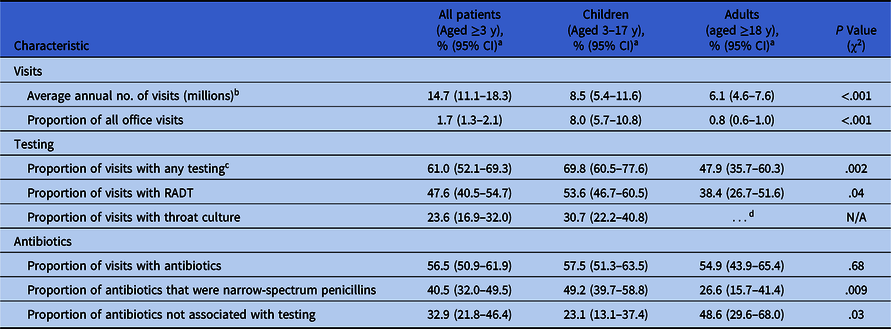
Table 1 shows rates of visits, testing, and antibiotic prescribing for pharyngitis. Laboratory tests were performed in 61.0% (95% CI, 52.1–69.3) of the 14.7 million (95% CI, 11.1–18.3 million) visits per year for pharyngitis. Antibiotics were prescribed in 56.5% (95% CI, 50.9–61.9) of visits, including in 47.8% (95% CI, 37.4–58.3) of visits without testing and 62.1% (95% CI, 55.0–68.7) of visits with testing. Among visits in which antibiotics were prescribed, 32.9% (95% CI, 21.8–46.4) were not associated with a laboratory test. Recommended antibiotics comprised 40.5% (95% CI, 32.0–49.5) of all antibiotics. Macrolides were the most commonly prescribed nonrecommended antibiotics (27.0% of antibiotics; 95% CI, 17.6–39.0).
Rates of Visits, Antibiotic Prescribing, and Performance of Laboratory Testing for Pharyngitis, by Age Group, 2014–2016

Note. CI, confidence interval; RADT, rapid antigen detection test; N/A, not applicable.
a Unless otherwise specified.
b Pharyngitis was diagnosed in 68.8% of visits, tonsillitis in 18.1% of visits, and streptococcal pharyngitis/tonsillitis in 18.9% of visits. The sum of these percentages exceeds 100% due to multiple diagnoses at some visits.
c Because RADT and throat culture may have been performed in the same visit, the sum of the proportion of visits with RADT and the proportion of visits with throat culture exceeds the proportion of visits with any testing.
d … indicates that estimate is unreliable because it is based on <30 observations and/or has a relative standard error >30%.
Children versus adults
Laboratory tests were performed more often in children (69.8% of visits; 95% CI, 60.5–77.6) than adults (47.9%; 95% CI, 35.7–60.3; P = .002). We detected no difference in the proportion of visits in which antibiotics were prescribed for children (57.5%; 95% CI, 51.3–63.5) compared with adults (54.9%; 95% CI, 43.9–65.4; P = .68). However, among visits in which antibiotics were prescribed, narrow-spectrum penicillins were prescribed more frequently for children (49.2%; 95% CI, 39.7–58.8) than for adults (26.6%; 95% CI, 15.7–41.4; P = .009).
Discussion
This study provides evidence of substantial inappropriate antibiotic prescribing for pharyngitis. Specifically, the proportion of visits in which antibiotics were prescribed for pharyngitis (57%) was substantially greater than the estimated prevalence of GAS in patients with pharyngitis: 20%–30% in children and 5%–15% in adults.Reference Shulman, Bisno and Clegg3 Additionally, antibiotics were prescribed in nearly 50% of visits without testing, and most antibiotics prescribed were not narrow-spectrum penicillins.
Although our findings suggest that improvements in antibiotic prescribing for pharyngitis are needed in both children and adults, we found that care was less often guideline-concordant for adults than for children. For example, adults and children received antibiotics in a similar proportion of visits, even though children with pharyngitis are approximately twice as likely to have GAS infection than adults. Similarly, adults were less likely than children to receive narrow-spectrum penicillins. Our findings are consistent with findings from prior studies that have demonstrated more appropriate prescribing in children than in adults.Reference Fleming-Dutra, Hersh and Shapiro1,Reference Agiro, Gautam and Wall7
Empiric antibiotics for GAS without testing may be justified in rare cases (eg, scarlet fever or household contact with GAS); however, laboratory testing is still recommended because clinicians cannot reliably distinguish viral from GAS pharyngitis.Reference Shulman, Bisno and Clegg3 Indeed, prior studies have demonstrated that laboratory testing is associated with more appropriate antibiotic prescribing for sore throat.Reference McIsaac, Kellner, Aufricht, Vanjaka and Low8,Reference Maltezou, Tsagris and Antoniadou9 Our results using nationally representative data from office visits found similar “appropriate testing rates”—defined as the proportion of antibiotic prescriptions associated with a laboratory test—to the HEDIS scores for children (67%–83%), which are derived from managed care plans.5 Accordingly, our findings may provide a benchmark for when the HEDIS measure is expanded to adults.
Our study has several limitations. The test results were not reported. Results of tests were not reported, the accuracy of ICD codes for pharyngitis could not be confirmed, and information about penicillin allergy was not available.
In summary, despite longstanding recognition, use of antibiotics without laboratory testing and overuse of nonrecommended antibiotics for pharyngitis remain important sources of inappropriate antibiotic prescribing. Expansion of the HEDIS performance measure for appropriate testing to include adults may promote more appropriate testing and treatment of pharyngitis in adults.
Acknowledgments
The findings and conclusions in this report are those of the authors and do not necessarily represent the official position of the Centers for Disease Control and Prevention.
Financial support
This work was supported by the Centers for Disease Control and Prevention.
Conflicts of interest
The authors have no conflicts of interest to disclose.