1. Introduction
Orbicular granitoid rocks are very rare and enigmatic geological phenomena that have captivated petrologists for over a century. They are characterized by their peculiar texture, with orbicules or orbs consisting of concentric shells of felsic and mafic minerals dominated by radial and tangential growth of elongate crystals surrounding a core of varying textural and mineralogical characteristics (Leveson, Reference Leveson1966). Despite their rarity, orbicular granitoids are found worldwide in low abundances (≪1%) within granitoids that span a wide spectrum of compositions and tectonic settings, implying that processes responsible for orbicule formation may be common to many different types of magma reservoirs. Orbicules have also been reported from shallow porphyry systems (Neef, Reference Neef1991), erupted volcanics (Ort, Reference Ort1992) and metamorphic core complexes (Monod et al. Reference Monod, Perez-Segura, Richard and Calmus1995).
Despite their interest both from an aesthetic and academic perspective, few detailed studies of orbicular granitoids have been published. Perhaps as a consequence, there remains considerable debate regarding the conditions and mechanisms responsible for their formation (Vernon, Reference Vernon1985; Symes et al. Reference Symes, Bevan and Qasim Jan1987; Frindt & Haapala, Reference Frindt and Haapala2004; Grosse et al. Reference Grosse, Toselli and Rossi2010; Sylvester, Reference Sylvester2011). Debate has centred on whether they result from crystallization in a melt (i.e. magmatic origin), or whether they form as a result of metamorphic or metasomatic events (Leveson, Reference Leveson1966; Thompson & Gilles, Reference Thompson and Giles1974; Elliston, Reference Elliston1984; Vernon, Reference Vernon1985). In recent decades, a growing consensus has emerged that orbicules are magmatic in origin and form in a magma that has experienced a superheating event that removes most existing nuclei, leading to a delay in crystal nucleation and growth (Vernon, Reference Vernon1985; Lindh & Nasstrom, Reference Lindh and Nasstrom2006; Grosse et al. Reference Grosse, Toselli and Rossi2010; Sylvester, Reference Sylvester2011). This delay in crystal growth causes a significant degree of undercooling to develop in the magma, representing disequilibrium conditions where crystallization of a given mineral occurs below its liquidus (hornblende and plagioclase in the case of the Bonney Pluton). This period of undercooling is often a brief period. Low nucleation rates and rapid crystal growth occur in the undercooled melts in which orbicules form, promoting dendritic and concentric crystal growth around any remaining nuclei in the melt (Vernon, Reference Vernon1985; Frindt & Haapala, Reference Frindt and Haapala2004). Upon attainment of equilibrium conditions in the melt, normal granitic crystallization resumes. Orbicule ‘pods’ are typically concentrated near the margins of plutonic complexes (Moore & Lockwood Reference Moore and Lockwood1973; Lindh & Nasstrom, Reference Lindh and Nasstrom2006) or entrained in dike-like or pipe structures (Sylvester, Reference Sylvester2011), implying that the late-stage migration of melts and/or fluids may play an important role in their formation.
In this paper we present field and petrographical observations from several spectacular outcrops of orbicular granite within the Bonney Pluton in southern Victoria Land, Antarctica. The extensive exposure of orbicular granitoids within the Bonney Pluton allows for a comprehensive comparison between orbicule outcrops on a batholithic scale (≥1000 km2; Smillie Reference Smillie1992) to be accomplished, and the diverse range of orbicule types within individual ‘pods’ and between orbicule outcrops provides a unique insight into the processes responsible for orbicule formation.
2. Geological setting
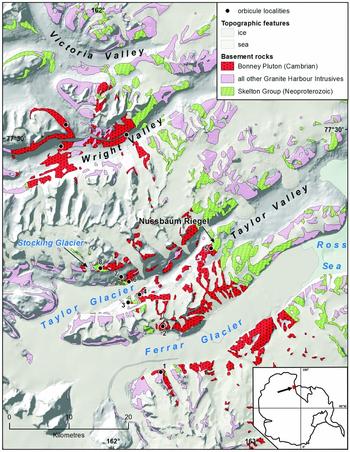
The Bonney Pluton (Fig. 1) which hosts the orbicular granitoids is a compositionally and texturally heterogeneous leucocratic granite of Cambrian age (499 ± 6 Ma; Allibone & Wysoczanski, Reference Allibone and Wysoczanski2002) that is exposed over an area of more than 1000 km2 in the Taylor Valley, southern Victoria Land (Smillie, Reference Smillie1992; Allibone et al. Reference Allibone, Cox, Graham, Smillie, Johnstone, Ellery and Palmer1993b ; Cox et al. Reference Cox, Turnbull, Isaac, Townsend and Smith Lyttle2012). The pluton belongs to the Granite Harbour Intrusive Complex, which intrudes the multiply deformed, upper amphibolite facies Skelton Group (formerly known as the Koettlitz Group) metasediments (schist, marble, gneiss) of Neoproterozoic age (Wysoczanski & Allibone, Reference Wysoczanski and Allibone2004). Metasedimentary xenoliths within the Bonney Pluton have identical lithologies to nearby Skelton Group lithologies, and their restriction to within c. 500 m of the contact suggests derivation from the Skelton Group. No chilling of the Bonney Pluton granite or contact aureole within the metasediment is observed. The contact is instead characterized by a contact zone up to 500 m wide within which a systematic change of fabric within the Bonney granite occurs (Cox, Reference Cox1993), representing a continuous progress from magmatic to solid-state conditions. Approximately 500 m from the contact the granitoids display a weak foliation delineated by aligned K-feldspar megacrysts and rare amphibolite xenoliths, with the foliation becoming more pronounced closer to the contact. Within 100 m of the contact, the Bonney Pluton appears as a strongly foliated augen-gneiss of tectonic origin. All foliations observed within the granitoids are parallel to the contact. The internal structure of the Bonney Pluton and structures developed in the Skelton Group host rocks were explained by Cox (Reference Cox1993) as the result of magma intrusion into deforming Skelton Group rocks during a regional NE–SW compressional event.
Geological map of southern Victoria Land simplified from Cox et al. (Reference Cox, Turnbull, Isaac, Townsend and Smith Lyttle2012) showing the known orbicule localities within the Bonney Pluton. Only Ordovician or older basement rocks and ice coverage are shown. Cover rocks from Devonian to Quaternary are transparent with a greyscale hillshade model shown as background. Orbicule localities are labelled 1–8. Location 5 is in the Nussbaum Riegel area, approximately located from Palmer et al. (Reference Palmer, Bradley and Prebble1967). Three unnumbered localities in the Wright Valley are approximately located from previous studies. Inset map of Antarctica with arrowed square highlighting the study area.

The Bonney Pluton is the largest of at least 11 texturally and petrographically similar plutons that comprise the Dry Valleys 1a Suite (DV1a) (c. 517–495 Ma; Allibone et al. Reference Allibone, Cox, Graham, Smillie, Johnstone, Ellery and Palmer1993a ; Encarnacion & Grunow, Reference Encarnacion and Grunow1996; Allibone & Wysoczanski, Reference Allibone and Wysoczanski2002; Cox et al. Reference Cox, Turnbull, Isaac, Townsend and Smith Lyttle2012) hornblende-biotite granitoids, all of which are characterized by calc-alkaline, I-type metaluminous geochemistry, indicative of generation along an active continental margin (Smillie, Reference Smillie1992; Allibone et al. Reference Allibone, Cox, Graham, Smillie, Johnstone, Ellery and Palmer1993b ). Emplacement of the DV1a Suite granitoids was synchronous with upper amphibolite facies metamorphism and deformation of the Skelton Group (Allibone et al. Reference Allibone, Cox, Graham, Smillie, Johnstone, Ellery and Palmer1993b ; Cox, Reference Cox1993). Orbicular textures have been recognized within other DV1a granitoids (i.e. Wheeler Pluton), suggesting that orbicule formation is a common process occurring within these concordant plutons (Allibone et al. Reference Allibone, Cox, Graham, Smillie, Johnstone, Ellery and Palmer1993a ).
The Bonney Pluton is heterogeneous in both composition and texture. Compositionally, the pluton varies between monzodiorite, quartz monzodiorite, granodiorite and monzogranite, with internal contacts between the different granite types characterized by interdigitating zones where inclusions of each granitoid type occur within the other (Smillie, Reference Smillie1992). Mafic enclave swarms are abundant yet irregular in distribution within the pluton, with the long axis of mafic enclaves aligned parallel to foliation in the host granitoid (Smillie, Reference Smillie1992). Mafic enclaves display sharp fine-grained cuspate margins, coarser-grained interiors and acicular apatite crystals; these are textures characteristic of quenching of hot mafic magma within a cooler more silicic host magma (Wiebe, Reference Wiebe1993; Hibbard, Reference Hibbard1995). This structural and textural evidence indicates coeval mafic magma injection within relatively melt-rich host granite. Alkali feldspar megacrysts are found in varying abundance (absent to dense swarms) and, where concentrated, are associated with abundant coarse-grained hornblende. The megacrysts are dimensionally aligned with the host granitoid foliation (Cox, Reference Cox1993; Smillie, Reference Smillie1992). Determining if mineral/enclave alignment is due to magmatic or solid-state plastic deformation is challenging; however, foliations observed appear to reflect a combination of both magmatic flow and syn-emplacement regional deformation. At the pluton margins, solid-state foliations (augen-shaped K-feldspar megacrysts) appear to overprint the well-developed magmatic foliation in the centre of the pluton defined by the alignment of enclaves, K-feldspar megacrysts, xenoliths and orbicules in an otherwise undeformed granitic matrix (Allibone et al. Reference Allibone, Cox, Graham, Smillie, Johnstone, Ellery and Palmer1993a ; Cox Reference Cox1993).
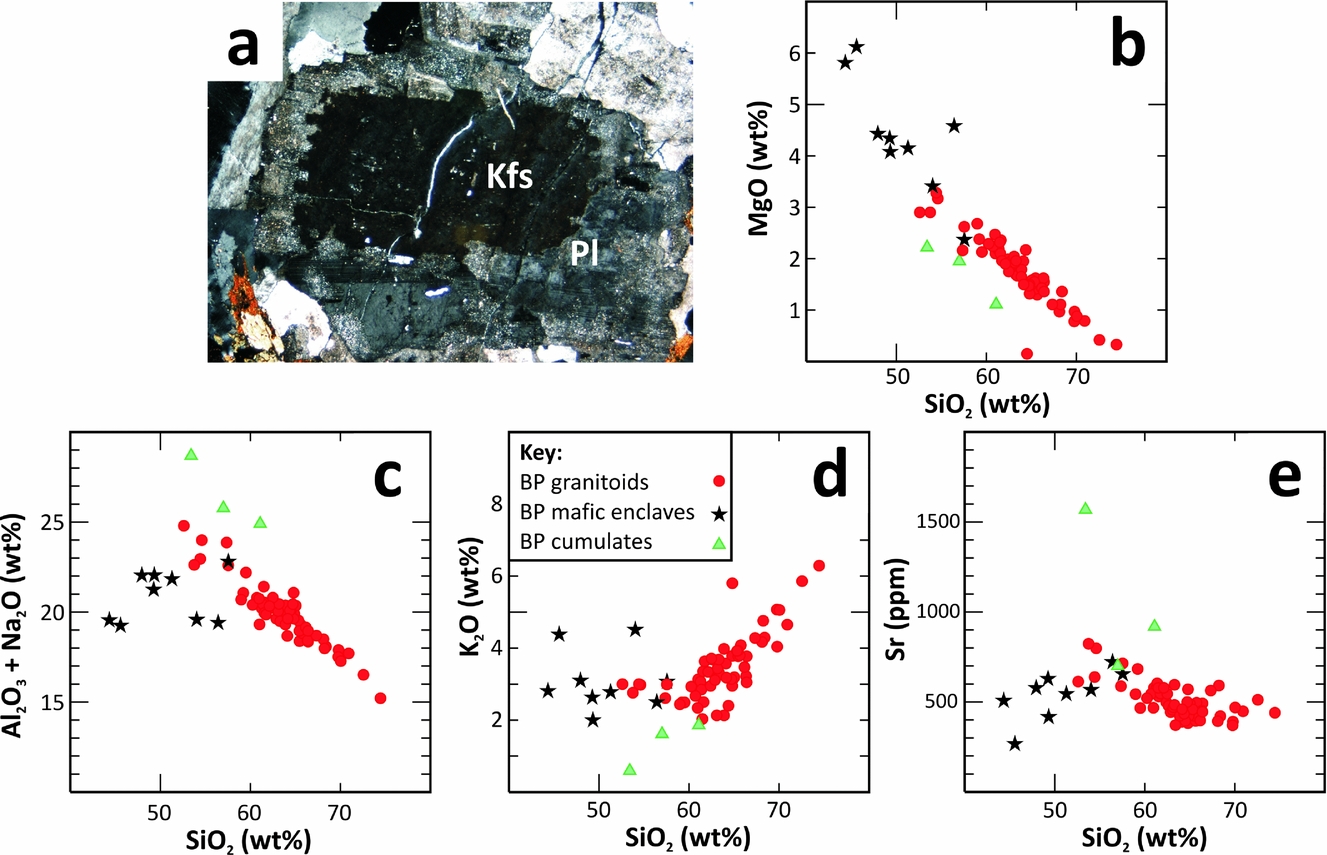
Several petrographic disequilibrium textures suggestive of mafic-felsic magma interaction are observed within the Bonney Pluton granites, including plagioclase mantling of embayed alkali feldspar crystals (Fig. 2a), plagioclase crystals with corroded An-rich cores mantled by sodic rims and complexly zoned plagioclase. Fine-grained mafic schlieren that grade into coarser more silicic layers are also present and are often folded and sheared, indicating deformation in a crystal-rich but plastic state.
Textural and geochemical characteristics of the Bonney Pluton highlighting the processes of magma mixing and fractional crystallization: (a) mantling of an embayed K-feldspar phenocryst by plagioclase (i.e. Rapakivi texture) within a coarse-grained hornblende granite (width of view 5 mm); (b–e) selected whole-rock major- and trace-element variation diagrams for the Bonney Pluton granitoids (including plagioclase-rich ‘cumulates’) and mingled mafic enclaves. BP – Bonney Pluton; Kfs – K-feldspar; Pl – plagioclase. All geochemical data are sourced from the GNS Science Petlab collection (http://pet.gns.cri.nz/).
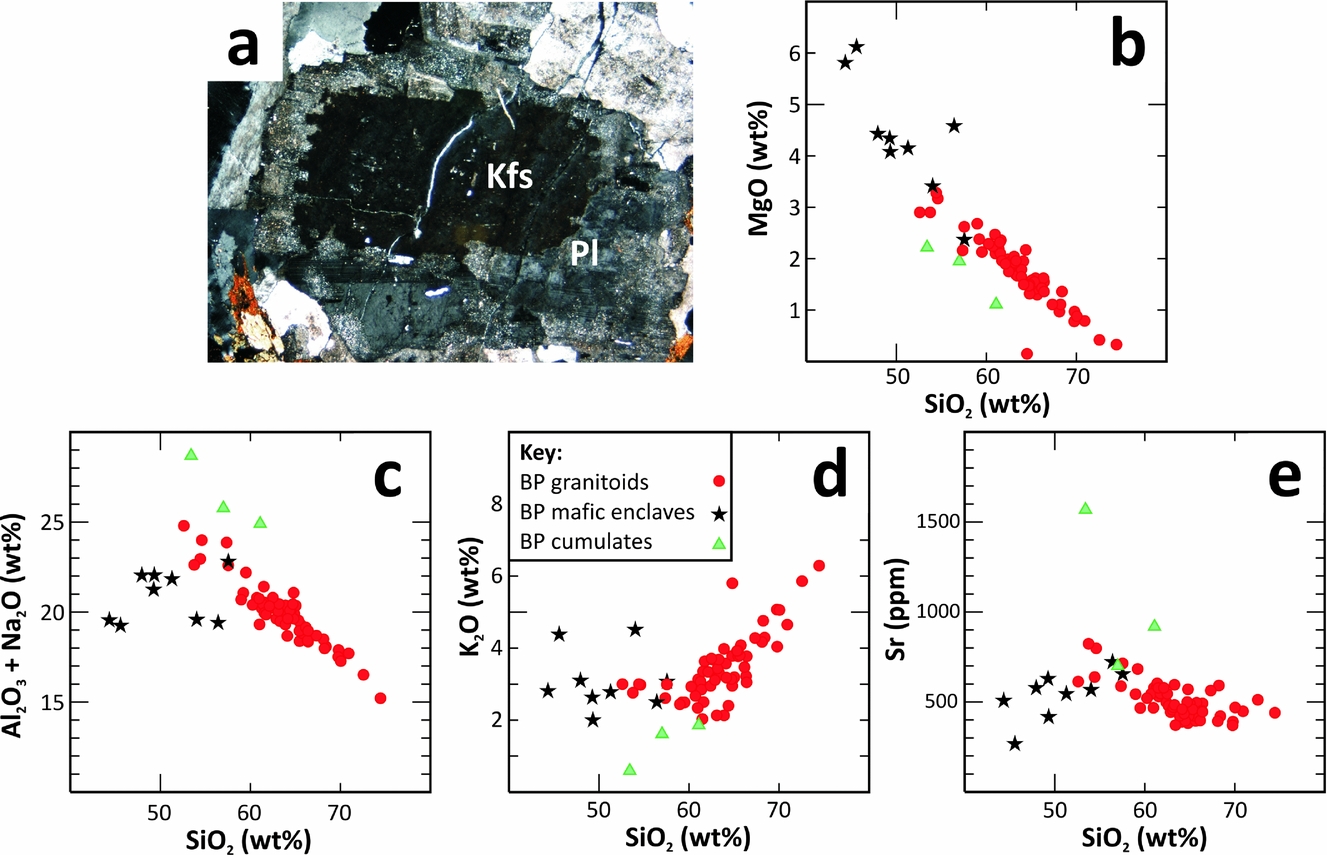
The structural and textural evidence indicate that mafic-felsic magma interaction, both mingling and mixing, was an important process throughout the evolution of the Bonney Pluton magma chamber. Major and trace element variation diagrams do not however display linear mixing relationships between the host granites and the mafic enclaves (Fig. 2b–e), indicating that magma mixing was not the principal process effecting compositional variation in the Bonney Pluton. Mixing between mafic enclaves and Bonney Pluton magmas is, nevertheless, considered to have occurred on a localized scale (i.e. immediately adjacent to injecting mafic magmas) on the basis of the textural evidence presented previously. Geochemical variation diagrams instead display curvilinear trends that are consistent with compositional diversity within the Bonney Pluton, being primarily the result of fractional crystallization (data sourced from Smillie, Reference Smillie1992 and http://pet.gns.cri.nz/).
Orbicules crop out as definable ‘pods’ or zones in a number of places within the Bonney Pluton, although they are almost exclusively confined to zones within a few hundred metres of the intrusive contact with the Skelton Group metasediments. However, rare orbicules are known to crop out towards the north in the centre of the pluton (Allibone et al. Reference Allibone, Cox, Graham, Smillie, Johnstone, Ellery and Palmer1993a ). The structural, textural and compositional heterogeneity of the Bonney Pluton indicates a long and complex history of magmatism (Cox & Allibone, Reference Cox and Allibone1991). This is consistent with recent observations that many large plutonic bodies are constructed incrementally over several millions of years by individual batches of both silicic and mafic magma and evolve via multiple episodes of magma replenishment, fractional crystallization and magma mixing (Wiebe & Collins, Reference Wiebe and Collins1998; Miller & Paterson, Reference Miller and Paterson2001; Coleman et al. Reference Coleman, Gray and Glazner2004; Turnbull et al. Reference Turnbull, Weaver, Tulloch, Cole, Handler and Ireland2010; Miller et al. Reference Miller, Furbish, Walker, Claiborne, Koteas, Bleick and Miller2011).
3. Field observations
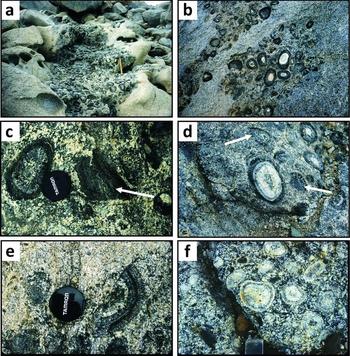
Outcropping orbicules typically form clusters or pods within the Bonney Pluton, some up to 20 m long and 2–3 m across (Fig. 3a, b). Orbicule pods as a whole, together with the long axes of the orbicules within them, are commonly aligned parallel to the foliation of the Bonney Pluton (in a manner similar to that of aligned mafic enclaves and K-feldspar megacrysts elsewhere within the pluton). Some orbicule pods are densely packed with orbicules crowded and moulded against one another, demonstrating plastic deformation (Fig. 4h). Other orbicule pods contain a lot more interstitial granitoid material which has a composition similar to that of the surrounding host rock. In several instances, mafic enclaves and xenoliths of Skelton Group metasediment are entrained within orbicule pods (Fig. 3c).
(a) A representative large orbicule pod with flow-aligned orbicules from location 6. This orbicule pod displays a gradational contact with the surrounding host Bonney Pluton granitoid. The majority of orbicules are ellipsoidal with their long axis parallel to the strike of the orbicule zone, which is itself aligned parallel to the foliation of the host granitoid. This zone of orbicules is c. 20 m long and 2 m wide. Note that all orbicules have a final outer rim that is hornblende-rich. (b) A smaller irregular-shaped orbicule pod, located c. 10 m away from the large orbicule pod in (a). Note the variation in orbicule size, shape and composition. This orbicule pod displays clear evidence for the dynamic and cyclic nature of orbicule formation within a mobile pocket of silicate melt, including: gradational contacts with the host granite; the presence of broken orbicules (solid enough to permit brittle deformation) and whole orbicules that are moulded around each other (soft enough to permit plastic deformation); and recycling of orbicules from a previous plagioclase-rich period of orbicule formation as intact and broken cores within a more mafic-H2O-rich orbicule pod. (c) Unassimilated metasedimentary xenolith (Skelton Group) within a small orbicule pod (arrowed). (d) Small orbicule pod showing broken orbicules (arrowed) and whole orbicules within the same pod. This relationship implies at least two episodes of orbicule formation within this orbicule pod. (e) Sharp edge along a fragmented orbicule, highlighting the brittle nature of orbicule break-up. (f) Plagioclase-rich pod of orbicules, location 8. Note that all orbicules have an outer shell that is plagioclase rich. Hammer head for scale.

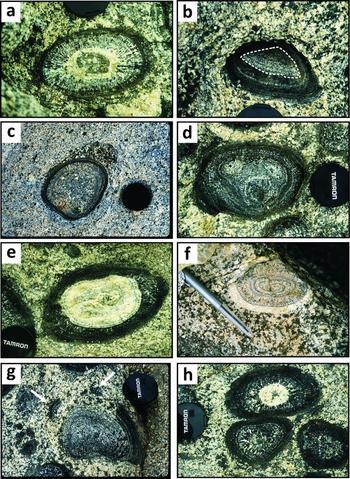
Photos of representative orbicule types: (a) metasedimentary core with an outer shell of radially and tangentially aligned hornblende and plagioclase crystals; (b) orbicule with a broken orbicule fragment as a core (dashed line), highlighting the cyclic process of orbicule formation and deformation; (c) orbicule with a core similar to the surrounding granitoid host; (d) multiple-cored orbicule (the three core objects have the appearance of crude ‘proto-orbs’ that are surrounded by a granitic matrix; this relationship suggests at least two phases of orbicule formation), (e) plagioclase-rich orbicule core surrounded by a hornblende-rich shell; (f) orbicule with a plagioclase-rich outer shell; (g) broken orbicule with only half its outer shell intact (fragments of the outer shell lie in the granitoid matrix (arrowed), indicating that the granitoid host was only partially crystalline at the time of orbicule fragmentation); and (h) cluster of orbicules, noting plastic deformation of orbicules as they mould against each other.

The largest orbicular pods observed in the field occur in close proximity to the Skelton Group – Bonney Pluton contact on the northern side of the central Taylor Valley (Fig. 1), and were the subject of an earlier study conducted by Palmer et al. (Reference Palmer, Bradley and Prebble1967) and Dahl & Palmer (Reference Dahl, Palmer, Oliver, James and Jago1983). The host Bonney Pluton for these pods is medium- to coarse-grained and varies in composition from monzodiorite to granite. The contact between orbicule pods and the surrounding host rock is typically poorly defined texturally, with the orbicule pod grading into the host granitoid over distances of up to 50 m, indicating that they are broadly coeval with crystallization of the host pluton. In some instances, however, orbicule-rich pods display sharp contacts with the host granitoid, indicating they may be later cross-cutting phenomenon.
Most of the orbicules themselves are ellipsoidal; more rounded types occasionally occur however. Orbicule size ranges from less than 2 cm to over 15 cm in longest dimension; most are however a uniform size of c. 8–10 cm in their longest dimension. All orbicules comprise a central core surrounded by hornblende- and/or plagioclase-rich ‘shells’ or rims, with the outer rim in sharp contact with the granitoid matrix. The variation in this core-shell-rim structure has led to the wide variety of orbicule types observed in the field (Fig. 4a–h). Orbicule cores are compositionally diverse and include: (1) metasedimentary xenoliths (calc-silicates and amphibolites derived from the Skelton Group) (Fig. 4a); (2) broken orbicule fragments (Figs 4b, 5b); (3) granitoid core similar in composition to the surrounding host granite (Fig. 4c); (4) multiple-cored ‘proto-orb’ structures (Fig. 4d); (5) plagioclase-rich cores (Fig. 4e); (6) fine-grained mafic cores texturally and mineralogically similar to mafic enclaves in the Bonney Pluton (i.e. fragments of mafic enclaves); and (7) early-formed phenocrysts. Some cores comprise the majority of the orbicule structure while other orbicules lack a definable core, which is probably a cutting effect (i.e. outcrop failed to expose the core of the orbicule). Interestingly, the shape of the orbicule core appears to determine the overall shape of many of the orbicules themselves, which may indicate relatively equal rates of crystallization in all directions outwards from the core (i.e. Vernon, Reference Vernon1985).
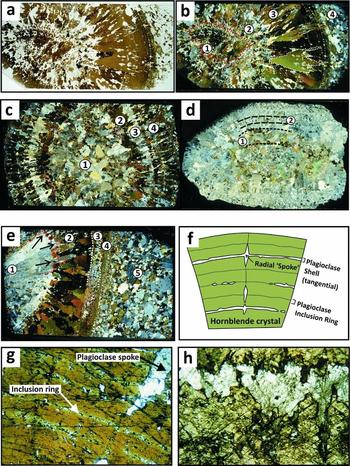
(a, b) CPL/PPL thin-section images of OU60549. The orbicule core consists of an orbicule shell fragment in a granitoid matrix (1, 2), and is surrounded by a shell of interlocking radially aligned hornblende up to 35 mm in length (3) and lesser amounts of radially and tangentially aligned plagioclase. Width of view 10 cm. (c) CPL thin-section image of an orbicule with a granitoid core (1) and alternating shells of dendritic hornblende and plagioclase (2–4). Width of view is 7 cm. (d) CPL thin-section image of OU60550 plagioclase-rich orbicule with two faint relict hornblende inclusion rings visible (1 and 2). Width of view is 7 cm. (e) Detailed CPL thin-section image of the edge of an orbicule that displays shells of contrasting composition and texture. Initial growth is characterized by dendritic plagioclase (1) which is followed by dendritic hornblende (2), a thin shell of poikilitic hornblende (3), surrounded by a fine-grained hornblende-rich rim in sharp contact (4) with the coarse-grained Bonney granite (5). Width of view is 4 cm. (f) Sketch showing the relationship between plagioclase inclusion rings, plagioclase ‘spokes’ and plagioclase shells. Plagioclase shells that do not surround the entire orbicule grade into the inclusion rings, indicating a genetic relationship between the two. (g) PPL thin-section image of plagioclase-ilmenite inclusion rings and ‘spoke’ within a wedge-shaped hornblende crystal. Width of view 5 mm. (h) PPL thin-section image of a tangential plagioclase shell within a larger wedge-shaped hornblende crystal. Plagioclase appears to have grown along cracks and cleavage planes in the dendritic hornblende. Width of view 5 mm.

Orbicule shells and rims are also compositionally and texturally diverse, typically comprised of varying proportions of radially and/or tangentially arranged hornblende and plagioclase with a minor biotite component. Orbicules may have only one outer shell, or multiple alternating shells. Orbicule shells are primarily hornblende-rich with a minor plagioclase component (Fig. 4h) or plagioclase-rich with a minor hornblende component (Figs 3f, 4f, 5d). Some orbicules have final outer shells comprised entirely of hornblende (Fig. 4h), whereas others have a final outer shell comprised entirely of plagioclase (Figs 3f, 4f). Despite the variation in orbicule shell numbers and mineralogy, pods of orbicules generally exhibit the same final outer shell mineralogy: either hornblende-rich or plagioclase-rich, but rarely both.
An orbicule zone near the eastern contact with the Skelton Group contains numerous broken orbicules, a function of the cyclic and dynamic process of orbicule formation and deformation within the Bonney Pluton. Broken orbicules display structures and textures that indicate both plastic and brittle deformation (Fig. 3e). Broken orbicule fragments that occur as cores within new orbicules are evidence for an earlier episode of orbicule growth (Figs 4b, 5b). Broken orbicules that lack a surrounding shell were most likely broken when the granitoids had higher crystal contents and orbicule growth had ceased within the magma (Fig. 4g).
4. Mineralogy methodology
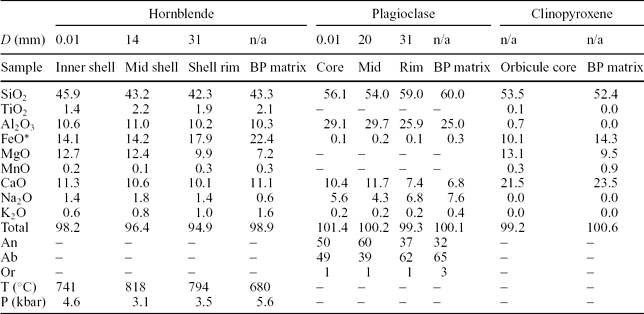
Major element compositions of hornblende and plagioclase from the host Bonney Pluton granitoids, and the orbicules themselves, were determined at Otago University on a JEOL Superprobe equipped with two wavelength-dispersive spectrometers using an accelerating voltage of 15 kV, an electron beam diameter of 5 μm, a 20 nA beam current and a counting time of c. 10 minutes per spot. Regular checks on various standards of known composition were performed throughout the course of analysis to ensure a relative error of <1%. Cation abundances used for temperature and pressure estimates were recalculated following the method outlined in appendix B of Holland & Blundy (Reference Holland and Blundy1994). Temperature estimates were made using the plagioclase-hornblende geothermometer (Thermometer B) of Holland & Blundy (Reference Holland and Blundy1994). Pressure estimates were made using the temperature-corrected Al-in-hornblende geobarometer of Anderson & Smith (Reference Anderson and Smith1995). Chemical compositions of representative hornblende, plagioclase and clinopyroxene analyses from orbicule OU60549 and the surrounding Bonney Pluton granite matrix are presented in Table 1. A complete list of mineral compositions and structural formula, calculated based on 32 (plagioclase), 23 (hornblende) and 6 (clinopyroxene) oxygens, can be found in the Supplementary Material (available online at http://journals.cambridge.org/geo).
Chemical composition (wt%) of selected hornblende, plagioclase and clinopyroxene analyses from an orbicule (OU60549) and the surrounding Bonney Pluton (BP) granitoid matrix. (Note that D is the distance in mm from shell core to rim.)

5. Petrographic descriptions and mineral chemistry
The heterogeneous Bonney Pluton comprises varying proportions of hornblende, dark brown biotite, plagioclase, alkali feldspar and interstitial quartz, with accessory clinopyroxene, allanite, zircon, apatite, monazite, titanite and opaques (Smillie, Reference Smillie1992; Cox, Reference Cox1993). The granitoids are characterized by plagioclase XAn between 43 and 10, ferrohornblende (and minor ferro-edenite, ferro-actinolite and actinolite) and Fe-rich clinopyroxene (diopside) which displays very small compositional variation throughout the pluton. Mingled mafic enclaves within the Bonney Pluton have slightly higher plagioclase XAn compositions (46–30), ferrohornblende and slightly more Mg-rich clinopyroxene (augite).
As previously stated, orbicules are characterized by a core of varying nature surrounded by concentric shells of hornblende and plagioclase crystals that display radial and tangential growth (Fig. 5a, b). Orbicule shells are either hornblende-rich with subordinate plagioclase (Fig. 4h; Fig. 5b zone 3), plagioclase-rich with subordinate hornblende (Fig. 3f; Fig. 5e zone 1) or comprise relatively equal proportions of both plagioclase and hornblende (Fig. 5c zone 4). Overall, most orbicule shells are hornblende-rich and are characterized by wedge-shaped hornblende crystals of varying width and length that radiate from the edge of the core outwards to the rim (Fig. 5a, b, e). Smaller lenticular hornblende crystals fill the gaps between the larger hornblende wedges. The wedge-shaped crystals are similar in texture to combs of euhedral quartz orientated perpendicular to vein walls and terminating in cavities, as found in some epithermal deposits (Dowling & Morrison, Reference Dowling and Morrison1988), and to the dendritic crystal growth preserved in pegmatites. These textures are interpreted to represent unimpeded crystal growth within an undercooled melt (London, Reference London2008).
Although hornblende is the dominant mineral comprising the orbicule shells, plagioclase also comprises an important part of the orbicule shell structure, forming radial ‘spokes’ between some of the fan-like hornblende crystals and forming thin tangential concentric shells (Fig. 5f, h). Plagioclase also forms concentric inclusion rings, observable only in thin-section (Fig. 5b, g), that interrupt hornblende shells; these consist of small (<0.1 mm) subhedral to euhedral crystals of plagioclase and ilmenite. Inclusion rings transgress grain boundaries between individual hornblende crystals. These small inclusions of plagioclase probably represent crystals incorporated onto the face of the advancing hornblende crystals as the crystal grew outwards into the melt, and was subsequently included into the shell structure of the hornblende. The contact between orbicule rims and the surrounding granite host rock is always sharp and is typically fine grained (Fig. 5e), suggesting an abrupt change in crystallization conditions. A detailed petrographical description and mineral chemistry study for a single orbicule (OU60549), representative of the characteristic orbicule type within the Bonney Pluton, is presented in the following section (5.a.). A description of a plagioclase-rich orbicule (OU60550) is also provided (section 5.b).
5.a. OU60549 (fragmented orbicular core)
The core of OU60549 (Fig. 5a, b) consists of an orbicule fragment within a matrix of clinopyroxene, brown hornblende, biotite and plagioclase, the same mineralogy as the host granitoid. Clinopyroxene within the orbicule core is Mg-rich diopside, and hornblende and biotite are also Mg-rich in comparison with the host granitoid (Table 1; Supplementary Material available online at http://journals.cambridge.org/geo). The XAn of plagioclase is also more calcic than plagioclase in the Bonney granite (XAn 50–52). The orbicule shell surrounding the core consists predominantly of an interlocking framework of lenticular hornblende crystals with inclusions of plagioclase and ilmenite. Many of the hornblende crystals are wedge shaped, with their apex pointing towards the centre of the orbicule, and extend the entire distance from the orbicule core to the granitoid matrix as single optically continuous crystals up to 35 mm in length (Fig. 5a, b). Other smaller lenticular hornblende crystals fill the gaps between the larger hornblende wedges. Acicular biotite crystals up to 1 mm in length lie along cleavage planes within the hornblende shells, as do secondary mineral phases including carbonate. The outer margin of the orbicule is sharp and consists of fine-grained hornblende.
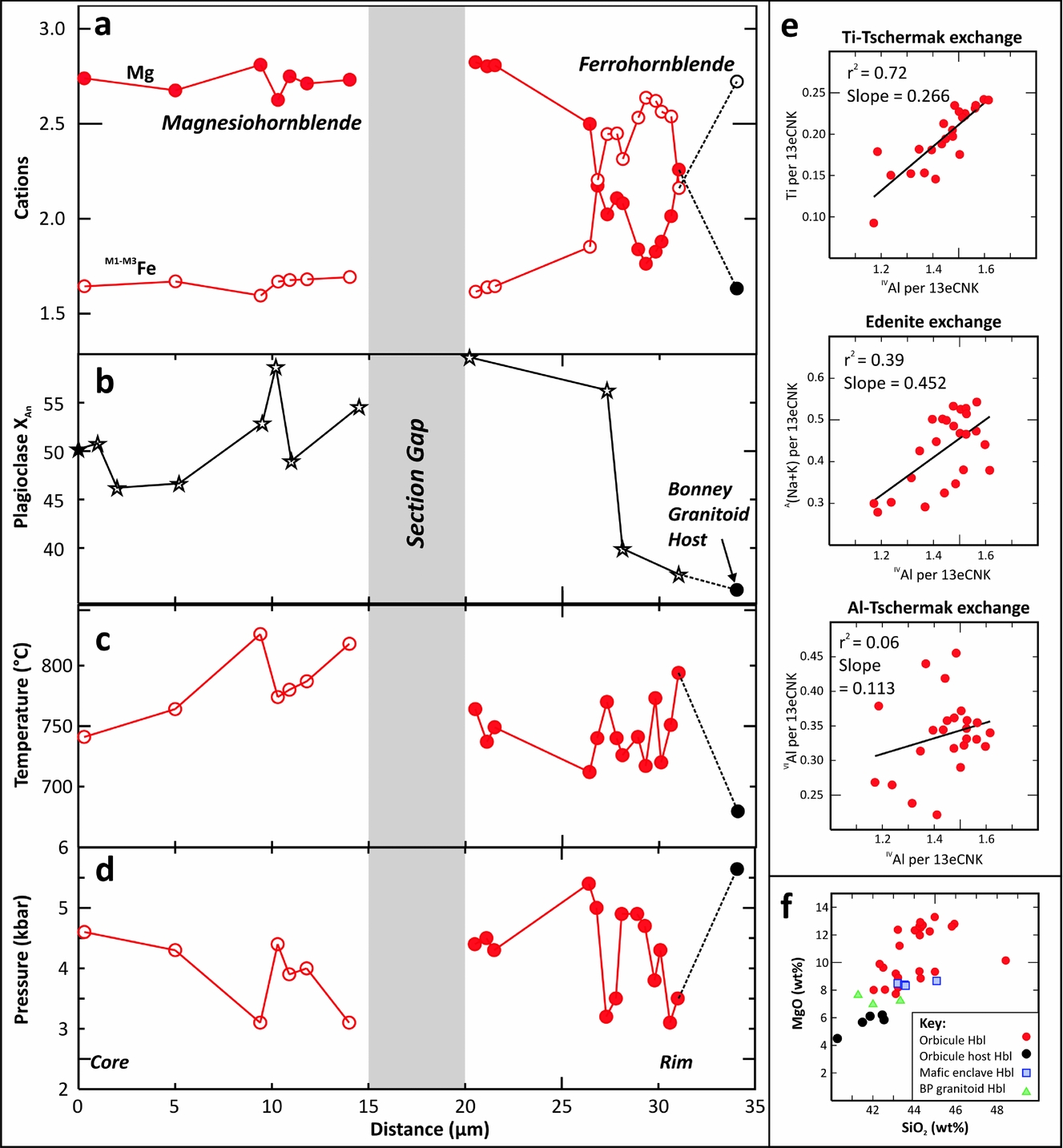
An electron microprobe transect was undertaken from the core to rim of a single wedge-shaped hornblende crystal from an orbicule shell in sample OU60549 to assess any spatial changes in composition. Representative analyses from shell core, mid-section and rim and Bonney Pluton matrix are presented in Table 1. Plagioclase crystals from inclusion rings within this hornblende crystal were also analysed, so that fluctuations in plagioclase composition as a function of distance from the orbicule core could be compared to fluctuations in hornblende composition. As displayed in Figure 6, significant variation outside of analytical error is observed. The majority of the hornblende crystal is classified as magnesiohornblende and displays relatively constant Mg- and Fe-content; however, Al and Ti (and consequently temperature and pressure) both display increases and decreases from orbicule core to rim. Towards the edge of the crystal, a sharp decrease in Mg-content and an increase in Fe-content are observed, and the hornblende type changes to ferrohornblende (the same composition hornblende as present in the surrounding host Bonney Pluton). At the immediate rim the hornblende crystal changes back to a magnesiohornblende. All hornblende analyses from this transect display positive correlations with the temperature-sensitive Edenite and Ti-Tschermak exchanges and poor correlation with the pressure-sensitive Al-Tschermak exchange (Fig. 6e), indicating that the Altot-content in hornblende is largely controlled by temperature. Analyses of plagioclase from inclusion rings within the hornblende crystal analysed in OU60549 also reveal fluctuations in the XAn from core to rim (increasing XAn of 50–60) followed by a sharp decrease in XAn towards the rim where XAn is 37 (Fig. 6b), the same average XAn of plagioclase within the Bonney Pluton granite.
(a) Spot probe analyses for Fe and Mg content of a transect across a single wedge-shaped hornblende crystal that extends radially from the orbicule core to the orbicule rim (OU60549). Note the large change in both Mg and Fe c. 26 mm from the orbicule core. (b) Anorthite content of plagioclase inclusion rings within the hornblende shell. Note the large drop in XAn at the point where Mg–Fe content in the hornblende changes dramatically. (c, d) Temperature and pressure estimates for hornblende. The composition of the hornblende and plagioclase (including pressure and temperature estimates) from the surrounding Bonney Pluton granite are also shown (black circles). (e) Plots of IVAl versus Ti, A(Na+K) and VIAl, illustrating the substitution mechanisms in the orbicule hornblende analysed in OU60549. Structural formulae of hornblende calculated using the method of 13 cations excluding Ca, Na and K (13eCNK) described in Holland & Blundy (Reference Holland and Blundy1994). (f) SiO2 versus MgO variation diagram for amphiboles from an orbicule (OU60549), the orbicular host granite, Bonney Pluton mafic enclaves and other Bonney Pluton granitoids. BP – Bonney Pluton; Hbl – hornblende.

5.b. OU60550 (plagioclase-rich orbicule)
In rare instances, orbicules consist almost entirely of plagioclase (Fig. 5d); some contain a highly variable and altered core of anhedral ferromagnesian minerals and sericitized plagioclase, while others have no definable core at all. These orbicules lack the hornblende-rich shells of the other orbicule types found in the Bonney Pluton, and instead contain small (<1 mm) radially aligned subhedral hornblende crystals in a plagioclase matrix which form incomplete rings around the orbicule. Plagioclase-rich orbicules are almost exclusively restricted to a densely compacted plagioclase-rich orbicule pod near the Stocking Glacier (locality 8, Fig. 1), implying a process in their formation distinct from the other studied hornblende-rich orbicule pods.
The core of OU60550 is comprised almost entirely of highly sericitized plagioclase poikilitically enclosed within large optically continuous hornblende crystals, with small amounts of subhedral to anhedral biotite, anhedral titanite and minor subhedral epidote. Hornblende crystals display textures indicative of replacement by biotite and chlorite. The surrounding shell of this orbicule consists of a framework of subhedral highly sericitized plagioclase crystals (XAn 35–40), within which subhedral hornblende crystals form at least two incomplete concentric rings around the orbicule core (Fig. 5d, 1 and 2). The boundary between the core and the surrounding shell is difficult to ascertain, but is largely defined by a change in grain size and crystal orientation.
6. Discussion
6.a. Location of the orbicule ‘pods’
Almost all known orbicule pods crop out in close proximity (<500 m) to the contact between the Bonney Pluton and the Skelton Group metasediments, in particular along the western contact where biotite-bearing metapelite and metapsammites predominate. Largely gradational contacts with the surrounding Bonney Pluton granite imply that the granite was only partially crystallized when the pockets of orbicular magma formed. This is consistent with studies that reveal that silicic magmas are often stored as crystal-rich (≥50 vol%) mushes for most of their supra-solidus (Bachmann & Bergantz, Reference Bachmann and Bergantz2006), and are constantly rejuvenated and remobilized by injection of hotter, more mafic magma. As crystallization of the H2O-saturated Bonney magma progressed, volatiles (dominantly H2O in intermediate and silicic magmas) were likely to have been increasingly concentrated in the residual melt where they became saturated and were exsolved. These H2O-rich melts were extracted from the Bonney Pluton magma when crystallinities were probably between 50 and 70 vol% crystals (the optimum melt extraction window before an interconnected crystalline network develops and inhibits melt extraction from crystals; Dufek & Bachmann, Reference Dufek and Bachmann2010), and were then concentrated as pockets along the margin of the pluton. Aqueous fluids and melts derived from crystallizing magmas are commonly concentrated and channelled along the margins of magma reservoirs. This process commonly results in the formation of comb layering and pegmatite formation (Moore & Lockwood, Reference Moore and Lockwood1973; London & Kontak, Reference London and Kontak2012), which display similar crystal growth textures to orbicules. Deformation, migmatization and amphibolite facies metamorphism of the Skelton Group was closely associated with Bonney Pluton emplacement (Allibone & Norris, Reference Allibone and Norris1992; Cox, Reference Cox1993), during which time dehydration reactions between the intruding Bonney magma and the Skelton Group metasediments may have produced H2O-rich fluids that may have been absorbed by the nearby pockets of silicate melt along this contact margin; however, we find no direct evidence to support this hypothesis.
6.b. Previous interpretation of Taylor Valley orbicules
Previous authors (Palmer et al. Reference Palmer, Bradley and Prebble1967; Dahl & Palmer, Reference Dahl, Palmer, Oliver, James and Jago1983) considered the Bonney Pluton orbicules to be products of incomplete dissolution between metamorphic xenoliths sourced from the Skelton Group, and the Bonney granitic magma, i.e. an entirely metasomatic origin. A model of orbicule formation involving coupled two-way diffusion of components between the outer edge of a xenolith and its surrounding magma was proposed on the basis of mass-balance calculations, and forms an orbicule with a plagioclase core surrounded by a mafic (hornblende) rim. This model is limited however, in that it requires every orbicule to have once contained a metasedimentary core. As displayed in Figure 4, a large variety of orbicule core types are present within the Bonney Pluton including mafic enclaves, orbicule fragments and early-formed phenocrysts.
The model of Dahl & Palmer (Reference Dahl, Palmer, Oliver, James and Jago1983) therefore fails to adequately explain the formation of orbicule shells around these non-metasedimentary xenolith core types. Furthermore, numerous unassimilated metasedimentary xenoliths occur as both cores to orbicules and within the granitoid host itself in close proximity to orbicule zones (Fig. 3c). Existing evidence for metasomatic reaction between xenoliths and the enclosing granitic magma is the occurrence of sparse quartzofeldspathic ‘haloes’ around calc-silicate xenoliths. This reaction also cannot be explained by the model of Dahl & Palmer (Reference Dahl, Palmer, Oliver, James and Jago1983); we therefore discount their model of orbicule formation.
6.c. Orbicule formation in response to superheating: mafic magma injection versus introduction of H2O
The most widely accepted model of orbicule formation involves the process of superheating, which destroys almost all pre-existing nuclei in a melt and leads to a delay in crystallization. This delay in crystallization results in an undercooled melt, where low nucleation and rapid crystallization rates promote dendritic and concentric crystal growth around any remaining solid objects (Vernon, Reference Vernon1985). Disequilibrium crystallization and orbicule growth in response to rapid undercooling of the melt is indicated by increasing XAn in plagioclase crystals from the shell of orbicule OU60549 (Fig. 6b) (Lofgren, Reference Lofgren, McKenzie and Zussman1974; Grosse et al. Reference Grosse, Toselli and Rossi2010) and the dendritic crystal habit of both plagioclase and hornblende (Fig. 5b, c, e), which supports the hypothesis that orbicule growth within the Bonney Pluton occurred in response to a superheating event.
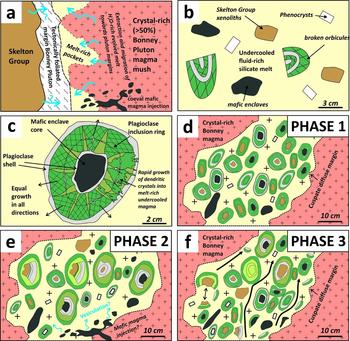
The two most common processes leading to superheating of a magma are: (1) the injection of hydrous fluids into a H2O-undersaturated melt, which effectively lowers its liquidus temperature; and (2) intrusion of mafic magma (1100–1300 °C) into a silicic melt (750–950 °C), which increases the temperature of the silicic magma. We hypothesize that the superheating event responsible for destroying nuclei in the Bonney silicate melt prior to orbicule formation was the result of hot, mafic magmas intruding into small pockets of evolved H2O-rich silicate melt that were extracted and concentrated along the margins of the crystallizing Bonney Pluton (Fig. 7a). Small bodies of H2O-rich intermediate-felsic magma can easily be superheated for a short period of time by a sudden intrusion of much hotter mafic magma, and the subsequent quenching of mafic magma commonly results in vigorous vesiculation (i.e. Sparks et al. Reference Sparks, Sigurdsson and Wilson1977; Vernon, Reference Vernon1985). Undercooling of the melt pockets where orbicules crystallized may also have been accentuated by exsolution of a water phase, which raises the magma liquidus temperature.
Proposed model of Bonney Pluton orbicule formation. (a) Schematic diagram (not to scale) illustrating the relationship between pockets of evolved volatile-rich melt extracted from the crystallizing and fractionating Bonney Pluton, and the crystal-rich Bonney Pluton. Injection of hot mafic magma results in superheating of the melt-rich pockets and dissolution of almost all nuclei. Some water absorbed from the dehydrating Skelton Group metasediments may also have migrated into the melt-rich pockets. (b) The few remaining nuclei (xenoliths, enclaves, phenocrysts, orbicule fragments) are suspended in an undercooled fluid-rich silicate melt prohibitive to crystal nucleation. (c) Rapid dendritic growth of hornblende around the remaining nuclei was promoted by the undercooled melt. Hornblende crystals grow radially outwards and small fluctuations in the composition and H2O-content at the crystallizing orbicule front result in orbicule shells and rings of alternating composition (i.e. hornblende versus plagioclase + ilmenite). (d) During phase one, orbicule growth is largely in situ. Although orbicule cores may be of variable composition, orbicules are of a similar size and composition and have the same number of alternating shells. No broken orbicules or recycling of orbicules is observed. Phase one may be followed by phase three, when orbicules become aligned. (e) Phase two represents an episode of orbicule recycling within the melt pockets. Broken orbicules of various compositions (in this example plagioclase-rich orbicules) occur as nucleation sites for a second phase of orbicule growth (in this case hornblende-rich orbicules). Orbicules all have the same outer composition shell but a highly variable inner shell composition and texture, representative of phase one orbicule growth within a pocket of melt with different composition. Orbicule sizes are variable: large orbicules represent phase two growth around recycled orbicule cores and small orbicules represent phase one growth around smaller nuclei, e.g. mafic enclaves, xenoliths, phenocrysts. These relationships imply processes of magma movement, vesiculation and fragmentation, which may have been triggered by a second episode of mafic magma injection. (f) The alignment of orbicules in ‘pods’ indicates some movement of the orbicules occurred within the pockets of melt, which was probably facilitated by the H2O-rich nature of the melt, and the movement of volatiles in response to episodic vesiculation and degassing. The process of orbicule transport and deposition occurred over stages in the cooling history of the orbicule pod. Moulding of orbicules around each other indicates that the orbicules were soft enough to deform plastically when moved by flow. Brittle fragmentation of almost-solid orbicules is probably the result of vesiculation. Following orbicule transport and deposition, near-equilibrium crystallization of the surrounding granitic magma resumes.

There is abundant evidence for multiple episodes of mafic magma intrusion into the Bonney Pluton in the form of mafic enclave swarms, acicular apatite and alkali feldspar with plagioclase mantles. The occurrence of entrained mafic enclaves within orbicule pods, or as cores within orbicules themselves, also indicates a temporal association. Within orbicule OU60549, magnesiohornblende, Mg-rich clinopyroxene and Ca-rich plagioclase are found towards the centre where initial shell growth occurred, whereas ferrohornblende, Fe-rich clinopyroxene and more Na-rich plagioclase are found on the shell rims. This implies that minerals towards the core crystallized within a more mafic Mg-Ca-rich melt than minerals crystallizing towards the orbicule rim, which have very similar compositions to the host granite. Higher XAn plagioclase in the shell crystals is a reflection of crystallization at higher temperatures (i.e. Putirka, Reference Putirka2005) than the surrounding host granitoid, consistent with crystallization from a hotter, more mafic Ca-rich melt. Elevated Ti contents and temperature estimates for shell hornblende crystals also support crystallization at greater temperatures than the host granitoid.
We propose that injection of hot mafic magmas (represented by the mafic enclaves) into evolved volatile-rich granitoid melt pockets induced superheating, and caused the composition of the magma at the initiation of orbicule growth to become hotter and more mafic. The mafic enclaves have MgO values higher than the host Bonney granites (Fig. 2b; MgO 2.3–6.2 wt% mafic enclaves; 0.8–3.3 wt% Bonney granites), and also contain clinopyroxene crystals that are more Mg-rich than the Fe-rich diopside clinopyroxene analysed in the Bonney granites (Table 1; Supplementary Material available online at http://journals.cambridge.org/geo). Furthermore, temperature appears to have exerted the largest control on the composition of orbicule hornblende crystals, which would more readily have been caused by mafic magma injection rather than the injection of H2O-rich fluids into a H2O-undersaturated melt.
6.d. Alternating shell compositions: cyclicity in orbicule formation
Bonney Pluton orbicules are highly variable in their internal structure and composition (Fig. 4). Shells that contain one dominant phase typically display dendritic crystal habits – both plagioclase (Fig. 5e) and hornblende (Fig. 5b, h) – indicating rapid and unimpeded crystal growth under non-equilibrium conditions within a highly undercooled melt. Rapid dendritic growth of hornblende crystals into a melt would have caused the magma immediately adjacent to the advancing crystal front to become depleted in the components required for continued growth (i.e. ferromagnesian elements and H2O) (McBirney & Noyes, Reference McBirney and Noyes1979). This would have resulted in the initiation of plagioclase crystallization immediately adjacent to the advancing crystal front, effectively filling the gaps as plagioclase inclusion rings and spokes (Fig. 5f–h). The same process would have occurred in plagioclase-dominated growth, where hornblende filled the gaps (Fig. 5d). Shells that display equal amounts of both plagioclase and hornblende indicate cotectic growth where conditions were favourable for coupled growth of both phases (Fig. 5c).
Alternations between plagioclase-rich and hornblende-rich shells (i.e. Fig. 5e) are a reflection of oscillating melt composition, temperature and P H2O, which in turn affects the magnitude of undercooling in the melt, nucleation rates and growth mechanisms for the respective phases (Shelley, Reference Shelley1993; Candela, Reference Candela1997). These changes may be extremely short-lived, as evidenced by the thin (<0.1 mm) plagioclase-ilmenite-rich ‘inclusion rings’ (Fig. 5b, g) where plagioclase crystallization was so short-lived that they were incorporated into optically continuous dendritic hornblende crystals. Where shell alternations are gradual or short-lived, changes in the phases crystallizing are probably due to local effects of disquilibirum crystallization (Shelley, Reference Shelley1993). Abrupt changes in the type of crystal growing within an individual shell (i.e. from plagioclase to hornblende in Fig. 5e, phase 1 to phase 2) potentially represent abrupt changes in the dynamic conditions of crystallization, i.e. the introduction of more mafic magmas and/or sudden volatile exsolution, which alters the magma composition, temperature and degree of undercooling.
At least four distinct phases of shell growth reflecting oscillations in melt composition, temperature and P H2O can be recognized in Figure 5e. Initially rapid dendritic plagioclase crystal growth occurred in phase 1 from a melt deficient in ferromagnesian elements and H2O, forming a plagioclase-rich shell. An abrupt change in conditions, perhaps in response to injection of mafic magma into the melt, results in rapid growth of hornblende crystals in a hornblende-rich shell (phase 2). An abrupt change from hornblende-dominated growth to poikilitic hornblende and plagioclase indicates cotectic coupled crystallization (phase 3), which was then followed by phase 4 growth of a fine-grained hornblende-rich rim at the orbicule margin.
Plagioclase-rich orbicules that lack hornblende-rich shells are found concentrated in one locality (Fig. 1, location 8; Figs 3f, 5d) or, in rare instances, as intact and broken cores recycled into hornblende-rich orbicules (Fig. 3b). Plagioclase-rich orbicules lack the radiating wedge-shaped dendritic crystal habits that characterize the more hornblende-rich orbicules; instead, where hornblende does occur, it poikilitically encloses plagioclase. This indicates that plagioclase crystallization dominated in this setting, perhaps in response to a less-mafic higher-temperature pocket of melt, where hornblende rarely reached the liquidus. These pockets of melt were still likely to have been H2O-rich, as evidenced by the coarse-grained hornblende-biotite-rich nature of the surrounding host granite (Fig. 3f).
6.e. Mechanical sorting and fragmentation of orbicules
Recycling of broken orbicules as cores, gradational contacts with the surrounding host granite, juxtaposition of broken and intact orbicules and orbicule alignment and compaction within ‘pods’ indicates that some movement of orbicules in a magma occurred. The moulding of orbicules around each other (i.e. Fig. 4h) illustrates that the orbicules were still soft enough to deform plastically when this movement occurred. The conundrum this poses is that granitic magma of Bonney Pluton composition is cool (c. 700–790 °C range in Zr-saturation temperature, Watson & Harrison, Reference Watson and Harrison1983; 665–820 °C range in hornblende thermometry, Holland & Blundy, Reference Holland and Blundy1994) and highly viscous, making magmatic flow much more difficult than in hotter less-viscous mafic magmas. The movement of orbicules would therefore have been largely restricted to the melt-rich pockets and occurred over relatively short distances prior to crystallization of the host granitoid, which would have been too viscous (≥50 vol% crystals) to permit large-scale magmatic flow. Orbicule flow within these melt-rich pockets was probably facilitated by the H2O-rich nature of the melt and volatile exsolution in response to vesiculation and degassing, which serves to lower the liquidus and solidus temperatures, decreasing the viscosity of the melt and allowing for magmatic flow to more readily occur (i.e. Pichavant, Reference Pichavant1981; Johannes & Holtz, Reference Johannes and Holtz1996).
Vesiculation is also inferred to have been responsible for the brittle fragmentation of orbicules. The hornblende-biotite-rich mineralogy (c. 50% of the enclave) of mafic enclaves indicates a H2O content of at least 3–4 wt% H2O in the melt (Frost & Mahood, Reference Frost and Mahood1987). When wet mafic enclaves are injected into a cooler silicic melt they exsolve volatiles (i.e. H2O) as a result of vesiculation during quenching and rapid crystallization (Eichelberger, Reference Eichelberger1980). Significant overpressure can be achieved by volatile exsolution from quenched mafic magmas during cooling and crystallization, which can fracture the surrounding rock/crystal-rich magma and bend and crack crystals in a brittle manner (Martin et al. Reference Martin, Pyle and Holness2006). Orbicule growth is thought to be a very rapid process (days to months; Grosse et al. Reference Grosse, Toselli and Rossi2010) which would easily allow for earlier formed orbicules to be fragmented and broken apart and recycled for a second episode of orbicule growth. Fragmentation of orbicule rims after orbicule growth had ceased (i.e. Fig. 4g) and crystallization of the host granite had presumably resumed, may have occurred in response to volatile exsolution and escape as a result of second-boiling in the crystallizing host granite magma. Volatile exsolution as a result of second boiling results in an increase in the volume of a magma body, resulting in an increase in internal pressure and subsequently, brittle fracturing (Burnham, Reference Burnham1985; Turnbull et al. Reference Turnbull, Deering, Tulloch and Weaver2012).
7. Proposed model of orbicule formation
Magmatic processes within a H2O-rich melt environment are the single-most important process in the formation of the orbicules and the characteristic alternating hornblende-plagioclase shell pattern of the orbs. We propose the following steps in the formation of Bonney Pluton orbicules.
1. Initial orbicular growth from pockets of H2O-rich silicate melt extracted from the crystallizing Bonney Pluton is implied on the basis that many orbicule cores and concentric shells are texturally identical to the host Bonney granitoid. These mobile volatile-rich silicate melts were concentrated along the margins of the Bonney chamber (Fig. 7a). Immediately prior to orbicule precipitation, these small pockets of melt experienced a superheating event which dissolved almost all pre-existing silicate nuclei from the melt (Fig. 7b). Superheating within the Bonney Pluton was caused by the introduction of hot mafic magmas, as represented by the mingled mafic enclaves. Superheating may have been enhanced by the introduction of H2O-rich fluids expelled from the Bonney Pluton and/or dehydrating Skelton Group metasediments; we observe no field, petrographic or geochemical evidence that H2O introduction was a major mechanism that caused superheating, however.
2. The absence of nuclei in the melt delayed crystallization, allowing a significant degree of undercooling to develop (i.e. Lofgren & Donaldson, Reference Lofgren and Donaldson1975) which in turn promoted rapid dendritic crystal growth and the development of orbicular shells around the few remaining fragmented crystalline substrates (Fig. 7c) (i.e. metasedimentary xenoliths, mafic enclaves, refractory crystals, broken orbs). Undercooling of the melt may have been enhanced by a sudden drop in P H2O and/or volatile exsolution (i.e. Grosse et al. Reference Grosse, Toselli and Rossi2010; Bachmann et al. Reference Bachmann, Deering, Ruprecht, Huber, Skopelitis and Schnyder2012) in response to magma degassing, vesiculation or possibly even a volcanic eruption (initiated by the vesiculation accompanied by mafic magma intrusion).
3. The alternation between hornblende-rich and plagioclase-rich shells was likely due to repeated changes in the composition, H2O-content, temperature and P H2O at the crystallizing orbicule boundary layer in response to pulses in the movement of magma, competition between crystallizing phases, episodic vesiculation, degassing and/or second boiling (Fig. 7c) (Shelley, Reference Shelley1993; Frindt & Hapaala, Reference Frindt and Haapala2004; Turnbull et al. Reference Turnbull, Deering, Tulloch and Weaver2012). Large variations in hornblende composition, and the correlation between hornblende Al- and Ti-content and the temperature-sensitive Edenite and Ti-Tschermak exchanges, do not reflect large changes in lithostatic pressure (i.e. whole-scale convection on the scale of several kilometres) but rather variation in temperature and P H2O. Reverse zoning in plagioclase shells (Fig. 6b) may also have formed in response to an increase in temperature and subsequently a decrease in the degree of undercooling in the melt.
4. The spherical nature of the orbicules requires spatial separation in the melt in which they crystallized. Initial orbicule growth is inferred to have occurred in situ within an undercooled pocket of H2O-rich melt, where crystal growth was rapid and unimpeded. Orbicule growth in this environment resulted in orbicules of similar size and composition (Fig. 7d).
5. The volatile-rich environment in which these orbicules formed was very dynamic, as evidenced by the formation of layered shells of varying composition and the presence of broken orbicules as cores within other orbicules (i.e. Figs 3b, d, 5b). Broken orbicules are interpreted to result from fragmentation in response to vesiculation and volatile exsolution as injected mafic magmas quenched and rapidly crystallized within cooler, more silicic magma. The fragmented orbicule may then act as a nucleation site for a second phase of orbicule growth (Fig. 7e).
6. The dynamic environment in which the orbicules formed is highlighted by the variable structure and composition of orbicule shells and crystal growth habits, the alignment of orbicules in pods, the brittle fragmentation of orbicules, and the recycling of orbicules for a second phase of orbicule formation (Fig. 7f).
7. At some stage, normal near-equilibrium crystal growth and nucleation within the granitic melt occurred and orbicule growth ceased. This change between orbicule growth and resumption of near-equilibrium granite crystallization was probably quite abrupt, as evidenced by the sharp contact of the orbicules with the surrounding granitic matrix (i.e. Fig. 5e) and the strong decrease in both XAn within plagioclase inclusions rings and Mg-content of hornblende towards the orbicule rim. The similarity in composition between the host granitoid hornblende and plagioclase and the outer shell hornblende and plagioclase also suggest that they both grew at similar times in the magmas history under similar conditions.
8. Conclusions
The interplay between changing rates of crystal nucleation, growth and diffusion in response to fluctuating composition, H2O-content, temperature (and degree of undercooling) and P H2O of the melt result in complexity within individual orbicule shells and between orbicule pods as a whole. Pulses in the movement of magma, competition between crystallizing phases and volatile exsolution may all have contributed to fluctuating conditions in the melt. In most instances, orbicules are hornblende-rich with subordinate plagioclase; however, the existence of a plagioclase-rich orbicule pod attests to the different conditions that existed within individual pockets of melt. Recycling of orbicules within the melt pockets is common, occurring as either whole (i.e. plagioclase-rich orbs) or broken cores around which a second episode of orbicule nucleation and growth occurred. Granitic crystallization following orbicule growth represents near-equilibrium crystallization when undercooling was slight, and hence nucleation and growth rates were low.
Acknowledgements
This paper presents results from field and laboratory work carried by RS as part of a M.Sc. thesis at the University of Otago, New Zealand. Field logistics for this study were expertly provided by the New Zealand Antarctic Division (DSIR) in Christchurch and Scott Base and by VXE-6 Air Squadron, US Navy. Discussions in the field and in the lab with Dave Craw, Alan Cooper, Simon Cox and Andrew Allibone helped clarify many of the ideas presented in this paper. Special thanks go to Richard Jongens for drafting the map, scanning slides and helpful comments on an earlier version of the manuscript. Thoughtful and constructive comments and suggestions that improved the overall quality of our interpretations from Chad Deering, David Shelley, Brian O'Driscoll, an anonymous reviewer and Editor Phil Leat are greatly appreciated. The authors gratefully acknowledge the funding provided for this study by the University of Otago Research Committee.