Introduction
Ospriocerus Loew is a genus in the asilid subfamily Stenopogoninae, tribe Stenopogonini (Diptera). The tribe in the New World is diagnosed in Martin (Reference Martin1970), Wilcox (Reference Wilcox1971), and Fisher (Reference Fisher, Brown, Borkent, Cumming, Wood, Woodley and Zumbado2009). Among other characteristics, members of the tribe have a head that, in anterior view, is more or less circular or even slightly higher than wide; the abdomen is slender and longer than the wings; male genitalia are nonrotated, and the females have spine-bearing acanthophorites at the tip of the abdomen.
The Stenopogonini consists of three genera in the Nearctic: Ospriocerus, Scleropogon Loew, and Stenopogon Loew. Ospriocerus contains 23 valid species; two are Neotropical, and the rest have Nearctic distributions. Scleropogon, with 22 species, is both Nearctic and Neotropical, whereas Stenopogon, by far the largest genus, with 146 named species, ranges worldwide (Cohen Reference Cohen2020).
In the past, the three genera have been considered distinct (Hull Reference Hull1962; Wilcox Reference Wilcox1971) or congeneric (Martin Reference Martin1968, Reference Martin1970; Wood Reference Wood1981), but at present, the consensus is to separate them (Fisher and Wilcox Reference Fisher and Wilcox1997; Dikow Reference Dikow2009; Fisher Reference Fisher, Brown, Borkent, Cumming, Wood, Woodley and Zumbado2009; Cohen Reference Cohen2020). Stenopogon is readily distinguished by its bare katatergite; in Scleropogon and Ospriocerus, this sclerite bears a patch of setae. The form of the antennae separates Ospriocerus and Scleropogon. The long antennae of Ospriocerus are characteristic: the first flagellomere is 2–7 times the combined length of the scape and pedicel. The second flagellomere is a short stylus with an apical pit and enclosed spine; this stylus may be fused with the first flagellomere, leaving a remnant pit and spine (Martin Reference Martin1968; Fisher Reference Fisher, Brown, Borkent, Cumming, Wood, Woodley and Zumbado2009). The first flagellomere in Scleropogon is less than 1.75 times the length of the scape and pedicel combined, and the second and third flagellomeres form a pointed stylus with a short apical spine (Martin Reference Martin1968; Wood Reference Wood1981).
In Canada, these genera are restricted to grasslands and adjacent woodland edges from Manitoba west to British Columbia, although the common and widespread Stenopogon inquinatus Loew, 1866 also inhabits dry, open forests.
The present paper focuses on Ospriocerus. For decades, two species have been known in Canada (Cannings Reference Cannings, Giberson and Cárcamo2014). Ospriocerus abdominalis (Say, 1824) (red-tailed rusty robber; Fig. 1) has been reported from British Columbia east to Saskatchewan (Strickland Reference Strickland1946; Adisoemarto Reference Adisoemarto1967; Martin Reference Martin1968; Cannings Reference Cannings, Giberson and Cárcamo2014). This species has been called O. aeacus (Wiedemann, 1828) in much of the more recent literature (Cannings Reference Cannings, Giberson and Cárcamo2014; Cannings et al. Reference Cannings, Cohen and McKnight2023), based on a replacement name proposed in the widely used but unpublished catalogue of Fisher and Wilcox (Reference Fisher and Wilcox1997). However, as Coquillett (Reference Coquillett1898), Lavigne and Dennis (Reference Lavigne and Dennis2019), and T. McKnight (personal communication) point out, no replacement name is necessary. Here, we maintain the prevailing use of the junior homonym as indicated in Article 23.9 of the International Code of Zoological Nomenclature (International Commission on Zoological Nomenclature 1999), pending a ruling by the Commission.
Ospriocerus abdominalis: A, male, lateral view; B, male, dorsal view of abdomen – Aden Bridge, Alberta, Canada, PMAE.IZ00176727 (PMAE); C, female, lateral view – Big Beaver, Saskatchewan, Canada, ENT024-006605 (RBCM); D, female, dorsal view of abdomen – Pinhorn Grazing Reserve, Alberta, GJHC00001765 (GJHC). Scale bar = 1 mm.

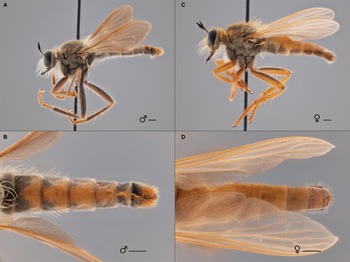
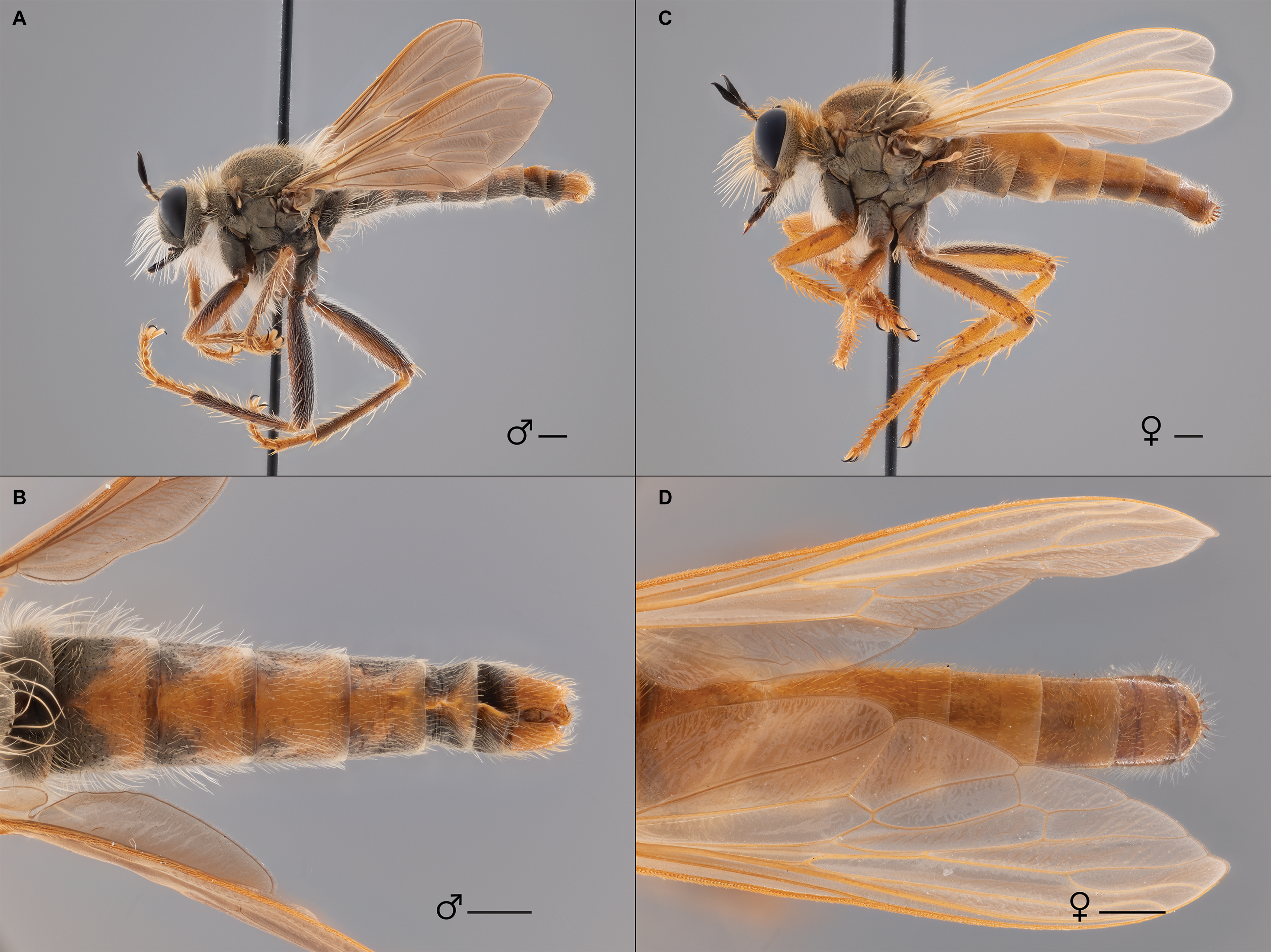
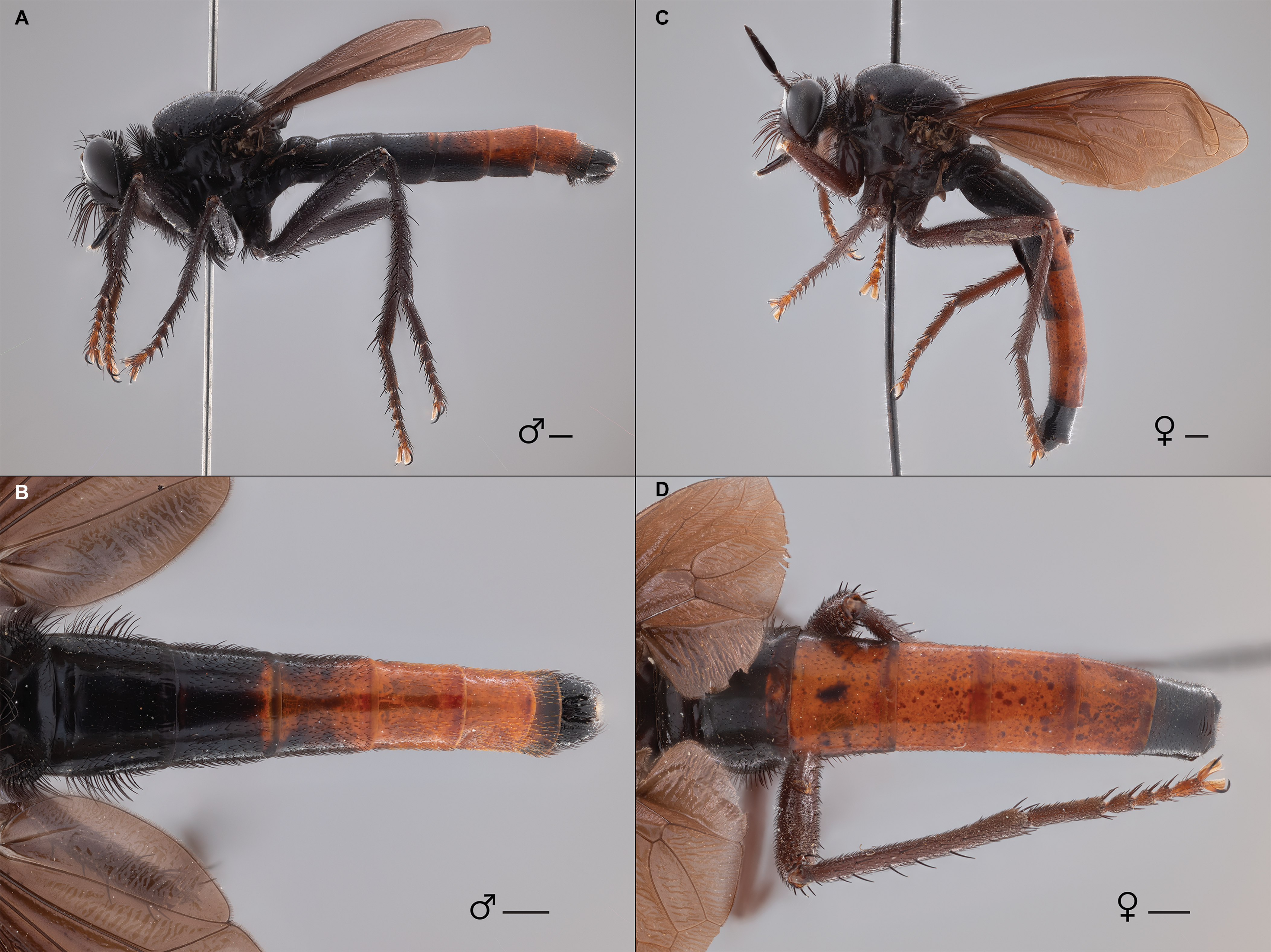
Ospriocerus latipennis (Loew, 1866) (broad-winged rusty robber; Fig. 2), a strictly Great Plains species, is known from Alberta, Saskatchewan, and Manitoba, Canada; it is listed in Adisoemarto (Reference Adisoemarto1967) as O. consanguineus (Loew, 1866). Ospriocerus pumilus (Coquillett, 1904) was erroneously included in the Alberta lists of Strickland (Reference Strickland1938) and Adisoemarto (Reference Adisoemarto1967). It ranges from Kansas south to Texas, United States of America (Fisher and Wilcox Reference Fisher and Wilcox1997; Cohen Reference Cohen2020).
Ospriocerus latipennis: A, male, lateral view; B, male, dorsal view of abdomen – Empress, Alberta, Canada, PMAE.IZ00140528 (PMAE); C, female, lateral view; D, female, dorsal view of abdomen – Milk River, Alberta, PMAE.IZ00157852 (PMAE). Scale bar = 1 mm.
Recently, while confirming the identity of an Ospriocerus vallensis Martin, 1968 (Idaho rusty robber) photograph from Oregon, United States of America (D.R. Paulson, personal communication), the present paper’s first author, R.A.C., realised that this species of intermontane grasslands, so similar looking to O. abdominalis, might be the Ospriocerus recorded in British Columbia (Fig. 3). Well before R.A.C. began studying robber flies in the early 1980s, British Columbia specimens of this large black and orange species were identified in the Canadian National Collection of Insects, Arachnids, and Nematodes (Ottawa, Ontario, Canada) and other collections as O. abdominalis. Adisoemarto (Reference Adisoemarto1967) also used this name for Alberta and British Columbia specimens; O. vallensis was described as a distinct species (Martin Reference Martin1968) just after Adisoemarto’s study was published. Based on these identifications, R.A.C. had always taken for granted that O. abdominalis was the correct name for the British Columbia species (Cannings Reference Cannings, Giberson and Cárcamo2014; Hébert et al. Reference Hébert, Jackson, Namayandeh, Grégoire Taillefer, Ghahari and Solecki2025). But is it? The present paper is the result of a re-evaluation of specimens of the genus in Canada.
Ospriocerus vallensis: A, male lateral view; B, male, dorsal view of abdomen – Oliver, British Columbia, Canada, ENT010-002723 (RBCM); C, female, lateral view; D, female, dorsal view of abdomen – Oliver, British Columbia, ENT024-006606 (RBCM). Scale bar = 1 mm.
Materials and methods
The general morphological terminology used is from Cumming and Wood (Reference Cumming, Wood, Brown, Borkent, Cumming, Wood, Woodley and Zumbado2009); most terms relating to male genitalia are from Cannings (Reference Cannings2002). English names are those listed by Cannings et al. (Reference Cannings, Cohen and McKnight2023). Taxonomy and geographical ranges in the United States of America are based on Fisher and Wilcox (Reference Fisher and Wilcox1997) and Cohen (Reference Cohen2020).
Specimens examined are housed in the Canadian National Collection of Insects, Arachnids, and Nematodes (CNC; Ottawa, Ontario); the Royal Alberta Museum (PMAE; Edmonton, Alberta); the Royal British Columbia Museum (RBCM; Victoria, British Columbia); the Royal Saskatchewan Museum (RSKM; Regina, Saskatchewan); the E.H. Strickland Entomological Museum, University of Alberta (UASM; Edmonton); and the collections of John Acorn (JAC; Edmonton); Gerald Hilchie (GJHC; Edmonton); and David Larson (DJLC; Maple Creek, Saskatchewan).
Body length measurements were made laterally from the face to the apex of the abdomen; antennae were excluded.
Specimens were photographed with a Nikon Z5 DSLR (Nikon, Tokyo, Japan) fitted with a Canon MP-E 65-mm macro lens (Canon, Tokyo, Japan) mounted on a WeMacro focus-stacking rail (WeMacro, Shanghai, China). Images were stacked with Helicon Focus 8 (Helicon Soft Ltd., Kharkiv, Ukraine) and edited with Adobe Photoshop (Adobe Inc., San Jose, California, United States of America).
Male genitalia dissection protocols generally follow Cannings (Reference Cannings2002). Genitalia were clipped off the abdomen and cleared for 12–15 hours in cold 10% KOH, then rinsed sequentially in glacial acetic acid and distilled water. They were dissected in glycerol and photographed in the same way as the whole specimens. The dissected material was then stored in a micro-vial containing glycerol, which was pinned under the specimen.
Photographs of live flies from Canadian localities on iNaturalist (https://iNaturalist.ca), an online platform for sharing natural history observations, are listed in the distributional information. Other information about prey is also taken from BugGuide (https://bugguide.net).
Results
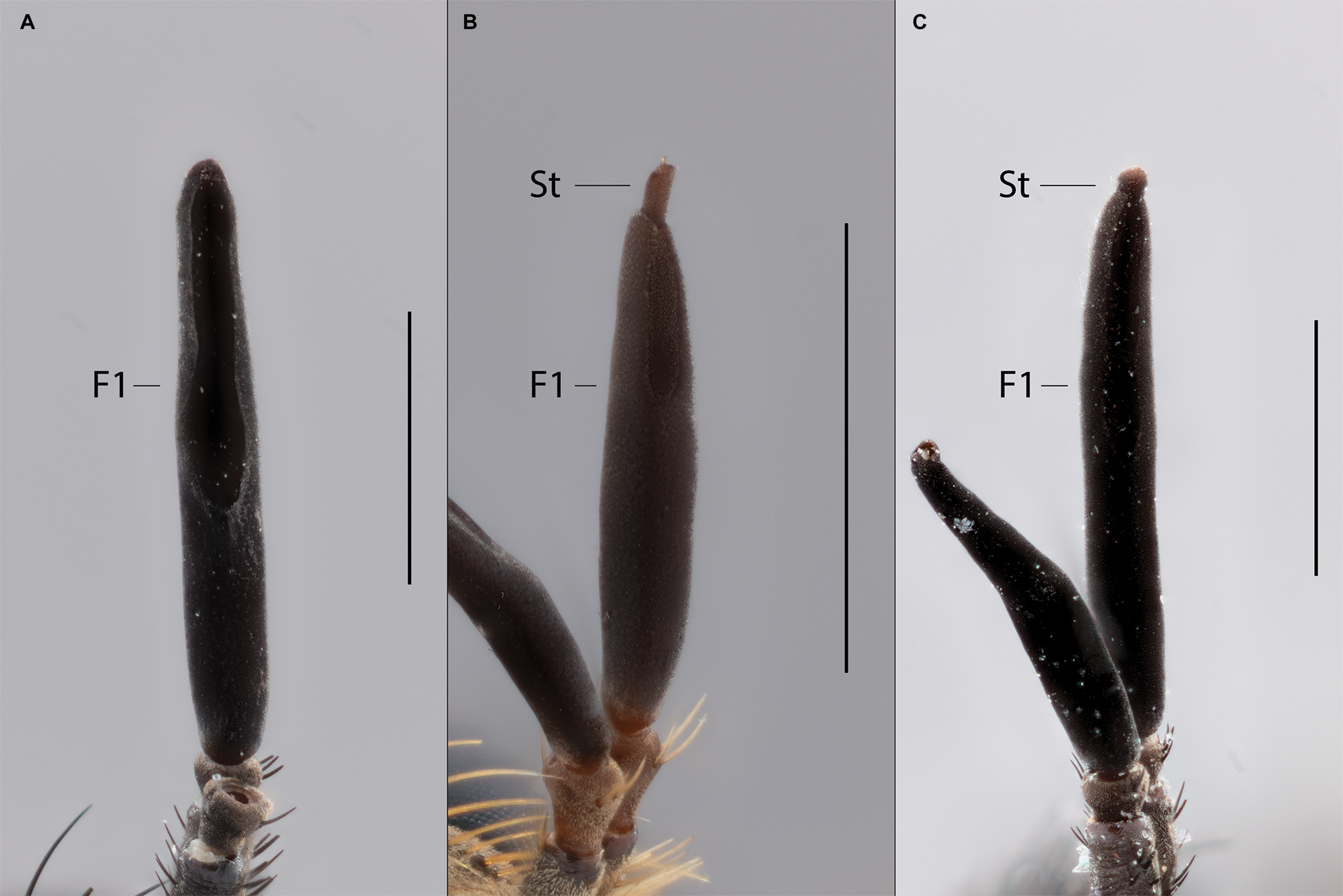
In this review of Ospriocerus in Canada, examination of specimens from British Columbia confirms that they are O. vallensis and not O. abdominalis. The main external differences between the two species are clearly outlined in the literature, for example, in Martin (Reference Martin1968) and Lavigne and Dennis (Reference Lavigne and Dennis2019). Despite this, the illustrations of the lateral view of the male terminalia of O. abdominalis and O. vallensis in the former paper are of little diagnostic value. However, differences in the antennal structure (Fig. 4) are diagnostic. Dissections of male genitalia herein represent the first detailed and comparative examination of these structures in these species. Notably, they add significant evidence that the similar-looking O. abdominalis and O. vallensis are distinct species. A comparison of exemplars from Alberta, Canada, and Wyoming and Arizona, United States of America, identified by external characters as O. abdominalis shows that the details of the genitalia among these specimens are closely similar (Figs. 5 and 6). In particular, because the shapes of the gonostylus and the associated lobes of the gonocoxite are vital in the linkage of the male and female genitalia during copulation, they are considered among the most critical characters for species separation in asilids. The striking similarities of these structures in the three specimens (Fig. 5B, D, F) emphasise that these widely separated populations are indeed conspecific.
Antennae: A, Ospriocerus abdominalis female – Big Beaver, Saskatchewan, Canada, ENT024-006605; B, O. latipennis male – Empress, Alberta, Canada, PMAE.IZ00140528 (PMAE); C, O. vallensis female – Oliver, British Columbia, Canada, ENT991-86458 (RBCM). F1, first flagellomere; St, stylus. Scale bar = 1 mm.
Comparison of male genitalia of Ospriocerus abdominalis from different regions of western North America: A and B, Pinhorn Grazing Reserve, Alberta, Canada, PMAE.IZ00170546 (PMAE); C and D, Chugwater, Wyoming, United States of America, ENT991-86456 (RBCM); E and F, Roosevelt Reservoir, Arizona, United States of America, ENT991-86455 (RBCM). Views: A, C, and E, epandrium, dorsal view; B, D, and F, gonocoxite, lateral view. gst, gonostylus; m lobe, medial lobe. Scale bar = 1 mm.

Male genitalia, Ospriocerus abdominalis – Pinhorn Grazing Reserve, Alberta, Canada, PMAE.IZ00170546 (PMAE): A, epandrium, dorsal view; B, hypandrium and left gonocoxite (right gonocoxite removed), ventral view; C, gonocoxite, lateral view; D, gonocoxite, dorsal view; E, phallus, ventral view; F, phallus, lateral view. cer, cercus; ej ap, ejaculatory apodeme; epan, epandrium; gcx, gonocoxite; gcx ap, gonocoxal apodeme; gp, gonopore (apical flange damaged); gst, gonostylus; hypan, hypandrium; m lobe, medial lobe; par sh, paramere sheath; vl lobe, ventrolateral lobe. Scale bar = 1 mm.

Three species of Ospriocerus are now known from Canada: O. abdominalis, O. latipennis, and O. vallensis. They are diagnosed and keyed here; colour patterns vary geographically. The key is adapted from Martin (Reference Martin1968) and Lavigne and Dennis (Reference Lavigne and Dennis2019) but is based on specimens from Canada and is meant to be used for the Canadian fauna.
In much of the western United States of America, O. abdominalis and O. vallensis are regionally sympatric. It is possible that in some collections where Ospriocerus specimens have not been identified using the key in Martin (Reference Martin1968), O. vallensis and other species have been overlooked and have been presumed to be the more widespread O. abdominalis. Curators should check the identification of Ospriocerus specimens in their care.
Identification key (also see species diagnoses)
-
1a. Black with orange or red on some abdominal segments (Figs. 1 and 3); bristles and hairs of body and legs mostly black. Antennal stylus absent (Fig. 4A) or present; if present, then short and as wide as long (Fig. 4C). Great Plains and valleys of the southern British Columbia Interior . .2
-
1b. Yellow and grey, usually with dark grey or black marks on sides of abdomen and on all or some femora (Fig. 2); bristles and hairs of body and legs white to pale brown. Antennal stylus longer than wide (Fig. 4B). Male genitalia as in Fig. 7. Cerci together V-shaped, apices extended past the epandrium apex; ventrolateral lobe of gonocoxite subapically with a brush of 4–6 long, curved bristles. Great Plains .O. latipennis
Figure 7.Male genitalia, Ospriocerus latipennis – Empress, Alberta, Canada, ENT991-86459 (RBCM): A, epandrium, dorsal view; B, hypandrium and left gonocoxite (right gonocoxite removed), ventral view; C, gonocoxite, lateral view; D, gonocoxite, dorsal view; E, phallus, ventral view; F, phallus, lateral view. cer, cercus; ej ap, ejaculatory apodeme; epan, epandrium; gcx, gonocoxite; gcx ap, gonocoxal apodeme; gp, gonopore; gst, gonostylus; hypan, hypandrium; lat ej pr, lateral ejaculatory process; m lobe, medial lobe; par sh, paramere sheath; sp sac, sperm sac; vl lobe, ventrolateral lobe. Scale bar = 1 mm.

-
2a. Antennal stylus absent (Fig. 4A). Abdominal sternites of both sexes usually black. Male genitalia as in Figure 6. Cerci expanded apicolaterally past apex of epandrium; ventrolateral lobe of gonocoxite tooth-like, ventrally directed; hypandrium narrow, weakly triangular, with shallow, bifid apical lobe. Great Plains .O. abdominalis
-
2b. Antennal stylus present, short, about as long as wide (Fig. 4C). Some abdominal sternites in both sexes usually with some red, normally on segments 4, 5–6, or 5–7. Male genitalia as in Figure 8. Cerci small, not expanded apicolaterally; ventrolateral lobe of gonocoxite almost as long as gonostylus, sickle-shaped, acute, and dorsally directed; hypandrium subequilateral triangle with strongly bifid and setose apical lobe extended posteriorly almost as far as tips of gonocoxite and gonostyli. Southern valleys of British Columbia’s Interior .O. vallensis

Male genitalia, Ospriocerus vallensis – Oliver, British Columbia, Canada, ENT024-006607 (RBCM): A, epandrium, dorsal view; B, hypandrium and left gonocoxite (right gonocoxite removed), ventral view; C, gonocoxite, lateral view; D, gonocoxite, dorsal view; E, phallus, ventral view; F, phallus, lateral view. Left gonocoxite was removed; structures in B, C, and D are mirrored images. cer, cercus; ej ap, ejaculatory apodeme; epan, epandrium; gcx, gonocoxite; gcx ap, gonocoxal apodeme; gp, gonopore; gst, gonostylus; hypan, hypandrium; lat ej pr, lateral ejaculatory process; lat pr, lateral process; m lobe, medial lobe; par sh, paramere sheath; sp sac, sperm sac; vl lobe, ventrolateral lobe. Scale bar = 1 mm.

Species accounts
Ospriocerus abdominalis (Say, 1824) (red-tailed rusty robber)
Ospriocerus aeacides Loew, 1866
Ospriocerus ventralis Coquillett, 1898.
Canadian Ospriocerus abdominalis specimens and photographs examined. AB, Alberta; SK, Saskatchewan.

Diagnosis. Length 16.7–20.5 mm; mean of 10 specimens = 18.5 mm. The abdominal colour pattern is variable. In the male, the abdomen is usually red from the apex of segment 2 to segment 6 or sometimes segments 7 and 8 (Fig. 1A, B); in the female, tergites are normally red dorsally from the apical areas of segment 2 to segment 5 (Fig. 1C, D). The sternites are usually black. The antennal stylus is absent (Fig. 4A). Dissected male genitalia are shown in Figure 6. The cerci are large and expanded apicolaterally past the apices of the epandrium. The hypandrium is a narrow, weakly triangular strip, with a shallow, bifid apical lobe much less developed than that of O. vallensis; the medial cleft is about half the length of the lobe. The ventrolateral lobe of the gonocoxite is a low tooth ventrally directed; the medial lobe is a short, strong hook. The gonostylus is sickle-shaped, acute, curved dorsally, and significantly longer than the lobes of the gonocoxite. Figure 5A–F compares selected parts of the genitalia of specimens from Alberta, Wyoming, and Arizona, showing little difference among them.
Range. Alberta east to Saskatchewan (not yet known from Manitoba) in Canada, and Minnesota south to Texas and California in the United States of America; Mexico. Ospriocerus abdominalis belongs to the western faunal element (Cannings Reference Cannings, Giberson and Cárcamo2014). In Canada, it has been found from Lethbridge east through southern Alberta (as far north as the Drumheller area) to southern Saskatchewan (east to Roche Percée and north to Fort Qu’Appelle). See Table 1 for records.
Taxonomic notes. Strickland (Reference Strickland1946) and Adisoemarto (Reference Adisoemarto1967) used the name Ospriocerus abdominalis for Alberta specimens; the name has been used for the species in North America for many years. Although Fisher and Wilcox (Reference Fisher and Wilcox1997) revived the use of O. aeacus because Wiedemann (Reference Wiedemann1828) determined that the name O. abdominalis was preoccupied, Lavigne and Dennis (Reference Lavigne and Dennis2019) retained it, agreeing with Coquillett (Reference Coquillett1898) that the new name, O. aeacus, was unnecessary. As indicated in the Introduction, despite using the name O. aeacus for many years, Cannings has reverted to O. abdominalis as the valid name of the species.
Notes on biology. Lavigne and Dennis (Reference Lavigne and Dennis2019) describe the species’ habitat in Wyoming as openings in pine and Douglas-fir forest and various types of shrub–steppe–grassland and grassland communities at elevations from about 1300 to 2400 m. In Canada, O. abdominalis inhabits prairie grasslands and dry rangeland environments (Fig. 9A) similar to those of O. latipennis.
Examples of Ospriocerus habitats in Canada: A, O. abdominalis – 3 km east–southeast of East Coulee, Alberta, along the Red Deer River, 51° 19' 46" N × 112° 27' 00" W, 22 June 2024 (photo by Matthias Buck); B, O. latipennis – 13 km south of Empress, Alberta, South Saskatchewan River, 50° 49' 57" N × 110° 01' 47" W, 28 July 2016 (photo by Matthias Buck); C, O. vallensis – view south to Oliver, British Columbia from the Fairview–White Lake Road, 49° 11' 16" N × 119° 35' 10" W, 19 May 2010 (photo by Robert A. Cannings).

Records in Canada range from 7 June to 24 August; 15 of 32 dates are in July.
Prey noted by Lavigne and Dennis (Reference Lavigne and Dennis2019) consists mostly of Hemiptera and Coleoptera. Rogers and Lavigne (Reference Rogers and Lavigne1972) and Lavigne and Dennis (Reference Lavigne and Dennis1994) recorded four species of Epicauta Dejean (Meloidae) as prey in Wyoming and Colorado, United States of America. In Montana, United States of America, a jumping spider, Phidippus purpuratus Keyserling (Araneae: Salticidae) was photographed feeding on O. abdominalis (ruxeh 2021).
Ospriocerus latipennis (Loew, 1866) (broad-winged rusty robber)
Ospriocerus consanguineus (Loew, 1866)
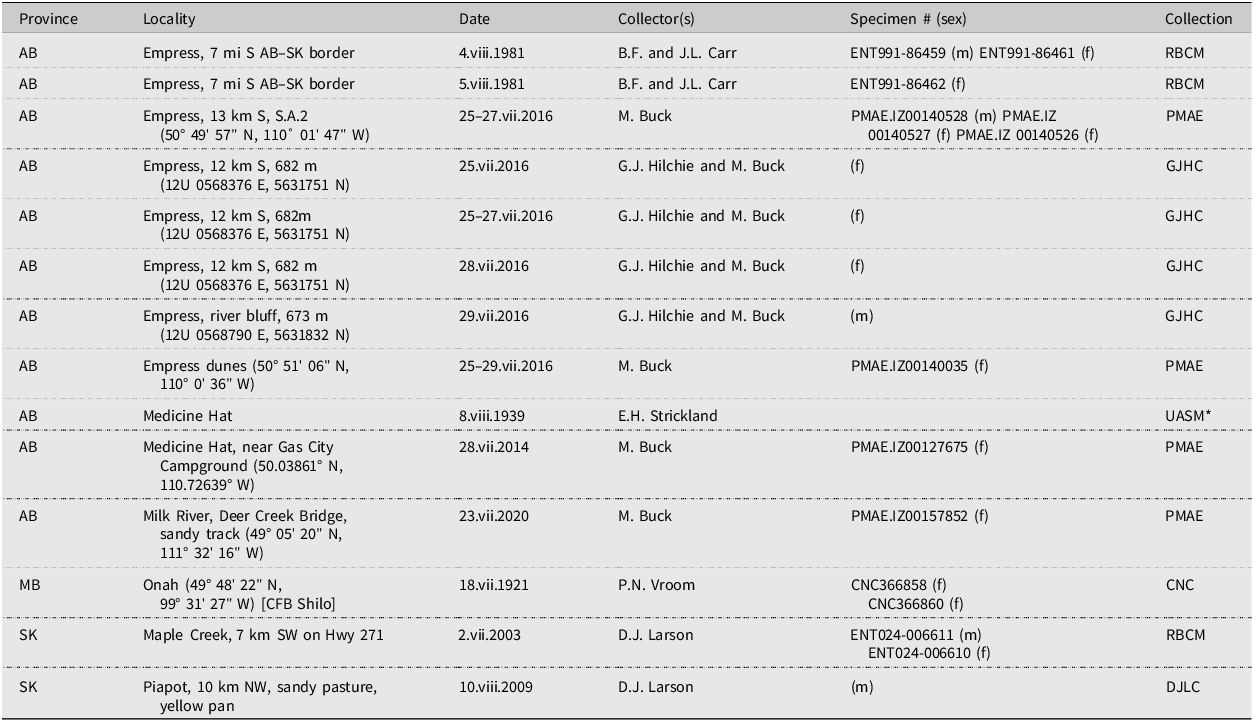
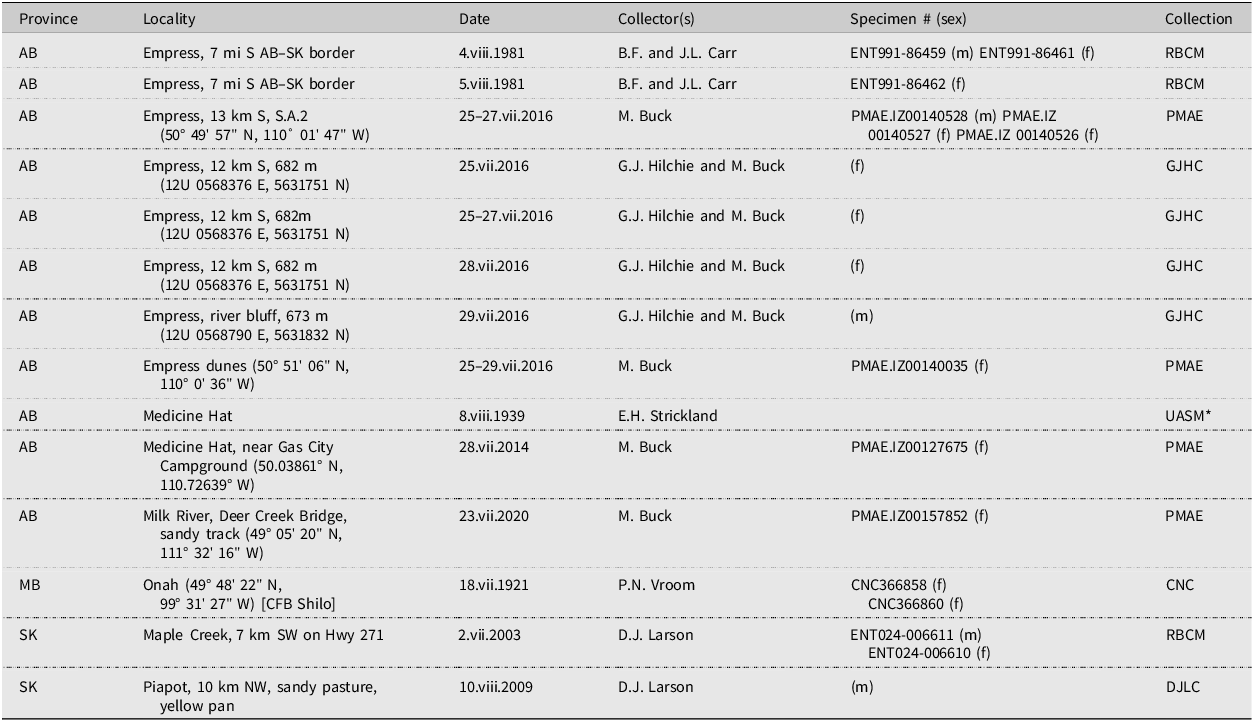
Canadian Ospriocerus latipennis specimens examined. AB, Alberta; MB, Manitoba; SK, Saskatchewan.
* in Adisoemarto (Reference Adisoemarto1967) as O. consanguineus
Diagnosis. Ospriocerus latipennis is, on average, the smallest of the three Canadian species, with a length of 14.2–20.0 mm; mean of 10 specimens = 16.9 mm. In Canada, it has a yellow or yellow–brown body, usually with dark grey or black marks laterally on the abdomen and on all or some femora (Fig. 2). Specimens from the southern United States of America, especially, can be orange–brown and have fewer grey markings. The setae are mostly white or pale brown. The antennal stylus is prominent and longer than wide (Fig. 4B). Dissected male genitalia are shown in Figure 7. The cerci together are V-shaped, with the apices extending posteriorly well past the end of the epandrium. The ventrolateral lobe of the gonocoxite is apically rounded and subapically bears a distinctive, strong brush of 4–6 long, curved bristles. The medial lobe is a darkened, acute hook facing laterally. The gonostylus in ventral view is elongate, moderately curved dorsally, with a blunt, acute tip; it extends posteriorly past the tips of the gonocoxite lobes.
Range. Alberta, Saskatchewan, and Manitoba in Canada, south to Utah, New Mexico, and Texas, United States of America; northern Mexico. The species belongs to the Great Plains faunal element (Cannings Reference Cannings, Giberson and Cárcamo2014). The known range in Canada is from the Milk River, Medicine Hat, and Empress areas of southern Alberta east through the Maple Creek and Piapot region of Saskatchewan to Onah in southwestern Manitoba. See Table 2 for records.
Taxonomic notes. Adisoemarto (Reference Adisoemarto1967) misidentified this species in Alberta as Ospriocerus consanguineus. Ospriocerus pumilus (Coquillett, 1904) is closely related to O. latipennis; it was listed from Alberta by Strickland (Reference Strickland1938). However, its known range is restricted to Kansas, Oklahoma, and Texas, United States of America (Fisher and Wilcox Reference Fisher and Wilcox1997; Cohen Reference Cohen2020).
Notes on biology. In Canada, Ospriocerus latipennis lives in prairie grasslands, rangeland, and associated sandy sites (Fig. 9B). In Wyoming, Lavigne and Dennis (Reference Lavigne and Dennis2019) recorded the species in various plant communities in short- to mid-grass plains and rangeland.
Adults are active in midsummer; Canadian records range from 2 July to 10 August.
Dennis and Lavigne (Reference Dennis and Lavigne1975) calculated that 56.5% of prey in a Wyoming study was Coleoptera, especially Notoxus apicalis LeConte (Anthicidae), targeted by the fly because of its great abundance in the habitat. This is a tiny beetle for a main prey item; calculated by weight, these percentages would be rather different. Hemiptera accounted for 18.7% and Diptera 10% of prey. Spiders were also taken. Lavigne and Dennis (Reference Lavigne and Dennis1994) documented five species of Meloidae as prey, three of them in the genus Epicauta.
Ospriocerus vallensis Martin, 1968 (Idaho rusty robber)
Ospriocerus vallensis Martin, 1968
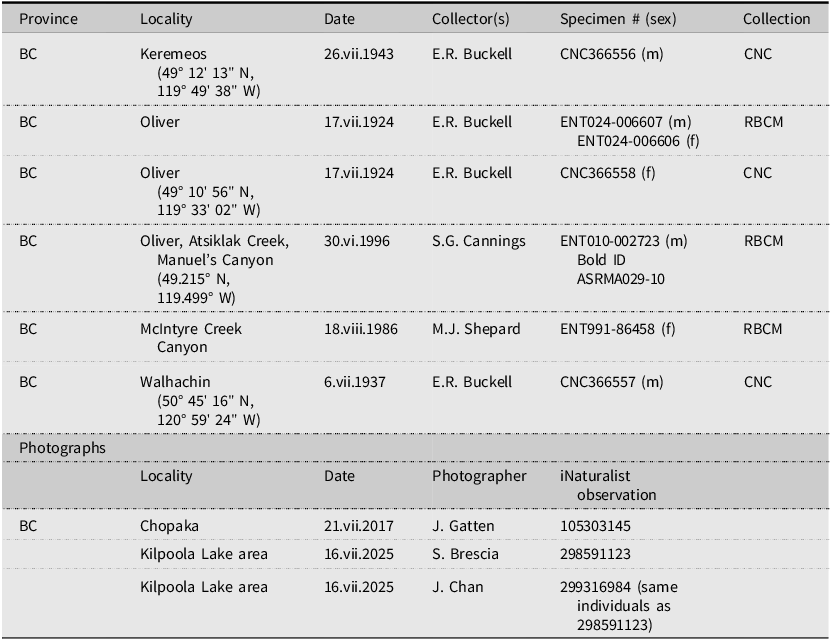
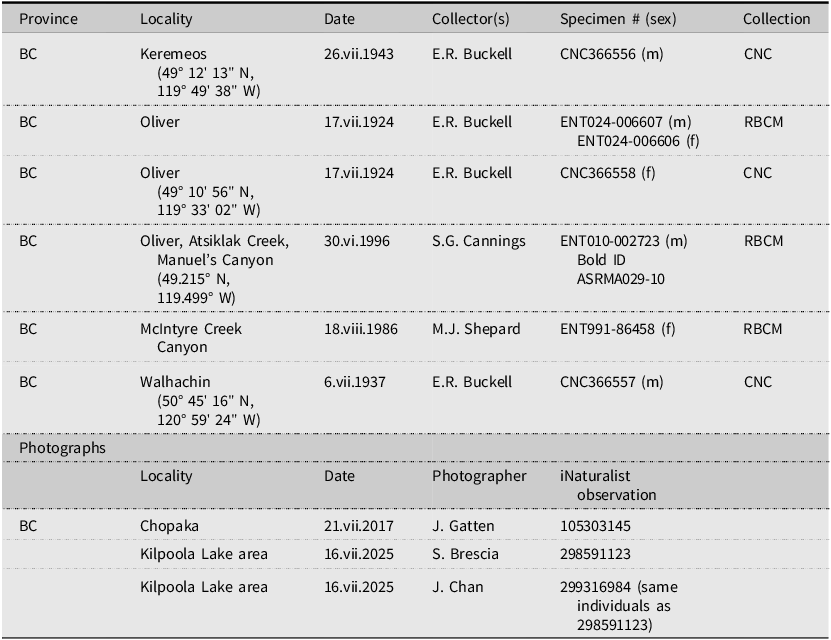
Canadian Ospriocerus vallensis specimens and photographs examined. BC, British Columbia.
Diagnosis. Ospriocerus vallensis is larger than O. abdominalis, with a length of 20.6–22.0 mm; mean of five specimens = 21.4 mm. The abdominal colour pattern is variable, but tergites are normally red dorsally from the apex of segment 2 or 3 to segment 7 or 8 (Fig. 3). Abdominal sternites 1–3 are black, and sternites 4–6 are red. Tergites 2–4 often have brownish pollen apicolaterally on the intersegmental membrane. The antennal stylus is short, about as long as wide (Fig. 4C). Dissected male genitalia are shown in Fig. 8. The cerci are small, not expanded apicolaterally as in O. abdominalis. The hypandrium is an approximate equilateral triangle with an elongate, strongly bifid, and setose apical lobe extending posteriorly almost as far as the tips of the gonocoxite and gonostyli. The ventrolateral lobe of the gonocoxite differs notably from the low tooth of O. abdominalis; it is almost as long as the gonostylus, sickle-shaped, acute, and dorsally directed; at its base, a strong, narrow tubercle is directed ventrally. The medial lobe is short, acute, and directed dorsally. The gonostylus is curved near the apex, acute, directed dorsally, and extended posteriorly to the apex of the ventrolateral lobe of the gonocoxite.
Range. British Columbia south into the United States of America, through Washington, Idaho, and Montana to Colorado, Nevada, and California. The species belongs to the Cordilleran faunal element, the part that inhabits Intermontane grasslands and shrub steppes in areas warmer and drier than the adjacent forests of the western mountains (Cannings Reference Cannings, Giberson and Cárcamo2014). In British Columbia, it is known mainly in the southern Okanagan and Similkameen valleys, but it has been collected as far north as Walhachin on the Thompson River near Kamloops. See Table 3 for records.
Notes on biology. Lavigne and Dennis (Reference Lavigne and Dennis2019) documented various grassland and shrub–steppe communities as O. vallensis habitat in Wyoming. In British Columbia, the relevant shrub–steppe communities are usually dominated by the shrubs Artemisia tridentata Nuttall (Asteraceae) or Purshia tridentata (Pursh) de Candolle (Rosaceae) and grasses such as Pseudoroegneria spicata (Pursh) A. Löve and Hesperostipa comata (Trinius and Ruprecht) Barkworth (Poaceae) (Fig. 9C)
Records in British Columbia range from 30 June to 18 August.
In British Columbia, O. vallensis is sympatric with the widespread red and black spider wasp, Priocnemis oregona Banks, 1933 (Hymenoptera: Pompilidae). This and other species of Ospriocerus that are red and black or all black might gain some protection through mimicry of similarly coloured, stinging pompilid wasps.
The relationship of Ospriocerus with blister beetles
Records of Ospriocerus species preying on blister beetles (Coleoptera: Meloidae) highlight a distinctive feature of the biology of this asilid genus – adults frequently are attracted to aggregations of meloids and often eat them. It is thought that the flies sequester the cantharadin poisons produced by the beetles and use them for their own protection, especially against predation by birds (Fisher Reference Fisher, Brown, Borkent, Cumming, Wood, Woodley and Zumbado2009). Therefore, perhaps, the bright colours of some species such as O. abdominalis and O. vallensis might be aposematic (Fisher Reference Fisher, Brown, Borkent, Cumming, Wood, Woodley and Zumbado2009), implying that the resemblance to some spider wasps is an example of Müllerian mimicry (J. Acorn, personal communication). It is interesting that O. latipennis has the most meloid prey species attributed to it but apparently lacks potentially aposematic colouration (B.D. Wingert, personal communication). Rogers and Lavigne (Reference Rogers and Lavigne1972) note that O. latipennis favours meloids as prey and list Zonitis atripennis (Say) from Wyoming, whereas Lavigne and Dennis (Reference Lavigne and Dennis1994) indicate the species feeds on Epicauta ferruginea (Say), E. normalis Werner, E. pennsylvanica (DeGeer), Gnathium minimum (Say), and Nemognatha lurida (LeConte) in that state. Lavigne and Dennis (Reference Lavigne and Dennis1994) report Epicauta atropos Pinto, E. ferruginea, and E. normalis as prey of O. abdominalis in Wyoming and Colorado. The meloid beetle, Lytta nuttalli Say, is likely the species fed on by O. abdominalis photographed on 8 July 2022 in Grasslands National Park, Saskatchewan by Nick Cairns (nacairns 2022).
Like O. abdominalis and O. latipennis, O. vallensis preys on meloid beetles, although this has not been reported in Canada. Near Adel, in Lake County, Oregon, Aaron Schusteff photographed a male eating an Epicauta species on 18 July 2012 (Schusteff Reference Schusteff2012a), and he discussed, with Eric Fisher, the relationship of the species with meloid beetles in Schusteff (Reference Schusteff2012b). Another male, photographed by Lisa Hill, fed on a Nemognatha meloid on 20 August 2023 near Estes, Franklin County, Washington (watercolorist 2023).
Acknowledgements
Dennis Paulson (Seattle, Washington, United States of America) piqued R.A.C.’s interest in the status of Ospriocerus species in Canada by requesting an identification of a fly in a photo taken by Netta Smith in Oregon; it turned out to be O. vallensis. Richard Yank (Ottawa, Ontario) checked the identities of Ospriocerus specimens in the Canadian National Collection. John Acorn (University of Alberta, Edmonton, Alberta), Matthias Buck (Royal Alberta Museum, Edmonton), Gerald Hilchie (Edmonton, Alberta), David Larson (Maple Creek, Saskatchewan), and Cory Sheffield (Royal Saskatchewan Museum, Regina, Saskatchewan) provided specimens and collection data. Matthias Buck kindly provided habitat photographs (Fig. 9A, B). John Acorn, Matthias Buck, Syd Cannings (Whitehorse, Yukon, Canada), Tristan McKnight (University of Arizona, Tucson, Arizona, United States of America), Brad Sinclair (Canadian Food Inspection Agency, Ottawa, Ontario), and Brittany Wingert (Edmonton, Alberta) commented on a draft of the paper and greatly improved its quality. Doug Yanega, University of California Riverside, California, gave valuable advice on nomenclature. Darren Pollock (Eastern New Mexico State University, Las Cruces, New Mexico, United States of America), Wayne Maddison (University of British Columbia, Vancouver, British Columbia) and Robb Bennett (Victoria, British Columbia) provided information on predators and prey of Ospriocerus. We appreciate their help and thank them all.
Competing interests
The authors declare that they have no competing interests.