Introduction
The process by which the state of Qin came to unify China has long been the subject of much academic study.Footnote 1 One of the salient achievements of the Qin empire, often mentioned by scholars, was the unification of measurement systems, including lengths, volumes, and weights. Qin Shihuangdi 秦始皇帝 (r. 246–221–210 BCE) and Qin Ershi 秦二世 (r. 210–207 BCE) each issued an edict about the regulation of the measurement systems (in 221 BCE and 209 BCE respectively), and had the edicts cast or engraved on the empire's standard containers and weights.Footnote 2 But there has been relatively little study of the means by which Qin empire bureaucrats attained accuracy and precision in measurement standards. Past scholars have focused on the conversion of Qin volumetric units to present-day metric units and on textual and philological analysis of the two edicts. They did not pay attention to issues such as how the standard measures and weights, and especially the measuring containers, came into being. We therefore lack a solid historical understanding of how Qin bureaucrats established the measuring standards, how they designed and produced the standard measuring containers, and how they ensured the precision of capacity and volume measurement. This article proposes to study the history of the attainment of accuracy and precision during the Qin Dynasty by focusing on the production and design of the measuring containers.
Literature Review
History of Technology
Measurement systems and technological methods by which accuracy and precision were achieved in ancient China have scarcely been explored in English scholarship, despite their fundamental importance in changing the ways technology developed in China. The grand project, “Science and Civilization in China,” initiated by Joseph Needham and continued by his successors, includes studies of mathematics, physics, mechanical engineering, and other subjects, all concerning accuracy and precision. But measurement systems and technological methods of producing the standard measures throughout multiple time periods in China were not undertaken as individual topics of inquiry, nor were they compared to other measurement systems or technological methods from other ancient civilizations.Footnote 3 Recently these topics have begun to attract attention from textual historians whose primary concern has been with the implementation of the measurement systems in different dynasties, with particular emphasis on the Qin Dynasty.Footnote 4 But the technological methods used to produce the standard measures have not been systematically explored in research to date.
Conversion of Qin Units to Metric Units
Extant Qin period measuring containers are made of either bronze or pottery.Footnote 5 Currently scholars have devoted a great portion of their work to the study of the conversion of Qin volumetric units into modern-day metric units and have attempted to trace their origins back to earlier periods.Footnote 6 The Qin containers were usually measured in units such as tong 甬/桶 (20,000 milliliter/ml), dou 斗 (2,000 ml), and sheng 升 (200 ml). Scholars have come to a consensus that the modern equivalence of one Qin sheng is about 200 ml.Footnote 7
For example, there is a famous bronze measuring container housed in the Shanghai Museum, traditionally called the “Shang Yang” fangsheng 商鞅方升 (the “Shang Yang” cuboidal container; Figure 1, left).Footnote 8 Its inscription includes a description of Shang Yang (ca. 390–338 BCE), when he bore the official title of “Daliangzao” 大良造 (the Greater and Superior Leader of the [Sovereign's] Accomplished).Footnote 9 Yang has several names recorded in history, such as Gongsun Yang 公孫鞅 (his original name), Wei Yang 衛鞅 (Yang from the Wei state), and Shang Yang 商鞅 (Yang, the Lord of Shang (Shang Jun 商君)). Scholars currently date this container to approximately 344 BCE.Footnote 10 Its inscription also describes the volume of the container: “shiliu cun wufencunyi wei sheng” 十六寸五分寸壹為升, which literally means “16.2 [cubic] cun is [one] sheng.” The length, width, and depth of the capacity of the cuboidal container are 12.5, 6.97, and 2.3 cm and its volume is approximately 202 cubic cm/202 ml. Scholars including Qiu Guangming 丘光明, Tang Lan 唐蘭 and Ma Chengyuan 馬承源 thus deduced that one sheng was about 202 ml in the 344 BCE Qin state.Footnote 11 According to this inscription, these scholars continued to convert Qin cun 寸 and chi 尺, the measuring units of length, into metric units. Since the capacity of the “Shang Yang” cuboidal container is 202 cubic cm or 16.2 cubic Qin cun, they deduced that one cubic Qin cun is approximately 12.48 cubic cm. Thus one Qin cun is 2.32 cm and one Qin chi is 23.2 cm.Footnote 12
The “Shang Yang” cuboidal container (left, accession no. 44331, length of the entire object 18.7 cm; dimensions of the cuboidal cavity: l. 12.4774 cm, wid. 6.9742 cm, dep. 2.323 cm, v. 202.15 cm3; w. 700 g) and the Qin Shihuang cuboidal container (right, accession no. 46425, length of the entire object 19 cm, dimensions of the cuboidal cavity: l. 12.47 cm, wid. 6.897 cm, dep. 2.51 cm, v. 215.65 cm3). Ca. 221 BCE. Collection of the Shanghai Museum. Photo by the author.

Considering the variations of the actual volume and the corrosion built on the walls of the container, scholars have determined that one Qin sheng was approximately 200 ml. When a Warring States period (475–221 BCE) bronze ding 鼎 was excavated from Ningxia Guyuan 寧夏固原, bearing an inscription of “Xianyang yi dou san sheng” 咸陽一斗三升,Footnote 13 Qiu Guangming and his colleagues continued to reconstruct the conversion of the Qin measurement units.Footnote 14 The inscription of the Guyuan ding says that the capacity of the ding should be one dou and three sheng (2000 + 200 x 3 = 2600 ml), while the actual capacity of this ding is merely 2500 ml. Consequently Qiu Guangming and his colleagues attempted to reconstruct that the actual capacity of one sheng in the Warring States period Qin state was about 192 ml. By utilizing many more examples, they concluded that the pre-imperial Qin volume system was similar to that of the imperial Qin system, despite the existence of variations.
This type of research is adequate for us to understand the conversion from Qin units to metric units, which we may rely on in future studies. But we should further illustrate the picture of the attainment of accuracy in measure in the Qin empire.
Philological Study of the Edicts
Past scholars’ primary interests of the Qin measurement policy lie at the philological study of the imperial edicts regarding the regulation of measurement systems.Footnote 15 Past scholars devoted much effort to the transcription and translation of the edicts, analysis of single characters, and semantic interpretation and separation of different sentences. Different versions of the transcribed and punctuated edicts have appeared and drawn attention from these scholars. They have also been keen to associate the edicts with historical records from Sima Qian's 司馬遷 (ca. 145–86 BCE) Shiji 史記 to explain how the Qin unified China with the measurement policy.
Methodology
Based on previous scholars’ achievement and contribution, I wish to reconstruct the history of the attainment of accuracy and precision in the volumetric system during the Qin Dynasty and in the future relate these findings to the ways in which the awareness of the Qin empire was cultivated among the populace.Footnote 16 I hope to first investigate what accuracy and precision meant to the Qin producers and users of the measuring containers. Establishing accuracy and precision was essential in all engineering and technological projects; this was extremely important in the study of all the grand infrastructure, palaces, and cemeteries building projects of the Qin empire. Did accuracy and precision entail following a single set of standards in Qin times? As Charles Sanft implies, there may have been more than one set of measurement systems extant even in the relatively unified Qin empire.Footnote 17 If the Qin bureaucrats who controlled the volumetric system were not following a single set of standards, how in turn did producers and users define accuracy and precision? And how did they handle multiple sets of standards and ultimately produce accurate measurements? I propose to begin by examining material features of the measuring containers. Close examination of the containers with the assistance of scientific analysis and 3D scanning technology will bring a new set of data to studies of this type.
The Production of Containers
I first explore how the clay models, cores, and molds of the bronze containers were prepared. This will help us relate the actual production methods to the definition and creation of accuracy and precision during the Qin Dynasty. First, we need to take account of the corrosion that has developed on metal surfaces of the containers and which has thereby increased the thickness of the walls, and thus altered the volume of the containers. By studying how the clay models, cores, and molds of the containers were prepared, we can go back to the original stage before corrosion had developed, and can thereby achieve a better understanding of how producers thought about the creation of volume.
Producers of the containers had to first create clay models and molds and pour molten bronze into the molds decorated with patterns and the characters of the imperial edicts in negative.Footnote 18 When the molten bronze had solidified, they had bronze containers with the patterns and edicts in the positive. However, the question of whether the casters began decorating on the models or molds awaits further examination. If they began by decorating on the models, they would have carved the patterns and edicts in positive form on the models (the decorated models appear virtually identical to the final bronze containers), thereby producing visually straightforward examples. This method would have required them to invest the decorated models with soft clay and wait for the clay to dry. They would then have removed the clay from the models to obtain the molds for casting. If, on the other hand, they began by decorating on the molds, they would have had to carve the patterns and edicts in negative form, or mirror-reverse fashion, onto the molds, which could have created a mold for casting. Since we do not have any textual record mentioning these processes, we will have to examine remaining casting traces on the bronze containers to determine which method the Qin casters most likely adopted.
Casting Inscription and Decorated Models
I argue that many of the containers in question originated from decorated clay models. The most solid evidence comes from my observation that most of the inscriptions on the containers were cast rather than engraved,Footnote 19 since the shape of the containers is relatively simple, and producers could well have begun by decorating on the molds. A definitive answer as to whether decorated models or molds were made first has always seemed elusive at surface level. But it does seem clear that the creation of any inscription containing multiple characters depended on carving the characters onto a clay model. The clay model provided a soft and easy-to-carve platform to create each stroke of the characters. Whereas for a mold maker to carve all the characters in mirror-reverse fashion onto the mold surface will always be much more difficult.
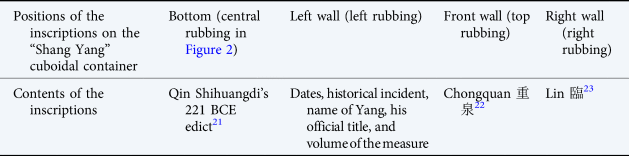
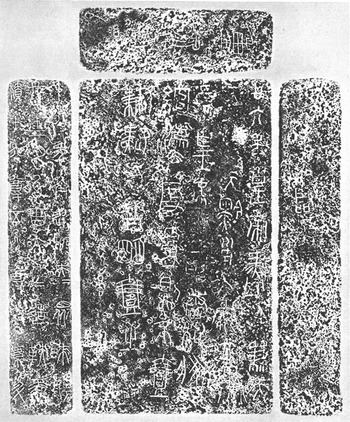
The well-known “Shang Yang” cuboidal container provides a clear clue to answering these questions. The inscription on the “Shang Yang” cuboidal container can be divided into four parts: the Qin Shihuangdi 221 BCE edict, the record of Yang and the volume of the measure, and two place names (Table 1 and Figure 2):Footnote 20
Inscriptions on the “Shang Yang” cuboidal container.

Rubbings of inscription on the “Shang Yang” cuboidal container. After Zhongguo gudai duliangheng tuji, 45, no. 81.

Translation of the inscription on the left wall:
[In the] eighteenth year, [the state of] Qi sent multiple ministers to pay [the state of Qin] an official visit.
On the day yiyou of the twelfth month in the winter of [the same year]. Yang, the Greater and Superior Leader of the [Sovereign's] Accomplished.
Volume [of the container] 16.2 [cubic] cun is [one] sheng
I observe that the 221 BCE edict and the place name “Lin” were cast, while on the other hand the record about Yang and the volume of the container and the place name “Chongquan” were engraved. Figure 3 demonstrates two characters of the 221 BCE edict, ming 明 and yi 壹 (center and right). The width of the strokes suggests that the characters could not have been engraved. It would appear that each character was instead first created on the clay model of the container by chiseling away the clay in carving out the strokes. This is why each stroke appears wide and smooth. The two characters can be compared to other cast characters on the Dagui 大騩 weight in the collection of the Nanjing 南京 Museum (Figure 3, left).Footnote 25 The width of the strokes of the characters, wan 綰 and fa 灋, also belonging to the 221 BCE edict, clearly shows that the inscription was cast and not engraved.
(Left) detail of the inscription on the Dagui 大騩 weight. Ca. 221 BCE. Nanjing Museum, accession no. 274. (Center and right) two characters, ming 明 and yi 壹, of the inscription of Qin Shihuangdi's 221 BCE edict on the “Shang Yang” cuboidal container. Photographs by the author.

By way of contrast, then, what do engraved characters look like? The left image of Figure 4 displays two engraved characters on one of the Jin Hou Su 晉侯穌 bells. Ma Chengyuan and others agree that this inscription was engraved by a knife made of a material harder than bronze, probably iron.Footnote 26 The strokes of each character appear blunt and narrow and, most importantly, there are traces of engraving inside each stroke. We can see in the image that the engraver had to cut off the hard bronze bit by bit, leaving repeated chiseling marks that would not have been present had the inscriber worked on a soft clay model, which would have allowed easy carving of long and smooth lines. The repeated chiseling marks are, astonishingly but subtly, very much visible on the portion of the record of Yang and the capacity of the cuboidal container (Figure 4, center and right).Footnote 27 One character in particular, shi 十 in the inscription on the left wall of the container, shows the chiseling marks. This part of the inscription was very clearly engraved rather than cast.
(Left) two engraved characters on one of the Jin Hou Su bells. Ca. 846 BCE. After Ma Chengyuan, “Jinhou Su bianzhong,” 16, fig. 2. (Center and right) the “Daliangzao Yang” 大良造鞅 inscription on the “Shang Yang” cuboidal container and detail of one character, shi 十 (indicated by an arrow). Photographs by the author.

A cast inscription can only be produced at the time of casting, while an engraved inscription is added later. This above-mentioned evidence suggests that the cuboidal container was cast in approximately 221 BCE, while the record of Yang and the volume were engraved later. The current consensus is that the cuboidal container was cast in Yang's time, around 344 BCE.Footnote 28 But if the 221 BCE edict was cast on the cuboidal container, it must surely date no earlier than 221 BCE. These observations overthrow the current consensus on the dating of the famous “Shang Yang” cuboidal container, and force us to revisit the history of the development of inscription production in ancient China, and by extension the sequence of container production.
If the cuboidal container was cast, this implies that its producers might have first created a decorated clay model with all inscriptions carved in positive, namely, a decorated model that looked exactly like the finished bronze container.Footnote 29 A decorated model with inscriptions carved in positive would have provided the producers with a visually straightforward example to refer to before the final casting. Moreover, the strokes of the characters ming and yi clearly illustrate that they were first carved on the soft clay model in positive. A clay mold was then packed around the model to absorb all carved, sunken inscriptions. The mold was then sliced into sections, removed from the model, and re-assembled. A clay core was inserted into the re-assembled mold to control the thickness of the walls of the container and its volume.Footnote 30 The core had to hold in position and should not join with the outer mold sections; otherwise there would have been defects, more specifically holes, in the final container.
Calculation, Imitation, or Replication?
Two more questions merit further investigation: 1) whether the Qin container casters used the same decorated model to produce multiple identical molds, and 2) whether they used the same core to produce models and molds. If the casters indeed used the same model to replicate identical molds, there is a possibility that we can find containers that share the same size, shape, same positioning and execution of characters of inscription, and decorative patterns, if any. If they used the same core to replicate models and molds, that makes a very different story. Containers that share the same core may not be identical in terms of size, shape, and positioning and execution of characters of inscription. But the volume or shape of the cavity, namely the empty sunken parts, of the containers would be identical in terms of size and shape.
Regarding the first question, the casting of bronze weights may serve as one reference point. I have examined over fifty Qin weights and not located a single identical pair.Footnote 31 Artefacts cannot be superimposed and compared easily unless they can be turned into 3D virtual models, and I have 3D-scanned some of the weights and provided related images and 3D models of the weights online so that other scholars can make their own comparisons.Footnote 32 My finding is that the bronze weights merely appear similar, and their casters likely consulted the designs of some earlier, original, or standard weights, but they did not replicate them.
Distinct from the weight casters’ concerns about mass and shape of solid weights, container casters on the other hand attended to the volume of the containers. I have examined and compared two containers, namely the “Shang Yang” cuboidal container and another measure also bearing Qin Shihuangdi's 221 BCE edict (Figure 1, right).Footnote 33 Though not identical, their size and shape are highly similar; and the positioning and execution of their inscriptions differ. These observations allow me to conclude that the two containers did not come from the same decorated model, but their volumes are quite similar, about 202 and 216 ml. We know that corrosion and tension over two millennia may have changed the shape and size of the bronze to a certain degree; thus the 14 ml variation is not a significant variation. Qiu Guangming and his colleagues, and the staff of the Shanghai Museum, Shanghai Shi Ceshi Jishu Yanjiusuo 上海市測試技術研究所, and the Shanghai Shi Jiliang Ceshi Guanliju 上海市計量測試管理局 carried out detailed measurements of the rectangular cavities of the two containers and found that their dimensions are very similar (12.5 × 7 × 2.3 and 12.5 × 7 × 2.5 cm3).Footnote 34 Taking into account the likely corrosion and deformation of the bronzes over time, we can conclude that the two containers share a very similar volume and also have cavities of the same size and shape.
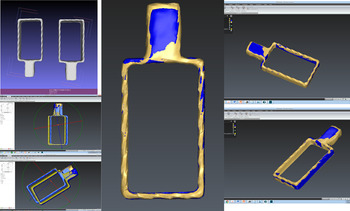
I made a 3D scan of the two containers and superimposed one onto the other in professional 3D computer software (Figure 5).Footnote 35 The result confirmed the measurements that the size and shape of their cavities are the same. Theoretically, to achieve the same volumes the rectangular cavities of the two containers do not need to share the same size and shape. For example, if one is 12.5 x 7 x 2.3 cm3, the other could be 20 x 5 x 2.2 cm3; their volumes are the same but the shapes of their cavities are different. It seems, however, that at least in this instance the casters of the two containers did not achieve the same volume by calculation. The superimposition result implies instead that they might have referenced from the shape of a standard container, or even shared the same core for their casting.
Comparing the cavities of the “Shang Yang” and the Qin Shihuang cuboidal containers. Top left: 3D models of the two containers, processed in Meshlab. We can see that their general shapes are slightly different. Center left and bottom left: attempting to superimpose the cavity of one container upon that of another, processed in 3D Reshaper. Center: finding no mismatch when the cavities of the two containers superimposed. Top right and bottom right: different views of the superimposed containers. Images by the author.

The shape of a container was determined by the shape of the assembled outer mold sections and the thickness of the metal by the space between the core and the outer mold, while the cavity of a container was determined by the shape and size of its core.Footnote 36 The focus of the container casters was always on the volume of the containers. The size and shape of the containers were usually a lesser concern. By sharing the same core, or by replicating cores of the same size and shape, the casters could easily and efficiently produce containers sharing the same volumetric standard. One may question the likely factors that might lead to any variation. Since the cores were made of clay, they might shrink to a certain degree during the pouring process when they encountered the hot molten bronze. But casters could bake the cores in advance before inserting them into the molds for casting.Footnote 37 Baking the cores makes water evaporate and burns off impurities, thus solidifying, stabilizing, and consolidating the shape and size of the cores, and this significantly reduces the possibilities of shrinkage during the pouring. Casters might well insert baked cores into the molds for casting and thereby reduce the risk of changes to the final volume of the containers. They could also choose a type of clay with a lower degree of contraction. Moreover, casters could also put soft clay into the cavity of an existing container and thereby obtain a clay core that bore the shape and size of the cavity of the existing container. Hence, they could replicate the shape and size of the cavity of almost all containers, and thus replicate the volumes and achieve the same volumetric standard.
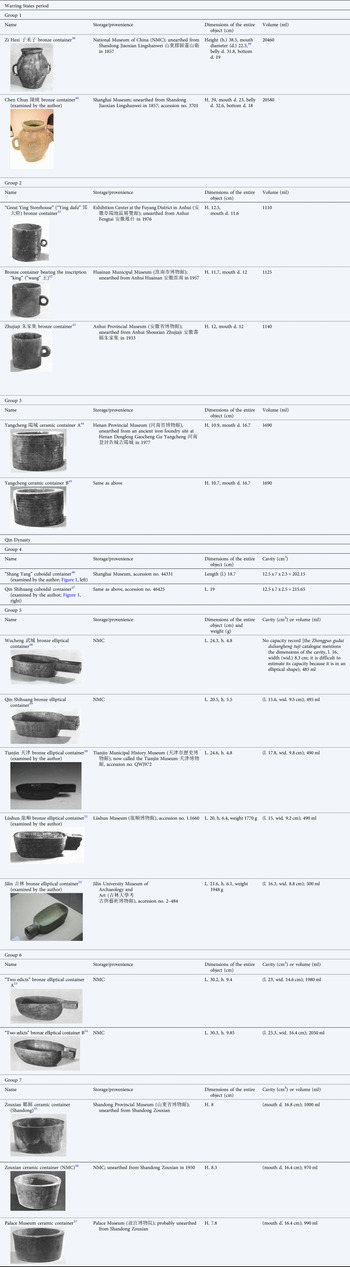
Table 2 provides a list of Warring States period and Qin Dynasty containers that provide more interesting clues:
List of Warring States period and Qin Dynasty containers that share almost the same volumes and cavities of very similar size and shape.

Although I have not examined and 3D-scanned all of these containers in person, the dimensions of their cavities provide interesting clues. We can observe from the images that the containers within each group may not derive from the same decorated models. But their cavities seem to be of a very similar size and shape. Further detailed research would be needed to reach firm conclusions on these issues. Observing the containers from Group 1 to Group 3, we may surmise that the practice of using the same clay cores to produce Qin Dynasty containers sharing cavities of the same size and shape might have developed since at least the Warring States period.
I have not located any use of spacers in any of the objects I have examined; but spacers that were used to sustain the core in the assembled mold, and thereby ensure the thickness of the walls of the containers, were not important. The wall thickness would not affect the volume. If the mold was placed in a fashion that the cavity faced the bottom, the core would be easily sustained and stabilized.
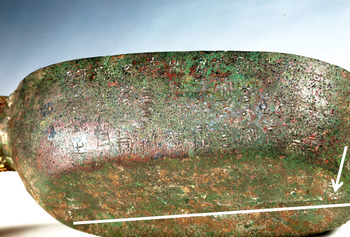
I found a very obvious mold line on the Tianjin bronze elliptical container (Figure 6). This mold line indicates that this container was cast from a mold assembled from separable mold sections. This is evidence of the use of the traditional section-mold casting method on Qin bronze containers.Footnote 58 Traditional bronze-casting methods still prevailed. In addition, surmoulage containers—those whose molds were created by investing clay around existing bronzes—probably did not exist. The newly cast bronzes would appear very similar to the original ones but they are slightly smaller because bronze shrinks as it cools. The shrinkage of the surmoulages would reduce the volume of the surmoulage container as compared to that of the original container, and the surmoulage technique is thus unsuitable for making measuring containers.
Mold line on the Tianjin bronze elliptical container, indicated by an arrow, along a straight line. Ca. 221 BCE. Tianjin Museum, accession no. QWJ972. Photo courtesy of the Tianjin Museum.

We have now established that the casters of the “Shang Yang” and Qin Shihuang cuboidal containers (Group 4, Table 2) might have shared the same core, or replicated the cores, in order to produce the cavities of the containers to maintain a standard volume and achieve an accurate and precise measurement. This implies that the Qin casters probably did not need to make careful calculations to measure volumes of containers. They could simply replicate or imitate the cores of standard containers and achieve the same volumetric standards. These hypotheses thus delineate a simple yet efficient method of attainment of accuracy and precision. This will eventually lead us to the larger question of what is really meant by the unification of the measurement systems of the Qin empire.Footnote 59
Bronze Being the Material for Establishing Standards
Currently we have two types of containers, made of either bronze or pottery. In past decades very few of them were archaeologically excavated but some were unearthed in Shandong Zouxian (Group 7, Table 2).Footnote 60 Recently, more pottery containers were excavated from the same place.Footnote 61 Scholars who have researched these finds have provided the volume data on the Zouxian pottery containers; but they have not considered whether the containers would have shared the same clay core as a means of ensuring efficiency of capacity.Footnote 62 Further research is needed to determine the production methods for the pottery containers.Footnote 63
The dominant material for establishing volumetric standards was bronze. The material choice constituted one of the essential concerns of the Qin bureaucrats. Whilst pottery containers can be very durable when handled with due care, in other circumstances pottery is considerably more fragile than bronze. Low porosity might be another significant factor favoring bronze. The beautifully executed inscriptions of the imperial edicts were also more prominent on bronze than on pottery. As long as neither pottery nor bronze containers deform, and there is no defect on the cast containers and no hole in the pottery ones, either material can create excellent vessels to maintain the volumetric standard; but bronze obviously ranked higher than pottery.
Design Origins of the Measuring Containers
The design origins of the Qin measuring containers are worth examining. My investigation of the design origins of the Qin weights reveals that they had close association with pottery jars from southeastern China and bronze bells.Footnote 64 This is a new field of research tracing the artistic references the Qin producers consulted. The artistic associations between the measuring containers and earlier pottery vessels, bronze measuring cups, dou 斗, shao 勺, jue 爵, and other vessels may be revealing when we find more examples. These vessels differed from the measuring containers in function, nevertheless, their shape and decorative patterns were designed with similar concerns. Scraping the inner walls of the bronze measuring containers, if any, would adjust the volume of the containers, which might have been a skill inherited from casters in charge of post-processing and polishing of earlier bronze vessels. I believe that these pursuits of the origins of techniques and designs will help illustrate a world of artistic relationships unknown to previous scholars.
Conclusion
This article provides a fresh perspective on the history of technology in ancient China. We can look into how standard settings of accuracy and precision contributed to the development of technology in the Qin empire. Investigating the foundations of all grand projects of the Qin empire involves the study of the so-called “unification of the measurement systems” because accurate and precise measurement was essential for the success of these projects. I have paid particular attention to how the measuring containers were produced. This study contributes to understanding how Qin bureaucrats utilized these actual, physical objects to define the concepts of accuracy and precision.
We now have better knowledge about the production of measuring containers and the methods used to inscribe characters on bronzes. Most of the extant measuring containers were made of bronze, and were produced with a variety of methods, in which replicating clay cores to produce containers with identical capacity seemed to be an efficient and most feasible method. This article thus enhances our understanding of how Qin producers cast bronzes that served as measuring standards.
The regulation of measurement systems and the technological methods used to establish standards of accuracy and precision are a burgeoning field in the broader realm of world history, and it has received attention from historians of civilizations other than China.Footnote 65 The history of the creation of the international metric system in the nineteenth-century France is also well-studied, for example.Footnote 66 Accordingly, this article contributes to this area of world history, and a fruitful comparison for the future may lie in contrasting the Qin empire with ancient Mesopotamia and France in the nineteenth century in order to examine how different regimes established standards and attained accuracy and precision with multiple technological means.
This article has also demonstrated the usefulness of incorporating advanced technologies, such as 3D modeling, in examining the production traces of Qin measuring containers. Artefacts can be superimposed upon one another only using virtual technology. It is challenging to confirm replication between two objects with seemingly identical shapes and designs, which are stored in different museums. 3D models of objects with seemingly identical shapes and designs will prove the best virtual models for comparison for the purposes of displaying whether said objects share exactly the same shape, or whether they merely appear similar. Few scholars have applied this methodology to the field of the history of technology in China.Footnote 67 It is to be hoped that the demonstration in this article will generate new avenues of development in the burgeoning discipline of digital humanities.