Developmental psychopathology has long recognized the importance and complexities of two or more disorders co-occurring (e.g., Caron & Rutter, Reference Caron and Rutter1991). In this paper, we shift the focus from comorbidity of disorders to possible co-occurrences among vulnerabilities to the development of psychopathology. Building on a long and honored history (Garmezy, Reference Garmezy1971; Masten & Garmezy, Reference Masten, Garmezy, Lahey and Kazdin1985; Murphy & Moriarty, Reference Murphy and Moriarty1976; Werner & Smith, Reference Werner and Smith1977), the concept of vulnerability to psychopathology fits well with an ontogenic process perspective (Beauchaine & McNulty, Reference Beauchaine and McNulty2013). Better understanding of vulnerability has the potential to reveal key mechanisms in the development of psychopathology (Ingram & Price, Reference Ingram, Price, Ingram and Price2010). In this paper, we build on the literature on specific individual vulnerabilities by proposing and testing a model of co-occurrence between infant vulnerabilities at two levels of analysis, each of which has been implicated in the intergenerational transmission of risk for psychopathology in infants born to women at elevated risk for perinatal depression, and examining the roles of prenatal and postnatal depression exposure on their co-occurrence. We further consider continuities and discontinuities, over the first year of infants' lives, in the patterns of co-occurrence among vulnerabilities, and the potential role of mothers' prenatal and postnatal depressive symptom levels in those patterns of continuities and discontinuities of co-occurrence. Specifically, we examine levels of prenatal depressive symptoms in mothers as a potential moderator in the co-occurrence between two vulnerabilities and in the continuity and discontinuity of co-occurrence and also examine questions of dose and timing, in terms of potential exposure to mothers' depression prenatally, in the postpartum, or in both developmental time periods.
At the psychophysiological level of analysis of vulnerability, asymmetry in frontal EEG activation during a resting baseline has been well established as an index of individual differences in emotion regulation beginning in infancy, with numerous studies finding that greater relative left frontal activation is associated with approach behavior/positive affect and greater relative right frontal activation is associated with withdrawal behavior/negative affect (e.g., Fox, Calkins, & Bell, Reference Fox, Calkins and Bell1994; Fox & Davidson, Reference Fox and Davidson1984). In particular, measures of resting frontal EEG asymmetry are thought to reflect traitlike tendencies and styles of processing affective information (Coan & Allen, Reference Coan and Allen2004). Prenatal and postpartum depression in women have both been found to be associated with the pattern of right frontal EEG asymmetry in their infant offspring, with moderate effect sizes (as meta-analytically reviewed by Thibodeau, Jorgensen, & Kim, Reference Thibodeau, Jorgensen and Kim2006); and that pattern in infants has been found to be prospectively associated with early indices or precursors of psychopathology, such as more stable observed behavioral inhibition over the first 4 years of life (Fox, Henderson, Rubin, Calkins, & Schmidt, Reference Fox, Henderson, Rubin, Calkins and Schmidt2001). Overall, resting frontal EEG asymmetry scores, beginning within the first month of life, have been found to be at least moderately stable over the course of infancy (Bell & Fox, Reference Bell, Fox, Dawson and Fischer1994; Field, Hernandez-Reif, & Diego, Reference Field, Hernandez-Reif and Diego2006; Fox, Bell, & Jones, Reference Fox, Bell and Jones1992), although stability between late infancy and 24 months of age is low (Howarth, Fettig, Curby, & Bell, Reference Howarth, Fettig, Curby and Bell2015).
At the behavioral level of analysis of vulnerability to the later development of psychopathology in infants, most attention has focused on trait-level negative affectivity (NA) temperament. As conceptualized by Derryberry and Rothbart (Reference Derryberry, Rothbart, Kalverboer and Gramsbergen2001), temperament NA refers to infants' tendencies to engage particular reactive processes in the face of negative emotions such as frustration or fear. Although temperament is understood to reflect behavioral tendencies to regulate emotion and physiological processes, it is typically measured in relation to patterns of behavior. Both prenatal and postpartum depression in mothers have been associated with infants' greater NA (Davis et al., Reference Davis, Snidman, Wadhwa, Glynn, Schetter and Sandman2004, Reference Davis, Glynn, Schetter, Hobel, Chicz-Demet and Sandman2007; Huot, Brennan, Stowe, Plotsky, & Walker, Reference Huot, Brennan, Stowe, Plotsky and Walker2004; Rouse & Goodman, Reference Rouse and Goodman2014). Conversely, NA in infants has been prospectively associated with higher levels of internalizing and externalizing problems among toddlers and preschool-aged children (Gartstein, Putnam, & Rothbart, Reference Gartstein, Putnam and Rothbart2012). Especially striking in terms of infant vulnerability to psychopathology, the specific infant temperament tendency to express negative emotions has been found to predict behavior problems and psychopathology as far forward as middle childhood (Bates, Bayles, Bennett, Rige, & Brown, Reference Bates, Bayles, Bennett, Ridge and Brown1991; Sayal, Heron, Rowe, & Ramchandani, Reference Sayal, Heron, Maughan, Rowe and Ramchandani2014) and even adolescence (Guerin, Gottfried, & Thomas, Reference Guerin, Gottfried and Thomas1997; Teerikangas, Aronen, Martin, & Huttunen, Reference Teerikangas, Aronen, Martin and Huttunen1998). Moreover, the temperament construct of NA can be reliably identified as early as 3 months of age (Gartstein & Rothbart, Reference Gartstein and Rothbart2003). Although NA has been found to be relatively stable over periods of 3 months within infancy, it generally increases over infants' first year of life (Bridgett et al., Reference Bridgett, Gartstein, Putnam, McKay, Iddins and Robertson2009; Gartstein & Rothbart, Reference Gartstein and Rothbart2003; Rothbart, Reference Rothbart1986). Despite this shift toward increasing NA over infancy, infant NA was found to be strongly associated with NA in preschool-aged children (Putnam, Rothbart, & Gartstein, Reference Putnam, Rothbart and Gartstein2008).
Given the strength of the evidence for each of these psychophysiological and behavioral levels of analysis of vulnerabilities in the intergenerational transmission of risk from depression in mothers, there are important reasons to consider how they may be associated with each other. The Goodman and Gotlib (Reference Goodman and Gotlib1999) model for the transmission of risk for the development of psychopathology from depression in mothers to their children argues for the importance of multiple domains of infant functioning to index vulnerabilities. Moreover, it is increasingly understood not only that risk factors, such as depression in mothers, are likely to be associated with heterogeneous vulnerabilities but also that no single vulnerability in infants is likely to explain the development of psychopathology (Cicchetti & Rogosch, Reference Cicchetti and Rogosch1996). In this paper, we consider the importance of understanding co-occurrences across psychophysiological and behavioral levels of analysis of vulnerabilities to the development of psychopathology in infants of mothers with elevated risk for perinatal depression given their history of depression prior to pregnancy.
In a seminal paper on domains of emotion regulation, Bauer, Quas, and Boyce (Reference Bauer, Quas and Boyce2002) called for investigation of how multiple systems relate to each other, albeit with a specific focus on biological systems, as being promising in enhancing prediction of later psychopathology. Consistent with that understanding, support has been emerging for the importance of studying co-occurrences across multiple levels of analysis of vulnerabilities (e.g., Obradović, Reference Obradović2016; Rotenberg & McGrath, Reference Rotenberg and McGrath2016). Systems working in sync with each other, which is sometimes referred to as coupling or coherence, may suggest more adaptive emotion regulation processes. For example, DiPietro, Costigan, and Pressman (Reference DiPietro, Costigan and Pressman2002) and DiPietro, Costign, Shupe, Pressman, and Johnson (Reference DiPietro, Costigan, Shupe, Pressman and Johnson1998) have shown that greater coupling of fetal heart rate and body movement is associated with a higher level of integration of the central nervous system and, later, with better infant state regulation; that such coupling increases with gestational age; and that lower coupling is found in fetuses of lower socioeconomic status women and those with higher daily stress levels.
Coupling of vulnerabilities in infants may similarly be suggestive of more adaptive regulation. Beauchaine (Reference Beauchaine2015) and Marsh, Beauchaine, and Williams (Reference Marsh, Beauchaine and Williams2008) argue that dysynchrony across levels of analysis, in particular between behavioral (e.g., observed sadness) and physiological (e.g., respiratory sinus arrhythmia) systems, may be a marker of emotion dysregulation. Similarly, Nigg (Reference Nigg2006) suggested that if physiological and temperamental domains do not coregulate, there is increased risk for the development of psychopathology. That is, it may be most adaptive when the systems at different levels of analysis work in sync with each other, even if both reflect a vulnerability; a mismatch (lower coherence or less association) between vulnerabilities may reflect greater risk for the development of psychopathology. Specifically, temperament NA and right frontal EEG asymmetry are measures of highly related systems, with both being understood to reflect tendencies toward behavioral withdrawal (e.g., Fox, Reference Fox1991; Rothbart & Derryberry, Reference Rothbart, Derryberry, Lamb and Brown1981). Thus, examining these two levels of analysis of vulnerability allows for consideration that depression exposure may be associated with dysynchrony between these two systems, suggesting emotional dysregulation.
In general population samples, not taking mothers' depression into account, studies of associations between infants' EEG and temperament (psychophysiological and behavioral levels of analysis of vulnerabilities to the later development of psychopathology, respectively) have yielded mixed findings. However, consistent with the longstanding understanding that resting frontal EEG asymmetry is an early psychophysiological marker of NA in infancy and that temperament is understood to reflect biologically based (i.e., nervous system) dispositions (e.g., Fox, Reference Fox1991; Rothbart & Derryberry, Reference Rothbart, Derryberry, Lamb and Brown1981), infants' resting relative right frontal EEG asymmetry has been found to be associated with higher maternal-rated fear in 9-month-old infants (Schmidt, Reference Schmidt2008), with greater distress in response to maternal separation in a small sample of 10-month-olds (Davidson & Fox, Reference Davidson and Fox1989), and with more inhibited behavior at 14 months among the subset of infants who had exhibited high levels of reactivity to novel sensory stimuli at 4 months of age (Calkins, Fox, & Marshall, Reference Calkins, Fox and Marshall1996). Resting relative right frontal EEG asymmetry and fear temperament (a component of NA), however, were not significantly correlated in 10-month-olds; moreover, neither 10-month-olds' EEG asymmetry predicted fear in 24-month-olds nor did 10-month-olds' fear predict EEG asymmetry at 24 months of age (Howarth et al., Reference Howarth, Fettig, Curby and Bell2015). The mixed support for associations between these two levels of analysis of vulnerability (psychophysiological [EEG] and behavioral [NA]) suggests a possible role of a moderator variable, in that for different subsets of infants, the direction of the association may differ. We explored the role of exposure to maternal prenatal depression as a possible moderator in that prenatal depression may disrupt the expected coherence and be associated with lower levels of association between the two levels of analysis of vulnerabilities. We further considered the possibility that the ongoing development of these systems may reveal reorganization, potentially yielding changes in coherence over the course of infancy.
How might exposure to mothers' depression during pregnancy be expected to be associated with the extent to which vulnerabilities co-occur? Heritability is one consideration in that, rather than inheriting a risk for depression per se, infants of depressed mothers are understood to inherit a predisposition to depression, including either trait negative affectivity (temperament) or relative right frontal resting EEG asymmetry or both. General tendencies at each of these two levels of analysis may be what is inherited, with potentially different genetic factors accounting for each. These behavioral and psychophysiological dispositions with which infants of depressed mothers might be born would then be expected to play out over time through complex Gene × Environment correlations (Rothbart, Sheese, Ryeda, & Posner, Reference Rothbart, Sheese, Rueda and Posner2011). In families in which the mother continues to experience depression postnatally, even if episodically, and the child is exposed to the stressors known to be associated with depression in mothers (Hammen, Reference Hammen, Goodman and Gotlib2002), the child's particular genetic vulnerabilities may be potentiated, which we would expect to be in the form of emotion dysregulation. Gene × Environment evocation likely would also be at play given that infants born with these behavioral and psychophysiological tendencies would influence their environments by, for example, adding to the challenge of a depressed mother to engage in sensitive, responsive care (Lenroot & Giedd, Reference Lenroot and Giedd2011).
In addition to heritability, another consideration in how mothers' prenatal depression might be associated with lower co-occurrence among vulnerabilities relative to vulnerabilities in infants of mothers low in depression is fetal programming. Fetal programming refers to influences on a fetus's development of neuroregulatory systems. As such, mothers' depression during pregnancy may influence fetal development in ways that are expressed as offspring vulnerabilities at multiple levels of analysis (see Lewis, Austin, Knapp, Vaiano, & Galbally, Reference Lewis, Austin, Knapp, Vaiano and Galbally2015, for a recent review of this literature). The influences on fetal neuroregulatory systems would be expressed in infants as behavioral traits, such as NA, and activity of brain systems, such as are reflected in frontal EEG asymmetries (Calkins, Reference Calkins1994). The major challenge for this conceptual model has been with the null or inconsistent finding on particular mechanisms that might explain what it is about fetal exposure to the mother's depression that matters for babies. Current considerations include cortisol or other stress hormones (Zijlmans, Riksen-Walraven, & de Weerth, Reference Zijlmans, Riksen-Walraven and de Weerth2015), epigenetic influences, and placental programming. Overall, the understanding is that depression during pregnancy represents multiple risks to offspring. However, given that most studies examined a single system or level of analysis, there has not been the opportunity to consider the extent to which prenatal depression exposure might disrupt the coherence of systems at different levels of analysis. For example, developmental plasticity may explain how the fetus may adapt to some aspects of its intrauterine environment, but systems may be differentially plastic and fetal programming effects may be highly specific (Lewis et al., Reference Lewis, Austin, Knapp, Vaiano and Galbally2015).
Moreover, it is important to understand how co-occurrences across levels of analysis of vulnerability may change or reorganize postnatally over the course of infant development. For example, there is theoretical support for developmental changes in the correlation between behavioral and psychophysiological markers of vulnerability (Beauchaine, Reference Beauchaine2001); in other words, as normative behavioral changes take place across development, the relation between psychophysiological and behavioral levels of analysis may also change. Further, it has been suggested that behavioral traits and neural systems associated with emotion regulation may change at differing rates across infant development (Kagan & Snidman, Reference Kagan and Snidman2004). As such, pairs of vulnerabilities may continually adapt, reorganize, and differentiate from each other over time (Nigg, Reference Nigg2006), with the latter point being most central to our premise. Nevertheless, there is little knowledge of how systems at different levels of analysis may relate to each other differently at different points over the course of infancy. In particular, it is essential to understand the extent to which prenatal exposure to mothers' depressive symptom levels might explain patterns of association among vulnerabilities not only early in infant development but also over the course of infants' development.
A highly practical concern is that it is not currently known to what extent the pattern of vulnerabilities seen in young infants foretells their vulnerabilities later in infancy. Might we expect infants to recover from vulnerabilities associated with fetal exposures? Although there was insufficiently strong justification for a specific hypothesis, contributing to this understanding was one of the aims of this study. Further, given that postnatal depression is associated with mothers showing less of the sensitive responsiveness that infants need for their developing emotion regulation (Calkins, Reference Calkins1994; Kopp, Reference Kopp1989), we also take postnatal depression exposure into account by considering the added role of postnatal depression and the relation of both dose and timing of exposure to maternal depression to continuity/discontinuity of the co-occurrences among the vulnerabilities.
Current Study
Both frontal EEG asymmetry and NA have strong theoretical and empirical support as infant vulnerabilities to the later development of psychopathology at two levels of analysis: psychophysiological and behavioral, respectively. It is compelling to further understand the role of perinatal depression exposure in the co-occurrence of these vulnerabilities in infants. Thus, among infants of women at risk for perinatal depression, this study addressed what role maternal prenatal depression plays in how strongly frontal EEG asymmetry and NA relate to each other early and over the course of infancy. We sampled women at elevated risk for perinatal depression based on their history of depression prior to pregnancy (Lancaster et al., Reference Lancaster, Gold, Flynn, Yoo, Marcus and Davis2010) and prospectively collected depression data during pregnancy and the postpartum, as well as conducting three waves of data collection across infancy at 3, 6, and 12 months of age.
Based on strong theoretical support for the adaptiveness of synchrony/co-occurrences and understandings of how prenatal depression exposure may interfere with normative development, we hypothesized that with higher levels of prenatal depression, infant frontal EEG asymmetry and NA would be less in sync with each other, that is, a positive association between NA and frontal EEG asymmetry, such that higher infant NA is associated with lower relative right frontal EEG asymmetry. Further, we examined the extent to which there may be shifting patterns of co-occurrences over the course of infancy and whether mothers' higher level of prenatal depression symptoms would be associated with less co-occurrence among the vulnerabilities over the course of development. In other words, in the context of higher maternal prenatal depression, we expected to see a clear vulnerability pattern (i.e., dysynchrony between the systems) emerge early in infancy, and we examined the extent to which that pattern remained over the course of infancy. Given knowledge of the role of postnatal depression, we also tested for the potential contribution of postnatal depression. Finally, to explore a role of dose and timing of exposure to mother's depression across both pregnancy and the postpartum, we compared infants who had been exposed prenatally only, postnatally only, or during both points in development (addressing dose). Subsequently, we explored a potential role of timing of exposure by comparing infants exposed prenatally only with those exposed both pre- and postnatally, those exposed postnatally only with those exposed both pre- and postnatally, and those exposed prenatally only with those exposed postnatally only.
We tested these hypotheses in a longitudinal study of 3-, 6-, and 12-month-old infants of women who had been depressed prior to their pregnancy in order to enhance the likelihood that infants would have been exposed to maternal depressive symptoms during the prenatal period, the postpartum period, or both. History of depression has been found to be one of the strongest predictors of postpartum depression (O'Hara & Swain, Reference O'Hara and Swain1996). In addition, rates of depression during the pre- and postpartum periods in general population samples are comparable to each other as well as to general rates for adult women at any point of life (Evans, Heron, Francomb, Oke, & Golding, Reference Evans, Heron, Francomb, Oke and Golding2001). In perinatal women with histories of major depressive episodes prior to pregnancy, rates of depression during pregnancy are doubled (Goodman & Tully, Reference Goodman and Tully2009), which, in conjunction with the multiple negative infant outcomes that have been linked to maternal depression (Goodman et al., Reference Goodman, Rouse, Connell, Broth, Hall and Heyward2011), provides a compelling argument for studying vulnerabilities in infants born to women at risk for perinatal depression.
Method
Participants
This study takes advantage of a prospective, longitudinal investigation of a unique sample of women at high risk for perinatal depression and their infants as part of a larger study, Perinatal Stress and Gene Influences: Pathways to Infant Vulnerability. Specifically, we focused on the subset of participants (n = 234) who completed at least one infant laboratory visit at 3, 6, or 12 months of age. There were eight sets of twins in the sample, yielding a sample size of 242 total infants. Women were recruited during pregnancy through a women's mental health program in a psychiatry department. The main inclusion criterion, indexing risk for perinatal depression, was women having met DSM-IV diagnostic criteria for depression at some point in their lifetimes. Reflecting the expected high rates of comorbidity between depression and anxiety, the women varied in terms of which disorder had been their primary lifetime disorder. For 82% of the women, major depressive disorder or depressive disorder not otherwise specified was their primary lifetime diagnosis; of these women, 30% also met criteria for panic disorder, 16% for obsessive compulsive disorder, 29% for generalized anxiety disorder, and 17% for social anxiety disorder. For the remaining 18% of the women, their primary lifetime diagnosis was an anxiety disorder (panic disorder, obsessive compulsive disorder, generalized anxiety disorder, or social anxiety disorder); all of these women also met criteria for major depressive disorder or depressive disorder not otherwise specified. Further inclusion criteria included less than 16 weeks pregnant measured from last menstrual period at intake and between ages 18 and 45. Exclusion criteria included active suicidality or homicidality, psychotic symptoms, bipolar disorder, schizophrenia, or currently active eating disorder, active substance use disorder within 6 months prior to last menstrual period or positive urine drug screen, illness requiring treatment that can influence infant outcomes (epilepsy, asthma, or autoimmune disorders), and abnormal thyroid stimulating hormone or clinically significant anemia.
Participating mothers ranged from 20.7 to 44.5 years of age at delivery (M = 33.84 years, SD = 4.49). Most (88%) were married. On average, mothers had completed 16.51 years (SD = 2.01) of education. Nearly half (43%) were primiparous. Total Hollingshead scores for women and their partners were on average 50.71 (SD = 8.98), indicating middle to upper middle class. The majority of the mothers were European American (89%), with the remaining 9% being African American, 1% Asian, and <1% each Native American and multiracial. Of the infants, 48% were female and 52% were male; the majority (77%) were born at term. Similar to findings with other samples of pregnant women with histories of major depressive episodes (Goodman & Tully, Reference Goodman and Tully2009), this sampling strategy in the current sample yielded 82 (34%) mothers who had at least one major depressive episode during the prenatal period and 55 (23%) who had at least one episode during the postpartum year.
Procedure
Data were collected as part of a larger, longitudinal study examining pathways to infant vulnerability to the development of psychopathology. All women participated in an informed consent procedure, and all procedures were approved by the Emory University Institutional Review Board. Data including depression symptom levels were collected from the women at multiple time points throughout pregnancy and the first 12 months postpartum. During pregnancy, women completed an average of 5.48 Beck Depression Inventory scales (BDI; Beck, Ward, Mendelsohn, Mock, & Erbaugh, Reference Beck, Ward, Mendelsohn, Mock and Erbaugh1961), with a range from 1 to 13 times (SD = 1.69). During the postpartum year, women completed an average of 5.74 BDI scales, with a range of 1 to 18 times (SD = 2.60). Mothers and infants participated in lab visits at infant ages 3, 6, and 12 months. During these visits, infants' EEG was collected during a 3-min baseline. Women also completed the Infant Behavior Questionnaire—Revised (IBQ-R) as a measure of infant temperament at each of the three infant ages.
At the visits when the infants were 3, 6, and 12 months of age, prior to the baseline segment, an EEG cap was secured to the infant's head while a research assistant manipulated toys in order to distract the infant. The baseline segment was designed to keep the infant quiet and alert and minimize eye movements and gross motor movements. Infants sat on their mothers' laps, and a research assistant blew bubbles for the infants to watch (Dawson, Panagiotides, Klinger, & Spieker, Reference Dawson, Panagiotides, Klinger and Spieker1997). Mothers were instructed not to talk to their infants during the EEG recording.
Measures
Maternal depression: BDI
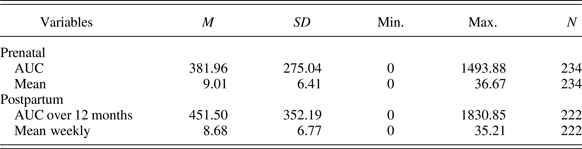
The BDI (Beck et al., Reference Beck, Ward, Mendelsohn, Mock and Erbaugh1961) is a 21-item self-report measure of depression symptom severity in the past week, with each item rated on a 4-point scale, ranging from 0 to 3. The score is a sum across items, with higher scores indicating greater severity of depressive symptoms. Scores of 0–9 indicate no depression, 10–18 indicate mild–moderate depression, 19–29 indicate moderate–severe depression, and 30–63 indicate severe depression (Beck et al., Reference Beck, Ward, Mendelsohn, Mock and Erbaugh1961). The BDI has been found to be both a valid and a reliable measure of depression severity, with an especially high degree of content validity and internal consistency reliability including during pregnancy (Beck et al., Reference Beck, Ward, Mendelsohn, Mock and Erbaugh1961; Ji et al., Reference Ji, Long, Newport, Na, Knight and Zach2011). For pregnancy, we calculated area under the curve (AUC) scores for each woman to represent the overall depression severity level across the pregnancy, standardized to a 40-week pregnancy. Although analyses were conducted using total AUC scores, both AUC scores and mean BDI scores during pregnancy are shown in Table 1 for ease of interpretation. For the postpartum, analyses were conducted using AUC scores calculated for each woman to represent the overall depression severity level during the first 12 months postpartum. For descriptive purposes, these AUC scores were divided by number of weeks (52) in order to determine the average weekly BDI score. Descriptive statistics for the total AUC scores and the weekly AUC scores are shown in Table 1. Because both the prenatal and the postpartum AUC variables were significantly skewed (D = 0.12 and 0.14, respectively, ps < .001), these variables were transformed using a square root transformation.
Descriptive statistics of maternal depressive symptom levels
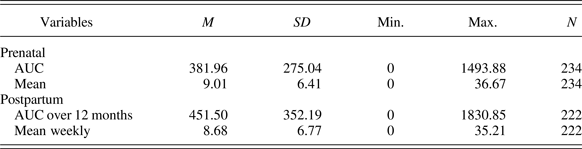
Note: Depression symptoms were measured with the Beck Depression Inventory; AUC, area under the curve.
Behavioral level of analysis of infant vulnerability: Temperament
Mothers completed the 191-item scale of infant temperament, the IBQ-R (Gartstein & Rothbart, Reference Gartstein and Rothbart2003), which is factor analytically based on Rothbart and Derryberry's (Reference Rothbart, Derryberry, Lamb and Brown1981) definition of temperament. Mothers rate the items regarding the infant's behavior during the past week in a variety of domains on a 7-point scale, from 1 (never) to 7 (always). The questionnaire yields 14 scales, with 10 to 18 items per scale and scale scores being the mean of items on that scale. Scales cluster into three overarching factor scores: orienting/regulatory capacity, surgency/extraversion, and NA. The variable of interest in this study, NA, is calculated as the mean of four scales: falling reactivity, fear, frustration/distress to limitations, and sadness, with a possible range of 1 to 7. Higher scores indicate higher levels of NA, which is conceptualized as poorer emotion regulation.
The IBQ-R is a reliable and valid index of infant temperament (Gartstein & Rothbart, Reference Gartstein and Rothbart2003) and has been proven to be resistant to the potentially biasing influence of parental depression (Gartstein & Marmion, Reference Gartstein and Marmion2008). For the current sample, the α coefficient for NA at 3 months was 0.71 and for the scales were as follows: falling reactivity (0.83), fear (0.89), frustration/distress to limitations (0.71), and sadness (0.86). At 6 months, the α coefficient(s) for NA was 0.76 and for the scales were 0.88 for falling reactivity 0.88 for fear, 0.82 for frustration/distress to limitations, and 0.82 for sadness. Finally, the α coefficient(s) for NA at 12 months was 0.87 and for the scales were 0.84 for falling reactivity, 0.89 for fear, 0.82 for frustration/distress to limitations, and 0.84 for sadness.
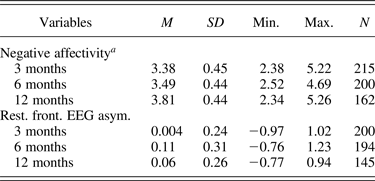
Descriptive statistics for the infant temperament (NA) scores can be found in Table 2. Of note, there was a restricted range of NA scores in this sample, with most infants falling at a moderate level of NA. This pattern is consistent not only with the sample on which the IBQ-R was developed (Gartstein & Rothbart, Reference Gartstein and Rothbart2003) but also with similar population samples (Rouse & Goodman, Reference Rouse and Goodman2014). The mean NA score in our sample was somewhat higher compared to Gartstein and Rothbart's normative data and essentially the same as the mean NA score for 3-month-olds in the Rouse and Goodman sample. The NA variable was significantly skewed at 3 months of age (D = 0.08, p < .001); a square root transformation was used for all of the NA scores.
Descriptive statistics of infant variables
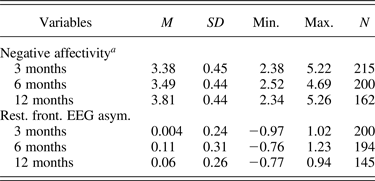
a Negative affectivity was measured by the Infant Behavior Questionnaire—Revised.
Psychophysiological level of analysis of infant vulnerability: EEG
The resting EEG recordings were made from 16 left and right scalp sites: frontal pole (Fp1, Fp2), medial frontal (F3, F4), lateral frontal (F7, F8), central (C3, C4), anterior temporal (T3, T4), posterior temporal (T7, T8), parietal (P3, P4), and occipital (O1, O2), referenced to Cz. EEG was recorded using a stretch cap (Electro-Cap, Inc., Eaton, OH) with electrodes in the 10/20 system. After the cap was placed on the infant's head, a small amount of abrasive gel was placed into each recording site and the scalp gently rubbed. Following this, conductive gel was placed in each site. Electrode impedances were measured and accepted if they were below 5K ohms. The electrical activity from each lead was amplified using separate James Long Company Bioamps (Caroga Lake, NY) and bandpassed from 1 to 100 Hz. Activity for each lead was displayed on the monitor of the acquisition computer. The EEG signal was digitized online at 512 samples per second for each channel so that the data were not affected by aliasing. The acquisition software was Snapshot-Snapstream (HEM Data Corp., Southfield, MI), and the raw data were stored for later analysis.
Infant EEG data were examined and analyzed using EEG Analysis System software developed by James Long Company (Caroga Lake, NY). The data were rereferenced via software to an average reference configuration. Average referencing, in effect, weighted all the electrode sites equally and eliminated the need for a noncephalic reference. Active (F3, F4, etc.) to reference (Cz) electrode distances vary across the scalp. Without the rereferencing, power values at each active site may reflect interelectrode distance as much as they reflect electrical potential. The average reference configuration requires that a sufficient number of electrodes be sampled and that these electrodes be evenly distributed across the scalp. Currently, there is no agreement concerning the appropriate number of electrodes (Davidson, Jackson, & Larson, Reference Davidson, Jackson, Larson, Cacioppo, Bernston and Tassinary2000; Hagemann, Naumann, & Thayer, Reference Hagemann, Naumann and Thayer2001; Luck, Reference Luck2005), although the 10/20 configuration that we used does satisfy the requirement of even scalp distribution.
The average reference EEG data were artifact scored for eye blinks using Fp1 and Fp2 (Myslobodsky et al., Reference Myslobodsky, Coppola, Bar-Ziv, Karson, Daniel and van Praag1989), with a peak to peak criterion of 100 uV or greater. Artifacts associated with gross motor movements over 200 uV peak to peak were also scored. These artifact-scored epochs were eliminated from all subsequent analyses. The data then were analyzed with a discrete Fourier transform using a Hanning window of 1-s width and 50% overlap. Power was computed for the 6 to 9 Hz frequency band. Infants and young children have a dominant frequency between 6 and 9 Hz (Bell & Fox, Reference Bell, Fox, Dawson and Fischer1994; Marshall, Bar-Haim, & Fox, Reference Marshall, Bar-Haim and Fox2002), and this particular frequency band has been correlated with patterns of emotion reactivity and emotion regulation during infancy (Bell & Fox, Reference Bell, Fox, Dawson and Fischer1994; Buss et al., Reference Buss, Schumacher, Dolski, Kalin, Goldsmith and Davidson2003; Dawson, Reference Dawson1994) and early childhood (Fox et al., Reference Fox, Henderson, Rubin, Calkins and Schmidt2001). The power was expressed as mean square microvolts and the data transformed using the natural log to normalize the distribution.
Frontal EEG asymmetry values were computed by subtracting ln power at left frontal (F3) from ln power at right frontal (F4). In infants and young children, power in the 6 to 9 Hz band has been shown to be inversely related to cortical activation during emotion reactivity and regulation (Fox, Reference Fox1994). Thus, a negative asymmetry score reflects greater relative right frontal activation (conceptualized as poorer emotion regulation), whereas a positive asymmetry score reflects greater relative left frontal activation. Descriptive statistics on the infant frontal EEG asymmetry values can be found in Table 2. The frontal EEG asymmetry values of the infants in our study are similar to those of infants in other studies focused on depressed and nondepressed mothers (e.g., Dawson, Klinger, Panagiotides, Spieker, & Frey, Reference Dawson, Klinger, Panagiotides, Spieker and Frey1992; Jones, Field, & Almeida, Reference Jones, Field and Almeida2009; Jones, Field, Fox, Davalos, & Gomez, Reference Jones, Field, Fox, Davalos and Gomez2001). The EEG variable was significantly skewed at 3 and 6 months of age (D = 0.07, p < .02 and D = 0.09, p < .001, respectively); therefore, this variable was transformed using a square root transformation at all three ages.
Data analytic strategy
Preliminary analyses
Data were checked for outliers, and descriptive statistics were run using IMB SPSS Statistics 22.
Hypothesis testing
We addressed the primary aim of this study, to examine the moderating role of mothers' depressive symptoms on the co-occurrence among vulnerabilities, as well as on the continuity/discontinuity among vulnerabilities over the course of infancy, using multilevel modeling (MLM) conducted in SPSS. Given that the association between infant frontal EEG asymmetry and NA is understood to be bidirectional (Howarth et al., Reference Howarth, Fettig, Curby and Bell2015), yet MLM requires specifying one variable as a predictor, two models were run: frontal EEG asymmetry predicting NA and NA predicting frontal EEG asymmetry. The independent variable (one of the two infant vulnerabilities) was centered at infant age 3 months. Maternal prenatal depression was indexed by AUC, and square root transformation was performed to correct the skewness of this index. This index was then grand mean centered to be included in the analyses. The three-way interaction (Infant Vulnerability × Age × Depression) was estimated along with all the lower order terms of these three variables included in the model to provide unbiased estimates of the three-way interaction.
Next we tested the hypothesis that with higher levels of prenatal depression, infant frontal EEG asymmetry and NA would be less in sync with each other: that is, a positive association between NA and frontal EEG asymmetry, such that higher infant NA is associated with lower relative right frontal EEG asymmetry. This hypothesis would be supported by, first, a significant three-way interaction between one of the infant vulnerabilities, age, and prenatal depression grand mean centered in predicting the other of the infant vulnerabilities. A planned contrast, examining the two-way interactions (Infant Vulnerability × Age) predicting the other infant vulnerability, tested separately for infants of mothers who were above or below the median split in terms of prenatal depressive symptoms, would reveal that the association between frontal EEG asymmetry and NA differs based on infant age and level of prenatal depression. The latter analysis also enabled us to examine our exploratory hypothesis regarding the role of infant age in potential changes in the associations between NA and EEG over infancy, in relation to levels of mothers' prenatal depression symptoms. Marginal R 2 from the multilevel model was calculated in SAS Version 9.4 (SAS Institute, Cary, NC) to index the variance explained by the fixed factors (Engert, Plessow, Miller, Kirschbaum, & Singer, Reference Engert, Plessow, Miller, Kirschbaum and Singer2014; Nakagawa & Schielzeth, Reference Nakagawa and Schielzeth2013).
In order to examine the impact of dose and timing of exposure to mother's depression, we ran MLM in SPSS. To examine dose, a categorical variable was created in which women were coded as having exceeded the BDI cutoff (≥10) for clinically significant levels of depressive symptoms during either the prenatal or the postpartum period, during both the prenatal and the postpartum period, or during neither the prenatal nor the postpartum period. To examine timing, a categorical variable was created in which women were coded as having exceeded the BDI cutoff (≥10) for clinically significant levels of depressive symptoms during only the prenatal period, during only the postpartum period, or during both the prenatal and the postpartum period. For both dose and timing, we followed up significant models from the primary hypothesis testing (frontal EEG asymmetry predicting NA and NA predicting frontal EEG asymmetry). The independent variable (one of the two infant vulnerabilities) was centered at infant age 3 months. The three-way interaction (Infant Vulnerability × Age × Depression Dose/Timing) was estimated along with all the lower order terms of these three variables included in the model to provide unbiased estimates of the three-way interaction. Support for the association between infant frontal EEG asymmetry and NA differing based on dose/timing of depression and age would be found first with a significant three-way interaction between one of the infant vulnerabilities, age, and depression group in predicting the other of the infant vulnerabilities. Second, post hoc comparisons between all three groups would reveal significant differences between the depression groups, which could be further explored with the two-way interaction (Infant Vulnerability × Age) predicting the other infant vulnerability separately for each of the depression groups.
Results
Preliminary analyses
Tests of normality and outliers
As is expected with longitudinal designs, there were missing data points. MLM has been found to be a useful strategy for analyzing between- and within-subject predictors in the context of missing data (e.g., Zautra et al., Reference Zautra, Davis, Reich, Nicassio, Tennen and Finan2008). The following describes missing data patterns.
A total of 220 women and their infants (91% of the total sample) completed the lab visit at infant age 3 months, and 22 (9%) missed the visit. At infant age 6 months, 209 women and their infants (86%) participated in the lab visit, 22 (9%) missed the visit, and 11 (5%) were dropped from the study prior to the visit. Finally, at infant age 12 months, 166 women and their infants (69%) completed the visit, 44 (18%) missed the visit, and 32 (13%) were dropped from the study prior to their visit. A total of 147 women and their infants (61%) completed all three visits; a total of 206 women and their infants (85%) completed at least two visits.
Of the 220 infants and their mothers who participated in the 3-month lab visit, 200 infants (91%) had usable resting EEG data; data for 9 infants (4%) were unable to be edited due to too much artifact, data for 7 infants (3%) were excluded for an insufficient quantity (less than 10 s) of artifact-free data, data for 2 infants (1%) were excluded as outliers (±3 SD from the mean), data for 1 infant (<1%) was unusable due to technical problems, and 1 infant (<1%) had no EEG data collected. In terms of infant NA data, 215 infants (98%) had IBQ-R data, and for 5 infants (2%), the IBQ-R was not collected. A total of 196 infants (89%) had usable data for both variables at 3 months.
Of the 209 infants and their mothers who participated in the 6-month lab visit, 194 infants (93%) had usable resting EEG data; data for 7 infants (3%) were unable to be edited due to too much artifact, data for 3 infants (1%) were excluded for an insufficient quantity (<10 s) of artifact-free data, data for 1 infant (<1%) was excluded as an outlier (±3 SD from the mean), data for 2 infants (1%) was unusable due to technical problems, and 2 infants (1%) had no data collected. In terms of infant temperament data, 200 infants (96%) had IBQ-R data, and for 9 infants (4%), the IBQ-R was not collected. Altogether, a total of 186 (89%) infants had usable data for both variables at 6 months.
Finally, of the 166 infants and their mothers who participated in the 12-month lab visit, 145 infants (87%) had usable resting EEG data; data for 7 infants (4%) were unable to be edited due to too much artifact, data for 4 infants (2%) were excluded for an insufficient quantity (<10 s) of artifact-free data, data for 2 infants (1%) were excluded as outliers (±3 SD from the mean), data for 2 infants (1%) were unusable due to technical problems, and 6 infants (4%) had no data collected. In terms of infant temperament data, 162 infants (98%) had IBQ-R data, and for 4 infants (2%), the IB-R was not collected. Altogether, a total of 140 infants (84%) had usable data for both variables at 12 months.
Identification of potential control variables
In order to test for possible confounding variables, we tested associations between demographic variables (maternal age, infant's gestational age at birth, infant gender, and antidepressant usage during pregnancy or the first year postpartum) and the two infant variables (NA and frontal EEG asymmetry) at each infant age. Maternal age was only associated with infant's NA at 6 months of age at a trend level, r (198) = –.14, p = .05; all other associations between maternal age and infant variables at 3, 6, and 12 months of age were not significant (rs < .10, ps > .19). Infant's gestational age at birth was not significantly associated with either infant variable at 3, 6, or 12 months of age (rs < .13, ps > .10). The only sex difference in infant variables was in infant frontal EEG asymmetry at 6 months, t (192) = 2.10 p = .04, in which case, female infants had greater relative right frontal EEG asymmetry than male infants. There were no other sex differences in the infant variables (ts < 2.10, ps > .05). The number of prenatal weeks that infants were exposed to maternal antidepressant use was not significantly associated with any infant variables at any age (rs < .11, ps > .19), nor was the number of postpartum weeks that mothers were taking antidepressants (rs < .15, ps > .06). Given this pattern of findings, no control variables were included in analyses.
Descriptive analyses
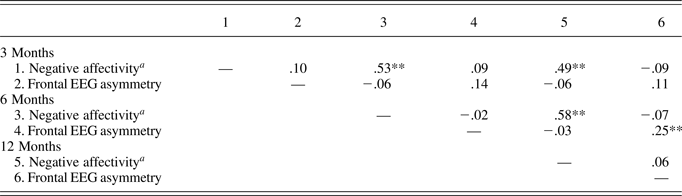
Results of Pearson product moment correlations (see Table 3) revealed no significant concurrent associations between the infant frontal EEG asymmetry and NA variables at 3, 6, or 12 months of age. In terms of prospective associations, there was strong evidence of stability of infant NA over time and evidence for small, but significant stability of infant frontal EEG asymmetry, albeit only from 6 to 12 months of age; there were no significant prospective associations between infant frontal EEG asymmetry and NA.
Concurrent and prospective associations among infant variables
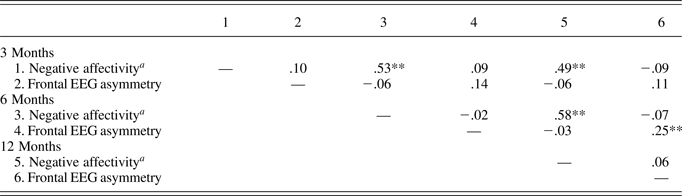
a Negative affectivity was measured by the Infant Behavior Questionnaire—Revised.
**p < .01.
Hypothesis testing
The results of MLM analyses for NA predicting frontal EEG asymmetry indicated some support for our hypothesis that with higher levels of prenatal depression, infant frontal EEG asymmetry and NA would be less in sync with each other: that is, a positive association between NA and frontal EEG asymmetry. These results yielded interesting findings regarding how the pattern of association between NA and EEG might change between early in infancy to later in the course of infant development (see Table 4). Specifically, the three-way interaction between NA, age, and prenatal depression grand mean centered in predicting frontal EEG asymmetry yielded a standardized estimate of 0.004 (SE = 0.002, p = .06). Although not statistically significant, it was associated with a marginal R 2 = .080. This pattern of results did not change when adding postnatal depression grand mean centered into the model as a covariate. Given the effect size, we probed the three-way interaction with planned comparisons, using a median split to create a categorical two-level variable on mothers' prenatal depression symptom level. The two-way interaction (NA × Age) predicting infant frontal EEG asymmetry was tested separately for infants of mothers who were above or below the median split in terms of prenatal depressive symptoms.
Multilevel models of infant negative affectivity (NA), age, and maternal prenatal depression predicting infant frontal EEG asymmetry
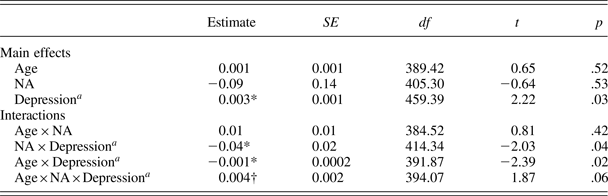
Note: NA was measured by the Infant Behavior Questionnaire—Revised.
a Depression symptoms were measured with the Beck Depression Inventory and calculated as area under the curve scores for the prenatal period (unless otherwise specified), then the state parameter was grand mean centered.
†p < .10. *p < .05.
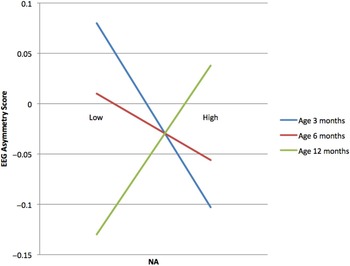
For infants of mothers who were high in prenatal depressive symptoms (above the median split), there was a significant two-way interaction of infant NA and age predicting infant frontal EEG asymmetry scores (β = 0.06, SE = 0.02, p = .01). Specifically, at infant age 3 months, there was a negative association between infant NA and frontal EEG asymmetry, such that higher NA was associated with greater relative right frontal EEG asymmetry (more negative EEG asymmetry scores; see Figure 1). By contrast, a positive association was present at infant age 12 months, with higher NA associated with lower relative right frontal EEG asymmetry (more positive EEG asymmetry scores). That is, with high levels of prenatal depression, infants shifted from having higher NA associated with greater right frontal asymmetry at 3 months of age to having higher NA associated with greater left frontal asymmetry at 12 months of age.
(Color online) The interaction of infant negative affectivity and age predicting infant EEG asymmetry scores among infants of mothers with high prenatal depression symptoms (above median split).

For infants of mothers who were below the median split in terms of prenatal depressive symptoms, there was no significant interaction between infant NA and age in predicting infant frontal EEG asymmetry (β = –0.02, SE = 0.02, p = .38). Therefore, a follow-up model was run in which the interaction term was removed, in order to investigate the main effects of age and NA on frontal EEG asymmetry in the context of low maternal prenatal depressive symptoms. Results from this model showed no support for NA as a main effect in the prediction of frontal EEG asymmetry, but a significant main effect of age (β = 0.004, SE = 0.002, p = .04) was present; for infants of mothers with low levels of depressive symptoms during the prenatal period, frontal EEG asymmetry scores increase with age, toward greater relative left frontal asymmetry.
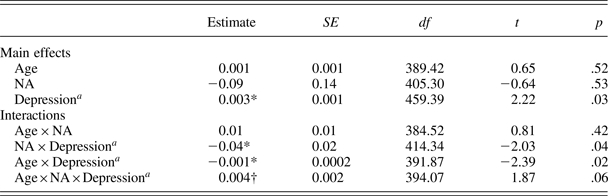
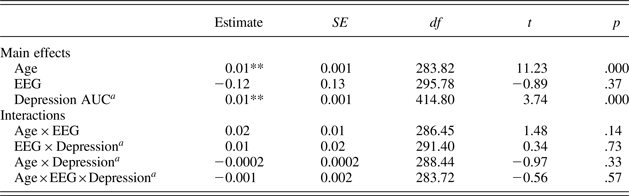
By contrast, in the model of frontal EEG asymmetry predicting NA, results did not provide evidence to support the hypothesis (see Table 5). Specifically, the interaction between age, frontal EEG asymmetry, and prenatal depression grand mean centered was not significant (β = –0.001, SE = 0.002, p = .57). When removing the nonsignificant three-way interaction term from the model, none of the two-way interactions were significant. In a final model removing the nonsignificant two-way interaction terms, there were two significant main effects. First, there was a significant main effect of age (β = 0.01, SE = 0.001, p < .001); for the sample as a whole, regardless of maternal depressive symptoms, with increasing age, NA increased, as had been shown descriptively in Table 2. Second, there was a significant main effect of prenatal depression (β = 0.004, SE = 0.001, p < .001); for the sample as a whole, and regardless of age, higher levels of prenatal depression were associated with higher infant NA. This pattern of results did not change when adding postnatal depression grand mean centered into the model as a covariate.
Multilevel models of infant frontal EEG asymmetry, age, and maternal prenatal depression predicting infant negative affectivity
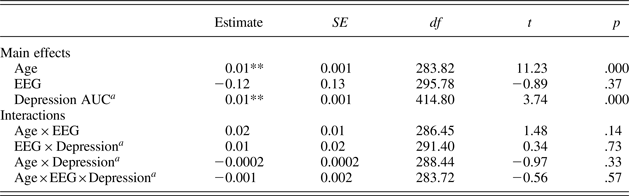
Note: Negative affectivity was measured by the Infant Behavior Questionnaire—Revised; AUC, area under the curve.
a Depression symptoms were measured with the Beck Depression Inventory and calculated as AUC scores for the prenatal period (unless otherwise specified), then the state parameter was grand mean centered.
**p < .01.
Dose of exposure to mother's depression
In order to determine whether this pattern of findings changed based on infants' exposure to differing doses of maternal depression, MLM analyses were rerun using a categorical variable in which women were coded as having exceeded the BDI cutoff for clinically significant levels of depression (≥10) during either the prenatal or the postpartum period, during both the prenatal and the postpartum period, or during neither the prenatal nor the postpartum period. Within the sample, 49 women (20%) exceeded the cutoff during either the prenatal or the postpartum period, 118 (49%) exceeded the cutoff during both the prenatal and the postpartum period, 51 (21%) did not exceed the BDI cutoff in either the prenatal or the postpartum period, and information was missing for the remaining 24 participants (10%). Consistent with the findings from the primary analyses, results of MLM analyses for NA predicting frontal EEG asymmetry indicated some support that differing doses of depression were associated with changes in co-occurrence among the vulnerabilities over time. Specifically, the three-way interaction between NA, age, and the categorical depression variable in predicting frontal EEG asymmetry yielded a standardized estimate of 0.03 (SE = 0.02, p = .09).
We then probed the three-way interaction running post hoc comparisons between all three groups (three comparisons). When comparing the group that experienced elevated depression symptom levels either pre- or postnatally to the group that experienced no perinatal depression, the three-way interaction was no longer significant, with a standardized estimate of –0.07 (SE = 0.05, p = .15). That is, there were no significant differences between infants of women with clinically significant depression in either the prenatal or the postpartum period and infants of women with no clinically significant levels of depression in the prenatal or the postpartum period in terms of the co-occurrence of infant EEG and NA over time.
Similarly, the three-way interaction when comparing the group that experienced no perinatal depression to the group that experienced elevated depression symptom levels both during the pre- and the postnatal periods was not significant, with a standardized estimate of 0.03 (SE = 0.02, p = .13). That is, once again, there were no significant differences between infants of women without depression in either the prenatal or the postpartum period and infants of women with depression in both the prenatal and the postpartum periods in terms of the co-occurrence among infant EEG and NA over time.
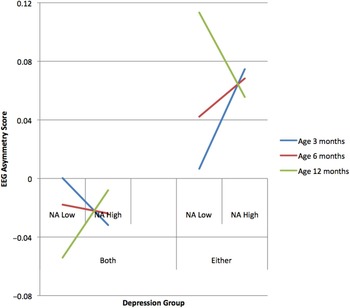
When comparing the group that experienced elevated depression symptom levels either pre- or postnatally to the group that experienced elevated depression symptom levels both during the pre- and the postnatal periods, the three-way interaction was significant, with a standardized estimate of 0.12 (SE = 0.04, p = .004). Therefore, the two-way interaction (NA × Age) predicting infant frontal EEG asymmetry was tested separately for infants of mothers who had elevated depression symptom levels in either the prenatal or the postpartum period, and for infants of mothers who had elevated depression symptom levels in both the prenatal and the postpartum periods (see Figure 2).
(Color online) The interaction of infant negative affectivity and age predicting infant EEG asymmetry scores among infants of mothers with clinically significant depressive symptom levels in both the prenatal and the postpartum periods (both) or significant depressive symptoms in either the prenatal or the postpartum period (either).

For infants of mothers who experienced elevated depression symptom levels either pre- or postnatally, the two-way interaction of infant NA and age predicting infant frontal EEG asymmetry scores was of marginal significance (β = –0.07, SE = 0.04, p = .06). Specifically, at infant age 3 months, there was a positive association between infant NA and frontal EEG asymmetry, such that higher infant NA was associated with lower relative right frontal EEG asymmetry (more positive EEG asymmetry scores). By contrast, this association was negative at infant age 12 months, such that higher infant NA was associated with greater relative right frontal EEG asymmetry (more negative EEG asymmetry scores). That is, with depression exposure in either the prenatal or the postpartum period, infants shifted from having higher NA associated with lower relative right frontal asymmetry at 3 months of age to having higher NA associated with greater relative right frontal asymmetry at 12 months of age.
By contrast, this pattern was reversed for infants of mothers who experienced elevated depression symptom levels both during the pre- and the postnatal periods, with the two way-interaction of infant NA and age predicting infant frontal EEG asymmetry scores being significant (β = 0.05, SE = 0.02, p = .03). Specifically, at infant age 3 months, there was a negative association between infant NA and frontal EEG asymmetry, such that higher NA was associated with greater relative right frontal EEG asymmetry (more negative EEG asymmetry scores). By contrast, a positive association was present at infant age 12 months, with higher NA associated with lower relative right frontal EEG asymmetry (more positive EEG asymmetry scores). That is, with depression exposure in both the prenatal and the postpartum period, infants shifted from having higher NA associated with greater relative right frontal asymmetry at 3 months of age to having higher NA associated with lower relative right asymmetry at 12 months of age.
Timing of exposure to mother's depression
In order to also determine whether the pattern of findings from the primary hypotheses changed based on differing timing of maternal depression, MLM analyses were rerun using a categorical variable in which participants were coded as having exceeded the BDI cutoff for clinically significant depression levels (≥10) during the prenatal period only, during the postpartum period only, or during both the prenatal and the postpartum period. Within the sample, 20 women (8%) exceeded the BDI cutoff in the prenatal period, 29 (12%) exceeded the cutoff in the postpartum period, and 118 (49%) exceeded the cutoff in both the prenatal and the postpartum period. Similar to the primary analyses, results of MLM analyses for NA predicting frontal EEG asymmetry indicated support for differing timing of depression being associated with changes in co-occurrence among the vulnerabilities over time. Specifically, the three-way interaction between NA, age, and the categorical depression timing variable in predicting frontal EEG asymmetry yielded a standardized estimate of 0.06 (SE = 0.03, p = .03).
We then probed the three-way interaction using post hoc comparisons between all three timing groups. When comparing the group that experienced prenatal depression only to the group that experienced elevated depression symptom levels both pre- and postnatally, the three-way interaction was no longer significant, with a standardized estimate of 0.04 (SE = 0.03, p = .19). That is, there were no significant differences between infants of women with clinically significant depression only in the prenatal period and infants of women with clinically significant levels of depression in both the prenatal and the postpartum periods in terms of the co-occurrence of infant EEG and NA over time.
Similarly, the three-way interaction when comparing the group that experienced prenatal depression only to the group that experienced postnatal depression only was not significant, with a standardized estimate of –0.08 (SE = 0.08, p = .33). That is, once again, there were no significant differences between infants of women with depression in the prenatal period only and infants of women with depression in the postpartum period only in terms of the co-occurrence of infant EEG and NA over time.
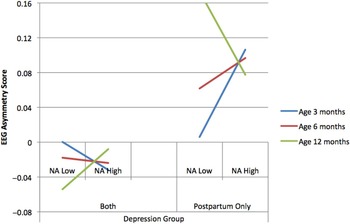
However, when comparing the group that experienced postnatal depression only to the group that experienced elevated depression symptom levels both pre- and postnatally, the three-way interaction was significant, with a standardized estimate of 0.16 (SE = 0.05, p = .002). Therefore, the two-way interaction (NA × Age) predicting infant frontal EEG asymmetry was tested separately for infants of mothers who had elevated depression symptom levels in only the postpartum period and for infants of mothers who had elevated depression symptom levels in both the prenatal and the postpartum periods (see Figure 3).
(Color online) The interaction of infant negative affectivity and age predicting infant EEG asymmetry scores among infants of mothers with clinically significant depressive symptom levels in both the prenatal and the postpartum periods (both) or significant depressive symptoms in the postpartum period only (postpartum only).

For infants of mothers who experienced elevated depression symptom in only the postnatal period, the two-way interaction of infant NA and age predicting infant frontal EEG asymmetry scores was significant (β = –0.11, SE = 0.05, p = .03). Specifically, at infant age 3 months, there was a positive association between infant NA and frontal EEG asymmetry, such that higher infant NA was associated with lower relative right frontal EEG asymmetry (more positive EEG asymmetry scores). By contrast, this association was negative at infant age 12 months, such that higher infant NA was associated with greater relative right frontal EEG asymmetry (more negative EEG asymmetry scores). That is, with depression exposure in the postpartum period only, infants shifted from having higher NA associated with lower relative right frontal asymmetry at 3 months of age to having higher NA associated with greater relative right frontal asymmetry at 12 months of age.
By contrast, this pattern reversed for infants of mothers who experienced elevated depression symptom levels during both the pre- and the postnatal periods, with the two way-interaction of infant NA and age predicting infant frontal EEG asymmetry scores being significant (β = 0.05, SE = 0.02, p = .03). Specifically, at infant age 3 months, there was a negative association between infant NA and frontal EEG asymmetry, such that higher NA was associated with greater relative right frontal EEG asymmetry (more negative EEG asymmetry scores). By contrast, a positive association was present at infant age 12 months, with higher NA associated with lower relative right frontal EEG asymmetry (more positive EEG asymmetry scores). That is, with depression exposure in both the prenatal and the postpartum periods, infants shifted from having higher NA associated with greater relative right frontal asymmetry at 3 months of age to having higher NA associated with lower relative right asymmetry at 12 months of age.
Discussion
In this prospective, longitudinal study, we investigated the role of maternal perinatal depression symptom levels in moderating the associations between infants' frontal EEG asymmetry and NA over the course of the first year of infancy. We chose frontal EEG asymmetry and temperament NA as two levels of analysis of infant vulnerability to the development of depression, consistent with a developmental psychopathology perspective on the Research Domain Criteria (RDoC; Cicchetti, Reference Cicchetti2008; Franklin, Jamieson, Glenn, & Nock, Reference Franklin, Jamieson, Glenn and Nock2015). We found partial support for our hypothesis that with higher levels of prenatal depression, infant frontal EEG asymmetry and NA would be less in sync with each other: that is, a positive association between NA and frontal EEG asymmetry. That is, we expected that higher infant NA would be associated with lower relative right frontal EEG asymmetry at least early in infancy, and we explored how that association might play out over the course of infancy. We found that the concerning pattern of dysynchrony did not emerge until 12 months of age. Specifically, we found that for infants of mothers with high prenatal depressive symptoms, infant NA and frontal EEG asymmetry were significantly negatively associated (synchronous) at infant age 3 months, whereas by infant age 12 months, there was a significant positive association (dysynchrony). That is, in the context of having been exposed to high prenatal depressive symptoms, at 3 months of age, infants' higher NA was associated with their greater relative right frontal EEG asymmetry, and at 12 months of age, higher NA was associated with lower relative right frontal EEG asymmetry. This pattern did not hold for infants of mothers with low prenatal depressive symptoms, because the association between infant NA and EEG was not significant regardless of infant age. Instead, for infants of mothers with low prenatal depressive symptoms, infant resting EEG scores increased (toward lower right frontal EEG asymmetry and greater left frontal EEG asymmetry) with age.
We expected to see a clear vulnerability pattern in the form of dysynchrony across NA and EEG asymmetry emerge early in development and explored, without specific hypotheses, the extent to which that pattern may remain over the course of infancy. In other words, in the context of higher maternal prenatal depression, we expected to see a clear vulnerability pattern (i.e., dysynchrony between the systems) emerge early in infancy, and we examined the extent to which that pattern remained over the course of infancy. Instead, we found that among 3-month-olds, for those whose mothers had high levels of prenatal depression symptoms, the vulnerabilities were comorbid (higher levels of NA were associated with greater relative right frontal EEG asymmetry), consistent with synchrony. In contrast, we found no significant co-occurrence across the course of infancy among infants of mothers with low levels of prenatal depression symptoms. Further, in terms of our exploratory hypothesis, we found shifting patterns of co-occurrences over the course of infancy exclusively among infants of mothers with high levels of prenatal depression symptoms. By 12 months of age, among infants of mothers with high levels of prenatal depression symptoms, higher NA was associated with lower right frontal EEG asymmetry, consistent with dysynchrony.
Our results contribute to the limited knowledge of the role of development in the emergence of patterns of co-occurrence across two levels of analysis of vulnerabilities to the development of psychopathology. In these ways, our findings are consistent with the intention of RDoC by taking a multiple levels of analysis perspective on psychopathology, with a focus on core emotional and affective processes (Cicchetti, Reference Cicchetti2008). At 3 months of age, in the context of high levels of maternal prenatal depressive symptoms, infants' vulnerabilities were in synchrony with each other, with the two vulnerabilities being comorbid. Although consistent with notions of coupling (DiPietro, Costigan, & Pressman, Reference DiPietro, Costigan and Pressman2002; DiPietro et al., Reference DiPietro, Costigan, Shupe, Pressman and Johnson1998), this is, nonetheless, concerning because these young infants were vulnerable in both domains/at both levels of analysis. By 12 months of age, however, we observed dysynchrony, which is suggestive of the concerns raised by Beauchaine and Nigg, that dysynchrony may be associated with increased risk for the development of psychopathology relative to individual markers of vulnerability (Beauchaine, Reference Beauchaine2015; Marsh, Beauchaine, & Williams, Reference Marsh, Beauchaine and Williams2008; Nigg, Reference Nigg2006).
Overall, these findings contribute to the small, but emerging body of literature linking vulnerabilities, particularly at two levels of analysis. Consistent with the notion of multifinality, we found that infants shifted in their patterns of association between two vulnerabilities. The finding that the higher levels of prenatal depression symptoms was linked to stronger associations between vulnerabilities as well as to the shifting pattern of those associations suggests an important role of maternal prenatal depression in infants' risk for the later development of psychopathology, not only early in infancy but also even as late as 12 months of age. That is, higher prenatal depression was associated with a pathway of co-occurring (synchronous) vulnerabilities early and then the potentially even more concerning dysynchronous vulnerabilities late in infancy. These findings suggest a particular developmental trajectory in regard to co-occurrences among vulnerabilities that is associated with mothers' prenatal depression symptom levels. It was interesting to note, however, that when prenatal depression symptom levels were low, the vulnerabilities were not synchronous, consistent with Howorth et al.'s (2015) finding of lack of association between fear temperament trait and frontal EEG asymmetry in a normative population. Given that much of the work on vulnerabilities of temperament and EEG during infancy and early childhood are based on at-risk samples, the lack of significant association when prenatal depression is low should not be surprising.
Our findings further contribute to the small set of studies on stability of each of the vulnerabilities over the course of infancy. Consistent with studies that sampled normative populations, we found that NA increased with age. Specifically, in the model of EEG predicting NA, we found that NA increases with increasing age for the overall sample, regardless of infant frontal EEG asymmetry scores and prenatal maternal depressive symptom levels. In addition, consistent with previous studies and the idea of infant NA being an early vulnerability marker, we found that NA increases with an increase in prenatal depression regardless of infant age and frontal EEG asymmetry. We also found that frontal EEG asymmetry scores increase with age, toward greater relative left frontal asymmetry, but only for infants of mothers with low levels of depressive symptoms during the prenatal period. Thus, for frontal EEG asymmetry, infants' prenatal exposure to their mothers' depression may interfere with normative development.
We found no significant contribution from mothers' levels of postnatal depression symptoms. Given our finding that higher prenatal depression symptoms were associated with changing patterns of association between the vulnerabilities, one might anticipate that postpartum depression symptom levels would contribute. Postnatal depression has been associated with mothers showing less of the sensitive responsiveness that infants need for their developing emotion regulation (Calkins, Reference Calkins1994; Kopp, Reference Kopp1989). Our findings suggest that postnatal depression symptom levels played no significant role beyond prenatal depression symptom levels. This finding is consistent with and builds on findings from a similar, but separate data set, that when both prenatal and postpartum depression symptom levels were considered in predicting infant NA at 3 months of age, only prenatal depression symptom levels significantly predicted infant NA (Rouse & Goodman, Reference Rouse and Goodman2014). It may be that postnatal depression symptom levels are sufficiently distal from infants' experiences and that a better test of the role of postnatal depression would be to examine the role of mothers' qualities of interaction with the babies. For example, we found that mothers' prenatal depression symptom levels were associated with higher infant rates of disorganized attachment particularly when early maternal parenting was less optimal (Hayes, Goodman, & Carlson, Reference Hayes, Goodman and Carlson2013). Our findings on the importance of prenatal depression suggest that future research would benefit from prospective assessment of depression beginning in pregnancy given that findings might otherwise be taken to support a role of postnatal depression, whereas the risk may have been in prenatal depression.
Despite the initial lack of support for a role of postnatal depression symptom levels on co-occurrence among infant vulnerabilities, we explored the question of the impact of the dose and timing of maternal perinatal depression exposure on co-occurrences among infant vulnerabilities over the course of infancy. Our findings suggested that, among infants who had the higher dose (that is, they were exposed in both the prenatal and the postpartum periods), as compared to those exposed in one period (either prenatal or postpartum) and those exposed in the postpartum period only, infants' vulnerabilities were in synchrony with each other at 3 months of age, with the two vulnerabilities co-occurring (higher NA with greater relative right frontal EEG), with a shift toward dysynchrony by 12 months of age. This suggests that vulnerabilities of infants exposed to a higher dose of depression (i.e., in both the prenatal and the postpartum periods) become less in sync over the course of infancy. This is in contrast to those infants exposed in either the prenatal or the postpartum period, or in the postpartum period only, for all of whom the pattern was dysynchrony at 3 months of age that became synchrony by 12 months of age. For these infants, it appears that they are able to “recover,” or develop synchrony, over the course of infancy, despite some exposure to depression.
With regard to timing, specifically, those infants exposed prenatally only did not differ from those exposed postnatally only in terms of their patterns of association between NA and EEG. Rather, as noted above, the group exposed to postnatal depression only differed from those who had been exposed during both the pre- and the postnatal periods, once again with a pattern such that the group of infants exposed in both periods demonstrated a pattern of vulnerabilities becoming less in sync over the course of infancy, whereas the group of infants exposed to postnatal depression only appeared to recover (i.e., develop synchrony) by 12 months of age. Overall, findings suggest a continuing negative impact of depression exposure during both the prenatal and the postpartum periods that extends at least to 12 months of age and is not accounted for by postnatal depression only, as infants exposed in only the postnatal period demonstrated instead an increase in synchrony with age.
Given that our hypotheses concerned patterns of association among the vulnerabilities and not directions of these associations, we did not expect differences to emerge when we followed the prescribed approach to the MLM analyses of examining the predicted co-occurrences separately, in each direction. When researchers have made directional hypotheses, it has typically been within a model of psychophysiology predicting behavior. Such an approach is consistent with the idea that biology underlies behavior. However, our pattern of findings suggests that behavior predicting psychophysiology may be at least as important. It may be that recurring patterns of behavior help organize cortical response systems, resulting in resting state neural architecture associated with specific patterns of EEG asymmetry. A self-organization conceptualization of temperament can explain this pattern of associations (Derryberry & Rothbart, 1997). It may be that in very early development, the neural systems affected by maternal prenatal depression exhibit a profile whereby EEG asymmetry predicts behavior, but that with continual exposure to the postnatal environment, behavior predicts frontal EEG asymmetry. This is consistent with the limited understanding in the field about how and when the infant vulnerabilities emerge over the course of development, as well as the potential dynamic interplay between behavioral and neurophysiological systems.
Strengths and limitations
Our study had numerous strengths. First, we implemented a sampling strategy of studying women at high risk for perinatal depression, based on their history of depression and/or anxiety, thereby essentially doubling the rate of pre- and postnatal depression relative to sampling general populations of pregnant women. Second, we conducted a prospective, longitudinal study, obtaining repeated measures of women's depression symptoms over the course of pregnancy and the first year postpartum, rather than relying on retrospective reports, and conducted three waves of data collection across infancy, at 3, 6, and 12 months of age. Third, we examined two of the most widely studied indices of infant vulnerability to the development of psychopathology that have strong empirical and theoretical support for their role in the transmission of psychopathology from depression in mothers, and which reflect two levels of analysis consistent with the RDoC approach. Fourth, our sample consisted of predominately middle-income adult women and their infants, which allowed for the examination of the association between maternal depressive symptoms and infant variables among women with histories of depression, without potential confounds associated with stressors such as poverty and young maternal age.
Despite the many strong features of this study, the findings need to be interpreted in the context of certain limitations. As much as sampling women with histories of depression and/or anxiety facilitated our testing of our hypotheses in that depression symptom levels were elevated relative to general population samples, conversely, generalization of our findings is limited to samples of women of similar risk for perinatal depression. Further, given our demographically low-risk sample, our findings might not be generalizable to more ethnically and sociodemographically diverse samples. We focused on resting EEG, based on evidence for its stability in infants (Field et al., Reference Field, Hernandez-Reif and Diego2006; Jones, Field, Davalos, & Pickens, Reference Jones, Field, Davalos and Pickens1997) and consistent with evidence that resting frontal EEG asymmetry reflects a traitlike ability to process affective information, relative to the more statelike response to a context (Quaedflieg, Meyer, Smulders, & Smeets, Reference Quaedflieg, Meyer, Smulders and Smeets2015). However, frontal EEG asymmetry while processing positive and negative emotions would also be of interest and may reveal further understanding of the role of perinatal depression in the emergence and consistency of vulnerability co-occurrences. Finally, although the model we interpreted accounted for 8% of the variance, it did not attain statistical significance. Nonetheless, planned analyses following-up on the interaction yielded interesting findings, revealing significant differences based on whether maternal depressive symptoms were high or low.
Future directions
Important next steps in this line of research include testing co-occurrence among other vulnerabilities, expanding beyond resting state indices of vulnerabilities, further exploring postpartum influences on potential shifts in co-occurrences over the course of infancy, and testing the role of patterns of co-occurrences in the later development of psychopathology. In terms of other vulnerabilities, those with good support for playing similar roles as frontal EEG asymmetry and NA include respiratory sinus arrhythmia and cortisol. For frontal EEG asymmetry, respiratory sinus arrhythmia, and cortisol, study of not only resting state but also reactivity and recovery indices and their co-occurrences would be well justified (Buss et al., Reference Buss, Schumacher, Dolski, Kalin, Goldsmith and Davidson2003, p. 11). Regarding additional potential postpartum influences on patterns of co-occurrence over infancy, likely candidates include mothers' quality of parenting, infants' exposure to environmental stressors, and caregiving from fathers or other caregivers. Finally, future studies with an even longer longitudinal timeframe than we were able to accomplish would be needed to test the proposed links between the patterns of co-occurrences among vulnerabilities that we observed and the emergence of indices of psychopathology, such as in the preschool years, with the expected multifinality of pathways.