INTRODUCTION
Grafting of tea (Camellia sinensis) has been done for at least 80 years; initially it was used in various ways to incorporate clonal material into breeding and seed production programmes (Barua, Reference Barua1989). As a method of propagation for commercial planting, early work involved grafting scions of selected clones onto mature seedling bushes in the field (Bezbaruah and Saharia, Reference Bezbaruah and Sahariah1982; Templer, Reference Templer1971). The aim was to upgrade the planting material without the expense of replanting, but success rate was often low (Templer, Reference Templer1971), and Willson (Reference Willson, Willson and Clifford1992) considered that ‘grafting and budding are unlikely to become economic at any time’.
More recent work has concentrated on grafting in the nursery using clonal rootstocks. In Malawi, Kayange et al. (Reference Kayange, Scarborough and Nyirenda1981) showed that yields from two low-yielding clones could be increased by over 40% by grafting onto vigorous rootstocks, without affecting the theaflavin content of the tea made from the scion clones. Even greater yield increases were reported by Satyanarayana et al. (Reference Satyanarayana, Cox and Sharma1991) in South India. In Kenya, published results have been less impressive. Bore et al. (Reference Bore, Njuguna and Owuor1995) described a trial in which yield of four scions was reduced by an average of 10% by grafting. In 1997, Bore considered that ‘use of composite [grafted] tea is still at infancy in Kenya’ (Bore, Reference Bore1997). However, by that date Brooke Bond Kenya (now Unilever Tea Kenya Ltd) had planted 175 ha of composites, following results of trials conducted from the early 1990s onwards. Results of some of those trials are summarized in this paper. In addition to identifying good stock–scion combinations for commercial planting, an objective of the trials was to try to understand how to identify good rootstocks for Kenyan conditions.
MATERIALS AND METHODS
Single node cuttings were cleft-grafted in the nursery, as described by Kayange (Reference Kayange1990). In large-scale commercial practice, this method has given over 90% success (J. F. Beakbane, personal comment, 1996). The trials were planted in the Kericho district of Kenya (approx. 0°30′S, 35°20′E); the sites are described below as ‘low’ and ‘high’ altitude, but all were above 1700 m asl.
Trials
Trials 1 and 2 were planted as split-plot designs, with scions as the main treatments, and rootstocks as sub-treatments. This design was adopted because the main interest was in rootstock effects and stock × scion interactions.
Trial 1 included six well-known Kenyan clones, AHP S15/10, BBK7, BBK35, BBK152, TRFK 31/8 and EPK TN14-3, in all combinations as both stock and scion, and also as ungrafted cuttings. Clone names are abbreviated below by omitting the initials of the organisation which developed each clone. Self-grafts were not included, but Bore et al. (Reference Bore, Njuguna and Owuor1995) found that self-grafting had no effect on yield. The trial was performed at two sites, at altitudes of 1707 m asl and 2105 m asl, with two replications at each site. Sub-plots consisted of 6 × 3 bushes, with a complete unrecorded guard row around each. The trials were planted in 1989, with 10 764 plants ha−1 in a rectangular planting pattern (122 × 76 cm). Yields were recorded from 1990 to 1996 at the lower site, and from 1990 to 1997 at the higher site.
Trial 2 included seven scions (BBK7, BBK35, BBK152, TRFK 6/8, TRFK 12/19, TRFK 31/8 and AHP SC12/28) on each of six rootstocks (BBT1, BBT207, EPK TN14-3, and three new selections: BBK China 1, BBK China 2 and BBK China 3), together with cuttings of the scions. The trial was performed on the same sites as for Trial 1 and planted in 1990, with four replications of 3 × 4 bush sub-plots, each surrounded by an unrecorded guard row, at each site. The planting pattern was the same as for Trial 1.
Trial 3 was on a single site (1815 m asl), planted in 1998. There were 19 scions, mostly clones selected primarily for quality of the made tea, in all combinations with four rootstocks, and also planted as ungrafted rooted cuttings. The rootstocks were BBK China 3 and EPK TN14-3 from Kenya, and TRFCA MFS87 and TRFCA PC87, from the Tea Research Foundation of Central Africa in Malawi (Ellis and Nyirenda, Reference Ellis and Nyirenda1995). To facilitate comparison with other trials, three standard clones were also included; these were BBK MRTM1, AHP S15/10 and TRFK 31/8. A standard composite was also included: 31/8 grafted onto EPK TN14-3, which, on the basis of results of Trials 1 and 2, has been planted on a commercial scale by Unilever Tea Kenya Ltd. The trial was in a randomized block design, with two replications; plots consisted of 12 bushes, without guard rows between plots, at a density of 13 248 bushes ha−1.
Recording
The trials were plucked at 10–14-day intervals, with a target shoot standard of three leaves and a bud, and yield of green leaf was recorded immediately after harvest at every plucking round. Yield of black tea was estimated from green leaf yield using a standard conversion factor of 22.5%, derived from factory records. After some plucking rounds, samples of shoots were taken from each plot and the average fresh shoot weight determined. From these samples, total shoot number harvested could then be estimated. Shoot dry matter content was also measured on small samples on several occasions. Data from Trial 3 were analysed in two ways: first, the 19 scion × 4 stock combinations were treated as a factorial design. For comparison with the standard clones, a second analysis was done, regarding each individual stock–scion combination as a separate treatment.
Trials were pruned approximately every four years, following standard practice in Kenya. After pruning, the weight of pruned material (‘pruning trash’) per plot was recorded; these data were converted to dry weights assuming a dry matter content of 40%, based on unpublished work in other trials. From these figures and the yield data, we estimated dry matter production (DMP) above the pruning height. Unpublished work has shown that pruning trash weight is significantly correlated with total plant dry weight, so we have used the ratio of yield to yield plus pruning trash as a proxy for harvest index (HI), though clearly the ratio is an overestimate of true HI because dry matter in the roots and stem below the pruning height is omitted.
In Trial 1 measurements of root length were made at the end of the nursery stage, by uprooting surplus plants. An attempt was also made to estimate root surface area, using the method of Wulster (Reference Wulster1985).
Quality of tea was assessed by manufacturing small samples with Teacraft mini-manufacture equipment. These samples were then tasted by professional tea tasters, and scored for various attributes. In Trial 1, samples were manufactured in batches of six, each batch including one scion on all rootstocks; thus possible scion effects were confounded with batch differences (attributable to sampling date, variation in manufacture or tasting date). Tasters scored samples for flavour, briskness, brightness, colour, thickness and leaf appearance, and gave them a value, relative to tea market prices at the time.
In Trial 3, samples were mini-manufactured from a factorial set of four scions on each of the four rootstocks and as straight cuttings. Tasters scored the samples for quality, thickness and colour. The samples were also subjected to analytical tests, including spectrophotometric analysis as described by Roberts and Smith (Reference Roberts and Smith1963), and measurements of infusion colour using a Minolta colour meter.
Costs
In the cleft grafting method, two cuttings are prepared for each plant and grafted together. The cost of preparing a cutting was KSh 0.45. Cuttings are taken from bushes that would otherwise have been producing tea, so the cuttings have an opportunity cost; this depends on tea price, but was approximately KSh 0.13. The actual grafting operation cost KSh 0.80 per plant. Thereafter, nursery and field planting costs are the same for cuttings and grafts, but losses in the nursery may be higher for grafts; we have assumed 80% success, compared to 90% for straight cuttings. The cost for a grafted plant is therefore (2 × (0.45 + 0.13) + 0.80)/0.8 = KSh 2.45, compared to (0.45 + 0.13)/0.9 = KSh 0.64 for a cutting. For 13 000 plants ha−1, the additional cost of grafting was KSh 23 530, equivalent to approximately US$ 360.
RESULTS
Yield and yield components
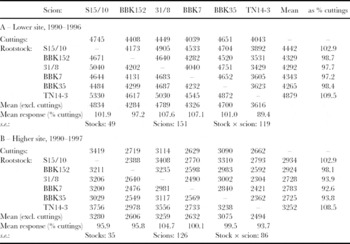
Trial 1. As expected (Squire et al., Reference Squire, Obaga and Othieno1993) yields were higher at the lower altitude site (Table 1). In a combined analysis of both trials, there were no significant interactions with site (stock × site, scion × site and stock × scion × site all non-significant). The stock × scion interaction was significant at the higher site (Table 1B), but not at the lower. The main reason for this appears to be the good response from grafting S15/10 onto 31/8, which had little effect on other scions.
Yields of black tea (kg ha.a−1) in Trial 1.

As a rootstock, TN14-3 was the most effective, increasing scion yield by an average of 9% across both trials and all scions. S15/10 was the only other rootstock to give a benefit, averaging a 3% increase. The other four clones all reduced yield when used as rootstocks.
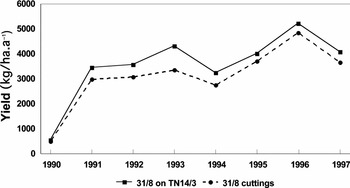
At both sites, the scions behaved much as expected from other clone trials, with S15/10 yielding highest, followed by BBK35 and 31/8. The scion most responsive to grafting was 31/8; yield of this clone was increased by all rootstocks, except BBK7 and BBK35 at the higher altitude site. At the lower site, BBK7 also responded well. Yield of TN14-3 as a scion was depressed by grafting onto other clones, except for S15/10. The highest yield was obtained from S15/10 grafted onto TN14-3, which yielded 10% more than cuttings of S15/10. 31/8 on TN14-3 was the next highest yielding combination, producing 13% more than cuttings of 31/8 at the higher site and 14% more at the lower site; after the first year when there was little effect, the increase in yield was fairly consistent from year to year (Figure 1).
Yield of clone 31/8 as cuttings and on rootstock TN14-3, Trial 1, higher site.

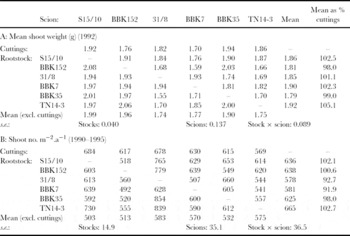
Mean weight per shoot was measured after each of 16 harvesting rounds in 1992; the plot means and the total weights of shoots (yield) were then used to estimate shoot numbers for the period 1990–1995. There was no effect of rootstocks on mean shoot weight at either site. Results for the higher site are shown in Table 2; differences in shoot numbers between rootstocks are greater than the differences in shoot weight. The poor yields on 31/8 and BBK7 as rootstocks (Table 1) were due to low shoot numbers, while the best rootstocks, S15/10 and TN14-3, gave the highest shoot numbers. Over all treatments (means for both sites), yield was highly correlated with shoot number (r = 0.844, 34 d.f., p < 0.001), but not with shoot weight (r = 0.306, p = 0.07).
Yield components in Trial 1, higher site.

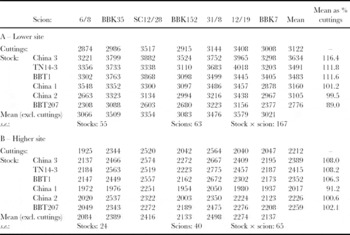
Trial 2. A combined analysis of yield data from both sites showed significant stock × site and scion × site interactions, but no three-way interaction (Table 3). The stock × scion interaction was significant at the higher site, but not when both sites were combined. Three rootstocks gave useful yield increases at both sites. At the lower site, China 3 was clearly the best, followed by TN14-3 and BBT1 (Table 3A); at the higher altitude site, China 3 and TN14-3 were equally good, followed by BBT1 (Table 3B). Of the other three roostocks, two were ineffective and one decreased yields; BBT207 was the worst clone at the lower site was and China 1 was the worst at the higher site.
Yields (kg made tea/ha.a−1) in Trial 2, 1990–1997

Among the scions, 12/19 was best at the lower site, and 31/8 at the higher site; 6/8, BBK152 and BBK7 gave the lowest yields at both sites. The highest yielding combination at the lower site was 12/19 on TN14-3, and at the higher site 31/8 on TN14-3.
At the lower site, there were significant differences among rootstocks in both mean shoot weight and shoot number, but at the higher site, only shoot numbers were affected. Results from the lower site are summarized in Table 4. Rootstocks China 3 and China 1 gave mean shoot weights significantly lower than from cuttings, but with China 3 this was made up for by significantly greater shoot number.
Effect of rootstocks on shoot weights and numbers, Trial 2, lower site.

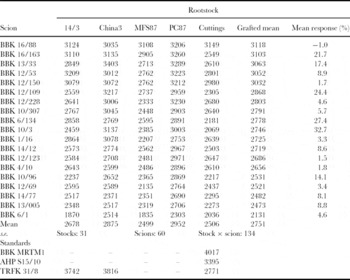
Trial 3. Mean yield was increased by grafting onto TN14-3, China 3 or PC87, but not onto MFS87 (Table 5). Overall, the best rootstock was PC87, giving an average yield increase of 18%, and performing best with 14 of the 20 scions. The other five scions gave greater responses on China 3. However, the best of the stock–scion combinations yielded 15% less than the MRTM1 standard, and only one (13/33 on China 3) was not significantly lower yielding than 31/8 on TN14-3.
Yields (kg made tea ha.a−1) in Trial 3, 2000–March 2007.

s.e. for comparing standards with indivdual stock × scion combinations: 132
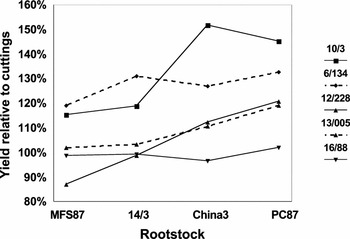
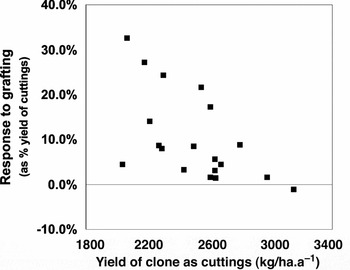
There was a significant stock × scion interaction, and Figure 2 shows that some scions gave much greater responses to grafting than others. There was a negative correlation between the yield of a clone as straight cuttings, and its average response to grafting (Figure 3; r = −0.583, 17 d.f., p = 0.009); in other words, lower yielding clones were more likely to respond, though Figure 3 shows that not all low-yielding clones responded to grafting.
Yield, relative to cuttings, of some clones in Trial 3.

Response to grafting (mean % increase, all rootstocks) of the scion clones in Trial 3, in relation to yield of the same clones as cuttings.

Dry matter production
Trial 1. There were no significant differences between rootstocks in weight of pruning trash, at either site. Despite the significant differences in yield noted above, effects on total DMP and HI were also non-significant, although TN14-3 gave mean DMP 14% above cuttings at the higher site and 5% at the lower site. Rootstocks did not differ in height of plucking table at the time of pruning in Trial 1 (this was not recorded in Trials 2 and 3).
Trial 2. Differences between rootstocks in weight of pruning trash were not significant, although China 3 gave 9% more trash than cuttings at both sites. However, the differences in yield were such that DMP and HI both showed significant responses. China 3, BBT1 and TN14-3 gave greater DMP than cuttings at the lower site, while China 3, TN14-3 and BBT207 gave greater DMP at the higher site. BBT207 gave lower HI than cuttings at the lower site, and China 1 gave lower HI at the higher site.
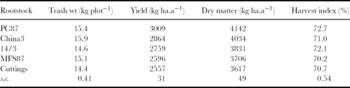
Trial 3. The weight of pruning trash was increased by grafting onto China 3, as was DMP (Table 6). The percentage increase in yield was greater than that in trash weight for three of the rootstocks; this was particularly marked for PC87, where yield was increased by an average of 17.8%, but trash weight by only 6.9%. In consequence, this roostock gave the highest HI, and the only one significantly greater than for cuttings. There were no significant stock × scion interactions in these data sets.
Rootstock means for dry matter production in Trial 3, up to time of pruning in 2004.

Quality
Trial 1. Shoot size is an important factor in quality of tea, with agronomic treatments which result in smaller shoots generally associated with higher quality. As shown in Table 2, rootstocks did not affect shoot size in Trial 1. Samples were mini-manufactured from four scions on each of the rootstocks, with duplicate samples from three of the scions. There were no significant differences between rootstocks for any of the attributes evaluated by the tasters. There were significant differences between scions for leaf appearance, infusion briskness and colour, and market value, but as noted above these were confounded with possible batch differences.
Trial 2. No evaluation of quality was done in this trial, but Table 4 shows that shoot size was not increased by grafting onto any of the rootstocks.
Trial 3. Two samples were taken for mini-manufacture from four scions on all four rootstocks, and also as straight cuttings. The tasting results showed significant differences in Quality score between scions, but no differences between rootstocks, nor any stock × scion interaction. Similarly for the spectrophotometric analyses and infusion colour, there were differences between scions for some parameters, but not between stocks, and no interactions.
Characteristics of a good rootstock
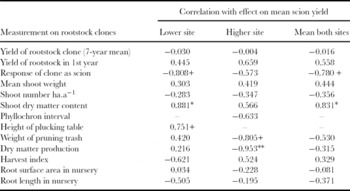
In Trial 1 we looked for correlations between the yield responses obtained by grafting and other characteristics measured on the rootstocks grown as cuttings. We also measured a variety of other growth characteristics; these are listed in Table 7, where correlations with the mean effect of the rootstocks are given. There were very few significant correlations, and little consistency between sites. The response to grafting of a clone used as scion was negatively correlated with performance as a rootstock at both sites, but the correlations did not reach 5% significance. Shoot dry matter content was positively correlated with rootstock performance at both sites, significantly so at the lower site.
Correlations between mean effect of rootstocks and measurements on rootstock clones grown as cuttings in Trial 1 (all correlations with 4 d.f).

Probability of higher correlation (4 d.f.): + p = 0.1 *p = 0.05 **p = 0.01
DISCUSSION
Yield
In all trials, one or more rootstocks significantly increased yields; significant stock × scion interactions were also observed, though in Trials 1 and 2 these were not consistent across sites. These interactions were mainly attributable to the fact that not all scions responded to grafting (e.g. Figure 3). Clone TN14-3 gave good results as a rootstock in all three trials, increasing yields by an average of 8% in Trial 1, 10% in Trial 2 and 7% in Trial 3. Clone 31/8 was among the more responsive scions, with a yield increase when grafted onto TN14-3 of 14% in Trial 1, 13% in Trial 2 and 35% in the standard plots of Trial 3.
In Trial 2, China 3 gave slightly better results than TN14-3, and in Trial 3 PC87 was better still. MFS87 gave no yield increase in Trial 3, but this clone performed well in Malawi (Kayange et al., Reference Kayange, Scarborough and Nyirenda1981), where it increased the yield of two scion clones by more than 40% over three years. MFS87 does improve drought tolerance of susceptible scions (Tuwei et al., Reference Tuwei, Kaptich, Langat, Smith and Corley2008), but its overall poor performance suggests that drought tolerance is not the only benefit from grafting in Kenya.
Kandiah et al. (Reference Kandiah, Kamal and Wimaladharma1979) observed that, although yield depended on both root and shoot systems, a high-yielding scion with a low-yielding clone as rootstock performed better than the reverse combination, but the results of Trial 1 suggest that this is an oversimplification. As the following figures (mean yields for both sites, kg ha.a−1) show, in some instances the higher yielding clone does give better results as scion than as rootstock, as for S15/10 and TN14-3, but clone BBK35 grafted onto S15/10 gave higher yields than the reverse combination:
S15/10: 4082 TN14-3: 3352 S15/10 on TN14-3: 4543 TN14-3 on S15/10: 3342
S15/10: 4082 BBK35: 3871 S15/10 on BBK35: 3756 BBK35 on S15/10: 4007
Kayange et al. (1979) and Nyirenda and Kayange (Reference Nyirenda and Kayange1984) observed that grafting gave greater responses with a low-yielding than with a high-yielding scion. This was confirmed in Trial 3, where there was a negative correlation between yield of a clone as cuttings and response to grafting, but there were some low-yielding clones which did not respond.
Quality
Shoot size (weight), as affected by agronomic treatments, is an important determinant of quality, but was little affected by grafting, in agreement with Pool and Nyirenda (Reference Pool and Nyirenda1981). The increases in yield came from increased shoot numbers. There were no effects of rootstocks on either organoleptic assessments by tasters or on analytical measurements, in agreement with the results of Kandiah et al. (Reference Kandiah, Kamal and Wimaladharma1979), Kayange et al. (Reference Kayange, Scarborough and Nyirenda1981) and Bore et al. (Reference Bore, Njuguna and Owuor1995).
Dry matter production
In Trials 1 and 2, grafting had little effect on the weight of pruning trash; height of the plucking table was not affected in Trial 1. In Trial 3, grafting did tend to increase the weight of pruning trash, but the effect on yield was greater than that on trash weight. This was particularly marked for PC87, where yield was increased by an average of 17.8%, but trash weight by only 6.9%. In consequence, this roostock gave the highest HI (and the only one significantly greater than for cuttings). Nyirenda and Kayange (Reference Nyirenda and Kayange1984) found a greater effect of rootstocks on stem circumference and branch number in a low-yielding than in a high-yielding scion; the scions in Trial 3, selected primarily for quality, were generally lower yielding than those in Trials 1 and 2.
The increases in shoot number but not in shoot weight suggest that grafting may have an effect on shoot replacement ratio (the number of shoots which are released from dormancy for each shoot harvested). Shoot growth rate is probably not affected (Pool and Nyirenda, Reference Pool and Nyirenda1981); a single set of measurements of phyllochron interval in Trial 1 at the higher site showed no effects of rootstocks (but significant differences between scions). If growth rate were affected, then with the same plucking interval for all treatments, faster growth should result in heavier shoots at harvest, but this was not observed.
Yield of tea is generally considered to be sink-limited (Tanton, Reference Tanton1979), so an increase in potential shoot numbers could lead to higher yields, with little effect on weight of pruning trash. However, as the bush gains height an increased number of buds is likely to lead to an increase in branch number, as observed by Nyirenda and Kayange (Reference Nyirenda and Kayange1984), and hence an increase in weight of prunings. Satyanarayana (Reference Satyanarayana1980) and Pallemulla et al. (Reference Pallemulla, Shanmugarajah and Kathiravetpillai1992) found that grafting did have large and significant effects on the weight of pruning trash, and for some combinations, Satyanarayana et al. (Reference Satyanarayana, Cox and Sharma1991) found that the percentage increase in pruning weight was greater than that in yield.
Characteristics of a good rootstock
One objective of Trial 1, where the rootstock clones were also included in the trial as cuttings, was to try to understand what characterizes a good rootstock for the Kericho environment. Without such information, the only way to screen possible rootstocks is to test them all in trials, which is very laborious. With only six rootstocks in Trial 1, the number of degrees of freedom was too small to allow useful multiple regression analyses, so we have only looked at simple correlations between rootstock performance (the average yield increase of scion clones brought about by grafting) and characteristics of the rootstock clones grown as cuttings. A more detailed study with a greater number of roostocks would be worthwhile.
In Malawi, it is considered that a rootstock should be vigorous and drought tolerant (Harvey, Reference Harvey1988). We found no significant correlations between rootstock performance and most measures of vigour for cuttings, including yield, bush height just before pruning and the weight of pruning trash, but there were positive (though not significant) correlations at both sites of rootstock performance with yield of the rootstock clone in the first year of production, which may be an indication of vigour. At the higher site there was a significant negative correlation of dry matter production with rootstock performance, the opposite to expectations from Malawi, but at the lower site the correlation was small and positive.
There were negative correlations (though not significant at the 5% level) of rootstock performance with scion response: the best rootstocks were least responsive as scions grafted onto other clones. This might be used to identify possible new rootstocks from among scions being tested on standard rootstocks, and is worth further study. For example, in Trial 3 clones such as 16/88 and 12/150, which gave no responses to grafting, might be worth testing as rootstocks.
Nyirenda (Reference Nyirenda1990) found in Malawi that two good rootstocks had a greater proportion of ‘storage’ to ‘feeder’ roots than two out of three other clones. We did not measure this, but we found no differences in either root length or surface area between good and bad rootstocks. Drought is not a regular feature of the Kericho environment, and it is therefore not surprising that we found no correlations between measures of drought tolerance and average rootstock performance over all years of the trial. Effects in drought years are considered in more detail elsewhere (Tuwei et al., Reference Tuwei, Kaptich, Langat, Smith and Corley2008).
The only other result of note was positive correlations with shoot dry matter content, significant at the lower site. It is not clear why rootstock performance should be related to shoot dry matter content, but this may be worth further investigation.
Costs and benefits
The additional cost of a grafted plant compared to a straight cutting is about US$0.028, including grafting costs, the loss of production while extra cuttings are produced and a possible lower nursery survival rate for grafted plants (80% assumed, compared to 90% for cuttings). At 13 000 plants ha−1, therefore, grafting adds US$360 to establishment costs. At current prices, the marginal value of each extra kg of tea is approximately US$0.65, so a yield increase of about 550 kg ha−1is needed to cover the additional costs. With increases averaging over 500 kg ha.a−1 from 31/8 on TN14-3 at the lower site, and over 400 kg ha.a−1 at the higher altitude site (Table 1), costs would be covered in less than two years. Thus there is no doubt that grafting can be profitable.
The fact that grafting can increase yield with little or no effect on quality of the scion offers a way of improving the yield of high-quality but low-yielding clones. However, 19 clones originally selected for high quality were tested in Trial 3, and although yields were often increased, in one instance by over 50%, none of the combinations came within 10% of the standard clone MRTM1, or the standard composite 31/8 on TN14-3. Taking the best composite for each scion, the average yield was 19% below 31/8 on TN14-3, and 25% below MRTM1. Thus unless the tea could be sold with a ‘quality premium’ of 25% or more, it would not be financially worthwhile to plant such material; the standards would give a better return on investment.
CONCLUSIONS
In much of the published work on grafting, very small numbers of stocks and scions have been tested, but conclusions based on small numbers may be misleading. We have shown that stock × scion interactions can be significant, and that yield of a scion is not a good guide to its response to grafting. High-yielding scions such as S15/10 in Trial 1 may respond, while some of the low-yielding scions in Trial 3 showed no response. The significant interactions mean that one cannot assume that grafting will always be beneficial; rootstock–scion combinations must be tested individually before undertaking large-scale planting.
We conclude that grafting can offer a useful way of improving the yield of some clones, but it does not remove the need to include yield as a criterion in clone selection. Once high-yielding clones with acceptable quality have been identified, grafting may then be considered as a possible way of improving yields still further.
Acknowledgements
We are grateful to Unilever Tea Kenya Ltd for permission to publish, and to the tea tasters for evaluating samples.