INTRODUCTION
Schizophrenia continues to be a challenge for clinicians and investigators in part because of the extensive heterogeneity observed in people with the illness. This heterogeneity includes biological as well as symptomatic features, course, and outcome. Hence a debate has developed as to whether schizophrenia is a collection of related and unrelated syndromes or a single disease entity that varies in severity across affected individuals (Gottesman & Gould, 2003; Heinrichs, 2004). Over the past 15 years researchers have attempted to organize the illness and reduce heterogeneity by applying various classification schemes and typologies. For example, patients have been assigned to subtypes based on symptoms (Buchanan & Carpenter, 1994), neuropsychological impairment (Goldstein, 1990; Hallmayer et al., 2005; Heinrichs & Awad, 1993; Hill et al., 2002), positive family history (Goldstein & Zubin, 1990), and premorbid functioning (Haas & Sweeney, 1992). It has been argued that, ultimately, these subtypes and distinctions may map onto corresponding pathophysiologies, etiologies, and treatment strategies.
Although cognitive impairment is broadly based in schizophrenia, a number of researchers have investigated more selective deficits as potential markers for neurocognitive subtypes. Verbal declarative memory is impaired in most, but not in all patients with schizophrenia (Cirillo & Seidman, 2003; Heinrichs & Zakzanis, 1998) and predicts functional outcome (Addington & Addington, 2000; Green, 1996) and quality of life (Green et al., 2000; Meltzer et al., 1996). Thus Paulsen and colleagues (Paulsen et al., 1995) found patterns of memory performance in schizophrenia that recapitulated patterns observed in subcortical (Huntington's disease) and cortical (Alzheimer's disease) dementia. Almost 50% of their schizophrenia sample showed a “subcortical” learning and memory profile (i.e., impaired performance on learning trials, normal retention across a delay interval and relatively preserved recognition memory). In contrast, approximately 15% demonstrated a “cortical” pattern (i.e., impaired learning and recognition with numerous intrusion errors). The rest of the sample, about 35% of the total, showed relatively normal performance.
More recently, Turetsky et al. (2002) used cluster analysis and also identified groups with cortical-subcortical and normative memory results. Approximately half of their schizophrenia sample was relatively unimpaired, whereas 30% was classified as “subcortical” and nearly 20% showed a “cortical” performance pattern. The three subgroups differed with respect to demographic variables and symptoms and diverged in terms of regional magnetic resonance imaging (MRI) and positron emission tomography (PET) findings. For example, “cortical” patients showed reductions in temporal lobe gray matter, whereas “subcortical” patients showed ventricular enlargement.
Yet whereas replication and neurobiological support for memory-based subtypes is encouraging, several questions require attention. First, Paulsen et al. (1995) as well as Turetsky et al. (2002) used cross-sectional patient data. Longitudinal studies of neurocognitive subtypes derived from cluster analysis suggest that subtype assignment is often unstable over time, with many patients classified differently at index and follow-up (Heinrichs et al., 1997). Hence the question arises as to whether proposed memory subtypes reflect persisting or transitory and perhaps state-dependent sub-syndromes. Moreover, memory performance indices used to define subtypes may vary in test–retest reliability over extended time intervals. Thus, the persistence and trait-like stability of any neurocognitive typology of schizophrenia must be demonstrated rather than assumed.
Another consideration involves the cognitive and neurobehavioral validity of proposed subtypes. Schizophrenia patients are impaired across most aspects of neurocognition and putatively different functions tend to share test variance (Nuechterlein et al., 2005). Hence it is possible that patients impaired on memory tests are also impaired in general intellectual ability, attention, and executive ability. Indeed at least two different grouping algorithms have shown that verbal memory impairment occurs in the presence of multiple deficits (Hallmayer et al., 2005; Heinrichs & Awad, 1993). Moreover, it is possible that groups defined by data from a particular test instrument are partly artifacts of the instrument itself. It stands to reason that a variety of cognitive and psychometric variables may underlie “memory” typologies and influence subsequent associations with neurobiological, genetic, and clinical data. Therefore it is important to assess the extent to which hypothesized memory subtypes are independent of particular instruments and selective or broadly inclusive in terms of cognitive function.
In contrast with subtypes derived from multivariate grouping techniques, some researchers advocate psychometric performance criteria and more parsimonious yet potentially more valid illness distinctions. For example, McDermid Vaz and Heinrichs (2002) partitioned a patient sample into impaired and unimpaired subgroups based on the total recall score on trials I–V of the CVLT (Delis et al., 1987). Impairment was defined as a score 2 standard deviations below normative values. In addition, subtype assignment matched groups for age, sex, IQ, and current medication. The memory-impaired subgroup had more residual symptoms and lower quality of life than the unimpaired group. This was consistent with evidence that verbal memory impairment is a correlate of neuroleptic non-responsiveness as well as functional outcome in schizophrenia patients (Green, 1996; Joober et al., 2002). However, no data on the long-term persistence of the impairment were provided and, apart from equivalent IQ levels, no findings relevant to the cognitive validity of the distinction were presented.
The purposes of this study were, first, to replicate the original “subcortical” and “cortical” memory subtypes in a schizophrenia sample using cluster analysis and to examine the temporal stability, cognitive, and clinical validity of the typology. Second, we were interested in comparing these stability and validity data with results obtained with the psychometric criterion for subtype assignment described by McDermid Vaz and Heinrichs (2002). Several considerations governed our approach. Paulsen et al. (1995) reported data from a patient sample diagnosed according to DSM-III-R (American Psychiatric Association, 1987) criteria prior to the widespread introduction of “atypical” anti-psychotic medication. Turetsky et al. (2002) did not report medication type. Medication is a consideration because atypical drugs may enhance several aspects of cognition including memory function (Cuesta et al., 2001; Harvey & Keefe, 2001). The use of data from patients receiving potentially performance-enhancing treatments complicates evaluation and interpretation of the original subtype formulation. In addition, Paulsen et al. and Turetsky et al. (2002) used the first version of the CVLT (Delis et al., 1987) to generate their typology. At the same time, the original investigations did not report data from supplementary measures that might support or refute the neuropsychological validity of the memory subtypes. Such measures include independent tasks of recall and vulnerability to intrusions as well as tests of other cognitive abilities including executive function and general intelligence. In light of these considerations we used data from an atypical neuroleptic-naive schizophrenia sample recruited in the mid-1990s and treated with conventional anti-psychotic medication. Studying this sample also provided the opportunity to utilize CVLT as well as supplementary cognitive and clinical data within a longitudinal design and to address questions of subtype stability and validity.
METHOD
Participants and Measures
The study included 102 patients (66 men, 36 women) who were recruited from local mental health programs affiliated with the Queen Street Mental Health Centre, a large provincial psychiatric facility located in Toronto, Ontario, Canada (see Heinrichs & Awad, 1993; Heinrichs et al., 1997). The York University Human Participants Review Committee and the Queen Street Mental Health Centre Ethics Committee approved the study. All patients met DSM-III-R criteria for schizophrenia (American Psychiatric Association, 1987). All patients were receiving conventional antipsychotic medication at the time of assessment. Participants were administered the CVLT (Delis et al., 1987) for the purpose of assessing verbal memory.
Fifty-five participants (36 men, 19 women) returned for a follow-up assessment approximately 36 months (M = 36.3, SD = 8.2 months) later. Reasons for nonparticipation included unsuccessful recontact (i.e., resulting from failure to respond to attempts at contact, discharge, or relocation 49%), direct refusal due to disinterest (42%), and death (8%). Comparisons of the follow-up and drop-out groups revealed no significant differences in sex, education, parental socioeconomic status, age of first hospitalization, duration of illness, time spent in hospital or mean chlorpromazine equivalent dose. However, the follow-up group was significantly younger than patients who declined to participate (F(1,100) = 5.99, p < .05).
Participants were re-administered the CVLT. In addition, they completed: (a) the Vocabulary and Block Design subtests of the WAIS-R (Wechsler, 1981) to provide an estimate of general intelligence, (b) the Wisconsin Card Sorting Test (WCST; Heaton, 1981) to index executive functioning, (c) the Purdue Pegboard Test (Purdue Research Foundation, 1948) for the assessment of fine motor dexterity, and (d) a word list recall paradigm designed to elicit proactive interference (Moscovitch, 1982; Sitskoorn et al., 2002; Wickens, 1970), which provided an additional measure of verbal memory and intrusion errors. This task involves the presentation of four successive lists of words from the same taxonomic category, with free recall trials following each presentation. A final trial is then presented that involves a new taxonomic category. In the present investigation, performance was divided into primary and secondary memory components as follows. Primary memory included any word that was recalled within seven words of its presentation, including the participant's own responses. The secondary memory score comprised the number of words recalled outside of this span. The total number of intrusion errors across the five trials and the secondary memory score from Trial 1 were used to test the validity of the memory-based typologies.
Clinical status was assessed with the 24-item version of the Brief Psychiatric Rating Scale (BPRS; Lukoff et al., 1986; Overall & Gorham, 1962). The subscales used in the present study were constructed by selecting those positive and negative symptoms that were most agreed on in the literature (Zakzanis, 1998). Finally, participants completed an abbreviated version of the Sickness Impact Profile (SIP; Bergner et al., 1981). A sum of four scales across self-reports of sleep and rest, home management, social interaction, and leisure activities provided an index of life quality and functional status.
Descriptive data for both the initial and follow-up group of patients are presented in Table 1. All patients were receiving standard neuroleptic medication and 55% received anticholinergic medication. No significant differences between patients medicated or not medicated with anticholinergic drugs were found with respect to any cognitive or clinical study variables.
Descriptive data for schizophrenia patients at the initial and follow-up assessment

Memory Subtyping
Two different methods of organizing patients into memory-based subgroups were evaluated. The two methods were:
Turetsky et al. (2002) cortical-subcortical- normative clustering typology
The patient sample from the initial assessment (Time 1) was partitioned into subgroups using a k-means cluster analysis of CVLT performance, following the method employed by Turetsky et al. (2002). The cluster analysis was used to generate groups that minimized within- and maximized between-cluster variability. Three CVLT indices were examined: (a) Total Recall (i.e., the total number of items correctly recalled over five learning trials), (b) the number of intrusion errors during category-cued recall, and (c) the difference between recognition discriminability and recall on learning Trial 5. The three CVLT indices were converted to standardized test scores based on normative data accounting for sex and age (Delis et al., 1987). More recent norms are available, but for only 2 (i.e., Total Recall and cued intrusions) of these indices (Heaton et al., 2004; Norman et al., 2000). Moreover, it was considered important to replicate the original method of Turetsky et al. Hence, the Delis et al. normative data were used. As outlined in their study, the number of clusters was set to three and the same procedure was used to subtype patients from the follow-up assessment (Time 2). The stability of the resultant subtypes across the two time periods was assessed by a kappa calculation.
McDermid Vaz and Heinrichs (2002) memory impairment dichotomy
The Total Recall score from the CVLT (Trials I–V) was used as the index of verbal memory for assigning patients to memory-impaired and memory-unimpaired groups. Patients were classified as memory impaired if their Total Recall score was two standard deviations below the average score from normative data accounting for sex and age (Delis et al., 1987). This procedure was first conducted on the patients from the initial assessment (Time 1) and then repeated with the group of patients from the follow-up assessment (Time 2). The stability of the subtypes across the two time periods was also assessed with the kappa calculation.
Statistical Analysis
The Statistical Package for the Social Sciences (SPSS), Version 11.0 was used for data analysis. Once each memory subtyping procedure was completed for patients at both time periods, the stability of the resultant subgroups was evaluated. Following this, the subtypes generated from each procedure were examined to determine if there were any differences on the illness-related variables and cognitive measures. Normally distributed data are presented with means and standard deviations. Group differences were examined using analysis of variance or a 2-tailed independent samples t-test for continuous variables. All analyses were considered statistically significant with obtained p-values < .05.
RESULTS
Cortical-Subcortical-Normative Typology
Typology replication (Time 1).
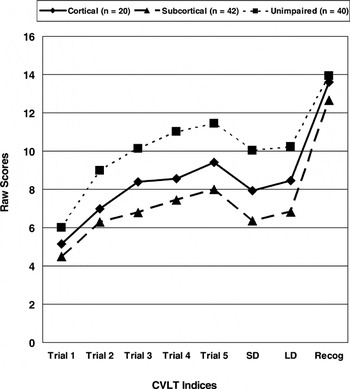
The cluster analysis generated 3 groups that were composed of 20, 42, and 40 patients, respectively. Figure 1 illustrates the mean values of the three cluster-defining variables for each of the groups. Examination of performance profiles across the three CVLT indices indicates that the three groups were generally consistent with the pattern for cortical, subcortical, and unimpaired distinctions reported by Turetsky et al. (2002). Specifically, one group (n = 40) performed better on Total Recall (Trials I–V) in comparison to the other two groups: Group 2 (n = 42), t(80) = 9.71, p < .001, and Group 3 (n = 20), t(58) = 6.02, p < .001, and performed within average limits based on normative data (i.e., z-score within one standard deviation of the mean) on the cued-intrusion score and the Discriminability-Trial 5 difference score. The remaining two groups were equally impaired on free recall. Comparison of these two impaired groups on the remaining CVLT indices indicated that one group (n = 20) made more cued intrusion errors than the other group (n = 42), t(60) = 13.37, p < .001, and had a lower Discriminability-Trial 5 difference score, t(60) = 2.48, p = .016. Given that these distinctions approximated those found by Turetsky et al., the three groups were labeled as unimpaired (n = 40), cortical (n = 20), and subcortical (n = 42) for the purpose of further analyses.

Time 1 mean scores on three cluster-defining variables for each of three patient clusters following procedures developed by Turetsky et al. (2002). Values are z-scores derived from patient data and published normative data (Delis et al., 1987), with M = 0 and SD = 1.
It is also important to note that some results deviated from Turetsky et al.'s (2002) proposed cortical-subcortical profile distinction. Examination of the subcortical group's performance across all three indices indicates that the patients within this cluster subtype actually performed within the normal range on cued intrusion errors (i.e., z-score within one standard deviation of the mean), with no significant difference between the subcortical and unimpaired groups. Furthermore, although the cortical group had a significantly lower score on the Discriminability-Trial 5 difference score than the subcortical group, this score did not fall within the impaired range. In fact, the cortical group's score was significantly higher than that of the unimpaired group, t(58) = 3.97, p < .001. This contrasts with Turetsky et al.'s typology, wherein the unimpaired and subcortical groups performed similarly and within the normal range on the Discriminability-Trial 5 difference score, whereas the cortical group performed significantly worse.
Figure 2 presents the performances of the three groups on primary CVLT indices and illustrates the partial conformity between the three subgroups and the expected cortical-subcortical distinction. Overall, the unimpaired group performed better than both of the impaired groups. However, Turetsky et al. (2002) reported a cortical group with deficient retention relative to the subcortical group. In the present study, both the cortical and subcortical groups demonstrated a similar level of performance for retention. Moreover, the cortical group performed at a level similar to the unimpaired group on the recognition trial and performed better on this trial than the subcortical group. This is different from the findings in Turetsky et al. in that the subcortical group from that study more closely approximated the unimpaired group on recognition and performed much better than the cortical group.

Time 1 mean performance scores across the California Verbal Learning Test trials for each of the three patient clusters following procedures developed by Turetsky et al. (2002). SD = short delay free recall; LD = long delay free recall; Recog = recognition.
Regarding illness-related characteristics, there were no significant differences between the three patient cluster groups in terms of age at illness onset, average chlorpromazine (CPZ) daily dose, and anticholinergic medication status.
Typology replication (Time 2)
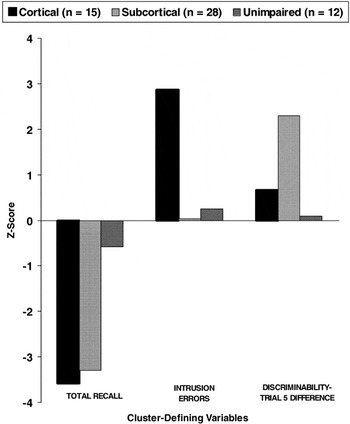
The same k-means cluster analysis of CVLT performance was conducted with the patients from the follow-up assessment (Time 2). The cluster analysis generated 3 groups, composed of 15, 28, and 12 patients. The mean values on defining variables for the resultant three groups are presented in Figure 3. Similar to the results from the cluster analysis conducted with the patients from the initial assessment, one group (n = 12) performed better on Total Recall (trials I–V) than the other two groups, Group 2 (n = 15), t(25) = 6.94, p < .001 and Group 3 (n = 28), t(38) = 7.30, p < .001, and performed within unimpaired limits as determined by normative data on both the cued intrusion error rate index and the Discriminability-Trial 5 difference score. The remaining two groups did not differ on Total Recall. However, one group (n = 15) had more cued intrusion errors, t(41) = 7.52, p < .001, and a lower Discriminability-Trial 5 difference score, t(41) = 3.96, p < .001, as compared to the other group (n = 28). Consequently, the groups were labeled as unimpaired (n = 12), cortical (n = 15), and subcortical (n = 28) for the purpose of further analyses.

Time 2 mean scores on three cluster-defining variables for each of three patient clusters following procedures developed by Turetsky et al. (2002). Values are z-scores derived from patient data and published normative data (Delis et al., 1987), with M = 0 and SD = 1.
Similar to the results based on the index data, the impaired groups generated from the follow-up cluster analysis conformed partially to the performance profiles expected based on Turetsky et al.'s (2002) distinctions. The subcortical and unimpaired groups did not differ with respect to the cued intrusion error rate index, with the subcortical group's score falling within one standard deviation of the mean of normative data. In addition, the cortical group's Discriminability-Trial 5 difference score was not significantly different from the unimpaired group and also fell within the normal range. Thus, although there were differences in performance between the subcortical and cortical groups across the three CVLT indices, these two groups did not show a pattern of impairment equivalent to that reported by Turetsky et al. (2002).
Performance on the primary CVLT indices is displayed in Figure 4 for each group. Similar to Time 1, the unimpaired group from the follow-up assessment performed better overall relative to the subcortical and cortical groups. Moreover, the two impaired groups demonstrated similar retention levels and performed equally well on the recognition trial.

Time 2 mean performance scores across the California Verbal Learning Test trials for each of the three patient clusters following procedures developed by Turetsky et al. (2002). SD = short delay free recall; LD = long delay free recall; Recog = recognition.
In terms of illness-related characteristics, there were no significant differences between the three patient cluster groups with respect to the age at illness onset, average chlorpromazine (CPZ) daily dose, and anticholinergic medication status.
Subtype stability and validity
A kappa value was calculated to determine the extent to which patients assigned to a cluster group during the initial assessment were assigned to the corresponding group at the follow-up assessment. The resultant kappa was .57 (p < .001), indicating a moderate degree of agreement in cluster classification across the two time periods. Approximately 63% of patients (n = 10) who were clustered into the unimpaired group at Time 1 also clustered into the unimpaired group at Time 2. Similarly, approximately 67% of cortical patients (n = 10) and 83% of subcortical patients (n = 20) from Time 1 were clustered into the same group at Time 2.
Cognitive variables relevant to the validity of the subtypes are presented in Table 2. The unimpaired group had a higher IQ than the cortical group, t(25) = 3.02, p = .006. On the independent test of word list recall, unimpaired patients performed better than the subcortical, t(38) = 2.51, p = .016, and cortical, t(25) = 4.43, p < .001, groups (Trial 1 Secondary Memory score). However, there were no significant group differences in the number of intrusion errors on this task. This is noteworthy because differential vulnerability to intrusion errors is a defining feature of Turetsky et al.'s (2002) typology. In addition, there were no differences among subgroups in executive (WCST Categories) or motor function (Pegboard Total Time).
Cognitive and clinical variables for three cluster groups

Table 2 also summarizes the scores for the clinical variables. In terms of symptoms (BPRS), the unimpaired group had significantly fewer negative (t(38) = 3.47, p ≤ .001) and positive (t(38) = 2.64, p = .01) symptoms than the subcortical group. Regarding the SIP measure, patients from the cortical group reported a lower, overall subjective quality of life than patients in the unimpaired group (t (25) = −2.3, p < .05). There were no other significant differences between subtype groups on the symptom and quality of life variables.
McDermid Vaz and Heinrichs (2002) memory impairment dichotomy
This subtyping approach classified 68 patients from the initial assessment as memory impaired and 34 patients as memory unimpaired. Patients were classified as memory impaired if their Total Recall score from the CVLT (Trials I–V) was two standard deviations below the average score from published normative data (Delis et al., 1987). The memory-impaired group had a later age at illness onset, t(100) = 2.31, p = .02 than the memory-unimpaired group, but there were no significant differences between the two groups in the average CPZ daily dose or anticholinergic medication status.
The patients from the follow-up assessment were partitioned into memory subgroups following the procedure used during the initial assessment. This yielded 43 patients classified as memory impaired and 12 patients classified as memory unimpaired. There were no significant differences in age of illness onset, average CPZ daily dose, or anticholinergic medication status between the two groups.
Subtype stability and validity
The stability of the memory subtypes across the two time periods was evaluated by a kappa calculation. A kappa of .50 (p < .001) resulted, indicating that there was a moderate degree of stability in the classification of patients from Time 1 to Time 2. Specifically, 15% of the patients were classified as memory-unimpaired across both time periods and 67% were consistently classified as memory-impaired. The two groups were compared in terms of adjunct test performance to assess cognitive validity. As presented in Table 3, the two groups differed on the independent test of word recall (Trial 1 Secondary Memory score), with the memory-impaired group performing below the memory-unimpaired group, t(53) = 3.68, p < .001. There was no evidence of differences in general intellectual ability, executive or motor function between the groups.
Cognitive and clinical variables for memory-impaired and memory-unimpaired groups

Findings from the clinical variables (Table 3) indicate that the memory-impaired group had elevated positive (t(53) = 3.74, p ≤ .001) and negative (t(53) = 3.91, p ≤ .001) symptoms relative to the memory unimpaired group. In addition, memory-impaired patients had lower overall life quality scores on the SIP relative to unimpaired patients (t(53) = 2.8, p < .01).
DISCUSSION
This study assessed whether verbal memory performance can be used to reduce the heterogeneity of schizophrenia by organizing patients into discrete, trait-like, and valid cognitive subtypes. Two methods of subtyping were examined: (a) the Turetsky et al. (2002) cortical-subcortical-normative profiles based on cluster analysis and (b) the McDermid Vaz and Heinrichs (2002) memory impairment dichotomy based on a psychometric criterion. Results suggest that both approaches yield potentially valuable illness distinctions, but only on a cross-sectional basis. The evidence does not support the idea that such distinctions represent enduring, trait-like variants of schizophrenia.
Cluster analysis of CVLT data from our sample of schizophrenia patients partially replicated the memory typology presented by Turetsky et al. (2002). Moreover, this occurred at two assessment points, 3 years apart. Nonetheless, these groups did not demonstrate the level of impaired performance reported by Turetsky et al. (2002). For example, the subcortical group in Turetsky et al.'s study scored approximately two standard deviations above the healthy control sample on cued intrusion errors. Moreover, in this study, the subcortical group was similar to the unimpaired group, performing within the normal range on cued intrusion errors at initial and follow-up assessments. In addition, the cortical group in Turetsky et al.'s study performed approximately five standard deviations below the control group on the Discriminability-Trial 5 difference score index. The cortical group in our study was not impaired on this measure at either assessment point.
There is evidence that the cortical-subcortical-normative typology lacks cognitive and clinical validity. Thus no significant differences were found between the subtypes with respect to intrusion errors on an independent proactive interference task. Turetsky et al. (2002) differentiated cortical and subcortical groups partly based on the total cued intrusion index from the CVLT reflecting, presumably, a selective vulnerability to this kind of recall error in the cortical or “Alzheimer-like” group. Also of note is the fact that the unimpaired group had a significantly higher IQ than the cortical group. This suggests that general cognitive impairment underpins group differences and casts doubt on the characterization of the typology as primarily mnestic in nature. It is also noteworthy that the subtype groups performed equivalently on a manual dexterity task (Purdue Pegboard). Because the subcortical memory pattern was based on the performance of Huntington disease patients, a selective motor deficit in the corresponding schizophrenia group would have supported the typology's neurological validity. In addition, the two impaired groups were not differentiated from one another based on residual symptoms (BPRS) or functional status (SIP).
Furthermore, the typology may not represent truly trait-like variants of schizophrenia. We found only a moderate degree of agreement between the initial and follow-up subtype cluster assignment. Approximately 27% of patients who were classified into a specific group at Time 1 were assigned to a different group at Time 2. This is not entirely unexpected, given that two of the three indices that define the typology have poor test–retest reliability. A supplementary analysis for our schizophrenia sample revealed that the intraclass correlation (ICC) for the Total Recall score between Time 1 and Time 2 was 0.72, which indicates moderately high test–retest reliability. However, the ICC for the number of cued intrusion errors was 0.17, and the Discriminability-Trial 5 Difference index correlation was 0.34. The poor reliability of the two key indices suggests that they may not be suitable for use as subtype indicators.
Overall, results from the present investigation suggest that memory performance patterns like the proposed cortical–subcortical-normative distinction exist in the schizophrenia patient population. However, these patterns may reflect trait-like conditions in some patients and transitory states in others. Moreover, it is likely that such “memory” patterns are more broadly cognitive in nature than the original formulation indicated. Although our study did not address Turetsky et al.'s (2002) neurobiological findings, the characterization of CVLT score patterns as “cortical” and “subcortical” in nature is unwarranted or premature in light of the evidence.
Indeed, although a simple dichotomy based on a performance score (McDermid Vaz & Heinrichs, 2002) also yields modest stability, it offers dividends in terms of parsimony, ease of application, and cognitive and clinical validity. Thus performance on an independent verbal recall task distinguished subgroups defined as memory impaired or preserved on the CVLT (Total Recall Trials I–V). Moreover, subgroups did not differ in vulnerability to intrusions, executive dysfunction, deficient manual dexterity, or general intellectual impairment. Hence, the evidence supports the existence of a patient subgroup defined primarily by memory acquisition characteristics rather than by multiple cognitive and motor deficits. Additionally, the findings provide evidence of clinical validity in that the two memory subgroups differed with respect to residual symptoms and functional outcome.
This study of memory-based subtyping had several limitations. First, the patients from the current study were all receiving conventional antipsychotic medication. Several researchers have reported that the cognitive functioning of schizophrenia patients is not significantly influenced by typical neuroleptics (Purdon et al., 2001; Velligan et al., 2002). Conversely, atypical antipsychotic medication may improve cognition in schizophrenia patients and has been linked to improvements in memory functioning specifically (see for example, Cuesta et al., 2001; Keefe et al., 1999; Purdon et al., 2000). Given the potentially confounding effect of medication status, future studies should examine the replication of the present results in a sample comprising patients taking typical neuroleptics, patients receiving atypical neuroleptics, and patients who may have received a combination of both types of medication over the course of their treatment.
Another issue is that we used published normative data to derive z-scores for the cluster analysis, whereas Turetsky et al. (2002) used a healthy control sample. Of note, however, is the fact that their control group was significantly younger and more educated than their schizophrenia patients. Thus, the healthy control group was not adequately matched to the patients on all demographic variables. Given that the normative data used in the present study accounted for the age and sex of the patient, the use of a control group may not have been more advantageous in this particular instance. However, the inclusion of a healthy control group could address issues such as the stability of memory performance in healthy individuals over time, and aid in quantifying practice effects with the same index measure.
Finally, the sample of schizophrenia patients from the follow-up assessment was relatively small, resulting in low power for the statistical analyses. Consequently, it is possible that there were significant group differences that were not detected. Future research, involving a larger sample size and more refined analyses with a greater number of independent measures could determine more precisely the nature of the clinical, cognitive, and neurobiological validity of the subtypes. In particular, it would be informative to use additional memory measures as well as neuroimaging techniques to address the question of whether a selectively amnestic variant of schizophrenia exists (Heinrichs, 2004).
There are alternatives to memory indicators, including measures of attention and executive ability, and these could be used to create typologies (e.g., Goldstein, 1990). It should also be noted that several methodologies have been developed for the detection, measurement and description of putative illness variants and subtypes of schizophrenia. These methods include latent class (McGrath et al. 2004) as well as taxometric (Meehl, 1995) and clustering (Goldstein, 1990) algorithms and procedures. As yet none have produced compelling evidence for a more biologically valid definition of schizophrenia. However, several investigators are pursuing promising leads based on the premise that cognitive impairment identifies a group of patients with a unique neurobiological and genetic profile (Hallmayer et al. 2005; Heinrichs, 2004, 2005; Toulopoulou et al., 2003).
ACKNOWLEDGMENTS
This research was supported by grants to the second author by the Ontario Mental Health Foundation. The information in this article and the article itself are new and original, not previously published electronically or in print and not under current review by any other publication. Portions of the data were presented at the annual meeting of the American Psychiatric Association, Toronto, Canada, May 2006, the biennial meeting of the International Congress of Schizophrenia Research, Colorado Springs, Colorado, April 2005, and the North American meeting of the International Neuropsychological Society, Baltimore, Maryland, February 2005. The authors would like to thank Jill Rich and Jane Irvine for their helpful discussions of the study results.