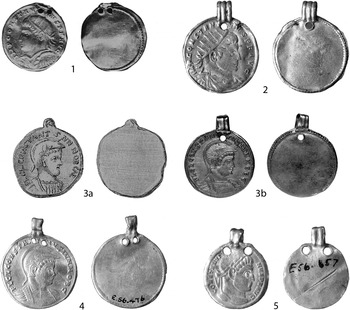
Research for a corpus of Roman gold coins found in Britain and Ireland revealed a small group of five uniface gold medallionsFootnote 1 in the names of Constantine I and his son Constantine II, the significance of which has not previously been noted. These medallions are lighter than Constantine's new gold coin, the solidus, and bear a portrait of the Emperor, or one of his sons, on the obverse with a reverse that is either blank or contains a central pellet.Footnote 2 The five specimens published here are all either pierced or mounted with an attachment loop, or both. From the obverse inscriptions and the style of the portraits these uniface medallions can be divided into three groups, struck in c. a.d. 318–20 (Nos 1–4), c. a.d. 324–26 (no examples of this group have been found in Britain or Ireland), and c. a.d. 330–40 (No. 5).
These curious objects are missing from many of the main corpora of coins and medallions of this period: although Cohen listed some varieties,Footnote 3 Bruun excluded them from RIC VII (a.d. 313–37), along with all medallions, while Kent, who did include medallions in RIC VIII (a.d. 337–64), also omitted them. Alföldi did include them in her discussion of Constantine's gold coinage,Footnote 4 but they are virtually absent from Gnecchi's monumental corpus of Roman medallions.Footnote 5
These pieces are without precedent in the Roman period in being uniface,Footnote 6 but it is clear from the portraiture and quality of engraving of the obverses that they are products of the official mints: the specimens listed in this note are likely to have been minted at Trier, while examples are also known with mint-marks of Siscia and Thessalonica, and also perhaps Aquileia. Specimens were struck in the names of Constantine I or his sons Constantine II, Crispus and Constantius II as Caesars and of Constantine II, Constantius II and Constans as Augusti: none are known for Licinius. All of them are products of the Western Empire.
Medallions of this type have been published in the numismatic literature since the mid-nineteenth century by Lelewel (Reference Lelewel1842), Sabatier (Reference Sabatier1863), von Sallet (Reference von Sallet1885), Münsterberg (Reference Münsterberg1923), and most recently Depeyrot (Reference Depeyrot and Hackens1996), who published no fewer than 45 specimens, although he did not include any of the five British or Irish specimens listed here. Holmes (Reference Holmes2004) has published a specimen in the National Museums of Scotland which is almost certainly the same as the one recorded from Birrens in the eighteenth century (No. 3), while Doyen (Reference Doyen2007) has published a piece in Rheims museum; to these can be added a further four examples from sales catalogues,Footnote 7 so the corpus now stands most probably at 55 specimens.
Just five of the examples known to Depeyrot were provenanced, and there is now a sixth example published too late for him to include in his paper which was found in Thrace.Footnote 8 Of these six pieces three come from within the Empire: one was a stray find from Clisson, France,Footnote 9 one from an uncertain provenance within the former Yugoslavia,Footnote 10 and the third was found in Thrace.Footnote 11 The other three examples come from beyond the frontier: two are from a hoard found at present-day Brestov in the district of Mukachevo, Ukraine in 1892Footnote 12 and one was found in Jutland.Footnote 13
The distribution of the British and Irish pieces is suggestive, since four were found beyond the frontier (one at Birrens in Dumfries and Galloway, Scotland (No. 3),Footnote 14 two at Newgrange, County Meath, Ireland (Nos 4 and 5), and one somewhere in Ireland (No. 2)), while the fifth (No. 1) only has a vague findspot near Penrith in Cumbria, close to the frontier. These pieces are completely blank on the reverse. All of them either have an attachment loop or were pierced: the two examples from Newgrange (Nos 4 and 5) and the one from Cumbria (No. 1) were pierced twice and also had an attachment loop, while the other specimen with an Irish provenance (No. 2) and the Birrens medallion (No. 3) also have an attachment loop but were pierced once.Footnote 15
Of the five specimens published here, four may be dated to c. a.d. 318–20: Nos 1 and 2 of Constantine I (both are the same as Depeyrot 6 var.) and Nos 3 and 4 of Constantine II (both are the same as Depeyrot 4, in Paris, and they share the same die with that specimen and with each other).Footnote 16 The fifth specimen of Constantine I from Newgrange (No. 5) is a new type unknown to Depeyrot; from its legend and the style of its portrait, it must have been issued between a.d. 330 and 337. All five specimens may be attributed to the mint of Trier.
The function of these pieces is unclear. They are without precedent in being uniface; it is also clear that they are products of official mints.Footnote 17 They must have been issued for a special purpose and the fact that they have no design on the reverse and all are either pierced or mounted with an attachment loop (or both) suggests strongly that they were made to be worn and were not intended as currency, as Münsterberg suggested.Footnote 18 Depeyrot suggests that they were intended for distribution to the army in imperial donatives and this is a possibility, but they are unlike any other medallions or coins struck for donatives. Holmes doubts the donative theory and — noting that they are uniface and that most are either provided with an attachment loop or are pierced — suggests that they were intended to be securely attached to something and that they were military merit awards.Footnote 19 That they were intended to be worn seems undeniable, but the fact that more of them have been found outside the Empire than within it seems to argue against their having been awarded to the regular army.
Since four out of five of the British and Irish examples and three out of six of the finds from the Continent were found beyond the frontier, this raises the possibility that either they could have been issued as subsidies for the barbarians or they could have been paid to the commanders of the laeti, the barbarian troops employed by the Roman authorities from the late third century onwards.Footnote 20 This is supported by the fact that the piercing or mounting of Roman coins for use as jewellery is a well-known phenomenon beyond the frontier,Footnote 21 while in Britain this practice was a phenomenon of the post-Roman period when coins ceased to be used as currency, but were valued as items of personal adornment.Footnote 22
Callu demonstrated that gold coins start to be pierced on a regular basis in the third century and that this practice continues into the Byzantine period;Footnote 23 he further showed that the majority of pierced gold coins are found in the barbaricum; for example, the majority of the solidi minted between a.d. 395 and 476 recorded by Fagerlie among finds from Sweden and Denmark are pierced,Footnote 24 and 40 out of 142 gold coins of the first to fifth centuries recorded from the former East Germany are pierced or otherwise reused as jewellery.Footnote 25 By contrast, in Callu and Loriot's corpus of 1,922 single finds of gold coins from Gaul and Germany,Footnote 26 only seven examples are pierced, demonstrating that coins circulating within the Empire, or at least in Gaul and Germany, were very seldom pierced.
Amongst the British and Irish finds, there are 30 pierced coins, 28 with an attachment loop, 12 set in a mount and 5 set in finger-rings, besides the 5 uniface medallions (out of a total corpus of 782 single findsFootnote 27 ). The great majority of these British finds date to the fourth to sixth centuries, most of which are believed to have come from Anglo-Saxon contexts. This again would seem to indicate that gold coins were generally only reused as jewellery (whether by being pierced or having an attachment loop or being set in a mount) either once they had travelled beyond the frontier or after the end of Roman rule in Britain. It is also notable that many large gold medallions of the fourth and fifth centuries a.d. have been found in the barbaricum and that these have often been converted into jewellery by being pierced or set in a mount, and it is clear that the peoples living beyond the frontier in Germany and the countries of eastern Europe undoubtedly prized such objects.Footnote 28 Gregory of Tours records how in the late sixth century emperors still gave gold medallions as gifts to German rulersFootnote 29 and no doubt this practice went back at least to the third century.
The weights of these medallions also show that they are unlikely to have been issued as currency, since there is a wide variation among individual specimens and they do not correspond to Constantine's new gold coin, the solidus, which was struck to a weight standard of 4.4 g. We know the weights of 44 specimens, 22 with an attachment loop and 22 without a loop (although in some cases the medallion still has the remains of a loop). The specimens with a loop have an average weight of 3.95 g, with a range of 3.07 g to 5.15 g; those without an average of 3.57 g, with a range of 3.06 g to 4.05 g. It seems clear that the mints did not attempt to strike these medallions to a consistent weight standard, in contrast with the solidi which were struck at a consistent standard with little variation among individual specimens. Of course the weight of these medallions would be of secondary importance if they were intended as jewellery rather than as currency. It is interesting that metal analysis of the two specimens from Newgrange (Nos 4 and 5), to be published shortly, shows that their metal content is comparable to the contemporary solidi, for they are respectively 95 and 96 per cent pure.
So, if it can be accepted that these medallions were not intended for currency but for some other purpose, what can be said about the historical context in Britain? Constantius I led a campaign into Scotland at the end of his reign in a.d. 305–6, and, before his death in York in 306, he ensured that the army acclaimed his son Constantine as his successor. Little is known of events in Britain in the following half-century, although the archaeological evidence suggests that it was the time of the province's greatest prosperity.Footnote 30 Eusebius' Vita Constantini, the reliability of which is doubtful,Footnote 31 refers to a campaign undertaken by Constantine in Britain probably before the defeat of Maxentius in a.d. 312,Footnote 32 while it has been inferred from coins issued in the name of Constantine at the mint of London with the ADVENTVS AVG reverse that he visited Britain on possibly three occasions in a.d. 307, 312 and 314.Footnote 33 Whether or not these coin types can be taken at face value, it is certain that Constantine accepted the title Britannicus Maximus at some point between a.d. 315 and 318.Footnote 34
It is possible that a peace treaty at the end of Constantius I's campaign resulted in the payment of subsidies to the peoples beyond the frontier, as is thought to have occurred at the conclusion of Severus' campaign in Scotland in a.d. 211. If that is the case, the payments appear to have been made to peoples in Ireland as well as Scotland, since only one example has been found in Scotland,Footnote 35 compared with no fewer than three from Ireland, from which Roman finds are otherwise rare.Footnote 36 Philip Rance has re-evaluated the relationship between the Irish people known as the Attacotti (who, he argued, lived in Munster in south-west Ireland) and Rome. Ammianus Marcellinus notes that they were one of the peoples who attacked Britain in the 360s, but the Notitia Dignitatum records the existence of units of troops drawn from the Attacotti serving in the Roman army in the 390s.Footnote 37 Could the two specimens from Newgrange and the other unprovenanced example from Ireland represent subsidies paid by the Roman authorities to Irish tribes such as the Attacotti?Footnote 38
To conclude, it seems from their highly variable weights that these medallions were not struck as currency but to be worn. Four specimens have findspots within the Empire (one close to the frontier), while seven were found in the barbaricum. Previous writers have suggested that they may have been intended as army donatives or as military merit awards, but the fact that more examples were found outside rather than inside the Empire seems to make this unlikely. Other possible explanations, suggested here, are that they may have been produced (a) as subsidies for the barbarians, coin-like in form, but already converted into jewellery, since the barbarians had developed a taste for using Roman coins as jewellery, or (b) as payment for troops of barbarian origin who were based inside the Empire, the laeti, who maintained contact with their relations who lived outside the Empire. This latter explanation seems to fit the available facts best, but, in the absence of conclusive evidence, must remain speculative.
CATALOGUE ( fig. 1)
1. Penrith area, Cumbria (NY 51 30) (Bland and Loriot Reference Bland and Loriot2010, 114)
Gold uniface medallions of the House of Constantine: (1) Constantine I, Penrith area, Cumbria; (2) Constantine I, Ireland; (3) Constantine II Caesar, Birrens, Scotland: (a) engraving from Gordon Reference Gordon1727; (b) medallion in National Museums Scotland; (4) Constantine II Caesar, Newgrange, Ireland; (5) Constantine I, Newgrange, Ireland. Scale 1:1.

Constantine I, c. a.d. 318–20
Description: Obv.: IMP CONSTANTINVS P F AVG, bust, radiate, dr., cuir., seen from rear, l. Rev.: blank. Pierced twice above head at 12 o'clock and 12.30.
Reference: Depeyrot 6 var. (this has bust r.).
Mint: Trier.
Weight: 3.33 g.
Location: Not known.
Source: Glendining's 28 February 1995, lot 41; Coin Register, British Numismatic Journal 65 (1995), no. 57; Shotter Reference Shotter2000, 218: ‘Penrith: A gold medallion of Constantine I was offered for sale by auction by Messrs Glendining in February, 1995. It is said to have been found in the Eden Valley, south of Penrith … See Shotter, TCWAAS 2, 96 (1996), 32.’; Richardson Reference Richardson1999, 24, no. 177.
Method and date of discovery: Not known, before 1995.
2. Ireland, Uncertain (Bland and Loriot Reference Bland and Loriot2010, 880A)
Constantine I, c. a.d. 318–20
Description: Obv.: IMP CONSTANTINVS P F AVG, bust, radiate, dr., cuir., seen from front, r. Rev.: blank. Pierced at 12 o'clock with attachment loop.
Reference: Depeyrot 6 var. (bust seen from in front rather than from rear).
Weight: 3.95 g.
Mint: Trier(?).
Location: National Museum, Dublin, ex Royal Irish Academy.
Source: Wilde Reference Wilde1862, 83. Not in Bateson Reference Bateson1973.
Method and date of discovery: Chance find, before 1862.
3. Scotland, Dumfries and Galloway, Birrens (NY 24 81) (Bland and Loriot Reference Bland and Loriot2010, 710)
Constantine II Caesar, c. a.d. 318–20
Description: Obv.: FL CL CONSTANT[I]NVS IVN NOB C, bust, helmeted, cuir., seen from front, r. Rev.: blank. Pierced at 12 o'clock with an attachment loop.
Reference: Depeyrot 4. Same obverse die as No. 4 and as Depeyrot 4.
Weight: 3.79 g.
Mint: Trier.
Location: National Museums of Scotland (H.C262).
Source: Gordon Reference Gordon1727, 18: ‘Near to this, to the West, are Marks of Stone Buildings, where several Roman Coins have been found. Mr Maxwell of Middleby made a present of a Gold Medal of Constantius Chlorus, dug up here, to my worthy Patron Baron Clark …’; Horsley Reference Horsley1732, vol. 2, 341; Haverfield Reference Haverfield1899, 162; Macdonald Reference Macdonald1917–18, 218–19; Macdonald Reference Macdonald1938–39, 261 (doubted the authenticity of the piece); Robertson Reference Robertson1975, 249. Holmes Reference Holmes2004 publishes this piece which is now in the National Museums of Scotland, ‘where it has been for some considerable time, although unfortunately with no recorded provenance or even details of acquisition’. The similarity of the piece that is now in the National Museums to that published by Gordon in 1727 as having been found at Birrens is so great that it seems very likely that they are one and the same, although Gordon's engraving does not accurately reproduce the inscription.
Method and date of discovery: Chance find, c. 1725.
4. Ireland, County Meath, Newgrange (O 005 730) (Bland and Loriot Reference Bland and Loriot2010, 878)
Constantine II Caesar, c. a.d. 318–20
Description: Obv.: FL CL CONSTANTINVS IVN NOB C, bust, helmeted, cuir., seen from front, r. Rev.: blank. Pierced twice above head, with attachment loop in between.
Reference: Depeyrot 4. Same obverse die as No. 3 and as Depeyrot 4.
Weight: 3.87 g.
Mint: Trier.
Location: National Museum, Dublin, E56.476.
Source: Carson and O'Kelly Reference Carson and O'Kelly1977, 15; Bateson Reference Bateson1973, 46, 10.
Method and date of discovery: Archaeological excavation, 1962–69.
5. Ireland, County Meath, Newgrange (O 005 730) (Bland and Loriot Reference Bland and Loriot2010, 875)
Constantine I, a.d. 330–37
Description: Obv.: CONSTANTI-NVS P F AVG, head, laur., r. Rev.: blank. Pierced twice above head with attachment loop in between.
Reference: Depeyrot –; cf. RIC VII Trier pl. 4, 190 and 192.
Weight: 3.07 g.
Mint: Trier(?).
Location: National Museum, Dublin, E56.657.
Source: Carson and O'Kelly Reference Carson and O'Kelly1977, 10; Bateson Reference Bateson1973, 46, 10.
Method and date of discovery: Archaeological excavation, 1962–69.