Citizens are better off when they encounter viewpoints that differ from their own for many reasons. When people come into contact with others with whom they disagree, they become more understanding of multiple points of view. They gain empathy for unfamiliar perspectives. Arguments become better developed and therefore more persuasive when discussants acknowledge and legitimize counterarguments. People become more politically tolerant (Gutmann and Thompson Reference Gutmann and Thompson1996; Mutz Reference Mutz2006). They also develop more nuanced opinions as they incorporate both positive and negative assessments toward the candidates they support (Huckfeldt, Mendez, and Osborn Reference Huckfeldt, Mendez and Osborn2004). Granted, the resulting uncertainty might lead to indecisiveness and disengagement among some conflict-averse citizens (Mutz Reference Mutz2006), but the benefits of hearing the other side seem to outweigh the costs. In the end, the quality of “deliberative opinion” in the citizenry depends in part on the extent to which people encounter and work out disagreements (Price, Cappella, and Nir Reference Price, Cappella and Nir2002). “Unless citizens come into contact with divergent political viewpoints, collective deliberation among citizens will fail to play a productive role within politics” (Huckfeldt, Mendez, and Osborn Reference Huckfeldt, Mendez and Osborn2004, 91).
Unfortunately, US citizens have fewer and fewer opportunities to encounter opinion diversity. This is regrettable; many individuals actually seem willing to surround themselves and discuss politics with people with whom they disagree (Huckfeldt, Johnson, and Sprague Reference Huckfeldt, Johnson and Sprague2002; Huckfeldt, Mendez, and Osborn Reference Huckfeldt, Mendez and Osborn2004). Outlets for doing this, however, appear to be dwindling. Many Americans are increasingly isolating themselves geographically, sorting themselves into politically homogenous communities of like-minded people (Bishop Reference Bishop2008). The news media's crucial role as providers of exposure to dissimilar views (Mutz and Martin Reference Mutz and Martin2001) is increasingly undermined by media fragmentation and the growing popularity of talk shows and other one-sided opinion-based political programs. These trends exacerbate some individuals' tendency to selectively expose themselves to viewpoints that do not challenge their worldview (Stroud Reference Stroud2011). Indeed, although Americans still seem to talk politics more than citizens in other countries, they tend to do so with people with whom they already agree (Mutz Reference Mutz2006).
With myriad opportunities for avoidance today, the workplace remains as one of the few places for people to encounter and discuss politics with nonlike-minded people. Mutz and Mondak (Reference Mutz and Mondak2006) explain why the workplace is unusually conducive to what they call “cross-cutting” political discussion. For starters: “Most American adults are employed, most workers spend more time on the job than in the neighborhood or in organizations, and virtually all jobs require contact with coworkers or customers” (141). In addition, people cannot always pick and choose their coworkers or customers and contact with both is often frequent and unavoidable. Like sports and popular TV programs, politics is a suitable topic for nonintimate conversations among coworkers. Coworkers may not share the same opinions, but disagreement does not necessarily inhibit informal “water-cooler” talk about current events. With their findings, Mutz and Mondak demonstrate that the workplace fosters greater exposure to people of opposing viewpoints than social contexts such as the family, the neighborhood, and voluntary associations.
In short, the workplace offers a remarkable setting for both opinion diversity and political discussion. What if the workplace consists of like-minded people? What if the opinion variety that usually distinguishes workplace environments is lacking? These questions were starting points of the analysis in this study. To answer them data from a series of two-part surveys of undergraduate students who participated in a semester-length internship program in Washington, DC, were analyzed. More than half of the students worked as interns in offices that could be categorized as partisan—House or Senate offices on Capitol Hill, for example. The remaining students worked in less-partisan environments such as nonprofit organizations, think-tanks, and federal agencies. These differences enabled comparison between students who interned in overtly partisan offices and students who worked in offices characterized by more opinion diversity. In addition, because the surveys were conducted both at the beginning and end of the semester, changes in key measures over time were assessed. In general, how did students who worked in partisan offices change relative to the students who worked in less-partisan internships?
GROUP POLARIZATION
What sorts of changes might be expected? How might partisan work environments be associated with opinion change that differs from less-partisan workplaces? Research on group polarization invited certain expectations. Under this theory, discussion or other forms of deliberative communication within a group of like-minded people prompt group members to move further in the direction in which they are predisposed (Isenberg Reference Isenberg1986). As a result, “groups of like-minded people, engaged in discussion with one another, end up thinking the same thing that they thought before—but in more extreme form” (Sunstein Reference Sunstein2007, 60–61). Empirical evidence suggests that polarization is associated with communication among liked-minded people, both in terms of face-to-face interaction (Huckfeldt, Mendez, and Osborn Reference Huckfeldt, Mendez and Osborn2004; Sunstein Reference Sunstein2007) and through the one-sided discussion that takes place on partisan media (Jones, Ferraiolo, and Byrne Reference Jones, Ferraiolo and Byrne2011; Mendelsohn and Nadeau Reference Mendelsohn and Nadeau1996; Stroud Reference Stroud2011).
Sunstein (Reference Sunstein2007) explains why polarization can occur under all of these circumstances. First, when like-minded people discuss politics, congenial arguments will tend to outnumber counterarguments. Second, group members who are out of synch with the rest of the group will either adjust their views to more closely fit the prevailing viewpoint or abandon the group and seek out other networks more closely aligned with their predispositions. Finally, individuals who are uncertain about their views on specific topics gain confidence in their predispositions after hearing or reading the opinions expressed by people like them.
Imagine how similar polarization phenomena might occur in a workplace consisting of like-minded people. Employees, recognizing that their views are widely shared in the office, discuss politics without fear of social isolation. Because prevailing viewpoints are so dominant, dissenters keep silent; if dissenters speak, their arguments are less persuasive largely because they seem so out of place. Coworkers in the majority but with doubts about their predispositions allay their misgivings following exposure to, or participation in, the discussion. Their existing tendencies are affirmed. Over time, the opinions of the individuals who work in the office become more extreme in the direction of the prevailing viewpoint.
This line of thinking led to the following hypothesis:
Over time, individuals who work in partisan offices will become more polarized than individuals who work in less-partisan environments.
RESEARCH DESIGN
To test this hypothesis, a dataset was created from on-line surveys of 132 undergraduate students who participated in a semester-length internship program in Washington, DC, between January 2007 and December 2011. As part of a pre- and postprogram evaluation process, students completed two on-line questionnaires: one at the beginning of the semester—before they started working at their internships—and the second at the end of the term. For both surveys, a set of program evaluation items was followed by a battery of standard political survey questions tapping students' partisanship, ideological orientations, views toward government and the political system, media use, demographics, and—most useful for this study—attitudes toward key public officials, institutions, and political parties.
Also importantly, students were questioned about their internships, including one item that asked them to choose the category that came closest to describing their internship—for example, “Democratic House Member's Office,” “Republican Senator's Office,” “Policy Think-Tank—Nonpartisan,” “Policy Think-Tank—Conservative,” “Federal Government Agency,” and many more. This item helped determine whether a student worked in a partisan environment. Most internship categories were clear-cut. Partisan internships included all internships on Capitol Hill (House and Senate offices as well as committees), the national party campaign committees (e.g., the Republican National Committee or the Democratic Congressional Campaign Committee), and advocacy groups. Less-partisan internships included nonprofit organizations, federal agencies, and nonpartisan think-tanks.
Granted, some of the less-partisan internships offered a mix of both environments. For example, federal agencies are staffed by a combination of permanent government employees and political appointees nominated by the president; presumably, political discussion takes place in these offices and the prevailing opinion may be shaped by the agency head and her or his deputies, all of whom report to the chief executive. Some nonprofit organizations and think tanks may claim to be nonpartisan, but they often lean toward one party or the other.Footnote 1 I was confident that the partisan environments were relatively homogenous in terms of the political views of the people who work there—for example, that a Democratic representative would be staffed by dedicated Democrats and that strong Republicans would dominate the staff of a national party organization such as the Republican National Committee. I was careful, however, to conceptualize other workplace environments as “less partisan” rather than clearly “nonpartisan.”
All of the relevant questions were asked both at the beginning and end of the semester. As a result, changes in attitudes could be assessed between the two time periods. Therefore, the study could be treated as a natural pretest/posttest experiment. Students who worked in partisan workplace environments made up the treatment group, leaving the students interning in less-partisan offices in the control group. Aside from the internships, the experiences of nearly all participants were remarkably similar. Students took the same classes, participated in the same cultural outings, shared group meals, and socialized together to a remarkable degree. Thus, as much as natural experiments allow, differences in change between the two groups can be explained—at least in part—by the introduction of the treatment, that is, the partisan workplace environment.
As a result, this research design benefits from high levels of internal validity. But there were obvious shortcomings: Subjects were not randomly selected, nor were they randomly assigned to their experimental conditions. In addition, having only 132 subjects limited the use of advanced statistical techniques. Given the small sample size, I decided to work with a significance level of .10, but this decision increases the likelihood of Type II error. And although external validity was enhanced by the qualities of a quasi-experiment, it was partly diluted by the use of undergraduate students as subjects who were not randomly selected. Thus, I interpret the following results with some degree of caution.
RESULTS
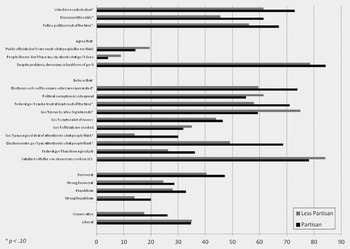
Testing the hypothesis eventually entails comparing how the two groups changed in terms of key measures taken at the beginning and end of the semester. First, however, I compared the two groups at the beginning of the semester—shortly after the students arrived in Washington, DC, but before their first day on the job (figure 1). By some measures the groups were similar. Partisan internships were slightly more popular than less-partisan internships among strong Republicans and strong Democrats and conservatives, but the differences were not statistically significant. There were no statistically significant differences in levels of internal and external efficacy, trust in government, and perceived levels of political corruption, government waste, and other related indicators.
Initial Differences/Partisan v. Less-Partisan Work Environments

Important distinctions, however, existed between the two groups. Even at the beginning of the semester, subjects who worked in partisan environments were already somewhat more politically engaged. They were much more likely to report discussing politics with family or friends: 61% report doing so daily, compared with only 46% of subjects working in less-partisan offices. About 73% of partisan interns reported voting in the previous election compared with about 61% of subjects working in nonpartisan offices. In addition, they were slightly more likely to say they follow politics and government “most of the time.” By some measures, partisan interns reported higher levels of support for the political establishment—perhaps not surprising given their interest in working in traditional political offices, but remarkable given that they had not yet started working there. They were twice as likely to indicate that the government pays “a good deal” of attention to popular will when it makes decisions. And they were 20% more likely to say elections make the government pay “a good deal” of attention to what the people think. All of these differences were statistically significant at the .10 level or higher.
Were they already more polarized? Were the students who eventually pursued partisan internships already more divided than the students who worked elsewhere? Here, I used two indicators of polarization—partisan polarization and ideological polarization. Standard 1–100 feeling thermometer measures were used for both. To compute a partisan polarization score, I calculated the difference between the respondent's rating of “The Democratic Party” and that of “The Republican Party,” then used the absolute value of the difference. For example, if respondents rated the Democratic Party a 75 and the Republican Party a 25, their partisan polarization score would be 50 (suggesting a relatively high level of polarization). If respondents rated the Democratic Party a 60 and the Republican Party a 50, their partisan polarization score would only be 10—a relatively low level of polarization. Ideological polarization scores were calculated in the same way using feeling thermometer scores for “Liberals” and “Conservatives.”
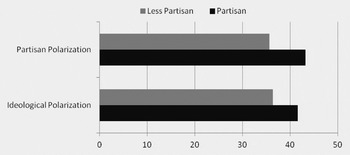
Even at this early stage, there were signs of differences in polarization (figure 2). On average, the partisan polarization score for partisan interns at the beginning of the semester was 43 compared with 36 for other students. Similarly, ideological polarization scores were 42 and 36 respectively. Although neither difference was statistically significant, their consistency foreshadowed the divide that would emerge as the analysis progressed.
Initial Differences in Polarization: Partisan v. Less-Partisan Work Environments

The lack of statistically significant polarization differences at this stage was no surprise. After all, I hypothesized that one group would change and the other would not—that students who worked in partisan environments would become more polarized over time whereas students who interned elsewhere would not—not that the two groups were different from the start. Even before the semester began, the students who eventually pursued partisan internships appeared to be more engaged in politics and more supportive of the political establishment. But I was more interested in whether they, more than their counterparts who worked in other environments, became more polarized after working in an environment that presumably fostered intense, one-sided discussion with little attention to opposing viewpoints.
To this end, I computed a simple change score by subtracting the respondent's polarization scores at the end of the semester from those of the beginning. For example, if a respondent's partisan polarization score was 25 at the beginning of the semester, then 35 at the end, the partisan polarization change score was +10, indicating that this individual had become more polarized in partisan terms by the end of the semester. A respondent whose ideological polarization score was 10 at the beginning of the semester and 5 at the end received a −5 for the change score, indicating that the respondent had become less ideologically polarized over time.
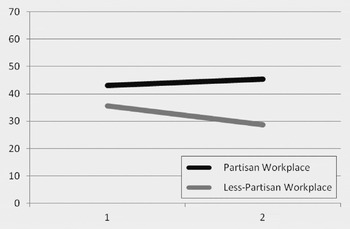
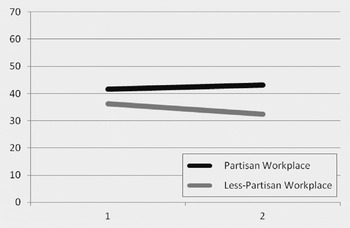
As expected, overall levels of polarization did not change much. Both partisan and ideological polarization actually declined, but by less than a point (−.81 and −.62 respectively). This stasis, however, masked an important difference between the two groups. Whereas students who worked in less-partisan environments became less polarized in partisan terms, the opposite was true for students who worked in partisan environments (figures 3 and 4). Specifically, partisan polarization scores increased by 4.32 points for partisan interns and declined by 6.98 points for nonpartisan interns—a statistically significant difference (p = .003). Ideological polarization scores also changed in the expected direction (increasing by 2.42 for partisan interns and decreasing by 4.09 for nonpartisan interns), but not enough to be statistically significant.
Partisan Polarization Change: Partisan v. Less-Partisan Workplace

Ideological Polarization Change: Partisan v. Less-Partisan Workplace

So far, the results suggest important differences in polarization between students who worked in partisan environments and students who did not. Surprisingly, much of the polarization gap can be explained by declines in polarization among people who pursued internships in less-partisan environments. In fact, it appears that polarization increased only slightly among those who pursued partisan internships. This twist triggered another set of questions about the two groups. In particular, my attention turned to the differences between Republicans and Democrats. Previous research suggests that Republicans may be more likely than Democrats to selectively expose themselves to information that is compatible with their existing beliefs (Jones, Ferraiolo, and Byrne Reference Jones, Ferraiolo and Byrne2011). The concentration of conservative Republicans in the audiences for Fox News Channel and political talk radio suggests that partisan media may be more of a draw on the right than the left (Jamieson and Cappella Reference Jamieson and Cappella2008). Much of the polarization in the US Congress over the past four decades has happened on the Republican side (Theriault Reference Theriault2008). Were Republicans more prone to workplace-enhanced polarization than Democrats?
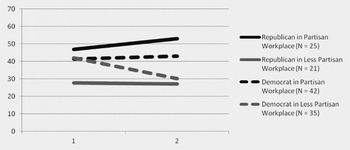
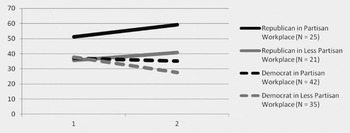
To explore this question, I created a new variable combining the partisan internship item with the standard seven-category party identification indicator.Footnote 2 Then I compared the statistical means of the two polarization change terms (table 1). Two of the groups underwent striking changes: Republicans who worked in partisan environments and Democrats who worked in less-partisan environments. Democrats who worked in less-partisan environments became strikingly less polarized. Republicans who worked in partisan environments became somewhat more polarized. These differences are shown in figures 5 and 6.
Polarization Change Scores: Republicans v. Democrats in Partisan v. Less-Partisan Workplaces

Partisan Polarization Change: Partisan v. Less-Partisan Workplace

Ideological Polarization Change: Partisan v. Less-Partisan Workplace

In summary, a partisan workplace environment mattered in two ways. It was associated with Republicans becoming more polarized. For Democrats, it seemed to counteract the general tendency of program participants to become less polarized over time. In other words, much of the difference in polarization outlined in figures 3 and 4 happened on the Republican side, with the decrease among Democrats.
DISCUSSION
In general, the results met expectations. Many of the individuals who worked in partisan environments did become more polarized over time, albeit slightly. It was surprising, however, to see that this shift was more acute among Republicans. Perhaps the distinction stems from disparate polarization in the US Congress. Between the 93rd (1973–74) and 108th (2003–04) Congresses, Republican lawmakers shifted further to the right than their Democratic counterparts moved to the left (Theriault Reference Theriault2008). Levendusky's analysis suggests that voters can adjust their partisanship in response to cues from elites in Congress (Reference Levendusky2009). Perhaps, in current and recent political climates, polarization is more of an elite-driven Republican phenomenon.
Also, I did not expect so many of the subjects to become less polarized over time. Perhaps this finding could be explained by other program-related influences outside of the workplace environments. Nearly all program participants lived together in a dorm-type residence, took the same classes, participated in cultural outings and occasional group meals, and socialized with each other. Although they sometimes grouped themselves along party lines, there was a remarkably high level of “cross-cutting exposure” to diverse viewpoints (Mutz Reference Mutz2006). There were many opportunities to talk politics—in groups of like-minded people, to be sure, but also with people who presented different points of view. Outside of the internship, the program served as an ideal environment for engaging in deliberation among people who both agree and disagree. For some reason, Democrats seemed to respond to these dynamics differently than Republicans. They became less polarized. For Republicans who worked in partisan offices, however, the effects of one-sided communication more than compensated for the tendency of most of the other program participants to become less divided.
In sum, certain workplace environments seemed to push some people to the extremes. These findings underscore the significance of the workplace as an increasingly exceptional context for cross-cutting political discourse (Mutz and Mondak Reference Mutz and Mondak2006). Outside of the workplace, citizens increasingly isolate themselves from perspectives unlike their own via the places they live, the friends they make, and the media they consume. This study examines what happens to individuals whose workplace causes them to miss this precious opportunity. For these individuals, plenty of political discourse occurred at work but not much “cross-cutting.” The advantages that come with diverse communication networks outlined earlier—for example, an enhanced willingness to grant legitimacy to the other side—were presumably less prevalent for these individuals. The result was some further shifting in the direction of existing viewpoints. This finding is consistent with Sunstein's warning that mediated and face-to-face “echo chambers” can lead to polarization.
Should we worry about polarization and its many potential causes—including the workplace effect studied here? Perhaps Americans are not as divided as the widely used red versus blue labels suggest (Fiorina et al. Reference Fiorina, Abrams and Pope2006). Or maybe the phenomenon has been misunderstood: rather than becoming more polarized, voters have simply sorted themselves into the party that better fits their ideology (Levendusky Reference Levendusky2009). If public polarization has increased, it has done so primarily among highly engaged citizens—that is, voters who most closely reflect the ideals of democratic citizenship (Abramowitz Reference Abramowitz2011). Voters now have distinct choices between two ideologically coherent parties—a clear departure from the days when George Wallace could claim that “there's not a dime's worth of difference between the parties.” Partly as a result, voter turnout is higher as are other indicators of political participation (Abramowitz Reference Abramowitz2011). And party labels are a more reliable predictor of how a politician will vote (Levendusky Reference Levendusky2009). How bad could this be?
Problems surface at the elite level. Even if there is disagreement over the extent of polarization in the public, there is a consensus that it is alive and well among elected officials and other political elites (Quirk Reference Quirk2011; Theriault Reference Theriault2008). In the US Congress, party-line voting has increased as moderates of both parties have either departed or suffered electoral defeat—often at the hands of primary voters. Many reasons explain this: redistricting; ideological and geographic sorting of voters; and an increase in procedural votes, which help congressional leaders keep their members in line (Theriault Reference Theriault2008). The most relevant explanation to this study, however, is an adaptation process whereby individual lawmakers become more extreme over time as they acculturate themselves to a partisan political environment (Theriault Reference Theriault2008); according to the analysis reported here, this adaptation process takes place at the staff level as well—and it happens quickly. The US government, with its many antimajoritarian characteristics, stagnates in these conditions. Especially during periods of divided government—the norm rather than the exception these days—effective governance requires bipartisan cooperation. Yet compromise is nearly impossible with such a vast ideological gap between the two parties.
Many of the subjects of this study are would-be governing elites. They arrived in Washington with high levels of engagement in public affairs, especially those students who eventually interned in partisan environments. They may not run for office (although some will), but many will move to Washington and join the staff of a member of the House, a senator, or a congressional committee. This study reveals that many of these students have already shifted further in the direction of their existing orientations, following just a few months working among like-minded people. In doing so, they may play at least a minor role in pushing Washington to the extremes.
ACKNOWLEDGMENTS
The author thanks James Madison University Washington Semester students for their inspiration and anonymous participation and Charles H. Blake for his input on various aspects of the project.