Implications
The Kenyan government hopes that artificial insemination (AI) can significantly improve animal productivity and help meet the soaring demand for animal products in Africa. This study revealed farmer preferences about AI services and costs in Kenya that, if implemented, could reverse a decline in its use. Kenya is watched closely by neighbouring countries so innovations successfully implemented in the Kenyan livestock sector, particularly breeding technologies, are widely emulated in the region.
Introduction
Continuing population and consumption growth will put pressure on the global demand for food for at least another 40 years (Godfray et al., Reference Godfray, Beddington, Crute, Haddad, Lawrence, Muir, Pretty, Robinson, Thomas and Toulmin2010). In East and Southern Africa, the demand and consumption of perishable products (fruits, vegetables, meat, fish and dairy) is predicted to grow substantially, by a factor of nearly eight, in the next 30 years (Tschirley et al., Reference Train and Weeks2014). Africa has a deficit in animal products (Rosegrant et al., Reference Rosegrant, Fernandez and Sinha2009) and in order to reduce the gap between supply and demand, changing the manner in which livestock are reared and increasing the productivity of individual animals on the African continent is necessary (Kosgey et al., Reference Kosgey, Mbuku, Okeyo, Amimo, Philipsson and Ojango2011), particularly for the 24 million people in East Africa who directly depend on dairy from livestock for their livelihoods (Herrero et al., Reference Herrero, Grace, Njuki, Johnson and Rufino2013).
In Sub-Saharan Africa (SSA), the dairy sector is a major socio-economic pillar, for both, food security and income generation, particularly at smallholder level (Mubiru et al., Reference Mubiru, Tenywa, Halberg, Romney, Nanyeenya, Baltenweck and Staal2007). Eastern Africa is Africa’s most promising region for dairy production (Ngigi, Reference Ngigi2005). The region holds 50% of Africa’s cattle, about 300 million head, and accounts for nearly half of the total milk produced on the African continent (47% in 2014; Food and Agricultural Organisation (FAO) of the United Nations, 2014).
Although much of eastern and southern Africa is well suited to dairy production, only Kenya has established a competitive dairy industry (World Bank, Reference Tschirley, Reardon, Dolislager and Snyder2013). In its Vision 2030, Kenya aims to reduce poverty and hunger through boosting growth in agriculture and livestock production by 6% to 8% per year (Kosgey et al., Reference Kosgey, Mbuku, Okeyo, Amimo, Philipsson and Ojango2011). The country has one of the largest dairy industries in SSA with an improved cattle herd larger than all of the rest of eastern and southern Africa (Staal et al., Reference Staal, Pratt and Jabbar2008). Dairy is the largest contributor of the country’s livestock Gross Domestic Product (GDP) (Muriuki, Reference Muriuki2003); dairy products (excluding live animals) make up 30% of all livestock GDP (Food and Agricultural Organisation (FAO) of the United Nations, 2011). Moreover, the Kenyan dairy industry provides a model that is relevant for dairy development in neighbouring African countries; the lessons learned in Kenya will have relevance for dairy development in these countries and further afield (Owango et al., Reference Owango, Staal, Kenyanjui, Lukuyu, Njubi and Thorpe1998).
Kenya’s (relative) success in dairy production largely comes from adoption of cross-bred cattle by smallholders and improvement of their linkages to the formal sector through cooperative milk collection and cooling centres (World Bank, Reference Tschirley, Reardon, Dolislager and Snyder2013). However, further gains in dairy production and marketing are constrained by technical constraints, lack of knowledge, money required to adopt new technologies (Zander et al., Reference Yorobe, Birol and Smale2013) and market constraints arising from poor access to markets, poor market conditions and insufficient access to credit (Godfray et al., Reference Godfray, Beddington, Crute, Haddad, Lawrence, Muir, Pretty, Robinson, Thomas and Toulmin2010).
One hopeful approach for increasing food production from livestock is the adoption of new technologies for breeding (Kosgey et al., Reference Kosgey, Mbuku, Okeyo, Amimo, Philipsson and Ojango2011). Superior germplasm have conventionally been disseminated by use of various breeding services such as natural bull services, AI, a combination of AI and bull services, and to a very limited extent, multiple ovulation and embryo transfer (Murage and Ilatsia, Reference Murage and Ilatsia2011). In developed countries with favourable environments and infrastructure, AI has become the most effective means of disseminating advantageous genes within a population at a reasonable cost leading to higher dairy productivity, shorter calving intervals and improved herd fertility (Stevenson, Reference Zander, Mwacharo, Drucker and Garnett2014). The Kenyan government has attempted to improve local dairy breeds by enhancing farmer accessibility to breeding services through subsidised AI services (Owango et al., Reference Owango, Staal, Kenyanjui, Lukuyu, Njubi and Thorpe1998). However, structural adjustments and liberalisation of AI services (Owango et al., Reference Owango, Staal, Kenyanjui, Lukuyu, Njubi and Thorpe1998) led to higher costs and declining accessibility of the service (Karanja, Reference Karanja2003). Although available, the share of smallholder farmers using the service has been decreasing (Baltenweck et al., Reference Baltenweck, Ouma, Anunda, Okeyo and Romney2004). Lack of market and service access and inputs (Mwanyumba et al., Reference Mwanyumba, Mwang’ombe, Lenihan, Olubayo, Badamana, Wahome and Wakhungu2010; Muia et al., Reference Muia, Kariuki, Mbugua, Gachuiri, Lukibisi, Ayako and Ngunjiri2011), lack of knowledge and changing preferences (Zander et al., Reference Yorobe, Birol and Smale2013) are some of the many issues that led to a decline in the use of AI, or reluctance to adopt it in the first place.
Reversing the reluctance to use AI necessitates critical assessment of the relationships between choice of breeding services and characteristics that could be influencing the farmers’ choices of these services (Murage and Ilatsia, Reference Murage and Ilatsia2011). This is important in providing clear understanding of important incentives, barriers and opportunities for targeting farmers to improve and encourage sustainable intensification in smallholder dairy business. One way in which smallholder farmers could improve access to breeding services such as AI would be through dairy hubs, which are organised and collectively owned by producers and farmers. Although predominantly for improved milk sales and marketing, the hubs could also facilitate access to other dairy-related services such as AI (Mutinda et al., Reference Mutinda, Baltenweck and Omondi2015). A few hubs have been installed but more information about what farmers think about them is needed for further development. One means of evaluating goods, products and services that are not yet available in the mainstream market are stated preference methods (Schulz et al., Reference Schulz, Breustedt and Latacz-Lohmann2014). One of these methods, choice experiments (CE), is a multiple attribute elicitation method that we applied to evaluate farmer preferences for AI service characteristics in Kenya. Our aims are to (1) assess dairy farmers’ preferences and values for the characteristics of AI services, measured by their willingness-to-pay (WTP), and (2) examine preference variation across farmers of different socio-economic backgrounds. The CE results can be used to assess costs and benefits of future dairy hubs by assessing the relative importance of their characteristics to farmers. This allows decision-making beyond financial considerations.
Extensive literature on CEs exists, both on the theoretical underpinningFootnote 1 and methodological development (Scarpa et al., Reference Scarpa, Ferrini and Willis2005; Train and Weeks, Reference Stevenson2005; Fiebig et al., Reference Fiebig, Keane, Louviere and Wasi2010; Greene and Hensher, Reference Greene and Hensher2010; Kragt, Reference Kragt2013). CEs have been applied in various fields such as transportation studies, health economics, marketing, environmental and agricultural economics. There has been an increase of CE application from developing countries, mainly on the evaluation of local livestock breeds,Footnote 2 but increasingly also to assess the adoption of sustainable agricultural practisesFootnote 3 . Studies that use CE for assessing preferences for technical assistance and engagement with extension agencies are most relevant for our study but are very rare (Yorobe et al., 2010; Abebe et al., Reference Abebe, Bijman, Kemp, Omta and Tsegaye2013). Another relevant study by Schipmann and Qaim (Reference Schipmann and Qaim2011) presents CE results assessing how farmers prefer to be linked to modern supply chains. From this analogy, it is evident that there are few CE applications with respect to technology adaptation and livestock production policy. Our study is the first to use a CE to assess characteristics of breeding services. The results could complement findings of other breeding and extension service evaluation studies that, from a farmers’ perspective, rank different services against each other (e.g. Bett et al., Reference Bett, Bett, Kahi and Peters2009), and other studies which assess animal performance against breeding objectives and selection criteria.
Material and methods
Choice experiment analysis
A CE is a survey-based method in which respondents make trade-offs by choosing their preferred scenario from choice sets of hypothetical scenarios characterised by a number of characteristics (attributes) and characteristics’ levels. In this case, the hypothetical scenarios describe how AI services could be delivered to smallholder farmers in dairy hubs. By choosing their preferred scenarios, farmers trade-off AI service characteristics. By analysing the data under the framework of the random utility theory (Luce and Tukey, Reference Luce and Tukey1964), we can assess importance of service characteristics relative to each other and obtain monetary values for them that can be used in benefit-cost analyses. These monetary values are expressed by respondents’ WTP for preferred services or willingness-to-accept (WTA) compensation for least preferred services, both values describing welfareFootnote 4 changes for farmers when using the services.
Choice data can be analysed using multinomial logit models. However, the restrictive assumption of independent and identically distributed error terms across scenarios and observations in these models presuppose homogeneity of preferences, which is not well suited to the realistic taste preferences of individuals (Hensher et al., Reference Hensher, Rose and Greene2005). Advanced models, for instance, random parameter logit (RPL) allow for relaxation of the assumption of constant marginal utility coefficients across individuals, hence, its ability to determine the possible sources of any heterogeneity that may exist (Hensher et al., Reference Hensher, Rose and Greene2005).
Scale heterogeneity might arise as an artefact of the design of the CE and how it was presented to respondents. Respondents are likely to perceive the choice tasks differently and have their own way of thinking about the trade-offs and how to make their choices. They also have different degrees of understanding of the choice tasks, all factors that can contribute to scale heterogeneityFootnote 5 . RPL models cannot account for this separation between scale and preference heterogeneity. Generalised multinomial logit (GMNL) models (see, Fiebig et al., Reference Fiebig, Keane, Louviere and Wasi2010; Greene and Hensher, Reference Greene and Hensher2010), on the other hand, can detect scale heterogeneity. These models can also provide a straightforward re-parameterisation of the attribute coefficients during the modelling process so enable direct estimates of the welfare estimates in WTP in space (called WTP-S model) rather than deriving them indirectly through simulations from distributions of coefficients in the utility function (Hensher et al., Reference Hensher, Rose and Greene2005; Train and Weeks, Reference Stevenson2005; Greene and Hensher, Reference Greene and Hensher2010). We estimate both, RPL (with and without interaction effects) and WTP-S models in NLOGIT, following recommendations by Chang and Lusk (Reference Chang and Lusk2011) who found this software package to be the best-performing among those tested.
Choice experiment design
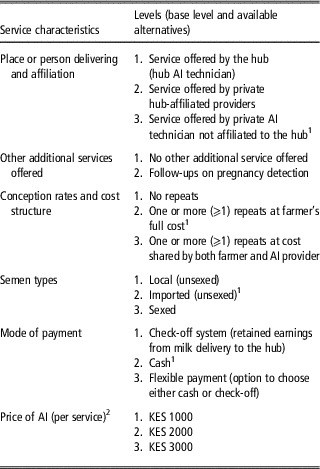
Focus group discussions and key informants interviews were used to determine the characteristics of AI services and the levels of those characteristics that are either commonly used or feasible to be used to improve the service. We finally included six characteristics, among them, a monetary value, ‘price of AI’ (Table 1). The five characteristics with three levels and one characteristic with two levels would result into 436 full factorial combinations (35×21=436), too many to have used in the survey. We applied an experimental design to obtain a manageable fraction of these combinations. We used the D-optimality criterionFootnote 6 that generated 54 unlabelled alternatives which were blocked into three alternatives per block (18 choice sets). An opt-out (‘zero’) alternative was added to each of the block of three to prevent forced answers for choice sets containing dominant alternatives (Scarpa et al., Reference Scarpa, Ferrini and Willis2005). Each respondent assessed six choice sets at a time. As all the characteristics, excluding ‘price of AI’, were designed to enter the model as discrete variables, for analysis, the choice data was effects-coded.
Artificial insemination (AI) service characteristics: attributes used to describe the choice sets and their levels

KES=Kenyan Shilling.
1 Reference level (in effect coding).
2 In US$ (US$1=KES 80).
Study area
The study was conducted in the western Kenya milk shed area where the East African Dairy Development (EADD) project, one of the current development efforts aiming to bring cost-effective AI services to dairy farmers in East Africa is implementing the ‘dairy hub’ approach. Dairy hubs consist of milk chilling and/or bulking plants from which smallholder dairy farmers access bulk markets for the milk they produce in their farms. The hubs can also offer additional dairy-related services to farmers, such as AI, that farmers could not access previously. In addition to the dairy hub concept on which this study is based and which is available in limited areas of the dairy milkshed in Kenya, a pre-bulking model is widely used in areas of low milk density in Kenya and other EADD project countries (see Mutinda et al., Reference Mutinda, Baltenweck and Omondi2015).
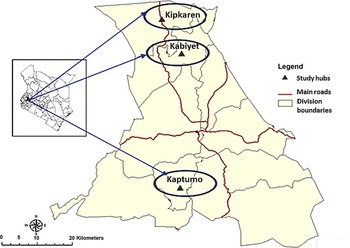
In selecting the study sites, the level of hub establishment was used as a criterion to select three out of the total 17 EADD project sites (located in high-potential dairy zones) in Kenya. The three hubs were Kipkaren hub, Kabiyet hub and Kaptumo hub, all in Nandi County (North Rift), western Kenya (Figure 1) and differed in both the length of time they had been operating and the services they provided additional to the milk chilling. Kipkaren hub, based around Tanykina dairy, was a well-established and farmer-owned milk collection plant (for both bulking and chilling) operating in the rich agricultural highlands of the North Rift Valley. This hub offered the widest range of additional services, including milk collection, marketing, AI, animal health and veterinary extension services, an agroveterinary and feed store and a village bank. Tanykina dairy also offered complementary medical health care to all shareholders in the dairy plant. Kabiyet hub had only recently been established. At the time of our survey, it had an established milk collection/chilling plant with some additional services such as an agroveterinary and feed store, but no financial or veterinary extension services (also no AI). Kaptumo hub, based around Kapcheno dairy, had not yet started operation at the time of our survey.
Study area in Nandi County (Kenya).

Sampling and data collection
A questionnaire and CE designs were developed from focus group discussions and key informants, conducted in April-May 2010 using semi-structured checklists. The sampling unit consisted of dairy farming households. The application of CE necessitated a minimum sample size of 300 households. Systematic random sampling, with the sampling frames drawn from membership registers at the respective study sites or constructed with the help of local leaders, was used to select a minimum of at least 100 dairy farmers per site in each of the three study sites. Structured questionnaires which included the CE questions were used to collect the required data from 301 respondents who were in-charge of farm activities in each household, mainly household heads (55% of the households were registered as members of the hubs). Primary data from the CE, farmer characteristics, farm characteristics and external characteristics related to the dairy enterprise were collected through personal interviews in August 2010.
Results
Model development
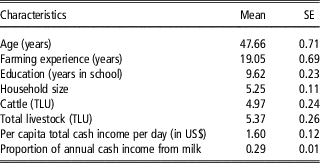
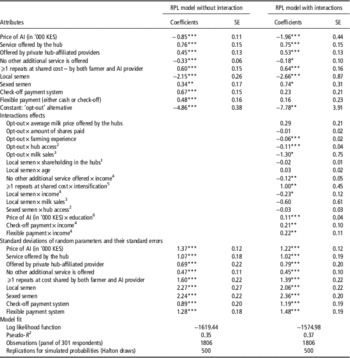
Selected dairy farmer/household characteristics are presented in Table 2. As a first step, we analysed the choice data using two basic models without interactions, a RPL (Table 3) and a WTP-S model (Supplementary Material S2). Both models showed similar model fits (R 2 of 0.35 is a good fit for choice models) and also the same signs for parameter estimates. The standard deviations were highly significant (P<0.01) for all (in the RPL model) and most (in the WTP-S model) attributes, suggesting a high degree of heterogeneity among respondents.
Respondents’ socio-economic characteristics

TLU=Tropical livestock unit.
TLUs are calculated in relation to BW with the standard being a mature cow weighing 250 kgs (TLU=1).
Farmers’ preferences for artificial insemination attributes and preference heterogeneity

RPL=Random parameter model; AI=Artificial insemination; KES=Kenyan Shilling.
***, **, *Significant at 1%, 5%, 10% levels, respectively.
1 Whether or not, a household has bought shares (shareholding) in the hubs.
2 Measured in terms of the distance (km) from village to the hubs.
3 Measured in terms of the proportion of total milk sold to the chilling hubs per day by the household.
4 Measured in terms of household per capita total cash income per day (in US$).
5 Measured in terms of exotic cattle kept, as compared with their crosses.
6 Measured in terms of average years of education for adult household members aged ⩾16.
The scale parameter in the WTP-S model was significant and moderately high, suggesting the existence of heterogeneity across respondents due to scale as well as due to individuals’ preferences. The WTP-S model did not outperform the RPL model and we therefore decided to undertake further analysis using only the RPL model.
In a second step, we included interaction effects into the RPL model to investigate further the sources of preference variation. The RPL model with interaction effects out-performed the basic RPL and WTP-S models (i.e. a better model fit based on likelihood ratio test) and showed a higher R 2 (0.37; Table 3). Earlier RPL models with interaction effects that included variables for the different hubs but these were not significant, obviating the need for separate analyses for each hub. Consequently, we present and discuss results from analysis of the pooled data set only.
Farmers’ preference for AI characteristics
The parameter estimates for the ‘opt-out’ alternative were negative and statistically significant (P<0.05) in the all models, providing evidence that dairy farmers were more likely to choose one of the presented choice alternatives rather than opting-out. Further, only 6% of the respondents opted-out in one or more of the six choice sets presented to them.
The parameter estimate for ‘price of AI’ was negative and strongly statistically significant (P<0.01) implying that dairy farmers were more likely to choose an AI profile with the lower price, ceteris paribus (Table 3).
Dairy farmers derived higher utility from AI services offered by the hub as opposed to services offered by non-hub affiliated private AI providers, ceteris paribus. Similar results were found for ‘service offered by private hub-affiliated technicians’. However, looking at the magnitudes of the coefficients (relative utilities), the parameter estimate for ‘service offered by the hub’ was of greater magnitude than that of ‘service offered by private hub-affiliated technicians’. Consequently, the model predicted a higher probability of selecting a profile with AI services being offered by hubs than for a profile with the services being offered by private hub-affiliated providers, ceteris paribus.
The positive and significant parameter estimate for ‘sexed semen’ suggested that farmers preferred ‘sexed semen’ over conventional (unsexed) semen, imported or local. The negative and significant estimate for ‘local semen’ suggested that farmers preferred imported semen (the reference level) over semen from locally raised exotic breeds and crossbreeds when using unsexed semen.
Likewise, the models showed that farmers preferred options with ‘⩾1 repeats at shared cost – by both farmer and AI provider’ (i.e. where the AI providers subsidises the cost of the repeats for farmers), over ‘⩾1 repeats at farmer’s full cost’ (reference level) and ‘no repeats’. The last option was insignificant in the models, hence dropped. The negative and significant estimate for ‘no other additional service is offered’ implied that farmers preferred ‘follow-ups for pregnancy detection’ (the reference level).
In the basic RPL model, the coefficients for ‘check-off payment system’ and ‘flexible system’ (a combination of both cash and check-off) were positive, indicating that farmers were more likely to choose options with these two characteristics than an option for cash payment. However, these attributes became insignificant once interaction effects had been included.
Preference variation
The RPL model with interaction effects revealed that household heads’ years of farming experience, hub access (the distance from the households’ village to the hubs) and the proportion of total milk sold per day by the household to hubs, had a negative and significant (P<0.10) influence on the choice of the opt-out alternative. As such, less experienced farmers, and farmers who sell little (or zero) milk through the dairy hubs, had a higher probability of opting out. These two characteristics implicitly characterised less dairy-oriented farmers, hence the low interest displayed in AI. Moreover, the results showed that farmers living nearer to the hubs had a higher probability of opting out.
Further, the results showed that farmers’ income was negatively correlated to the preference for ‘local semen’ (which refers to semen from locally raised exotic breeds) and ‘no other additional service offered’. As such, it was determined that 46% and 40% of the farmers with relatively high total household cash income showed a negative preference for ‘local semen’ and ‘no other service offered’ attributes, respectively. The converse applied to education and intensification level, of which 54% and 76% of dairy farmers whose adult household members with relatively high levels of educate and who keep exotic cattle, respectively, were found to have positive and significant preferences for ‘price of AI’ and ‘⩾1 repeats at cost shared by both farmer and AI provider’. This implied that more literate farm households (farmers) and farmers keeping exotic cattle derived high utility from AI and were willing to pay more for AI and even to repeat the use of AI should conception fail after the first attempt. We also found a negative correlation between age of household head and level of education.
Welfare estimates of AI service characteristics
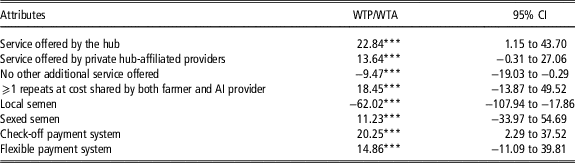
Table 4 presents the mean welfare estimates and the 95% confidence intervals obtained from the basic RPL model. The estimates were obtained by simulation, drawn from 10 000 replications. The estimated dairy farmers’ marginal WTP for ‘service offered by the hub’ was approximately US$ 23, ceteris paribus. This implied that dairy farmers would earn a welfare gain of approximately US$ 23 if provision of AI services changed from the status quo (being offered by private service providers who are not affiliated to the hubs), to being offered by hub technicians. Dairy farmers would gain approximately US$ 14 from ‘service offered by private hub-affiliated providers’, and US$ 18 from cost-sharing (‘⩾1 repeats at cost shared by both farmer and AI provider’).
Welfare estimates: willingness-to-pay or willingness-to-accept compensation (in US$) for artificial insemination (AI) service characteristics (per service)

WTP=willingness-to-pay; WTA=willingness-to-accept; CI=confidence interval.
***Significant at 1% level.
Farmers would be willing to pay an estimated US$ 11, if, ceteris paribus, the AI service would offer sexed semen as opposed to imported (and unsexed) semen. However, farmers displayed a negative utility for ‘local semen’, implying that dairy farmers would be willing to accept compensation of US$ 62 from welfare loss due to the use of local semen. Further, farmers would also incur a marginal welfare loss of approximately US$ 9 if AI services were not accompanied by follow-ups for pregnancy detection as an additional service.
Discussion
By using a CE, we were able to assess farmers’ preferences for AI services as part of dairy hubs that are currently being trialled in Kenya as a means of increasing the rate of AI use. From a model selection point of view, we were surprised that the WTP-S model did not outperform the RPL model, contrary to other studies (for instance, Kragt, Reference Kragt2013). This suggests that accounting for both scale and preference heterogeneity leads to a significantly improved model fit. We therefore decided to report mainly the results of the two RPL models, one without and one with interaction effects, which allowed for variation of preferences across farmers. Accounting for preference heterogeneity was also more in line with our aim of understanding behavioural changes and farmers’ WTP (see Greene and Hensher, Reference Greene and Hensher2010) rather than accounting for scale heterogeneity.
The CE results showed that only 6% of farmers did not opt for improved AI service scenarios. This means that the remaining 94% would like AI service provision to be improved. In essence, the study results suggest that, despite the decline in the demand for AI services in recent years, farmers are willing to use AI if the quality of the services is improved. For the overall goal of providing dairy products to a growing population in SSA, this is a promising result. Despite the benefits and challenges of AI, especially as a means of genetic improvement by reducing costs (see Ojango and Pollot, 2001) and given the Kenyan Government and development agents’ focus on this technology, our paper looks at preference for this service as opposed to mechanisms to bring about genetic improvement. Although in a hypothetical setting, this CE application is the first study of its kind to explore breeding services for smallholders in Kenya, shedding light on the social dimensions of improvements to animal performance through breeding services, rather than focusing on breeding objectives and selection criteria. The results could be useful for development of a wider network of farmer-owned dairy hubs in the country and help give farmers more control in their aspiration for increasing animal productivity.
Among the reasons, AI adoption rates remain poor in Kenya is that farmers are discouraged by a lack of services providers, the long distances between farms and providers (e.g. Mwanyumba et al., Reference Mwanyumba, Mwang’ombe, Lenihan, Olubayo, Badamana, Wahome and Wakhungu2010) and poor infrastructure such as roads. Our results point to the possibility that the observed decline in AI use over recent years could also have been because the characteristics of the services provided are not those preferred by farmers. In other words, the decline of AI use among smallholder dairy farmers in Kenya could be reversed by improving AI service delivery (as also observed by Karanja, Reference Karanja2003; Baltenweck et al., Reference Baltenweck, Ouma, Anunda, Okeyo and Romney2004; Zander et al., Reference Yorobe, Birol and Smale2013). For instance, offering the service through organised and well-managed producer/farmer organisations is one way of improving service delivery (from the observation that farmers derive positive and significant utilities from AI services offered by dairy hubs). This is true even among non-members of hubs, who still use hub services, albeit at slightly different terms. The fact that ‘hub membership’ was not a significant parameter explaining heterogeneity for the attribute ‘service offered by the hub’ implies that there is no difference in preferences between members and non-members. The observed positive preference for AI services offered by dairy hubs could be because the hubs offer assurance of availability, perceived reliability (AI technicians from the hubs are seen as reliable since they are managed by and answerable to the farmers through the producer/farmer organisations that run the hubs), and can offer payment arrangements that suit farmers’ needs.
Technical services offered by hub technicians are preferred over private hub-affiliated providers, and over private technicians not affiliated to the hubs. Farmers prefer private technicians not affiliated to the hubs the least because they would have to give up the control they have gained by fully owning the hubs. Other studies suggest that private extension services are needed to initiate structural change in SSA and as a way of meeting farmers’ needs and enhancing their livelihoods through increasing food production (Reardon et al., Reference Reardon, Barrett, Berdegué and Swinnen2009). However, farmers often do not trust private service providers, tending to feel disempowered and exploited (e.g. Rwelamira, Reference Rwelamira2015) even when they acknowledge that private service providers are more efficient than services provided by the government or NGOs (Bellemare, Reference Bellemare2010).
Our results also have implications for breeding and breed selection as most farmers view imported semen as superior to semen from locally raised exotic breeds (or sometimes crossbreeds). This could be because farmers prefer high-yielding breeds to which farmers in Western Kenya attach great importance for milk production (Makokha et al., Reference Makokha, Karugia, Staal and Oluoch-Kosura2006). Consequently, the observed high negative welfare effect of local semen (US$ −62) could be because farmers think that locally bred cows produce less milk than imported breeds. It was surprising that farmers did not prefer the cheaper local semen, given that one reason for a decline in AI use is its high price (Owango et al., Reference Owango, Staal, Kenyanjui, Lukuyu, Njubi and Thorpe1998; Karanja, Reference Karanja2003). This could be because farmers do not trust the quality of local semen, a view likely to be reinforced by intense government promotion of imported semen from exotic breeds as a means of rapidly increasing national output of livestock products. The promotion is happening despite potential interactions between genotype and the environment (GEI) which can mean that desirable traits, such as higher milk production, are not expressed under some environmental interactions (e.g. Ojango and Pollott, Reference Ojango and Pollott2002). Farmers might not be aware of these GEI and unconditionally believe in the benefits of imported semen of exotic breeds.
By the same logic, it was also surprising that farmers preferred sexed semen over imported semen. Sexed semen is more expensive than unsexed imported semen and a relatively new technology with which farmers have little experience. The use of sexed semen offers dairy farmers an opportunity to obtain more (and better) heifer calves. On the other hand, the high WTP for sexed semen could have been expected given that smallholders in the central Kenyan highlands have little land and/or fodder and therefore need to intensify their dairy production without expanding it. This means that farmers, if adopting AI, prefer an expensive AI service with the best available (‘sexed’) semen rather than paying for AI services with local semen which, while more affordable, is likely to give less satisfactory results. The unavailability of or inability to access this high-quality semen might explain why farmers do not want to adopt AI at all. The negative preference for ‘local semen’ and ‘no other service offered’ by relatively well-off farmers (higher household total cash income) could be because wealthier farmers can, not only afford AI service, but seek quality AI services (i.e. local semen and no follow-ups for pregnancy detection by AI technicians indicate poor quality AI service).
The converse would be true for poorer farmers who are usually the target beneficiaries of development initiatives. It is therefore evident that at the start, poor dairy farmers would be willing to accept basic services (lower quality AI), but as their income improves, due to development initiatives, the farmers would seek services of better quality.
The CE results show that farmers prefer an AI service that includes follow-ups to ensure conception occurs. This suggests that low conception rates and numerous repeats are major problems for farmers in the study area. This was also confirmed by farmers during the survey when discussing their choices in the CE and found elsewhere (Murage and Ilatsia, Reference Murage and Ilatsia2011). The welfare loss from non-existence of the follow-ups could also be seen as a reflection of the loss in milk production due to delayed conception owing to low conception rates and pregnancy detection.
The value of WTP for ‘⩾1 repeat at cost shared by both farmer and AI provider’ represents the amount farmers are willing to pay for a repeat, and clearly indicates that dairy farmers would be willing to shoulder part of the cost of repeats (a cost-sharing scheme). It can be argued that repeats and conception failures occur partly due to failure of farmers to detect oestrus or their inability (financial or geographical) to access the service at the right time. As such, the results could indicate that farmers do not entirely blame AI technicians for failures. The positive preference for ‘price of AI’ and ‘⩾1 repeats at cost shared by both farmer and AI provider’ by educated households and households with more exotic cattle than crossbreeds, respectively, could be because literate farmers rapidly adopt new technologies, whereas farmers with many exotic breeds are generally operating in a more intense system and are relatively better-off than those in less intense systems and can afford to pay more. Less literate farmers, as noted elsewhere (Rogers, Reference Rogers2003), tended to be suspicious of new innovations (in this case, use of AI) and generally fell into the laggard category or innovation discontinuers.
In the RPL model with interaction effects the mode of payment is insignificant, but if socioeconomic factors are held constant (i.e. the basic RPL model), farmers derive significant welfare gains from both ‘check-off system’ and ‘flexible system’. With ‘flexible system’, farmers can choose to pay either through ‘cash’ or by ‘check-off system’. Consequently, farmers appreciate the role of input credit and flexibility in their mode of payment. The check-off system is an interlocking of input and output transactions which has emerged as a viable institutional arrangement in post liberalisation Africa for enabling transactions in certain cash crops although can be challenging to manage (i.e. excessive competition renders the model unviable, yet absence of competition can lead to exploitation of farmers; Kydd et al., Reference Kydd, Dorward and Poulton2003). The AI market in Kenya is liberalised, hence the results could be reflecting the sector’s need to create a balance to meet the said challenges by seeking to balance the cash and check-off system thus avoiding the exploitation of farmers by a monopolistic market as could happen with a pure check-off system. Moreover, the displayed WTP could also signify a cash-constrained economy where farmers are uncertain of accessing liquid cash in emergency situations.
Variables describing the different hubs (Kipkaren, Kabiyet and Kaptumo) were insignificant in earlier RPL models and omitted from the final models. This was rather surprising suggesting that it did not matter to farmers if the hubs were already functioning or only planned for the future (Kaptumo) or operating but not providing AI (Kabiyet). This is another positive sign that farmers welcome and will use the AI services provided by future hubs.
Farmers’ overall value (sum of the WTP estimates) of an improved AI service (offered by the hubs, cost-sharing of repeats, using a flexible payment system and providing quality semen) is estimated at about US$ 56 when providing imported semen and US$ 67 when proving sexed semen. When using a check-off payment system, these values even increase by US$ 5. The mean household annual expenditure on AI (status quo i.e. not improved) was US$ 24.5. These values are slightly higher than the actual costs of AI in the study area and other areas within the country. Data collected in 2014 from EADD (phase II) site in Kenya revealed farmers paid an average annual cost of US$ 35 for AI and the cost of AI in Timau milkshed ranged from US$ 10 to 37.5 (Karuga, Reference Karuga2009).
Conclusion and policy implications
Efforts to increase the supply of animal products to a growing population can benefit greatly from information on farmers’ needs and preferences for services supporting their dairy production. AI supports the dissemination of beneficial genes within a population at a reasonable cost and could thereby be a cost-effective way of increasing milk production. In this study, we investigated farmers’ preference for AI service characteristics using a CE. The use of AI among dairy smallholders has been declining, but our results suggest that this could be reversed if the quality of the AI service was improved and better matched farmers’ preferences. The study revealed that farmers preferred AI services to be delivered through dairy hubs, an innovative form of collective action that supports both market access and access to other relevant inputs. Farmers were further found to prefer the use of high-quality semen in the hubs, flexible payment services, the cost-sharing for AI repeats while disliking the services to be provided by private AI technicians not affiliated to the hub. We conclude that collective action through producer/farmer organisations, such as the hubs, can bring the necessary policy change needed to increase farmers’ access to and use of AI and improve animal health and performance. Through better marketing and extension strategies that can be offered through the hubs, and that can be tailored to the diversity of the farming population in Kenya and neighbouring countries, farmers can increase their income from dairy. In addition, input credit, evident from the preference of check-off and flexible payment system, could also constitute an important policy instrument for supporting continued diffusion of breeding services among smallholder dairy farms in SSA. Our results give evidence that supplying AI services through dairy hubs could overcome some of the constraints that have so far impeded efficient dissemination of the technology among smallholders.
Acknowledgements
Financial support from DAAD (German academic exchange services) and ILRI (International Livestock Research Institute) is acknowledged and the authors are grateful to Stephen Garnett from Charles Darwin University for comments on the draft text.
Supplementary material
To view supplementary material for this article, please visit https://doi.org/10.1017/S1751731116002354