For many years, studies of the history of the press outside of Europe and North America have used the conceptual tools developed for the European press. These were framed by an Enlightenment agenda, a nation-state approach, and the assumption that the state is the object and not a participant of debates in the public sphere. The borders of the public sphere have been treated as largely coterminous with those of a given state or nation and its dominant language. This is articulated in Jürgen Habermas's seminal Strukturwandel der Őffentlichkeit (The Structural Transformation of the Public Sphere)Footnote 1 and Benedict Anderson's equally seminal Imagined Communities, where the newspaper has been elevated to the rank of a main prop for the formation of an imagined community.Footnote 2 The evidence seems weak on either end. A few years before Habermas's study, Reinhart Koselleck's (historical rather than sociological) dissertation Kritik und Krise demonstrated not only that a substantial part of the “public sphere” was shielded from the public through the secrecy of the Freemasons, but that their articulation was from the outset as translingual, transcultural, and transnational as this association itself.Footnote 3 Anderson's “imagined community” nicely catches the fact that nations, especially during high temperature periods, are often perceived from within and without as a cohesive body, and that this cohesion is all in the imagination. The concept of the nation as a circulating sphere for careers of elite members developed by Anderson seems to have traction beyond the immediate Latin American circumstances for which it was developed. However, the “homogeneous, empty time” (204) in which newspaper reports are consumed stands awkwardly with the cross-border and cross-language flows of information, opinion, and rhetoric that mark their content.
A fine way to see how the transcultural nature of the public sphere was perceived during the nineteenth century is the opening scene in the older Reference Dumas (Pere)Dumas's novel Mémoires d'un médecin: Joseph Balsamo, written between 1846 and 1848. It opens on the gloomy top of the Donnersberg in the Eifel Mountains in Germany, close to the French border, with a secret Freemason meeting that assembles Swedenborg from Sweden, Lavater from Geneva, La Fayette, Lord Fairfax, and Captain John Paul Jones from the North American revolution, Ximenes from Malta, and Cagliostro (Balsamo) from everywhere and from no place in particular. The meeting concludes that revolutions to overthrow autocracy were the order of the day, and it decides that the weakest link to be broken is France. Balsamo is put in charge.Footnote 4
The scene highlights the boundary-crossing structure of the public sphere (as well as the boundary-crossing of the agendas) with regard to people most articulate in this domain. On the very practical level of book publishing and without engaging in broader generalisations, Robert Darnton has convincingly documented the border-crossing feature of the public sphere. He traced most publications seen as undermining royal authority and preparing the ground for the French Revolution to publishers in Neufchatel (then a Prussian enclave), and in Leiden, which was famous for its presses and the religious and political freedoms it granted. From there, the books and pamphlets were smuggled underground to distributors in France.Footnote 5 Among the most widely-read journals in France during the eighteenth century we find the Gazette de Leyde, the Gazette d'Amsterdam, and the Gazette de Bas-Rhin, all of which were published outside France, while the foreign-run Journal de Genève came out in Paris. All of these journals were important voices for reform. The Charivari (Paris) in its turn set off an increasingly global wave of satirical journals, first the London Charivari: Punch in London, and in the next decades other journals in places as different and distant from each other as Vienna, Tokyo, Hong Kong, Berlin, and Shanghai. All of them were sharing an ironical urban distance to the powers-that-be, and were as eagerly copying each others’ images and ideas as the new illustrated journals from The Graphic to the Illustrated London News, the Illustrirte Volkszeitung (Leipzig) and the Dianshizhai huabao (Shanghai) shared their illustrations and sometimes articles.Footnote 6
The concept “Őffentlichkeit” in the German title of Habermas's book is better than its English translation. “Őffentlichkeit” means both public sphere as in the expression “in aller Őffentlichkeit” (in full public view), and the chattering and listening people populating this sphere as in the phrase “die Őffentlichkeit hat mit Empörung zur Kenntnis genommen” (the public has learned with dismay). This latter aspect is important because it ties that rather foggy “public sphere” to human agency and a particular form of communication with its own—mostly Enlightenment-derived—rules. To make up an “Őffentlichkeit,” having newspapers, coffee houses, and chatterboxes will not do, it has to come with the self-assertiveness of collective reason, and the rule that civility rather than bomb-throwing marks the “civilised” form of public communication. Media that cross language, cultural, and social borders have thus a sizeable baggage to carry. This baggage formed in response to the social and cultural requirements of the environment where these media were originally made. It was a capital and a burden, the first because it was viable and attractive in the new environment, and the second because some accommodation to the local environment had to be found to maintain the very purpose and standing of the border-crossing of the medium. This accommodation starts with the use of the local vernacular (even though this vernacular is changed in the process), but might also include adjustment in rhetoric, distribution technique, management, and other features.
The weight of Habermas and Anderson's conceptual models has meant that the agency driving non-Euro-American press history has been defined as a subnarrative of European imperial and colonial power projection. A number of recent empirical studies have begun to suggest that these conceptual tools are inadequate for the “elsewhere” press. They do not, however, question the general validity of these tools even for the European environment.Footnote 7 The present study proposes to go this extra step: namely, to test the overall validity of these frames through an analysis of two early Chinese-language periodical publications characterised by their radical difference to the standard European models. In a first step it will offer two case studies: one of a Chinese-language journal edited by a German missionary from the small settlement set aside for foreigners in Canton, and the other a Chinese-language daily edited by a young British merchant in the Shanghai International Settlement. In a second step, this paper will confront the features extracted from these two case studies with the European conceptual tools and conclude with questions about their validity even for the European case.
Case Study: The East Western Monthly Magazine, 1833–1838
Foreign Protestant missionaries in China made various efforts from the early nineteenth century to reduce the disproportion of their pitifully small troupe. To do so, they published books and periodicals in Chinese, banking on a Chinese book culture and substantial, if very uneven, levels of literacy. While in their outside appearance these publications remained largely traditional, these Protestant missionary publishers introduced one new format that was widely used in the West: the periodical. The result is that all early Chinese-language periodicals were published by foreigners and outside the territory controlled by the Qing Empire. The periodical on which this case study will focus, the Dongxi yang kao meiyue tongji zhuan 東西洋考每月統紀傳 (East Western Monthly Magazine), was the fourth attempt to establish the periodical medium in the Chinese-writing world. But it was also the first to come out at the margins of the Qing Empire in the section reserved for the foreign factories in Canton and to primarily target readers inside the Empire.Footnote 8 Begun in 1833 by the Prussian revivalist missionary Charles Gutzlaff (1803–1851),Footnote 9 it came out during a period of heightened tension between foreign, especially British, traders and the Chinese authorities supervising trade in Canton in the years before the Opium War.Footnote 10
From the outset, the East Western Monthly as well as its predecessors had a focus on the need for and benefits of transcultural interaction and they provided a unified theological rationale for it. Because god had created the world, all humans had the same origin and were endowed with the same faculties. God was not partial to any of them,Footnote 11 they were “brothers and sisters” in “one family.” People from different countries and cultures should therefore “live in harmony and support each other”Footnote 12 and exchange the best others had to offer to improve their material and moral condition. Because the entire world was created and sustained by the one god, studying nature was a good way to study the marvellous works of god. The East Western Monthly therefore shared scientific and technical discoveries made far away in the West with Chinese readers as part of this transcultural exchange. Altogether, the East Western Monthly would help its Chinese readers to actually “see,” shi 視, that the world was one.
As the titles of these magazines (“Our World,” “All-Under-Heaven,” “East-West”) indicated, their subject matter was the world and not a nation-state. The editors acted as cultural brokers in both directions as they also wrote profusely to introduce China to Western readers. The East Western Monthly was, Gutzlaff argued, “published with a view to counteract these high and exclusive notions [current among Chinese], by making the Chinese acquainted with our arts, sciences, and principles.”
Given the unfamiliar format and content, Gutzlaff had no illusion of immediate success. He wrote “the Chinese themselves must, at least for some months, be incapable of appreciating a publication of this nature; and consequently little support can be immediately looked for from them.” In order to launch the journal he tried to gain “the patronage of the foreign community of Canton and Macao” to cover the expenses of the East Western Monthly and to introduce the magazine to some Chinese with whom its members were in contact. With the same focus as the East Western Monthly, and with Gutzlaff's strong support, the Society for the Diffusion of Useful Knowledge in China was set up in Canton in 1834Footnote 13 along the lines of the British Society for the Diffusion of Useful Knowledge (1826–49). This British society tried to wean lower-class readers away from the popular raucous chapbooks by giving access to scientific information and elevated moral principles. Its Chinese counterpart addressed literate Chinese readers which it felt had substantial exposure to dead knowledge, superstition, and self-aggrandisement.
Unfortunately for Gutzlaff, tensions between China and foreigners continued to rise and Chinese authorities banned the “evil and obscene [Chinese-language] books by the foreign barbarians” in Canton in 1835 and ordered their destruction.Footnote 14 After a one-year hiatus, the East Western Monthly resumed publication in 1837 from Singapore, edited now by the Society for the Diffusion of Useful Knowledge.
The magazine became directly self-sustaining through subscriptions by foreigners without depending on the London Missionary Society or the envisaged Chinese readers to whom it seemingly continued to be distributed for free, as no subscription form was ever included. The six hundred copies of the first issue sold out quickly and another three hundred were printed.Footnote 15 This means that the East Western Monthly was a collective effort of the Canton foreign community to engage with Chinese officials, merchants, and commoners. When the East Western Monthly resumed publication in 1837, the one-thousand-copy reprint of all past issues in book form signals continued interest.
The strategy to engage foreign subscribers to introduce the magazine to Chinese contacts seems to have worked. In 1833, the periodical Chinese Repository had remarked about the East Western Monthly that “few of the natives, we understand, have as yet become subscribers to the work; many copies of it, however, have fallen into their hands; and, so far as we can learn from personal inquiry and common report, they generally entertain a favorable opinion of it.”Footnote 16
The East Western Monthly was only one among the periodical publications coming out at the time in Canton and Macau. While the others (newspapers as well as periodicals) were in English or Portuguese, their focus on China served a similar purpose for the foreign community as the East Western Monthly did for its Chinese readers. More importantly, a growing number of Chinese officials and private citizens started perusing them in the original or in translations. They all must be considered part of the early “Chinese” press. The multilinguality of the Chinese press begun at this time follows a consistent worldwide pattern and remained a consistent and important pattern at least until 1949.Footnote 17 The notion that the “American press” is exclusively the English-language press published in the United States is as unfounded (and common) as the notion that the “Chinese press” only refers to periodicals in Chinese.Footnote 18
The Agency of the Envisaged Chinese Reader
It would seem a foregone conclusion that the agency directing the output of this journal was Gutzlaff's and, through him, a largely collective push from the members of the local foreign community residing in Canton, Macao, and Singapore outside the official firewall surrounding the Chinese public sphere. The East Western Monthly was attuned to their interests and accommodated their reluctance to become involved in missionary pursuits. From here, it is only a small step to describe the magazine as an example of “cultural imperialism,” a dependent variable of the growing power asymmetry prevailing at the time between England and the Qing Empire. This line of argument gains plausibility from the British display of this asymmetry in power during the Opium War.Footnote 19
I suggest testing the hypothesis that the opposite is true, namely, that the main agency was exercised by the envisaged Chinese reader, an anonymous collective character unknown to those putting together the East Western Monthly; that the agency of this character is passive; and that the public sphere, all government efforts to the contrary notwithstanding, is intrinsically not bound by political, language, or cultural borders.
The outward appearance of the East Western Monthly followed its predecessors in signalling familiarity to Chinese readers. It used Chinese bamboo-pulp rather than Swedish paper and came with a date defined by the year of the Daoguang Emperor's rule rather than the Christian calendar. It used woodblock prints and the reprints used the new photolithography. But the magazine also came with attractive innovations such as a table of contents; high-quality hand-coloured maps of the Qing Empire, Russia and its dependencies in Central and East Asia, and Southeast Asia, all of them with the place names in Chinese; and precise scientific drawings illustrating astronomical phenomena such as eclipses of the sun and moon or scientific breakthroughs such as the steam engine.
The East Western Monthly boldly stated that its focus was not god, sin, Jesus, or redemption, but “East and West”—the world—and it offered to be up-to-date: a “monthly.” It arrived with the double promise of timeliness and worldliness that had become the marker of the titles of new periodicals springing up in many different places. Since the beginning of imperial China in the late third century BCE, the Chinese court had always defined itself as situated in the “world.” This, however, came with the assumption that China formed the pinnacle at the centre with the Chinese emperor in overall control and that stretching out from there at ever greater distance and lower ranks were the tributary states.
Each issue of the East Western Monthly came with a quotation on the front page, which was often taken up in the first article. These quotations were not from the Bible, Plato, or handbooks of international law, but were without exception based on statements from Chinese canonical texts. These quotations “translated” canonical statements about China at the top of a hierarchical world into a modern “flat” world without such hierarchies. The “world” focus, however, did also have a revivalist connotation. The expected millennium was to be a global event, and an “outpouring of the spirit” was expected to prepare the “heathen” for the coming of the lord and the message of the missionaries about it.
The phrase “All about the four oceans are one family, the myriad clans are the children [within it]”Footnote 20 on one cover is first reported in Han dynasty sources, where it refers to the Chinese emperor treating all about the four oceans as one family under his patriarchal rule. It is recast in the East Western Monthly to point at the equality among all mankind and the intimate connection among its members. An exhortation from the imperial moral tract Shengyu (Sacred Edict) on the hoped-for cooperation between soldiers and civilians to “mutually encourage each other, together cherish an attitude of charity and love,”Footnote 21 was recast into a maxim for international relations. The best of the Chinese canonical tradition, the East Western Monthly suggested, were fully compatible with its own global values once their artificially restricted use for a China-centred universe was abandoned.
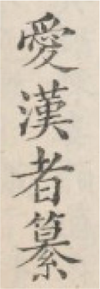
Gutzlaff signalled his own editorial attitude on the front page with the sobriquet “Ai Han zhe,” “[Compiled by] Someone who loves the Han- (愛漢者纂).” (See image 1)
Gutzlaff's sobriquet “Ai Han zhe [Zhuan],” ([Compiled by] Someone who loves the Han- (愛漢者纂)). On East Western Monthly Magazine's front page. Dong Xi yang kao meiyue tongjizhuan, February issue, 1834, front page.

Each of the features mentioned above was dictated by an envisaged reader of Chinese who lived in the Qing Empire, but has real-life existence only in the heads of the editor, the writers, the people doing the layout and printing, and the Western subscribers. This gives initial plausibility to the hypothesis about the “passive agency” of this figure in the entire process of creating and distributing the East Western Monthly, exercised through the ultimate act in this process, namely, reading the magazine and appreciating its content, or not.
The East Western Monthly itself gives us a clearer profile of the envisaged reader by inserting stories about readers perusing and discussing it. A dialogue in December 1833 has a Mr. Wang seeing the East Western Monthly on the table when he “visits” an Englishman with whom he is “in contact,” which obviously was not such a rarity as sometimes assumed. After praising his guest for his “great book learning,” the Englishman repeatedly and modestly urges him to point out any mistakes or infelicities in the East Western Monthly to the editor. Such help would be much appreciated because it would ensure that the East Western Monthly would be “useful for all” “scholars and merchants from your esteemed country.”Footnote 22 This gives us “scholars and merchants” as envisaged Chinese readers.
In an 1837 piece, a Chinese “Confucian scholar” is trying to convince a Chinese friend “who has not passed examinations” and still has difficulty to “get the general meaning of texts” to read the East Western Monthly. Asked “what is the use of such a [journal],” he claims that as opposed to many other texts, which are incomprehensible, a waste of time, or unsavoury, the East Western Monthly “is full of useful things throughout.” “It is published with the particular aim of bringing broad benefits to Han Chinese, enabling them to understand the scientific patterns of things so as to penetrate their principles and set their own nature straight.” The Confucian scholar makes a special point that the editor “greatly respects the Chinese and would not even dare to look askance even at those with modest gifts and shallow learning.” Given this laudable motive, “who would refuse to accept it?”Footnote 23
Here the envisioned readers are a Confucian scholar and a much less learned acquaintance. To facilitate reading for people with lower educational levels, the East Western Monthly followed its predecessors by using a simple documentary style with a restricted vocabulary and added an unusual feature in a literati culture where punctuation was considered the work of the reader: it inserted punctuation. When the East Western Monthly resumed publication in 1837, Gutzlaff pointed out in his preface that “until now the majority of readers had been merchants.” To accommodate their particular news interests, the East Western Monthly was inserting monthly commodity prices.Footnote 24
One particularly sensitive issue at the time was the shipping of opium from India to China by mostly British and American traders. It was especially sensitive for Gutzlaff himself, who admired the political institutions of England and its advancement in industry, but explicitly denounced the consumption of opium in the East Western Monthly, and printed several memorials by Chinese officials describing the economic and social effects of the drug on China in the harshest terms and demanding its rigorous suppression. Gutzlaff's own editorial comments did not mince words: “The evils of the spread of this abomination are beyond words . . . opium is simply poison and nothing else! That is why we have to block its distribution, eradicate its root, and stop its sources.”Footnote 25 To dry up this market, he wrote, “it was absolutely necessary to teach people the true method to break off consumption of opium.” Gutzlaff felt that adopting the Christian faith was such a true method. Both the curse of opium and the cure for it came from the same source. Support for removing Chinese trade barriers and support for the suppression of the opium trade remained shared features of the Chinese-language press and missionary activism. Methods and medicaments to overcome opium addiction would be among the most frequent advertisements in the Shenbao newspaper, quite apart from news and editorials against its sale and spread. Missionaries organised the movement against the government's protection of the opium trade in England long before this issue was taken up by Chinese reformers.
The East Western Monthly made great efforts to offer a comparative history and chronology of China and foreign countries to familiarise Chinese readers with the best and worst from all sides. It offered biographies of George Washington and Napoleon as examples of important leaders,Footnote 26 descriptions of representative government in England and the United States as examples of political institutions that were different from those in China,Footnote 27 and fictional letters from Chinese residing in Europe and the United States describing, for example, the educational system in the German states.Footnote 28 Following a practice of the inland missions in Europe to make complex information more easily accessible to readers with low educational levels, Gutzlaff often used fictional narratives to convey news and information.Footnote 29 The East Western Monthly presented astronomical and geographical data with high-quality graphs and maps, and described technical innovations ranging from the steam engine to suits for underwater work. It offered a monthly summary of world news as gathered from the papers brought by ships to Canton.
The timeliness promised by the East Western Monthly's title was relative. Under the prevailing asymmetry of information, things were new for Chinese readers that had long stopped being newsworthy elsewhere. As the East Western Monthly and the English-language press in Canton all relied on the papers and letters brought by ships to Canton, China became part of an incipient translingual, transnational, and transcultural flow of news and opinion. Gutzlaff considered the Europeans’ interest in news an important element in their advancement, held it up for emulation by his Chinese readers, and made this possible by summarising the content of Western papers.Footnote 30 The multilingual Chinese press in turn began to contribute to international news and its editors actively published in Europe and the United States about China.
Gutzlaff's stand-alone East Western Monthly had to accommodate the entire range of relevant information. Entering into an environment containing nothing of the infrastructure, the social and cultural routines, and the background knowledge a new periodical in Europe or North America would have found ready-made, the East Western Monthly had to first create this environment for itself. This came with the price of its being an information omnibus with little of the edginess and controversy characteristic of some of the more important European journals at the time.
The East Western Monthly only had a thin distribution network into the Qing territory. Even these thin links to the envisaged readers, however, activated enough agency to have some of them spread parts of the East Western Monthly's contents through their own much more widely-read and distributed writings. The world geographies by Wei Yuan (1794–1857) and Xu Jiyu (1795–1873) from the 1840s, which remained standard references in China for decades, both used the East Western Monthly as a partly acknowledged important source.Footnote 31
In this short disquisition we have seen that the crossing of a medium such as the periodical across linguistic, cultural, social, knowledge, and geographic borders puts into sharp profile features encoded into this genre, which would not have shown up had they not been put to the test in this extreme case of a Chinese-language periodical published by a foreigner from the fringes or from outside of the Qing territory. The association of the journal with any “national” space is meaningless as it is in its very design (even illegally) transgressing borders of states, cultures, languages, social routines, and traditions, and reproduces this border-crossing of its distribution in the border-crossing of its content, in the genres used, in the subject matter described, in the sources used, and in the “world” focus of its approach.
While a single journal running over some five years with a very modest distribution is unlikely to change the world, the dynamics of the process of transcultural flow can already be observed. Three main points may be made.
The medium of the “journal” was the result of European developments under very specific—and varied—historical conditions characterised by substantial translingual and transcultural flows within Europe. It arrived ready-made in the Chinese-writing world, where neither the infrastructure, nor the institutional framework, nor the social and literary routines which had formed its original context were in place. Within a few decades of wider transcultural flows along the same asymmetrical imbalance, conditions had evolved that were able to accommodate the journal format. The dynamics of the development of the vernacular journal in East and Southeast Asia invert the original process. The journal is not the result of “internal” developments of the conditions for its existence; rather, the ready-made form is the instigator for the conditions for its existence. Transcultural flow opens options for new practices, which are then filled in, appropriated, and acculturated by local agency. These dynamics are set in motion under conditions of a perceived asymmetry in both maturity and time that makes the transcultural attractive.
The agency in the process analysed here seems to be with the missionaries (or even Gutzlaff in person), supported in this case by subscription and distribution by the foreign merchant community in Canton. Gutzlaff in his turn was producing a medium which he had not invented, but with which he was familiar—in his own and other languages—from his education and religious affiliation.
In a practical shortcut to a quick conclusion, these missionaries have been cast as agents of European colonialism or imperialism. In fact, for determining the locus of agency it matters little whether the activist is German, Chinese, Bengali, English, or Turkish. In fact, in most cases the key movers in such transcultural flows are not from the then-stronger side in asymmetrical power relations. The most important factor in the operations of a medium in the public sphere is the acceptance by a reader. It is the pull rather than the push. Without this pull, the copies pile up in some moist basement and rot, notwithstanding all the enthusiasm and energy the editors might have wasted on their product. The main agency is with the envisaged readers. They do not enter the show only after the product is finished; they are there from the outset. In most cases, the reader is a composite fantasy product made up of personal acquaintances, personal prejudices, hearsay, and some loose guesswork about the acceptance of earlier exemplars of the medium. This imagined reader has no name and address, and might do no more than choose not to read the periodical.
The envisaged reader's agency comes with a strange marker. It is passive. The abstract category “agency” obviously has to be differentiated. The key question in our context is not the actual time and energy spent to write, edit, finance, print, and manage the distribution of an issue of the journal by a person or a group, but the impact the reader's agency has on realising the ultimate purpose of the effort. In the case outlined above, the specific activity is all with Gutzlaff and his supporters, and this activity even includes the creation of a vision of “the Chinese reader.” However, the key impact for the success or failure of the entire enterprise comes from a relatively simple yes/no decision by this unknown potential reader, which does not even have to be accompanied by a monetary input.
Someone publishing in the public sphere strives to be read, and the reader as the imagined consumer is present in the language selected, in the rhetorical devices, in the topic selection, in the information pitch to which every piece is targeted, in the values sported, and in the distribution channels selected. We see the envisaged reader guiding Gutzlaff's hand in every piece. Gutzlaff writes and publishes in Chinese. He writes Chinese in a largely vernacular style, not in the complex, highly literate style used by Chinese literati in “high-culture” communication and official documents. Gutzlaff sees the Chinese “Confucian” literati as imbued with the same trite rationalism as the representatives of the official Protestant churches in Pomerania and England. In addition, claustrophobic sinocentrism will prevent these literati from developing a serious interest in overseas matters, whether commercial or religious. Gutzlaff uses a written language familiar to merchants and small urban dwellers from morality books and novels, because they are what will make or break his journal.
In many cases, he will use fictional devices to bring this reader into the story in person and insert a Chinese perspective, or to situate a topic in an environment familiar to his reader. An example is a short biography of George Washington. A Chinese from Jiangxi province visits Canton, and sees the American flag over one of the compounds in the small foreign settlement there. A local guide informs him that this is the American flag, followed by a sketch of the founding of the United States together with a short biography of George Washington.Footnote 32 Through this device the information is not imposed, but asked, and the depiction can easily accommodate the angle and the information level of the envisaged reader. The eventual impact of the finished product is again determined by the readers, this time, however, by their flesh bodies. If they see the medium as a useful new option developed elsewhere, they will be the ones to bring about the infrastructure, to develop the routines of handling this medium, and even become contributors to this journal or editors of a new one. The push and pull in the process are in a complex relationship. The push anticipates factors that might increase pull, and fashions itself accordingly; the pull operates with a critical assessment of the offering that is informed by two factors: relevance for the environment of the pull agents, and potential contributions the pulled element is likely to make in the new environment. Both reflect the success of the prefiguring of this response in the cultural good on offer.
Getting the genre “periodical” accepted in the Chinese universe was a drawn-out process and the East Western Monthly was the third effort. It would take another forty years for a true breakthrough. It came in 1884 with the Dianshizhai huabao (Dianshizhai illustrated), a Chinese illustrated paper published in Shanghai by another foreigner, Ernest Major, that joined the likes of the London Illustrated or Illustrirte Volkszeitung in the international turn to primarily visual media.Footnote 33
In a second, and shorter, round, I will now test the basic premises developed here in a different case, the Shenbaoguan publishing house.
Case Study: Ernest Major's Shenbaoguan in Shanghai
Ernest Major (1842–1908) did not have to start from scratch when he set up the Shenbao publishing house in Shanghai in 1872. There already was one Protestant and one Catholic publishing house with small print runs, and an English-language paper, the North China Herald, had published a selection of its news in Chinese since 1862 for compradors of the largely foreign-owned merchant houses. Like Gutzlaff, Major was famous for the ease of his spoken and written Chinese, but he kept his distance from missionaries. He was a merchant depending on his readers without the missionary network and convert following to support forays into the public sphere, or a missionary society willing to subsidise his publications.
Extrapolating from Ernest Major's actions, as he left no personal records, it is a plausible hypothesis that he was guided by Scottish Enlightenment ideas of contributing to public “betterment” while running a successful business.Footnote 34 He left London for Hong Kong at age nineteen with a substantial grounding in Chinese acquired from a live-in Chinese teacher. Given the modest means of the family, hiring such a teacher signalled the parents’ global perspective—the mother was born in the Raj, daughter of an employee of the East India Company, the father worked in the War Ministry, which had its own global perspective.
Major, who had no publishing experience, set up a publishing house as a business venture. It published a Chinese-language newspaper, the Shenbao; a sequence of cultural journals, including the Chinese-language illustrated journal already mentioned, the Dianshizhai huabao;Footnote 35 old and newly-written Chinese-language books, but few translations from Western languages; and it pioneered commercial art reproduction with lithography.Footnote 36 His company was a pioneer of technical innovation in China with movable type, lithography, newsprint, and copper printing of maps, and it established very high editorial, aesthetic, and paratext standards for its publications. Like Gutzlaff's periodical, the Shenbao coated the radical newness of its approach and offerings by emulating formal and rhetorical features familiar to Chinese readers.Footnote 37
The Shenbao set itself up as the point of communication between high and low, between state and society.Footnote 38 It combined a daily reprint of the court's official Peking Gazette as the voice of the state, with an opinion page and local, Chinese, and international news as society's communication. It presented itself as the answer to what it saw as the main obstacle to China's progress, namely the disconnect between high and low, between the court and society. The Shenbao saw the state not simply as the object of discussions in the public sphere, as Habermas had proposed, but as an important and legitimate speaker with its own media. It published articles critical of the state authorities’ failure to share relevant information and inviting the public to learn about and discuss state plans and problems of relevance to all to increase the acceptance and quality of governance.
Although the Chinese state is neither addressed nor discussed in Gutzlaff's journal, the existence of his East Western Monthly and its ways of distribution engage with the Chinese state's control of public articulation in its territory and even its efforts to prevent foreigners from learning Chinese. Translated into propositions as he might have articulated them, Gutzlaff argued that the state's efforts to control public information and discussion by pushing its own dispensation and blocking alternatives were counterproductive. They prevented knowledge about the world from reaching China, with the effect of blocking access to innovative political institutions and new technical and scientific developments, and they locked the country into a web of superstition and cultural arrogance that prevented it from getting access to the salvation coming with the faith in Christ. The legitimacy of the voice of the Chinese state in the public sphere was not denied, but East Western Monthly rejected the state's claim to a monopoly. As missionaries were prevented from challenging this monopoly in person within the country, the East Western Monthly was shipped inland through invisible channels.
Both the Chinese court and the British embassy considered print products bona fide commercial goods. In practical terms, this meant that the Shenbao could be distributed inland and that the Qing administration was even obliged to enforce contract compliance of Chinese debtors to Major's company. Given the existence of private letter-carrying services, and of a system of money transfer through the traditional Chinese banks, the basic infrastructure and legal conditions were in place for setting up a national distribution network for newspapers and books. The paper's efforts to reach the envisaged Chinese readers and remain independent, however, weakened the British authorities’ willingness to protect the paper, while increasing the risk of efforts by the Qing court to curtail its spread.
Qing officials, whose tolerance of the paper was crucial, liked the quick access to the full reproduction of the official Peking Gazette, and they probably liked to read about the problems of their colleagues. The paper's discussions on national policies, however, they saw as an infringement—by private people without credentials and by foreigners without a true knowledge of China—on their privilege to address policy issues in secret memorials to the court. When they read critical comments about themselves, they suspected that their opponents had manipulated the paper and supported banning it.Footnote 39
On the British side things were not much different. The British consulate general in Shanghai had no control over Major's enterprise. Internal records suggest that the consular officials were deeply apprehensive that the Shenbao pursued its own course even in foreign policy matters vital to British interests, while any Chinese official irritated about an article in the paper would unfailingly turn to the British diplomats with the request to reign in these unruly British subjects. The legal instruments for such interventions, however, were not available. The Sepoy Mutiny in India in 1857 had alerted the British Foreign and Colonial Offices to the danger that came with the vernacular newspapers and their—often British—editors, and for a while they monitored them closely. If possible, as in India, they regulated them. When the Japanese authorities in 1876 officially asked British Ambassador Parkes to ban British subjects from publishing vernacular papers in Japan, Parkes was only too happy to oblige. That was the end of British-managed Japanese-language papers. This development had been reported in China, but although the British consulate in Shanghai even suggested to a high-ranking official (Guo Songtao) who had felt offended by a Shenbao article that he move in the direction of a ban, such a move never materialised.Footnote 40
Neither the consulate's protection nor accommodation by Chinese officials, however, could have secured the success of the Shenbao among readers of Chinese. Major's legal extraterritoriality—he could only be tried in a consular court—was important and he used it skillfully to protect his Chinese journalists and printers. But it could not secure acceptance by the envisaged readers. The Shenbao's survival and success depended on the agency of its Chinese readers in accepting or rejecting the paper. Among the indicators of this success are not simply print runs and manifest signs of acceptance from both readers and potential contributors, but also the emulation of the paper's model by others, who started competing with it. The ultimate compliment came in 1874 from Ye Tingjuan, the Qing official in charge of the Shanghai walled city. A man from Xiangshan in Canton, he sympathised with other Xiangshan men who were incensed at the Shenbao reporting about the harsh treatment Ye's underlings had meted out to a famous Peking opera actor, Yang Yuelou, who had, with the consent of the mother, married a girl from a “good” Xiangshan family (opera actors were legal outcasts, barred from marrying into “good” families). Aware that he would find no official sanction for a ban of the Shenbao, but bent on countering the paper's influence and weakening its economic base, Ye Tingjuan used money from the official coffers to set up a newspaper of his own. To claim the Shenbao's prestige of journalistic independence for this venture, he installed a foreigner as the nominal editor in chief. His paper was even bilingual, containing in each issue a longish English-language insert introducing fully noncontroversial and often trite elements of Chinese culture. When it came to a court trial because of a libel suit from the Shenbao, this foreigner testified that the new paper was fully micromanaged by Ye Tingjuan and that he himself had no say at all in determining content.Footnote 41
This counter-text highlights, through its emulation, the very features which—at least in Ye Tingjuan's view—were responsible for the success of the Shenbao. The competing paper quickly collapsed and so did two successors. The nonacceptance of these papers by Chinese readers regardless of their official backing is an exercise in passive agency that highlights the appreciation of the independent and open editorial stance of the Shenbao by readers and advertisers. The ultimate stage in this ironic emulation of the Shenbao was reached in 1886 when Kuang Qichao, one of the editors of the official's paper (who also knew English well), moved back to Canton to set up a new paper, the Guangbao (Canton Daily), that was modelled after the Shenbao, and not just in form.Footnote 42
The Shenbaoguan was not passively waiting for the readers’ agency to unfold, however. It developed a very extensive network of Chinese writers, editors, painters, contributors, and correspondents numbering several thousand into something like a Shenbaoguan community. They were involved in the manifold activities of the publishing house, especially the book publishing, for which an established cultural and legal framework existed. The company's book publishing drew high praise from many men of letters for making available rare, long lost, and simply inaccessible cultural treasures from China's past in high-quality, modestly priced prints. Once linked to the Shenbaoguan publishing house, these men of letters would also see the Shenbao as a paper of “their” publisher. Major corresponded with this community through nearly daily notes on the paper's first page, asking for suggestions, searching for manuscripts, and encouraging them to submit opinion pieces and poems. This Shenbaoguan community served to activate the passive but crucial agency of the envisaged reader through its feedback. The paper's acceptance by its Chinese readers, including this elite Shenbaoguan community, whose members’ names appeared in the Shenbaoguan publications, was crucial for its success and longevity. The legal protection enjoyed by the foreign editor and his company in the Shanghai International Settlement helped prevent its being closed down. Its great impact throughout the Chinese-speaking world and its commercial success, however, hinged on the agency of the Chinese readers.
The focus of Shenbao reporting was on matters considered relevant to China. These were presented in a language that made efforts to be “easy” for wider audiences without classical education and in a narrative form that tried to bridge deficits in background information without being didactic. At the same time, the Shenbao remained a Shanghai paper committed to open trade, modern forms of communication and transportation, and the gradual development of modern political institutions linking state and society. The stance taken by the Shenbao on crucial policy issues was very explicitly articulated in the “best Chinese interest,” but it was as clearly stated that this did not necessarily mean agreement with the Qing court. Major defended himself against the occasional charges that the Shenbao was representing foreign interests with the blunt argument that the Shenbao was an unsubsidised commercial paper and that any suspicion among its envisaged Chinese readers that it was a propaganda organ for a foreign power would have meant the end of its sales and commercial viability. The steeply rising sales signalled acceptance of the paper's claim to independence by its Chinese readers.
The well-known and fully acknowledged fact that the paper was owned and managed by a British national was only retroactively read after 1949 as proof for its being part of the “cultural imperialism” accompanying British projections of military, economic, and political power.Footnote 43 For contemporary Chinese and foreigners, Major's British passport was a double asset. It associated the paper with the British press, which at the time was even in Chinese publications praised for its independence and objective reporting, and it secured protection against a Peking government that explicitly denied the legitimacy of anyone without official status arguing publicly about the great issues of the country.
The Shenbao was not an advocacy newspaper, which—within a loose definition—the missionary-run papers were. It offered itself as a platform for public articulation and for communication between the court and society and within society. A substantial part of its opinion pieces on the first page were not from its staff, but from people knowledgeable about the issue under consideration. As was the common practice at the time, they would mostly sign with their pen names. When controversies occurred, opponents were given space to articulate their opinions.
At the same time, the paper was well aware of the inverse logic in which it was operating. Set up in Shanghai by a British citizen, it enjoyed all the formal legal protection of Great Britain while the stringent British libel laws, which were a constant threat for British papers in England as well as in Hong Kong, failed to have any effect in Shanghai. I am not aware of a single libel suit against the Shenbao before 1900. In this sense, the Shenbao was freer than the British papers in London, but it was so because of the particular asymmetries characteristic of Shanghai at the time, not because the inner dynamics of Chinese society had created an environment more conducive to a free press than that prevailing in England. The Shenbao editorials operated as a training ground for Chinese public articulations, be they from journalists, officials, or private citizens. On occasion, Major intervened to explain and to a degree enforce the rules of such public debate, such as abstaining from invective, paying attention to the reasoning of the other side, and being willing to change opinions. As was the case for Gutzlaff's journal, we have an inverse dynamic where the product of a transcultural interaction searches out agents to develop (or thwart) the conditions for its enduring local existence. The envisaged readers helped the Shenbao to cross borders as a medium, but the paper also relied on borders for a shielded existence that allowed it to unfold and make the Shanghai International Settlement into the Chinese media capital.Footnote 44
The Borders of the Public Sphere?
Scholarly discussion of the public sphere and the role of the press has benefitted from interventions that have created a common terminology across languages. These terms, however, come with a set of shared assumptions. Reduced to their bare minimum, these are: that the public sphere is a realm where an enlightened and informed public can publicly discuss the great questions of state and society, with the state as the object but not a participant in these discussions (Habermas); that the public sphere is coterminous with the nation-state (Habermas), and that the periodical press within the nation-state territory is instrumental in helping the inhabitants form an “imagined community” of the members of the given nation as simultaneous readers of the same information (Anderson); that the worldwide spread of the modern press is a subnarrative of the military, economic, and political expansion of Western colonialism and imperialism; and that the local acceptance of these new media was either the result of the exertion of some form of violence or, in a more subtle process, that of the colonisation of the minds even of people whose countries were not colonised.Footnote 45
Based on the two Chinese case studies above, then, what are the borders of the public sphere and where are they? What is the role of the state in the public sphere? What is the relationship between vernacular media controlled by foreigners and the official institutions and actions of their home country? And how does local agency determine the fate of foreign-owned media? The case studies presented above allow us to critically engage with these broader questions and the available scholarly answers to them.
The content of Gutzlaff's journal, the genres it used, and the place of its publication were all situated at the point where China and the world met. Like its Canton English-language contemporaries, it drew on news, opinion, and information circulating throughout the world. If the ships carrying the papers were late, he would write that he had no news to convey. As he also started to carry memorials by Chinese officials on controversial issues such as opium imports, the East Western Monthly moved to become a platform linking China and the world. This was the case for news and opinion and scientific information as well as socio-political and historical information. True, Gutzlaff himself was a foreigner, but one who “loved the Chinese,” wrote in Chinese, and was arguing the Chinese case even while being critical of China's official disdain for things foreign.
Gutzlaff was a cultural broker familiar with both parties and he did as much to introduce general knowledge about China in the West as he did to introduce general world knowledge to China. Major's Shenbao was published in the International Settlement of the Shanghai treaty port. He quickly developed a correspondents’ network in the main urban centres of China, subscribed to Reuters for international news, included the full Peking Gazette every day as top-down court information, and managed to get men of letters to submit their essays on the great questions of the time, as well as “bamboo-twig ballads” about their impressions of the Shanghai International Settlement. Relying on street hawkers for local distribution, on intermediary dealers for regional, and on the letter-carrier service for national distribution, as well as on a large array of local bookstores in different parts of the country, the paper with its rich and expanding package of news and opinion gradually reached its envisaged readers and offered them the real option to exercise their agency or not.
The Shanghai International Settlement was a treaty port that quickly became the hub in a cross-shaped network of commercial and information exchange between China north and south of the Yangtze River on the one axis, and inland China and international ports on the other. This unique position of the International Settlement came with the additional boon that the Jiangnan region, Shanghai's hinterland, happened to be the wealthiest and culturally most developed region of China. The Taiping Civil War (1851–1864) had driven large numbers of wealthy men and educated scholars to seek refuge in the Settlement, and the rapid development of this very modern Western-style city on Chinese soil kept these sojourners there and attracted many more in the following decades, further swelling the city's ranks of people with business acumen and cultural skills.
Commercially speaking and in terms of news and opinion, the Settlement was more closely connected to other treaty ports in East Asia and commercial hubs elsewhere in the world than to the Chinese hinterland. In terms of global and Chinese information and opinion, this was the ideal “contact zone” where the foreigners would congregate who wanted to know about China and the world and the Chinese would congregate who wanted to know about the world and China. The result was that almost anyone interested in a public discussion of Chinese issues and looking for a livelihood for doing so was congregating here. This situation continued and further developed at least until Japan occupied the Settlement in 1941. In terms of public sphere, Shanghai might dominate the national Chinese media market, but it was an exclave, and this very feature allowed it to be the contact zone between China and the world, the exchange and negotiation platform between state and society in China, as well as the point where information about China congregated outside government control.
As a consequence of the extreme concentration in Shanghai of people articulating in the public sphere and the media used for this articulation, the fluffy notion of the “public sphere” can be and has to be further specified by defining its varying “density” in different spaces. If we define those actively expressing themselves in the public sphere as “speakers,” those following such expressions as “readers,” and the platforms carrying these articulations as “media,” the density of the public sphere can be measured by the numbers of these three factors in a given locality. Even within older nation-states, the density of the public sphere varies greatly, with the lowest density in rural areas and the highest in urban centres. Among these, the largest commercial centres tend to take on the role of media capital, very often in distinction to the political capitals, and these commercial capitals have acquired this status because they are the links to world trade. The Shanghai International Settlement combines all the features of a commercial and media capital with an extremely high public-sphere density. While putting exact numbers to it is fraught with uncertainty, at its peak the concentration of Chinese speakers and media was on the order of 60 percent, while the national and international reach of its media to its readers reached only 30–40 percent.
On neither the commercial nor the public side, however, had Shanghai managed to become a fully global centre like London or New York. Its dependency on the Chinese hinterland as its source for exports and the market for imports as well as its clientele for financial services had become evident already during the 1860s. There was a discussion about whether the Settlement should set itself up in full independence of the British and American (as well as Chinese) governments along the model of the cities in the Hanseatic League. After the British government pointed out that Shanghai's treaty-secured free access to the Chinese hinterland would then be revoked, the discussion ended. During the period discussed in this article, Shanghai was still primarily defined as part of a transcultural and translingual public sphere situated in an exclave on Chinese territory but dependent on the Chinese market and overwhelmingly concerned with Chinese matters.
The potential of newspapers to form an imagined community seems marginal at best. Newspapers at the stage of nation building reach only a small—if important—part of the population. They come with a great diversity in their news selection and viewpoints, as well as the type of audience they target. Finally they are, especially in the initial stages, very often a foreign medium that is controlled and managed by foreigners. Anderson's argument is not empirically grounded, and would have a hard time accommodating, for example, the multivocal, multilingual, and exceedingly contentious daily newspaper fare during the heyday of the Chinese press in the Republican period. Chinese-language papers were published by private Chinese citizens; by British citizens of Chinese descent from the Straits Settlements; by Chinese government organs; by foreign governments who were exerting direct or indirect control; or by foreigners with a strong commitment to Chinese interests. They shared the public sphere with a large number of foreign- language newspapers and periodicals published in China itself by foreigners, Chinese individuals, or Chinese government agencies.Footnote 46 These foreign-language papers had a largely Chinese readership. The largest among them were subscribed to the Reuters, Rengo, Wolff, or Havas news services, which their Chinese-language contemporaries were not, and so these foreign-language papers were the main source of foreign and sometimes domestic news and opinion for the Chinese-language papers. Neither the unified dispensation for an imagined community will be found here, nor the strong nationalist rhetoric.
Habermas and Anderson treat the development of the public sphere and the “imagined community” respectively as a process of organic growth. This can only be done by handling countries in Europe and Latin America as homogenous units, which in the perspective of the historical actors at the time, they were rather not. In both fields, the close geographical, linguistic, and political proximity within a country notwithstanding, substantial transcultural flows occurred—at least from the perspective of the historical actors, which is all that counts, because it is all that stimulated their own agency. Once one moves into areas marked by larger cultural distances such as that prevailing between Britain and Southeast Asia or China in the first half of the nineteenth century, the problem shows up in sharp contours. The transcultural flow here means that more or less ready-made cultural products are made available in an environment that had not developed these products on its own or not to this degree.
The process in the two examples provided here is the exact opposite of that described by both Habermas and Anderson. The finished product is first, and the conditions for its genesis and continued reproduction come later. In the case of success, they are developed on the basis of its being accepted in the new environment. Looking back from the process of transcultural flows over large cultural distances to those over short distances, it turns out that both follow the same dynamics, but it is clearly visible only in the first, and tends to be muddled in the second case. The challenge is thus to reread the relationship between public articulations in the public sphere in, for example, what is today France and Germany, in the manner historical actors saw it, namely as a bona fide transcultural flow, including the inverse logic between the finished product and its conditions of existence and reproduction just outlined.
The two works in question, followed by and following a widely shared practice, treat the national public space as homogenous. While in an age of high penetration of radio, TV, and internet access this might seem more or less plausible, this treatment fails to thematise the scholarly challenge which comes with the strong factual inhomogeneity of the public sphere. Once the question is clearly posed, few people would deny the lack of homogeneity in the density of the public sphere (defined in numbers of active participants and volume of their participation) between, say, the city of Hamburg with its many publishing houses, Castrop-Rauxel, a middling former mining town, and the village of Todtnau in the Black Forest. Again, a look at latecomers like China in the modernisation process highlights the very high degree of variation in the public sphere and opens the field of study to similar phenomena in the much-better-researched European universe.
Conclusion
The notion of the “dual economy” is familiar from development economics. It refers to an economy where the “modern sector” is all concentrated in one place, such as a port or a capital. This place is closely connected with the world, while the rest of the country largely follows subsistence agriculture and is cut off from the world. The public sphere tends also to be concentrated in certain spots with most of the voices—and even passive participants—concentrated there. Shanghai is an evident example. In Shanghai, we have from early on a high concentration of public-sphere media, and the city maintained and even greatly developed this role until 1949. The Chinese public sphere, at least as far as a public articulation on grand issues of state, society, and individual life in media for wide dissemination is concerned, is largely coterminous with the Shanghai International Settlement between 1870 and at least the Japanese occupation in 1941.
The reduction of the “public sphere” concept to the Enlightenment agenda deprives it of its analytical power for empirical study. As Keith Baker has shown, even in the middle of Enlightenment France of the eighteenth century, the state had its public voice, its historians, and its lawyers quite apart from providing the legal framing of the public sphere.Footnote 47 Formalised as the realm between state and society in which the great issues between them and within society are discussed and negotiated, the “public sphere” concept facilitates specific historical investigations. The Chinese state claimed and claims again a monopoly of public articulation that included installing certain high officials as yanguan 言官 (“speaking officials”) with the right to make critical comments. Gutzlaff silently rejected this monopoly. Major did so explicitly by accepting the Peking Gazette as the court's legitimate public voice but putting it on equal footing with society's voices on the opinion page, and making the news available to both. Reacting to the quick spread and acceptance of societal public articulation, the Chinese state eventually upgraded its own public voice through a series of official papers to regain the high ground of public articulation. The extreme example of the Chinese state magnifies a problem with the public-sphere concept that on closer inspection is also present in the area for which the concept was developed.