

Introduction
In June of 2016, the Indian government announced sweeping changes to its foreign investment laws that eliminated government approval processes for most sectors and substantially increased the maximum foreign equity allowed for firms in several sectors including retail, food, defense, airlines, broadcasting, and pharmaceuticals. In response, several Indian trade unions voiced their strong disapproval. Unions that represented government employees announced an indefinite strike.Footnote 1 Far-left and far-right affiliated trade unions issued strong condemnations of the proposed liberalizations, arguing such moves would not increase employment, but would lead to increased labor law violations and push small firms out of business.Footnote 2
In contrast, business groups reacted positively to investment policy changes. Indian pharmaceuticals expressed support for loosened restrictions on foreign direct investment (FDI) in that sector, arguing that decreased scrutiny of foreign funded mergers and acquisitions (M&A) would benefit domestic firms.Footnote 3 Industry watchers emphasized the fact that private Indian firms would be more able to monetize their shares. And in 2016, the value of inward pharmaceutical M&A deals increased by over 80 percent year-over-year.Footnote 4
The Indian case described above is interesting because it challenges conventional wisdom regarding the politics of FDI.Footnote 5 The most prominent existing explanations of FDI liberalization use factor proportion models from international trade theory to argue domestic capital is disadvantaged by multinational entry while workers benefit from the jobs new investment creates. These models argue liberalization occurs when workers gain political power over capital—mainly through democratization. Yet, as the above example illustrates, workers often oppose liberalizing reforms to investment law while domestic firms frequently support these changes.
I develop an elite-centered theory of FDI liberalization in which shifts in domestic credit allocation environments influence large domestic firms’ preferences over foreign investment policies. When local financial markets are repressed, influential domestic firms use their political connections to receive subsidized access to credit markets. Under such conditions, these business interests successfully lobby for protection against more productive foreign entrants. In contrast, when governments no longer control credit allocation decisions, well-connected domestic businesses become credit-constrained and push their lawmakers to allow foreign equity participation in domestic industry. They do so in anticipation that liberal FDI policy environments will allow them to pursue partnerships and buy-outs from better financed multinational enterprises (MNEs).
I find ample evidence consistent with this theory. Using measures of FDI restrictiveness that collectively cover 166 countries from 1973 to 2015, I demonstrate that countries that pursue reforms to domestic credit allocation processes subsequently loosen restrictions on foreign ownership of local enterprise. A country with a one standard deviation increase in banking reforms restricts foreign participation in roughly 7 percent less industries. This finding is robust to an array of estimation techniques and multiple alternative explanations for FDI liberalization, including regime type, economic development, trade openness, economic crisis, and external pressure from international lenders or regional competitors. Additionally, causal mechanism probes show that the relationship between banking sector reforms and FDI liberalization is strongest when domestic political institutions favor business interests, particularly through informal channels. Industry level analysis from 2000–2015 suggests that financial constraints may condition the relationship between capital intensity and industry-level liberalizations, though the evidence here is weaker.
These findings have broad implications for processes of economic integration and retrenchment. First, my analysis challenges typical frameworks for explaining the politics of change. International political economy (IPE) scholarship typically relies on punctuated equilibrium models to explain economic liberalization, in which actors’ preferences are fixed and changes to domestic political institutions explain changes in economic openness. The theory developed here provides a more flexible framework within which to examine the sources of continuity and change in IPE by considering how finance structures actors’ policy preferences. This framework of dynamic preference updating can be fruitfully applied to other dimensions of global economic and political change. Second, my focus on elite lobbying extends insights from the trade politics literature to move the scholarship on FDI policy beyond factor-proportion based explanations to more fully consider the complex calculations domestic firms face when determining whether global integration will ultimately benefit or harm them. Finally, this analysis calls into question received wisdom regarding the distributive effects of globalization. The large scale acceptance of models that explain liberalization as a disruption of incumbent advantage naturally emphasize the potential of globalization to benefit new entrants and workers. However, if well-connected domestic firms set the terms of investment liberalization, deepening integration may entrench rather than diminish incumbents’ power. Heterogeneous capacity to adapt to changing environmental conditions may reinforce inequalities as well-positioned actors adjust to new economic realities, while vulnerable actors are further weakened. Therefore, IPE scholars must explore more fully how globalization affects market concentration within and across borders, and how these processes of consolidation affect politics.
Who favors FDI?
MNEs are increasingly central to the structure of the global economy. They orchestrate as much as 80 to 90 percent of all trade globally through their supply chains.Footnote 6 Rules governing MNE entry to local markets through FDI powerfully influence the ways in which countries’ economies integrate into the global economy. For example, Thailand and Malaysia have undergone extensive liberalization of entry restrictions in most sectors, including semiconductors, which allows foreign firms to establish wholly-owned subsidiaries in these countries. Such laws have encouraged leading electronics MNEs to locate high value–added activities in these jurisdictions.Footnote 7 In contrast, foreign firms hesitate to transfer intellectual property to subsidiaries in China due to complicated and shifting FDI regulations. This has resulted in massive growth in inward investment in low value–added activities, such as assembly, but less investment in high value–added activities, such as semiconductor wafer fabrication.
That governments would restrict FDI at all is puzzling from an efficiency perspective. FDI is considered the “good cholesterol” of capital flows. While the the growth-promoting effects of MNE entry are by no means automatic,Footnote 8 FDI is more stable than portfolio flows and can provide financing cushions during times of economic distress. Given these dynamics, we might expect governments to enthusiastically encourage FDI, especially in comparison to other, more volatile international capital flows.
However, many developed and developing countries substantially restricted MNE entry in the mid-twentieth century before pursuing more liberal policy environments, starting in the 1980s. Even today, FDI policies are frequently far from fully liberalized. The 2014 Annual Report on Exchange Arrangements and Exchange Restrictions lists 151 countries as having some degree of limitations on FDI.Footnote 9 In the aftermath of the 2007–8 global financial crisis, many countries, including the United States, Germany, France, China, and Russia, debated or enacted legislation aimed at further restricting FDI.Footnote 10 This anti-FDI sentiment arose despite a lack of similar demands for increases in short-term capital controls.
What explains these variations in government policies toward FDI? Existing IPE theory argues the distributive effects of FDI benefit labor at the expense of capital, and therefore governments will be more open to FDI when domestic capital loses political power. This may occur through democratization,Footnote 11 Left partisanship,Footnote 12 or economic crises that empower international financial institutions to demand neoliberal reforms in exchange for financial support. Accordingly, IPE theory generally sees FDI flows as a materially positive phenomenon for ordinary citizens and a popular component of neoliberal policies.
This interpretation of FDI politics is at odds with reality. Scholars studying MNE activity in advanced industrial countries find that FDI inflows reduce worker's perceptions of their job security,Footnote 13 unions block FDI into their industries to forestall erosion of collective bargaining power,Footnote 14 and politicians strategically block certain FDI projects to placate the economic-nationalist sentiments of voters.Footnote 15 Developing countries’ experiences also suggests citizens’ preferences over FDI are more complex than factor proportion models anticipate. When FDI generates political action in the developing world, it is often within the context of labor groups protesting MNEs. This is largely because citizens interpret foreign investment through the lens of economic globalization, and they frame their understanding of the implications of investment through a debate about foreign pressures on national interests.Footnote 16 And even when citizens develop negative beliefs over FDI, the minutiae of investment policies rarely translates into popular political action. Instead, most of the time foreign investment laws remain in the purview of “Quiet Politics,” meaning the political dynamics that characterize policymaking when “highly organized interest groups dominate the policy process in arenas shielded from public view.”Footnote 17
A theory of MNE regulation that emphasizes the dynamic interest of domestic firms opens new avenues to explore how firms generate preferences over policies and the conditions under which those preferences can change. Scholars influenced by constructivist paradigms have increasingly studied how ideational factors can generate coalitions supportive of a variety of economic reforms.Footnote 18 Others have argued that support for FDI among the political and economic elite has grown as MNE activity has increasingly shifted from enclave and extractive activities to be more connected to domestically-owned economic activities.Footnote 19 The theory I develop and test below complements these arguments, but considers how shifts in the structure of capital markets can induce firm agents to update their policy preferences, not because of shifting ideology, but because their material incentives have changed.
Financing constraints and domestic support for FDI
When domestic firms have ample access to low-cost financing, they will support policies that heavily regulate and restrict MNE entry. FDI inflows place substantial competitive pressures on local firms in both labor and product markets. Foreign entry drives up wage bills by stimulating demand for labor, particularly highly-skilled.Footnote 20 Inward FDI also generates substantial productivity pressures on incumbent firms. Foreign entrants are more productive than incumbents,Footnote 21 particularly when locating in previously protected industries.Footnote 22 Multinational entry forces less efficient domestic firms to exit due to these pressures.Footnote 23 Even among domestic firms that survive foreign entry, the superior access to finance and technological sophistication that characterizes MNEs makes them better able to overcome natural entry barriers in concentrated markets and to significantly reduce incumbents’ market share.Footnote 24
Despite their threats to domestic firms, MNEs can also bring technology, know-how, capital, and purchasing needs that may benefit at least a subset of domestic firms.Footnote 25 As with status quo bias in other policy areas,Footnote 26 domestic firms will view unrestricted FDI with caution since they face identifiable and universal costs but uncertain and firm-specific benefits to multinational entry.
While domestic firms may have first-best preferences of restricting FDI to minority positions, this is conditioned on the financing environment. When large, well-connected domestic firms have relatively easy access to inexpensive sources of credit, they are able to maintain an anti-FDI position. When they experience large and persistent negative financing shocks, these same business interests will begin to view FDI as an important source of potential capital.
Insights from the finance, law, and economic growth literature help explain firms’ shifting policy preferences. This approach places the interests of owner-managers versus minority shareholders as central to understanding firm behavior. As economic agents, local business owners seek to maximize wealth, specifically, the value of their ownership stake in their company plus any resources they are able to divert for personal use, often referred to as the private benefit of control.Footnote 27 The value of local firms depends on a set of factors ranging from macroeconomic consideration, such as local economic growth prospects and exchange rates, to firm-specific assets, such as technology and managerial acuity. However, all firms’ values rely fundamentally on their ability to raise external finance such that operations and investment activities can exceed the wealth of owner-managers. Most formal and empirical work in this literature focuses on how institutional constraints structure firms’ choices over raising finance through debt or equity. But equity can be raised raised through either portfolio or direct investment; portfolio equity investment is merely a claim on future cash flow, while direct investment also entails some amount of managerial control.
We can represent an owners utility function through the following equation:
 $$U_\epsilon = \beta_\epsilon V + D$$
where β ε is the owner's equity stake in the firm, V is the value of the firm, which is a function of sales minus expenses, some of which include cost of any debt financing, and D is the value of private benefits of control.
This equation highlights how financing affects a local firm's maximization problem. Because debt-financing costs decrease profits, firms begin to view equity financing more favorably as their borrowing costs cross some threshold. But raising cash through stock offerings has its own costs. Firms often must strengthen minority shareholder protections in order to raise adequate capital.Footnote 28 Without such protections, equity valuations are low and owner-managers must relinquish more cash flow rights to raise substantial funds. Strengthening corporate governance decreases D, since such protections make owner-managers more accountable to minority investors.Footnote 29 Alternatively, firms can raise equity through direct investment. Direct investors may not require stronger minority shareholder protections since they will take a management stake. However, owner-managers will need to share in D with direct investors.
Thus, firms face trade-offs regarding financing decisions. They can borrow, which allows them to raise capital without relinquishing future cash flow rights or the private benefits of control, but at the expense of firm value. They can raise equity diffusely through stock offerings, which does not decrease V, but decreases insiders’ ownership stake and requires some decrease in D in order to attract potential investors. They can take on directly invested partners, who partake in management and therefore will also demand some portion of D.
When faced with an easy credit environment, firms will likely advocate for FDI restrictions. In countries with high levels of government intercession in credit markets—through mechanisms such as directed credit requirements, excessively high reserve requirements that keep government borrowing rates low, and subsidized credit to targeted firms and industries—large and politically important firms can easily finance operation and expansion through subsidized debt.Footnote 30 Accordingly, firms support policies that restrict foreign entry outright or to minority joint ventures. This allows them to maintain ownership and accrue private benefits to control, while also limiting competition in product and labor markets. While repressed financial systems ration credit, the losers of financial repression—small, weakly-organized firms—are poorly situated to pressure governments to reform,Footnote 31 and are unlikely to benefit from inward FDI.Footnote 32
When global and local conditions weaken politically-influential firms’ privileged access to inexpensive credit, the policy preferences of these firms shift and they instead value the financing opportunities that FDI generates over the potential costs of MNE entry. Banking reforms undermine the rents of large, politically connected companies that enjoy privileged access to finance under conditions of financial repression.Footnote 33 More open FDI policy environments can ameliorate credit constraints of these firms. Analysis of World Bank Enterprise Surveys of firms’ perceptions of financing constraints indicate that firms are less likely to believe financing is a binding constraint when operating in countries more open to FDI, and this difference is largely driven by the perceptions of firms with at least some foreign ownership.Footnote 34 Research on financial constraints and global supply chains similarly finds that integration into MNEs’ supplier networks provides local firms with greater access to finance.Footnote 35 Additionally, firms most likely to improve their financing position with FDI liberalization are also most likely to lobby governments. Leveraging a World Bank Enterprise Survey question on the propensity to lobby, I find that firms more likely to lobby governments are large, engage in exporting, sell to the government or to MNEs, and have at least some degree of foreign ownership.Footnote 36
There are several observable implications of a financing constraints theory of FDI liberalization. In the most reduced form, liberalization of FDI equity restriction should be more likely after sustained negative shocks to large firms’ financing costs:
Hypothesis 1:
Countries will be more likely to reduce restrictions on foreign direct equity ownership when large domestic firms face increased financing constraints.
Additionally, since firms in capital intensive industries require greater access to financing for operations and expansion than less capital intensive activities, the relationship between financing constraints and industry-specific FDI liberalization should be increasing in capital intensity:
Hypothesis 2:
The relationship between financing constraints and equity openness will be stronger for more capital intensive industries.
Finally, if it is domestic business interests that press for FDI liberalization in the wake of financing constraints, we should expect that the relationship between banking sector reforms and FDI liberalization will be stronger in countries whose political institutions favor business interests:
Hypothesis 3:
The relationship between financing constraints and equity openness will be stronger when domestic political institutions favor business interests.
Empirical analysis
This section presents empirical analysis that tests the connection between domestic firm financing constraints and policies toward FDI. I begin by overviewing concepts and measures. Next, I present empirical tests of my three hypotheses.
Measures
Because no one measure of FDI policy extends from the 1970s to present day, I use two variables to maximize cross-national and temporal coverage. Equity Restrictions measures the percentage of industries in which foreign firms are excluded or regulated to minority share status for a given country–year.Footnote 37 This variable is my preferred measure because it has broad coverage over a long historical time frame, including ninety-four countries from 1970 to 2000, the thirty years in which policies toward MNEs changed most dramatically. Additionally, it is conceptually closest to my interest in regulations over entry, which govern the right of MNE establishment and are the most crucial component of FDI policy. I supplement Equity Restrictions with Liberal Policy Change, which counts the number of liberalizing FDI regulatory changes a country has enacted in a given year.Footnote 38 These data are available across all UN member countries from 2000 to 2015.
To identify shifts in financial constraints, I focus on measures of banking sector repression and openness. Previous formal theory building has focused on domestic capital's policy preferences after temporary liquidity shocks, such as financial crises.Footnote 39 However, temporary liquidity squeezes may not be enough to alter firms’ policy preferences. This is because FDI, unlike portfolio investment, is a long-term capital commitment that has lengthy lead times and is therefore rarely a useful source of investment in an acute crisis. Instead, I focus on variables that capture fundamental changes in the extent to which political actors intercede in credit markets. Most fundamentally, banking sector reforms weaken the ability of governments to direct subsidized credit to politically influential firms. As interest rate controls loosen and banks no longer face requirements to lend preferentially to particular industries or well-connected firms, key firms’ borrowing costs increase substantially. While, over time, banking reforms can lead to efficiencies that make credit more broadly available, such reforms do so by reducing the rents connected firms receive through their privileged position in domestic financial markets.Footnote 40
I use two measures of banking sector repression and reform. First, when possible I use Banking Reforms, which has broad temporal and cross-sectional coverage, including 103 countries from 1973–2005.Footnote 41 The index compiles qualitative judgments over liberalization in five aspects of banking sector policy: credit controls and excessively high reserve requirements, interest rate controls, state ownership in the banking sector, prudential regulations and supervision of the banking sector, and securities market policies. Unfortunately, this measure ends in 2005, which makes its use for models that extend to 2015 questionable.
For more contemporary data (2000–2015), I follow the World Bank's framework for measuring global financial development and use Net Interest Margin to measure the efficiency of the domestic banking sector.Footnote 42 In repressed banking systems, credit allocation is inefficient because the government drives banks’ decisions over which industries and firms to lend.Footnote 43 In such systems, overall lending is expensive, while politically important firms receive subsidized credit. While a measure of regulation, such as existence of directed credit requirements, would be preferable to an outcome measure, Net Interest Margin is available across my sample and time period and is widely used as a proxy for banking sector efficiency, with higher margins indicating less efficient systems.Footnote 44 Countries that scored low on Banking Sector Reform in 2005 have, on average, higher values of Net Interest Margin (around 5 percent) than do countries that measured highly reformed on the Banking Sector Reform in 2005 (2 percent). Visual inspection of individual countries’ Net Interest Margin over time suggests the variable did not react in a systematic way to the Global Financial Crisis.
Controls
I include a vector of variables to control for alternative explanations prevalent in the literature.Footnote 45 All variables come from the World Bank's World Development Indicators, unless otherwise specified, and are lagged by one year. These include level of Development, proxied by GDP per capita; Democracy, measured through an indicator variable that takes a value of 1 if a country's score on the Polity scale is greater than or equal to 6 and 0 otherwise;Footnote 46 economic Crisis, which equals 1 for any year in which a country experienced a currency, banking, and/or sovereign debt crisis;Footnote 47Under IMF Program, which equals 1 for any year in which a country is subject to a conditionality clause associated with an IMF loan; Inflation, which proxies for generally poor economic conditions; Fixed Exchange Rate;Footnote 48Private Domestic Credit scaled by GDP, which measures the size of local credit markets;Footnote 49Trade Openness, proxied by imports plus exports over GDP; Human Capital, proxied through tertiary enrollment; and Regional Regulations, which I construct to measure the average value for each FDI regulation measure in each country–year for a country's regional peers.Footnote 50 All non-indicator variables are standardized to ease interpretation. Several variables exhibit right-hand skew and are log transformed. A5–11 in supplementary materials provide descriptive statistics and countries included in analysis.
Financial constraints and FDI policy
To test hypothesis 1, I estimate a series of equations that model the relationship between financial constraints and FDI policy reform. For models of Equity Restrictions, I run OLS regressions with a lagged dependent variable,Footnote 51 fixed country and year effects,Footnote 52 and country-clustered standard errors. In the supplementary materials (A12–14), I confirm my results are robust to several different modeling techniques, including FGLS, with panel specific autoregressive estimators, and OLS, with panel corrected standard errors (PCSEs) and country and year dummies.Footnote 53 Because Liberal Policy Change is a count variable, I use a negative binomial regression to estimate models of this outcome variable.Footnote 54 Most of the variation in Net Interest Margin occurs across, rather than within, countries for the years 2000–2015, so I do not include country fixed effects. Moreover, included fixed effects would drop any country from my model that did not enact a policy change over the time period analyzed. I do include year fixed effects, which model the effects of global market conditions on the propensity to liberalize.
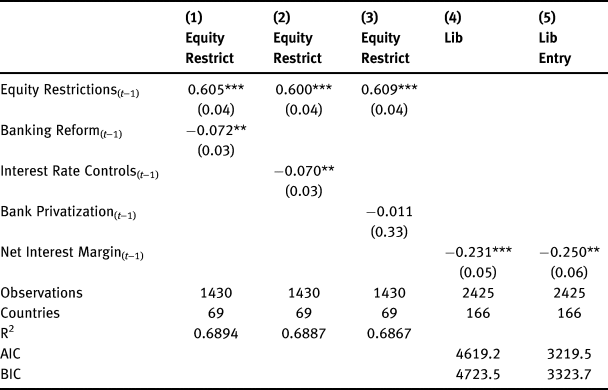
Model 1 in table 1 reports the result of the most basic model, which includes a lagged dependent variable of Equity Restrictions and a one year lag of Banking Reforms.Footnote 55 The model returns a negative and statistically significant relationship; as a country experiences a 1 standard deviation increase in banking sector openness, its equity restrictions decrease, on average, by 7.2 percent of a standard deviation. In Models 2 and 3, I further disaggregate the index and find that Interest Rate Controls have a negative and statistically significant relationship with Equity Restrictions, while the coefficient estimate for Bank Privatization is negative but not statistically significant. These findings corroborate a relationship between the dismantling of subsidized credit and FDI liberalization. The lack of a statistically significant relationship between Bank Privatization and Equity Restrictions suggests the relationship between banking reforms and FDI policy is driven by credit concerns and not by a broad programmatic embrace of neoliberal deregulation. Models 4 and 5 report parameter estimates for negative binomial regressions that estimate the rate of liberalizing changes to general FDI policies and to entry-related regulations for a country–year. As mentioned above, these models use Net Interest Margin as a proxy for financial constraints because the banking reform data are only available through 2005. Higher values of Net Interest Margin indicate a less competitive banking environment and provide evidence of a repressed banking sector in which well-connected firms have privileged access to finance. For both models, Net Interest Margin is statistically, significantly, and negatively associated with FDI reforms. Model 4 calculates a 1 standard deviation increase in this variable above the mean decreases the propensity to enact any liberalizing change by 20.6 percent. Model 5 finds the same increase in Net Interest Margin decreases the probability of enacting a liberalizing change to entry requirements by 22.1 percent.
Financial Constraints and FDI Liberalization

Country-clustered standard errors in parentheses. Constant and year dummies not reported.
*p <.1, **p <.05, ***p <.01
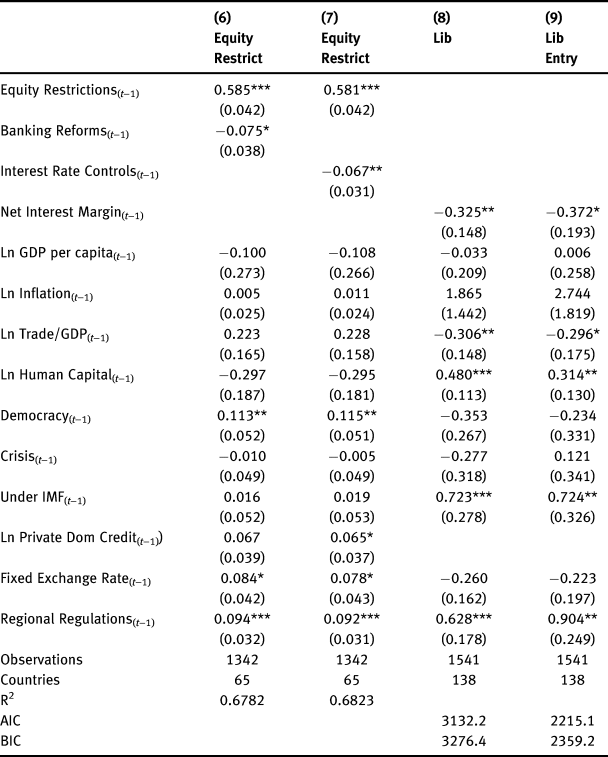
In table 2, I re-estimate analysis including the control variables described above. To conserve space, I only replicate analysis on models 1, 2, 4, and 5. Across these models, my central findings hold. Banking Reforms, Interest Rate Controls, and Net Interest Margin all retain statistical significance.Footnote 56 The models also suggest regional patterns matter; the more restrictions a country's peers erect, the more likely that country is to maintain barriers of its own.
Financial Constraints, FDI Policy, and Alternative Mechanisms

Country-clustered standard errors in parentheses. Constant and year dummies not reported.
*p <.1, **p <.05, ***p <.01
In models using Equity Restrictions, most control variables are not statistically significant predictors of policy. Democracy is positive and statistically significant in both models 6 and 7, which suggests democracies are more likely to restrict FDI entry than authoritarian regimes, once controlling for domestic banking sector conditions. This finding runs counter to previous work that argues democratization drives liberalization. However, supplementary analysis (A13–14) shows this finding is less robust across varying estimation methods.Footnote 57
In models that estimate FDI regulatory changes, more control variables are statistically significant. High levels of trade reduce the propensity of enacting more liberalizing policies across each model. High levels of human capital increase the likelihood of a liberalizing change. In contrast to the historical models, countries under IMF programs are more likely to liberalize. These findings suggest economic distress has become more likely to lead to liberalizations of FDI policies in recent years. However, these findings are largely consistent with a financing constraints logic to investment liberalization.
Endogeneity concerns
One may worry that banking sector reforms may be endogenous to FDI policy liberalization. Economic liberalizations are often structured around comprehensive reform packages, and therefore the statistical relationship between banking sector and foreign equity liberalization may be driven by simultaneity. From the perspective of policy elites, technocratic reports on reform sequencing tend to associate FDI liberalization with real sector reforms, such as tariff reductions and banking sector reforms with policies toward portfolio investment.Footnote 58 Therefore, the experience of policy elites suggests governments do not routinely consider banking policy to be tied to FDI policy.
While a review of technocratic writing and thought at the time suggests policymakers rarely saw technocratic rationale for sequencing banking and FDI reforms,Footnote 59 I also employ two modeling techniques, the results of which are available in supplementary materials (A17–19), to establish statistically the temporal ordering of banking and FDI reforms, and to rule out concerns that all neoliberal reforms simply lump together. First, I use error correction models to differentiate between the short and long-term effects of banking reforms on FDI policy. I find banking sector reforms have long term, but not simultaneous, effects on FDI policy. Second, I use granger causality tests to demonstrate that banking sector reforms precede FDI policy liberalization, but not the reverse, and that banking sector reforms do not “granger cause” other liberalization reforms such as short-term capital account openness or trade liberalization. Jointly, these tests provide increased certainty that the relationship between banking sector reforms and FDI liberalization is not spurious.
Capital intensity, financial constraints, and industry-level policy
If business interests drive investment liberalization as a way to increase access to finance, liberalization of entry requirements should occur more often for capital intensive industries because such industries have the greatest financing needs. This relationship should also be stronger in economies that have undergone banking sector reform since large firms in those environments lose their privileged access to credit markets. This expectation is precisely the opposite of what we would anticipate if FDI liberalization were driven by labor demands for jobs, namely that labor intensive industries should then be most likely to liberalize because such industries are best poised to generate employment. Thus, testing how industry-level capital intensity affects the propensity to liberalize FDI policy can adjudicate between an elite-led or labor-driven explanation of policy change.
I start by estimating a series of simple, discrete variable equations that model the propensity for a government to enact an FDI policy change for a particular industry at time t, using data from UNCTAD's Investment Policy Monitor as described in the previous section. Note that these data also include policy changes that are not specific to industry; I exclude these from the following analysis because they cannot be assigned a capital intensity value.
I include two explanatory variables—Capital Intensity and Banking Reform—as well as an interaction between the two variables. I measure Capital Intensity in the following way. Following convention in the economics literature, I construct a measure of capital intensity that subtracts the cost of labor inputs from the value of production divided by the value of production for each industry on a yearly basis. This measure can be thought of as the ratio of capital inputs over the total cost of production. Because these data are rarely available at the country level, especially in developing countries, I use the United States as my baseline.Footnote 60 I calculate this measure from the U.S. Bureau of Labor Statistics data on multifactor productivity at the industry level. These data are available at the North American Industry Classification System (NAICS) three-digit industry level from 1987 to 2014. However, the United Nations Conference on Trade and Development (UNCTAD) data classifies investment policies through the Standard Industrial Classification (SIC) two-digit system. Therefore I match the NAICS data to the appropriate SIC code. This creates a unique capital intensity measure for thirty-seven industries for each year.Footnote 61 To aid in interpretation, I standardize Capital Intensity. As in the previous section, I measure banking reform in two ways. First, through Banking Reform, which is the measure that most closely proxies for government control over credit markets. Because my analysis covers 2000–2015, I use countries’ scores from 2005 for the remaining ten years of the sample. We may worry that banking regulations may have changed substantially from 2005–15. Accordingly, I also run a series of models using Net Interest Margin.Footnote 62 I include all control variables described in the previous section.
I estimate these models with logit link functions and fixed year effects.Footnote 63 I am unable to perform analysis with country and industry fixed effects for two reasons. First, country fixed effects drops all countries that had no changes in investment policy over the time period. Second, industry fixed effects become collinear with the Capital Intensity measure. It is computationally challenging to perform multilevel analysis for these models because of separation issues. Instead, I cluster standard errors by country.
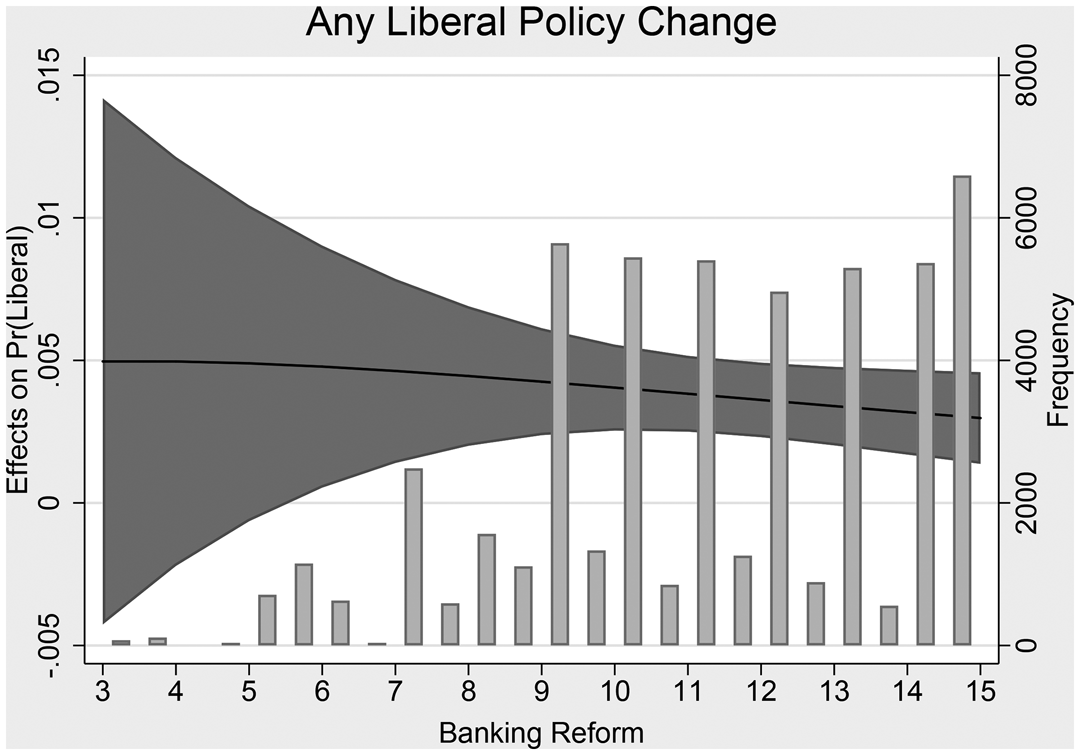
I report marginal effects plots for the interaction of Capital Intensity and both measures of Banking Reform here and provide full regression tables in supplementary materials (A21–24).Footnote 64Figure 1 illustrates how Banking Reforms condition the relationship between capital intensity and the propensity to enact liberalizing policy change. The results are suggestive, but not conclusive. At low levels of domestic banking reform—stated slightly differently, in economies characterized by continued government intervention into credit markets—Capital Intensity has no statistically significant effect on the propensity to liberalize. The lack of statistical significance is consistent with hypothesis 2, but is driven by large standard errors rather than a smaller coefficient estimate. However, at higher levels of banking sector reform, Capital Intensity is associated with a positive and statistically significant effect on the propensity to liberalize. The slightly downward sloping estimated effect suggests that the influence of capital intensity on FDI reforms is strongest in credit environments that are transitioning from heavy state intervention to more market-driven dynamics. This relationship persists when we restrict analysis solely to liberalizing changes to entry regulations.
Marginal Effects of Capital Intensity by Banking Reform—95% Confidence Interval

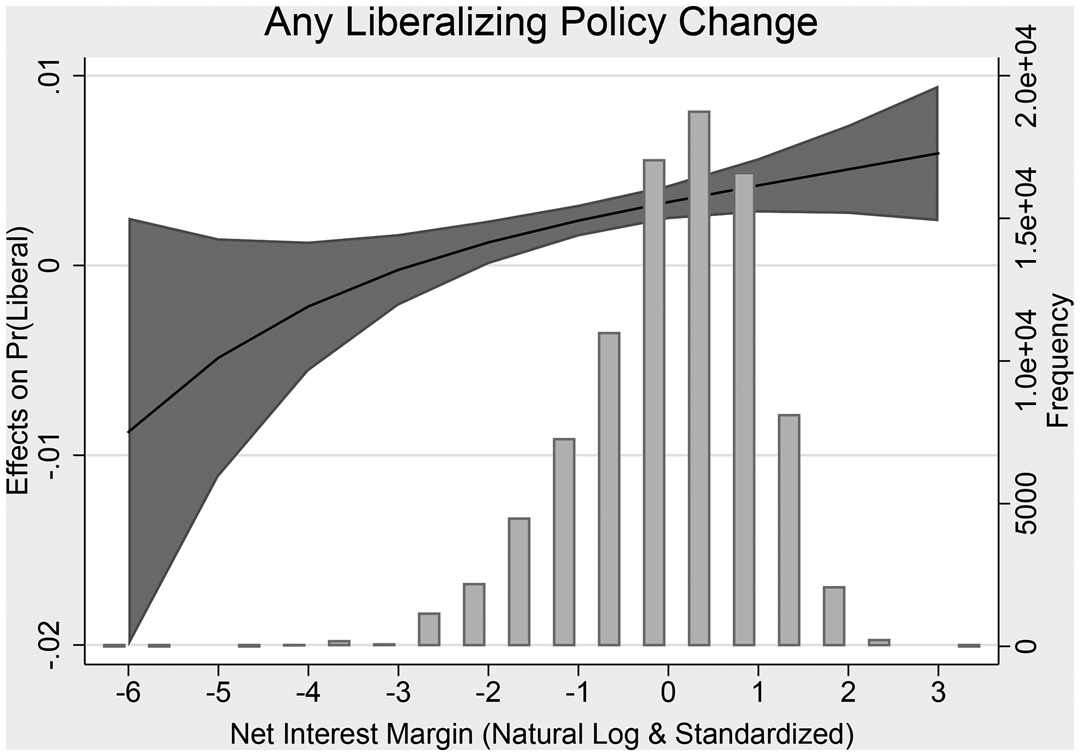
As a robustness, I rerun analysis using Net Interest Margin to proxy for the efficiency of the banking sector instead of Banking Reform. Recall, this measure is available across all years in my sample. The results suggest the relationship between banking sector regulations and FDI policy have shifted in recent years. As with the analyses above that used Banking Reform, Net Interest Margin conditions the effect of Capital Intensity on the propensity to enact any liberalizing change and entry liberalization specifically. However, the relationship between Net Interest Margin and Capital Intensity differs from my expectations. As figure 2 illustrates, in these models, banking sector inefficiency intensifies the positive relationship between capital intensity and liberalization. Since more inefficient banking sectors are likely to be more repressed, these findings seem to contradict other analysis.
Marginal Effects of Capital Intensity by Net Interest Margin—95% Confidence Interval

How should we interpret these findings? First, it is important to note that Net Interest Margin was associated with reduced number of aggregate FDI reforms in the previous section. The conflicting results may be driven by the fact that the models presented here drop all reforms that are not specific to an industry and countries with more efficient banking sectors also enact more broad-based FDI policy reforms. Second, it seems that in recent years, economic distress has had an increasing influence on FDI policy. Recall from the previous section that models of country-level policy from 2000–2015 found that being under an IMF program was positively associated with passing liberalizing FDI policy reforms. This finding holds in these models as well. It may be that in recent times even countries with relatively repressive financial sectors respond to macroeconomic problems by trying to entice foreign investment. Finally, there is evidence that countries with inefficient banking systems are more likely to be active in changing FDI policies, both in a liberalizing as well as a restricting direction. Unlike models that use banking regulatory variables, banking sector inefficiencies seem to also make the passage of restrictive investment policies more likely.Footnote 65 In sum, there is some suggestive evidence that capital intensive industries operating in less repressed banking sectors subsequently undergo liberalization, but the relationship is complex and statistical results are not definitive.
Financing constraints, domestic political institutions, and FDI Policy
This section tests hypothesis 3: that domestic political institutions that empower business interests condition FDI liberalization. I re-estimate models used to test hypothesis 1, this time sequentially adding measures of both electoral and bureaucratic institutions. Because I am interested in within country change, I focus on models that measure FDI policy through Equity Restrictions. This choice means analysis ends in 2000, but also provides richer within country variation for the explanatory variables of primary interest.
I proxy for business-friendly domestic political institutions through three measures. First, I measure formal channels of influence through executive and legislative partisanship.Footnote 66Executive Partisanship and Legislative Partisanship each measure the economic policy orientation of the party of the chief executive and the largest party in government, respectively. If governments face pressures from business interests to liberalize FDI policy when banking reforms disrupt their privileged access to finance, we should expect lobbying pressure from these groups to be particularly successful when Right parties are in power, since they are closely aligned with capital. Moreover, the party of the executive should be more critical for the direction of FDI policy than legislative partisanship because substantive changes to investment law are often created through executive decree.
My second two variables proxy for the prevalence of informal channels through which firms’ may exert their influence.Footnote 67 Following the literature on political capture, I conceptualize under-professionalized state apparatuses and cultures of corruption as norms and institutions that favor economic elites over other societal interests.Footnote 68 I use International Country Risk Guide (ICRG) measures of Corruption and Bureaucratic Quality. Corruption is measured on a 6-point scale in which higher values indicate a better institutional environment—that is one characterized by less corruption. ICRG characterizes corruption as “excessive patronage, nepotism, job reservations, ‘favor-for-favors,’ secret party funding, and suspiciously close ties between politics and business.”Footnote 69 While Corruption accounts for system-wide tendencies to blend political and business interests in non-transparent ways, Bureaucratic Quality measures the extent to which a country's bureaucracy is autonomous from ruling political parties and figures. This four point scale, with higher values indicating a more autonomous bureaucracy, considers attributes such as formal mechanisms for recruitment and personnel training that allow government bureaucrats to maintain consistency through leadership turnover.Footnote 70
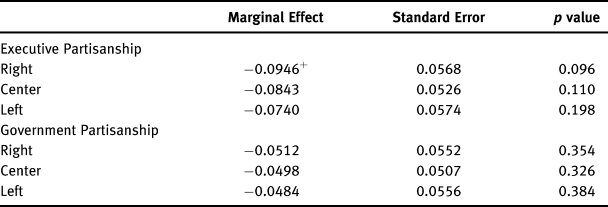
To conserve space, I report regression output in supplementary materials (A25) and instead focus on computing marginal effects of the modeled interactions. Table 3 reports marginal effects of Bank Reform on Entry Restrictions given executive and legislative partisanship. Entry Restrictions are more likely to decline under Right executives, but this relationship is significant only at the 90 percent confidence interval. No other executive party is associated with statistically significant changes to investment regulation. There is no evidence that the party of the legislature conditions the relationship between the banking environment and restrictiveness toward foreign firm entry. Together, these estimations provide continued, though somewhat limited, support for the contention that firm preferences drive FDI liberalization processes. Certainly, the results run counter to arguments that left parties embrace FDI to generate employment opportunities for constituents.Footnote 71
Marginal Effects of Bank Reform by Partisanship

+p <.1.
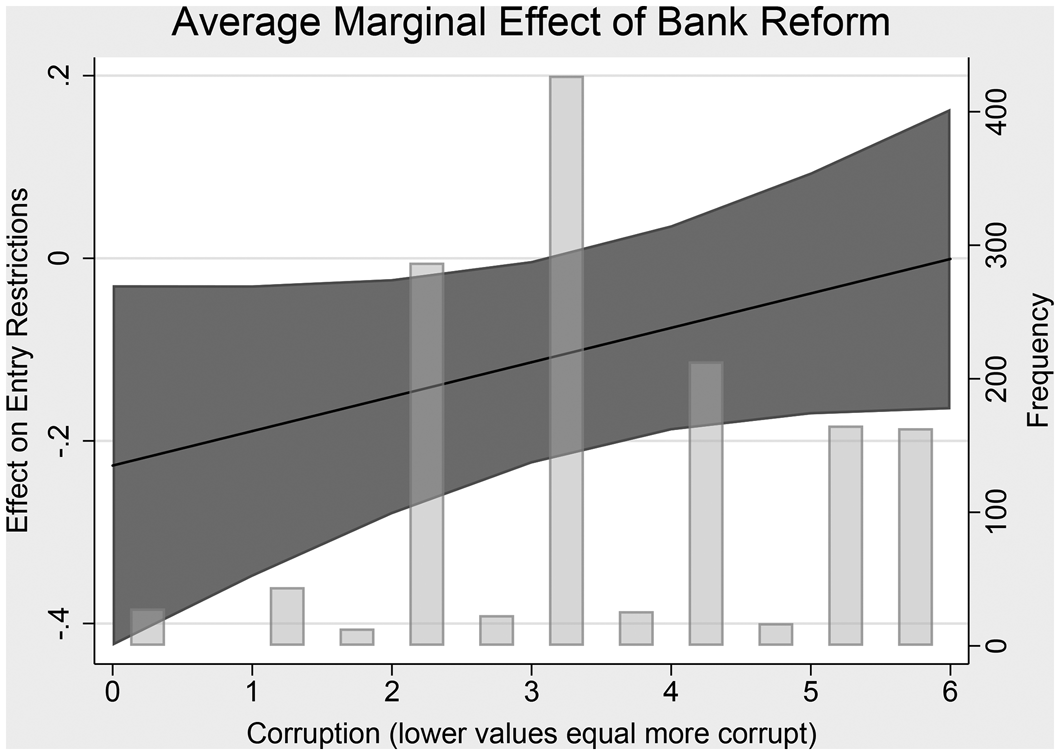
There is more evidence that informal institutions that favor business elites intensify the relationship between financial constraints and liberalizing FDI policy. Figure 3 illustrates the effect of Bank Reform on Equity Restrictions conditional on the level of domestic Corruption. The upward sloping line indicates Bank Reform predicts a reduction in Equity Restrictions in countries characterized by high levels of corruption, but not in countries with lower levels of corruption. The shaded area around the line indicates 95 percent confidence intervals; after countries cross the middle of the corruption scale, the statistical significance of the relationship between Bank Reform and Entry Restrictions ceases.
Marginal Effects of Bank Reform by Corruption—95% Confidence

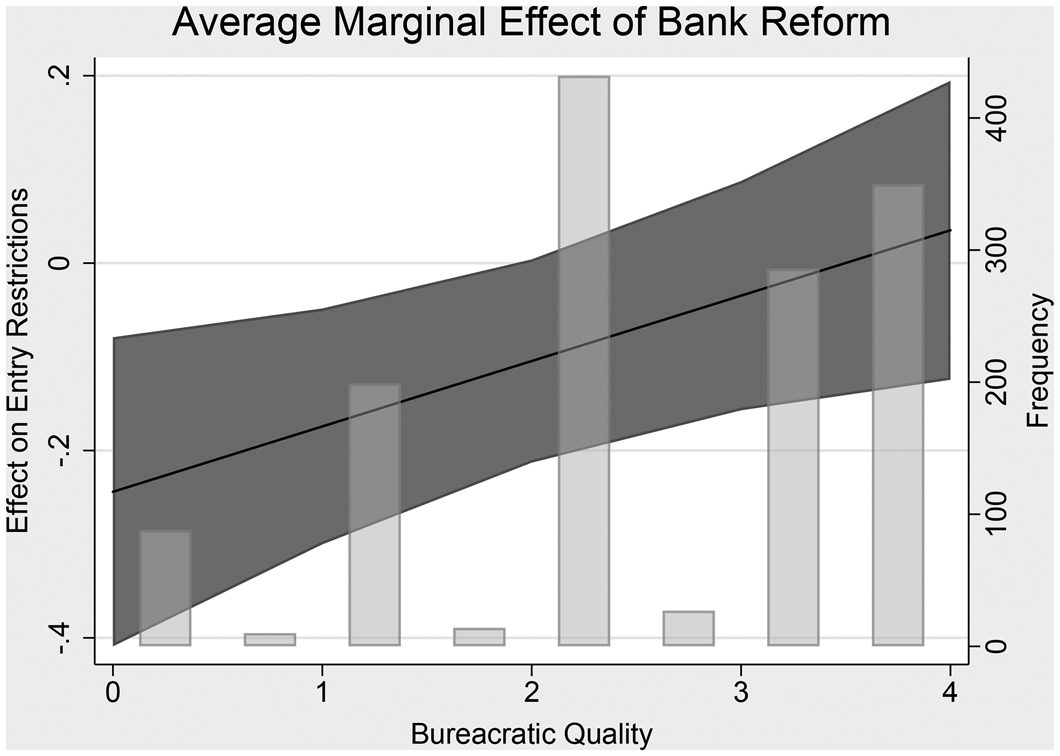
Figure 4 provides a visual representation of the effect of Bank Reform on Equity Restrictions conditioned on the quality of the domestic bureaucracy. Here we see a similar, but more pronounced, relationship. At low levels of Bureaucratic Quality, Bank Reform has a negative and statistically significant effect on Entry Restrictions, while in countries characterized by high levels of bureaucratic autonomy, this relationship recedes. The size of the effect is rather large. At a rating of “1” on the Bureaucratic Quality measure, a standard deviation increase in Banking Reform is associated with a decrease in Equity Restrictions equivalent to 20 percent of a standard deviation.
Marginal Effects of Bank Reform by Bureaucratic Quality—95% Confidence

In sum, the empirical tests reported here provide: strong evidence that increased financial constraints are associated with liberalizing changes to FDI policies, particularly regarding entry restrictions (hypothesis 1); evidence that financial constraints are somewhat associated with targeted liberalization of capital-intensive industries (hypothesis 2), though the direction of this relationship is complex and difficult to make strong claims to; and substantial evidence that the relationship between banking sector reforms and FDI liberalization is strongest when domestic political institutions favor business interests, particularly through informal channels (hypothesis 3).
Conclusion
In this article, I demonstrate that banking sector reforms can induce changes to policies toward foreign investment and that business interests likely drive this process. My theory predicts that domestic firms prefer protection from foreign entry so long as they maintain access to subsidized credit, but that large scale banking reforms create financing pressures that render domestic business interests more amenable to MNE entry. Using a variety of measures of FDI policy, I find evidence that banking sector reforms precede FDI liberalization and that this relationship is stronger when domestic political institutions favor business interests.
These findings have broad insights for deepening our understanding of processes of economic (dis)integration. First, my analysis challenges how scholars of economic integration conceptualize and explain the politics of change. While comparative historical institutionalism has increasingly developed rich conceptions of various processes of institutional change, IPE scholars have continued to rely disproportionately on punctuated equilibrium models. These relatively simple models of policy variation and change have performed quite well in providing a base of knowledge of the distributional political underpinnings of macroeconomic policy orientations and governments’ stance toward economic integration. However, as the global economy becomes increasingly integrated, historical patterns of distributional cleavages are becoming less important. Developments in new–new trade theory show firm size and the ability to take advantage of economies of scale are increasingly important to understanding how integration affects individual firms. As workers gain employment in increasingly global value chains, voter attitudes over globalization become progressively complex. Previous shifts in both the structure of the world economy and the precise way in which individual countries are integrated into global trading and financing patterns influence actors’ preferences over openness in future periods. Actors update their beliefs; preferences are not static. As global and local forces place various pressures on different interests groups, their strategies can shift. This may be because their underlying preference structures shift leading to ideational transformations, or because the constraints that structure their utility functions change. This analysis contributes to a richer, and ultimately more flexible, conceptualization of sources of continuity and change in IPE by considering the ways in which access to financing structures preferences over openness. We can easily imagine extending this framework of dynamic preference updating to other dimensions of the global political economy as well.
Second, my focus on elite politics reorients explanations of liberalization away from narratives that emphasize democratization's popularization of policymaking and instead considers how business power accrues and is expressed in technically complex issue areas. Extending a “Quiet Politics” approach to FDI regulation challenges assumptions that publics develop interest in or acumen over technocratic economic policy details. Citizens may agitate for economic growth and jobs, but they may also leave the minutiae of policy to specialists. When business interest groups are ceded substantial lobbying space, exploring firms’ policy preferences becomes more important since they can more easily set the terms of debate and policy implementation. This requires careful attention to firm- and industry-level sources of heterogeneous preferences, as well as richer theories about how local context interacts with firm characteristics to generate business groups’ preferences and strategies toward policy influence.
Finally, my analysis has important consequences for how scholars interpret the distributive effects of globalization. Rather than disrupting incumbent advantages, investment liberalization may benefit the largest and most politically influential firms in a local economy while disadvantaging smaller firms and workers. These distributive implications are important. They suggest political economy scholarship on economic liberalization should pay closer attention to how actors’ size and power resources influence their adaptive capabilities. Large changes in the regulation of the local economy may reinforce inequalities as actors with the resources to adapt to changing environmental conditions gain further advantages over actors too vulnerable to meaningfully acclimate to shifting economic structures. The ability to realize large increasing returns to scale may reinforce the dominance of industry giants and large diversified conglomerates over smaller economic units. These dynamics require political economists to more carefully consider the ways in which globalization disadvantages small units over large, reinforces and accelerates pre-existing inequalities rather than moderating them, and how such dynamics affect the politics of globalization.
This research is only a partial advancement toward better understanding the role of the domestic financing environment in the politics of FDI and policies toward multinational production networks more generally. The data available here are unable to answer many important questions at the firm level; future research could better identify how variations among political institutions influence the channels through which domestic firms articulate their preferences over FDI policy and the conditions under which local and foreign firms will coordinate their lobbying efforts. Additionally, the inconclusiveness of the relationship between financial repression, capital intensity, and FDI policy warrants greater attention with better measures.
Furthermore, these results have implications for the future of policies toward FDI. Anecdotally, developed host economies enacted a series of more restrictive policies toward FDI in the wake of the 2008 financial crisis. One explanation for these barriers may be that increased government intervention in precarious banking sectors led to conditions favorable to anti-FDI policies. Future research should consider the extent to which government efforts to stabilize domestic banks could inadvertently lead to further restrictions on foreign equity. More generally, if financial constraints generate coalitions conducive to FDI openness, under what conditions can liberalization be reversed? Is the process of reform and reversal frictionless, or is the erection of barriers to foreign equity increasingly difficult after foreign firms are already established locally? Such questions are particularly poignant in a global financial environment marked by the rise of FDI flows originating in emerging economies; the increasing presence of MNEs in infrastructure, service, and agricultural projects; and increased calls for government intervention in credit markets to stabilize domestic banking systems considered to be more vulnerable to negative shocks as a result of financial integration.
Supplementary material
To view supplementary material for this article, please visit https://doi.org/10.1017/bap.2019.13