Introduction
Immediate resuscitation is required for a person who loses his airway or pulse. This immediate response is typically performed by a bystander or workplace first aid provider. Gilmore et al found that the odds ratio of survival improved when a person in cardiac arrest received bystander-initiated cardiopulmonary resuscitation (CPR), and that the importance of this intervention was more pronounced when the time interval between collapse and defibrillation increased.Reference Gilmore, Rae, Becker and Eisenber 1 However, less than 30% of all out-of-hospital resuscitation attempts are initiated by lay bystanders, and bystander-initiated CPR occurs in less than 30% of all cases when warranted.Reference Eisenburger and Safar 2 Fear of liability, lack of confidence, fear of making things worse, anxiety about performing in front of an audience, and apprehensions about contracting disease or infection are among the reasons why many bystanders, both trained or untrained, do not respond in emergency situations.Reference Das and Elzubeir 3 ,4
The large number of CPR training services has led to different standards in the design and delivery of training.Reference Cullen 5 While millions of people are trained each year, the efficacy of this training, and the subsequent performance of the skills learned, has come into question.Reference Parnell and Larsen 6 , Reference Higdon, Heidenreich and Kern 7 Current literature states that many necessary skills of CPR are forgotten shortly after certification, with rapid deterioration of skills and knowledge in two to six months.Reference Gilmore, Rae, Becker and Eisenber 1 , Reference Cullen 5 As there is an expectation that immediate and effective emergency life-saving CPR will be provided within the workplace, the purpose of this study was to examine the extent to which this is true in an industrial or service-oriented workplace environment.
Methods
Following institutional ethical review board approval, participants were recruited by contacting large industrial employers in the Lower Mainland of British Columbia, Canada that regularly contract out first aid training. All employees paid to provide first aid within the workplace were eligible to participate. Researchers approached the person/people in charge of safety or first aid to gain permission and recruit participants.
All data were collected at the worksite. Employers were instructed to schedule their employees to participate in the study throughout the day, and to give them no details except that it was a CPR study. Participants entered the study room individually, where they met the researchers and gained their first knowledge of the details of the study. After their demographic information was recorded on data collection papers, participants were introduced to the scenario set up in a second room.
The scenario involved a training manikin (ResusciAnne SkillReporter, Laerdal, Stavanger, Norway) lying on the floor, with a frayed electrical cord (plugged into an outlet, but not live) placed across the chest. The participant was told “you are called to a scene by a fellow worker. The worker said that the patient fell to the ground and was shaking. No one knows what happened. Everything is as found unless we tell you otherwise.” Researchers watched for scene safety, monitoring the victim's level of consciousness, alerting emergency medical system (EMS), effective management of ABCs (airway, breathing, and circulation), and cycles of compressions and ventilations, followed with reassessment of ABCs. Finally, participants were expected to place the victim in the recovery position. A timestamp program using an Excel spreadsheet version 14 (Microsoft Corporation, Seattle, Washington USA) was used to record and assess the correct order and proper execution of each of the steps for the CPR scenario. The Laerdal recording manikin was connected to sensors and a computer that recorded the rate, depth, and frequency of breathing, and the rate, depth, and location of chest compressions (Laerdal PC SkillReporting System, Laerdal, Stavanger, Norway).
Standard answers were given for common questions that were asked by participants. When asked to phone 911, the researchers replied with “I can do that,” and then told participants “EMS will be here in about 10 minutes.” When asked any specific question that could bias the outcome of the scenario the reply was “do what you would do in real life.”
Data Assembly
Data were assembled in a series of Microsoft Excel spreadsheets. Descriptive statistics were calculated using Excel functions. Descriptive and graphical data were reported based upon the groupings of “days since last training.” In each case, data was assembled using the following categories:
-
• 1 = 1-30 days (<1 month);
-
• 2 = 31-90 days (1-2.9 months);
-
• 3 = 91-182 days (3-5.9 months);
-
• 4 = 183-364 days (6-11.9 months);
-
• 5 = 365-546 days (12-17.9 months);
-
• 6 = 547-729 days (18-23.9 months);
-
• 7 = 730-1094 days (24-35.9 months); and
-
• 8 = >1094 days (three or more years).
Criteria for retention of CPR skills have typically included both sequence and skill information. In 1996, Brenan et al adopted a revised, simplified checklist rating each of 14 essential skills on a five-point subjective rating scale (outstanding, very good, competent, questionably competent, or not competent).Reference Brennan, Braslow, Batcheller and Kaye 8 This list of 14 skills was used to rate participants in the present study on a dichotomous scale as performed or not performed, with a potential overall rating of 14.
Data Analysis
Both descriptive and statistical analyses were performed. Regressions and multivariate ANOVAs were performed to explore the impact of the number of days since the person was last trained, and to investigate the relationship between previous training and recertification on performance measures, using SPSS version 10 (IBM, Armonk, New York USA).
To investigate the effects of days since training on the pre-CPR safety check, an aggregate score was created from the variables adopted by Brenan et al:
-
(1) Ensure no danger;
-
(2) Gloves;
-
(3) Pocket Mask;
-
(4) Tap or gently shake shoulder;
-
(5) Speak to patient;
-
(6) If another person is available, have them activate EMS;
-
(7) Open the airway using appropriate technique;
-
(8) Maintain open airway;
-
(9) Ear over mouth, observe chest: look, listen, and feel for breathing;
-
(10) Seal pocket mask properly;
-
(11) Ventilate 1;
-
(12) Ventilate 2;
-
(13) Assess for visible signs of circulation and carotid pulse; and
-
(14) Landmark—correct hand placement.
The highest score on this aggregate variable was 14, with one point assigned for each of the variables performed prior to beginning CPR cycle 1.
To investigate the relationship between ventilations and days since last training, an aggregate variable for ventilations within each cycle was created based on whether the participant ventilated the patients twice as required (score = 2), once (score = 1), or did not ventilate at all (score = 0). For this variable, the maximum score per cycle was 2 and the minimum score was 0.
To investigate the relationship between compression and time since last training, a compression variable was created by calculating the number of compressions away from the number the participants were trained to perform. As some participants were trained to perform 15 and others 30 compressions, those trained at 15 were scaled by a factor of 2. For a small number of participants, training targets were estimated based on when training occurred and when rules changes for number of compressions were initiated.
The relationship between pulse and breathing checks and actual days since last training was investigated using an aggregate score created from the variables:
-
• Pulse is present (performed after cycle 4 and 8);
-
• Breathing is present (performed after cycle 4 and 8); and
-
• Place patient in recovery position (performed after cycle 8).
The highest score on this aggregate variable was 5, with one point assigned for each of the variables performed at the designated time points.
Results
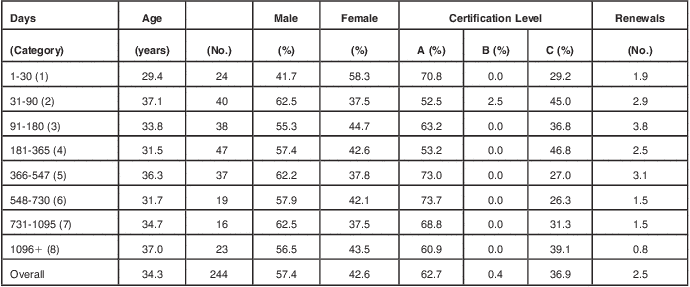
A total of 244 participants had CPR training and complete data for analysis. Of these, 140 were male, and 104 were female, with an average age of 34.3 years. These participants were divided into categories based on the number of days since their last first aid training. The distribution of participants across the eight categories of “days since training” is provided in Table 1. Of the participants with complete data, 62.7% were trained in CPR at a Level A, and 36.9% at a Level C. On average, they had renewed their certificates 2.5 times.
Distribution of Participants across Categories of “Days since Training”

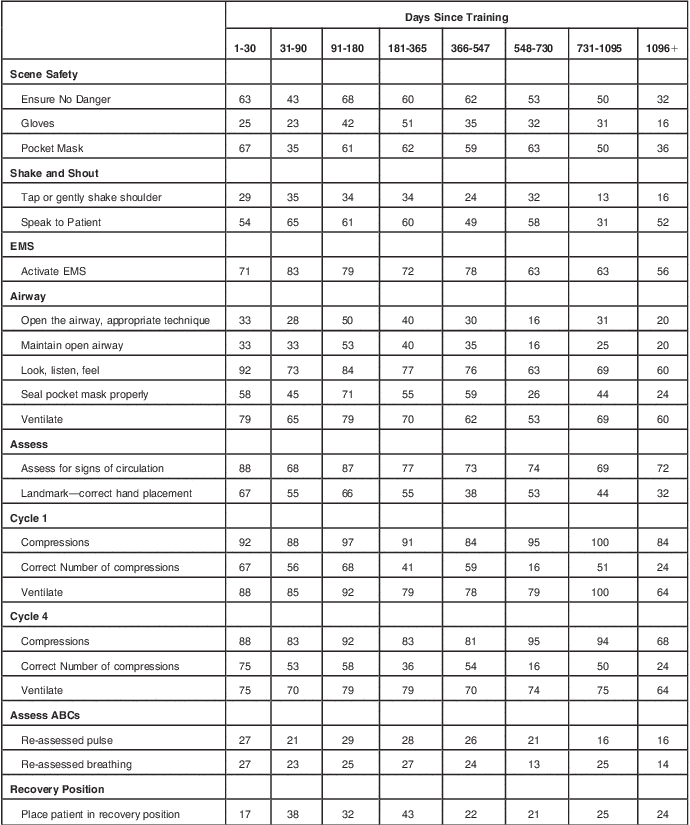
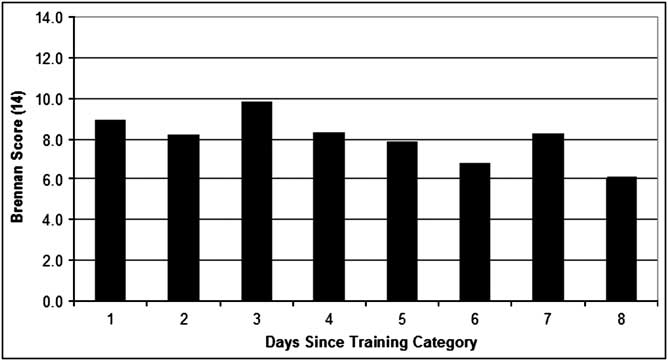
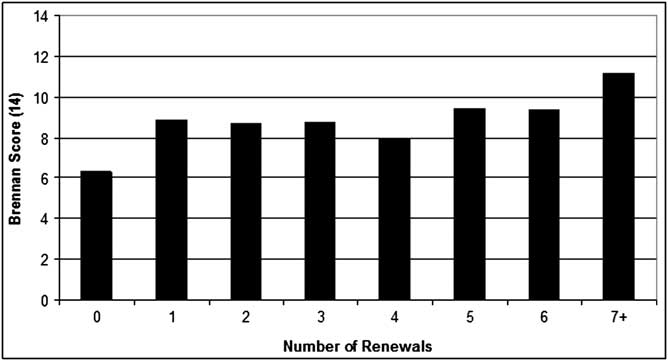
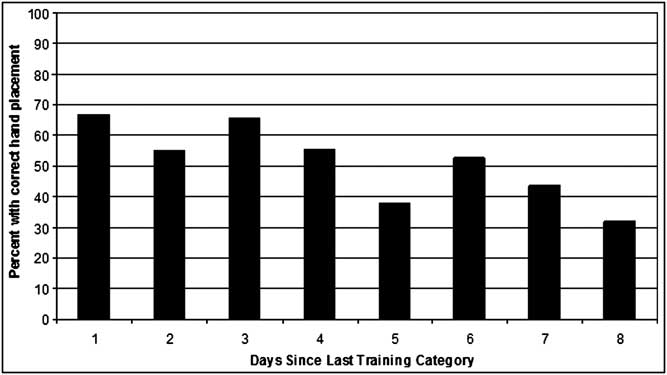
The percentage of completion of each step in the provision of CPR to an unconscious victim, based on days since training categories, is provided in Table 2. Many of the knowledge-related assessment skills appeared to deteriorate with time, such as those involved in determining scene safety, and activation of the EMS. A decline in physical skill can be seen in airway control and landmarking for chest compressions. Figure 1 demonstrates average scores out of 14 as per Brenan et al's list for each of the categories of “days since training.”Reference Brennan, Braslow, Batcheller and Kaye 8 Scores deteriorated over time since last training, demonstrating a general decay in CPR provision. There was a positive effect on skill retention with the number of renewals; a participant who had renewed his CPR certificate seven or more times had the highest scores related to CPR skill (see Figure 2). The highest scores in category 3 may therefore be partially inflated, because this group had the greatest number of renewals.
Unconscious CPR Scenario: Percentage of Participants Completing Each Step, Categorized by Days since Training

Relaxed Brennan Scores (out of 14) for each Category of “Days since Training”

Relaxed Brennan Scores (out of 14) Related to the Number of Times Participants had Renewed their Certificates

The skill-based components of CPR delivery diminished with time. There was a trend for fewer individuals to correctly landmark for chest compressions (Figure 3) and control the airway for ventilations (Table 2) as the time since training increased. However, many of the knowledge-based items did not show any typical pattern of decay, although “ensuring no danger” and “activating the EMS” both showed a decline over time since last training.
Percentage of Participants in each “Days since Last Training” Category who Correctly Landmarked for Chest Compressions

Statistical Results
Once missing data were removed, 243 cases were used for regression analysis. A linear regression of the number of renewals on the Brennan aggregate score out of 14 suggests that approximately 15% of the variance in score can be accounted for by the numbers of times certified (r2 = 0.147). The correlation between these two variables is approximately 0.38 and is significant (F [1, 241] = 41.58, P < .000).
A linear regression for days post-certification on Brennan score suggest that days post-certification is a less accurate predictor of CPR score than the number of recertifications. The results below suggest that only four percent of the variance in score can be accounted for by the days since certification (r2 = 0.04). The correlation between these two variables is approximately 0.19, and is less significant than the relation between the number of times certified and score (F [1, 241] = 9.94, P < .002).
A Pearson correlation was used to determine whether a linear relation existed between the variable days since training and the aggregate variable for pre-CPR safety checks (a score out of 14). The variables were negatively correlated (n = 244, r = -.224, P = .000). As days since last training increased, performance worsened. The number of days since CPR training was completed was significantly correlated with decreased performance of the pre-CPR safety assessment and preparation for CPR.
An 8x8 General Linear Model Repeated Measures ANOVA with ventilations (an aggregate variable based on the number of ventilations performed in each of eight cycles) as the within factor and time since training (eight time periods) as the between factor was performed. For this variable, the maximum score per cycle was 2 and the minimum score was 0. Days since training ranged from 7 to 4422. Pearson correlations were performed for actual number of days since training versus the number of ventilation attempts performed at each cycle. There were no significant correlations between days since training and ventilatory attempts. ANOVA results for ventilations and days since training indicate that the Observed Power for each test performed was 1, indicating that statistical power was sufficient for each test. Box's Test of Equality of Covariance Matrices were significant (Box M = 661.23, F = 2.278, P = .000) and the null hypothesis that the observed covariance matrices of the dependent variables were equal across groups was rejected. As a result, Dunnett's T3 was utilized for all post-hoc paired contrasts. Wilk's Lambda (0.563) indicated a significant multivariate effect F(7, 244 = 25.472, P = .000, Partial Eta2 = .259) for ventilations but not for ventilations by time of training. Mauchley's Test of Sphericity was significant, and a Greenhouse-Geisser correction for degrees of freedom was utilized to test within-subject effects. There was a significant within-subjects effect F(2.585, 244 = 82.399, P = .000), indicating a significant change in the number of ventilation attempts over the eight cycles. There was a significant linear effect F(7, 236 = 152.899, P = .000, Partial Eta2 = .393) indicating a linear trend in the data for ventilations performed at each cycle. There was a decrease in the ventilatory attempts following cycle four, regardless of time since training.
The between-subjects effect was non-significant F(7, 236 = 1.333, P = .235, Partial Eta2 = .038), indicating that the number of ventilations performed did not change with the number of days since training. There were no significant between-group contrasts using Dunnett's T3. There was considerable variability in the number of ventilations attempted, but not consistently related to time since training; There was no significant decrement in skill retention associated with ventilations attempted.
An 8x8 General Linear Model Repeated Measures ANOVA with compressions (an aggregate variable based on the error in the number of compressions performed in each of eight cycles) as the within factor and time since training (eight time periods) as the between factor was performed. ANOVA results for compressions away from target and days since training demonstrate an Observed Power for each test performed of 1, indicating that statistical power was sufficient for each test. Box's Test of Equality of Covariance Matrices was significant (Box M = 1355.856, F = 4.684, P = .000), and the null hypothesis that the observed covariance matrices of the dependent variables were equal across groups was rejected. As a result, Dunnett's T3 was utilized for all post-hoc paired contrasts. Wilk's Lambda (.657) indicated a significant multivariate effect F(7, 244 = 17.304, P = .000, Partial Eta2 = .343) for the number of compressions away from the target over the eight cycles. The multivariate effect for number of compressions away from the target by time of training was also significant (Wilk's Lambda = .665), F(49, 244 = 2.021, P = .000, Partial Eta2 = .057); however, this result had a very small effect size. Mauchley's test of Sphericity was significant, and a Greenhouse-Geisser correction for degrees of freedom was utilized to test within-subject effects. There was a significant within-subject effect F(2.194, 244 = 75.074, P = .000, Partial Eta2 = .240) indicating a significant change in the number of compressions away from the target value over the eight cycles. There was a significant linear effect F(7, 238 = 120.176, P = .000, Partial Eta2 = .336), indicating a linear trend in the data for the number of compressions away from the target at each cycle. There was an increase in errors for compressions following cycle four, independent of time since training.
The between-subjects effect was significant F(7, 238 = 2.328, P = .025, Partial Eta2 = .064), indicating that the deviations in the number of compressions performed from the target value changed with time since training. One significant post-hoc contrast was observed using Dunnett's T3. The number of compression errors from the target value was lower for CPR participants trained 91-182 days prior to retesting compared to those participants trained ≥1096 days prior to the test date; the number of compressions that deviated from the target increased with the number of days since CPR training occurred. The effect size was small and the results should be interpreted with caution.
Two-tailed Pearson correlations (0.05 significance level) were performed with the actual number of days since training versus the number of compression errors that occurred at each cycle. Eight correlations were performed, and a strict Bonferroni correction for the number of correlations was utilized (0.05/8 = .00625 for significance). Four of eight correlations were significant with this correction. The number of days since training was significantly correlated with the number of compression errors for CPR cycle 1 (n = 246, r = .215, P = .001), CPR cycle 2 (n = 246, r = .201, P = .002), CPR cycle 3 (n = 246, r = .248, P = .000), and CPR cycle 4 (n = 246, r = .302, P = .000). The results suggest that the number of CPR errors from the trained target increase with time since training for CPR cycles one through four. In support of these data, there was a small between-subjects effect suggesting that a decrement in CPR skills occurred in the number of compressions administered at each cycle. However, for CPR cycles five through eight, all participants performed poorly and the number of errors from target increased substantially independent of time since training.
A Pearson correlation was used to determine whether a linear relation existed between the actual days since training, with an aggregate variable comprising pulse and breathing checks and patient placement variables. The variables were weakly negatively correlated (n = 244, r = -.166, P = .009). The number of days since CPR training was completed was significantly correlated with decreased performance of checks for breathing, positioning, and placement at the appropriate times.
Discussion
The ability of trained personnel to deliver CPR in an employment setting is paramount for employee safety. With two-year renewal dates, the ability of these trained personnel to provide this critical life-supporting first aid has been questioned.Reference Eisenburger and Safar 2 , Reference Brennan, Braslow, Batcheller and Kaye 8 , Reference Mahony, Griffiths, Larsen and Powell 9 The results of the present study confirm that both CPR skill and knowledge deteriorate to what may be unacceptable levels prior to recertification.
The skill and knowledge components have been separated out in several studies of CPR retention. CPR skills include correct rate and depth of ventilations, and rate, depth and hand placement during compressions. CPR knowledge is typically represented by the demonstration of the proper sequence of events, regardless of effectiveness. Moser and Coleman suggest that CPR skills appear to decline at a faster rate than knowledge, with significant decline in CPR skills occurring as early as two weeks post-training.Reference Moser and Coleman 10 In both intensive care nursesReference Leith 11 and airline cabin crew,Reference Mahony, Griffiths, Larsen and Powell 9 theoretical CPR knowledge retention 12 months post-training was high, but there was an inability to meet the standard passing criteria in CPR skill performance.
The present study demonstrates a decline in both knowledge and skill. Deterioration of physical skills showed consistent declines, with negative correlations with time since last training. For example, there was a trend for fewer individuals to correctly landmark for chest compressions and control the airway for ventilations as the time since training increased. Knowledge-related assessment skills were less consistent. While those elements involved in determining scene safety and activation of the EMS were linked to decay, other knowledge items did not show such a trend. It appears that the skill-based components may deteriorate in a more predictable fashion following training, while the reduction in knowledge would be contaminated by the repetition of training in those who had recertified their first aid one or more times. Examining the relationship between knowledge and skill performance in emergency medical technicians, Brown et al found accurate knowledge to be related to better performance of chest compression rate and compression to ventilation ratio, although overall performance was poor.Reference Brown, Dias and Saini 12
McKenna and Glendon measured the CPR skills of 124 occupational first aid attendants at two, six, 18 and 36 months post-training.Reference McKenna and Glendon 13 Their results showed a rapid, linear decay in CPR skills from two to 36 months, with a 50% decline in performance over two months. Only 2.4% of those trained were deemed to be effective after three years. As with other authors, these authors concluded that CPR retraining must occur more frequently if industrial first aid legislation was to provide protection to employees who were under the assumption they would be provided adequate care should it be required.
But is frequency the only answer? McKenna and Glendon demonstrated a significant time effect demonstrating CPR skill decline, with the rate of decline dependent on the initial skill mastery.Reference McKenna and Glendon 13 Similarly, Hubert et al found CPR skills were better memorized in a previously trained group, emphasizing the importance of repeated refresher training for better retention of knowledge and skills.Reference Hubert, Cassan and Rifler 14 The present results support this observation. The number of times certified appears to be a better predictor of performance on subsequent tests of CPR skill and knowledge than time since last training. To improve skill retention, and hence, survival rates following bystander-initiated CPR, strategies to reduce the rate of skill deterioration must be simple and effective, independent of time and place, and cause minimal disruption of the working day.
As many skills deteriorate rapidly over the course of the first 90 days, changing frequency of certification is not necessarily the best way to increase retention of skill and knowledge. Alternative methods of regularly “refreshing” a skill that could be delivered at a high frequency (such as every 90 days) should be explored. A recent example of this strategy found that bi-monthly “refreshers” resulted in improved psychomotor competence in CPR delivery.Reference Niles, Sutton and Donoghue 15 For airport personnel, Wollard et al concluded that frequency of refreshers at short intervals not only improved skill, but also confidence, suggesting these personnel might be more willing to respond in an emergency.Reference Woollard, Whitfield and Newcombe 16 Efforts should be made to investigate skill deterioration, and to determine if simple and cost-effective updating strategies (e.g., email, web-based scenarios that may include video or text, posters) can reduce the rate of decay.
Limitations
Participants in this study were faced with an artificial situation which may, in some instances, have impacted performance times. Skilled performance on a manikin may also be difficult, as some people have problems locating the correct anatomical landmarks.
Conclusion
Despite widespread training initiatives in Canada and the United States to train health care providers and laypersons alike, the number of lives saved through the initiation of basic life supporting first aid remains suboptimal. A bystander or workplace first aid provider able to deliver CPR, followed quickly by advanced cardiac life support, improves both survival rate and recovery.Reference Gilmore, Rae, Becker and Eisenber 1 , Reference Pearn 17 With two-year renewal dates, the ability of trained personnel to provide life-supporting first aid is unclear. The results of this study suggest that repetition may be more important than days since last trained for skill and knowledge retention. For example, a person who trained 90 days prior to testing who was recertified seven or more times may well outperform those who were just trained for the first time on most tasks. More research is needed to identify simple and cost-effective strategies for updating CPR skills and knowledge.
Abbreviations
- ABC:
-
airway, breathing and circulation
- CPR:
-
cardiopulmonary resuscitation
- EMS:
-
emergency medical system
Acknowledgement
Declan Lawlor from the Academy of Emergency Training was instrumental in helping to formulate the study design, design of the data collection tools, and choice of measurements.