





Introduction
Severe mental illnesses (SMIs) are chronic psychiatric conditions characterized by marked and persistent functional limitations, including, among others, bipolar disorder (BD) and schizophrenia (SCZ) (Zumstein & Riese, Reference Zumstein and Riese2020). Their often progressive course, with relapses and enduring limitations of cognitive, occupational, relational, and autonomy functional domains, negatively impacts and diminishes quality of life even during inter-episodic phases (Nevarez-Flores et al., Reference Nevarez-Flores, Sanderson, Breslin, Carr, Morgan and Neil2019; Vigo, Thornicroft, & Atun, Reference Vigo, Thornicroft and Atun2016). Depressive symptoms and cognitive dysfunction have consistently been identified as important predictors of functional impairment in this population (Gitlin & Miklowitz, Reference Gitlin and Miklowitz2017; Nevarez-Flores et al., Reference Nevarez-Flores, Sanderson, Breslin, Carr, Morgan and Neil2019). In recent years, sleep disturbances have emerged as an additional contributor to functional outcomes and a potentially modifiable treatment target (Kallestad et al., Reference Kallestad, Hansen, Langsrud, Ruud, Morken, Stiles and Gråwe2012; Stafford, Oduola, & Reeve, Reference Stafford, Oduola and Reeve2024).
Sleep disturbances are frequent manifestations of acute psychiatric states, but they also act as prodromal markers (Scott et al., Reference Scott, Kallestad, Vedaa, Sivertsen and Etain2021), relapse predictors (Pancheri et al., Reference Pancheri, Verdolini, Pacchiarotti, Samalin, Delle Chiaie, Biondi, Carvalho, Valdes, Ritter, Vieta and Murru2019), severity indicators (Freeman, Taylor, Molodynski, & Waite, Reference Freeman, Taylor, Molodynski and Waite2019), and correlates of suicidal risk (Bort et al., Reference Bort, Possidente, Oliva, De Prisco, Sommerhoff, Fico, Fernández-Plaza, Obach, Montejo, Martinez-Aran, Vieta and Murru2025; Li et al., Reference Li, Lam, Zhang, Yu, Chan, Chan, Espie, Freeman, Mason and Wing2016). Individuals with SMI also exhibit elevated rates of organic sleep disorders, including obstructive sleep apnea (OSA), restless legs syndrome (RLS), or REM-sleep behavior disorder (RBD) (Stubbs et al., Reference Stubbs, Vancampfort, Veronese, Solmi, Gaughran, Manu, Rosenbaum, de Hert and Fornaro2016; Teman et al., Reference Teman, Tippmann-Peikert, Silber, Slocumb and Auger2009; Weber et al., Reference Weber, Danker-Hopfe, Dogan-Sander, Frase, Hansel, Mauche, Mikutta, Nemeth, Richter, Schilling, Sebestova, Spath, Nissen and Wetter2022). These associations are largely explained by multiple risk factors, often present in SMI, such as metabolic syndrome, obesity, poor physical health, and psychotropic medication side effects (Huhn et al., Reference Huhn, Nikolakopoulou, Schneider-Thoma, Krause, Samara, Peter, Arndt, Bäckers, Rothe, Davis, Salanti, Leucht and Cipriani2019; Liu et al., Reference Liu, Myles, Foley, Watts, Morgan, Castle, Waterreus, Mackinnon and Galletly2016; Mackie & Winkelman, Reference Mackie and Winkelman2015).
Sleep disturbances may contribute to functional impairment through several mechanistic pathways. First, alterations in slow-wave sleep, REM sleep, and sleep spindles disrupt cognitive neuroplasticity and the integrity of the thalamo-cortical and frontolimbic circuits (Embang et al., Reference Embang, Tan, Ng, Loyola, Wong, Guo and Dong2025; O’Regan et al., Reference O’Regan, Poole, Otaiku, Jackson and Rosenzweig2025). These alterations interfere with memory consolidation, learning, attention, and executive function, impacting real-life functioning (Pearson et al., Reference Pearson, Uglik-Marucha, Miskowiak, Cairney, Rosenzweig, Young and Stokes2023; Samalin et al., Reference Samalin, Boyer, Murru, Pacchiarotti, Reinares, Bonnin, Torrent, Verdolini, Pancheri, de Chazeron, Boucekine, Geoffroy, Bellivier, Llorca, Viet and de Chazeron2017). Second, REM instability and changes impair mood regulation, increasing next-day hyperarousal, stress reactivity, rumination, and irritability, thereby amplifying affective and anxious symptoms (Baglioni et al., Reference Baglioni, Nanovska, Regen, Spiegelhalder, Feige, Nissen, Reynolds and Riemann2016; Palagini, Hertenstein, Riemann, & Nissen, Reference Palagini, Hertenstein, Riemann and Nissen2022). Third, poor sleep quality and excessive daytime sleepiness (EDS) contribute to daytime fatigue, reduced motivation, and diminished social and occupational engagement, potentially impairing functionality in individuals with SMI (Kaplan & Harvey, Reference Kaplan and Harvey2009; Walz et al., Reference Walz, Magalhães, Reckziegel, Costanzi, Giglio and Kapczinski2013). Fourth, OSA may further compromise functioning through recurrent sleep fragmentation and intermittent hypoxia, resulting in cognitive deficits, EDS, and increased cardiovascular risk. Collectively, these mechanisms support the transdiagnostic impact of sleep disturbances on cognition, mood, physical health, and socio-occupational functioning across psychiatric disorders.
Although sleep disturbances have gained increasing attention in psychiatric research, their possible influence on functional outcomes remains insufficiently explored, requiring analytical approaches capable of testing complex pathways. Structural equation modeling (SEM) is a valuable method for examining such relationships by integrating theoretical constructs and observed variables, and it is especially useful in psychiatry as it allows researchers to generate clinically meaningful latent constructs from different psychometric tools (Beran & Violato, Reference Beran and Violato2010). Most SEM studies examining functionality in SMI focused primarily on psychiatric symptoms and cognition as determinants of functioning (Lin et al., Reference Lin, Huang, Chang, Chen, Lin, Tsai and Lane2013; Ohta et al., Reference Ohta, Nakataki, Takeda, Numata, Tominaga, Kameoka, Kubo, Kinoshita, Matsuura, Otomo, Takeichi, Harada and Ohmori2018), whereas only a limited number of studies have incorporated sleep disturbances alongside psychiatric domains to explain functional impairment, and have been restricted to BD patients (Samalin et al., Reference Samalin, Boyer, Murru, Pacchiarotti, Reinares, Bonnin, Torrent, Verdolini, Pancheri, de Chazeron, Boucekine, Geoffroy, Bellivier, Llorca, Viet and de Chazeron2017).
The present study aimed to (a) examine the prevalence and functional correlates of sleep disturbances in individuals with SMI, and (b) to model the direct and indirect pathways linking sleep disturbances and psychiatric symptoms to functional outcomes.
Methods
Study design
This cross-sectional study was conducted in the psychiatric outpatient unit of the Hospital Clinic de Barcelona between May 2019 and May 2025, using nonconsecutive sampling. This center is a tertiary-level hospital and, as such, it is a reference center for seriously ill patients. The outpatient unit serves a catchment area of ~540,000 citizens. The study protocol was approved by the Ethics Committee of the Hospital Clínic de Barcelona (HCB/2023/0131), and all participants gave written consent before inclusion.
Participants
Participants were eligible if they met the following inclusion criteria: (1) diagnosis of BD, schizoaffective disorder, SCZ, or related psychotic disorders according to the Diagnostic and Statistical Manual of Mental Disorders–5th edition (DSM-5; American Psychiatric Association, 2013), without a specific clinical state requirement; (2) aged 18 years or older; (3) voluntary participation; and (4) sufficient Spanish language proficiency to complete the assessments.
Exclusion criteria included: (1) night-shift work, (2) neurological disorders, (3) intellectual disability, or (4) active substance use disorder.
Instruments
Participants completed structured interviews to collect sociodemographic information and were administered the following validated sleep questionnaires with evaluator support:
-
• Pittsburgh Sleep Quality Index (PSQI) is a self-report questionnaire that assesses sleep quality over the previous month through 19 individual items grouped into 7 components (subjective sleep quality, sleep latency, sleep duration, sleep efficiency, sleep disturbances, use of sleep medication, and daytime dysfunction). The sum of the seven components yields a global score, with scores >5 indicating poor sleep quality (Buysse et al., Reference Buysse, Reynolds, Monk, Berman and Kupfer1989).
-
• Epworth Sleepiness Scale (ESS) is an eight-item tool that evaluates the likelihood of falling asleep in everyday situations using a Likert scale ranging from 0 to 3. A score >10 indicates EDS (Johns, Reference Johns1991).
-
• STOP-Bang Questionnaire is an acronym representing eight risk factors for OSA: snoring, tiredness, observed apneas, high blood pressure, body mass index (BMI) higher than 35 kg/m2, age older than 50 years, neck circumference larger than 40 cm, and male sex. A score ≥ 3 indicates a high risk for OSA (Chung et al., Reference Chung, Yegneswaran, Liao, Chung, Vairavanathan, Islam, Khajehdehi and Shapiro2008).
-
• Insomnia Severity Index (ISI) is a self-report questionnaire used to assess the severity of insomnia complaints through seven items rated on a Likert scale from 0 to 4. A score ≥ 15 indicates clinical insomnia (Morin et al., Reference Morin, Belleville, Bélanger and Ivers2011).
-
• Single-question screening for RLS (SQ-RLS): ‘When you try to relax in the evening or sleep at night, do you ever have unpleasant, restless feelings in your legs that can be relieved by walking or movement?’ (Ferri et al., Reference Ferri, Lanuzza, Cosentino, Iero, Tripodi, Spada, Toscano, Marelli, Aricò, Bella, Hening and Zucconi2007). A positive response was considered a positive screening result for RLS.
-
• Single-question screening for RBD (SQ-RBD): ‘Have you ever been told, or suspected yourself, that you seem to ‘act out your dreams’ while asleep (e.g., punching, flailing your arms in the air, making running movements, etc.)?’ (Postuma et al., Reference Postuma, Arnulf, Hogl, Iranzo, Miyamoto, Dauvilliers, Oertel, Ju, Puligheddu, Jennum, Pelletier, Wolfson, Leu-Semenescu, Frauscher, Miyamoto, Cochen de Cock, Unger, Stiasny-Kolster, Livia Fantini and Montplaisir2012). A positive response was considered a positive screening result for RBD.
The following variables were collected during participant assessments: age, gender, marital status, employment status, living situation, psychiatric diagnosis, and current medications. Psychiatric diagnosis and psychotropic prescription were verified through medical records.
Clinical severity was assessed using the Clinical Global Impression – Severity of Illness (CGI), a seven-point clinician-rated measure of overall illness severity, with higher scores indicating greater severity (Guy, Reference Guy1976). Symptom severity and functionality were measured using the following clinician-rated measures:
-
• Hamilton Anxiety Rating Scale (HARS) is a 14-item scale assessing the psychological and somatic symptoms of anxiety. Each item is rated from 0 to 4, yielding a maximum score of 56 (Hamilton, Reference Hamilton1959).
-
• Montgomery Åsberg Depression Rating Scale (MADRS) is a 10-item scale assessing the severity of depressive symptoms. Each item is rated from 0 to 6, yielding a maximum score of 60 (Montgomery & Åsberg, Reference Montgomery and Åsberg1979).
-
• Positive and Negative Syndrome Scale–Negative Subscale (PANSS-N) is a seven-item scale assessing the core negative symptoms of schizophrenia. Each item is rated from 1 to 7, yielding a maximum score of 49 (Kay, Fiszbein, & Opler, Reference Kay, Fiszbein and Opler1987).
-
• Young Mania Rating Scale (YMRS) is an 11-item scale assessing the severity of manic symptoms. Items are rated on either a 0–4 or 0–8 scale, yielding a maximum score of 60 (Young, Biggs, Ziegler, & Meyer, Reference Young, Biggs, Ziegler and Meyer1978).
-
• Functioning Assessment Short Test (FAST) is a 24-item instrument assessing psychosocial functioning during the previous 15 days across six domains (autonomy, occupational functioning, cognition, financial issues, interpersonal relationships, and leisure). Each item is rated from 0 to 3, yielding a maximum score of 72 (Rosa et al., Reference Rosa, Sánchez-Moreno, Martínez-Aran, Salamero, Torrent, Reinares, Comes, Colom, Van Riel, Ayuso-Mateos, Kapczinski and Vieta2007).
Statistical analyses
All statistical analyses were performed using Jamovi (version 2.3.28) and R (version 4.3.1). Descriptive statistics were used to summarize socio-demographic, clinical, and sleep disturbance variables. As continuous variables were not normally distributed, bivariate associations were examined using Spearman correlation coefficients. Group comparisons between participants with and without sleep disturbances and between BD and SCZ spectrum disorders were conducted using the Mann–Whitney U test for continuous variables and chi-square tests or Fisher’s exact test for categorical variables. Effect sizes were reported as rank biserial correlations for Mann–Whitney tests and Cramer’s V for chi-square tests. For the sleep disturbance group comparisons and the correlation analyses, p-values were adjusted for multiple comparisons using the Benjamini–Hochberg false discovery rate (FDR) procedure. To control for potential confounding, linear regression models were performed with insomnia and EDS as predictors of functional impairment, both unadjusted and adjusted for diagnosis (SCZ spectrum disorder and BD diagnosis), age, sex, and educational level.
An SEM was specified to examine the direct and indirect associations among sleep disturbances, psychopathology domains, and functional outcomes. Variables included in the model were selected based on theoretical and clinical relevance to functional impairment in SMI, alongside exploratory bivariate analyses. These included the following sleep disturbances and psychopathology domains: insomnia, OSA risk, depressive/anxious symptoms, negative symptoms, and manic symptoms.
No formal a priori power calculation was performed for the SEM. Given the absence of universally accepted sample-size criteria for SEM, a sample of more than 200 participants was considered adequate based on general recommendations for models of moderate complexity and study feasibility (Kline, Reference Kline2023). SEM analyses were performed using the lavaan package (version 0.6-19) in R. Latent constructs were specified for domains assessed using multiple psychometric measures: insomnia (ISI total score and selected components of the PSQI) and joint anxiety/depression (HARS and MADRS total scores excluding their respective insomnia/reduced sleep items). Confirmatory factor analysis was performed to select the PSQI components that adequately loaded into an insomnia unidimensional construct. Functional impairment (FAST total score), negative symptoms (PANSS-N), apnea risk (STOP-Bang), and manic symptoms (YMRS) were included as observed variables. Covariances among exogenous variables (insomnia, mania, negative symptoms, and apnea risk) were freely estimated to account for shared variance and improve model stability. Model estimation was performed using maximum likelihood (ML), and missing data were handled with full information maximum likelihood (FIML). Model fit was evaluated using standard criteria: Comparative Fit Index (CFI), Tucker–Lewis Index (TLI), Root Mean Square Error of Approximation (RMSEA), and Standardized Root Mean Square Residual (SRMR), with acceptable fit values of CFI/TLI ≥0.90, RMSEA ≤0.08, and SRMR ≤0.08. Standardized coefficients, standard errors, and R 2 values were reported.
Statistical significance for all analyses was set at p < 0.05 (two-tailed).
Results
Sample characteristics
The sample consisted of 229 participants with a mean age (± SD) of 51.3 ± 13.2, with 118 (51.5%) being female. The most prevalent diagnosis was BD (n = 125, 54.6%), followed by SCZ (n = 83, 36.2%), and schizoaffective disorder (n = 21, 9.2%). The majority of participants were receiving a disability pension (54.8%), were unmarried (53.8%), lived with their family (70.2%), and had attained at least a secondary level of education (65.3%). Most participants were treated with antipsychotic medication (83.8%), one third received lithium (33.6%), and 38.4% were prescribed benzodiazepines.
Compared with participants with SCZ spectrum disorders, those with BD differed significantly in sex, marital status, living status, educational level, occupational status, onset episode, and use of lithium, mood stabilizers, and antipsychotics. Participants with SCZ spectrum disorders also showed greater illness severity, higher depressive and negative symptom scores, and poorer functional outcomes.
Overall, 158 patients (69%) screened positive on at least one sleep measure, and 40 (17.5%) screened positive on more than two measures. Poor sleep quality was reported by 120 participants (55.6%). Regarding the specific sleep-related problems assessed, high risk of OSA (n = 60, 45.8%) was the most prevalent, followed by positive screening for RLS (n = 45, 21.4%), clinically significant insomnia (n = 29, 19.9%), EDS (n = 41, 19.3%), and positive screening for RBD (n = 19, 13.5%).
Sociodemographic and clinical characteristics of the sample are presented in Table 1. Sleep screening characteristics of the sample are presented in Table 2.
Sociodemographic and clinical characteristics of the sample

Table 1. Long description
A data table with 6 columns: Clinical and sociodemographic variables, Total sample (n = 229), B D (n = 125), S C Z spectrum disorders (n = 104), and Diagnosis comparison (Test statistic and p-value).
Key findings include:
* Age: Total mean 51.3 plus or minus 13.2. No significant difference (p = 0.364).
* Female sex: 57.6% in B D vs 44.2% in S C Z (p = 0.044).
* Marital status: Significant difference (p < 0.001); 71.1% of S C Z are unmarried compared to 37.6% of B D.
* Educational level: Significant difference (p < 0.001); 30.4% of B D have University education vs 16.3% in S C Z.
* Occupational status: 70.1% of S C Z receive a disability pension compared to 41.6% of B D (p < 0.001).
* Diagnosis: S C Z group consists of Schizophrenia (79.8%) and Schizoaffective disorder (20.1%). B D group consists of B D type I (69.6%) and B D type II (30.4%).
* Medication: Lithium use is significantly higher in B D (58.4%) than S C Z (3.8%). Antipsychotic use is higher in S C Z (93.2%) than B D (76%).
* Clinical Scales: Significant differences (p < 0.001) found in P A N S S minus N (B D: 11.51; S C Z: 16.29) and F A S T (B D: 17.89; S C Z: 31.98). M A D R S and C G I also showed significant differences (p = 0.016).
Note: BD, bipolar disorder; BMI, body mass index; CGI, Clinical Global Impression, severity; FAST, Functional Assessment Short Test; HARS, Hamilton Anxiety Rating Scale; MADRS, Montgomery Asberg Depression Rating Scale; PANSS-N, Positive and Negative Syndrome Scale, Negative Symptoms; SCZ, schizophrenia; SD, standard deviation; YMRS, Young Mania Rating Scale.
Sleep screening characteristics of the sample

Table 2. Long description
The table consists of three columns: Sleep screening scores, Mean plus or minus S D, and N (percentage).
* P S Q I (Pittsburgh Sleep Quality Index) for poor sleep quality (greater than 5): Mean 6.59 plus or minus 3.72, N = 120 (55.55 percent).
* STOP-Bang for high risk of O S A (greater than or equal to 3): Mean 2.69 plus or minus 1.68, N = 60 (45.8 percent).
* I S I (Insomnia Severity Index) for clinically significant insomnia (greater than or equal to 15): Mean 7.95 plus or minus 6.18, N = 29 (19.86 percent).
* E S S (Epworth Somnolence Scale) for excessive daytime sleepiness (greater than or equal to 11): Mean 5.97 plus or minus 4.63, N = 41 (19.25 percent).
* Single question for R L S (Restless legs syndrome): Mean is not applicable, N = 45 (21.43 percent).
* Single question for R B D (Rapid Eye Movement Sleep Behaviour Disorder): Mean is not applicable, N = 19 (13.48 percent).
Note: ESS, Epworth Somnolence Scale; ISI, Insomnia Severity Index; PSQI, Pittsburgh Sleep Quality Index; RBD, Rapid Eye Movement Sleep Behaviour Disorder; RLS, Restless legs syndrome.
Bivariate analyses
Group comparisons
Poor sleep quality and clinically significant insomnia were associated with higher depressive (p = 0.006 for both) and anxious symptom severity (p = 0.006 for both), greater global clinical severity (p = 0.023 and 0.050, respectively), and worse functional impairment (p = 0.032 and 0.026, respectively). Poor sleep quality was also associated with BD diagnosis (p = 0.039) and greater manic symptom severity (p = 0.033), whereas clinically significant insomnia was associated with greater negative symptom severity (p = 0.047).
High risk of OSA was associated with greater global clinical severity (p = 0.004), worse functional impairment (p = 0.006), male sex (p = 0.004), and BMI above 25 kg/m2 (p = 0.004).
EDS was associated with greater negative symptom severity (p = 0.043) and better functional outcomes (p = 0.043), and was more frequent among participants with BD diagnosis (p = 0.006).
Detailed results of the group comparisons are presented in Supplementary Table S1.
Correlation analyses
Insomnia severity and poor sleep quality were strongly associated with depressive and anxious symptoms (p = 0.002 for both), manic symptoms (p = 0.042 and 0.007, respectively), and global clinical severity (p = 0.017 and 0.003, respectively). Additionally, poor sleep quality was associated with worse functional impairment (p = 0.031).
Risk of OSA was associated with greater global clinical severity (p = 0.002) and worse functional impairment (p = 0.003).
EDS was inversely correlated with negative symptom severity (p = 0.002) and functional impairment (p = 0.011).
Detailed results of the correlation analyses are presented in Supplementary Table S2.
Structural equation modeling (SEM)
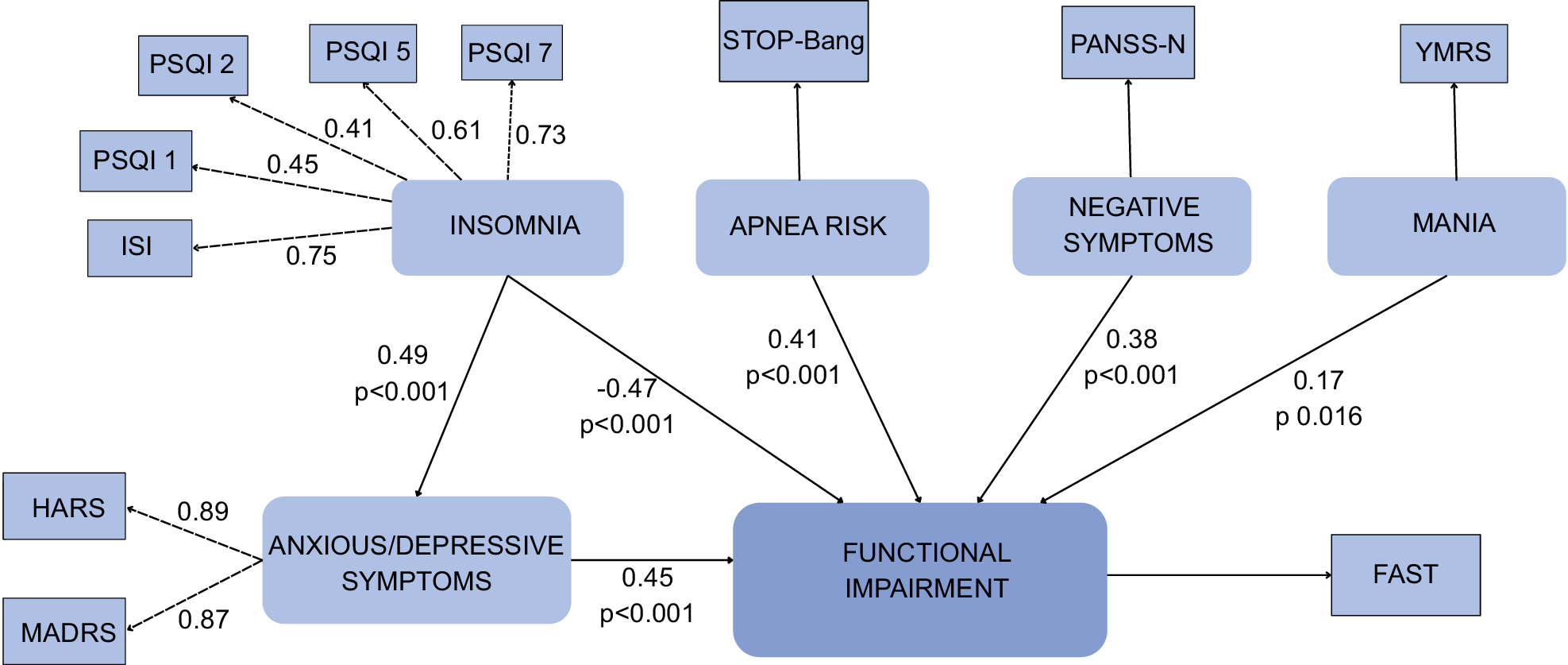
The SEM was specified based on the theoretical and clinical relevance of sleep disturbances and psychopathology domains for functional outcomes, supported by the associations observed in the bivariate analyses. Confirmatory factor analysis indicated that all observed indicators loaded significantly onto their respective latent constructs for insomnia and anxiety/depression (standardized loadings over 0.40, all p < 0.001). PSQI components 1 (subjective sleep quality), 2 (sleep latency), 5 (sleep disturbances), and 7 (daytime dysfunction) demonstrated coherent and significant factor loadings, supporting their inclusion in the insomnia latent construct. The anxiety/depression latent construct was defined using HARS and MADRS total scores excluding the sleep-related items. The rest of the variables were modeled as observed indicators, as their corresponding scales were considered psychometrically unidimensional (FAST for functional impairment, STOP-Bang for OSA risk, PANSS-N for negative symptoms, and YMRS for mania symptoms).
Alternative theoretically plausible specifications (including age, EDS, multigroup models by diagnosis, and OSA risk as mediator) were explored but did not improve model fit or interpretability.
The final model showed acceptable fit to the data (χ 2(36) = 76.49, p < 0.001; CFI = 0.92; TLI = 0.88; RMSEA = 0.07 [90% CI: 0.048–0.092]; SRMR = 0.073) and explained 46.8% of the variance in functional impairment (R 2 = 0.468).
Greater severity of depressive/anxious symptoms (β = 0.45, p < 0.001), negative symptoms (β = 0.38, p < 0.001), OSA risk (β = 0.41, p < 0.001), and manic symptoms (β = 0.17, p = 0.016) were independently associated with poorer functional outcomes. Insomnia exhibited a significant direct negative effect on functional impairment (β = −0.47, p < 0.001), indicating better functioning with higher insomnia scores when controlling for other variables. However, insomnia also had a significant indirect positive effect on functional impairment through depressive/anxious symptoms (β = 0.22, p < 0.001), resulting in a smaller negative total effect (β = −0.24, p = 0.017). These findings suggest an inconsistent partial mediation where insomnia is associated with functional impairment via depressive/anxious symptoms but shows an opposite direct association with functional impairment.
Table 3 presents standardized direct and indirect effects, and the final SEM is illustrated in Figure 1.
Standardized estimates from the final structural equation model predicting functional impairment

Table 3. Long description
The table contains four columns: Predictor, Standardized beta, S E, and p.
Top section results:
* Insomnia: beta -0.466, S E 0.166, p less than 0.001.
* Anxiety/Depression: beta 0.454, S E 0.112, p less than 0.001.
* Negative symptoms: beta 0.381, S E 0.135, p less than 0.001.
* Apnea risk: beta 0.409, S E 0.156, p less than 0.001.
* Mania: beta 0.174, S E 0.099, p 0.016.
Bottom section (Mediation effect: Insomnia to Anxiety/Depression to Functional impairment):
* Indirect effect: beta 0.224, S E 0.086, p less than 0.001.
* Total effect: beta -0.242, S E 0.138, p 0.017.
Note: β, standardized regression coefficient; SE, standard error.
Structural equation model of sleep disturbances, psychopathology domains, and functional impairment in severe mental illness. Note: FAST, ‘Functional Assessment Short Test’; HARS, ‘Hamilton Anxiety Rating Scale’; ISI, ‘Insomnia Severity Index’; MADRS, ‘Montgomery Åsberg Depression Rating Scale’; PANSS-N, ‘Positive and Negative Syndrome Scale, Negative Symptoms’; PSQI 1, ‘Pittsburgh Sleep Quality Index, Component 1’; PSQI 2, ‘Pittsburgh Sleep Quality Index, Component 2’; PSQI 5, ’Pittsburgh Sleep Quality Index, Component 5’; PSQI 7, ‘Pittsburgh Sleep Quality Index, Component 7’; YMRS, ‘Young Mania Rating Scale’.

Figure 1. Long description
The diagram consists of blue rectangular nodes connected by solid and dashed arrows with numerical path coefficients and p-values.
At the top level, four latent variables are shown as rounded rectangles:
1. INSOMNIA: Connected by dashed arrows to four indicators: P S Q I 1 (0.45), P S Q I 2 (0.41), P S Q I 5 (0.61), P S Q I 7 (0.73), and I S I (0.75).
2. APNEA RISK: Connected by a solid arrow to STOP-Bang.
3. NEGATIVE SYMPTOMS: Connected by a solid arrow to P A N S S minus N.
4. MANIA: Connected by a solid arrow to Y M R S.
In the middle-left, a fifth latent variable, ANXIOUS or DEPRESSIVE SYMPTOMS, is connected by dashed arrows to H A R S (0.89) and M A D R S (0.87).
At the bottom center is the primary outcome node, FUNCTIONAL IMPAIRMENT, which points to F A S T.
Pathways to FUNCTIONAL IMPAIRMENT include:
* From INSOMNIA: -0.47 (p < 0.001).
* From APNEA RISK: 0.41 (p < 0.001).
* From NEGATIVE SYMPTOMS: 0.38 (p < 0.001).
* From MANIA: 0.17 (p = 0.016).
* From ANXIOUS or DEPRESSIVE SYMPTOMS: 0.45 (p < 0.001).
Additionally, a solid arrow connects INSOMNIA to ANXIOUS or DEPRESSIVE SYMPTOMS with a coefficient of 0.49 (p < 0.001).
Additional regression analyses adjusted for diagnosis
Linear regression analyses were conducted as sensitivity analyses to further interpret the direction of associations observed in the SEM model and bivariate analyses between EDS, insomnia severity, and functional impairment.
EDS was associated with better functional outcomes in unadjusted analyses (p = 0.026). However, this association was no longer significant after adjusting for diagnosis, age, sex, and educational level (p = 0.074), indicating that the inverse association was explained by differences in demographic and diagnostic characteristics.
In contrast, insomnia severity remained significantly associated with functional outcomes after adjustment for diagnosis, age, sex, and educational level (p < 0.001), suggesting that this association was independent of these demographic and diagnostic characteristics.
Detailed results on additional regression analyses are presented in Supplementary Table S3.
Discussion
This study provides an extensive examination of sleep disturbances, as perceived by the patients, and their relationship with psychiatric symptoms and functional impairment in a large sample of individuals with SMI. Overall, 69% of participants screened positive on at least one sleep measure, with poor sleep quality being the most common finding (55.6%). Among the specific sleep-related problems assessed, high risk of OSA (45.8%), positive screening for RLS (21.4%), EDS (19.3%), insomnia (19.9%), and positive screening for RBD (13.5%) were all highly prevalent. It should be noted that positive screening for RLS and RBD may reflect lifetime occurrence of suggestive symptoms and does not necessarily indicate current clinical presentation. Participants with sleep disturbances exhibited higher depressive, anxious, and negative symptoms, as well as poorer functional outcomes. Among these sleep disturbances, insomnia and high risk of OSA emerged as the sleep variables most strongly associated with functional impairment, with effect sizes comparable to core psychiatric symptoms, including depressive/anxious, negative, and manic symptoms.
In both correlational and group-based analyses, greater insomnia severity was associated with worse functioning. Although insomnia showed a negative direct coefficient in the final SEM, this finding should be interpreted with caution. Despite excluding the sleep-related items from the anxiety/depression measures used in the SEM, insomnia and affective symptoms remain closely intertwined. Accordingly, the opposite signs of the direct and indirect effects suggest an inconsistent mediation or suppression pattern rather than a genuinely protective effect of insomnia on functioning. Therefore, the results do not support a simple interpretation whereby insomnia would improve functioning; instead, they point to a more complex relationship, partly explained by affective symptoms. This is broadly consistent with previous studies showing that insomnia is associated with poorer functional outcomes in SMI, although this relationship appears to be substantially mediated by depressive and anxious symptomatology (Laskemoen et al., Reference Laskemoen, Simonsen, Büchmann, Barrett, Bjella, Lagerberg, Vedal, Andreassen, Melle and Aas2019; Samalin et al., Reference Samalin, Boyer, Murru, Pacchiarotti, Reinares, Bonnin, Torrent, Verdolini, Pancheri, de Chazeron, Boucekine, Geoffroy, Bellivier, Llorca, Viet and de Chazeron2017; Stafford et al., Reference Stafford, Oduola and Reeve2024). Given that insomnia is a core feature of affective distress, its association with functional outcomes is clinically plausible. This interpretation also aligns with previous evidence indicating that depressive symptoms and cognitive dysfunction, both of which may worsen in the presence of sleep disturbances (Medic, Wille, & Hemels, Reference Medic, Wille and Hemels2017), are among the main predictors of functioning in SMI populations (Gitlin & Miklowitz, Reference Gitlin and Miklowitz2017; Joseph et al., Reference Joseph, Kremen, Franz, Glatt, van de Leemput, Chandler, Tsuang and Twamley2017).
High risk of OSA was associated with disability of a magnitude comparable to negative symptoms, a well-established predictor of functional outcomes in SCZ spectrum disorders (Kalisova et al., Reference Kalisova, Michalec, Dechterenko, Silhan, Hyza, Chlebovcova, Brenova and Bezdicek2023; Okada, Hirano, & Taniguchi, Reference Okada, Hirano and Taniguchi2021). Growing evidence indicates that people with SMI are at an increased risk of OSA (Annamalai et al., Reference Annamalai, Palmese, Chwastiak, Srihari and Tek2015; Kelly et al., Reference Kelly, Douglas, Denmark, Brasuell and Lieberman2013; Okada et al., Reference Okada, Miyata, Iwamoto, Fujishiro, Noda and Ozaki2022; Stubbs et al., Reference Stubbs, Vancampfort, Veronese, Solmi, Gaughran, Manu, Rosenbaum, de Hert and Fornaro2016), explained by a higher rate of metabolic syndrome, obesity, cardiovascular disease, and psychotropic sedative effects (Goldfarb et al., Reference Goldfarb, De Hert, Detraux, Di Palo, Munir, Music, Piña and Ringen2022; Liu et al., Reference Liu, Myles, Foley, Watts, Morgan, Castle, Waterreus, Mackinnon and Galletly2016; Reeve, Robbins, & Hodgekins, Reference Reeve, Robbins and Hodgekins2025). Despite this, sleep-related breathing disorders remain underdiagnosed and undertreated in psychiatric populations (Gupta & Simpson, Reference Gupta and Simpson2015; Nikolakaros et al., Reference Nikolakaros, Virtanen, Markkula, Vahlberg and Saaresranta2015), possibly due to limited clinician awareness, stigma, barriers in health access, and failure to adequately investigate physical health issues in this population (Faulkner, Firth, Shiers, & Kalucy, Reference Faulkner, Firth, Shiers and Kalucy2025). In the final SEM, OSA risk remained independently associated with poorer functioning even after accounting for psychiatric symptom dimensions, supporting the view that sleep-disordered breathing is not merely a correlate of general illness burden, but a potentially modifiable contributor to disability.
Overall, the final SEM showed that worse functioning was independently associated with higher anxiety/depression, more severe negative symptoms, greater OSA risk, and manic symptoms. Among these, affective symptoms, negative symptoms, and OSA risk showed the strongest standardized effects. Taken together, these findings suggest that functional outcomes in SMI are not explained by a single psychopathological domain, but rather by the combined contribution of psychiatric and sleep-related factors.
The implications of our findings are clinically relevant. When OSA is adequately treated, patients with SCZ improve their cognitive performance, as well as depressive and negative symptoms (Aftab et al., Reference Aftab, Anthony, Rahmat, Sangle and Khan2021; Myles et al., Reference Myles, Myles, Coetzer, Adams, Chandratilleke, Liu, Mercer, Vakulin, Vincent, Wittert and Galletly2019; Sugishita, Yamasue, & Kasai, Reference Sugishita, Yamasue and Kasai2010). Taken together, these findings support systematic screening and adequate treatment of sleep-related breathing disorders as a modifiable target for improving functional outcomes in SMI.
After controlling for diagnostic category and demographic variables, EDS was no longer associated with better functional outcomes. BD diagnosis emerged as a strong independent predictor of both better functioning and EDS, accounting for this counterintuitive finding. EDS is common in BD and SCZ (Hawley et al., Reference Hawley, Gale, Sivakumaran, Paul, Kondan, Farag and Shahzad2010; Kaplan & Harvey, Reference Kaplan and Harvey2009) and arises from multiple determinants, including affective symptoms, sleep-related breathing disorders, circadian misalignment, and psychotropic medication effects (Barateau, Lopez, Franchi, & Dauvilliers, Reference Barateau, Lopez, Franchi and Dauvilliers2017; Laskemoen et al., Reference Laskemoen, Simonsen, Büchmann, Barrett, Bjella, Lagerberg, Vedal, Andreassen, Melle and Aas2019). However, BD is characterized by marked circadian rhythm instability and a tendency toward an evening chronotype, which could explain their greater propensity to EDS (Tonon et al., Reference Tonon, Nexha, Mendonça da Silva, Gomes, Hidalgo and Frey2024; Zou et al., Reference Zou, Zhou, Yan, Yao and Lu2022). Conversely, patients with SCZ often exhibit decreased interoceptive awareness (Yao & Thakkar, Reference Yao and Thakkar2022), which may contribute to underreporting of subjective sleepiness despite clinically significant EDS. In addition, negative symptoms such as anergia, amotivation and social withdrawal may limit engagement in everyday situations embedded in ESS scoring (public place activities, traveling, driving), thereby artificially lowering ESS scores (Gronewold et al., Reference Gronewold, Lenuck, Gülderen, Scharf, Penzel, Johns, Frohnhofen and Hermann2021; Gurkan, Sarac, Memis, & Ozbaki, Reference Gurkan, Sarac, Memis and Ozbaki2024). Overall, circadian, clinical, and measurement-related factors likely explain the association between EDS and BD in our sample.
Together, these findings support the perspective that sleep disturbances are clinically relevant factors in relation to functional outcomes in individuals with psychiatric illnesses. There is an urgent need for systematic sleep screening in individuals with SMI given the importance of sleep disturbances in functional, psychiatric, and physical health outcomes in this population (Kallestad et al., Reference Kallestad, Hansen, Langsrud, Ruud, Morken, Stiles and Gråwe2012; Li, Zhong, & Meng, Reference Li, Zhong and Meng2025; Shah et al., Reference Shah, Pant, Bommasamudram, Nayak, Roberts, Gallagher, Vaishali, Edwards, Tod, Davis and Pullinger2025). Failure to identify and treat sleep disorders, such as OSA or insomnia, may result in symptom misattribution with unnecessary psychotropic prescription, and can lead to serious medical health issues (Lévy et al., Reference Lévy, Kohler, McNicholas, Barbé, McEvoy, Somers, Lavie and Pépin2015; Medic et al., Reference Medic, Wille and Hemels2017). Given the elevated cardiovascular morbidity and mortality in SMI, addressing sleep disturbances represents a clinically modifiable factor within psychiatric care (De Hert et al., Reference De Hert, Correll, Bobes, Cetkovich-Bakmas, Cohen, Asai, Detraux, Gautam, Möller, Ndetei, Newcomer, Uwakwe and Leucht2011; Minhas et al., Reference Minhas, Patel, Malik, Hana, Hassan and Khouzam2022).
This study has several limitations. First, its cross-sectional design precludes causal inference between sleep disturbances, symptomatic domains, and functional outcomes (Vieta & De Prisco, Reference Vieta and De Prisco2024). Second, sleep disturbances were assessed using screening questionnaires rather than objective sleep measures, which may limit the accuracy of prevalence estimates. Third, the sample size constrained the complexity of the SEM and may impact the stability of the estimates (De Prisco & Vieta, Reference De Prisco and Vieta2024). Medication effects on functioning could not be fully disentangled, and cognitive performance, an important determinant of functional outcomes, was not assessed. Finally, the diagnostic heterogeneity of the sample should be considered, as both BD and SCZ spectrum disorders were included. This heterogeneity may have introduced additional variability in the observed associations and may limit the specificity of the model to each diagnostic group. Future studies using larger samples, longitudinal designs, and objective sleep measures should examine diagnostic-specific models to better clarify causal mechanisms and the relationship between sleep disturbances, psychiatric symptoms, and functional outcomes in SMI.
Conclusions
Sleep disturbances are highly prevalent in individuals with severe mental illness and are clinically relevant in relation to functional outcomes, beyond their association with core psychiatric symptoms. Insomnia and high risk of obstructive sleep apnea emerged as the sleep-related variables most strongly associated with functional impairment. Notably, insomnia showed both direct and indirect effects on functioning, mediated through depressive and anxious symptoms. These findings underscore the importance of systematically assessing sleep disturbances in psychiatric care, given their high prevalence, substantial clinical impact, and potential modifiability. Addressing sleep disturbances may represent a promising therapeutic target to improve not only functional outcomes but also psychiatric and physical health in this population, although longitudinal and interventional studies are needed to confirm these relationships.
Supplementary material
The supplementary material for this article can be found at http://doi.org/10.1017/S0033291726106023.
Acknowledgments
AM thanks the support of the Spanish Ministry of Science and Innovation (PI22/00840) integrated into the Plan Nacional de I + D + I and co-financed by the ISCIII-Subdirección General de Evaluación and the Fondo Europeo de Desarrollo Regional (FEDER), and from La Marató-TV3 Foundation grant 202230-31.
MDP is supported by the Translational Research Programme for Brain Disorders, IDIBAPS.
VO is supported by a Rio Hortega 2024 grant (CM24/00143) from the Spanish Ministry of Science, Innovation, and Universities financed by the Instituto de Salud Carlos III (ISCIII) and co-financed by the Fondo Social Europeo Plus (FSE+).
Funding statement
This research received no specific grant from any funding agency, commercial, or not-for-profit sectors.
Competing interests
AM has received grants or served as a consultant, advisor, or CME speaker for the following entities: Abbotto, Angelini, Idorsia, and Lundbeck, outside the submitted work.
EV has received grants and served as consultant, advisor or CME speaker for the following entities: AB-Biotics, Abbott, AbbVie, Adamed, Alcediag, Angelini, Biogen, Beckley-Psytech, Biohaven, Boehringer-Ingelheim, Casen-Recordati, Celon Pharma, Compass, Dainippon Sumitomo Pharma, Eli-Lilly, Esteve, Ethypharm, Ferrer, Gedeon Richter, GH Research, Glaxo-Smith Kline, HMNC, Idorsia, Johnson & Johnson, Lundbeck, Luye Pharma, Medincell, Merck, Mitsubishi Tanabe Pharma, Newron, Novartis, Organon, Orion Corporation, Otsuka, Roche, Rovi, Sage, Sanofi-Aventis, Sunovion, Takeda, Teva, and Viatris, outside the submitted work.
GF has received grants and served as a consultant, advisor, or CME speaker for the following entities: Angelini, Boehringer-Ingelheim, Esteve, Johnson & Johnson, Lundbeck, Rovi, and Viatris, outside the submitted work.
VO has received CME-related honoraria from Viatris, outside the submitted work.
The remaining authors declare none.
Ethical standards
The authors assert that all procedures contributing to this work comply with the ethical standards of the relevant national and institutional committees on human experimentation and with the Helsinki Declaration of 1975, as revised in 2008. The study protocol was approved by the Ethics Committee of Hospital Clínic de Barcelona (HCB/2023/0131), and all participants provided written informed consent before inclusion.




 Open access

