INTRODUCTION
Plasma-chemical processing of organic material from archaeological artifacts for 14C dating has been used for over 30 years (e.g., Russ et al. Reference Russ, Hyman, Shafer and Rowe1990; Steelman and Rowe Reference Steelman and Rowe2002, Reference Steelman and Rowe2012; Rowe Reference Rowe2009), and a low energy plasma 14C sampling system recently has been built at the Office of Archaeological Studies (OAS) in Santa Fe, NM (Rowe et al. Reference Rowe, Blinman, Martin, Cox, MacKenzie and Wacker2017). In the plasma oxidation method used at OAS, one step is the use of Ar-plasmas to desorb potentially contaminating modern CO2 from chamber and sample surfaces after insertion of a sample into the chamber. Usually there is no significant re-dox reaction in the Ar-plasma, and in routine practice the effectiveness of Ar-plasmas at eliminating adsorbed atmospheric CO2 is confirmed via observing decreasing CO2 pressure measurements during decontamination steps.
This study investigates rare instances of unexpectedly large pressure increases and persistent CO2 release that continued through many Ar plasmas. Such samples have included turkey feathers, porous wood, bones, etc., some after periods of preheating to 140°C and all after system pressure had been reduced to <1.33 × 10⁻⁴ Pa in advance of plasma treatments. Clearly, something outside of the assumed model of Ar-plasma cleaning was occurring.
Complications associated with Ar plasma applications were previously observed during refinements of the plasma oxidation technique. Steelman and Rowe (Reference Steelman and Rowe2002) noted problems of moisture or volatile organics in studies that included a modern t-shirt label. Argon plasma cleaning of the label resulted in cm-sized dark deposits on the chamber walls, indicating the condensation of volatile organic compounds and sputtering of organics by the plasma. Steelman’s (Reference Steelman2004) dissertation concluded: “From this feasibility study, we learned that argon plasmas may not be ideal for organic materials. Afterwards, perishable artifacts were only exposed to oxygen plasmas … with the expectation that the products from the first sequential oxygen plasma may have some modern contamination from adsorbed CO2” (p. 26–27). Discard of the first oxidation plasma products without dating is an alternative to the Ar plasma cleaning step (Steelman, personal communication 2020; this work).
EXPERIMENTAL PROCEDURE
An advantage of plasma oxidation in radiocarbon sampling is that at low energies potential carbonate contamination does not need to be removed. Potential contaminants with plasma samples include humic acid contamination of archaeological items buried in soil, surface organic contaminants, and absorbed or adsorbed atmospheric CO2. Although application of strong base washes is traditional in standard humic acid pretreatments, rinsing in a pH 8 phosphate buffer solution is a minimally destructive approach for removal of humic acids from samples prior to plasma oxidation (Ellis Reference Ellis2008; Armitage et al. Reference Armitage, Ellis and Merrell2012). Rinses are carried out at room temperature, with or without ultrasonication, and are repeated as many times as necessary to leave a colorless and transparent supernatant liquid. pH 8 phosphate buffer pretreatment requires only that material be robust enough to soak in an aqueous solution without significant deterioration, compared with the harsh acid-base-acid treatment used in traditional 14C dating. Once pH 8 buffer applications are finished, distilled water washes can remove buffer phosphate salts, although these would not affect 14C dates. To remove moisture after pretreatment, we generally dry samples in an oven at 40°C for several days if specimens are particularly sensitive and a “non-destructive” approach has been requested. If specimens are robust or if “non-destructive” handling is not a consideration, specimens are dried in an oven at 140°C. All samples experience further drying by being subjected to high vacuum (∼10–4 Pa) for at least 12 hr, and often days, prior to initial plasma exposure, routinely coupled with heat lamp application.
PLASMA DEVICE AND STANDARD OPERATION
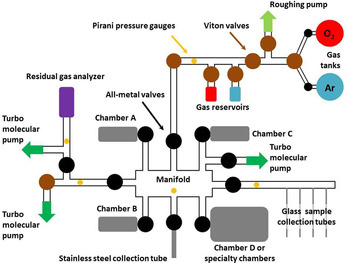
The OAS plasma unit (Rowe et al. Reference Rowe, Blinman, Martin, Cox, MacKenzie and Wacker2017) is a high vacuum system (Figure 1), maintaining pressures of ∼10−4 Pa with two turbo molecular pumps and their roughing pumps. A third turbo molecular pump serves as a residual gas analyzer and can augment the main system pumps. An independent roughing pump is used to initiate low vacuum pressures in the core of the system. Five Pirani gauges monitor pressures in the different portions of the system. Reservoirs of research purity Ar (99.999%) and O2 (99.999%) gases are filled from the source tanks and facilitate efficient chamber loading. The manifold can be isolated or is used when needed to augment O2 gas availability in individual chambers during oxidation. O2-plasma cleaning of empty chambers or Ar-plasma decontamination can be carried out simultaneously in all chambers for higher sample throughput, but radiocarbon sample oxidation is carried out for each chamber individually.
Schematic diagram of the low energy plasma radiocarbon sampling device at the Office of Archaeological Studies, Center for New Mexico Archaeology, Santa Fe, NM. Chambers A–D are ∼150–200 mL. Larger and smaller chambers are available for attachment at the Chamber D location.

Low pressure (133 Pa) plasmas are initiated using a radio frequency (RF) generator that produces power levels as high as 300 W. Powers up to 200 W are used for simultaneous O2 plasma cleaning of chambers. Argon plasmas are routinely operated at 40 W, while powers of 2–20 W are used for most O2 sampling plasmas. Chamber temperatures are monitored with an infrared thermometer. O2 plasmas up to 275 W are possible, producing chamber temperatures of ∼250°C. Depending on the need to minimize any apparent damage to artifacts, sampling can be carried out at chamber temperatures as low as 30° C. Standard chambers are circa 150–200 mL in volume, but two larger glass chambers can be attached to accommodate larger artifacts.
During plasma operation at 133Pa, a stainless-steel tube attached to the manifold is cooled with liquid nitrogen (LN2; −196°C) to freeze out CO2 and H2O that is evolved. The LN2 trap is passive, i.e., the gas is allowed to diffuse into the trap rather than pumping gases through the trap. The system pressure decreases throughout the period of plasma exposure as oxygen is consumed and CO2 and H2O are sequestered. For the OAS device, when system pressure is 80 percent of starting pressure, it usually indicates enough CO2 has been produced for a date. LN2 is maintained on the stainless-steel trap for an additional 6 min after the plasma is turned off, assuring that virtually all H2O and CO2 are trapped (evidenced by pressure constancy). Other gases, not frozen at –196°C, are then pumped away. CO2 is separated from H2O by allowing the LN2 trap to warm naturally after removal of the LN2. Warming is continued until a plateau forms (about 90 s) in the system pressure as CO2 is released, as water remains frozen. At that point the valve to the stainless-steel trap is closed retaining water, adequately separating H2O from the released CO2.
Four 4 mm outside diameter glass sample collection tubes are attached to the manifold. CO2 released from the stainless-steel trap is recollected for 14C dating within one of the glass tubes using LN2. The collection time for the LN2 within a glass tube is typically ∼30 min. The glass tube is then flame-sealed, broken from the system, and the ampule is shipped to the Zürich-ETH AMS laboratory for radiocarbon dating. The ETH AMS laboratory can directly date CO2 samples of 30–100 µg C, bypassing graphite conversion for the 14C measurement (Ruff et al. Reference Ruff, Wacker, Gäggeler, Suter, Synal and Szidat2007; Fahmi et al. Reference Fahrni, Wacker, Synal and Szidat2013; Wacker et al. Reference Wacker, Fahrni, Hajdas, Synal, Szidat and Zhang2013).
Although the plasma oxidation technique was developed to date organic vehicle/binders in rock paintings, we have generally found no meaningful difference when dating other types of organic artifacts (Chaffee et al. Reference Chaffee, Hyman and Rowe1993; Steelman and Rowe Reference Steelman and Rowe2002, Reference Steelman and Rowe2004; Steelman et al. Reference Steelman, Rowe, Turpin, Guilderson and Nightengale2004; Rowe Reference Rowe2005, Reference Rowe2009; Terry et al. Reference Terry, Steelman, Guilderson, Dering and Rowe2006; Armitage et al. Reference Armitage, Ellis and Merrell2012).
ANOMALOUS OBSERVATIONS DURING CLEANING AND DECONTAMINATION
While the architecture and theory of plasma oxidation sampling are relatively straightforward, steps in the process are complex and can be contingent on the characteristics of the materials being sampled. Before loading chambers with specimens, the empty system is subjected to alternating evacuation to ∼10–4 Pa and O2-plasmas until <0.5 µg C as CO2 is detected. The clean system is brought to atmospheric pressure, chambers are then disconnected, samples are placed into the chambers, and the system components are reconnected. Atmospheric contamination enters the chambers at this time, but care is taken not to add any physical contaminants to the chambers or samples while loading. Radiocarbon dates on 14C standards have demonstrated that negligible physical contamination occurs during OAS loading procedures and that the efficacy of the O2-plasma cleaning of the chambers persists.
Ambient contamination from atmospheric CO2 is removed from the chambers with high vacuum (∼10–4 Pa), but some contamination may remain as adsorbed CO2 on surfaces of the samples and chambers. There is also a theoretical risk of contamination from absorbed CO2 within porous materials.
Any adsorbed CO2 is removed with the introduction of research purity Ar at 133 Pa. Specimens and chambers are subjected to low-energy Ar plasmas, usually ∼50 W distributed across all four chambers simultaneously, reaching temperatures of ∼50°C. Ar (40 AMU) is near CO2 (44 AMU) in molecular weight, so Ar-plasmas effectively scour specimen and chamber surfaces, kinetically dislodging CO2 molecules. LN2 on the stainless-steel trap captures any H2O (usually inconsequential) and CO2. Gases are pumped out above the LN2, the LN2 is removed from the trap, and the CO2 pressure evolved during Ar cleaning is measured. The Ar-plasma cleaning steps are repeated as often as necessary to eliminate any significant remaining contamination.
When <0.5 µg C as CO2 is captured in a 0.5-hr decontamination plasma exposure, the specimen is deemed ready to be processed using plasma oxidation. We often observe CO2 at levels of several µg C during the first few Ar plasmas. It is not clear whether that CO2 is adsorbed gas or whether the CO2 is the result of Ar-plasma sputtering of the artifact organic material. Since Ar is chemically inert, we expect that little carbon is removed from materials other than as adsorbed or absorbed CO2. However, deposits sometimes appear on chamber walls from condensation or sputtering of organic materials by the Ar plasma, and a small minority of samples exhibit anomalously high CO2 pressures through repeated Ar-plasma cleaning steps (the subject of this research).
Conventional 14C laboratories follow several approaches to potential surface contamination by adsorbed CO2. The final step of acid-base-acid pretreatment leaves the sample slightly acidic which reduces the potential adsorption of CO2. Also, conventional samples are generally larger in volume, and when the entire sample is combusted, any surface adsorbed CO2 is considered negligible as a proportion of total carbon. However, since plasma oxidation is a surface preferential technique that oxidizes a minimum of organic carbon for dating purposes, any surface contamination could create a proportionately greater risk in dating. Ar plasma scouring is the approach used at the OAS laboratory, and surface oxidation with the discard of the first sample is another effective approach when a specimen will yield sufficient C for multiple samples (Karen Steelman, personal communication 2020).
OXYGEN-PLASMA CO2 PRODUCTION
When a specimen is ready for sampling, research grade O2 (99.999%) is introduced at 133 Pa into the chamber and manifold. An O2-plasma is initiated in the chamber (as low as 2 W and ∼30°C) and maintained until sufficient µg C in the form of CO2 has been produced (target is ∼90 μg C). Monitoring pressure changes during plasma oxidation allows estimation of the amount of CO2 formed and avoids over or under oxidation of the specimen. Temperature usually rises slowly to maximum after ∼10 min, and the RF power is carefully maintained and manually tuned throughout the run. The time (and RF power) necessary to generate sufficient CO2 for dating varies with composition and surface area of the specimen exposed to the plasma. As little as 2 min is sufficient to collect >100 μg C as CO2 from circa 0.5 cm2 of charcoal surface area, but for carbon-poor surfaces or materials, oxidation may need to run for 1 hr at powers up to 15 W. Sample oxidation is always carried out at plasma energies and temperatures below levels used for system cleaning.
Gases are exposed to the passive LN2 trap during the oxidation phase to capture what has been created in the chamber (essentially CO2 and H2O). Six min after the plasma has been turned off the vacuum is opened until system pressure has been reduced to low 10–3 Pa. The vacuum is closed and LN2 is removed from the trap, releasing CO2 into the closed system. After the CO2 has come off and before H2O starts to come off (as evidenced by a pressure plateau), the valve on the stainless-steel trap is closed, leaving only CO2 in the system. After evaluating system pressure to confirm that sufficient CO2 is present, another LN2 trap is placed on the bottom of a glass collection tube. Pressures are monitored to ensure that only the requisite amount of carbon is captured in the tube, and the ampule is sealed and is ready for separation from the apparatus. Usually at least two CO2 ampules from a single specimen are collected through sequential oxidations. The backup samples are used in case of difficulties with the initial sample, but they are also used to check reproducibility. In special cases up to 65 CO2 samples have been collected from a single specimen. Reliability of the technique is routinely checked by dating 14C standard samples, e.g., TIRI or VIRI wood material.
In 2016, we added a Stanford Research Systems Residual Gas Analyzer 200 (RGA) to the plasma system. Although without calibration the RGA provides only qualitative data, it permits us to analyze gases produced at different stages in specimen processing. For example, we can characterize: (1) initial gases introduced into the chamber; (2) gases that are not collected within an LN2 trap; (3) gases, dominated by CO2, that are released when LN2 is replaced with ethanol- LN2 (–116°C, retaining water); and (4) gases released when the collection trap warms to room temperature (dominated by water). Output characterizations are by molecular weight, and the ionization process of the RGA disassociates a portion of each gas into its constituents (water appears as H, H2, O, and O2 as well as H2O). Some gases cannot be distinguished other than by circumstantial evidence: both CO and N2 have a molecular weight of 28, and both will contribute to that mass peak. If CO2 (mass 44) is present it increases the probability that at least some of mass 28 peak reflects a contribution by CO rather than N2.
ANOMALOUS ARGON DECONTAMINATION OBSERVATIONS
More than 350 oxidation sample collections have been completed by the OAS laboratory through 2020. During Ar decontamination of perhaps 5 percent of the specimens, we have observed pressure increases of up to 3.3 kPa, more than 20 times what would be expected in cases of adsorbed CO2. One of the early and extreme cases was the bunt (described below), which prompted a detailed investigation. We determined that water was being desorbed from the specimens, forming water-plasmas and releasing hydrogen and oxygen species. The oxygen species resulted in the oxidation of organic material on the bunt surface to CO, CO2, and additional water, and the combination of water release and premature oxidation under the Ar plasma was creating the pressure increase and the appearance of continued contamination issues. The persistence of significant absorbed water through standard drying and high vacuum with heating was not anticipated.
Archaeological Wooden Bunt
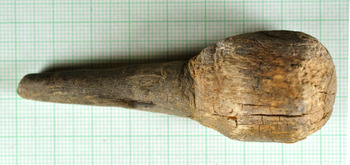
The wooden “bunt” (Figure 2) is from an archaeological site in New Mexico (LA46316). A bunt is analogous to a spear point except that it is used to stun rather than puncture the intended target. Destructive radiocarbon sampling was authorized by the tribal owners of the artifact as part of a larger research project, but this specimen was submitted by the researcher for minimally destructive plasma sampling by the OAS laboratory. This application of plasma sampling is slightly problematic since the bunt almost certainly had been handled many times during excavation and as a museum artifact over decades. Surface contamination from skin oils (at least) is possible. That would result in an age younger than the true age if present in sufficiently high concentration. The sample was rinsed in a pH 8 phosphate buffer solution to remove humic acids (inconsequential), but the effectiveness of the pH 8 rinse to minimize other types of contamination is poorly known.
Photograph of the bunt in which we observed large CO2 pressure rises during Ar-plasmas. Notice the cracks and high porosity permitting the inclusion of considerable water into the interior of the artifact. The smallest graph paper squares are 0.1 cm.

This is a large sample (estimated volume >20 cm3), with an appreciable surface area and porosity. We used Ar plasmas in an attempt to remove any adsorbed CO2 before initiating O2- plasmas to collect CO2 for 14C dating. In normal situations, measured CO2 yield decreases with each subsequent Ar plasma, and fewer than five Ar plasmas are usually needed to reduce surface contaminating CO2 to <0.5 μg carbon. However, after six Ar plasmas, CO2 pressure release was still much higher than expected, 1980 Pa versus the 67 Pa pressure associated with a clean specimen and chamber.
Before the sixth Ar-plasma run was initiated, the gas evolving from the wooden bunt under vacuum conditions (∼10–5 to ∼10–4 Pa) was examined with the RGA. Gas spectra desorbing from the bunt showed water as the dominant peak, with lesser H2 and near background levels for CO2 and CO or nitrogen (N2); the latter two share mass 28.
We then followed the partial pressures of the following gases through a 25-min Ar-plasma run (Figure 3): H2 (mass 2), Ar (mass 40), N2 and CO (both mass 28), CO2 (mass 44), H2O (mass 18), and O2 (mass 32). Atomic carbon, nitrogen and oxygen can also be detected. CO and N2 can be partially differentiated by expected cracking patterns in RGA spectra. E.g., CO would have a 16 peak 10 percent as high as the 28 peak and 12 at 5 percent of the 28 peak, whereas N2 would show a 14 peak about 7 percent of the 28 peak. As expected, when gas during the active Ar-plasma was admitted into the RGA system, the pressure was at first dominated by Ar, because 133 Pa of Ar had been introduced to the system to initiate the plasma. But by ∼2 min after plasma initiation, H2 gas rapidly increased, as did CO (inferred as described above), CO2, and H2O respectively. H2 continued increasing until nominally the same pressure as Ar at ∼8 min into the plasma. The CO peak increased at first, but CO2 production began to overtake CO until they were about the same pressure at ∼12 min, at which time H2 had increased to ∼50X the Ar pressure; H2 began to dominate the total pressure at that time. The RGA showed that production of H2 was largely responsible for the excessive pressure increases we had observed earlier in studies of Ar plasmas that prompted this investigation.
RGA analysis during an Ar-plasma (161010a) of a water-rich wooden bunt showing the change in relative peak heights of the various gases listed.

Apparently, significant water was absorbed and retained by the bunt even after warming for several days at 140°C following the pH 8 phosphate buffer and distilled water rinse pretreatment. The bunt was kept in the vacuum for 15 hr with heat lamps at a temperature ∼90°C, but even after these drying conditions, water was still being released by the bunt. Under RF application, water plasmas formed rapidly, producing excited species of hydrogen and oxygen within 1–2 min. Whether the water was released by temperature rise or by other energetic effects of the RF power, we are uncertain. Oxygen from the water break-up formed an O2 component of the plasma, and excited species reacted with carbon from the wooden artifact, initially forming CO. CO2 is formed by oxidation of CO as the equilibrium shifts. Water increases faster than it dissociates into O2 and H2 and slowly increases throughout plasma operation. Finally, with H2 dominating chamber pressure, the bunt is almost producing as much water as is being pumped out through the RGA. This interpretation agrees with Nguyen et al. (Reference Nguyen, Foster and Gallimore2009) who ran Ar-plasmas and intentionally introduced water vapor to produce H2O-plasmas. They used much higher powers (250 to 1000 W) than we do (typically 2 to 15 W). They found no effect on water-plasma rates run with two different Ar flow rates, 5 and 10 cc/min. H2 plasma species react much less effectively with the organic wooden material than oxygen species do under our conditions so that we only see oxidation effects. Reduction would be expected to produce CH4, 16 amu, the same as atomic oxygen so that it would be difficult to detect on the RGA. With further experimentation, we found that water-plasmas formed even without an Ar-plasma to initiate or maintain them. That is, there was enough H2O so that H2O plasmas were formed spontaneously as RF power was applied.
Water-Plasma
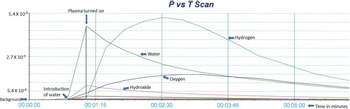
A water-plasma (without Ar or O2 or a specimen) was initiated to see the potential effects on the re-dox system. Liquid water was introduced into the system and then the pressure was reduced until the water was in a gaseous state. Water was sequestered in a metal finger and introduced into the system at 265 Pa inside the system manifold (0.274 L) with an open chamber. The RGA was started and a background reading taken (Figure 4). At ∼45 s the valve for the RGA was opened to introduce the water. Before the RF power was turned on, the RGA recorded water, hydroxide and oxygen as the main gases in the system, resembling the cracking pattern of H2O in the ion source of the RGA. At ∼1 min RF power was initiated in the chamber. Almost instantaneously, there was a partial dissociation of the water into H2 and O2. This pure H2O-plasma was run at 265 Pa with 2 watts RF power, and the RGA trace confirms the principle effects shown in Figure 3: (1) A rapid increase in H2, dominating the spectra; (2) A slower increase in O2, but more rapid than that in Figure 3 where the O2 also formed a plasma, but being consumed as it reacted with the organic matter in the bunt; and (3) A change in H2O pressure as the H2O-plasma forms or reacts depending on the circumstances in the chamber.
RGA trace of a pure H2O plasma at 265 Pa with 2 watts of RF power showing the near instantaneous dissociation of water into hydrogen and oxygen.

Colloidal Extract from the Fifth International Radiocarbon Interlaboratory Standard (VIRI I) Whalebone
We prepared a second, quite different water-rich sample to study. The specimen consisted of dried colloidal solids left over from evaporation of supernatant liquid produced during the treatment of VIRI I whalebone with pH 8 phosphate buffer. This sample is similar to the bunt only in that both contained substantial absorbed water. In order to study the effect of moisture on plasma reactions, we purposefully tested a sample that had not been subjected to high heat. Also, this sample is much smaller and would be expected to release any contaminating adsorbed CO2 quickly. Enough water was present to support a water-plasma and hence oxidizing conditions, and the CO2 collected after the third Ar plasma was dated. We then ran an O2-plasma to collect a second sample for 14C dating for comparison. Conditions on the O2-plasma were milder than for the Ar/water-plasma: <39°C versus ∼52°C, respectively. Results of the dating are discussed below.
Third International Radiocarbon Interlaboratory Comparison Belfast Pine Standard (TIRI Wood)
Prior to this study, we had collected and dated six CO2 samples from TIRI Wood specimens to compare with the consensus date (4503 ± 8 BP for dating based on AMS measurements) of the TIRI wood standard from other radiocarbon laboratories (Scott et al. Reference Scott, Cook, Naysmith and Staff2019). To evaluate whether water-plasmas produce accurate 14C dates, two types of specimens were prepared for this study: (1) a TIRI Wood specimen was soaked in water and deliberately left inadequately dried so that considerable residual water was contained in the specimen, and (2) a dry TIRI Wood specimen that was subjected to a 265 Pa water-plasma. In the second experiment, the water plasma was prepared as described above in the RGA study of water plasma constituents. CO2 samples from the two experimental collections (not O2 plasmas) were submitted for AMS dating.
RADIOCARBON DATING RESULTS
The initial perception of the water plasma complications raised concerns about the effectiveness of normal OAS plasma cleaning and sampling protocols (Ar plasma elimination of adsorbed atmospheric CO2) and the validity of the subsequent 14C dates for water-rich specimens.
Archaeological Wooden Bunt
To understand what was occurring in the Ar-plasmas with the wooden bunt, we dated a CO2 sample from the bunt that had been collected with an Ar-H2O plasma. Two 10 W Ar-plasmas were run first to remove or reduce adsorbed atmospheric CO2. In addition we collected a CO2 sample from a subsequent O2 plasma. Five plasmas were run between the Ar oxidation (OAS#161007a-2) and the O2 oxidation (161012a-1) and those additional plasmas will likely have removed all significant atmospheric CO2 if present. The radiocarbon dates for the two CO2 fractions are shown in Table 1. The first fraction is ∼400 years younger, suggesting inclusion of modern CO2, whether from adsorbed CO2 or improper handling (surface contamination such as with skin oils) we cannot conclusively determine.
Radiocarbon dates on the wooden bunt.

To calculate the extent of possible “contamination” of the Ar-plasma oxidation of the bunt sample, we followed Mook and Waterbolk (Reference Mook and Waterbolk1985:27).
 $$^{{\rm{14}}}{\rm{a}} = {\rm{e}}^{ - {\left( {{\rm{T}}/{\rm{8}}0{\rm{33}}} \right)}}$$
where 14a is the fractional radiocarbon activity of the sample and T is the age of the sample in radiocarbon years BP.
For our example,
 $$^{{\rm{14}}}{{\rm{a}}_{{\rm{sample}}}} = {{\rm{e}}^ - }^{\left( {{\rm{T}}/{\rm{8}}0{\rm{33}}} \right)}{\rm{with}}\,{\rm{T}} = {\rm{2425}}\,{\rm{BP}},{\,^{{\rm{14}}}}{{\rm{a}}_{{\rm{sample}}}} = {{\rm{e}}^{ - \left( {{\rm{2425}}/{\rm{8}}0{\rm{33}}} \right)}} = 0.{\rm{7394}}$$
and,
 $${}^{14} {\rm {a}}_{\textrm{``true age''}} = {\rm e}^{-({\rm T}/8033)} \text{ with T}\, = 2810 \text{ BP }, ^{14} {\rm {a}}_{\textrm{``true age''}} = {\rm e}^{-(2810/8033)} = 0.7048$$
Equation (2) is used to calculate the fractional effect of contamination on the reported radiocarbon age.
 $${\rm X} = ({}^{14} {\rm {a}}_{\textrm{sample}} {}^{-14} {\rm {a}}_{\text{``true age''}} )/ ({}^{14} {\rm {a}}_{\textrm{contamination}} {}^{-14} {\rm {a}}_{\text{``true age''}} )$$
14acontamination is considered to be 1.00%. That allows only a crude assessment as atmospheric CO2 activity can vary depending on the particular environment.
 $${\rm{X}} = \left( {0.{\rm{7394}}-0.{\rm{7}}0{\rm{48}}} \right)/\left( {{\rm{1}}.00-0.{\rm{7}}0{\rm{48}}} \right) = 0.0{\rm{737}} = {\rm{11}}.{\rm{7}}\% $$
Thus, if either the atmospheric contamination or surface contamination by inappropriate handling scenario were correct, the first 14C determination would include ∼12% contamination with modern CO2. That conclusion does not fully agree with the δ13C determinations (–28.7‰). Modern atmosphere CO2 δ13C is ∼–8.5‰, and although adsorbed (or absorbed) modern CO2 may be contributing to the earlier age, it probably does not account for the difference.
We now believe that the bunt was a poor choice for this investigation despite its role in initiating the study. The bunt was derived from a museum collection and had been sporadically handled by researchers over decades. Plasma oxidation is a dominantly surface 14C sampling technique, and it is susceptible to surface contamination of specimens, such as by modern skin oils (Rowe et al. Reference Rowe, Blinman, Martin, Cox, MacKenzie and Wacker2017). In this case, repeated oxidation and dating until a stable age is achieved would probably be would be a more valid approach, with contamination by atmospheric CO2 likely eliminated in the first several Ar-H2O plasma exposures.
VIRI I Whalebone Colloidal Extract
A second set of radiocarbon dates were run on a dried colloidal extract that was dissolved from the whalebone during pH8 phosphate buffer treatment for removal of potential humic acids. This sample was not chosen as representative of the correct date of the whalebone. The dates obtained on our sample were just over 1000 years younger than the consensus age, 8331 ± 6 BP (Scott et al. Reference Scott, Gordon and Naysmith2010). Rather it was selected as we anticipated that it would contain substantial concentrations of water. The colloidal material was separated by rinsing the pH 8 phosphate buffer solution with distilled water and concentrating the material by evaporation within a ceramic boat that had been cleaned by oxygen plasmas. The dates in Table 2 refer to (1) an Ar-water “oxidation” extraction and (2) a straightforward O2-plasma oxidation extraction of the carbon for dating. These two samples gave identical dates within their uncertainties. We conclude that all atmospheric CO2 had been removed by the time of the first Ar-plasma oxidation run on the colloid. That Ar/water-plasma run showed a substantial increase in pressure (>1.25 kPa mostly H2), whereas the O2-plasma oxidation showed no significant pressure rise, indicating that the contribution from a water- plasma had been negligible in the second run. This pair of dates indicates that concurrent values are obtained when the samples contain negligible absorbed CO2. Again, we detected no visible change in the sample after plasmas.
Radiocarbon dates on VIRI I Whalebone colloid.

* Material remaining in the supernatant liquid following pH 8 pretreatment of the whalebone.
TIRI Belfast Pine
Two new 14C samples of the TIRI Belfast Pine standard were submitted for AMS dating to evaluate whether water-plasma produced CO2 agreed with the six previous samples that had been obtained using oxygen-plasmas to produce CO2. Table 3 summarizes the radiocarbon dates we obtained in our laboratory to that point. The 14C analyses were determined directly on the CO2 at the ETH-Zürich laboratory in the Laboratory of Ion Beam Physics.
Radiocarbon dates on two TIRI wood samples subjected to water-plasmas, compared with six previous 14C dates obtained with O2 plasmas in the OAS laboratory.

The average of six previous radiocarbon dates from our laboratory is 4540 ± 25 years BP. One of the samples was partially embedded in powdered alumina and a second example was partially painted with sodium silicate. These extra substances were added as an experiment to investigate whether these substances could be used to mask unwanted features on a specimen. Neither of the added materials appears to have affected the TIRI 14C dates. Both are in agreement with our previous average as well as the consensus date for ages estimated by accelerator mass spectrometric measurements, 4508 ± 3 BP (Scott et al. Reference Scott, Cook, Naysmith and Staff2019).
SUMMARY AND CONCLUSIONS
The OAS laboratory routinely uses Ar cleaning plasmas to assure that any significant amount of adsorbed CO2 from atmospheric contamination has been eliminated prior to O2 oxidation and collection of CO2 samples for 14C dating. Under most circumstances CO2 yield declines to inconsequential levels through up to five progressive Ar plasma runs, demonstrating the effectiveness of the cleaning protocol. However, CO2 yield is maintained or even increases during Ar plasma cleaning of a minority of samples, preventing us from affirming the lack of modern contamination. Water release from the bunt during Ar plasma exposure was suspected as the confounding factor for this and for some other specimens. This water release was despite samples having been dried in either 40°C or 140°C ovens for up to three weeks prior to being placed in the plasma chambers and having been subjected to vacuums of ∼10–4 Pa for at least 12 hr prior to Ar plasma cleaning.
Water release from samples during Ar-plasma cleaning was confirmed by RGA analyses of system gases prior to and during Ar-plasma cleaning. The released H2O forms a combined Ar-H2O plasma, and the O plasma species initiate premature oxidation of the organic carbon portions of the target specimens. The CO2 from premature oxidation cannot be distinguished from contaminating atmospheric CO2.
The potential effects of premature oxidation on 14C dating were investigated by collecting and dating CO2 from an archaeological artifact (wooden bunt), from a colloidal extract from VIRI-I whalebone, and from TIRI Belfast Pine.
Radiocarbon dates on samples treated with an Ar-water plasma and then by an O2-plasma, indicate that it is possible to get accurate dates from CO2 generated by both of these techniques. In both cases, we assume that potentially contaminating adsorbed atmospheric CO2 had been essentially removed from the sample by the first plasma treatments. An occasional benefit of excess water samples may be that small amounts of surficial contamination will be oxidized and removed during the “Ar-cleaning” step resulting in a cleaner sample for the following oxidation and CO2 collection for 14C dating. Our best examples of agreement of the Ar-water and water-plasmas are the two TIRI wood samples and the VIRI I whalebone colloid samples. Agreement between the Ar-water and O2-plasma 14C dates for TIRI wood and VIRI I whalebone colloid samples indicate that that samples were free of significant atmospheric CO2.
The OAS results and Steelman’s observations suggest that we can derive reliable 14C dates on water-rich samples if we ensure the removal of potential adsorbed atmospheric CO2 from the samples by discarding CO2 associated with initial plasma exposures regardless of whether final CO2 samples are produced by H2O or O2 plasma oxidation.
ACKNOWLEDGMENTS
This work was funded in part by a grant from the National Center for Preservation Technology and Training and the Donald E. Pierce Endowment for Archaeology and Conservation. We thank Professor Russell Palma, Minnesota State University, Mankato, for the donation of the residual gas analyzer, and Professor Robert Pepin, Morse-Alumni Professor of Physics, Emeritus, University of Minnesota, Minneapolis, for his donation of a substantial amount of vacuum equipment to our laboratory. We are also grateful to Prof. Palma and Shelby Jones for commenting on this paper; their suggestions have improved it. Comments from Karen Steelman and an anonymous reviewer on an earlier version of this paper were very useful and also improved its substance and presentation.