INTRODUCTION
Elizabeth (Liz) Brumfiel's career as an anthropologist and archaeologist both signified and stimulated important developments in Aztec studies. The articles that comprise this Special Section of Ancient Mesoamerica grew out of a symposium held in 2009 at the Society for American Archaeology Annual Meeting in Atlanta to honor Liz and bring together senior colleagues along with then current and former graduate students. In addition to the authors of this Special Section, other contributors to the SAA session included Susan T. Evans, John Millhauser, Jeffrey R. Parsons, and Rita Wright. Here I will overview some of Liz's many contributions with a focus on her research in Aztec studies and the people, places, and intellectual currents that helped shape them. In addition to her published works, I also interviewed Liz before her death, along with colleagues, friends, and family members.
Why Anthropology?
Elizabeth Margarethe Stern, born March 10, 1945 to George and Rosella Taitch Stern, grew up in Chicago during the post-World War II years. The G.I. Bill had made higher education accessible to working and middle class students, mostly men who helped fuel the growth of social sciences, including anthropology. Margaret Mead became the public face of anthropology, even though Hollywood and television promoted domestic roles for women in idealized white middle-class families (Patterson Reference Patterson1995:100). Popular culture stereotyped archaeologists as either “obsessed” older professors or handsome young adventurers in search of lost civilizations and treasure. But, social changes were afoot. Although Liz Stern's childhood playmate, Harrison Ford, grew up to become an actor and play the part of a dashing Hollywood archaeologist, “Indiana Jones,” she became the groundbreaking professional archaeologist and professor.
A book by W. Ben Hunt, The Golden Book of Indian Crafts and Lore (Reference Hunt1954), prompted Liz's early childhood interest in indigenous people. A fifth grade visit to an exhibit about North American Indians at the Chicago Museum of Science and Technology further encouraged her desire to learn more about Native Americans. Liz's mother told her that if she were interested in Indians, she should become an anthropologist for her career and also get paid. Had her mother foreseen the decline in academic employment in anthropology during the 1970s, she might have suggested another career. The placement of exhibitions about American Indians in natural history and science museums, such as the one the Stern family visited in Chicago, the stereotypes they encouraged, and archaeology's limited engagement with descendent communities in many parts of the U.S. became the focus of pointed critiques. These critiques of archaeological practice encouraged Liz's commitment to community archaeology (e.g., Thomas Reference Thomas2000; see Overholzter Reference Overholtzer2016).
Liz's interests in social inequality also took root in childhood as the horrors of the Nazi holocaust were documented. Born into an ethnically Jewish family, by age four Liz was asking herself, “What would she do if they came to snatch me? Why do some groups of people have such power over others?” We can see how Liz wove these early concerns into her later scholarship and political commitments.
Liz Goes to Ann Arbor
Liz began her formal study of anthropology in the early 1960s as an undergraduate at the University of Michigan. She was torn between archaeology and ethnography. The intrusiveness of participant observation as it was practiced before the development of more collaborative approaches made her uneasy so she turned to archaeology. Almost a stereotype of processual archaeology, in 1966 the Michigan Archaeologist published Liz's first article, “Using the IBM 7090 in the Classification of Ground Stone Tools” (Brumfiel Reference Brumfiel1966). Computers had made possible the analysis of large archaeological data sets and the application of quantitative methods that have since become routine. Once she discovered that ground stone “tools were not made so that they would conform exactly to a specific type,” Liz left their study to others, but she continued to employ statistical methods and probabilistic sampling strategies as seen in her recent analysis of pottery and spindle whorl motifs (Brumfiel Reference Brumfiel1966:230, Reference Brumfiel, Johansen and Bauer2011a). In this work she analyzed design motifs to measure conformity within and between households to see how their internal dynamics influenced politics, and to challenge the view that only elites shaped ideologies, a theme echoed by her Northwestern colleague, Cynthia Robin (Reference Robin2016). The contrast between her first article and its application of statistics and Liz's more recent work encapsulates how social archaeology has developed since the 1970s (Patterson Reference Patterson, Meskell and Preucel2004:67–68).
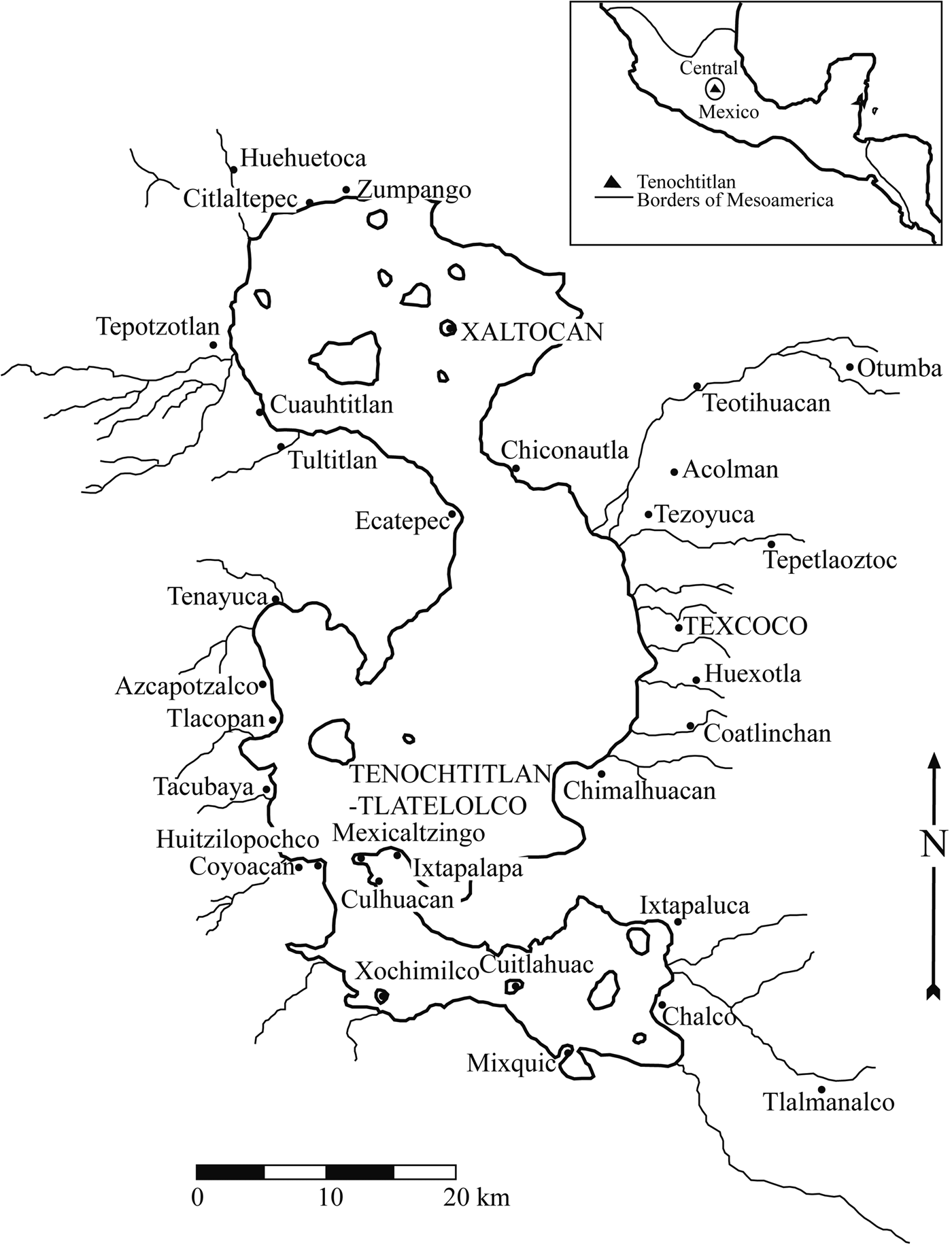
Late Postclassic city-state capitals in the Basin of Mexico. Redrafted by Kristin Sullivan.

Undergraduate life in Ann Arbor was not all anthropology. While living at the Society of Friends Cooperative house, Liz met Vincent (Vince) Brumfiel. Liz was the meal planner for the House and Vince held the role of steward. In other words, Liz wrote up a grocery list and Vince did the shopping —a division of labor that they continued during their many years together (Elizabeth Brumfiel, personal communication 2009). Liz and Vince enjoyed a long friendship, but after graduation Liz joined the Peace Corps and headed to Bolivia. Six months later Vince also went to Bolivia where he proposed marriage to Liz. She left the Peace Corps to become Liz Brumfiel and then studied for a Masters degree in anthropology at UCLA. Despite numerous ground stone artifacts in the UCLA collections, she crossed subfields to write her thesis, “Supraorbital Prominence: A Test of Two Hypotheses,” a reflection of her broad engagement with anthropology and commitment to empirically grounded research (Brumfiel Reference Brumfiel1969).
Vince encouraged Liz to pursue her Ph.D. in anthropology; Liz was not sure how successful she would be as a woman making a career in archaeology, but knowing she had Vince's support (and income to fall back on) she returned to the University of Michigan for her doctorate. Her Peace Corps experience piqued Liz's interest in the Andes and so she chose to work with Jeffrey Parsons who then was doing fieldwork in Peru. Parsons recalls that “right away I sensed she was an original, with many innovative ideas, and not afraid to take intellectual chances” (Parsons and Nichols Reference Parsons and Nichols2012). He especially remembers the informal seminars on the Aztecs with Liz, Charles Gibson, Mary Hodge, Mary Parsons, Judy Nowak, and others in his office (Parsons and Nichols Reference Parsons and Nichols2012). Although Parsons resumed survey in 1972 in the Basin of Mexico (Nichols Reference Nichols and Brereton2006: 117–121), Liz received her first introduction to archaeological fieldwork in Mexico from a former student of Parsons, Richard Blanton (Reference Blanton1978) who was surveying and mapping Monte Albán in Oaxaca. After this first taste of Mexico, the people, the weather, the food, and the archaeology, she never looked back.
Parsons introduced Liz to Aztec archaeology in 1972 when she joined his settlement survey of the southern Basin of Mexico (Brumfiel Reference Brumfiel1982; Parsons et al. Reference Parsons, Brumfiel, Parsons and Wilson1982). To prepare for the survey, Liz took up jogging in Ann Arbor so she could keep up with Parsons' long strides. Liz was an early member of a cohort of women archaeologists conducting research in Central Mexico and pursuing doctoral degrees in the 1970s and early 1980s. Following the survey, Parsons began to think about follow up projects starting with Formative sites. Liz, however, suggested that because of the rich documentary sources, it made more sense to start with Aztec sites. In 1973 Liz began her dissertation fieldwork at the important Middle Postclassic (ca. a.d. 1150–1350/1400) city-state capital of Huexotla in the eastern Basin of Mexico that during the Late Postclassic (a.d. 1350–1521) was eclipsed politically and economically by Texcoco. That summer Parsons dropped off Liz and her sole crewmember—Vince Brumfiel— in Texcoco. She had to figure out first, how to get a bus to Huexotla and, second, how to implement a program of intensive survey and collections of a large Aztec site.
After walking over the site for a week, Liz and Vince took a bus to Oaxaca to consult with Henry Wright who was visiting there. Liz decided on a probabilistic sampling strategy that became a model for subsequent work at other Aztec sites. The goal of her project was to test the economic symbiotic model of Aztec urbanism that saw each city-state integrated through the market of its capital town or city where craft specialists concentrated as they did in the imperial city of Tenochtitlan. This model envisioned Aztec city-state capitals as smaller versions of Tenochtitlan. Each market in city-state capitals was tied into a chain of urban markets that created the Central Mexican Symbiotic Region (Sanders Reference Sanders1965:67). William Sanders began the Basin of Mexico settlement pattern project in the Teotihuacan Valley where one his students, William Mather, had discovered abundant evidence of craft manufacturing at the Aztec city-state capital of Otumba and this seemingly lent support to the symbiotic model, although Otumba's urban configuration was much more dispersed than Tenochtitlan (Sanders and Evans Reference Sanders, Evans, Sanders and Evans2001:997–999; cf. Charlton et al. Reference Charlton, Nichols and Charlton1991; Nichols Reference Nichols, Hodge and Smith1994, Reference Nichols, Hirth and Pillsbury2013). Liz, however, found no evidence for concentrations of craft specialists in the areas of Huexotla she surveyed. This led her to explore how the politics of the imperial expansion of Tenochtitlan and Texcoco restructured the economies of city-states in the core of the Basin of Mexico—published first in an article in Current Anthropology followed by articles in American Anthropologist (Brumfiel Reference Brumfiel1980, Reference Brumfiel1983, Reference Brumfiel1987a). Subsequent investigations at other Aztec sites by Liz and other archaeologists have provided a broader and less normative view of Aztec urbanism and political economy (Nichols Reference Nichols, Hodge and Smith1994, Reference Nichols, Hendon and Joyce2004:274–278; Nichols and Evans Reference Nichols and Evans2009; Smith Reference Smith2008).
THE ALBION YEARS
After completing her Ph.D., Liz continued teaching courses at Eastern Michigan University until she started a tenure-line position at Albion College in 1977. Positions in undergraduate liberal arts departments were generally seen as research dead-ends. The sharp decline in academic employment for anthropologists in the 1970s, however, meant that archaeologists interested in academic careers had to take advantage of the opportunities came their way. Liz knew she enjoyed teaching and she saw teaching anthropology to mostly white middle-class students at Albion as a social good.
Although Liz had to be something of a closet publisher at Albion, she used the opportunity to teach broadly and to expand her knowledge of anthropology, and new developments in social theory. She also was able to publish at her own pace.
Jeffrey Parsons continued his support of Liz's research. In 1981 she mapped and made systematic surface collections at the Aztec site of Xico in the southern Basin of Mexico while Parsons excavated chinampas (drained fields) in Lakes Chalco-Xochimilco (Brumfiel Reference Brumfiel and Isaac1986). Parsons (personal communication 2009) recalls that it was during the 1981 field season that the Parsons and Brumfiels started to play “killer Parcheesi, where no quarter is asked and no quarter is given.”
Perhaps another advantage of Albion College was that it made juggling career and family more feasible than the situation women often encountered in large research-focused universities at that time. Liz's career from the outset was a partnership with Vince Brumfiel (personal communication 2008)—a contrast to the conventional academic two-person, one-man career trajectory. Vince, a high school mathematics teacher, traveled widely with Liz and listened to dozens of her talks, sometimes the same one several times, and offered her feedback. He also valued Liz's advice, especially her good insights about human relations. When their son Geoff was young, Vince remained in Albion while Liz did summer fieldwork (Elizabeth Brumfiel, personal communication 2009). The upside of this arrangement for Liz was that she missed toilet training; the downside for her was the loneliness of being apart from her family.
With her work at Xico and Huexotla, Liz began to build a comparative database of Aztec centers. Drawing on these data, along with documentary sources, she continued to examine the Aztec political economy in a series of articles published in the 1980s (Brumfiel Reference Brumfiel1980, Reference Brumfiel1983, Reference Brumfiel and Isaac1986, Reference Brumfiel1987a, Reference Brumfiel, Brumfiel and Earle1987b, Reference Brumfiel, Brumfiel and Earle1987c, Reference Brumfiel, Miller, Rowlands and Tilley1989, Reference Brumfiel, Gero and Conkey1991a, Reference Brumfiel and Harvey1991b). Liz approached her Aztec research as historic archaeology and emphasized the complementarity of documentary and archaeological data. Over this period agency increasingly framed her research about imperialism and Aztec provincial relations. Taking this approach, she looked at sumptuary goods not just as status markers, but explored how Aztec elites employed such goods in political negotiations (Brumfiel Reference Brumfiel, Brumfiel and Earle1987b). She interacted with archaeologists engaged with Marxist theory, such as Christine Gailey, Antonio Gilman, Philip Kohl Randall McGuire, and Thomas Patterson. Patterson considers her application of Marxist analysis of class relations as “the most textured of the 1980s and 1990s” (Patterson Reference Patterson, Meskell and Preucel2004:72–74).
Timothy Earle and Liz, who had known each other since graduate school at the University of Michigan, coedited the volume, Specialization, Exchange, and Complex Society (Brumfiel and Earle Reference Brumfiel, Earle, Brumfiel and Earle1987). Their introduction quickly became a widely cited overview that contrasted adaptational and political models. In this work, they emphasized how elites in the past, as in the present, manipulated the economy, not to enhance the resource base of commoners, but to finance governance institutions and expand their power (Brumfiel and Earle Reference Brumfiel, Brumfiel and Earle1987b). William T. Sanders, someone most often associated with adaptational models, regarded Liz's article on Aztec craft specialization in that volume as an exemplar of how to integrate archaeological and documentary data (Brumfiel Reference Brumfiel, Brumfiel and Earle1987c; William Sanders, personal communication 2001).
By the mid-1980s Liz was ready to begin a long-term field project at another Aztec center. However, only a few of these sites remained accessible to archaeologists in the Basin of Mexico. Liz first planned to develop a project at Otumba that, in contrast to Xaltocan, had abundant evidence of specialized manufacturing. However, Thomas Charlton had prior claims to the site. Jeffrey Parsons took Liz and Leah Minc to visit Tepetlaxotoc and Xaltocan. Tepetlaxotoc was badly disturbed so Liz decided to work at Xaltocan, despite the town's reputation for not being receptive to archaeologists. This island site in the northwest Basin of Mexico was an important Otomí center during the Postclassic period and unusual in the northern Basin. In addition to its long occupation, Aztec I pottery, notably sparse at most sites in the northern Basin, is abundant at Xaltocan indicating that its cultural affiliations lay to the south (Brumfiel Reference Brumfiel and Brumfiel2005a).
XALTOCAN
Supported by a grant from the Heinz Charitable Trust, Liz began fieldwork at Xaltocan with a program of intensive surface collection (Brumfiel Reference Brumfiel and Brumfiel2005a:35; Chimonas Reference Chimonas and Brumfiel2005). She obtained the required permits from the Instituto Nacional de Antropología e Historia (INAH), Mexico that she presented to town officials. But, as she started fieldwork in 1987 a crowd gathered demanding that Liz explain why they should let her work in their town. During the ensuing discussion Liz made a deal, if they would allow her to work in their town, she would teach them and their children about Xaltocan's rich history (Brumfiel Reference Brumfiel1994a). Rather than encourage oppositional politics, she included some of the most skeptical local residents on her crew and they became some of her closest friends (Enrique Rodríguez-Alegría, personal communication 2013). Thus began community archaeology at Xaltocan long before such became regular practice elsewhere in archaeology (Overholtzer Reference Overholtzer2016).
Years before it has become fashionable for archaeologists to collaborate with locals, Liz has talked about running a full service archaeological project in Xaltocan. She does the excavations, and she has also made educational exhibitions in Xaltocan, contributed to the local museum, given lectures to the people of Xaltocan and in the Municipio de Nextlalpan, and raised awareness of history and archaeology among locals. Perhaps a good anecdote about the power of this sort of interaction happened when a bulldozer exposed a number of complete Aztec pots in Xaltocan, an unusual find. Normally all of them would have been looted and stored in people's houses or sold. But, some of Liz's workers and friends picked up many of these fabulous vessels and took them to the museum for exhibition and for the benefit of the community (Enrique Rodriguez-Alegría, personal communication 2009).
While excavating, Liz selected artifacts suitable for the local museum exhibit and she and her collaborators frequently lead site tours for local people, school groups, and anyone interested in learning about ancient Xaltocan. Although they might not always agree, Liz developed mutually respectful relations with people at Xaltocan as well as with students and colleagues who worked with her in the field and laboratory.
Liz's work contributed to an upswing in Aztec archaeology in the 1980s. In addition to Liz's prior investigations at Huexotla and Xico, her work at Xaltocan continued for nearly two and half decades (Brumfiel Reference Brumfiel1992, Reference Brumfiel1994a, Reference Brumfiel and Wright1996a, Reference Brumfiel1996b, Reference Brumfiel1997, Reference Brumfiel and Keber2000, Reference Brumfiel and Brumfiel2005a, Reference Brumfiel and Brumfiel2006a, Reference Brumfiel, Johansen and Bauer2011a). Susan Evans excavated at the rural village site of Cihuatecpan (Reference Evans1988), and Eduardo Matos Moctezuma (Reference Matos Moctezuma1994) continued the spectacular excavations at the Templo Mayor and also assumed direction of the Proyecto Tlatelolco in 1987. Salvage projects included work by Raúl García Chávez (Garcia Chávez et al. Reference Garcia Chávez, Ramírez, Gámez, Córdoba and Gamboa1998, Reference Garcia Chávez, Glascock, Elam and Iceland1990) at Atzcapotzalco, and Chimalhuacan. Mary Hodge and Leah Minc (Hodge and Neff Reference Hodge, Neff and Brumfiel2005; Hodge et al. Reference Hodge, Neff, Blackman, Minc and Neff1992, Reference Hodge, Neff, Blackman and Minc1993; Minc Reference Minc2006; Minc et al. Reference Minc, Hodge G., Blackman, Hodge and Smith1994; Neff and Hodge Reference Hodge, Neff and Hodge2008) began regional studies of Aztec pottery and employed neutron activation analysis (NAA). Hodge (Reference Hodge2008) also excavated at Chalco. Thomas Charlton and I, with the assistance of Cynthia Otis Charlton (Charlton et al. Reference Charlton, Nichols and Charlton1991, Reference Charlton, Nichols and Charlton2000, Reference Charlton, Charlton, Neff, Nichols, Pool and III2008; Nichols Reference Nichols, Hodge and Smith1994), co-directed a project of surface collections and excavations at Otumba to document craft workshops there and Michael Smith (Reference Smith2012: 136–146) directed a significant program of household archaeology at Aztec sites in Morelos. Themes of political economy and the relationship of politics and economics cross cut these projects that also provided time depth and details about Aztec society to complement documentary sources (Berdan et al. Reference Berdan, Blanton, Boone, Hodge, Smith and Umberger1996; Smith and Hodge Reference Smith, Hodge, Hodge and Smith1994:23–24).
These research programs rested on post-W.W. II intellectual shifts in archaeology. The materialism championed by Pedro Armillas (Reference Armillas and Bennett1948) expanded Mexican archaeology from a focus on monumentality; cultural ecology and neo-evolutionary theory theoretically framed the Basin of Mexico settlement pattern project that provided a regional perspective on urbanism, stratification, agricultural intensification, and state formation (Nichols Reference Nichols, Hodge and Smith1994:267–268; Nichols and Evans Reference Nichols and Evans2009:267; Sanders et al. Reference Sanders, Parsons and Santely1979:359–418). This work included excavations of agricultural features and in the Teotihuacan Valley excavations of both prehispanic and colonial houses, prefiguring the development of household archaeology (e.g., Armillas Reference Armillas1971; Charlton Reference Charlton1972; Parsons Reference Parsons and Harvey1991; Sanders et al. Reference Sanders, Parsons and Santely1979:221–358). The recognition of the significance of rural landscapes and urban centers beyond their monumental cores laid the foundation for more focused projects such as the long-term program of household archaeology that Liz launched at Xaltocan with a theoretical framing drawn from current social theory.
With support from the National Science Foundation (NSF) and permission from the Instituto Nacional de Antropología e Historia (INAH), Liz began the project, “Production and Power at Xaltocan,” that melded agency theory, class analysis, and household archaeology (Brumfiel Reference Brumfiel2005, Reference Brumfiel, Johansen and Bauer2011a, Reference Brumfiel2011b, Reference Brumfiel2011c). In this and all her work at Xaltocan, Liz involved Mexican and North American students and encouraged their interests. While directing fieldwork at Xaltocan, Liz was also actively publishing. Two volumes edited by her appeared in 1994 and by this time her publication record in both substance and productivity equaled that of her colleagues in departments with major graduate programs. Both books, Economic Anthropology of the State (Brumfiel Reference Brumfiel1994a) and Factional Competition and Political Development in the New World (Brumfiel and Fox Reference Brumfiel and Fox1994), which she edited with John Fox, examined state formation from the perspective of political actors. Liz saw tributary states like the Aztecs developing from competition among political elites who created demand for surplus wealth that formed the basis of elite power. She extended these ideas to Aztec ethnic politics to consider how and why material expressions of ethnicity might be recovered in the archaeological record drawing on her work at Xaltocan (Brumfiel Reference Brumfiel, Brumfiel and Fox1994b).
Because so much production in early states was household-based, states had to intervene in the domestic economy. But, Liz observed that often such interventions were only partially successful because households also pursued their own goals. We also see in this work how Liz also turned her attention to the limits of state power (Brumfiel Reference Brumfiel1994a, Reference Brumfiel, Brumfiel and Fox1994b, Reference Brumfiel and Wright1996a, Reference Brumfiel1996b, Reference Brumfiel1997).
Xaltocan provided a good case to explore relations between politics, economics, and ecology. After becoming an important city-state in the northwestern Basin of Mexico, documentary sources describe Xaltocan's defeat by Cuauhtitlan's and the Tepaneca in 1395 and how people fled the town (see Brumfiel Reference Brumfiel2005a:31; Overholtzer and De Lucia Reference Overholtzer and De Lucia2016). Under the Triple Alliance, Xaltocan apparently lost its ruler and the Aztec ruler resettled Xaltocan in 1435; this represents a clear example of direct meddling in city-state rulership by the Mexica (Brumfiel Reference Brumfiel2005:31; Overholtzer and De Lucia Reference Overholtzer and De Lucia2016). Liz (Brumfiel Reference Brumfiel2005a:31–32) predicted that Xaltocan's economy would have declined under Aztec rule and shifted its focus from farming to production of high-protein lacustrine products, like salt, waterfowl, fish, and algae, for sale in Tenochtitlan, and perhaps neighboring markets as part of the restructuring of the regional economy with the growth of Tenochtitlan and the Aztec empire. During the Late Postclassic Xaltocan seems to have experienced a decline in standard of living and some forms of manufacturing but an increase in cotton thread/cloth production. Liz (Reference Brumfiel2005a:33) speculated that the dike constructed between Ecatepec and Chiconautla to reduce the flow of water south increased the salinity of Lake Xaltocan, perhaps reducing the productivity of its chinampas. The rerouting of the Cuauhtitlan River to flow into Lake Zumpango by Cuauhtitlan's ruler, a rival of Xaltocan might have contributed to the abandonment of Xaltocan's chinampas, which puts these economic changes in a slightly different light (Morehart Reference Morehart2014, Reference Morehart2016).
Morehart (Reference Morehart2016; Morehart and Eisenberg Reference Morehart and Eisenberg2010) one of Liz's former graduate students, investigated Xaltocan's chinampas and documented a reduction over time in maize diversity—something no one had previously measured. This standardization can be linked to the intensification of both commerce and taxation during the Middle and Late Postclassic. Consistent with increasing commercialism of the Middle and Late Postclassic, Rodríguez-Alegría and Stoner (2016) found that despite on-going conflicts, Xaltocan increased imports of plain ware cooking and serving vessels from Cuauhtitlan, and this persisted after the Aztec conquest (see also Nichols et al. Reference Nichols, Elson, de Estrado, Glascock and Mikkelson2009).
We also see in Liz's research about the Aztecs how the ideas of creative scholars such as Liz sometimes get ahead of the data as with her interpretation of spindle whorl distributions at Cihuatecpan as evidence of male oppression of women in Aztec society (Evans Reference Evans, Inomata and Houston2001:261). The long-term research program at Xaltocan that fostered both undergraduate and graduate research continues building on and modifying Liz's ideas and interpretations. Their research found a more complicated settlement history for Xaltocan that Liz originally modeled (DeLucia and Overholtzer Reference De Lucia and Overholtzer2014). Susan Chimonas' (Reference Chimonas and Brumfiel2005) analysis of surface collections made by Liz at Xaltocan, however, initially cast some doubt about the total abandonment of the town and she found a much smaller decline in population after Xaltocan's defeat than Liz (Brumfiel Reference Brumfiel, Gero and Conkey1991) had earlier estimated. Alexandra Miller's (Reference Miller2007) GIS analysis for her undergraduate thesis went further to show actual continuity of occupation. Overholtzer's (Reference De Lucia and Overholtzer2014) excavations unambiguously determined that some parts of Xaltocan were continuously occupied in Aztec times and that new occupation was established along its shoreline. The documentary references to abandonment thus denote a reduction in Xaltocan's political status and movement of some, but not everyone from the town.
Overholtzer and De Lucia (Reference Overholtzer and De Lucia2016), both former students of Liz, discuss how distinctive funerary practices and house constructions and the association with Aztec II Black-on-orange pottery set the lakeshore dwellers apart from other Xaltocan households. Mata-Míguez and colleagues (Reference Mata-Míguez, Overholtzer, Rodríguez-Alegría, Kemp and Bolnik2012) analysis of aDNA from burials at Xaltocan determined that the Aztec conquest of Xaltocan involved the replacement of some matrilines, most likely immigrants from other ethnic groups, although the researchers could not rule out alternative explanations. These recent projects exemplify how Liz's former students and colleagues are employing new methodologies to expand the research program she began at Xaltocan in new directions that also are applicable elsewhere.
ENGENDERING AZTEC ARCHAEOLOGY
By the early 1990s Liz's influence extended well beyond Aztec archaeology because of her ability to apply theoretical concepts of feminism, agency and practice theory, and class analysis to the social archaeology of complex societies (Gándara Reference Gándara, Nichols and Pool2012:38; Nichols and Pool Reference Nichols, Pool, Nichols and Pool2012:5). The Archaeology Division of American Anthropological Association chose Liz as their distinguished lecture and the subsequent article published in American Anthropologist, “Breaking and Entering the Ecosystem” remains a highly lucid statement of agency approaches (Brumfiel Reference Brumfiel1992). She drew on social theory, and her own research to challenge systemic and structural approaches. Agency and social identity are interconnected and engendering archaeology played an important role in Liz's career as a pioneer in Aztec gender studies. In graduate school at Michigan, Liz began spending time with Marxists and feminists and in 1976 Gail Ruben asked her to develop a paper on state formation for a session at the annual meeting of the American Anthropological Association. Liz entitled this early paper “Ecological Theories of the State: Critique and Possible Alternatives.” As the title suggests and by Liz's own admission, she did not yet “get feminism” (Elizabeth Brumfiel, personal communication 2009).
Liz's approach to archaeology took an important shift when Joan Gero and Meg Conkey invited her to present a paper at their conference, “Women and Production in Prehistory,” held at the Wedge Plantation in Georgetown, South Carolina in 1988. Publication of the ensuing volume, Engendering Archaeology: Women and Prehistory, was historic (Gero and Conkey Reference Brumfiel, Gero and Conkey1991). I heard Liz present a version of her paper from that conference, “Weaving and Cooking: Women's Production in Aztec Mexico,” and recall thinking how creatively she had recast thinking about commonplace spindle whorls and ceramic griddles (Brumfiel Reference Brumfiel, Gero and Conkey1991).
Clearly, by the time Engendering Archaeology was published Liz had “got feminism” and figured out how to apply it to Central Mexican archaeology. It was “the most fun she had had writing a paper” and working on that paper transformed how she thought about archaeology. For Liz this conference also was a privilege to be among leading women in her field, as well as a turning point. She subsequently authored and co-authored over a dozen articles addressing gender, most drawing on her research on the Aztecs (Brumfiel Reference Brumfiel, Gero and Conkey1991, Reference Brumfiel1992, Reference Brumfiel and Wright1996a, Reference Brumfiel1996b, Reference Brumfiel, Costin and Wright1998a, Reference Brumfiel and Klein2001a, Reference Brumfiel, Elson and Covey2006a, Reference Brumfiel and Nelson2006b, Reference Brumfiel, Brumfiel and Feinman2008; Brumfiel and Nichols Reference Brumfiel, Nichols and Hirth2009; Brumfiel and Overholtzer Reference Brumfiel, Overholtzer, Haperin, Faust, Taube and Giguet2009; Brumfiel and Robin Reference Brumfiel, Robin, Robin and Brumfiel2008, Reference Brumfiel, Robin, Nichols and Pool2012). The volume edited by Liz and her Northwestern colleague, Cynthia Robin, Gender, Household, and Society (Brumfiel and Robin Reference Brumfiel, Robin, Robin and Brumfiel2008), shows how the study of gender in archaeology has moved beyond incorporating women into the past to challenge persistent, and often implicit assumptions about gender roles and to show significant differences in the degree to which societies in the past emphasized gender differences and hierarchies (De Lucia Reference De Lucia, Robin and Brumfiel2008; Joyce Reference Joyce, Nichols and Pool2012; Pyburn Reference Pyburn, Robin and Brumfiel2008). A recurrent theme of her work was to cast ancient households as active sites and agents of economic, political and ideological change, all too often overlooked because of the western association of domesticity, women, and passivity (Brumfiel and Nichols Reference Brumfiel, Nichols and Hirth2009:239). Rodríguez-Alegría and Stoner (Reference Rodríquez-Alegria and Stoner2016) discuss the engagement of women in all levels of the Aztec economy, the domestic economy, markets and commerce, and the tribute system. Liz was at the forefront of the development of the archaeology of gender, considered by some the most important advancement of the field in the 1980s (Preucel and Mrozowski Reference Preucel, Mrozowski, Preucel and Mrozowski2010:14).
No Good Deed Goes Unpunished
Liz always identified herself professionally as an anthropologist, and she saw the American Anthropological Association (AAA) and the Archaeology Division (AD) as her professional home. In the early 1990s she served on the Archaeology Division's Executive Committee and was Chair of the AAA's 98th Annual Meeting. In the world of the academy and professional service, no good deed goes unpunished. When the AD Nominations Committee sent Liz an email asking to nominate her to run for president—she quickly read the message and responded “yes,” thinking that being president of the Archaeology Division would be manageable and interesting. Only later when the AAA office contacted her to confirm placing her name on the ballot as a candidate for president of the Association, did Liz realized her mistake of reading email too quickly. She ran on a platform of improving anthropology's role in current political discourse and won the election. Liz became the only archaeologist in the last half-century to serve as the president of AAA, whose membership since the separation of the Society for American Archaeology is predominately cultural/social anthropologists.
In 2004, the first year of Liz's presidency, the Association faced a major crisis because of a labor strike against the hotel in San Francisco where the AAA annual meeting was to be held. There were no good options; she and the Executive Board decided to move the annual meeting to the Hilton Hotel in Atlanta, thus avoiding breaking the hotel contract at enormous cost to the association. Few attended the meeting, but the AAA survived, thanks in no small part to “an extraordinarily skillful job” by Liz (William Davis, personal communication 2009). As president, she also set up a Governance Commission to reexamine AAA's governance process and structure. Bill Davis, who was the AAA Executive Director at the time, notes that “Liz's thoughtful approach to the fundamental issues of membership democracy, authority, and representation have left the Association with a legacy of good governance that has not been adequately recognized” (William Davis, personal communication 2009).
Liz Gets Religion
In the mid-1990s Liz (Brumfiel Reference Brumfiel and Wright1996a, b, Reference Brumfiel1998b, Reference Brumfiel, Alcock, D'Altroy, Morrison and Sinopoli2001b, Reference Brumfiel, Joyce and Hendon2004, Reference Brumfiel and Brumfiel2005a, Reference Brumfiel and Brumfiel2005b, Reference Brumfiel, Elson and Covey2006a) began to extend her research on Aztec power and social relations to a consideration of ideology, asking the question, how effective was Aztec state ideology in subordinating different social groups? Who were the audiences of state theater? How did people in the hinterlands respond, how thoroughly did they embrace the ideology of their conquerors?
She began this work by looking first at gender; did Aztec imperialism and militarism reduce the status of women? For answers she turned to figurines, mass-produced household ritual objects, from provincial centers. The patterns Liz observed prompted her to question the degree to which commoners in the hinterlands embraced the ideology of cosmic warfare (Brumfiel Reference Brumfiel1996b). Moreover, despite the importance attached to Aztec imperialism, increasing market integration became an important vehicle for the spread of Mexica ideology. Although many Aztec figurines used in household rituals were mass produced in molds, people at Xaltocan (and elsewhere) also collected and curated Early and Terminal Formative figurines. Liz and Lisa Overholtzer (Brumfiel and Overholtzer Reference Brumfiel, Overholtzer, Haperin, Faust, Taube and Giguet2009:311) suggest they collected these earlier figurines as antiquities because they embodied narratives of creation. Other types of figurines embodied women's experiences of childbirth and were used in associated rituals during the Middle and Late Postclassic. As warfare and imperialism intensified, and the Aztec population expanded rapidly, they reasoned that rising birth rates heightened risks associated with pregnancy and childbirth (Brumfiel and Overholtzer Reference Brumfiel, Overholtzer, Haperin, Faust, Taube and Giguet2009:315).
What about the state ritual of human sacrifice? Popular portrayals depict scenes with throngs of thousands of people watching priests cutting out hearts from captives atop a great temple. But, the ceremonial enclosure in Tenochtitlan was too crowded with buildings to hold such crowds (Sanders Reference Sanders, Sanders, Mastache and Cobean2003). In her article “Huitzilopochtli's Conquest” (Brumfiel Reference Brumfiel1998b), Liz argues that these sacrifices were intended to impress young warriors. “Within this space, religious and sacred rituals repetitiously affirmed the dependence of all living things on human sacrifice and the high moral status of those who risked their lives to capture sacrificed warriors” (Brumfiel Reference Brumfiel1998b:11).
In other articles (Reference Brumfiel, Alcock, D'Altroy, Morrison and Sinopoli2001b, Reference Brumfiel, Elson and Covey2006a), Liz explored the extent to which provincial elites embraced the cosmic warfare ideology. She suggests that these rulers had more immediate concerns and, thus, focused on rituals to propitiate the life-giving forces of rain and fertility on which their power depended. Perhaps such rituals also masked growing disparities between nobles and commoners and the pervasiveness of hierarchy in Aztec society. The larger point is that although core religious principles and practices were widely shared, Aztec ideology was not totalizing. Diverse histories, experiences and social identities, as well as militarism and imperialism, shaped Postclassic worldviews (Brumfiel Reference Brumfiel, Alcock, D'Altroy, Morrison and Sinopoli2001b:310, Reference Brumfiel, DeMarrais, Gosden and Renfrew2005c, Reference Brumfiel, Blanton and Parsons2005d). Ideology was not exclusively elite-driven, as Liz emphasized in her last article published in Ancient Mesoamerica on commoner uses of the ritual calendar (Brumfiel Reference Brumfiel2011b:63–64).
Cynthia Robin (Reference Robin2016), Liz's colleague and collaborator at Northwestern University, takes up the theme of the dominant ideology with regard to the Classic Maya. Her findings at the site of Chan, Belize dispute the notion that only elites possessed the capacity to understand esoteric knowledge. Trigger (Reference Trigger2003:671) argues that because subjects in pre-modern states saw human rulers as “answerable to the gods,” this might have acted as a break on overexploitation of commoners because shortfalls in food supply undermined both the stability of society and the cosmic order. In Robin's view the most “pernicious” aspect of the dominant ideology model is that it denies that coercion is needed to enforce inequalities. Although elites manipulated ideologies and came to be seen as manifestations of deities or cosmic forces, deities also depended on commoners, and Earle (Reference Earle1997:192) argues, “The effectiveness of ideology ultimately rests on its relationship to other sources of power. Liz in her studies of tribute cloth wrestled with how archaeologists might distinguish voluntary compliance from coercion” (e.g., Brumfiel Reference Brumfiel and Wright1996a, Reference Brumfiel1996b, Reference Brumfiel1997).
Returning to Chicago
Liz returned to Chicago in 2003 as professor of anthropology at Northwestern University; the Aztecs, feminism, and agency came with her, along with the presidency of the American Anthropological Association. Liz was the first woman archaeologist working in central Mexico to hold to hold the rank of tenured (full) professor in a department of anthropology with a doctoral program in the U.S. Liz quickly attracted talented students who wanted to work with her.
The move to Chicago and Northwestern University further advanced Liz's career as it allowed her to teach and mentor both graduate and undergraduate students in a major research university. It was a very productive period for her. Less than a decade after coming to Northwestern, four students received Ph.D.s under her guidance. She and Enrique Rodríguez-Alegría co-directed a NSF-funded project, “Elite Strategies and Political Change at Xaltocan.” As reflected in this Special Section, Liz's graduate students have built on the intellectual foundations she provided to take Postclassic archaeology and social theory in new directions (e.g., Morehart Reference Morehart2016; Morehart and DeLucia Reference Morehart and De Lucia2015; Overholtzer and De Lucia Reference Overholtzer and De Lucia2016; Rodríguez-Alegría and Stoner Reference Rodríquez-Alegria and Stoner2016). Liz did not forsake undergraduate teaching and she and Cynthia Robin incorporated articles written by Northwestern undergraduate students in their volume, Gender, Households, and Society: Unraveling the Threads of the Past and the Present (Robin and Brumfiel Reference Robin and Brumfiel2008). For her community work, the people of Xaltocan honored Liz with an Eagle Warrior Medal; recognition she deeply valued.
Liz helped to bring the Aztecs to Chicago, a diverse city with a large Mexican American community. Liz, along with Gary Feinman, Leonardo López Luján, Juan Alberto Román Berrelleza, and Felipe Solis, organized the exhibition, “The Aztec World” at the Field Museum in Chicago (Brumfiel and Feinman Reference Brumfiel and Feinman2008). The exhibit provided a view of Aztec society through ordinary objects of pottery and obsidian to masterworks of state sculpture that integrated art historical and anthropological understandings of Aztec society with a particular focus on gender and class.
CONCLUDING THOUGHTS
How did a Chicago girl growing up in the shadows of W.W. II and the ensuing Cold War and Civil Rights movement, come to return to Chicago in the next century as a leading scholar of the Aztecs and archaeology? Certainly we must credit Liz's intellect, curiosity, and articulation, along with her charm and humor. Over the course of Liz's career opportunities for women in archaeology expanded, although Liz never took such for granted. When Liz was hired at Northwestern University, she brought with her social theory shaped by feminism, Marxism, and practice and agency melded with a long-term commitment to fieldwork and promoting social equality (Brumfiel Reference Brumfiel, Elson and Covey2006b:31). Liz recognized important theoretical concepts and skillfully expressed them with great lucidity. Liz showed with concrete examples from her own research how abstract ideas could be translated to the archaeological record (Wright Reference Wright2009). She drew on documentary sources to historically situate both commoner and elite political actors as they made history in the shifting Postclassic landscape of city-states and empires (Brumfiel Reference Brumfiel and Keber2000; Nichols and Pool Reference Nichols, Pool, Nichols and Pool2012:14).
From the beginning of her career, Liz presented her ideas and findings in major journals, at national and international conferences and professional meetings, and sought external support for her research, including during her years at Albion College when such was not expected of her. Her teaching and research were interconnected. Liz saw teaching as an opportunity to learn and as a social good, not a labor tax and she extended those values through mentoring, engaged anthropology, and community archaeology. Alongside Liz, was her valued partner, Vince Brumfiel. Lastly, but certainly not least, in contributing to Liz's success, were the weather, the food, and the people of Mexico.
RESUMEN
Como antropóloga y arqueóloga, la carrera de Elizabeth (Liz) M. Brumfiel a la vez significó y estimuló importantes avances en la investigación sobre los aztecas. Los artículos que conforman esta Sección Especial de Ancient Mesoamerica surgieron de un simposio celebrado en el 2009 en la 74ª Reunión Anual de la Sociedad para la Arqueología Americana en Atlanta con el propósito de homenajear a Liz y reunir a colegas establecidos con sus estudiantes de posgrado actuales y anteriores. Este artículo sintetiza solo algunas de las múltiples contribuciones de Brumfiel, enfocándose en particular en su investigación sobre los aztecas y la gente, los lugares y las corrientes intelectuales que le dieron forma. Como complemento a sus obras publicadas, este artículo incorpora detalles importantes relevados en entrevistas con Brumfiel antes de su muerte además de observaciones de sus colegas, amigos y miembros de su familia.
Más allá de su interés intelectual en la antropología y la arqueología, el impulso que sostenía Brumfiel por indagar los orígenes de la desigualdad se remonta a su infancia. Brumfiel comenzó su carrera en los estudios aztecas abordando nada menos que el modelo económico simbiótico del intercambio y la especialización durante el Imperio de la Triple Alianza, un modelo que prevé a las capitales ciudad-estados como versiones más pequeñas de Tenochtitlan. Sus hallazgos en Huexotla y Xico cuestionaron este modelo y en su lugar Brumfiel se enfocó en la política del intercambio y las estrategias tanto de las clases gobernantes como de los grupos domésticos de las clases socio-económicas más marginalizadas. Su proyecto arqueológico a largo plazo en Xaltocan fue construido sobre y amplió esos temas mediante la aplicación de teorías sociales para aclarar diferentes aspectos de la sociedad azteca además de la desigualdad en términos más generales desde una perspectiva de agencia de abajo hacia arriba. Brumfiel promovió la investigación de género y la aplicación de la teoría feminista, avanzando la investigación de la simple incorporación de mujeres en nuestros recuentros del pasado para desafiar supuestos persistentes y a menudo implícitos sobre los roles de género y revelar diferencias significativas en el grado en que las sociedades antiguas hicieron hincapié en las diferencias y jerarquías de género. El compromiso intelectual de Brumfiel también guió su dedicación a la arqueología comunitaria y su liderazgo profesional.
ACKNOWLEDGEMENTS
Liz introduced me to Enrique Rodríguez-Alegria when he worked with her at Xaltocan as a graduate student at the University of Michigan, and it was a great pleasure to collaborate with him organizing the session for the Society of American Archaeology Annual Meeting that Liz attended and this Special Section of Ancient Mesoamerica. Many individuals shared thoughts and photos with me: Vince Brumfiel, William Davis, Wendy Ashmore and Thomas Patterson, Meg Conkey, Joan Gero, Christopher Morehart, Jeffrey Parsons, Lisa Overholtzer, Enrique Rodríguez-Alegría, Rita Wright, and staff of the American Anthropological Association. Kristin Sullivan redrafted the map of the Basin of Mexico and translated the abstract. Collaborating with Liz on two articles was immensely rewarding intellectually for me. I am fortunate for the many conversations with Liz about archaeology, anthropology, our sons and husbands, politics, and Mexico and Mexican food, and herself. I thank Geoffrey Brumfiel for my last image of Liz with a joyous smile at his wedding in her Chicago apartment shortly before she died on January 1, 2012.