I. INTRODUCTION
The research of metal-based polymer micelles has attracted great interest due to the potential applications in medical or nanotechnological field. Reference Schacher, Rupar and Manners1–Reference Wang and McHale3 In recent years, ingenious strategies have been developed to make such metal-containing polymer micelles. Reference Guillet, Fustin, Mugemana, Ott, Schubert and Gohy4,Reference Reddy, Lee and Gopalan5 For example, one approach is to use a hydrophobic or amphiphilic polymer bearing a ligand group at one side of the chain to perform further assembly by metal–ligand interaction. Reference Joubert and In6–Reference Hassan, Reddy and Haque11 Another approach is to introduce supramolecular linkers to link together different block copolymers. Reference Bronich, Keifer, Shlyakhtenko and Kabanov12–Reference Liu, Wen and Wang14 To achieve this, a diblock copolymer consisting of a neutral hydrophilic block and a block with ligand groups is required so that added metal ions can cross-link the ligand-carrying blocks together. More recently, novel copolymers bearing side-chain ligands, such as carboxylic, pyridine, and tripyridine group were reported. Reference Jochum, Brassinne, Fustin and Gohy15
On the other hand, as a newly developed nanocomposite building block, polyhedral oligomeric silsesquioxanes (POSS) with an inorganic cage (SiO1.5) n structure surrounded by eight organic groups has many advantages of being nontoxic, biocompatible, and mechanically stable, and so on. Reference Lichtenhan16–Reference Reddy, Lee and Gopalan19 Due to its special structure and chemical characteristics, POSS-containing copolymers have become one of the interesting areas in the field of organic–inorganic hybrid materials and attracted more and more attentions in the past decades. Reference Joshi and Butola20–Reference Choi, Kim and Raghu24
In our present work, we developed a novel block copolymer consisting of hybrid POSS units and pyridine-1,2,3-triazole groups for the formation of metal-containing polymer micelles. It is expected that the self-assembly of the designed diblock copolymer can be induced by supramolecular interactions including hydrophobic interaction and metal–ligand coordination as well as electrostatic interaction. Firstly, we synthesized the ligand 4-vinylbenzyl-2-pyridine-1H-1,2,3-triazole (VBPT) by using copper-catalyzed click reaction, and then incorporated it into polymer chains. Secondly, the diblock copolymer, poly(methacrylate-POSS)-b-poly(4-vinylbenzyl-2-pyridine-1H-1,2,3-triazole) (PMAPOSS-b-PVBPT), was prepared consecutively by RAFT via the homopolymerization of propyl methacrylate POSS and the chain extension of VBPT. Thirdly, the structure and molecular weight of PMAPOSS-b-PVBPT were characterized by NMR and GPC. Finally, the self-assembly behaviors were investigated by TEM and DLS as well as NMR. In addition, the self-assembly mechanism and the stability of the polymer micelles were investigated.
II. EXPERIMENTAL
A. Materials
3-(3,5,7,9,11,13,15-heptaisobutylpentacyclo[9.5.1.1. Reference Wang and McHale3,Reference Landfester and Weiss9 .1 Reference Reddy, Lee and Gopalan5,Reference Jochum, Brassinne, Fustin and Gohy15 .1 Reference Zhou, He and Harruna7,Reference Bronstein, Sidorov, Valetsky, Hartmann, Colfen and Antonietti13 ]octasiloxan-1-yl)-propylmethacrylate (MAPOSS, product No. MA0702) was purchased from Hybrid Plastics Company. Azobis(isobutyronitrile) (AIBN) was recrystallized from ethanol and dried at ambient temperature. The RAFT chain transfer agent, cumyl dithiobenzoate (CDB), was synthesized according to the literature. Reference Perrier, Barner-Kowollik, Quinn, Vana and Davis25 Vinylbenzyl chloride, 2-ethynylpyridine, N,N,N′,N″,N″-pentamethyldiethylenetriamine (PMDETA, 99%), NaN3, HAuCl4, Zn(OTf)2, and CuCl2 were purchased from J&K Chemical Ltd. and used as received. Sodium ascorbate, anhydrous diethyl ether, NaI, MgSO4, and CuSO4·5H2O were purchased from Aladdin Ltd. and used as received. Ethylene glycol, toluene, acetic ether, methanol, dimethylformamide (DMF), dimethyl sulfoxide (DMSO), chloroform (TCM), dichloromethane (DCM), and tetrahydrofuran (THF) were dried over CaH2 and distilled before use.
B. Synthesis
1. Synthesis of 4-vinylbenzyl azide (VBA)
4-Vinylbenzyl chloride (2.0 g, 13 mmol), NaN3 (1.7 g, 26 mmol), and NaI (0.2 g, 1.3 mmol) were dissolved in DMSO and stirred at 80 °C for 15 h. When cooled, the solution was extracted with 25 mL of water and 75 mL of anhydrous diethyl ether. The organic phase was separated. The product VBA was washed with water, and then dried with MgSO4. The yield was 91%.
1H NMR (δ/ppm, CDCl3): 7.42 (d, 2H, J = 8.1 Hz, Hdd′); 7.27 (d, 2H, J = 8.1 Hz, Hee′); 6.72 (dd, 1H, J = 10.7 Hz, 17.8 Hz, Hb); 5.76 (d, 1H, J = 17.8 Hz, Ha1); 5.27 (d, 1H, J = 10.7 Hz, Ha2); 4.32 (s, 2H, –CH2N3). 13C NMR (δ/ppm, CDCl3) (Fig. S1): 50.43 (Cg); 137.89 (Cf); 129.22 (Ce); 128.80 (Cd); 128.45 (Cc); 135.18 (Cb); 127.79 (Ca).
2. Synthesis of 4-vinylbenzyl-2-pyridine-1H-1,2,3-triazole (VBPT)
2-ethynylpyridine (1.0 mL, 9.9 mmol), 4-vinylbenzyl azide (2.4 g, 15 mmol), PMDETA (1.0 mL, 4.8 mmol), sodium ascorbate (0.59 g, 3.0 mmol), and CuSO4·5H2O (0.37 g, 1.5 mmol) were dissolved in DMF (20 mL) in a flask equipped with a magnetic stirring bar. The mixture was stirred at 40 °C for 24 h. When cooled, the solution was extracted with 100 mL of water and 25 mL of DCM respectively for five times. Finally, the residues were dissolved in DCM and passed through a silica gel chromatographic column to remove 4-vinylbenzyl azide. The product yield was 90%.
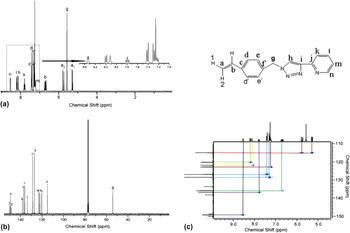
1H NMR (δ/ppm, CDCl3) [Fig. 1(a)]: 8.54 (m, 1H, Hn); 7.22 (m, 1H, Hm); 8.20 (m, 1H, Hl); 7.79 (m, 1H, Hk); 7.41 (d, 2H, Hdd′); 7.29 (d, 2H, Hee′); 6.70 (dd, 1H, Hb); 5.76 (d, 1H, Ha1); 5.27 (d, 1H, Ha2); 8.12 (s, 1H, HhN3); 5.57 (s, 2H, Hg). 13C NMR (δ/ppm, CDCl3) [Fig. 1(b)]: 149.98 (Cj); 137.30 (Ck); 120.40 (Cl); 122.94 (Cm); 148.97 (Cn); 130.15 (Ci); 122.14 (Ch); 54.16 (Cg); 138.28 (Cf); 128.60 (Ce); 126.95 (Cd); 133.61 (Cc); 135.97 (Cb); 115.00 (Ca).
(a) 1H NMR, (b) 13C NMR, and (c) HMQC spectra of VBPT (in CDCl3).

3. Synthesis of PMAPOSS macro-RAFT agent
A mixture of MAPOSS monomer (4.3 g, 4.5 mmol), CDB (49 mg, 0.18 mmol), and AIBN (1.5 mg, 9.0 × 10⁻³ mmol) was dissolved in 2.5 mL toluene in Schlenk tube. The reaction mixture was carefully degassed by five cycles of consecutive freeze-pump-thaw operations. The tube was subsequently placed in an oil bath at 65 °C for 48 h. The reaction was stopped by plunging the tube into liquid nitrogen. The product was precipitated, and washed with a mixed solvent (V methanol/V acetic ether = 7/1) for four times, and then it was dried under 25 °C in vacuum for 24 h. The product yield was 75%.
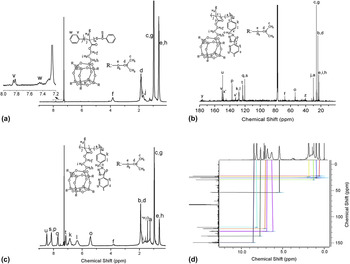
1H NMR (δ/ppm, CDCl3) [Fig. 2(a)]: 0.96 (br d, 42H, Hc); 1.88 (br m, 7H, Hd); 0.63 (br d, 14H, He); 3.86 (br t, 2H, Hf); 1.68 (br m, 2H, Hi); 0.65 (br t, 2H, Hh); 0.97 (br s, 3H, Hg); 1.65 (br s, 2H, Hj); 7.0–7.9 (5H, –C6H5).
(a) 1H NMR spectrum of PMAPOSS18; (b–d) 13C NMR, 1H NMR, and HMQC spectra of PMAPOSS18-b-PVBP84 (in CDCl3).

4. Synthesis of PMAPOSS-b-PVBPT
VBPT (1.3 g, 5.1 mmol), PMAPOSS (M n, NMR = 1.7 × 10⁴, 0.30 g, 0.017 mmol), and AIBN (0.66 mg, 4.0 × 10⁻³ mmol) were dissolved in 1.8 mL of THF and placed in Schlenk tube which were thoroughly deoxygenated by five consecutive cycles of freeze-pump-thaw operation. The tube was subsequently heated in an oil bath at 80 °C for 36 h. The reaction was stopped by plunging the tube into liquid nitrogen. Small molecules were removed by dialysis in DMF for 2 days. Reference Dai, Kang, Zeng, Chen, Xu, Luo, Yu, Jie, Yue, Chong, Cheng, Liu and He26 The density of the prepared PMAPOSS18-b-PVBP84 was 0.6041 g cm−3.
1H NMR (δ/ppm, CDCl3) [Fig. 2(b)]: 8.47 (m, 1H, Hu); 8.16 (m, 1H, Hs), 8.14 (s, 1H, Hp), 7.68 (m, 1H, Hq), 7.13 (m, 1H, Ht); 6.86 (d, 2H, Ht); 6.34 (d, 2H, Hl); 5.41 (s, 2H, Ho); 3.83 (br t, 2H, Hf); 0.63 (br d, 14H, He); 0.65 (br t, 2H, Hh); 0.96 (br d, 42H, Hc); 0.97 (br s, 3H, Hg); 1.25 (br s, 2H, Ha); 1.65 (br s, 2H, Hj); 1.68 (br m, 2H, Hi); 1.88 (br m, 7H, Hd); 1.90 (br m, 1H, Hd). 13C NMR (δ/ppm, CDCl3) [Fig. 2(c)]: 178.01 (Cy); 150.10 (Cv); 149.33 (Cu); 148.39 (Cx′); 120.16 (Cp); 132.21 (Cv′); 127.77 (Ck); 127.76 (Cl); 122.84 (Ct); 120.16 (Cq); 122.37 (Cs); 68.01 (Cf); 53.70 (Co); 40.10 (Cz); 29.71 (Cj); 29.70 (Ca); 25.76 (Cc); 25.75 (Cg); 23.85 (Cb); 23.84 (Cd); 22.49 (Ce); 22.48 (Ci); 22.47 (Ch).
C. Self-assembly of PMAPOSS-b-PVBPT in chloroform
Firstly, PMAPOSS-b-PVBPT was dissolved in chloroform under argon atmosphere. And then Zn(OTf)2 and HAuCl4 solutions with different concentrations were added respectively. Finally, the micelles were obtained after stirring for 10 h.
D. Self-assembly of PMAPOSS-b-PVBPT in ethylene glycol
PMAPOSS-b-PVBPT was first dissolved in a small volume of common solvent THF, and then followed by slow addition (1.5 mL/min) of a known volume of ethylene glycol, a selective solvent for PMAPOSS-b-PVBPT. The mixed solution was exposed to air at room temperature until the complete evaporation of THF. The concentration of micelle solutions discussed was 2 mg/mL. To study the effect of metal ion on the micelles, CuCl2 and Zn(OTf)2 solutions with different concentrations were introduced to the micelle solutions.
E. Characterization methods
All 1H NMR, 13C NMR, and 2D HMQC spectra were recorded on a Bruker AV300 NMR spectrometer (Bruker-Spectrospin AG, Switzerland) in deuterated solvents containing tetramethylsilane (TMS) as an internal standard. Chemical shifts (δ) are given in ppm relative to TMS. Infrared spectra (FTIR) were recorded by a Nicolet Avatar 360 FTIR (Nicolet Instrument Corp.). We used pycnometer (5 mL) to determine the polymer density. X-ray diffraction (XRD) was performed on a Bruker AXS D8-advance diffractometer. Thermal gravity (TG) and differential thermal gravity (DTG) were carried out on a Netzsch Analyzer (model STA 409EP, Netzsch Corp., Germany). Dynamic light scattering (DLS) experiments were performed on a ZetaPALS equipment to measure the particle size of the self-assembly copolymer micelles and clusters. Transmission electron microscopy (TEM) was performed on a JEM-2100 at an acceleration voltage of 200 kV. To prepare the samples, a small drop of the resultant product solution was deposited onto a carbon-coated copper electron microscopy grid and dried under room temperature. Gel permeation chromatography (GPC) characterization was measured in Waters 1515 being equipped with a series of Waters styragel columns to determine the molecular weights and the molecular weight distributions. THF was used as eluents with a flow rate of 1.0 mL/min, and the calibration was carried out with a polystyrene standard.
III. RESULTS AND DISCUSSIONS
A. Synthesis and characterization of PMAPOSS-b-PVBPT
To construct novel POSS-containing block copolymers (BCPs) with the ability to coordinate with metal, the didentate pyridine-1,2,3-triazole ligand possessing four nitrogen atoms was incorporated into the polymer side chains. The synthesis route of PMAPOSS-b-PVBPT diblock copolymer is shown in Scheme 1. The synthesis included two steps. Firstly, 4-vinylbenzyl-2-pyridine-1H-1,2,3-triazole (VBPT) used as a second monomer in RAFT polymerization was synthesized by click reaction. As a convenient and efficient binding method, click reaction is a cycloaddition reaction between azide and alkyne groups that highly selectively forms the click group 1,2,3-triazole as product under mild conditions. Reference Giera, Huisgen and Polborn27 Here, VBPT was synthesized from 2-ethynylpyridine and 4-vinylbenzyl azide. The 1H NMR, 13C NMR, and HMQC spectra of the product VBPT are recorded in Fig. 1. In the 1H NMR spectrum [Fig. 1(a)], doublet of doublet (Ha1, Ha2, and Hb) proton resonance peak locating at 5.76, 5.27, and 6.70 ppm with a relative peak integration ratio of 1:1:1 were assigned to iso-, trans-, and substituted vinyl proton, respectively. The chemical shifts of –CH2(g)– in benzyl group and =CH(h)–N in triazole group were δ 5.57 and δ 8.12, respectively, with a peak integration ratio of 2:1. It can be observed that no resonance peaks appeared at 3.05 and 4.32 ppm, which suggested that the click reaction has occurred because the chemicals shifts of 3.05 and 4.32 ppm were assigned to the proton resonances of terminal alkyne CH≡ of 2-ethynylpyridine and –CH2N3 of 4-vinylbenzyl azide, respectively. A couple of carbon-d and carbon-d′ had the same chemical shift, so that fourteen signal peaks appeared in the 13C NMR spectrum. The 13C NMR assignments are labeled in Fig. 1(b). The HMQC experiment [Fig. 1(c)] showed the cross peaks between the protons and carbons, which proved the assignments in the structure analysis. For example, the cross peaks (8.54, 148.97); (7.22, 122.94); (8.20, 120.40); and (7.79, 137.30) represented the connectivity of protons and carbons in pyridine ring. The proton of 1,2,3-triazole with δ 8.12 was coupled to the carbon with δ 122.14. Therefore, VBPT was successfully synthesized in our work.
Synthesis of PMAPOSS-b-PVBPT via the combination of click reaction and RAFT polymerization.

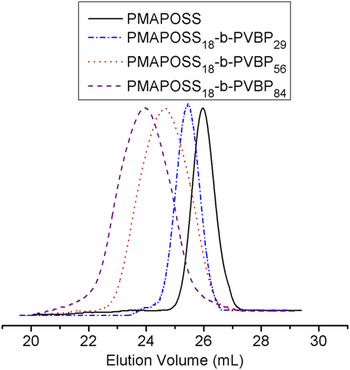
Secondly, AIBN and CDB were used as an initiator and chain transfer agent to anticipate the RAFT polymerization of PMAPOSS-b-PVBPT diblock copolymer. The 1H NMR spectra of PMAPOSS18 macro RAFT agent and PMAPOSS18-b-PVBPT84 copolymer as well as 13C NMR and HMQC spectra are shown in Fig. 2. The FTIR spectra of VBA, VBPT, and PMAPOSS-b-PVBPT were recorded to provide more evidence for the proposed mechanism and the expected structures. It can be seen from Fig. S2 that the absorption peaks at 2100 cm−1 (−N3), 811 cm−1(p-Ar), 1630 cm−1, and 3006 cm−1 (RCH=CH2) confirmed the chemical structure of VBA structure. As the addition reaction between VBA and 2-ethynylpyridine completed, the distinctive absorption at 2100 cm−1 for −N3 stretching in VBA disappeared, while a sharp absorption at 772 cm−1 for RCH2 appeared. Moreover, as RAFT radical polymerization between VBPT and MAPOSS occurred, the disappearance of the peak at 1630 cm−1, 3006 cm−1 for RCH=CH2 in VBPT and the appearance of the peak at 2962 cm−1 for –CH3 in PMAPOSS-b-PVBPT revealed that the diblock copolymer was successfully synthesized. As for the first chain segment of PMAPOSS18, the conversion was determined by calculating the peak integration areas of the methyleneoxy group (–CH2O–, 2nH, δ 3.85, where n is the degree of polymerization) and the vinyl group (CH2=, 2H, δ 5.58, 6.15) of the unreacted MAPOSS monomer. Here, the relative molecular weight calculated by NMR was about 1.7 × 10⁴. All resonance peaks of PMAPOSS are assigned in Fig. 2(a). As for the number-average degree of polymerization (DP n ) of PVBPT, it could be calculated from Fig. 2(c). The chemical shift of –CH2(o)– in benzyl group of PMAPOSS-b-PVBPT was about 5.47 ppm. Therefore, the DPn, VBPT formula was DPn, VBPT = I 5.47/I 3.85 × DPn, MAPOSS, whereas, DPn, MAPOSS = I 3.85/I 7.85. Finally we calculated the relative molecular weight of PMAPOSS-b-PVBPT by the formula of M n, PMAPOSS-b-PVBPT, NMR = DPn, VBPT × M VBPT + M n, PMAPOSS, NMR. Reference Deng, Bernard, Alcouffe, Galy, Dai and Gerard28,Reference Yang, Deng, Zeng, Yuan, Chen, Luo, Liu, Xu and Dai29 At the same time, GPC was also used to measure molecular weight. GPC curves of PMAPOSS and PMAPOSS-b-PVBPT are shown in Fig. 3. It can be seen that the molecular weight and the molecular weight distribution (PDI) against the polystyrene linear standards of PMAPOSS were M n = 9.1 × 10⁴ and PDI = 1.04, respectively. The difference in the results of the measured molecular weight between NMR method and GPC method might be attributed to the compact cage structure of PMAPOSS. Reference Deng, Bernard, Alcouffe, Galy, Dai and Gerard28–Reference Xu, Chen, Xie, Li, Yang, Deng, Yuan, Chang and Dai30 The main characteristics of the resulting BCPs are given in Table I. It included the samples prepared at different reaction times of 8, 15, and 36 h with a molar ratio of [VBPT]:[Macro-RAFT]:[AIBN] = 300:1:0.05. The results showed that as the reaction time prolonged, the degree of polymerization increased, resulting in a longer PVBT macromolecular chains. In this work, we prepared three diblock copolymers of PMAPOSS18-b-PVBP29, PMAPOSS18-b-PVBP56, and PMAPOSS18-b-PVBP84. GPC results demonstrated that these PMAPOSS-b-PVBPT copolymers had a narrow polydispersity. In addition, XRD results of PMAPOSS18-b-PVBP84 (Fig. S3) showed that a broadened peak appeared without sharp lines on the shoulder, which indicated that PMAPOSS-b-PVBP should be a kind of noncrystalline polymer. As far as the thermal stability of the prepared copolymer, the TG/DTG curves (Fig. S4) of PMAPOSS18-b-PVBPT84 were recorded from room temperature to 800 °C under air atmosphere. It showed that the pyrolysis of polymer started at 310 °C and completed at 760 °C, which were divided into two stages. The first heating period (310–460 °C) with a weight loss of 44.0% was related to the loss of PVBPT block. The second heating period from 460 to 760 °C with a weight loss of 46.3% was corresponded to the loss of PMAPOSS block. In a word, the PMAPOSS-b-PVBPT polymer has a good thermostability.
GPC curves of PMAPOSS and PMAPOSS-b-PVBPT copolymers with different chain extensions of VBPT monomer.

PMAPOSS-b-PVBPT copolymers synthesized successively via RAFT.

a The M n, NMR was determined from 1H NMR spectra after purification.
b Measured by GPC calibrated with linear polystyrene (PS) standards.
c The formulas are M n, PMAPOSS = ([MAPOSS]0/[CDB]0) × χ1 × MMAPOSS + MCDB; M n, BCP = M n, PMAPOSS, NMR + ([VBPT]0/[Macro-RAFT]0) × χ2 × MVBPT + MCDB; [MAPOSS]0, [VBPT]0, [CDB]0, and [Macro-RAFT]0 were the initial concentrations of the MAPOSS, VBPT, and RAFT agent, respectively. χ1 and χ2 were the conversions of MAPOSS and VBPT.
B. Self-assembly of PMAPOSS-b-PVBPT in chloroform
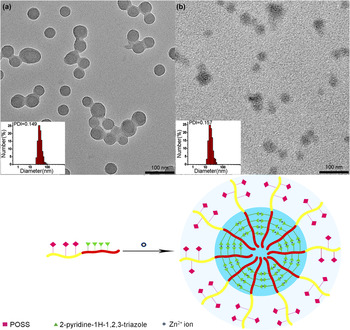
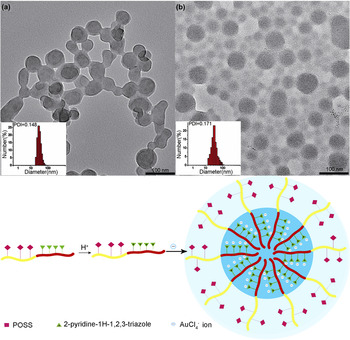
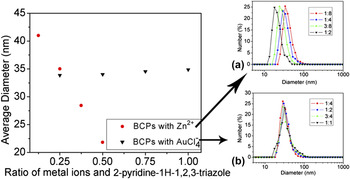
Tremendous effort has been focused on generating well-organized nanoscopic structures over large scales by the self assembly of BCPs over the past decade. The construction of organic nanoparticles can be achieved by the intermolecular forces between pendant functional groups on the polymer chain. As chloroform is a good solvent for both PMAPOSS and PVBPT block, we choose it to investigate the effect of metal ions on the self-assembly of PMAPOSS-containing BCPs in common solvents. TEM characterizations (Figs. 4 and 5) showed that the micelle formation was observed as either Zn(OTf)2 or HAuCl4 was added into the solution. However, it is very interesting to note that as the added amount of metal ions increased, the micelle size decreased. It was also found that the variations of micelle size were different for the Zn(OTf)2–PMAPOSS18-b-PVBPT84 and HAuCl4–PMAPOSS18-b-PVBPT84 system. As for the Zn(OTf)2–PMAPOSS18-b-PVBPT84 system was concerned, the micelle shrank from about 35 nm [Fig. 4(a)] to a smaller size of 25 nm [Fig. 4(b)] as the molar equivalent of the added Zn(OTf)2 to VBPT unit changed from 1:8 to 1:2. When it came to the HAuCl4–PMAPOSS18-b-PVBPT84 system, the phenomenon was different. As the added amount of HAuCl4 increased for 4 times (from 1:4 to 1:1), the size distribution became broad [see Fig. 5(b)] while the average size of the formed micelles had no much difference compared with Fig. 5(a). More data were collected in our experiment by DLS measurement. DLS data of polymer micelles with different molar ratios of metal ions to VBPT units are shown in Fig. 6, which declared the variation of micelle size by adding different amounts of metal ion. Apparently, DLS characterizations were well in accordance with the TEM results. We explained that the different effect of Zn2+ and [AuCl4 −] may be attributed to the different driven force between the metal ions and PMAPOSS18-b-PVBPT84. It is known that the positively charged Zn2+ ions could coordinate with the “NN” atoms of pyridine-1,2,3-triazole in the PMAPOSS18-b-PVBPT84 chains, therefore, the metal–ligand coordination interaction played an important role to drive the assembly. Commonly, the coordination number of Zn2+ is 4, that is, each Zn2+ ion has the ability of coordinating with two equivalents of didentate ligands. This provided a great possibility to produce an interaction between different macromolecular chains. More amount of Zn2+ ions were added, more coordination bonds formed in a micelle. This implied that the driven force for the self-assembly enhanced in a micelle, resulting in a more compact arrangement of PMAPOSS18-b-PVBPT84 macromolecular chains. And then, it made the micelle size of Zn2+-PMAPOSS18-b-PVBPT84 system turn smaller, which is shown in Fig. 6(a). When HAuCl4 was added into the PMAPOSS18-b-PVBPT84, the protonation of PMAPOSS18-b-PVBPT84 would happen in the site of nitrogen-containing ring. Therefore, the negatively charged ion [AuCl4 −] could interact with the protonated PMAPOSS18-b-PVBPT84 through electrostatic interaction, which also drove the self-assembly of PMAPOSS18-b-PVBPT84 to form micelle in common solvent system. However, different from the one-to-two mode of coordination, the one-to-one mode of electrostatic interaction made each PMAPOSS18-b-PVBPT84 macromolecular chain relatively independent. Therefore, even if the added amount of [AuCl4 −] increased, the micelle size could keep almost unchanged. What's more, we suggested that the shell component of the formed micelle was PMAPOSS and the core component was PVBPT. This suggestion would be proved by NMR characterization as follows.
TEM images and schematic illustration of the Zn2+–PMAPOSS18-b-PVBPT84 system with different molar ratios of Zn2+ to VBPT in TCM, (a) Zn2+:VBPT = 1:8, (b) Zn2+:VBPT = 1:2. The insets were DLS data.

TEM images and schematic illustration of the HAuCl4–PMAPOSS18-b-PVBPT84 system in TCM with different molar ratios of [AuCl4 −] to VBPT in TCM, (a) [AuCl4 −]:VBPT = 1:4, (b) [AuCl4 −]:VBPT = 1:1. The insets were DLS data.

DLS data of the metal–PMAPOSS18-b-PVBPT84 system with different molar ratios of the added metal ions (a) Zn2+ and (b) [AuCl4 −].

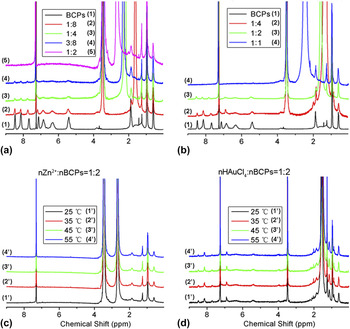
We used NMR to characterize the chemical structure of metal–PMAPOSS-b-PVBPT micelle in common solvent and to obtain a better understanding of the self-assembly process of the metal–PMAPOSS-b-PVBPT system. It can be seen from Fig. 7 that as the molar equivalent of the added metal ions increased from 0 to 0.5, the corresponding NMR signals for the PVBPT chain segment decreased gradually until its disappearance, while the NMR signals for PMAPOSS chain segment were still unchanged. This proved our suggestion that PMAPOSS chains formed the shell layer of the metal–PMAPOSS-b-PVBPT micelle and the core component of the micelle was metal–PVBPT part, which suggested that “intra-micelle” interaction existed.
(a, b) 1H NMR spectra of Zn2+–PMAPOSS18-b-PVBP84 and HAuCl4–POSS18-b-PVBP84 with different molar ratios of metal to POSS18-b-PVBP84; (c, d) VT-NMR spectra of Zn2+–PMAPOSS18-b-PVBP84 (1:2) and HAuCl4–POSS18-b-PVBP84 (1:2) micelles in CDCl3.

When the molar ratio of Zn2+ to VBPT unit was 1:2 [Fig. 7(a)] and the mole ratio of HAuCl4 to VBPT unit was 1:1 [Fig. 7(b)], both the signals of VBPT in the metal–PMAPOSS-b-PVBPT system disappeared completely. Variable temperature NMR experiments were performed to investigate the thermal stability of the metal–PMAPOSS-b-PVBPT micelles. Figures 7(c) and 7(d) showed that as the temperature increased from 25 to 55 °C, 1H NMR spectra of both Zn2+–POSS18-b-PVBPT84 (1:2) and HAuCl4–POSS18-b-PVBPT84 (1:2) hardly changed, which demonstrated a good thermostability of these metal–PMAPOSS-b-PVBPT micelles. To further confirm the stability property, the variation of micelle size and size distribution was observed by DLS over time (Fig. S5). We did not notice any change in the size of the micellar solution under a period of 3 days. Besides, the micelle size kept unchanged during the heating process, indicating that the intermolecular forces that keep the micelles together are strong.
FTIR spectroscopy was used to demonstrate the interaction between metal ions with organic functional groups of PVBPT. As illustrated in Fig. S6, when metal ions were added into the solution, some IR absorption peaks of PMAPOSS18-b-PVBPT84 became wider and shifted to lower wavenumber, which indicated the existence of the coordination interaction (Zn2+ with organic functional groups) and the electrostatic interaction ([AuCl4 −] with organic functional groups).
C. Self-assembly of PMAPOSS-b-PVBPT in ethylene glycol
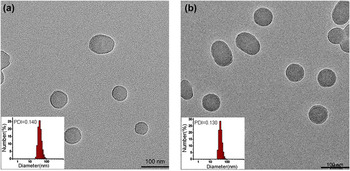
As ethylene glycol is a selective solvent for PMAPOSS-b-PVBPT, we chose it to set a further comparison, aiming at investigating the effect of metal ions on the self-assembly of PMAPOSS-containing BCPs in selective solvent. When the PMAPOSS-b-PVBPT THF solution was added to EG, the PVBPT chains extended into the EG solvent environment to form a shell wall, whereas the hydrophobic POSS aggregated together to form the core domain due to the hydrophobic interaction, which was different from the micelle in common solvent chloroform. The TEM morphologies of PMAPOSS-b-PVBPT in EG are shown in Fig. 8. It can be seen that regular spherical micelles were formed. Comparing PMAPOSS18-b-PVBPT29 [Fig. 8(a)] with PMAPOSS18-b-PVBPT84 [Fig. 8(b)], we can find that the size of PMAPOSS-b-PVBPT micelle increased as the content of PVBPT chain segment increased. The DLS average diameters of PMAPOSS18-b-PVBPT29 and PMAPOSS18-b-PVBPT84 were about 40 nm and 50 nm, respectively.
TEM images of PMAPOSS18-b-PVBPT29 (a) and PMAPOSS18-b-PVBPT84 (b) in ethylene glycol system. The insets are their DLS data.

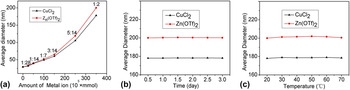
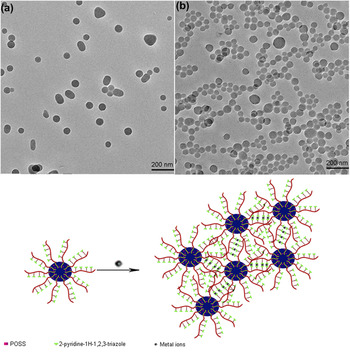
Because PVBPT chain segments contained the coordinated pyridine-1,2,3-triazole groups, the self-assembly affected by metal ions was further investigated. DLS data of polymer micelle with different amounts of metal ions are shown in Fig. 9(a). It can be seen that the addition of CuCl2 or Zn(OTf)2 could gradually make the PMAPOSS18-b-PVBPT84 micelles become bigger in size, which was opposite to the above obtained results in the common solvent TCM system. When the added amount of CuCl2 or Zn(OTf)2 was 0.5 eq (molar equivalent), the DLS diameter of Cu2+/PMAPOSS18-b-PVBPT84 micelle and Zn2+/PMAPOSS18-b-PVBPT84 micelle reached 180 nm and 200 nm, respectively. We explained that the metal–ligand interaction between metal ions and pyridine-1,2,3-triazole units extending to the solvent could drive the PMAPOSS18-b-PVBPT84 micelles to conduct a assembly behavior. The “inter-micelle” interaction would attract more micelles to aggregate together, resulting in the formation of micelle clusters, which might enlarge the micelle diameters. Figure 9(a) demonstrated that when the amount of metal ions increased, the average diameter of polymer micelle increased correspondingly. This implied that the “inter-micelle” metal–ligand interaction played an important role on the metal/PMAPOSS18-b-PVBPT84 system. It also showed that the DLS diameters of Zn2+/PMAPOSS18-b-PVBPT84 micelle clusters were a bit larger than that of Cu2+/PMAPOSS18-b-PVBPT84. This difference in micelle size affected by different metal ions might be concerned with many factors, such as the metal ion radius, the complexation ability, the aggregation number, and so on. For example, the ion radius of Cu2+ is 0.073 nm while that of Zn2+ is 0.074 nm. In addition, the dynamic and thermal stability of the metal/PMAPOSS18-b-PVBP84 clusters were detected. The experimental results [Figs. 9(b) and 9(c)] showed that the metal/PMAPOSS18-b-PVBP84 clusters had a good stability because their size almost kept constant for 3 days under room temperature, and nearly unchanged during a heating process ranged from 20 to 70 °C. What's more, we used TEM characterization to further observe the morphologies of the PMAPOSS18-b-PVBPT84 assembly system with and without the addition of Zn2+ ions. TEM images (Fig. 10) clearly displayed that the copolymer micelle clusters formed as metal ions was added into the assembly system. This proved the above explanations that strong metal–ligand coordination interacted between PMAPOSS18-b-PVBPT84 and Zn2+. Based on the above, the schematic illustration of the proposed mechanism is given in Fig. 10.
DLS data of the metal/PMAPOSS18-b-PVBPT84 system under different conditions in ethylene glycol solvent. (a) Different molar ratios of added metal ions, (b) the effect of time, and (c) the effect of temperature.

TEM images and schematic illustration of PMAPOSS18-b-PVBPT84 (a) and Zn2+/PMAPOSS18-b-PVBPT84 (b) in ethylene glycol system.

IV. CONCLUSIONS
Hybrid diblock copolymers PMAPOSS-b-PVBPT were prepared via click reaction and RAFT polymerization in our work. The pendent group pyridine-1,2,3-triazole in the side chains gave the PMAPOSS-b-PVBPT copolymers to have the ability of coordinating with metal ions and being protonated by acid. Owing to the presence of the PVBPT block, micelle formation and structure could be controlled by the addition of metal ions and HAuCl4. It is interesting to note that in common chloroform solvent, both the positively charged Zn2+ and negatively charged AuCl4 − could induce the formation of inverted micelles with a PVBT core and a PMAPOSS shell. Besides, the micelle could aggregate together to produce larger micelle clusters upon the addition of metal ions. However, it is worthy to note that both the metal/PMAPOSS-b-PVBPT micelles and the metal–PMAPOSS-b-PVBPT micelles had a good dynamic and thermal stability.
In a word, the metal-containing polymer micelles were constructed from the novel diblock copolymer PMAPOSS-b-PVBPT with the pyridine-1,2,3-triazole units. We hope this kind of work would be helpful to perform further study in the fields of microreactors and micellar gels as well as drug delivery.
Supplementary Material
To view the supplementary material for this article, please visit http://dx.doi.org/jmr.2014.292.
ACKNOWLEDGMENT
This work was supported by the National Natural Science Foundation of China (51103122, 51273164, U1205113).