Introduction
Subjective experiences of memory dysfunction are of growing importance in research on pathological aging (Sperling et al., Reference Sperling2010), particularly because they hold promise for very early preclinical detection of dementia of the Alzheimer's type (DAT). At present, mild cognitive impairment (MCI) is commonly classified on the basis of neuropsychological assessment with an emphasis on episodic memory dysfunction (Petersen et al., Reference Petersen, Smith, Waring, Ivnik, Tangalos and Kokmen1999). Clinical criteria for MCI also require the presence of a subjective memory complaint, or, in some cases, an observation of change from an informant. This is usually described in general terms and is elicited within the context of a routine clinical history (Petersen et al., Reference Petersen, Smith, Waring, Ivnik, Tangalos and Kokmen1999; Winblad et al., Reference Winblad2004). Importantly, there is no definitive framework to guide clinicians’ exploration of subjective memory symptomatology. There is, however, an emerging interest in developing and refining the clinical evaluation of memory symptoms on presentation (Jessen et al., Reference Jessen2014).
There is no global consensus on the measurement of subjective memory complaints in MCI. Studies investigating subjective memory complaints predominantly rely on questionnaires that probe responses to itemized lists of circumstances where memory lapses can occur, such as the Memory Assessment Clinics Questionnaire, or MAC-Q (Buckley et al., Reference Buckley2013). Direct evaluation of memory personally relevant episodic or semantic knowledge, arguably the archetypical expression of subjective memory, is not typically included in the mainstream diagnostic approach to MCI, perhaps due to the difficulty in verifying the response. Personal memory encompasses autobiographical memory (ABM), personal semantic memory (PSM), and autonoetic consciousness. Autobiographical memory refers to the recollection of highly contextualized individual experiences (Wheeler et al., Reference Wheeler, Stuss and Tulving1997), involving remembering the details of the event as they took place within a spatiotemporal and emotional context (Irish et al., Reference Irish, Lawlor, Coen and O’Mara2011a; Reference Irish, Lawlor, O’Mara and Coen2011b). Autonoetic consciousness represents the rich accompanying re-experiencing of the event, and the mental capacity to travel forwards and backwards in time (Wheeler et al., Reference Wheeler, Stuss and Tulving1997). Personal semantic memory, on the other hand, refers to personally relevant knowledge or facts about the individual (Robinson and Swanson, Reference Robinson and Swanson1990). For instance, an individual's recall of a birthday party will be characterized by the rich spatiotemporal and emotional ABM detail, and perhaps intensified by the autonoetic re-experiencing or reliving of the event in the mind's eye. In addition, personal semantic knowledge will be accessible to the individual, for example, of their birth date or the names of the individuals who attended. The ABM–PSM system as a cognitive entity is underpinned by a neural network involving medial and lateral temporal, prefrontal, and posterior parietal cortices (for a review see Svoboda et al., Reference Svoboda, McKinnon and Levine2006). There is also growing evidence for a loss of ABM–PSM function in individuals with MCI and DAT (Hou et al., Reference Hou, Miller and Kramer2005; Fraser et al., Reference Fraser, O’Carroll and Ebmeier2008; Leyhe et al., Reference Leyhe, Müller, Milian, Eschweiler and Saur2009; Irish et al., Reference Irish, Lawlor, O’Mara and Coen2010; Irish et al., Reference Irish, Lawlor, Coen and O’Mara2011a). In our view, this provides a promising foundation on which to investigate the nature of subjective memory at a preclinical stage.
In individuals with DAT, poor ABM performance is associated with bilateral medial temporal atrophy and anterolateral temporal neocortex. Personal semantic memory, on the other hand, is associated with atrophy in the temporal neocortex, often bilaterally (Gilboa et al., Reference Gilboa, Ramirez, Köhler, Westmacott, Black and Moscovitch2005). Measures of new learning and retention are associated with decrements in entorhinal and hippocampal volume in healthy older individuals and in MCI (Mormino et al., Reference Mormino2009). Despite extensive work on new learning (Mormino et al., Reference Mormino2009; Pike et al., Reference Pike2011; Rentz et al., Reference Rentz2011; Kantarci et al., Reference Kantarci2012; Lim et al., Reference Lim2013; Reference Lim2014) no studies have investigated the relationship between ABM, PSM, and autonoetic consciousness, and Alzheimer's disease (AD) biomarkers such as neocortical β-amyloid burden, brain atrophy, and apolipoprotein E ɛ4 (APOE ɛ4), to the best of our knowledge. While this study will primarily focus on ABM and PSM, measures of new learning will also be included because they play a major role in the current diagnosis of MCI. Neuroimaging studies of healthy elderly adults also suggest that a relationship exists between poorer performance on new learning tasks and increased brain β-amyloid load both cross-sectionally (Rentz et al., Reference Rentz2011; Kantarci et al., Reference Kantarci2012) and longitudinally (Lim et al., Reference Lim2014). This relationship is complex; some studies report a low-to-moderate-effect size (Mormino et al., Reference Mormino2009; Kantarci et al., Reference Kantarci2012), and others report no relationship (Pike et al., Reference Pike2011). Carrying the APOE ɛ4 allele might also play a mediating role in this relationship (Pike et al., Reference Pike2011; Kantarci et al., Reference Kantarci2012; Lim et al., Reference Lim2013).
The first aim of this study was to determine the extent to which neocortical β-amyloid, brain atrophy, and APOE ɛ4 influence ABM, PSM, and autonoetic consciousness. The second aim was to determine which memory variables (new learning, ABM, and PSM) would explain variations in β-amyloid burden. As PSM is affected by primarily neocortical pathology, and because β-amyloid accumulation first appears in neocortical tissue, we hypothesized that PSM would be a stronger predictor of β-amyloid burden in individuals with MCI than will ABM, which is more dependent on medial temporal regions.
Methods
Participants
The Australian Imaging, Biomarkers and Lifestyle (AIBL) Study of Ageing is a longitudinal study with follow-up assessments every 18 months. This is a study of healthy controls (HC) and individuals with MCI 36 months after the larger AIBL baseline assessment. By the 36-month time-point, the cohort comprised 154 AD participants, 58 MCI participants, and 611 HC. Funding permitted approximately one quarter of these subjects to undergo imaging at baseline.
Recruitment of the AIBL cohort
Human research approval for the current study was obtained in Victoria from St Vincent's Hospital and the University of Melbourne, and Hollywood Private Hospital in Western Australia. The methods of recruitment and exclusion criteria for the AIBL Study have been published elsewhere (Ellis et al., Reference Ellis2009). In brief, elderly volunteers were screened for the following exclusion criteria: a history of dementia other than DAT, psychiatric illness, Parkinson's disease, cancers within the last few years, symptomatic stroke, uncontrolled diabetes, diagnosed sleep apnea, and alcohol consumption greater than recommended levels. A diagnostic review panel of neurologists, geriatricians, psychiatrists, and neuropsychologists, chaired by the fourth author (DA), oversaw the classification into HC, MCI, and DAT groups according to well-established criteria (Ellis et al., Reference Ellis2009; Petersen et al., Reference Petersen, Smith, Waring, Ivnik, Tangalos and Kokmen1999). Mild cognitive impairment classification was made based on cognitive performance falling at least 1.5 SD below appropriate normative levels on one or more neuropsychological tests (or two or more if initially recruited as a HC), expressed subjective memory complaint, and current preservation of activities of daily living. We recruited MCI participants who were still diagnosable with MCI three years after baseline AIBL diagnosis, or those with a new diagnosis of MCI by the 36-month AIBL assessment.
Recruitment for this study
This is a cross-sectional sub-study that recruited AIBL participants at the 36-month follow-up time-point of the larger AIBL study, who had specifically undergone positron emission tomography (PET) and magnetic resonance (MR) imaging at the 36-month follow-up AIBL assessment (Ellis et al., Reference Ellis2014). Only HC and MCI participants were eligible to participate, and 45 (HC = 31; MCI = 14) consented to participate in this study. All participants were recruited via telephone and asked to participate in a one-hour semi-structured interview and the CANTAB Paired Associate Learning (PAL) task in their homes.
Personal memory measure
The Episodic Autobiographical Memory Interview (EAMI) was administered in the participant's home by the first author (RB). This interview has been described in detail elsewhere (Irish et al., Reference Irish, Lawlor, O’Mara and Coen2010; Irish et al., Reference Irish, Lawlor, O’Mara and Coen2011b). The EAMI is a semi-structured interview that involves three parts; the first assesses PSM recall by probing personal factual information that can be shared by family and friends, and the second assesses ABM event recall by probing subjective experiences that are unique to the individual and can be recalled within a specific spatiotemporal context. The final part probed an individual's ability to re-experience the event. For the current study, a shortened version of the EAMI was used, taking approximately 40 minutes, in which recall was constrained to the Recent Period (within the last five years).
The PSM part involved three items. The first asked the participant to recall the names of three people that they had only met in the last five years (one point for the full name and one point for their relationship to the individual). The second involved recalling the location and route to a frequented establishment in the last five years (one point each for the name of the establishment, location, what they did there, and how they traveled there). The third item related to the ability to recall the exact date, month, year, and location of a personally significant event within the last five years (one point for each of the four specifics remembered). This totaled to a maximum score of 14 for the PSM component.
The ABM component required the participant to recall, in as much detail as possible, a personally significant event that occurred within the last five years. Once participants stopped spontaneously producing information pertaining to the event, the interviewer probed for further details using seven phenomenological categories taken from the Event Details Checklist of Moscovitch and colleagues (Reference Moscovitch, Yaschyshyn, Ziegler, Nadel and Tulving2000). These probes included event detail, temporal, spatial, sensory, implication of the event, emotion, and thought recall. Each detail was awarded a maximum score of one point, which would be summed to a maximum score of seven points. The autonoetic consciousness section was attached to the ABM component and asked the individual to describe each of the following aspects within the autonoetic experience: perspective, continuity, image quality, emotional connection, and recollective experience.
These interviews were recorded with the approval of the participant, transcribed, and scored by the interviewer and a blinded clinical neuropsychologist. Inter-rater reliability, as measured by intraclass correlation coefficient, was high for all three sections (r ABM = 0.92; r PSM = 0.94; r AUTOCON = 0.92), aligning with reported values for the longer version of the EAMI (Irish et al., Reference Irish, Lawlor, O’Mara and Coen2011b). In an effort to avoid any compensatory effects of ABM, the PSM section was administered first. Interviews were recorded with the approval of the participant, transcribed, and scored by the interviewer and a blinded clinical neuropsychologist. Both ABM and PSM recall were treated as continuous measures, while the autonoetic consciousness variables were dichotomous, i.e. an individual displayed ease or difficulty with the variable.
Measures of new learning and retention
The standard neuropsychological assessment involved a mean administration time of two hours (for details and references see Ellis et al., Reference Ellis2009). The following tests were administered by AIBL neuropsychologists at the 36-month time-point: the California Verbal Learning Test-Second Edition (CVLT-II) short delay free recall and long delay free recall, and the Wechsler Memory Scale (WMS) Logical Memory (LM) immediate and delayed recall measures (Story 1 only) were administered to measure verbal learning, and the Rey Complex Figure Test (RCFT) 30-minute delayed recall and the CANTABeclipse v3.0 PAL Stage 6 errors adjusted score, to measure non-verbal memory (participants who were unable to complete Stage 6 were allocated the error score of the lowest-performing individual attempting the stage).
Image acquisition
Participants in the current study had already undergone imaging in the larger AIBL study at the 36-month time-point, which we accessed. In total, 42 individuals (HC = 31, MCI = 11) underwent Pittsburgh Compound B (PiB)-PET or MR imaging, and 30 of these participants (HC = 22, MCI = 8) underwent both PiB-PET imaging and MR. There were no demographic differences between those who underwent one or both scans so we treated these participants as the same in statistical analyses. We will now discuss the larger AIBL study imaging protocol.
11C-PiB-PET imaging
Amyloid imaging with PET was conducted using 11C- PiB. Positron emission tomography methodology has previously been described in detail (Rowe et al., Reference Rowe2010). Standardized uptake value (SUV) data were summed and normalized to the cerebellar cortex SUV, and the resulting tissue ratio is termed SUV ratio (SUVR). In the current study, the PiB SUVR index was considered as a continuous measure. Thirty-eight participants (HC = 30, MCI = 8) underwent PiB-PET imaging.
Magnetic resonance imaging
T1-weighted MRIs were segmented into cerebrospinal fluid, gray and white matter. Estimates of gray matter as well as for left and right hippocampal volumes for each participant were calculated (for detailed methods, see Rowe et al., Reference Rowe2010). All volumes were normalized to intracranial volume. Thirty-four participants (HC = 23, MCI = 11) underwent MR imaging.
Statistical analyses
Analyses were conducted using SPSS version 22.0. In order to reduce the potential for multicollinearity, a principal components analysis (PCA) was performed to reduce left and right hippocampal volumes into one factor. The distribution of β-amyloid deposition values was skewed in HC, so a bootstrapping technique available in SPSS was used to determine a robust estimate of the mean difference between HC and MCI. Differences in AD imaging biomarkers were ascertained using t-tests and analysis of covariance (ANCOVA) analyses. The t-tests (and χ 2 analyses for the dichotomous autonoetic consciousness variables) were used to determine the difference between HC and MCI on all personal memory variables, namely, ABM, PSM, and autonoetic consciousness. Logistic regression (for autonoetic consciousness variables) and hierarchical regression (for PSM, ABM, and the measures of new learning and retention) models were used to determine how AD imaging biomarkers relate to both personal and measures of new learning and retention, taking into account the variance explained by age and APOE ɛ4 carrier status. Missing data existed for both memory and affective measures but totaled less than 10% of the entire dataset (refer to Table 1).
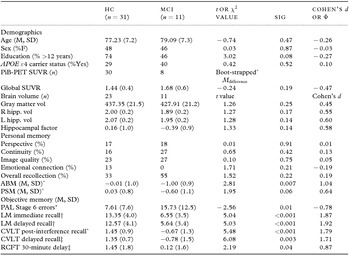
Demographic, AD biomarker and memory differences between HC and MCI

^ = bootstrapping was calculated using SPSS-specified method, * = adjusted score (if a participant failed Stage 6), † = age-scaled score, ‡ = z score.
APOE = apolipoprotein E; PiB = Pittsburgh Compound B; PET = positron emission tomography; SUVR = standardized uptake value ratio; ABM = autobiographical memory; PSM = personal semantic memory; PAL = Paired Associate Learning; CVLT = California Verbal Learning Test; LM = logical memory; RCFT = Rey Complex Figure Test; hipp. = hippocampus; vol. = volume.
Results
Demographic characteristics
No significant differences between the HC and MCI groups were evident for age, sex, and APOE ε4 carrier status. As expected, there was an elevated percentage of non-carriers in the HC group (71% compared with 54%). Healthy controls showed a trend towards having a higher percentage of individuals who attained more than 12 years of education (74% compared with 46%) although this did not reach statistical significance (see Table 1).
Factor analysis of left and right hippocampal volumes
Left and right hippocampal volumes were significantly correlated: r(35) = 0.86, p < 0.0001. These data were reduced in a PCA to produce one hippocampal volume factor. The loadings of both right and left hippocampal volumes on the factor were 0.96, and this factor accounted for 92.7% of the total variance explained.
Hippocampal and gray matter volume
There were no differences between HC and individuals with MCI in terms of right and left hippocampal volumes or the hippocampal volume factor (see Table 1). When age was included as a covariate, it had no influence on hippocampal volume: F(1, 31) = 1.56, p = 0.21, η 2 = 0.05.
There was also no significant difference in overall gray matter volume between HC and MCI. Age had a significant main effect on gray matter volume: F(1, 31) = 11.43, p = 0.002, η 2 = 0.27, supporting previous findings of age-associated gray matter atrophy (Good et al., Reference Good, Johnsrude, Ashburner, Henson, Fristen and Frackowiak2002; Giorgio et al., Reference Giorgio2010). Apolipoprotein E ɛ4 carrier status did not influence any brain volume measures.
Global and regional PiB SUVR
There were no differences between HC and individuals with MCI in terms of global and regional PiB SUVR deposition (see Table 1). PiB retention was moderately variable in the two groups, and as expected, most HC clustered below the PiB positive cut-off. While our HC group showed equivalent global PiB retention rates as reported by Rowe et al. (Reference Rowe2010) in the 18-month follow-up, our global SUVR mean was slightly elevated in comparison with the mean PiB SUVR of 1.38 reported at 36-month follow-up (Villemagne et al., Reference Villemagne2013). The average global PiB retention in our MCI group was below the PiB SUVR of 1.96 reported at both 18-month and 36-month time-points (Rowe et al., Reference Rowe2010; Villemagne et al., Reference Villemagne2013). Global SUVR was highly correlated with regional SUVR values, so global PiB retention was used to represent PiB retention in individuals.
Age was significantly correlated with global SUVR in HC, r(30) = 0.45, p = 0.02, but not in individuals with MCI, r(8) = 0.01, p = 0.98. Having an APOE ɛ4 allele positively correlated with global SUVR in individuals with MCI, ρ(8) = 0.76, p = 0.03, but this relationship was only a positive trend in HC, ρ(30) = 0.32, p = 0.08.
Personal memory and measures of new learning and retention
Compared to HCs, MCI participants performed worse on ABM recall but not on any other personal memory variables (perspective, continuity, image quality, emotional connection, overall recollection, and PSM recall). Although individuals with MCI did not perform significantly poorer on PSM recall, a moderate-effect size existed, suggesting an impact to some degree. As expected, MCI participants performed worse on all measures of new learning and retention (PAL 6 stage errors, LM immediate and delayed recall, CVLT short and long delayed recall, RCFT 30-minute delay). Table 1 shows the differences on the memory measures and their respective effect sizes.
Relating AD imaging biomarkers to personal memory variables
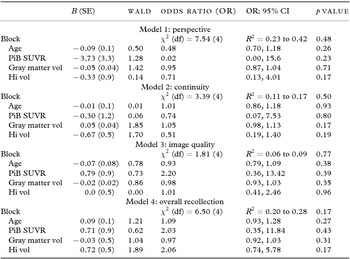
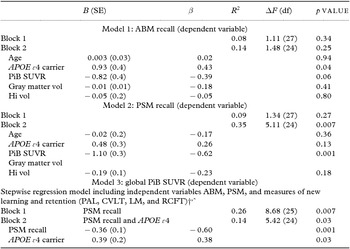
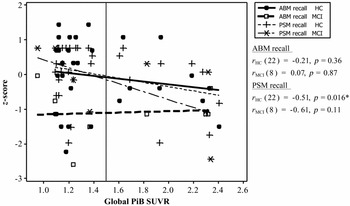
Alzheimer's disease imaging biomarkers, age, and APOE ε4 were not associated with autonoetic consciousness variables (i.e. perspective, continuity, image quality, emotional connection, and overall recollection; refer to Table 2 for details). The data for emotional connection were highly skewed so this variable was excluded from analyses. At a univariate level, ABM recall showed a trend towards being related to global SUVR (β = –0.39, p = 0.06) and had a significant relationship with APOE ε4 (β = 0.43, p = 0.04), but the overall model was not significant (p = 0.25). A trend between poorer ABM recall and smaller hippocampal volume in MCI participants showed a moderate-effect size, this was not significant. Personal semantic memory recall was significantly related to global PiB retention (β = –0.62, p = 0.001) after taking into account the variance explained by age, APOE ε4 carrier status, gray matter, and hippocampal volume (see Table 3). Figure 1 shows the strong relationship between poorer PSM recall and larger global PiB retention in both the HC and MCI groups, although the relationship was not significant in individuals with MCI.
Logistic regression models predicting autonoetic consciousness variables

Note: Emotional connection is excluded due to very significant skew.
Hi = hippocampal; vol = volume; PiB = Pittsburgh Compound B; SUVR = standardized uptake value ratio.
Hierarchical linear regression models predicting personal measures

†These measures were reduced to produce two factors using principal components analysis (PCA) orthogonal rotation.
^Paired Associate Learning (PAL) Stage 6 error score, CVLT short and long delayed recall, and RCFT 30-minute delay were not related to global SUVR, hippocampal or gray matter volume, age or APOE ɛ4 carrier status in a separate regression analysis. Logical memory immediate and delayed recall were related to age (β = −0.54, p = 0.002 and β = −0.47, p = 0.01, respectively), but no other variables.
ABM = autobiographical memory; PSM = personal semantic memory; Hi = hippocampal; vol = volume; PAL = Paired Associate Learning; CVLT = California Verbal Learning Test; LM = logical memory; RCFT = Rey Complex Figure Test; APOE = apolipoprotein E; PiB = Pittsburgh Compound B; SUVR = standardized uptake value ratio.
Scatter plot of global PiB SUVR by ABM and PSM recall (as represented by z scores) in healthy controls and individuals with MCI. Note: the x-value cut-off indicates PiB SUVR = 1.5.

Memory predictors of AD biomarkers: a final model
In order to reduce the number of variables in a post hoc regression analysis, PCA with varimax rotation was run on the measures of new learning and retention (PAL Stage 6 errors, LM immediate and delayed recall, and CVLT short and long delayed recall). RCFT 30-minute delayed recall was excluded from the analysis as it produced a Hayward case (or a loading greater than one). Two memory factors with Bartlett factor scores were produced, accounting for 83% of the variance explained; the first factor incorporated the CVLT-II and PAL measures, and the second factor included the LM measures.
A post hoc stepwise regression model was conducted to find the best statistical predictor (out of ABM, PSM, the two memory factors, age and APOE ε4) of global PiB retention in HC and those with MCI (see Table 3, Model 9). The best predictor was PSM recall (β = –0.59, p = 0.001), followed by APOE ε4 (β = 0.41, p = 0.02). This overall model accounted for 40% of the variance explained in global PiB retention.
Discussion
Autobiographical memory recall was impaired in individuals with MCI, supporting previous research (Hou et al., Reference Hou, Miller and Kramer2005; Leyhe et al., Reference Leyhe, Müller, Milian, Eschweiler and Saur2009; Irish et al., Reference Irish, Lawlor, O’Mara and Coen2010; Irish et al., Reference Irish, Lawlor, Coen and O’Mara2011a). Performance in PSM recall did not differentiate the diagnostic groups, but the moderate effect size is commensurate with that shown in our previous study (Buckley et al., Reference Buckley2014). Participants with MCI did not differ from controls on the overall autonoetic re-experiencing of a memory, consistent with a previous investigation using the same measure (Irish et al., Reference Irish, Lawlor, O’Mara and Coen2010). Unlike Irish and colleagues (Irish et al., Reference Irish, Lawlor, O’Mara and Coen2010), we did not find differences between the groups in emotional connection, continuity of the imagery, viewer perspective, and vividness, most likely reflecting difference in patient samples and study methodology. Aligning with the established profile for amnestic MCI (Winblad et al., Reference Winblad2004), participants with MCI were impaired on all measures of new learning and retention, namely LM, CVLT-II, RCFT, and the PAL task. Inclusion in the MCI group was dependent on performance at least 1.5 SD below the normative mean on any one of the first three measures (or other AIBL measures not reported here). While this introduces some potential for circularity, the PAL task, which played no role in defining the groups, also differentiated HC from MCI.
There were no differences in global neocortical amyloid burden or gray matter volumes between HC and those with MCI. The HC group showed global PiB retention comparable to that observed in previous AIBL studies, but the average PiB retention for our MCI participants was lower than the larger AIBL cohort, at 1.7 compared with 1.9 (Rowe et al., Reference Rowe2010; Villemagne et al., Reference Villemagne2013). The present cohort is derived from the Villemagne et al. (Reference Villemagne2013) study, in the context of the longitudinal AIBL study. Individuals with a longer history of cognitive decline, who had since converted to diagnosable dementia, who in their majority presented with high PiB retention, did not meet selection criteria for the present study, yielding a cohort with low PiB retention. We also found a large dispersion of gray matter volumes in both diagnostic groups, similar to that seen in the larger AIBL cohort (Rowe et al., Reference Rowe2010; Villemagne et al., Reference Villemagne2013).
Personal memory, specifically, PSM, ABM, and autonoetic consciousness, was not related to overall gray matter or hippocampal volumes. There was a trend towards a relationship between smaller hippocampal volume and lower ABM performance in individuals with MCI, but this did not reach statistical significance. In functional imaging studies of healthy adults, ABM is associated with a “core” functional network, featuring the hippocampus (for a review, see Maguire, Reference Maguire2001; Svoboda et al., Reference Svoboda, McKinnon and Levine2006). Hippocampal atrophy did not have a relationship with ABM in either diagnostic category, raising the notion that different samples and imaging methodologies might play a role in the divergent finding. It is also possible that through the course of a 36-month longitudinal study, our sample contained a higher percentage of individuals with non-progressive MCI, which might explain the lack of an expected finding. An alternative explanation is that this might be a slightly more resilient group, and the data might be considered in this light.
Global neocortical amyloid burden had a significant impact on PSM recall in HC. A correlation of moderate size was also evident in the MCI group, but fell short of significance due to small sample size. Our findings align with studies showing verbal memory dysfunction in amyloid positive elderly without dementia (Pike et al., Reference Pike2007; Rentz et al., Reference Rentz2011; Lim et al., Reference Lim2014). This relationship between PSM and neocortical amyloid deposition was not changed by controlling for age, gray matter volume, and APOE ε4 carrier status, suggesting a slight divergence from some studies showing a moderating effect of APOE ε4 (Kantarci et al., Reference Kantarci2012; Lim et al., Reference Lim2013). Personal semantic memory performance was the sole personal memory variable associated with brain neocortical amyloid burden in the final model, contributing unique variance to PiB retention, even when measures of new learning and retention were included. Interestingly, PSM did not differentiate HC from MCI. Unlike PSM, ABM recall did differentiate between the diagnostic categories but did not demonstrate a convincing relationship with neocortical amyloid burden. This pattern raises the possibility that ABM difficulties are underpinned by an alternative neuropathological mechanism, such as tauopathy. The autonoetic re-experiencing of personal memories, which is fundamental to ABM function (Wheeler et al., Reference Wheeler, Stuss and Tulving1997; Conway and Pleydell-Pearce Reference Conway and Pleydell-Pearce2000), was also not associated with neocortical amyloid deposition.
Conclusion
While the samples in this study are smaller than desirable, these findings do open up what we consider to be an important new direction in Alzheimer's research. To the best of our knowledge, this study provides the first insight into the impact of early AD-related neuropathological changes on personal memory function in the elderly without dementia. Our findings show that ABM and PSM were differentially affected by diagnostic category. Neocortical amyloid deposition affected both systems disparately by influencing PSM but not ABM. These findings suggest that separate neuropathological mechanisms are mediating ABM and PSM. Autobiographical memory and PSM are largely dependent on different, but overlapping and interacting, neurofunctional components of the temporal system (Maguire Reference Maguire2001; Gilboa et al., Reference Gilboa, Winocur, Grady, Hevenor and Moscovitch2004; Svoboda et al., Reference Svoboda, McKinnon and Levine2006). Our findings show that PSM is influenced by neocortical amyloid burden, while other underlying neurodegenerative processes that initially impinge on the hippocampal formation, such as tauopathy, might exert a greater effect on the essentially episodic aspects of ABM.
Conflict of interest
None.
Description of authors’ roles
Rachel Buckley administered the EAMI interview, carried out the statistical analyses, and wrote the paper. Michael Saling oversaw the analyses. David Ames, Alan Rembach, Stephanie Rainey-Smith, and Kathryn Ellis oversee and coordinate the AIBL study at the Melbourne site. David Ames also chairs the AIBL diagnostic panel, on which Nicola Lautenschlager, Greg Savage, Cassandra Szoeke, and Kathryn Ellis also serve. Nicola Lautenschlager, Paul Maruff, and Greg Savage serve on the leadership group of the Clinical and Cognitive Stream of the AIBL study. Lance Macauley represented CSIRO on the management committee. Ralph Martins and Colin Masters oversee the AIBL study, sit on the management committee. Ralph Martins and Stephanie Rainey-Smith lead and coordinate the Perth arm of the AIBL study. Chris Rowe leads the AIBL imaging arm, serves on the AIBL management committee. Victor Villemagne also oversaw the imaging component. Cassandra Szoeke represented CSIRO at management committee meetings from 2009–2011. All authors critically reviewed drafts of this manuscript.
Acknowledgments
The AIBL study (www.AIBL.csiro.au) received support from Commonwealth Scientific and Industrial Research Organisation, CSIRO, the Science and Industry Endowment Fund (www.SIEF.org.au), National Health and Medical Research Council, NHMRC, and Dementia Collaborative Research Centres (DCRC), as well as Industry, including Pfizer, Merck, Janssen, and GE Healthcare. We thank all the participants who took part in the study and the clinicians who referred MCI participants to the study.