Figures of intersexed individuals perhaps representing the minor Greek deity Hermaphroditus became, for reasons that are not entirely clear, strikingly popular in Roman sculpture and wall painting in the latter half of the first century CE. Depicting a fully bisexed human body, these figures have resulted in competing interpretations regarding their purpose, meaning, and effect.Footnote 1 As it happens, we also have a text from the Augustan period that purports to explain not only the origin of the intersexed Hermaphroditus, but the production of future bisexed individuals, in Ovid's Metamorphoses Book 4. When discussing the sculptures and wall paintings of Hermaphroditus, as a result, scholars have been inevitably drawn to Ovid's narrative.Footnote 2 The pull of Ovid is admittedly almost irresistible, and his reputation as a poet who challenges norms, conventions, and genres makes it attractive to see him as creating room for modern notions of gender fluidity.Footnote 3 As Georgia Nugent argued more than thirty years ago, however, Ovid's narrative is, in curious ways, a reductive version of the myth, ‘a paradigmatic example of how what is sexually threatening may be textually recuperated and stabilized’.Footnote 4 I wish to reanimate Nugent's arguments here, and to suggest that scholars’ regular invocation of Ovid when interpreting the products of Roman art is a mistake, for two reasons: first, the figure Ovid describes is, in fact, not typical of what we see in Roman sculptures and wall paintings; and second, Ovid presents a version of Hermaphroditus’ gender identity that is deliberately less challenging to the stability of sexual binarism—and to traditional gender roles—than are those material depictions. For those of us who wish to advocate for the rights of intersexed individuals, in other words, Ovid is the wrong champion.
Before I enter into that discussion, I need to clear away a few possible misconceptions. In this paper I am going to refer to ‘hermaphrodites’ because that is the term used in modern scholarship for a particular sculptural figure from ancient Rome. I am not discussing the real lives of historical intersexed individuals in Rome, though such individuals surely did exist. Recent scientific studies indicate that humans with ambiguous sexual genitalia are born at a rate of roughly one in 1,500 to 2,000, with the degree of ambiguity varying widely.Footnote 5 But there are very few records of intersexed individuals surviving into adulthood and, once recognized, living in Roman society.Footnote 6 When such individuals are mentioned, they often enter the historical record as negative portents, and von Stackelberg argues that until 92 BCE such individuals were regularly put to death on discovery in a rite of expiation.Footnote 7 Somewhat later, Pliny the Elder tells us with a tone of moral disapproval that gignuntur et utriusque sexus quos hermaphroditos uocamus, olim androgynos uocatos et in prodigiis habitos, nunc uero in deliciis (‘individuals are born of both sexes, whom we call hermaphrodites, and who once were called androgynous and considered prodigies, but who are now used for pleasure’, HN 7.34). While these historical references are fascinating—and indeed, the sculptures of Hermaphroditus may have had real effects on the lives of intersexed individuals—they are not the subject of this essay. Rather, I want to focus on the sculptural tradition of a particular intersexed figure, and how it might have produced meaning in first-century Rome.
To be sure, it may well have been Ovid's text that led to an increased interest in depicting the figure of Hermaphroditus.Footnote 8 Peter Knox has argued convincingly that Ovid appears to have influenced programs of mythological paintings in Pompeii (including an astonishing 52 paintings of the Narcissus story).Footnote 9 In the case of Hermaphroditus, Ovid writes a compelling and highly literary narrative, and several elements of his version seem to be innovations of his own. Not least, other versions do not narrate a transformation; in the rest of the tradition, Hermaphroditus is an ambiguously sexed individual from the start.Footnote 10 The story of how ze became intersexed has an innate fascination for modern readers and, as we will see, Ovid engages in several sophisticated literary allusions in the course of his story, playing with the idea of textual transformation as well as sex change.Footnote 11 But in the telling of his story, Ovid mitigates Hermaphroditus’ challenge to sexual binarism and ‘recuperates’ (to use Nugent's terminology) hir through the use of a known, and degraded, gender category in early Imperial Rome—that of the mollis (‘soft’) male.Footnote 12 His narrative, in other words, is reductive.
The Sculptural Tradition
Let me turn to the sculptural depictions first, so that we can see how what they depict is not quite what Ovid narrates as coming into being. Nearly all of our sculptures of Hermaphroditus date from the Roman period, though they are generally thought to be copies of Hellenistic originals.Footnote 13 There are three standard sculptural types of the hermaphrodite, which I generally categorize by position: standing (also called the ‘Pergamene’), sleeping (the ‘Borghese’), and struggling. The struggling hermaphrodite is represented by two sub-types, the ‘Dresden’, in which the hermaphrodite physically fights off the attentions of a satyr, and the ‘Berlin-Torlonia’, in which a larger hermaphrodite and smaller satyr are involved in a more ambiguous erotic encounter. Of these different general modes of depiction, we have numerous small figurines and fragments of standing hermaphrodites, at least 10 large-scale sculptures of sleeping hermaphrodites, as many as 26 sculptures of the ‘Dresden’ type, and 12 struggling figures of the ‘Berlin-Torlonia’ type.Footnote 14
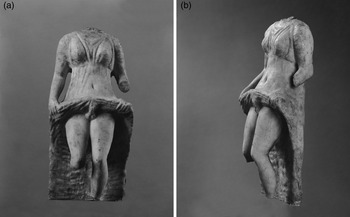
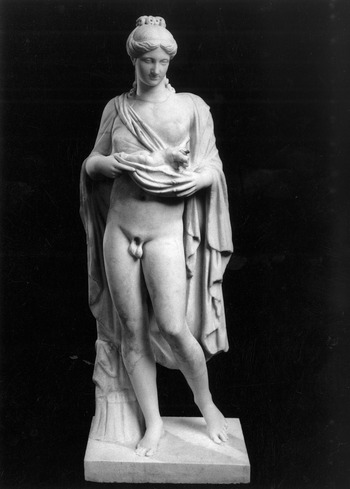
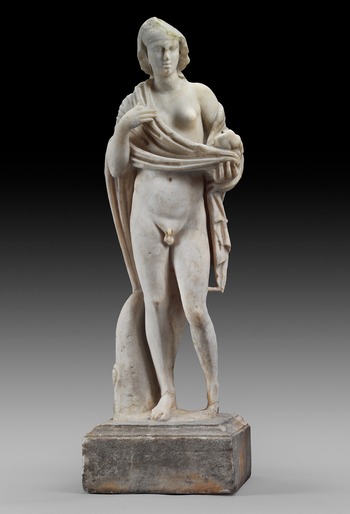
The earliest of these figures belong to a common version of the standing type, the anasyromenos, or ‘skirt-lifting’ figure and the earliest examples seem to have had associations with an Attic fertility cult.Footnote 15 The pose imitates that of the well-known ‘Baubo’ female figurines, sometimes associated with Demeter, with a much older cultic history.Footnote 16 These figurines have their own complex history and interpretation; by replicating the anasyromenos pose of these figures, the Hermaphroditus statues seem to be enacting a kind of sculptural parody. Judging by the top half of the sculpture we expect to see a female form, and instead ze lifts hir skirts to reveal male genitalia. We see considerable variation in the body types, particularly of these standing figures, and Åshede has recently argued that modern interpreters have placed too much emphasis on the sculptures’ male genitalia.Footnote 17 In some versions, the body appears generally female, and the erect penis appears to be a sort of deliberate surprise (see Figures 1a and b, a damaged figurine at the University of Pennsylvania Museum). In other standing hermaphrodites (not all of them of the anasyromenos type), the overall body type appears more male than female, with narrow hips and fairly masculine, if youthful, torsos (see Figures 2 and 3). On the latter two sculptures, it seems fair to say that the female breasts are at least as disruptive of a clear sexual bimorphism as are the male genitals.Footnote 18 Aileen Ajootian and John Clarke argue that these figures appear to have had an apotropaic function, associations that the figure may never completely lose.Footnote 19 In the Hellenistic and Roman periods, however, statues of hermaphrodites clearly take on new decorative functions, not directly related to cult.
A damaged, small figurine of Hermaphroditus anasyromenos, possibly 2nd century BCE. 29.5 × 14 × 9 cm. University of Pennsylvania Museum of Archaeology and Anthropology. Courtesy of the Penn Museum, object # MS5970.

Hermaphroditus anasyromenos; the statue holds a figure of Eros in the lifted folds of hir robes, possibly 1st century CE. Found outside of Rome, perhaps at Tor Morancia. Sala delle columbe, Musei Capitolini, Rome. © Sovrintendenza Capitolina ai Beni Culturali, Rome. Archivio Fotografico dei Musei Capitolini.

Hermaphrodite, Roman, Imperial period, about 20 BCE to 40 CE. Marble, probably from the Greek island of Paros. Weight: 58.1 kg (128 lb). 91.4 × 24.8 × 30.2 cm. Photograph © Museum of Fine Arts, Boston (2021).

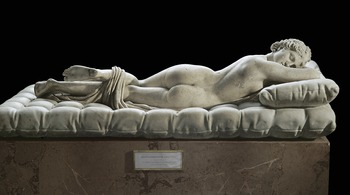
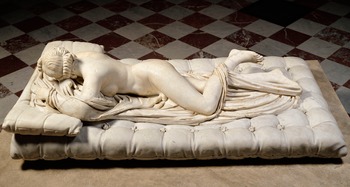
More familiar to the museum-going public are the figures of sleeping hermaphrodites, including some from private houses in Pompeii. We see considerably less variation in body type in the sleeping figurines than in the standing versions. The sleeping hermaphrodite is typically arranged such that, when seen from one side, the viewer sees what appears to be a young, beautiful woman in a state of undress, as is the case in the Louvre Hermaphroditus (Figure 4a). Ze rests hir head on hir arms, and turns hir face to the viewer; from this side the viewer has an unobstructed view of hir nude buttocks, which we perhaps imagine to have been covered at an earlier moment in time by the sculpted bedsheets that are now tangled around hir ankles and feet. When the viewer walks around to the other side of the statue, however, she experiences a surprise (Figure 4b). The statue lifts hir hip so that ze rests on hir left knee, and so hir male genitalia are clearly displayed.
The Louvre Hermaphroditus from the back, Roman, 2nd century CE. Presumed a copy of a Hellenistic original; the mattress was added before 1620 by Gian Lorenzo Bernini. 148 cm. © RMN-Grand Palais/Art Resource, NY. Photo: Hervé Lewandowski.

The Louvre Hermaphroditus from the front. Photo credit: Erich Lessing/Art Resource, NY.

While the precise meaning of these sculptures is still hotly debated, Clarke points out that a consistent feature of their composition is ‘the mechanism of the double-take’.Footnote 20 That is, the viewer is led to expect a sculpture of a sexually fully developed female, and is taken by surprise when she sees a figure whose sexual characteristics are both female and male. As Trimble has recently pointed out, however, the viewing experience of these sculptures would have been complex, and the meanings produced by these sculptures go beyond one of simple surprise. In her analysis of the Palazzo Massimo sleeping hermaphrodite (which she dates to 130–150 CE), Trimble argues that the sculpture seems to have been designed to be viewed primarily from the back, from which angle the body appears to be that of a highly idealized and erotic female form.Footnote 21 Once one moves to the front of the sculpture, and experiences the ‘surprise’ of realizing that this is a hermaphrodite, Trimble argues, the viewer is forced to reconsider her or his own earlier response: ‘Knowing, now, that the curves of the back belong to Hermaphrodite…do you look at them differently, though they have not changed?’Footnote 22 At the risk of oversimplifying, the visual goal of these sculptures is to confound the viewer with the figure's complete, adult gender ambivalence, an experience that Trimble suggests ‘delivers not only humor and surprise but also challenge and risk’.Footnote 23
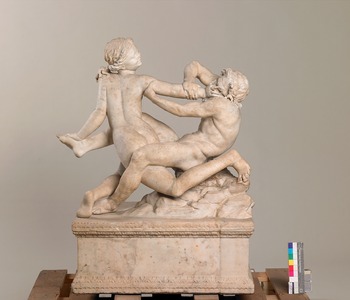
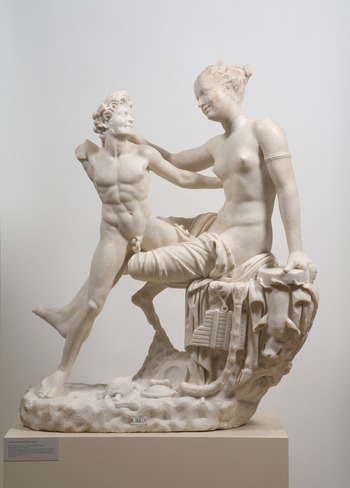
The reaction of initial surprise followed by the viewer's discomfort is enacted within the sculpture group in the ‘struggling’ form. In the ‘Dresden’ configuration, Hermaphroditus is attacked by a satyr or pan—a notoriously randy semi-human male—who unexpectedly encounters greater-than-female strength, and is unable to overpower the object of his desire (see a statue group from National Museums Liverpool, Figure 5). At first glance, the assailant in these sculptures does not seem to be put off by the hermaphrodite's intersexed body but, as Ridgway points out, there is a certain ambivalence in the representation of the struggle.Footnote 24 Though Hermaphroditus is impossibly contorted in hir struggle, ze has also hooked the satyr's leg with hir own, threatening to unbalance hir assailant. Ridgway suggests that the composition ‘may also bespeak the ambivalence of the protagonists’ mood and the uncertainty of their actions’ outcome.’Footnote 25 In the ‘Berlin-Torlonia’ configuration, a somewhat oversized hermaphrodite has been approached by a satyr-figure again, and here the interaction is still more ambivalent. In these statue groups, the satyr appears to hesitate before the bisexed form that he encounters, and the hermaphrodite seems to respond to his assault with some interest; hir hand is behind his neck, and his body is trapped in place by hir left leg (see Figure 6). If we are to assume that the satyr's desire for the hermaphrodite stands in for that of a (presumably male) Roman viewer, then the discomfort that our Roman viewer may have experienced is here represented by the satyr's inability to escape.
An example of the ‘Dresden’ type of Hermaphrodite and satyr statue group, 2nd century CE. Base discovered with sculpture but does not belong to it. Restorations on the left arm and right leg of the hermaphrodite, her left breasts; restorations to the satyr include the lower right leg from the knee, the lower calf and the foot, right thigh and some damage on the fingers and toes. 97 × 80 cm. # 59.148.30. © National Museums Liverpool.

‘Berlin-Torlonia’ configuration of Hermaphroditus and satyr, 2nd century CE. In this example the satyr's head is a modern reproduction; Hermaphroditus’ head is ancient but does not belong to this statue. © Antikensammlung, Staatliche Museen zu Berlin. Photo: Johannes Laurentius.

We should note that the responses of the satyrs in these groups are not uniform, and Åshede argues cogently that we should not assume a simple, universal response of erotic rejection.Footnote 26 Trimble, similarly, argues that for a typical Roman male viewer, whether perceiving the hermaphrodite as a young woman or as a ‘sexy boy’, ze is in any case a legitimate erotic object for the presumed male gaze.Footnote 27 At the same time, the hermaphrodite is always the initial object of desire for a markedly more masculine subject; there are no sculpture groups of hermaphrodites being seduced, or approached, by women (or pursuing women themselves).Footnote 28 In this regard, the hermaphrodite seems to occupy a conventionally feminine position within the sculpture group's narrative. And in general, the later forms of the figure, especially the sleeping and struggling forms, are increasingly feminine in terms of body type.Footnote 29 The musculature is not that of an adult, fully masculine male. Instead we see a fully developed female body (or possibly young, somewhat effeminate male): the buttocks are rounded, the hips pronounced. Hir hair is in a feminine style, hir face conforms to sculptural standards of feminine beauty, and ze generally has well-developed female breasts. On many of the more well-known versions of the figure, it is the male sexual organs that appear out of place, that are the unexpected and significant marker of sexual ambivalence.Footnote 30 And although there is significant variation in presentation, in all these figural types the hermaphrodite has fully developed sexual characteristics of both sexes, female breasts and a male penis and testicles, and it is that ambivalence that the interaction with hir hyper-masculine assailant emphasizes.
It is, of course, difficult to derive a single narrative meaning out of a static visual representation, though that has not stopped scholars from making the attempt. Clarke, for example, imagines the sculpted Hermaphroditus as a kind of marriage counseling, and suggests that ‘Hermaphroditus stands for…the psychological impossibility of ever understanding the feelings of the beloved’.Footnote 31 Von Stackelberg has taken a more careful, and in my view, more fruitful approach. She has carefully analyzed the find-spots of sculpted and painted hermaphrodites, pointing out that whenever we are certain of the find-spot of a hermaphrodite (sculpture or painting) it is either in or near a house's garden.Footnote 32 Von Stackelberg suggests that this relatively consistent placement reflects the function and meaning of gardens in Roman houses—they are spaces that are associated with women as well men and, in contrast to purely masculine spaces, they require movement, circulation, and transition. So, she argues, the hermaphrodite is an appropriate emblem for this sort of unsettled space.
In forwarding this interpretation, however, von Stackelberg goes farther, and argues that, ‘[t]he material, literary, and historical context for the appearance of the hermaphrodite in Roman art points to hir interpretation not as a freakish body, erotic challenge, or manifestation of gender anxiety but primarily as a wish for domestic harmony’.Footnote 33 There is a great deal of merit in von Stackelberg's analysis, though I do not think that every image of Hermaphroditus supports this last view (and indeed, we should allow different images to suggest different meanings, as Åshede argues).
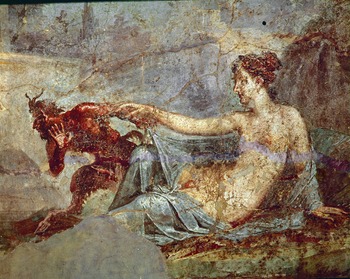
A painting from the House of the Dioscuri in Pompeii emphasizes an imagined confrontation with gender ambivalence, and suggests at least some discomfort with it (Figure 7). This painting, which I take to be humorous in intent, captures a particular moment from a deliberate viewpoint. The figure in the background, probably Pan, has approached a sleeping hermaphrodite from the rear. As such, he was not able to see what we clearly can (or could when the painting was new)—that the figure he intends to molest is an intersexed individual. Pan's visual experience, then, is parallel to that of a Roman viewer who walks around to the front of a sleeping hermaphrodite statue—as inhabitants of Pompeii might well have done, and as millions of visitors to the Louvre do today. In this case, however, as the hermaphrodite awakens and turns towards Pan—perhaps, in this instance, not with resistance but with interest—Pan sees who ze is and flees in a moment of visceral rejection.Footnote 34 His upraised hand and head turned away from the hermaphrodite are clear visual signals of his response.
Pan fleeing from a hermaphrodite, 2nd century CE. Fresco from the Atrium of the House of Dioscuri, Pompeii. 91 × 143 cm. Museo Archeologico Nazionale, Naples. Photo credit: Erich Lessing/Art Resource, NY.

The critical question, of course, is what causes Pan to react in this way in this painting? Pan is well known for his omnivorous sexual appetites and would not necessarily be opposed to having a sexual encounter with an attractive young man, still in the relatively soft phase of attractive adolescence. We should not, then, read this as a moment of ‘homosexual panic’. Rather, what Pan finds off-putting in this scene is precisely that aspect of the hermaphrodite that the sculptures emphasize through surprise: hir full sexual ambivalence.Footnote 35 The point is even more explicit because the hermaphrodite's potential assaulter is himself a hybrid creature (as often): human from the waist up (often with small horns on the head), but a goat from the waist down. So the humor in this painting, as well as in the statue groups, stems from the idea of one hybrid (human/animal) being repulsed by another (female/male).Footnote 36 Now, we viewers are not quite Pan; for the person looking at the painting, perhaps seeing Pan's reaction allows a moment of detached amusement. Unlike Pan, we can view the hermaphrodite and enjoy hir aesthetic qualities (and indeed, we have the best view of hir) and laugh at Pan's moment of emotional discomfort.Footnote 37 Such a viewing may allow, in other words, the Roman viewer to distance himself or herself from feelings of anxiety about the sexual ambiguity of the central figure.
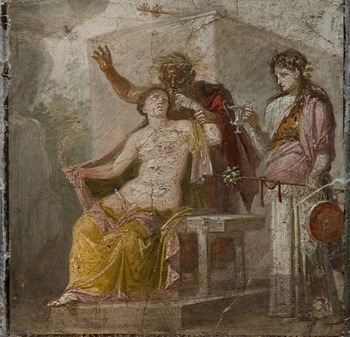
The possibility of another kind of response is brought to light by another of the paintings of a hermaphrodite from Pompeii, from the House of M. Epidi Sabini (Figure 8). Here, Silenus approaches a hermaphrodite from behind, but his reaction is at least ambiguous. The hermaphrodite seems to have a firm grip on Silenus’ beard, and Silenus is holding the hermaphrodite's wrist. Is Silenus trying to get away, or is he rather pleased by what he has discovered?Footnote 38 I think it at least possible that the painting is meant to be read in the context of the depiction of erastai and eromenoi on Attic pottery, in which the erastes is regularly ‘chucking the chin’ of the eromenos, and the eromenos frequently grabs the wrist of the erastes with erotic intent.Footnote 39 Here the eromenos/hermaphrodite has adopted an aggressive version of the erastes’ traditional role, and the erastes/Silenus is perhaps momentarily resisting. But in any case, the figure here is polyvalent enough that we can say the Romans were capable of thinking of the figure of the hermaphrodite in a variety of ways, and were willing to imagine engagement with full sexual ambivalence with erotic pleasure.
Old satyr with hermaphrodite, Imperial Roman, c.50–79 CE. Fresco from the House of M. Epidi Sabini, Pompeii. Museo Archeologico Nazionale, Naples. © Vanni Archive/Art Resource, New York.

The Narrative
In terms of fully expressed sexual ambivalence, the material record is strikingly different from Ovid's text. As Ovid tells the story, Hermaphroditus is the offspring of Mercury and Venus. Though his appearance is mildly gender-ambiguous even before his transformation (see below) his sex at the start seems unequivocally male. He stumbles one day onto the Phrygian spring of Salmacis. Unknown to him, this spring is inhabited by a particularly feminine nymph, who falls in love with the youth at first sight. She approaches him and asks for a kiss, but is rebuffed. Subsequently, she withdraws and hides, leaving Hermaphroditus at the spring; enticed by the clear cool water, he strips naked, plunges in, and begins to swim. At this point, Salmacis leaps into the water and wraps herself around him, kissing him though he resists, in a sexual frenzy. The story reaches its conclusion with two significant prayers: Salmacis prays never to be parted from Hermaphroditus; and Hermaphroditus appeals to his parents and asks that whoever enters this spring in the future will be, as he has been, made soft. Though both prayers are answered, it is significant that they do not have the same aim: Salmacis prays to never be separated from the young man—in other words, she prays, perhaps without realizing it, for the creation of an intersexed individual. Hermaphroditus, male from the start, prays instead for the creation of effeminate men in the future. This, I would argue, is a surprising (and disappointing) conclusion to Ovid's tale of transformation: Hermaphroditus may become intersexed (see below), but the primary signs of that change are simply a softening of his body—and of the bodies of future men who visit this spring.
Ovid's story does present significant challenges to gender norms. One of the curious aspects of his story is that there is a great deal of gender non-normative behavior and gender indeterminacy before Hermaphroditus’ transformation.Footnote 40 At the start of the story, we learn that Hermaphroditus’ male body is ambiguously gendered even before the narrative starts:
It is worth noting that Ovid is already playing games; when he says that this boy—not formally named for another hundred lines—takes his names from his parents, he means of course their Greek names, and even Aphrodite's Greek name is hidden in the Latin under the apparent neologism Cythereis; he does not start life as Mercurivenus, as the Latin text might lead us to understand. The idea that this will be a story about the deity Hermaphroditus is literally hidden from the unsuspecting reader, who will come upon his name only at the end of the tale.Footnote 42 The fact that both mother and father can be seen in him becomes meaningful in a new way once we reach the end of the story, but it is not, in itself, remarkable. Such a statement would not, in another narrative, be taken as a sign of sexual ambiguity, and it is only with hindsight after we finish reading the narrative that we can recognize it as such here.
With Salmacis, however, we begin to see a series of more explicit gender inversions and even doubled inversions. When we first meet the nymph, we are told that she refuses to go hunting with Diana and the other nymphs, preferring to bathe, and wash her hair, and look into her own mirror-like pond:
Now, this behavior is not gender non-normative; but by presenting it as a series of negative statements, Ovid suggest that Salmacis rejects the normal gender-bending of Diana's nymphs (who like to hunt and run wild) in order to adopt a more traditional feminine role. So far in the tale, she is unusual by virtue of being conventionally feminine—so much so, that Robinson has suggested that we are meant to see her as the likely victim of a rape.Footnote 43 But when she sees the young Hermaphroditus, as various scholars have noted, she becomes the subject who views the erotic object, and she wields an aggressive, possessive gaze.
Here it is important to note that, though the behaviors of the two characters in the narrative are mildly non-normative in terms of gender, neither is presented as ambiguously sexed. When Salmacis sees the unnamed youth for the first time, she sees him as a puerum (‘boy’, 4.316), and desires him as such. She attempts to seduce him with a speech modeled on that of Odysseus to Nausicaa in Book 6 of the Odyssey, though here Salmacis plays the role of Odysseus (another mild inversion of gender through intertextual allusion).Footnote 44 At the end of her speech, however, she seems to imagine herself as female in a wished-for heteroerotic union:
The young boy rejects her suggestion and threatens to leave; Salmacis pretends to yield the place to him, and hides behind some shrubbery while Hermaphroditus contemplates her spring. Here, again, he is marked with language that suggests effeminacy: temperie blandarum captus aquarum / mollia de tenero uelamina corpore ponit (‘captured by the coolness of the seductive waters / he takes off the soft clothing from his tender body’, 4.344f.). But this sort of softness and tenderness is appropriate to a young man as well as to a woman; it is part of what makes pueri attractive, to men and women, in the Roman sexual system.Footnote 46 In other words, at this point Hermaphroditus occupies an ambiguous gender status as a puer who has not yet become a man; but nothing in the passage suggests that Salmacis mistakenly desires him as female. Ovid is playing, in other words, with a limited set of ambiguities that were normal—and normative—in the Roman sex/gender-system, but there is little here to suggest that he is challenging those norms.
Once Hermaphroditus plunges into the water, Salmacis attacks him with a vigor that most readers see as masculine:Footnote 47
Again, we should note that Salmacis has no confusion here about what she desires. The fact that she burns with desire for Hermaphroditus’ nuda forma (‘naked body’, 4.346) suggests that there is no sexual ambiguity here, however tender and pale that body is. We do see a nice touch in the final verb, as the spring-nymph captures Hermaphroditus in a particularly aquatic fashion: circumfunditur (4.360): she ‘pours herself around’ him, an image that suggests that Hermaphroditus maintains a male ability to penetrate even in his overwhelmed and fairly passive state (see further below). In this story it is the outwardly feminine Salmacis who behaves like so many male rapists in the Metamorphoses, seeing, grasping, possessing, and taking what she wants. Her eyes are even compared to Apollo (Phoebus) as the sun, a god who pursues numerous women in the Metamorphoses. We should not, however, fail to note how strikingly this rape narrative differs from the sculptural tradition. The sculptures present an aggressive male who attacks a presumed woman. Ovid seems to have deliberately inverted the sex of the aggressor, and presumed sex of her victim, from the depictions in the statue groups, while pushing the gender identity of each to their logical limits: Salmacis is an emphatically feminine nymph with a masculinizing gaze, and Hermaphroditus (still not named) is correctly identified as a male, if a soft, pale, and effeminate one.Footnote 48
Immediately following this passage is one of the poetic showpieces of the episode, a series of three epic similes that describe Salmacis’ rape of the boy:
What is most impressive about this rapid series of similes is the way that Ovid has reimagined rape. In each of the three comparisons, the act of forced sex is described not in terms of penetration, but in terms of surrounding, enveloping, wrapping around. We also see, as my students have pointed out, something of a progression in the three images.Footnote 49 In the first, it is not initially clear who is raping whom: the eagle has grabbed and is holding the snake, who seems initially the victim—but then it turns out to be the snake that does the wrapping-round and constraining. In the second term, we have a fairly passive, vegetal image, and one that suggests a symbiotic rather than violent coupling, but it is clear that the ivy does the wrapping-round. With the third term—an image from the aquatic world—a squid engages in a clear, aggressive act of capture against an ‘enemy’ (hostem, 4.366)—its tentacles metaphorically rendered as whips. The images, then, move from more ambiguous to less, with the representative of Salmacis in each metaphor progressing from grabbed, to passively growing around, to grabbing. By the end of the series, she is an agent of aggressive female rape—in itself a kind of gender reversal—against which all the boy can do is passively hold out and deny joy.
Curiously, all of this carefully prepared gender-bending disappears almost entirely at the moment of transformation, to be replaced by a rather disappointing failure of masculinity.Footnote 50 First, Salmacis appeals to the gods and asks that the two never be parted. After she presses her body against Hermaphroditus, we read that her prayer is fulfilled, though not in the way, presumably, that she had in mind. Here is the critical passage in full:
It is true that Ovid speaks in vague terms of a bisexed body in lines 378f., a point to which I will return. At the point of transformation, however, two curious things happen, as Nugent pointed out over thirty years ago: first, Salmacis seems simply to disappear from the narrative. Hermaphroditus keeps his (bisexed but grammatically masculine) name, and the person who emerges from the pool seems to maintain his consciousness, and thinks of himself, it seems, as still male. Salmacis as a subject simply disappears never to be heard from again.Footnote 52 Second, there is almost no narration of the supposed change in sex in this episode. It is instructive here to look briefly at one of Ovid's other apparent sex change narratives, that of Iphis in Book 9. At the moment when Iphis changes from being a young woman to being a boy (he is not old enough to be a man), we are given a specific catalogue of his changes, which I have argued elsewhere are markers of gender rather than sex:Footnote 53
The contrast to Hermaphroditus’ transformation is striking. The effect of Salmacis merging with Hermaphroditus does not seem to involve the boy developing any specific female sexual characteristics; he does not, in the narrative, grow longer hair, wider hips, a curved torso, more rounded buttocks, or female breasts. Perhaps even more striking, his gender does not seem to change any more than his sex does. His features do not grow less sharp, or his step shorter. One general change and one specific change are mentioned: he finds that the waters he entered ‘as a man’ have made him ‘half-male’ (semimas), and the only physical change mentioned is that his ‘limbs softened’ (4.380–2). As Sharrock has recently put it, ‘[i]t is true that his membra are also mollita and he speaks uoce no longer uirili (4.38f.), but given his youthful, ephebic status at the beginning of the passage and the extreme infectiousness of any one aspect of damage to masculinity, these elements are hardly traces of the individual person who was Salmacis.’Footnote 55
To put it another way, Hermaphroditus’ bisexuality is, as Nugent points out, expressed purely in terms of masculinity and its lack: ‘While we might imagine representing the hermaphrodite in terms of excess, or at least plenitude, Ovid presents it in terms of deficiency; it is not really one, but less than one.’Footnote 56
In other words, despite the suggestion that Hermaphroditus is duplex (4.378) and biformis (4.387), the actual description of this doubled form is distressingly singular—and it is that of the ‘soft’, mollis male.Footnote 57 In fact, it is less than singular, in that being made mollis Hermaphroditus apparently becomes half a man (semiuir).Footnote 58 That figure becomes iterative, moreover, with Hermaphroditus’ prayer. He prays, ‘in a non-manly voice’ (4.382)—a curiously negative declaration that does not tell us what his voice is like—that whatever man enters this spring will ‘emerge half a man, and will soften, in the waves he touches’ (4.38f.).Footnote 59 Rather than praying that men who enter the spring leave it ambiguo sexu, for example, or that they become ‘half-female’, Hermaphroditus only asks that they ‘soften’, mollescat (3.386), the one positively described aspect of his own transformation.Footnote 60 Needless to say, the story does not ever imagine what would happen if a woman entered the spring; the logic of the narrative is such that it is not femininity, but masculinity that is at risk. This narrative, in other words, becomes a prime example of the one-sex model of gender difference, in which femininity, if it can be said to exist at all, is defined as nothing more than a failure of masculinity.Footnote 61
In this regard, we should take a second look at the terms semimas and semiuir, each of which appears in the passage above. Groves suggests that these terms are ‘the traditional and pejorative Roman term for intersex individuals’,Footnote 62 but in fact they are rarely used in that sense. Livy does use the term semimas in that sense twice (Ab urbe cond. 31.12.8; 39.22.5).Footnote 63 Anderson's commentary on this passage notes that these terms are generally not used to describe bisexed individuals; semimas is typically used to denote eunuchs, a category of men thought of as effeminate, diminished in their manhood, but not bisexed. It is in this sense that—back in the Metamorphoses—one of the centaurs who is battling the hyper-masculine Caenus refers to him as semimas in the battle of Lapiths and Centaurs (12.505–7); the centaur is not celebrating Caenus’ sexual ambiguity, but rather attacking his masculinity by suggesting that, despite his superhuman impenetrability, he somehow really still carries the female sex of his birth. This, however, is a battlefield taunt, not a statement of fact.Footnote 64 Similarly, Anderson notes of semiuir that ‘[i]t can apply variously to semihuman monsters like the centaurs, to unmanned people like eunuchs, and to unmanly males like cowards and effeminates.’Footnote 65 The word, despite what we might expect, does not normally denote the intersexed, but rather varieties of molles, ‘soft’ and generally unmanly men. Anderson explains the unusual usages in the story of Hermaphroditus by suggesting that Ovid has no vocabulary to describe the intersexed, and is pressing vocabulary from another gender-non-normative category into awkward service. I argue, rather, that Ovid uses these terms precisely because he has transformed the myth of Hermaphroditus into a story about molles men.
It is true, of course, that the figure Hermaphroditus becomes in Ovid's text is described in terms that suggest, at least briefly, a fully intersexed individual. This is most forcefully brought out in lines 4.378f. (quoted above): nec duo sunt sed forma duplex, nec femina dici / nec puer ut possit, neutrumque et utrumque uidentur (‘They are not two, but a doubled form, such that ze can neither be called / a woman nor a boy; neither and both they seem’). This is Hermaphroditus, after all, and these two lines strike me as a clear nod to the sculptural tradition. Here, briefly, we seem to have an intersexed individual, and the ambiguity that ze presents in these two lines is a challenge. The poet admits, in fact, to being unable to specify hir sex, reflected in gender-neutral pronouns—the only instance in all of the Metamorphoses of a human body referred to in this manner, as Lees points out.Footnote 66 Moreover, as Peter Kelly has shown, line 379 is a clear intertextual reference to Lucretius’ description of the production of androgynous beings in the early phases of creation (as indicated by my emphasis in the final line):Footnote 67
Kelly goes on to suggest that by alluding to Lucretius’ account of creation, Ovid ‘link[s] Hermaphroditus ontologically with an earlier stage in cosmic history’,Footnote 68 and specifically to a time when the materials of the universe, like Hermaphroditus’ sex, were less clearly distinct.
What is remarkable about the passage in Ovid as a whole, however, is how little sexual ambiguity seems to have survived in the character of Hermaphroditus who speaks. As Lees notes, the narrator, Alcithoe, presents his body as sexually ambiguous, but does not describe that ambiguity with any precision.Footnote 69 And if it is difficult for that narrator to discern Hermaphroditus’ sex, he does not express any internal confusion, referring to himself with the noun natus immediately after the transformation. This point is further supported by another of the allusions that Kelly discusses. As Kelly rightly observes, there are a number of parallels between the narrative of Hermaphroditus’ transformation and the story of the creation of the universe at the beginning of the Metamorphoses. In that narration, Kelly states, ‘[t]he elemental opposites of the hot and the cold, the dry and the wet, the soft and the hard, and the light and the heavy are in a state of turmoil, lack stable division and occupy a single body (unum corpus).’Footnote 70 And indeed, I believe that Kelly is right to see these parallels. But what is striking to me is how much more ambiguous is the description of the early universe than the description of Hermaphroditus which follows in Book 4; towards the end of the passage that Kelly discusses, Ovid states:
Where Kelly would like to see in mollia cum duris (1.20) a tie to the mollitia membra of Hermaphroditus (4.381f.), I see rather a striking contrast.Footnote 71 That is, the description of the beginnings of the universe contains a competition between contrasting elements. But Hermaphroditus, as Ovid has described him, is not an amalgam of competing elements; he is just soft, and no positive description marks that softness as significantly different from that which he exhibited before his transformation, other than making it permanent. There is only an ambiguity here if we think of him as a fully adult male, who should, in the Roman value system, be hot, dry, and hard. Despite the ambiguities of 4.378f., in other words, when Ovid describes Hermaphroditus in this narrative, he has only half of the allegedly competing elements. Instead of a challenging third term to the sexual binary, he has been recuperated as a failed man, a soft puer who will remain as such.
Many of the elements of this argument were put forward decades ago by Nugent; but recently scholars, motivated by an entirely laudable desire to not erase intersexed identities from the ancient record—however fictional, have resisted this reading. Many readers, including this author, have a desire to find in Ovid a transgressive author, and a text that challenges the gender binary. And I do not mean to suggest that there is nothing transgressive about the figure of the mollis male in ancient Rome. Indeed, a fully adult male who chose to adopt a mollis persona could, and it seems that some probably did, engage in deliberate challenges to gender norms.Footnote 72 We might legitimately read such individuals as genderqueer, and posing a threat to normative masculinity. But there is no indication in this text that Hermaphroditus sees his transformation—or perhaps, crystallization—as a mollis male as anything but shameful, and his prayer for future bathers in the spring of Salmacis reads as a curse. We can, in other words, read against the grain and see in the figure of Hermaphroditus a model for self-affirming gender non-normativity.Footnote 73 But I do not think that Ovid's text lends itself especially well to such a reading. Instead, Ovid presents the aition of Hermaphroditus as a disaster that happens to a young man against his will (to say nothing of the complete erasure of Salmacis in this same disaster). This is made clearer when we consider some of the possible sources for Ovid's narrative.
The figure of Hermaphroditus is mentioned in Greek and Latin literature before Ovid, but we should note that in no earlier version does a young unambiguously male character become intersexed. As Robinson notes, ‘and as far as anyone considered his early life, it seems likely that he was thought to be born this way’.Footnote 74 It is the story of the transformation—taken so often to be ‘the story’—that seems to be the particular invention of Ovid. And if we read carefully, we will realize that this invention of Ovid's is not the story that we should have expected. In fact, the story that Ovid's internal narrator initially sets up is an aition, but not an aition for intersexed individuals, precisely. Rather it is an aition for the remarkable qualities of the spring at Salmacis:
Hermaphroditus’ prayer at the end of the story becomes the ‘cause’ that the story narrates: not the creation of the intersexed deity, but why men who enter the spring come away softened, ‘half-men’.
Unlike the story of Hermaphroditus’ transformation, this aspect of the story seems not to be Ovid's invention: the spring of Salmacis was well known enough that other sources refer to its characteristic softening qualities. Vitruvius argues that the ‘softening’ properties of the spring are in fact a metaphor for the fact that the spring led to (Greek) civilization of the local barbarians, after a Greek colony arrived there (2.8.12). In a similar vein, Strabo discredits the allegations that the spring causes softening, and uses this argument to moralize instead about self-control:
ἡ Σαλμακὶς κρήνη, διαβεβλημένη οὐκ οἶδ’ ὁπόθεν ὡς μαλακίζουσα τοὺς πιόντας ἀπ’ αὐτῆς. ἔοικε δ’ ἡ τρυφὴ τῶν ἀνθρώπων αἰτιᾶσθαι τοὺς ἀέρας ἢ τὰ ὕδατα⋅ τρυφῆς δ’ αἴτια οὐ ταῦτα, ἀλλὰ πλοῦτος καὶ ἡ περὶ τὰς διαίτας ἀκολασία.
(Geogr. 14.2.16)The spring of Salmacis has been slandered—I know not why—as softening those who drink from it. For the delicacy of humans seems to be blamed on airs or waters. But the cause of delicacy is not these things, but wealth and lack of control in one's way of life.
For both Strabo and Vitruvius, then, the idea that the spring softens men is known, but either recuperated or rejected: for Vitruvius, this ‘softening’ is a metaphor for various civilizing influences, while in Strabo's case, softness maintains a negative sense, that of an unmanly ‘delicacy’ (τρυφή).
Neither Strabo nor Vitruvius mention Hermaphroditus, though, and we might have thought that combining Hermaphroditus with Salmacis was a characteristically brilliant innovation of Ovid's own. But as it happens, we have a likely source for this combination. A Hellenistic inscription found at the spring of Salmacis in Halicarnassus in 1995 and published in 1998 contains a lengthy, somewhat discontinuous narrative about the many wonders of the local site of Halicarnassus.Footnote 75 The date of the inscription is not entirely secure, but is generally taken to be the 2nd or 1st century BCE—earlier than Ovid, at any rate. Lines 17–22 of this inscription contain a curious version of a myth in which Hermaphroditus interacted with Salmacis.
νύμφης ἱμερτὸν κατέχει δόμον, ἥ ποτε κοῦρον
ἡμέτερον τερπναῖς δεχαμένη παλάμαις
Ἑρμαφρόδιτον θρέψε πανέξοχον, ὃς γάμον εὗρεν
ἀνδράσι καὶ λέχεα πρῶτος ἔδησε νόμωι·
αὐτή τε σταγόνων ἱεροῖς ὑπὸ νάμασιν ἄντρου
πρηύνει φώτων ἀγριόεντα νόον.
(SEG 48.1330.17–22)Footnote 76
She [the city of Halicarnassus] controls the lovely home of the nymph [Salmacis], who once
received our kouros in her delightful hands,
and nourished Hermaphroditus the completely eminent, who discovered marriage
for men, and first bound beds with law.
And she [Salmacis], under the sacred streams dripping in the cave,
softens the uncivilized mind of men.
In this version of Hermaphroditus’ story, ze was already bisexed when ze arrived at the spring (in keeping with all other known myths of Hermaphroditus at this time); Salmacis’ role was to nurture hir, in lines that make Salmacis parallel to the nymphs that nurtured Hermaphroditus ‘in Idaean caves’ at the start of Ovid's story (Met. 4.288f., quoted above). Later, we are told, Hermaphroditus initiated the practice of marriage. Here the softening role of the spring—who does not disappear—comes to be enacted by her divine adopted son, and is expressed in entirely positive terms. This text, somewhat surprisingly, presents a positive image of Hermaphroditus as intersexed and genderqueer, and an attempt to recognize the importance of hir in the local history and culture of the place. In this regard, the inscription is very much in line with the explanatory version of Vitruvius.
It seems at least possible that Ovid knew the inscription—or some version like it—and that this was what inspired him to create a transformation story for Hermaphroditus that involved the famously ‘softening’ spring Salmacis.Footnote 77 This would have been the kind of clever, recherché bit of Hellenistic knowledge that Ovid would be proud of. We should note here too the introduction to the narrative, in which Ovid calls attention to the ‘hidden’ cause of the spring's properties (4.287). The spring may have been well known, but the relation to Hermaphroditus seems less so, and what Ovid's narrative does is make the creation of Hermaphroditus into the cause for the spring's qualities; a ‘hidden’ cause, perhaps, because Ovid invented it.Footnote 78
If we assume that Ovid knew the inscription, or a version like it, then it is instructive to note how his narrative differs from it. First, it seems, then, that Ovid has deliberately sexualized the myth: Salmacis in Ovid is a rapist instead of a wet-nurse, and the thing that makes Hermaphroditus an intersexed individual is an act of forced sex.Footnote 79 Second, unlike the version in the Salmacis inscription, Hermaphroditus’ legacy is not one of civilization and lawful marriage (in entirely positive terms), but rather the production of not-quite-men.Footnote 80 Hermaphroditus becomes a semimas, and the men who follow him will become semiuiri, not civilized husbands. Ovid's Hermaphroditus is recuperated, again, simply as an effeminate man, a boy who maintains his softness and never achieves full masculinity.
Rejecting Ovid
A multivalent response to gender instability is precisely what Ovid's description, I would argue, does not give us. His Hermaphroditus is playing with a set of instabilities, but a different set than that of the sculptures—namely, those that surround the perennial anxiety of performing Roman masculinity. But because Ovid's figure seems resolutely male, if not masculine, even after the transformation, he is ultimately less challenging than the material representations of hir. We can, of course, rescue Ovid as a postmodern champion of polyvalency—we can point to the words biformis and duplex in the description of the transformation, and insist on their primacy, despite the lack of any ensuing positive description. As resisting readers, we could suggest that Ovid, by dislocating this myth from being an origin story of the bisexed god who invented marriage to an origin story of molles males, presents a comment on the instability of masculinity as a function of regulatory social roles. But it seems to me that we are working rather hard, in this instance, to preserve a vision of Ovid that the text does not fully support.Footnote 81
Recently Vanda Zajko, for entirely commendable reasons, has suggested that, if we ‘listen with’ Ovid, we can use his text as a way to open up space in the modern world for intersexed or genderqueer individuals.Footnote 82 She does so despite clearly acknowledging the problems of Ovid's text, and her final admonition is less an interpretation of the text than an advocation of a certain kind of reading. She suggests that ‘[t]he strategic choice of highlighting either plenitude or lack in any particular interpretative moment should not obscure the potential of the story to celebrate the originality of Hermaphroditus, to herald him, in the words of Canguilhem, as “an inventor on the road to new forms”.’Footnote 83 I am sympathetic to Zajko's proposed reading, and happy to ‘celebrate the originality of Hermaphroditus’. But as I have gotten older, I have grown less interested in rescuing Ovid from himself; this story seems to me deliberately less radical and less challenging than the images we find in Roman houses and villas. It is, in my mind, roughly parallel (though not identical) to the sort of modern abusive behaviors that equate various trans identities with homosexuality, generally with the intent of denigration. Perhaps it is not worth the effort to recuperate Ovid's narrative; perhaps we should acknowledge that here Ovid is a masculinist Roman for whom the intersexed Hermaphroditus becomes a vehicle in his literary game to present the mollis male as a failed man. I suggest that using Ovid's narrative to interpret the Roman images is both misdirecting and constraining rather than liberating. We should take seriously Zajko's injunction to listen; but we may find it more productive to ‘listen with’ the sculptural and painted representations of Hermaphroditus that became so curiously popular during the latter half of the first century CE in Rome and Roman Italy.