





Introduction
Lumbar degenerative disc and facet joint disorders are a common cause of chronic low back pain (CLBP) and disability among the adult population (Traeger et al., Reference Traeger, Buchbinder, Harris and Maher2017; Australian Commission on Safety and Quality in Health Care, 2022). CLBP is one of the commonest conditions seen in primary care (Traeger et al., Reference Traeger, Buchbinder, Harris and Maher2017) and its management is often challenging due to the variable contributions of biological, social and psychological components (Traeger et al., Reference Traeger, Buchbinder, Harris and Maher2017; Croft et al., Reference Croft, Sharma and Foster2020; Australian Commission on Safety and Quality in Health Care, 2022). Percutaneous image-guided pain procedures (PIGPP) are commonly used in the management of CLBP (Manchikanti et al., Reference Manchikanti, Falco, Pampati, Cash, Ramsin, Benyamin and Hirsch2013; NICE Guidelines (NG59) LBP and sciatica in over 16s; 2016; National Institute for Health and Care Excellence (NICE), 2016; Juch et al., Reference Juch, Maas and Ostelo2017; Ashton et al., Reference Ashton, Price, Fleming, Blom, Culliford, Evans, Foster, Hollingworth, Jameson, Jeynes, Moore, Orpen, Palmer, Reeves, Rogers and Wylde2024). These procedures, which include injections of steroids, anti-inflammatory agents and local anaesthetics around the spinal and nerve root dura, facet joints and lumbar medial branch dorsal rami, may be done for diagnostic or therapeutic purposes.
There is no consensus regarding either how or when to assess efficacy of these various procedures although changes in pain levels, disability levels, quality of life measures and mental health scales have all been advocated (NICE Guidelines (NG59) LBP and sciatica in over 16s, 2016). Consequently, the evidence base for these procedures is variable (NICE Guidelines (NG59) LBP and sciatica in over 16s, 2016; Traeger et al., Reference Traeger, Buchbinder, Harris and Maher2017; Beynon et al., Reference Beynon, Elwenspoek and Sheppard2019). A recent review of 22 international guidelines (Zhou et al., Reference Zhou, Salman and McGregor2024) found neither mention nor recommendation for their use. UK NICE guidelines, 2016 (18), and findings from the NERVES RCT (Wilby, Reference Wilby, Best and Wood2021), advocate epidural foraminal steroid injections only for sciatica. Despite the variable and generally cautious recommendations concerning these procedures their use increased by 14% year on 200% in the USA over the period 2010–2019 (Manchikanti et al., Reference Manchikanti, Abd-Elsayed, Kaye, Pampati, Sanapati, Nampiaparampil, Knezevic, Soin, Gharibo and Hirsch2024) and their cost–benefit analysis remains unclear (Manchikanti et al., Reference Manchikanti, Falco, Pampati, Cash, Ramsin, Benyamin and Hirsch2013; Juch et al., Reference Juch, Maas and Ostelo2017; NICE Guidelines (NG59) LBP and sciatica in over 16s, 2016; Ashton et al., Reference Ashton, Price, Fleming, Blom, Culliford, Evans, Foster, Hollingworth, Jameson, Jeynes, Moore, Orpen, Palmer, Reeves, Rogers and Wylde2024).
In this study, which was prompted by a review that revealed 28% (95% CI 19–37%) of new patients referred from primary care with LBP to a South Australian specialist spinal centre had undergone one or more PIGPP in the 6 months prior to referral (Tennant et al., Reference Tennant, Yau, Yull, Murphy and Whittle2023), we audited practice concerning these therapies for the calendar year 2022 at a suburban South Australian capital city primary care centre with two clinics. The primary aim was to describe the incidence and type of diagnostic and therapeutic PIGPP in this cohort. Secondary aims were to: i) evaluate the pain profiles of the patients to whom the procedures were prescribed; (ii) evaluate how and when the practitioners prescribing these procedures evaluated their effectiveness; iii) establish how many of the GPs at the centre used these procedures; and (iv) compare the data to other primary care centres. The audit findings, although temporally coinciding with the publication of the Australian National Commission into Low Back Pain (2022), are useful since they provide insight into the use of these procedures in a non-academic (Croft et al., Reference Croft, Sharma and Foster2020) primary care setting that potentially could be extrapolated to other Australian practices.
Methods
Setting
South Australian capital city suburban primary care centre with two practice locations.
Study type
An audit.
Cohort
Adult (≥ 18 years) patients who presented with LBP at the primary care centre between January 1, 2022, and December 31, 2022. Patients with a diagnosis of cancer were excluded.
Search terms and data collected
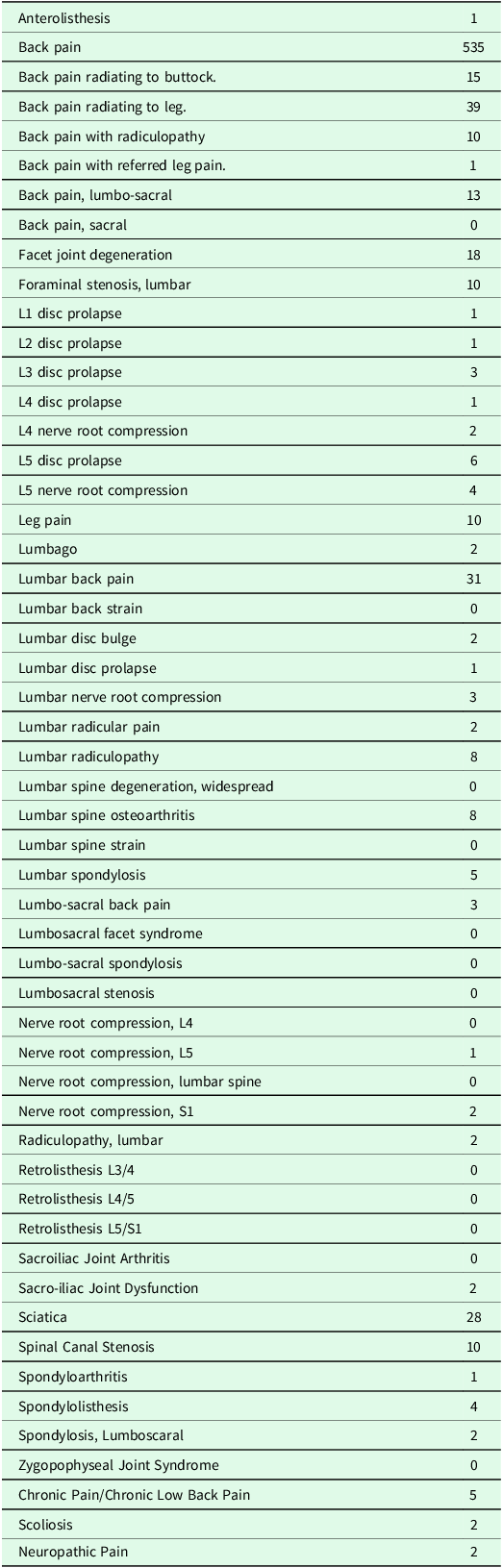
The practice database (Best Practice software versions: from January 2022 Saffron SP2 Rev1 and from September 2022 Saffron SP3) was explored using 53 defined diagnostic terms and codes to identify individuals with LBP and those who underwent a PIGPP (e.g. facet joint, foraminal or translaminar epidural steroid injection and radiofrequency denervation). The MeSH (medical subject headings) terms used are listed in appendix 1 and are all native to the Best Practice software (not custom coded).
For relevant patients demographic (age, gender, Body Mass Index [BMI]), pain distribution and duration, previous management strategies (pharmacotherapy, physical therapies), prior radiological investigations (X-rays, Bone scans, CT or MRI scans), prior percutaneous image-guided spinal injections, clinician ordering the procedure or referral and any lumbar surgery were recorded. Data was extracted by three investigators (JL, JT and NG) and any queries resolved by discussion with DY.
The type of PIGPP, number of levels and laterality were documented. The notes were interrogated for any documentation of the pre- and post-interventional objective status of the patient regarding their pain, disability and quality of life scores.
Comparison of practice to other centres and guidelines
Several relevant review articles on clinical practice guidelines for LBP in primary care and secondary care were reviewed together with findings concerning PIGPP performed in primary care centres.
Statistical analysis
Since this was an audit, descriptive statistics (means, standard deviations and 95% Confidence Intervals) were used rather than statistical methods that test hypotheses (Kooistra, Reference Kooistra, Dijkman, Einhorn and Bhandari2009). Variables were described by means and confidence intervals and compared using the Welch’s two sample t-test, Mann–Whitney U test and Fishers exact test.
Ethics
This project was approved by the Adelaide University Low-Risk Human Research Ethics Committee, approval number H-2023-297. A waiver of written informed consent was also granted.
Results
The two primary care sites at which the study was performed had 21 GPs (9.0 wte) and 29,578 registered patients during the period of study whose age ranges were <24 years (32%), 24–44 years (33%) and >45 years (35%). The two clinics are located 22 and 24 km from the Adelaide Central Business District and are mixed billing practices. In 2022, 75,184 GP appointments occurred across both sites. They are located in an area with an Index of Relative Social–Economic Disadvantage of 1030 and an Index of Relative Social–Economic Advantage and Disadvantage of 986 ranking it 10th and 15th respectively of least disadvantaged areas of 72 Local Governments Regions in South Australia (The City of Adelaide Socio-Economic indexes for Areas, 2021).
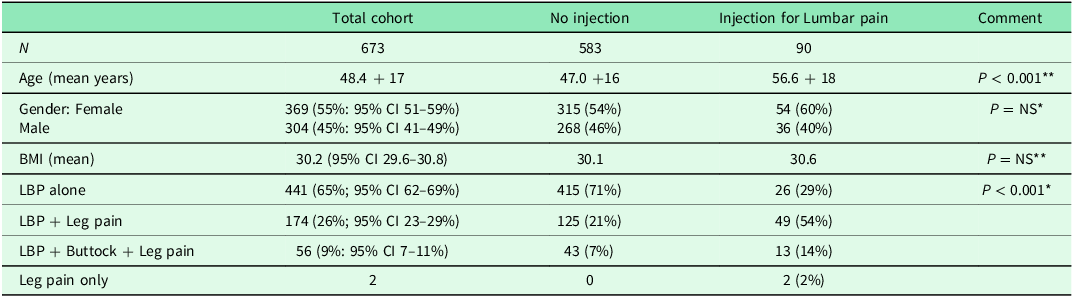
The search of both sites’ databases identified 2828 adult (≥18 years) patients who had a history of one of the 50 LBP related MeSH terms up to and including 2022. The clinical records for these patients were examined, and 673 patients were identified as having been seen in 2022 by a GP and coded with one or more of the MeSH terms. The demographic (age, gender), BMI and details of location of their pain are listed in Table 1.
Demographic and clinical features of 673 patients seen during 2022 at an Australian suburban primary care centre with symptoms suggestive of lumbar musculoskeletal degeneration causing LBP. Ninety had a percutaneous image-guided pain procedures (PIGPPs). The cohort ages and BMIs of the PIGPP patients and non-PIGPP patients were similar, but the former were significantly younger. Patients with CLBP alone were significantly less likely to have a PIGPP than those patients with CLBP plus leg/buttock pain

Table 1. Long description
A table comparing demographic and clinical features of 673 patients seen during 2022 at an Australian suburban primary care center with symptoms suggestive of lumbar musculoskeletal degeneration causing lower back pain (LBP). The table has 10 rows and 5 columns. The columns are labeled Total cohort, No injection, Injection for Lumbar pain, and Comment. The rows are labeled N, Age (mean years), Gender: Female, Gender: Male, BMI (mean), LBP alone, LBP + Leg pain, LBP + Buttock + Leg pain, and Leg pain only. The table presents data on the number of patients, their mean age, gender distribution, mean BMI, and the location of their pain. Notable trends include significant differences in age and pain location between patients who received injections and those who did not.
Abbreviations: BMI = Body Mass Index; LBP = lumbar back pain; NS = not significant; CI = Confidence Limits; NS not significant: * = Fisher Exact test; ** Welch’s two sample t-test.
Of the 673 patients, 90 (13%: 95% CI 11–16%) had a PIGPP. There were no significant differences in BMI or gender distribution in those having a PIGPP compared to those not having a procedure, but these patients were significantly (p < 0.001) older (see Table 1). The incidence of a PIGPP was significantly lower in those patients with LBP alone compared to patients with LBP and combinations of leg and buttock pain (p < 0.001: Fishers Exact test). Eighty-eight of the patients undergoing PIGPPs (97%) had CLBP (that is pain >3 months in duration). The duration of LBP was between 3 and 12 months in 12 patients (13% of the PIGPP cohort) and >12 months for 76 patients (84% of the PIGPP cohort). Two patients with predominant sciatica had a PIGPP within 3 months of pain onset. Both patients had a foraminal steroid injection.
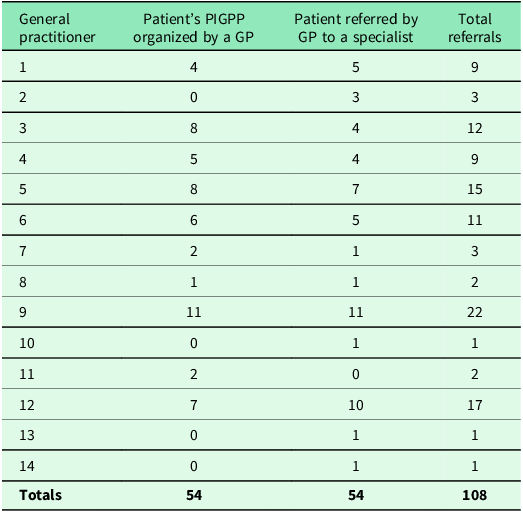
Fourteen of the 21 GPs in the practices organized the management of these patients. In 54 patients the procedures were organized primarily by the GP, in 44 patients by a specialist clinician following GP referral to the specialist and in 2 cases it could not be determined (see Table 2). Seven patients had lumbar spinal surgery prior to 2022 and 4 had surgery during 2022. The number of GP appointments with LBP issues for each of the 90 patients who had a PIGPP during 2022 ranged from 1 to 18 with mean 4 and median 3.
The number of percutaneous image-guided pain procedures organized directly or following referral to a medical specialist by each of the 14 general practitioners (GPs) who were involved in the management of the 90 LBP patients having these procedures in 2022. The number of total referrals to a specialist is >46 since 8 patients were re-referred to a specialist by a GP

Table 2. Long description
A table titled ‘The number of percutaneous image-guided pain procedures organized directly or following referral to a medical specialist by each of the 14 general practitioners (GPs) who were involved in the management of the 90 LBP patients having these procedures in 2022.’ The table has 14 rows and 4 columns. The columns are labeled ‘General practitioner,’ ‘Patient’s PIGPP organized by a GP,’ ‘Patient referred by GP to a specialist,’ and ‘Total referrals.’ Each row corresponds to a different general practitioner and shows the number of procedures organized directly by the GP, the number of procedures following referral to a specialist, and the total number of referrals. The data is as follows: Row 1: General practitioner 1, Patient’s PIGPP organized by a GP 4, Patient referred by GP to a specialist 5, Total referrals 9. Row 2: General practitioner 2, Patient’s PIGPP organized by a GP 0, Patient referred by GP to a specialist 3, Total referrals 3. Row 3: General practitioner 3, Patient’s PIGPP organized by a GP 8, Patient referred by GP to a specialist 4, Total referrals 12. Row 4: General practitioner 4, Patient’s PIGPP organized by a GP 5, Patient referred by GP to a specialist 4, Total referrals 9. Row 5: General practitioner 5, Patient’s PIGPP organized by a GP 8, Patient referred by GP to a specialist 7, Total referrals 15. Row 6: General practitioner 6, Patient’s PIGPP organized by a GP 6, Patient referred by GP to a specialist 5, Total referrals 11. Row 7: General practitioner 7, Patient’s PIGPP organized by a GP 2, Patient referred by GP to a specialist 1, Total referrals 3. Row 8: General practitioner 8, Patient’s PIGPP organized by a GP 1, Patient referred by GP to a specialist 1, Total referrals 2. Row 9: General practitioner 9, Patient’s PIGPP organized by a GP 11, Patient referred by GP to a specialist 11, Total referrals 22. Row 10: General practitioner 10, Patient’s PIGPP organized by a GP 0, Patient referred by GP to a specialist 1, Total referrals 1. Row 11: General practitioner 11, Patient’s PIGPP organized by a GP 2, Patient referred by GP to a specialist 0, Total referrals 2. Row 12: General practitioner 12, Patient’s PIGPP organized by a GP 7, Patient referred by GP to a specialist 10, Total referrals 17. Row 13: General practitioner 13, Patient’s PIGPP organized by a GP 0, Patient referred by GP to a specialist 1, Total referrals 1. Row 14: General practitioner 14, Patient’s PIGPP organized by a GP 0, Patient referred by GP to a specialist 1, Total referrals 1. The totals for each column are: Patient’s PIGPP organized by a GP 54, Patient referred by GP to a specialist 54, Total referrals 108.
These 90 patients underwent a total of 103 PIGPPs. Seventy-seven patients had a single session PIGPP and 13 patients PIGPPs on two separate sessions. The procedures comprised 39 facet joint steroid injections, 33 foraminal epidural injections, 23 interlaminar caudal epidural injections and 8 Radiofrequency rhizotomies for facet joint pain. The PIGPPs were performed at one spinal level in 63 patients, two levels in 21 patients and more than two levels in 6 patients. Procedures were bilateral in 49 patients and unilateral in 41. The medication injected was usually a combination of Betamethasone or Dexamethasone and Ropivacaine or Lidocaine with the precise combination and injected volume varying with practitioner performing the procedure.
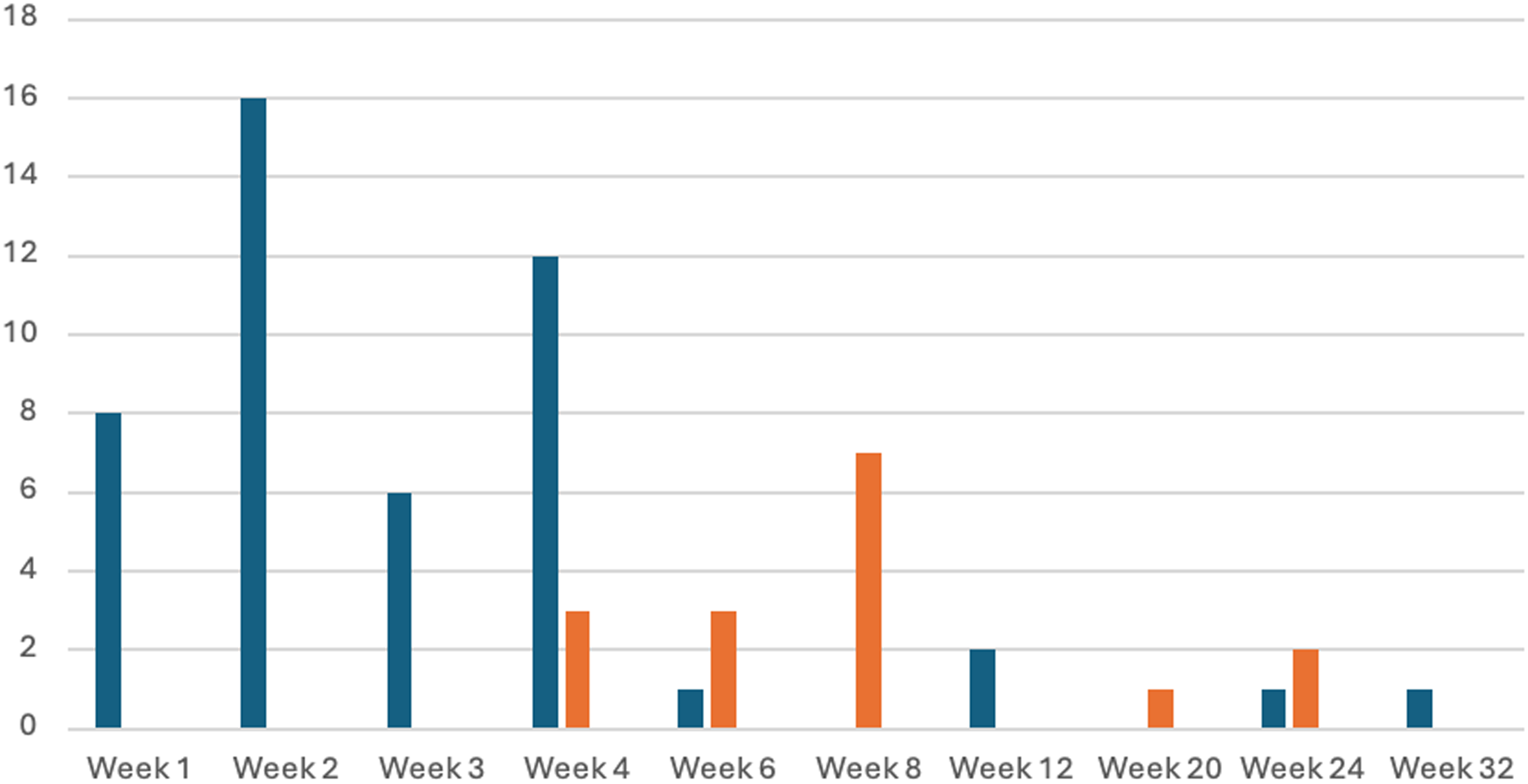
The outcome of the procedures was documented in the records for 47 of the 54 patients whose PIGPPs were arranged by the GP (87% follow up 95% CI 75–95%). This documentation was a qualitative statement with 34 (72% (95% CI 57–84%) showing ‘some improvement’ and 13 (28%; 95% CI 16–43%) ‘none’. Forty-two of 44 patients referred to a medical specialist were followed up after the PIGPP by the specialist and correspondence sent to the GP. Whilst the primary care practice received evidence of specialist review in these 42 patients, outcome after injection was recorded in only 16 patient’s letters (38%; 95% CI 24–52%). Of these 16, one half had reductions in pain after injection and the other half did not. In none of the 90 cases was there any objective documentation of Patient-Reported Outcome Measures such as changes in pain visual analogue score, quality of life score or disability score. There was also no documentation about any procedural complication. Figure 1 details when the patients where first followed up after the procedure. GPs reviewed patients significantly earlier (median week 2 post-procedure) than specialists whose median time to review was week 8 post-procedure (p < 0.001; Mann–Whitney U test).
Time of initial follow-up following a percutaneous image-guided spinal procedure for LBP in patients seen by their GP (blue bar) or specialist (orange bar). There is a bi-modal distribution with GPs seeing their patients significantly (p < 0.001 Mann-Whitney U test) earlier than the medical specialist (median week 2 versus week 8 respectively).

Discussion
This audit analysed the use of PIGPPs at a South Australian suburban primary care centre in 2022. These procedures were used in 90 (13%: 95% CI 11–16%) of 673 patients diagnosed with various MeSH terms covering LBP and lumbar degenerative conditions. Fifty-four of these patients (60%: 95% CI 49–70%) had their PIGPP managed directly by GPs, 44 after referral to a specialist and in 2 it was not determined. Patients having the procedures were significantly older and had significantly more leg and buttock pain than those not having a PIGPP. Ninety-seven percent also has chronic pain (> 3 months) with the majority (84%) having pain for>12 months before undergoing the PIGPP. There is no directly comparable dataset analysing the incidence of image-guided spinal procedures from a primary care centre. Kamper et al., Reference Kamper, Logan and Copsey2020, in a systematic review of 26 studies, reported data that included management of LBP from 18 family practices. Although it reported the use of medicines, physical therapies and specialist referrals it did not mention PIGPPs. In an editorial on the paper by Kamper and colleagues Croft and colleagues (Croft et al., Reference Croft, Sharma and Foster2020) concluded ‘we don’t know the half of it’ alluding to the guideline discordant practices described. Subsequent studies of LBP management in primary care from France (Peurois et al., Reference Peurois, Bouton and Bègue2022) and Spain (Kovacs et al., Reference Kovacs, Fernández, Cordero, Muriel, González-Luján and Gil del Real2006) also did not mention PIGPPs.
The absence of comparative data is perhaps not surprising since in a review of practice guidelines for primary care for LBP in 2018, five guidelines did not recommend PIGPPs and four did not recommend radiofrequency denervation (Oliveira et al., Reference Oliveira, Maher and Pinto2018). Two guidelines did however suggest diagnostic blocks to the facet joints as a guide to the utility of subsequent radiofrequency denervation (Oliveira et al., Reference Oliveira, Maher and Pinto2018). Traeger et al., Reference Traeger, Buchbinder, Harris and Maher2017 also reported aspects of CLBP treatments in a narrative review and both epidural and facet joint steroid injections were not recommended by either contemporary UK or US guidelines. Although these procedures are specialized in nature and different healthcare systems may adopt different models in referral and performance, this study provides novel data that could be a benchmark for other Australian primary care practices.
In addition to defining the incidence of these procedures, the findings identified a major issue with absence of objective measurements of pain, disability and functional status of patients both before and after the procedures by the GPs. No standardized assessments such as pain Numerical Rating Scale or Visual Analogue scale, Oswestry Disability Index or EQ-5D were used. Outcomes were qualitative and binary in nature (‘improved/not improved’) and recorded at variable times after the injection that differed significantly between GPs and specialists. If these procedures are to be used in primary care a consensus as to which pain, functional and disability scales that should be used and when they should be performed needs to be made. The absence of documentation of any complications (Voelker et al., Reference Voelker, Pirlich and Heyde2022), is another shortcoming. Without longitudinal, objective data the contribution both medically and financially of PIGPPs in patients with CLBP, with or without radicular involvement remains, unclear. Another problem compounding such data and assessments is that often CLBP patients have multiple psychosocial and medical comorbidities that may complicate and limit the validity of the instrument administered specifically to changes in CLBP (Rundell et al., Reference Rundell, Gold, Hansen and Bresnahan2017; Curatolo et al., Reference Curatolo, Rundell, Gold, Suri, Friedly, Nedeljkovic, Deyo, Turner, Bresnahan, Avins, Kessler, Heagerty and Jarvik2022).
Given that many primary care clinical practice guidelines do not recommend these procedures and there is consistent evidence of their limited clinical roles and inconclusive evidence base as both a therapy and diagnostic tool (Kim et al., Reference Kim, Sharma and Gupta2021; Curatolo et al., Reference Curatolo, Rundell, Gold, Suri, Friedly, Nedeljkovic, Deyo, Turner, Bresnahan, Avins, Kessler, Heagerty and Jarvik2022; Ashton et al., Reference Ashton, Price, Fleming, Blom, Culliford, Evans, Foster, Hollingworth, Jameson, Jeynes, Moore, Orpen, Palmer, Reeves, Rogers and Wylde2024) why are they performed in primary care? Two-thirds of the GPs at the sites, directly or indirectly, referred patients for these procedures. Although the senior author (DY) has an Extended role in Spinal medicine (Whittle et al., Reference Whittle, Yull, Yee, Czechowicz, Murphy, Clausen and Yau2023) and is familiar with the spectrum of PIGPPs many of his GP colleagues who do not have a specific interest in LBP management, also referred patients for these procedures. This referral pattern may have been prompted by the fact that almost all these patients (98%) had chronic LBP, with the 84% having LBP > 12 months. The 2022 LBP Clinical Standard (Australian Commission on Safety and Quality in Health Care, 2022) suggests specialist referral when pain has not resolved by 12 weeks. Additionally, only 23 of 440 patients (5%: 95% CI 3–8%) with LBP alone underwent a PIGPP compared to 67 of 233 (29%: 95% CI 20–30%) patients having combinations of LBP, leg and buttock pain (p < 0.001). This is reassuring in that the GPs are cautious about arranging these procedures until the recommended non-interventional managements have failed and or CLBP symptoms have evolved and spread to the buttock and leg. Nonetheless the 29% incidence of PIGGS in the later population is high given the various guidelines about their use. There are, however, many reasons why GPs do not follow clinical guidelines (Cranney et al., Reference Cranney, Warren, Barton, Gardner and Walley2001; Slade et al., Reference Slade, Kent, Patel, Bucknall and Buchbinder2016; Croft et al., Reference Croft, Sharma and Foster2020) and this may explain the use of PIGPPs in this audit.
There are several limitations to the study. As with all audits there may be incorrect, incomplete or complete omission of relevant data in the case notes such as the indeterminate outcomes in many patients who had their injections managed by medical specialists. (Logan et al., Reference Logan, Dawe, Aubrey-Bassler, Coombs, Parfrey, Maher, Etchegary and Hall2020). In addition, assessment of the outcomes of the injections was severely limited by failure of the clinicians to use any objective measurement tools. This finding is representative of a well recognized deficiency in electronic medical records from primary care (Dungey et al., Reference Dungey, Glew, Heyes, Macleod and Tate2016; Canaway et al., Reference Canaway, Chidgey, Hallinan, Capurro and Boyle2024). However, rectifying such problems is unfortunately not straightforward (Costa et al., Reference Costa, Lin, Blyth, Huckel-Schneider, Buchbinder, Gnjidic, Langford, O’Connor, Schneider and French2025).
The absence of any data relating to procedural complications, although uncommon (Voelker et al., Reference Voelker, Pirlich and Heyde2022) is also problematic. These collective shortcomings are multifactorial (Croft et al., Reference Croft, Sharma and Foster2020) and reflect that the study was a retrospective audit and not a prospective study with a dedicated protocol and time for the GPs to collect relevant data. Thus, although the study can describe incidence of PIGPPs and some demographics, it cannot and does not provide information concerning evaluation or appropriateness of PIGPPs, their clinical effectiveness, or about the functional or cost–benefit analysis of these procedures.
Since the study was supervised by the senior author and auditing his own practice there is a possibility of ascertainment bias. However, we approached the study with an open mind regarding the potential findings and we do not believe there was any confirmation or procedural bias. We believe the data are robust in providing a snapshot of the incidence and use of PIGPPs in Australian suburban primary care in 2022. The possibility of either not coding correctly or mis-coding patients who had LBP during 2022 is a real possibility and represents a well-recognized problem that can result in under coding of a disease in primary care (Yimer et al., Reference Yimer, Zhang, Humphries, Lunt, Jani, McBeth and Dixon2025). However, the patient numbers, gender distributions and age profiles are all very similar to recent studies evaluating other aspects of LBP in primary care (Kovacs et al., Reference Kovacs, Fernández, Cordero, Muriel, González-Luján and Gil del Real2006; Peurois et al., Reference Peurois, Bouton and Bègue2022). Although the two practice sites are located in relatively affluent suburbs, a recent review has suggested that age, gender and socio-demographic characteristics do not significantly influence help-seeking in patients with LBP (Adamson et al., Reference Adamson, Hunt and Nazareth2011).
The findings of a relatively high use of PIGPPs may reflect the senior author’s (DY) influence on the practice both as a respected senior clinician and GP specialist in spinal medicine, a so-called spinal clinician (Whittle et al., Reference Whittle, Yull, Yee, Czechowicz, Murphy, Clausen and Yau2023). To determine whether this incidence and practice of PIGPPs for CLBP in primary care is an idiosyncratic finding or representative of practice at other Australian suburban and rural primary care centres therefore requires further studies.
Conclusion
Future studies need to address the issue of paucity of objective clinical data accompanying the use of PIGPPs in primary care. Prospective studies about PIGPPs should consider asking patients to fill in Oswestry Disability Index, an EQ-5D-5L to assess quality of life and a visual analogue pain score prior to the PIGPP since this would provide important baseline data that may allow evaluation of their appropriateness, cost and clinical effectiveness.
Data availability statement
The data for this study is held privately and securely by the Corresponding Author Dr Derek Yull (derek.yull@adelaide.edu.au).
Acknowledgements
The authors would like to thank the current and ex-practice managers and all participating GPs at the practices at HealthSense Medical Centres, Golden Grove and Fairview Green, South Australia.
Author contributions
Jordan Lesicar: Methodology, Software development and designing computer programmes, Investigation, Writing – original draft and review.
Joshua Tinnion: Investigation, Writing – original draft and review.
Nik Glynatsis: Investigation, Writing – original draft and review.
Yun-Hom Yau: Resources, Writing – original draft and review, Supervision.
Ian Whittle: Validation, Formal Analysis, Data curation, Writing – original draft and review, Visualization.
Derek Yull: Conceptualization, Methodology, Validation, Formal Analysis, Investigation, Resources, Data Curation, Writing – original draft and review, Visualization, Supervision, Project Administration, Funding Acquisition.
Funding statement
The corresponding author received the RACGP Foundation ANEDGP Innovation Grant 2024 for this study.
Competing interests
None of the authors has any conflict of interest relating to this study
Ethical standards
The research was performed in accordance with the relevant guidelines and regulations, e.g. the Australian National Statement on Ethical Conduct in Human Research which is in accordance with the National Health and Medical Research Council Act 1992 and the Declaration of Helsinki. Ethics approval for the study was obtained from The University of Adelaide Low-Risk Human Research Ethics Committee number H-2023-297.
Appendix A
See Table A1.
Search terms used and frequency of occurrence (total 789 as some patients given more than one code per visit)

Table A1. Long description
A table with 2 columns and 35 rows. The first column lists various search terms related to back pain and spinal conditions, and the second column shows the frequency of occurrence for each term. The terms include conditions like anterolisthesis, back pain, facet joint degeneration, disc prolapse at different levels, nerve root compression, radiculopathy, and various types of lumbar spine issues. The frequencies range from 0 to 535. Notable terms with higher frequencies include back pain (535), lumbar back pain (31), and facet joint degeneration (18). Terms with a frequency of 0 include lumbar back strain, lumbosacral facet syndrome, and several others.

 Open access

