1 Introduction
In analogy with group theory, a fusion category
 ${\mathcal C}$
is called perfect if and only if the trivial simple object
 $\textbf {1}$
is the unique one-dimensional simple object of
 ${\mathcal C}$
. Recently, perfect fusion categories have frequently appeared in the classification of integral modular categories, see [Reference Alekseyev, Bruns, Palcoux and Petrov1, Reference Burciu and Palcoux4, Reference Czenky, Gvozdjak and Plavnik6, Reference Czenky and Plavnik7, Reference Liu, Palcoux and Ren13] for examples. A premodular category
 ${\mathcal C}$
is a balanced, braided fusion category. By definition, a modular category is a premodular category with a non-degenerate S-matrix (see, e.g., [Reference Drinfeld, Gelaki, Nikshych and Ostrik9]). Unfortunately, most of them stopped at the classification of perfect integral modular categories. Therefore, examples of perfect integral modular categories are crucial in the classification work.
It is known that the Drinfeld center
 $\mathcal {Z}(\operatorname {Vec}^{\omega } _G)$
is perfect for any non-abelian simple group G [Reference Burciu and Palcoux4, Reference Zhou and Dong19], where
 $\operatorname {Vec}^{\omega }_G$
is a pointed fusion category with underlying group G. Notice that
 $\mathcal {Z}(\operatorname {Vec}^{\omega }_G)$
is equivalent to
 $\operatorname {Rep}(D^{\omega }(G))$
-the representation category of the twisted double of G by [Reference Dijkgraaf, Pasquier and Roche8]. It is interesting that
 $\mathcal {Z}(\operatorname {Vec}^{\omega }_G)$
is the unique example of perfect integral modular category that we have found so far.
The alternating group
 $A_5$
is the smallest simple group and the Drinfeld center
 $\mathcal {Z}(\operatorname {Vec}^{\omega }_{A_5})$
has FP dimension
 $3600$
. Thus, it is natural to ask the following question (see also [Reference Burciu and Palcoux4, Question 11.8]).
Question 1.1 Is there a perfect integral modular fusion category of FP dimension less than
 $3600$
?
In [Reference Zhou and Dong19], we gave a partial answer to the above question. In the present article, we continue the study of this topic under the assumption that the fusion category involved is weakly group-theoretical. A fusion category is called weakly group-theoretical if it is Morita equivalent to a nilpotent fusion category. This class of fusion categories has been extensively studied in the literature in the past decade, see [Reference Bruillard, Galindo, Ng, Plavnik, Rowell and Wang2, Reference Etingof, Nikshych and Ostrik11, Reference Natale14, Reference Natale15, Reference Ostrik and Yu17] for examples. In particular, any weakly group-theoretical fusion category is weakly integral, i.e., has integral Frobenius–Perron (FP) dimension. On the other hand, all known fusion categories having integral FP dimension are weakly group-theoretical. This phenomenon motivates the following open question (see [Reference Etingof, Nikshych and Ostrik11, Question 2]).
Question 1.2 Does there exist a weakly integral fusion category which is not weakly group-theoretical?
Although it still remains open, the prevailing opinion among experts leans towards a negative answer to Question 1.2. Therefore, our assumption on the present article is relatively mild.
As mentioned above, a weakly group-theoretical fusion category is weakly integral. If a weakly group-theoretical modular category
 ${\mathcal C}$
is perfect then
 ${\mathcal C}_{pt}$
, the largest pointed fusion subcategory of
 ${\mathcal C}$
, is trivial. Subsequently, the universal group
 ${\mathcal U}({\mathcal C})$
is trivial and
 ${\mathcal C}={\mathcal C}_{ad}$
, the adjoint subcategory of
 ${\mathcal C}$
, by [Reference Gelaki and Nikshych12]. This implies that
 ${\mathcal C}$
is integral, i.e., every simple object of
 ${\mathcal C}$
has integral FP dimension. Therefore, for our purposes, we only need to consider the case
 ${\mathcal C}$
is integral. Our main result shows that
 $\mathcal {Z}(\operatorname {Vec}^{\omega }_{A_5})$
is the unique example of perfect weakly group-theoretical modular category of dimension less than
 $14400$
.
The reference for the theory of fusion categories are [Reference Drinfeld, Gelaki, Nikshych and Ostrik9, Reference Etingof, Gelaki, Nikshych and Ostrik10]. Throughout this article, we will work over an algebraically closed field k of characteristic
 $0$
.
2 Solvable group and solvable fusion category
The theory of solvable groups has been extensively studies in the literature, and many excellent conclusions have been obtained. In this section, we first list some well-known results which will be frequently used throughout the whole article.
Theorem 2.1 (Burnside’s Theorem)
Let
 $p,q$
be distinct prime numbers and G be a group of order
 $p^aq^b$
, where
 $a,b$
are nonnegative integers. Then G is solvable.
Theorem 2.2 (Feit–Thompson Theorem)
Any finite group of odd order is solvable.
Theorem 2.3 (Generalized Feit–Thompson Theorem)
Any finite group of order congruent to
 $2$
modulo
 $4$
is solvable.
Definition 2.1 Let n be a natural number. We say that a finite group G is a
 $K_n$
-group if and only if
 $|G|$
has n distinct prime divisors.
Theorem 2.4 [Reference Zhang, Chen, Chen and Liu18, Lemma 2.1]
Let G be a finite simple
 $K_3$
-group. Then, G is isomorphic to one of the following simple groups:
Alternating groups:
 $A_5$
,
 $A_6$
;
Linear groups:
 $L_2(7)$
,
 $L_2(8)$
,
 $L_2(17)$
,
 $L_3(3)$
;
Unitary groups:
 $U_3(3)$
or
 $U_4(2)$
.
Hence, a simple
 $K_3$
-group has order
 $60, 168, 360, 504, 2448, 5616, 6048,$
or
 $25920.$
Lemma 2.5 Let G be a finite group of order
 $p^2qr$
, where
 $p,q,$
and r are distinct prime numbers. Then, one of the following holds.
-
(1) G isomorphic to
 $A_5$
.
-
(2) G is solvable.

Proof If G is simple then (1) follows from Theorem 2.4. If G is not simple then G contains a nontrivial normal subgroup, say N. Then, N and
 $G/N$
are both solvable by Theorems 2.1–2.3. Hence, G is solvable. This proves (2).
A fusion category is called solvable if it is Morita equivalent to a cyclically nilpotent fusion category. By [Reference Etingof, Nikshych and Ostrik11, Proposition 4.5(ii)], the category
 $\operatorname {Rep}(G)$
of representations of a finite group G is solvable if and only if G is a solvable group. A relevant result that will be used throughout this work is that a solvable fusion category
 ${\mathcal C}\neq \operatorname {Vec}$
contains a nontrivial invertible object [Reference Etingof, Nikshych and Ostrik11, Proposition 4.5(iv)], which implies that this class of fusion categories are not perfect.
3 The FP dimensions of simple objects in equivariantization
In this section, we recall from [Reference Burciu and Natale3] the FP dimensions of simple objects in equivariantization. For the general knowledge on equivariantization and de-equivariantization, the reader is referred to [Reference Drinfeld, Gelaki, Nikshych and Ostrik9].
Let
 ${\mathcal C}$
be a braided fusion category. The Müger centralizer
 ${\mathcal D}'$
of a braided fusion subcategory
 ${\mathcal D} \subseteq {\mathcal C}$
is given by:
 $$ \begin{align*} {\mathcal D}' = \{ X \in {\mathcal C} \; | \; c_{Y, X} \circ c_{X, Y} = \operatorname{id}_{X,Y} \; \text{for all} \; Y \in {\mathcal D} \}, \end{align*} $$
where
 $c_{X,Y}: X\otimes Y\to Y\otimes X$
is the associated braiding. The Müger center of
 ${\mathcal C}$
is the centralizer
 ${\mathcal C}'$
of the category itself. In particular, the Müger center of
 ${\mathcal D}$
is
 ${\mathcal D}\cap {\mathcal D}'$
.
Let
 ${\mathcal C}$
be a braided fusion category and
 ${\mathcal D}=\operatorname {Rep}(G)$
be a Tannakian subcategory of
 ${\mathcal C}$
. Then, the group G admits an action on the de-equivariantization
 ${\mathcal C}_G$
. We shall denote
 $G_X:=\text {Stab}_G(X)\leq G$
the inertia subgroup of X, that is,
 $$ \begin{align*}G_X=\{g\in\ G|g\cdot X=X\}.\end{align*} $$
The simple objects of
 ${\mathcal C}$
are parameterized by pairs
 $(X,\pi )$
, where X runs over the G-orbits on
 $\operatorname {Irr}({\mathcal C}_G)$
and
 $\pi $
is an equivalence class of an irreducible
 $\alpha _X$
-projective representation of the inertia subgroup
 $G_X$
, where
 $\alpha _X\in \ H^2(G_X,k^*)$
is a
 $2$
-cocycle. We use
 $S_{X,\pi }$
to denote the isomorphism class of the simple object corresponding to the pair
 $(X,\pi )$
. Then, we have the following relation [Reference Burciu and Natale3, Corollary 2.13]:
 $$ \begin{align} \operatorname{FPdim}(S_{X,\pi})=\dim(\pi)[G:G_X]\operatorname{FPdim}(X). \end{align} $$
Lemma 3.1 Let
 ${\mathcal C}$
be a braided fusion category and
 $\operatorname {Rep}(G)$
be a Tannakian subcategory of
 ${\mathcal C}$
. Consider the action of G on
 ${\mathcal C}_G$
. If there exists an invertible simple object
 $\textbf {1}\neq g\in \operatorname {Irr}({\mathcal C}_G)$
such that the orbit
 $\operatorname {Orb}(g)$
has size one then
 $\operatorname {FPdim}(S_{\textbf {1},\pi })=\operatorname {FPdim}(S_{g,\pi })$
for all
 $\pi $
. In particular,
 ${\mathcal C}$
is not perfect.
Proof By the Orbit-Stabilizer Theorem, the inertia subgroup
 $G_g$
of g is G which coincides with the inertia subgroup of the trivial object
 $\textbf {1}$
. Then, equation (3.1) shows that simple objects
 $S_{\textbf {1},\pi }$
and
 $S_{g,\pi }$
have the same FP dimensions. Taking
 $\pi $
a trivial irreducible
 $\alpha _X$
-projective representation of G,
 $S_{\textbf {1},\pi }$
, and
 $S_{g,\pi }$
both have FP dimension
 $1$
, which implies that
 ${\mathcal C}$
is not perfect.
Lemma 3.2 Let
 ${\mathcal C}$
be a braided fusion category and
 $\operatorname {Rep}(G)$
be a Tannakian subcategory of
 ${\mathcal C}$
. Consider the action of G on
 ${\mathcal C}_G$
. If G is a simple group and p is the smallest prime divisor of
 $|G|$
then there can not exist an orbit of size p.
Proof Assume that
 $X\in \operatorname {Irr}({\mathcal C}_G)$
is a representative of a size p orbit. Then, the inertia subgroup
 $G_X$
of X has index p in G, which shows that
 $G_X$
is a normal subgroup of G. This contradicts the fact G is simple.
Let
 ${\mathcal C}$
be a braided fusion category and
 $\operatorname {Rep}(G)$
be a Tannakian subcategory of
 ${\mathcal C}$
. The de-equivariantization
 ${\mathcal C}_G$
is a braided G-crossed fusion category of FP dimension
 $\operatorname {FPdim}({\mathcal C})/|G|$
[Reference Drinfeld, Gelaki, Nikshych and Ostrik9, Proposition 4.26]. If
 ${\mathcal C}$
is modular then the associated G-grading of
 ${\mathcal C}_G$
is faithful and the trivial component
 ${\mathcal C}_G^0$
of
 ${\mathcal C}_G$
is a modular category of FP dimension
 $\operatorname {FPdim}({\mathcal C})/|G|^2$
by [Reference Drinfeld, Gelaki, Nikshych and Ostrik9, Proposition 4.56]. Hence, if
 ${\mathcal C}$
is integral then
 ${\mathcal C}_G^0$
is also integral and
 $\operatorname {FPdim}({\mathcal C})/|G|^2$
is an integer by [Reference Drinfeld, Gelaki, Nikshych and Ostrik9, Corollary 4.27].
4 Main result
Lemma 4.1 Let
 ${\mathcal C}$
be an integral modular category of FP dimension
 $2^am$
, where m is odd, a is an integer such that
 $0\le \ a\le 3$
. Assume that
 ${\mathcal C}$
is weakly group-theoretical. Then,
 ${\mathcal C}$
is solvable.
Proof By [Reference Natale16, Theorem 3.1],
 ${\mathcal C}$
contains a nontrivial Tannakian subcategory. Let
 $\operatorname {Rep}(G)$
be any Tannakian subcategory of
 ${\mathcal C}$
. Since
 $|G|^2$
divides
 $\operatorname {FPdim}({\mathcal C})$
,
 $|G|$
is either odd or congruent to
 $2$
modulo
 $4$
. In both cases, G is solvable. This proves every Tannakian subcategory of
 ${\mathcal C}$
is solvable. Hence,
 ${\mathcal C}$
is solvable by [Reference Natale16, Theorem 5.1].
The following corollary has been previously proved in the paper [Reference Chakravarthy, Czenky and Plavnik5], an alternative proof is offered below.
Corollary 4.2 Let
 ${\mathcal C}$
be an integral fusion category of odd FP dimension or of FP dimension congruent to
 $2$
modulo
 $4$
. Assume that
 ${\mathcal C}$
is weakly group-theoretical. Then,
 ${\mathcal C}$
is solvable.
Proof Let
 ${\mathcal Z}({\mathcal C})$
be the Drinfeld center of
 ${\mathcal C}$
. Then,
 ${\mathcal Z}({\mathcal C})$
is a modular category and
 $\operatorname {FPdim}({\mathcal Z}({\mathcal C}))=\operatorname {FPdim}({\mathcal C})^2$
. By [Reference Etingof, Nikshych and Ostrik11, Proposition 4.1],
 ${\mathcal Z}({\mathcal C})$
is also weakly group-theoretical. Then,
 ${\mathcal Z}({\mathcal C})$
is solvable by Lemma 4.1. The result then follows from [Reference Etingof, Nikshych and Ostrik11, Proposition 4.5].
Lemma 4.3 Let
 ${\mathcal C}$
be an integral modular category of FP dimension
 $10800$
. Assume that
 ${\mathcal C}$
is weaky group-theoretical. Then,
 ${\mathcal C}$
is not perfect.
Proof Let
 $\operatorname {Rep}(G)$
be a maximal Tannakian subcategory of
 ${\mathcal C}$
. Since
 $|G|^2$
divides
 $10800$
,
 $|G|$
either has at most two distinct prime divisors, or
 $|G|=2\times 3\times 5$
, or
 $|G|=60$
. Then, G is solvable except
 $G=A_5$
. Hence, it suffices to consider the case
 $G=A_5$
, otherwise
 ${\mathcal C}$
is solvable by [Reference Natale16, Theorem 5.1]. When
 $G=A_5$
, we consider the de-equivariantization
 ${\mathcal D}_G$
of
 ${\mathcal D}$
by G, where
 ${\mathcal D}$
is the Müger centralizer of
 $\operatorname {Rep}(G)$
in
 ${\mathcal C}$
. Then,
 $\operatorname {FPdim}({\mathcal D}_G)=3$
. Hence,
 ${\mathcal D}_G$
is pointed. Consider the action of G on
 ${\mathcal D}_G$
. Since
 $\operatorname {Irr}({\mathcal D}_G)$
only contains three elements, there must exist an orbit
 $\operatorname {Orb}(g)$
with size
 $1$
. If
 $g\neq \textbf {1}$
then
 ${\mathcal C}$
is not perfect by Lemma 3.1. If
 $\operatorname {Orb}(\textbf {1})$
is the unique orbit which has size
 $1$
then
 $\operatorname {Irr}({\mathcal D}_G)$
has an orbit with size
 $2$
. However, Lemma 3.2 shows an orbit cannot have size
 $2$
. This proves that
 ${\mathcal C}$
is not perfect.
Let
 ${\mathcal D}$
be a braided fusion category. We say that a Tannakian subcategory
 ${\mathcal F}\subseteq {\mathcal D}$
is Lagrangian if
 ${\mathcal F}'={\mathcal F}$
.
Lemma 4.4 Let
 ${\mathcal C}$
be an integral modular category of FP dimension
 $p^aq^2r^2$
, where
 $p<q<r$
are prime numbers and
 $a=4$
or
 $5$
. Assume that
 ${\mathcal C}$
is weakly group-theoretical. Then, one of the following holds.
-
(1)
${\mathcal C}$
is solvable. -
(2)
${\mathcal C}$
is equivalent to
${\mathcal Z}(\operatorname {Vec}^{\omega }_{A_5})$
as a braided fusion category. -
(3)
$\operatorname {FPdim}({\mathcal C})=7200$
and
${\mathcal C}$
is not perfect.


Proof By Corollary 4.2, we may assume that
 $p=2$
. By [Reference Natale16, Theorem 3.1],
 ${\mathcal C}$
contains a maximal Tannakian subcategory
 ${\mathcal F}=\operatorname {Rep}(G)$
. Since we have that
 $|G|$
either has two distinct prime divisors, or
 $|G|=2qr$
or
 $|G|=2^2qr$
. If either of the first two possibilities holds true then G is solvable, and hence
 ${\mathcal C}$
is solvable by [Reference Natale16, Theorem 5.1]. If the last possibility holds true then G is either solvable or
 $G=A_5$
(see Lemma 2.5). If G is solvable then
 ${\mathcal C}$
is solvable. This gives case part (1). If
 $G=A_5$
then we consider the two possible cases of a:
 $a=4$
or
 $a=5$
.
Case
 $a=4$
. Since
 ${\mathcal F}$
is Tannakian, the Müger centralizer
 ${\mathcal F}$
is contained in
 ${\mathcal F}'$
. On the other hand,
 $\operatorname {FPdim}({\mathcal F})\operatorname {FPdim}({\mathcal F}')=\operatorname {FPdim}({\mathcal C})$
implies that
 $\operatorname {FPdim}({\mathcal F})=\operatorname {FPdim}({\mathcal F}')$
(see [Reference Drinfeld, Gelaki, Nikshych and Ostrik9, Theorem 3.14]. So
 ${\mathcal F}={\mathcal F}'$
and hence
 ${\mathcal F}$
is Lagrangian. Thus,
 ${\mathcal C}$
is equivalent to the center
 ${\mathcal Z}(\operatorname {Vec}^{\omega }_{A_5})$
of
 $\operatorname {Vec}^{\omega }_{A_5}$
by [Reference Drinfeld, Gelaki, Nikshych and Ostrik9, Theorem 4.64], for some cohomology class
 $\omega \in H^3(A_5,k^*)$
. This gives part (2).
Case
 $a=5$
. Assume on the contrary that
 ${\mathcal C}$
is perfect. Let
 ${\mathcal D}$
be the Müger centralizer of
 ${\mathcal F}=\operatorname {Rep}(G)$
in
 ${\mathcal C}$
. By the same argument as the previous case,
 ${\mathcal F}$
is contained in
 ${\mathcal D}$
. Hence,
 ${\mathcal F}={\mathcal F}\cap {\mathcal D}$
is the Müger center of
 ${\mathcal D}$
. By [Reference Drinfeld, Gelaki, Nikshych and Ostrik9, Theorem 3.14],
 ${\operatorname {FPdim}({\mathcal D})=120}$
. Let
 ${\mathcal D}_G$
be the de-equivariantization of
 ${\mathcal D}$
by G. Then,
 ${\mathcal D}_G$
is modular and
 $\operatorname {FPdim}(D_G)=2$
. In particular,
 ${\mathcal D}_G$
is pointed. Set
 $\operatorname {Irr}({\mathcal D}_G)=\{\textbf {1},g\}$
and consider the action of G on
 ${\mathcal D}_G$
. If
 $\textbf {1}$
and g are contained in the same orbit, then [Reference Burciu and Natale3, Corollary 2.13] shows that
 $\operatorname {FPdim}({\mathcal D})=\operatorname {FPdim}({\mathcal F})=60$
, which is impossible. Hence, they lie in disjoint orbits, and thus exists an orbit with size
 $1$
. It is impossible by Lemma 3.1. This proves part (3).
So far, we can determine the possible perfect modular categories which have FP dimension less than
 $14400$
under the assumption that they are weakly group-theoretical. First, if
 $\operatorname {FPdim}({\mathcal C})$
has at most two distinct prime divisors then
 ${\mathcal C}$
is solvable by [Reference Etingof, Nikshych and Ostrik11, Theorem 1.6]. Second, if
 $\operatorname {FPdim}({\mathcal C})=dm$
with m the largest square-free divisor of
 $\operatorname {FPdim}({\mathcal C})$
such that
 $gcd(m, d)=1$
then
 ${\mathcal C}$
contains a pointed fusion category of FP dimension m [Reference Burciu and Palcoux4, Corollary 1.17]. In both cases,
 ${\mathcal C}$
is not perfect. Finally, if
 $\operatorname {FPdim}({\mathcal C})<3600$
then
 ${\mathcal C}$
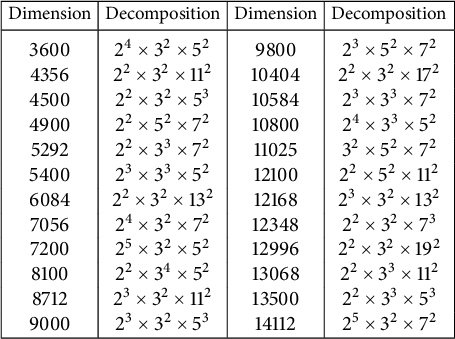
is not perfect by [Reference Zhou and Dong19, Theorem 4.1]. Hence, it suffices to consider the following possibilities (see Table 1).
By the results obtained above, one knows that Lemma 4.1 can deal with all but cases
 $\operatorname {FPdim}({\mathcal C})=3600$
,
 $7056, 7200$
,
 $10800, 14112$
; Lemma 4.3 can deal with the case
 $\operatorname {FPdim}({\mathcal C})=10800$
; Lemma 4.4 can deal with the rest cases. Therefore, we can get our main result.
Decomposition of dimension.

Theorem 4.5 Let
 ${\mathcal C}$
be a weakly group-theoretical modular category of dimension less than
 $14400$
. If
 ${\mathcal C}$
is perfect then it must be equivalent to the Drinfeld center
 ${\mathcal Z}(\operatorname {Vec}^{\omega }_{A_5})$
of the alternating group
 $A_5$
.
Acknowledgements
The authors would like to express their gratitude to the referee for his/her insightful comments and valuable suggestions.