INTRODUCTION
The sharp-tail sunfish (Masturus lanceolatus) otherwise called point-tailed sunfish (FAO, 1984) was first described by Liénard (1841) from Mauritius under the name of Orthagoriscus lanceolatus (Hubbs & Giovannoli, Reference Hubbs Carl and Giovannoli1931) and was later re-described by Gill (Reference Gill1884). The species is strictly restricted to marine waters and is highly cosmopolitan in nature. The occurrence has been recorded in all tropical and temperate seas except the eastern Pacific (Parenti, Reference Parenti2003).
Masturus lanceolatus has a confirmed distribution in the western Atlantic, and occurs from Nova Scotia to south-eastern Brazil (Klein-MacPhee, Reference Klein-MacPhee, Collette and Klein-MacPhee2002; Menezes, Reference Menezes, Menezes, Buckup, Figueiredo and Moun2003) with special occurrence from India, Brazil and the USA (Figueiredo & Menezes, Reference Figueiredo and Menezes2000). The occurrence of sunfish along the Indian coasts is uncommon, as only few species have been recorded so far (Devaraj et al., Reference Devaraj, Nammalwar and Thiagarajan1976). As far as the authors Arumugam et al. (Reference Arumugam, Balasubramaniam and Chellapa1994) and Chellappa et al. (Reference Chellapa, Balasubramanian and Arumugam2002) were aware, very few studies from various parts of the world have provided morphological characters for Masturus species. Masturus lanceolatus is a taxon with different ecological preferences, and it has a pelagic larval stage seen to be thriving in coastal marine waters (Fraser-Brunner, Reference Fraser-Brunner1951).
Sharp-tail sunfish (Masturus lanceolatus) belongs to the family Molidae of class Actinopterygii and order Tetraodontiformes (e.g. pufferfish, triggerfish, boxfish and filefish). Nevertheless, its placement within Tetraodontiformes is still considered to be controversial. It is widely agreed that the family Molidae is monophyletic, but molids have been variously placed in sister groups in a combination of Diodontidae (porcupine fish), Tetraodontidae and Ostraciidae (trunk fish) families or as an addition to families of Diodontidae with Ostraciidae. Molecular studies suggest a split in Tetraodontiformes into Tetraodontidei (an addition of Triacanthidae with Balistidae, Monacanthidae, Tetraodontidae, Diodontidae and Molidae families) and Triacanthodoidei (a combination of families of Ostraciidae with Triodontidae and Triacanthodidae) which was found to be highly attributable to ecological radiations into shallow (Tetraodonteidei) and deep (Triacanthodoidae) marine water habitats (Pope et al., Reference Pope, Hays, Thys, Doyle, Sims, Queiroz, Hobson, Kubicek and Houghton2010). Fraser-Brunner (Reference Fraser-Brunner1951) divided the species of the family Molidae into three genera: Ranzania, Masturus and Mola. He found a close relation between Mola and Masturus rather than to Ranzania which was further supported by the studies of Bonaparte (Reference Bonaparte1841) and Gill (Reference Gill1897) and has received a strong certification, both by morphological study (Santini & Tyler, Reference Santini and Tyler2002) and through further molecular research (Yamanoue et al., Reference Yamanoue, Miya, Matsuura, Katoh, Sakai and Nishida2004; Bass et al., Reference Bass, Dewar, Thys, Streelman and Karl2005; Alfaro et al., Reference Alfaro, Santini and Brock2007). At present, four species are found throughout the world under Molidae, i.e. common mola (Mola mola), sharp-tail sunfish (Masturus lanceolatus), southern sunfish (Mola ramsayi) and slender mola (Ranzania laevis). Another species of Masturus is M. oxyuropterus cited by Masuda et al. (Reference Masuda, Amaoka, Araga, Uyeno and Yoshino1984) and Devaraj et al. (Reference Devaraj, Nammalwar and Thiagarajan1976), and another two species of Ranzania, namely R. truncata and R. typus were earlier cited by Arumugam et al. (Reference Arumugam, Balasubramaniam and Chellapa1994). Gill (Reference Gill1884) based on the oldest genus Orthogoriscus (Bleeker, Reference Bleeker1873) differentiated the genus Masturus from the oceanic sunfish Mola mola principally by having a projection on its clavus (pseudo-tail in the form of a lance), much wider caudal fin and it seemed to be produced medially into a complete rounded lobe.
MATERIALS AND METHODS
A single healthy live sample was obtained from a sub-surface routine exploratory survey of oceanic tuna and allied resources by long lining in the Indian exclusive economic zone (EEZ) in the Arabian Sea by a survey ship MFV ‘Yellow Fin’ attached to the Fishery Survey of India, Mormugao, Goa, a sub-ordinate office under the Department of Animal Husbandry, Dairying and Fisheries, Ministry of Agriculture, Government of India, New Delhi. The survey operation commenced at 0530 hrs on 26 October 2013 operating with 500 hooks (100 baskets with 5 hooks each) in the Lakshadweep Sea (latitude 12°N/longitude 72°E). The morphometric (cm) and meristic characters were recorded.
RESULTS
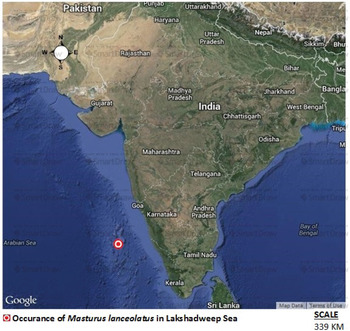
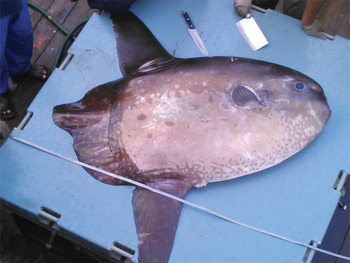
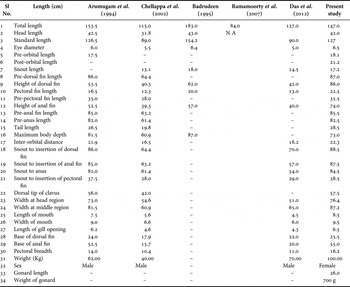
On 26 October 2013, a 100 kg Masturus was hooked in basket number 93 and hook number 3, while hauling lines in Lakshadweep Sea (latitude 12°05.04′N longitude 72°12.32′E) in a depth range of 1,005 m (Figure 1). The sea remained calm and current direction was towards the south-east and wind direction was towards the north-west. The total length (TL) of the species was 147 cm and all the morphometric and meristic characters are described in Table 1 and Figure 2. The body was found to be oval-shaped and it displayed a two-toned colour pattern with dark brown to light brown in colour in a dotted fashion. The skin was leathery, thick and rough due to the presence of minute tooth-like scales called denticles and with less mucous. Snout was found to be rounded with a terminal mouth, teeth in each jaw were fused into a single element, and the dorsal and anal fin lobes were entire and continuous with the caudal fin gradually tapering. The fins were almost dark to dark brown in colour. Projection was noticed in the middle of the caudal fin.
Occurrence of Masturus lanceolatus in new locality: Lakshadweep Sea, India.

Sharp-tail sunfish (Masturus lanceolatus).

Morphometric and meristic characteristics of Masturus lanceolatus, compared to specimens in the literature.

DISCUSSION
Masturus are large pelagic fish, living at a depth of 670 m (Lopes et al., Reference Lopes, Oliveira-Silva, Batista, Esquivel and Olavo2004). They are also considered to spend most of their time in depths less than 200 m, preferring a temperature of more than 20°C (Seitz et al., Reference Seitz, Weng, Boustany and Block2002). They have well developed grotesque rounded bodies with gigantic size (Kulkarni, Reference Kulkarni1953; Arumugam et al., Reference Arumugam, Balasubramaniam and Chellapa1994) ordaining the position of the world's heaviest marine teleosts, having a very tall and laterally flat body (Araújo et al., Reference Araújo, Silva-Falcão, Falcão, Marques and Joca2010). Konow et al. (Reference Konow, Fitzpatrick and Barnett2006) opined that Molas, thrives in a marine environment where reefs are abundant, the inhabitant fish belonging to families Chaetodontidae and Pomacanthidae helps in cleaning off the ectoparasites. In India, maximum information was recorded from the Gulf of Mannar biosphere reserve, known for its beautiful coral reef ecosystem, supporting the above hypothesis. Although Lakshadweep Sea is known to have beautiful dense coral reefs, this is the first record of Masturus in this area and no ectoparasites were noticed on the body of the species. The dorsal and anal fins are used for propulsion and the caudal fin is modified into clavus. The longevity of Masturus lanceolatus is estimated at 105 and 82 years for female and male respectively (Araújo et al., Reference Araújo, Silva-Falcão, Falcão, Marques and Joca2010). Parenti (Reference Parenti2003) studied the slow growth and late maturation in Molas following k-strategic characteristics and demonstrated that they have the greatest fecundity, with as many as 300,000,000 eggs.
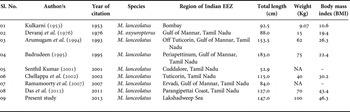
Judging from the data obtained, eight records of Masturus occurrence were made in the mainland of India (Table 2) and all descriptions made by earlier authors were of dead specimens from various fish landing centres; there are no records on geographical locations, so there are no correct records for the geographical locations from which the eight recorded specimens were caught. In and around Indian group of islands (Andaman and Nicobar in Bay of Bengal; Lakshadweep in Arabian Sea) within the Indian EEZ, no citation of Masturus had been made so far. Hence this may be the third largest and heaviest species in terms of mass in India and the Lakshadweep area may be the first confirmed locality of Masturus. In India, the largest Masturus was recorded in Periapattinum (183 cm), followed by off Tuticorin (153.5 cm), Gulf of Mannar, whereas Bombay (now Mumbai) witnessed the first Masturus lanceolatus (97.5 cm). Das et al. (Reference Das, Gopalakrishnan and Saravanakumar2012) reported the last observed catch of Masturus lanceolatus during 2001 with TL of 52.9 cm and in 2011, also reported for the sixth occurrence (TL of 127 cm) in all over India. However, they missed two more citations of Masturus lanceolatus reported by Chellappa et al. (Reference Chellapa, Balasubramanian and Arumugam2002) and Ramamoorty et al. (Reference Ramamoorty, Varghese, Raju, Kashinath and Seeni2007). Hence, the report made by Das et al. (Reference Das, Gopalakrishnan and Saravanakumar2012) was in fact the eighth report of Masturus lanceolatus. Our result in Lakshadweep added a new locality and is the ninth report all over India. Comparing the body mass index (BMI) to those specimens recorded earlier, the species from Bombay was the thinnest (BMI = 10.6) while the fattest BMI (46.3) was recorded in the present study (Table 2).
Chronology of occurrence of Masturus lanceolatus in the Indian exclusive economic zone (EEZ).

Our knowledge about the natural history of Masturus lanceolatus in Indian waters is very sparse. It is not even the targeted catch in Indian waters but most probably due to tetrodotoxic character (Halstead, Reference Halstead1988) and the first poisoning caused by Masturus was reported by Huang et al. (Reference Huang, Liu, Huang, Huang and Hwang2011). The deep diving behaviour, migration patterns, population structure and the ecology of this family are still difficult to understand due to lack of information and rare availability of these species. Further research is needed to fully elucidate the natural history of Masturus lanceolatus in Indian waters.
ACKNOWLEDGEMENTS
The authors acknowledge the support and encouragement provided by all officers and crew members of MFV ‘Yellow Fin’. The authors are also extremely thankful to Professor (Dr) Pratap Kumar Mohanty, Department of Marine Sciences, Berhampur University, Odisha, India for critically evaluating the manuscript. The authors are grateful to Mr Rahul Khot and Miss Reshma Pitale (Bombay Natural History Society, Mumbai) for their extended help. The authors acknowledge the facilities and support extended by the Fishery Survey of India, Ministry of Agriculture, Government of India.