Introduction
Hearing loss is the most common sensory disorder worldwide. Congenital hearing loss affects one in every 1000 neonates. Non-syndromic hearing loss accounts for approximately 80 per cent of hereditary hearing loss disorders, and is characterised by complete absence of any other clinical disorder except hearing loss. It is genetically heterogeneous, and more than 100 genes have been implicated in its aetiology to date (see the Hereditary hearing loss homepage, http://www.via.ac.be/dnalab/hhh/ maintained by Guy Van Camp, University of Antwerp and Richard Smith, University of Iowa). Despite such extreme genetic heterogeneity, 50 per cent of inherited hearing loss cases have been attributed to mutations in the GJB2 gene. This gene encodes the gap junction protein connexin 26 (Online Mendelian Inheritance in Man (OMIM) 12011), which plays a critical role in the recycling of potassium ions in the inner ear during sensory transduction.Reference Unger, Kumar, Gilula and Yeager1
A large number of GJB2 mutations (more than 90) have been identified in non-syndromic hearing loss patients worldwide (see the Ballana E, Ventayol M, Rabionet R, Gasparini P, Estivill X. Connexins and deafness Homepage. website http://www.crg.es/deafness maintained by the Deafness Research Group (CRG)). Studies conducted in different ethnic populations have shown marked ethnic and regional variations in the prevalence of these mutations. A single base deletion, 35delG, is the most common mutation in Caucasian populations.Reference Green, Scott, McDonald, Woodworth, Sheffield and Smith2 The 167delT mutation has been found to be present as a founder mutation in an Ashkenazi Jewish population, with a carrier frequency of about 4 per cent.Reference Morell, Kim, Hood, Goforth, Friderici and Fisher3 These two mutations in general are considered to contribute to 70 per cent of non-syndromic hearing loss cases.Reference Sobe, Vreugde, Shahin, Berlin, Davis and Kanaam4
Prelingual, recessively inherited hearing loss has long been recognised in India. A significant number of the deafness loci have been found in the Indian population. The W24X mutation has been reported to be the most common GJB2 mutation in predominantly consanguineous south Indian families with non-syndromic hearing loss.Reference Ramshankar, Girirajan, Dagan, Ravi Shankar, Jalvi and Rangasayee5–Reference Ramchander, Nandur, Dwarakanath, Vishnupriya and Padma7 However, the prevalence of GJB2 mutations in north Indian patients has previously remained largely undefined. In the present study, we present the results of clinical and genetic investigations for GJB2 mutations in 100 unrelated north Indian patients diagnosed with non-syndromic hearing loss, and their relatives.
Materials and methods
Subjects
One hundred consecutive north Indian patients (59 males and 41 females; mean age 12.06 years; age range 0.8–45 years) affected by congenital, non-syndromic, sensorineural hearing loss were enrolled in the present study. Patients were recruited from the otolaryngology department of the Post-Graduate Institute of Medical Education and Research, Chandigarh, India, between March 2004 and September 2005.
Written, informed consent was obtained from each family member prior to their recruitment, and the study was approved by the institute ethics committee.
The patients were ascertained using precise history and clinical criteria. Patients with the following features were excluded from the study group: an abnormal membrane or middle-ear cavity; history of infection during pregnancy (i.e. Toxoplasma, Rubella, Cytomegalovirus, Herpes (TORCH)); history of meningitis (bacterial) and jaundice; exposure to ototoxic drugs; acoustic trauma; and babies born premature and weighing less than 1500 g.
Medical history and pedigree information were obtained using a questionnaire.
One hundred unrelated, age- and sex-matched, healthy subjects with no family history of hearing loss of any cause were enrolled as controls. The controls comprised relatives of patients with non-otological diseases, attending the out-patient department. Informed consent was obtained from all controls.
Audiological assessment
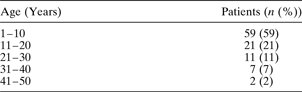
Pure tone audiometry (PTA) or behavioural audiometry was performed in all the non-syndromic hearing loss subjects, in their relatives and in the controls, using an audiometer (Madsen Orbiter 922; ABI, 3700 Automated DNA Sequencer - Applied Biosystems, Foster City, CA, USA). Pure tone thresholds were obtained at 0.5, 1, 2, 3, 4, 6 and 8 kHz. The severity of hearing loss was determined by taking the average hearing loss at 0.5, 1 and 2 kHz. Patients' hearing loss was defined as mild (25–40 dB), moderate (41–55 dB), moderately severe (56–70 dB), severe (71–90 dB) or profound (more than 90 dB). In young children, behavioural audiometry was used to determine the auditory thresholds in free field conditions. Pure tone audiometry was performed in 70 patients, and play or behavioural audiometry was performed in 23 patients. All subjects had an auditory brainstem response assessment in order to determine objectively the hearing levels. Table I shows the age at which audiological examination was done. Impedence audiometry, including tympanometry and stapedial reflex testing (Madsen Orbiter 901, 226 Hz probe) was performed in order to rule out any middle-ear abnormality, and otoacoustic emissions (OAEs) were recorded as an objective test. Type A curve on tympanometry, was defined as a peak between −100 and 200 daPa with static compliance of 0.25–1.5 ml, type B curve as a similar peak with static compliance lower than 0.25 ml, and type C curve as a peak greater than 0.25 ml but a pressure less than −100 daPa.
Age at which audiological tests were performed

Molecular analysis and mutation detection
Peripheral blood was obtained by venepuncture from the non-syndromic hearing loss subjects, their families and the controls. Genomic deoxyribonucleic acid (DNA) was extracted using a modified phenol-chloroform method.Reference Gill and Werrett8 Part of the coding exon of GJB2 (exon two) was amplified with the primers 1F (5′-TCT TTT CCA GAG CAA ACC GC-3′) and 1R (5′-GAC ACG AAG ATC AGC TGC AG-3′).Reference Ramshankar, Girirajan, Dagan, Ravi Shankar, Jalvi and Rangasayee5 This primer set amplified DNA fragments of 286 bp. To check for the presence of W24X and 167delT mutations, restriction enzyme digestions (with enzymes Alu1 for W24XReference Khullar, Bhalla, Sharma, Sehrawat and Panda9 and Pst1 for 167delTReference Bors, Andrikovics, Kalmar, Erdei, Galambos and Losonczi10) were performed on the polymerase chain reaction products obtained, using primers 1F and 1R. For detection of the 35delG mutation, a nested polymerase chain reaction using 1F and an additional primer (5′-CTG GTG GAG TGT TTG TTC cCt C-3′) was performed.Reference Mehmet, Al-Wardy and Al-Khabory11 The 87 bp polymerase chain reaction product obtained was subjected to restriction digestion with EcoN1.Reference Mehmet, Al-Wardy and Al-Khabory11 Digested polymerase chain reaction products were size-electrophoresed using 12 per cent polyacrylamide gel electrophoresis and visualised by silver staining. All the results were confirmed by direct sequencing using an ABI 3700 automated DNA sequencer (Applied Biosystems, Foster City, CA, USA).
Results and analysis
All the patients in our study were compatible with recessive inheritance of non-syndromic hearing loss. Eighteen patients had more than one affected family member with prelingual hearing loss (i.e. familial hearing loss). The remaining cases were sporadic in nature, with only one family member being diagnosed with prelingual hearing loss.
Audiological results
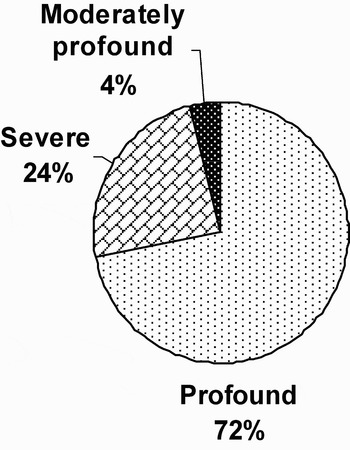
All cases were found to have moderately severe, severe or profound hearing loss, as shown in Figure 1. Only one patient had a type B tympanometry curve, but his PTA showed profound hearing loss and he had a history of hearing loss since birth. A type C curve was found in the right ear of one patient and in the left ear of another, while their other ear had type A curves. All other patients had type A tympanometry curves. Acoustic reflexes were absent in all patients. Evoked OAEs were tested in all patients and were absent in all.
Distribution of patients according to severity of hearing loss.

Molecular analysis results
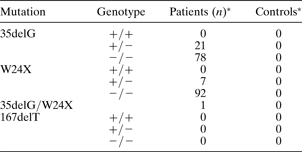
We found GJB2 mutations in 29/100 (29 per cent) individuals. Table II shows the frequency of tested mutations. Twenty-one patients (21 per cent) had the 35delG mutation and seven (7 per cent) had the W24X mutation. The 167delT mutation was not detected in any patient. Both the observed mutations were found to be heterozygous. One patient (P49, F46) was found to be a compound heterozygote with 35delG/W24X. In order to determine the carrier frequency of these mutations, 100 control subjects were also screened for the presence of these mutations. None of the mutations were found in control subjects.
Frequency of 35delG, W24X and 167delT mutations

* Total = 100.
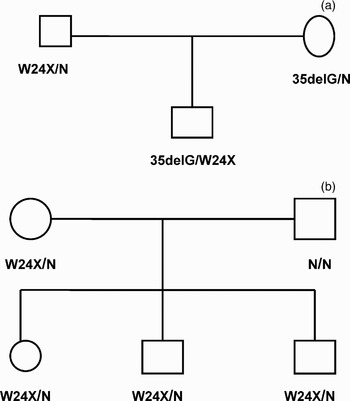
All the available family members of the non-syndromic hearing loss subjects with mutant GJB2 alleles were also screened for the presence of mutations. In family F46, the proband (P49) was found to be compound heterozygous for 35delG/W24X mutation, and the father and mother had W24X and 35delG heterozygous mutations, respectively. The proband had congenital, profound, sensorineural hearing loss, whereas both mother and father had normal hearing (Figure 2a).
Two families showing segregation of non-syndromic hearing loss and connexin 26 mutations. (a) Family F46; the proband (P49) was found to be compound heterozygous for 35delG/W24X mutation, while the father and mother had W24X and 35delG heterozygous mutations, respectively. (b) Family F20; all the three affected sibs (P20, P21 and P22) were found to be W24X heterozygous, whereas the mother and father had W24X/N and N/N genotypes, respectively.

In family F20, all the three affected sibs (P20, P21 and P22) were found to be W24X heterozygous, whereas the mother and father had W24X/N and N/N genotypes, respectively. The first sib (P20) had moderately severe hearing loss and the other two (P21, P22) had severe hearing loss; however, both parents had normal hearing (Figure 2b).
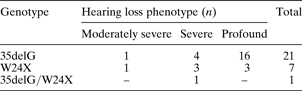
The genotype–phenotype correlation of GJB2 mutations with severity of hearing loss is shown in Table III. Although the majority of the probands carrying the mutant alleles had severe to profound hearing loss, no direct correlation between the genotype and the severity of disease was observed.
Audiological data and corresponding GJB2 mutations in non-syndromic hearing loss patients

Discussion
Mutations in the GJB2 gene, which encodes for the gap junction protein connexin 26, are a major cause of inherited congenital hearing loss. Mutations in this gene have been studied in various ethnic groups. Different mutation frequencies have been reported amongst different ethnic populations, suggesting marked ethnic and regional variations in mutation prevalence.Reference Rabionet, Gasparinin and Estivill12 Of the variants identified, a causative role was initially established for the 35delG mutation, which causes a frameshift mutation leading to formation of a truncated connexin 26 protein. The 35delG variant is the most commonly identified mutation in the different populations studied worldwide; however, studies conducted on Indian subjects have revealed a relatively low frequency or even absence of this mutation.Reference Ramshankar, Girirajan, Dagan, Ravi Shankar, Jalvi and Rangasayee5–Reference Ramchander, Nandur, Dwarakanath, Vishnupriya and Padma7
In the present study, we investigated the prevalence of different GJB2 mutations in non-syndromic hearing loss patients of north Indian origin. We found the 35delG mutation to be the most prevalent one in our patients. Ours is the first report indicating the presence of this mutation in Indian patients; two previous reports from south India included mainly consanguineous south Indian families and reported an absence of the 35delG mutation. This observed difference in mutation prevalence may be due to ethnic differences between south and north Indians.Reference Ramshankar, Girirajan, Dagan, Ravi Shankar, Jalvi and Rangasayee5–Reference Ramchander, Nandur, Dwarakanath, Vishnupriya and Padma7 Moreover, the consanguineous nature of families in these studies,Reference Ramshankar, Girirajan, Dagan, Ravi Shankar, Jalvi and Rangasayee5, Reference Ramchander, Nandur, Dwarakanath, Vishnupriya and Padma7 as compared with the non-consanguineous families enrolled in the present study, may be responsible for the observed variation in 35delG mutation frequency between the two research populations.
A nonsense mutation at codon 24 in the GJB2 gene (i.e. the W24X mutation) results in formation of a protein which is just one-tenth the length of the wild type protein. The W24X mutation has been found to be the most prevalent GJB2 mutation and restricted to Indian subcontinent probably occurring as a founder effect.Reference Ramshankar, Girirajan, Dagan, Ravi Shankar, Jalvi and Rangasayee5 However, we found the W24X mutation to be the second most prevalent mutation in our population. The frequency of this mutation in our patient population was similar to that reported by Ramchander et al. in non-syndromic hearing loss patients from Andhra Pradesh.7 However, two other studies have reported higher frequencies of the W24X mutation in Indian patients, suggesting regional variation in the prevalence of this mutation.Reference Ramshankar, Girirajan, Dagan, Ravi Shankar, Jalvi and Rangasayee5, Reference Maheshwari, Vijaya, Ghosh, Shastri, Kabra and Menon6
Another GJB2 mutation, the 167delT variant, has been reported to be the predominant cause of non-syndromic hearing loss in Ashkenazi Jews. However, this mutation was not observed in any of our patients. The absence of this mutation in Indian patients has been reported in earlier studies.Reference Ramshankar, Girirajan, Dagan, Ravi Shankar, Jalvi and Rangasayee5–Reference Ramchander, Nandur, Dwarakanath, Vishnupriya and Padma7 Our results further confirm the absence or low incidence of this mutation in Indians.
In our study, one patient had compound 35delG/W24X heterozygous mutation, and his father and mother had the W24X and 35delG heterozygous mutations, respectively. The proband had congenital, profound, sensorineural hearing loss, whereas both mother and father had normal hearing. A previous studyReference Maheshwari, Vijaya, Ghosh, Shastri, Kabra and Menon6 has also reported the presence of 35delG/W24X compound mutation in multiple affected members of a family, indicating association of this compound mutation with profound hearing loss. The 35delG and W24X mutations each result in premature termination, and affected subjects produce only truncated, nonfunctional connexin 26 gap junction protein, leading to hearing loss.
• Non-syndromic hearing loss is characterised by complete absence of any other clinical disorder except hearing loss
• This study found that 35delG was the most prevalent GJB2 gene mutation in north Indian patients with non-syndromic hearing loss
• The high frequency of 35delG mutation and relatively low prevalence of W24X mutation, compared with south Indian populations, indicates a large variation in the prevalence of connexin 26 mutations in different regions of India
• Identification of GJB2 gene mutations will enable better carrier screening and genetic counselling
We observed a wide variation in the phenotypic expression of the hearing loss in a family (F20) with W24X/N mutation; two of the sibs with this mutation had severe hearing loss whereas the third had moderately severe hearing loss, indicating a lack of definite genotype–phenotype correlation between GJB2 mutations and disease. Mutations in GJB2 have been found to be responsible for profound, severe or moderate hearing loss, and often show inter- as well as intrafamilial variability.Reference Denoyelle, Marlin, Weil, Moatti, Chauvin and Garabedian13 It has been suggested that other factors may modify the expression of the GJB2 gene.Reference Murgia, Orzan, Polli, Martella, Vinanzi and Leonardi14
The GJB2 gene mutations observed in all of our patients were heterozygous in nature. Despite the sequencing of the coding region of the GJB2 gene (exon two), the 167delT mutation was not identified, although a mutation in the promoter regions, untranscribed regions or exon one cannot be ruled out. It has been hypothesised that other factors may modify the phenotypic effects of mutations in the GJB2 gene, as the existence of modifier genes has been known for quite some time. A nuclear-mitochondrial gene interaction has also been proposed.Reference Riazuddin, Castelein, Ahmed, Lalwani, Mastroianni and Naz15 One possibility is that, in such individuals, hearing loss is due to a mutation in an entirely different gene which shares partial functioning with GJB2. Our results are further strengthened by the findings of Samanich et al., who have also reported a very high frequency of heterozygosity in their study group of African American and Caribbean Hispanics.Reference Samanich, Lowes, Burk, Shanske, Lu and Shanske16
Acknowledgement
The authors thank the Indian Council of Medical Research, India, for providing financial assistance for this research.