Introduction
Emotional responses are one of the main psychological mechanisms through which humans interact with their environment. Borderline personality disorder (BPD) is characterized by serious problems in interpersonal relationships and emotional functioning (APA, 2000). Some people even argue that the emotional dysfunction represents the central patho-mechanism of the disorder (Linehan, Reference Linehan1993; Sanislow et al. Reference Sanislow, Grilo, Morey, Bender, Skodol, Gunderson, Shea, Stout, Zanarini and McGlashan2002; Conklin et al. Reference Conklin, Bradley and Westen2006). One of the most important factors underlying social and emotional functioning is the ability to recognize emotions in facial expressions because recognizing the feelings communicated by others is crucial for adequate emotional and social responses (Liberman et al. Reference Liberman, DeRisi and Mueser1989). Likewise, facial emotion recognition has been found to be a successful predictor of social outcome in psychiatric patients (Kee et al. Reference Kee, Green, Mintz and Brekke2003). Given that individuals with BPD exhibit enormous deficiencies in the establishment and maintenance of interpersonal relationships, it can be hypothesized that these are based on an impaired ability to decode salient interpersonal emotional information. However, only a few studies have been published examining the ability of BPD patients to recognize facial expressions of emotions and those studies yielded partly contradictory results. Regarding the accuracy of facial affect recognition, Wagner & Linehan (Reference Wagner and Linehan1999) compared women with BPD and healthy subjects using a free-choice, self-paced facial emotion recognition task. The results indicated that BPD patients seem to be able to perceive and categorize emotions accurately. For the identification of fearful faces an even higher accuracy of BPD patients was found, reflecting a heightened sensitivity. A recent study by Lynch et al. (Reference Lynch, Rosenthal, Kosson, Cheavens, Lejuez and Blair2006) supports this finding of heightened sensitivity; when basic facial expressions of emotion were morphed from neutral to maximum intensity, BPD patients correctly identified emotional expressions of anger and happiness at an earlier stage than healthy controls. By contrast, Levine et al. (Reference Levine, Marziali and Hood1997) and Bland et al. (Reference Bland, Williams, Scharer and Manning2004) reported a decreased accuracy of BPD patients in their recognition of anger, fear and disgust when comparing their performance to a non-affected control group. Minzenberg et al. (Reference Minzenberg, Poole and Vinogradov2006) recently suggested an intact ability of BPD patients to recognize isolated facial or prosodic information. However, when facial and prosodic information was combined, patients were impaired, indicating a specific deficit in higher order integration of social information. This inconsistency in results may be due to the implementation of different stimulus material and task instructions. Additionally, and possibly more importantly, time may be an influencing factor. Previous studies in BPD did not take into consideration that everyday life requires a very fast recognition of facial emotional expressions for adequate reactions in social interactions. On the contrary, in experimental settings facial stimuli were mostly presented without any time limits.
To specify emotion recognition deficits in BPD more closely, the current study implemented two facial emotion recognition tasks, using different kinds of response formats. In the first task, the Fear Anger Neutral (FAN) Test, subjects had to make a rapid decision between two response categories: negative and neutral facial expressions. Because BPD patients seem to have problems predominantly with the perception of the negative emotions fear and anger (Levine et al. Reference Levine, Marziali and Hood1997; Koenigsberg et al. Reference Koenigsberg, Harvey, Mitropoulou, Schmeidler, New, Goodman, Silverman, Serby, Schopick and Siever2002), as well as the perception of neutral facial expressions (Donegan et al. Reference Donegan, Sanislow, Blumberg, Fulbright, Lacadie, Skudlarski, Gore, Olson, McGlashan and Wexler2003), the ability to rapidly discriminate between negative and neutral facial expressions was examined. The second task, the Emotion Recognition (ER) Test, was an emotion-specific task in which subjects had to choose one out of five emotions without a distinct time limit. In contrast to previous studies using the facial stimuli developed by Ekman & Friesen (Reference Ekman and Friesen1984), the present study is the first to use a colored, therewith more ecologically valid, set of facial stimuli (Gur et al. Reference Gur, Sara, Hagendoorn, Marom, Hughett, Macy, Turner, Bajcsy, Posner and Gur2002).
We hypothesized that if BPD patients are generally impaired in emotion recognition, performance deficits should manifest in both emotional tasks. If, however, task format and instructions as well as valence influence emotional recognition in BPD, performance in the FAN Test and the ER Test may differ.
Method
Participants
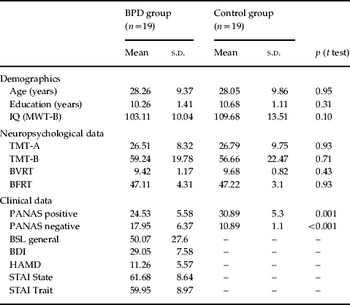
Nineteen patients with BPD (17 women, two men; 14 in-patients, five out-patients) from the Department of Psychiatry and Psychotherapy of RWTH Aachen University participated in the study. Initially, four more patients were tested but their data had to be excluded from further analysis (n=1, incomplete data for several tests; n=1, BPD diagnosis not confirmed; n=2, remarkably low intelligence). Data for one further patient had to be excluded after a statistical screening for outliers (performance scores deviated by more than 3 standard deviations from the group mean). A control sample of 19 healthy subjects (17 women, two men) was recruited through advertisements and was matched pairwise to patients according to gender, age (±2 years) and years of education (±2 years). There were no significant differences between groups on these demographic variables (see Table 1).
Demographics and clinical characteristics of the study groups

BPD, Borderline personality disorder; MWT-B, Mehrfachwahl Wortschatz Intelligenztest (vocabulary intelligence test); TMT-A, Trail Making Test, Part A; TMT-B, Trail Making Test, Part B; BVRT, Benton Visual Retention Test; BFRT, Benton Facial Recognition Test; PANAS, Positive and Negative Affect Schedule; BSL, Borderline Symptom List (general score); BDI, Beck Depression Inventory; HAMD, Hamilton Depression Rating Scale; STAI, State–Trait Anxiety Inventory.
To confirm the BPD diagnosis in patients, the German version of the Structured Clinical Interview for DSM-IV, Axis II Personality Disorders (SCID-II; Fydrich et al. Reference Fydrich, Renneberg, Schmitz and Wittchen1997) was administered by a trained and experienced psychologist. Severity of BPD symptomatology in terms of subjective strain was assessed by the Borderline Symptom List (BSL; Bohus et al. Reference Bohus, Limberger, Frank, Sender, Gratwohl and Stieglitz2001), depressive symptoms were estimated by the Beck Depression Inventory (BDI; Beck et al. Reference Beck, Ward, Mendelson, Mock and Erbaugh1961) and the Hamilton Depression Rating Scale (HAMD; Hamilton, Reference Hamilton1960), the latter performed by the treating psychiatrist, level of anxiety by the State–Trait Anxiety Inventory (STAI; Spielberger et al. Reference Spielberger, Gorsuch and Lushene1970) and current affective state by the Positive and Negative Affect Schedule (PANAS; Watson et al. Reference Watson, Clark and Tellegen1988). On average, BPD subjects had a moderate level of symptom severity and high levels of state and trait anxiety. They reported prominent feelings of depressiveness; the clinician, however, did not confirm any major depression in any of the subjects. BPD subjects also reported significantly less positive and more negative affect than healthy subjects prior to the study. At the time of the study all patients were attending for treatment and all but one participant with BPD was receiving psychotropic medication; 15 were taking one or more antidepressives [selective serotonin reuptake inhibitors (SSRIs), n=6; serotonin-norepinephrine reuptake inhibitors (SNRIs), n=5; tricyclic antidepressants (TCAs), n=7] and eight were taking one or more neuroleptics (typical neuroleptics, n=4; atypical neuroleptics, n=6). Five of the 19 patients took a combination of antidepressive and neuroleptic medication.
All subjects were screened with the German version of the Structured Clinical Interview for DSM-IV, Axis I Disorders (SCID-I; Wittchen et al. Reference Wittchen, Wunderlich, Gruschwitz and Zaudig1997). All but five of the 19 BPD patients had co-morbid Axis I disorders, with nine patients having one additional Axis I disorder, one having two additional co-morbidities, two having three further psychiatric diagnoses and two patients even being diagnosed with four additional psychiatric disorders. In every case, however, the BPD diagnosis was the first-order diagnosis. Co-morbid disorders included life-time drug dependence (alcohol, n=2; polytoxicomania, n=1), post-traumatic stress disorder (PTSD; n=9), eating disorder (n=6) and panic disorder (n=5). Patients with a current major depressive episode, life-time diagnosis of bipolar disorder, any kind of psychotic disorder, current substance dependence excluding nicotine dependence, attention deficit hyperactivity disorder (ADHD) or the presence of any neurological disorder were excluded from the study. None of the healthy subjects showed any Axis I disorder. Three subjects of an initial sample of 22 healthy subjects were excluded after a positive screening on the International Personality Disorder Examination (IPDE; Loranger et al. Reference Loranger, Susman, Oldham and Russakoff1993), which was used for an assessment of personality disorders (IPDE-S; Loranger et al. Reference Loranger, Susman, Oldham and Russakoff1993).
A short neuropsychological test battery was administered to all subjects assessing main cognitive processes. The following tests were applied: the Trail Making Test, Parts A and B (TMT-A, TMT-B; Reitan, Reference Reitan1992), the Benton Visual Retention Test – Revised (BVRT; instruction A – multiple choice; Sivan, Reference Sivan1992) and the Mehrfachwahl Wortschatz Intelligenztest (MWT-B; Merz et al. Reference Merz, Lehrl, Galster and Erzigkeit1975), a German test of verbal crystalline intelligence. Finally, performance on the Benton Facial Recognition Task (BFRT; Benton et al. Reference Benton, Sivan, Hamsher, Varney and Spreen1983) was assessed to exclude the possibility that subjects had a general deficit in the recognition of faces, independently of the expressed emotion. Demographic, neuropsychological and clinical data for the patient and the control group are reported in Table 1.
The study was performed according to the latest version of the Declaration of Helsinki. All participants gave written informed consent after having received a full description of the study.
Measures
The FAN Test
The newly developed FAN Test is a short version of the Facial Emotions for Brain Activation Test (Gur et al. Reference Gur, Sara, Hagendoorn, Marom, Hughett, Macy, Turner, Bajcsy, Posner and Gur2002; Schneider et al. Reference Schneider, Gur, Koch, Backes, Amunts, Shah, Bilker, Gur and Habel2006) and assesses the ability to discriminate fearful, angry and neutral facial expressions. It comprises 16 angry, 16 fearful and 32 neutral facial expressions of the stimulus set originally presented by Gur et al. (Reference Gur, Sara, Hagendoorn, Marom, Hughett, Macy, Turner, Bajcsy, Posner and Gur2002). Each emotional category consists of the same number of male and female faces from different ethnicities (46 Caucasian, 14 African and four Asian). As the FAN Test was developed for imaging studies, 16 scrambled faces were shown interspersed in the test. Subjects were informed about the meaning of the scrambled face and were asked not to react to it but to remain focused.
All pictures were presented on a computer screen in a pseudo-randomized order using the Presentation® software package (Neurobehavioral Systems Inc., San Francisco, CA, USA). Stimuli were presented for 2 s with an inter-stimulus interval of 1 s. Subjects were asked to indicate the valence of the facial expression within the 2 s by pressing one of two buttons with the index finger of their dominant hand. Reaction side for correct answer was randomized across subjects to control for lateralization effects.
The ER Test
Task development and application to healthy subjects were described previously (Kohler et al. Reference Kohler, Turner, Stolar, Bilker, Brensinger, Gur and Gur2004). In brief, the ER Test contains 40 colored pictures of faces expressing four different emotions (happiness, sadness, fear, anger) or no emotion. Facial stimuli were derived from the same set of facial expressions provided by Gur et al. (Reference Gur, Sara, Hagendoorn, Marom, Hughett, Macy, Turner, Bajcsy, Posner and Gur2002) but did not include faces used in the FAN Test. Stimuli were presented in a pseudo-randomized order on a computer screen and subjects had to choose one out of five emotions without a distinct time limit.
Statistical analysis
Statistical analyses were performed with SPSS software (SPSS Inc., Chicago, IL, USA). Levene's tests were performed and yielded homogeneity of variances for all variables except for accuracy measures of neutral faces. The Shapiro–Wilk test revealed that a normal distribution was not given for all variables. However, as the ANOVA is very robust against violations of this prerequisite if homogeneity of variances is present and sample sizes are equal (and >10) for all factor levels (Ito, Reference Ito and Krishnaiah1980), which applied to our data, we relied on ANOVAs.
To test whether group (BPD group versus control group) had an effect on the ability to discriminate facial expressions of emotion in the FAN Test, a 2×2 repeated-measures ANOVA was computed, with group the between-subjects factor and emotional valence (negative versus neutral) the within-subjects factor. The dependent measures of performance were percentage of correct responses and also reaction times (RTs). Contrast tests within an ANOVA were computed to decompose significant effects. The possibility that response accuracy might interfere with RT was addressed by correlation analyses. Spearman's correlations were conducted between response accuracy, RTs and relevant clinical measures of affect (BSL, BDI, PANAS and STAI) and cognition (TMT, MWT-B, BVRT). For the ER Test, equivalent statistical analyses were performed. A 2 (group)×5 (emotion) repeated-measures ANOVA was followed by contrast tests and correlation analyses. To compare subjects' performance directly on the FAN Test and the ER Test, sensitivity (probability of correct identifications of a target), specificity (probability of correct rejections of a non-target) and RTs were compared in paired t tests. For all significance tests, α levels of 0.05 were adopted, and for ANOVAs Greenhouse–Geisser corrected p values are reported.
As there was a high co-morbidity with PTSD (n=9) in our BPD sample, the influence of an additional diagnosis of PTSD was taken into account by including PTSD co-morbidity as a covariate in the analyses. Finally, medication status (no medication, antidepressive medication, neuroleptic medication, a combination of antidepressive and neuroleptic medication) was considered as a covariate.
Results
The FAN Test
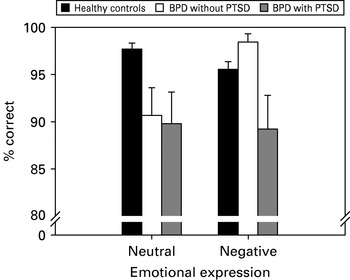
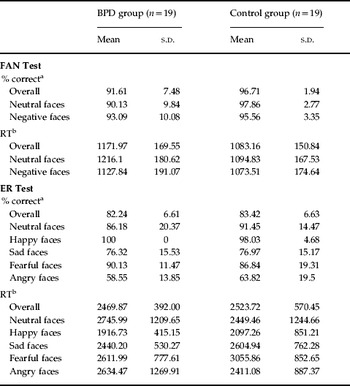
Table 2 presents the means and standard deviations for the FAN Test. The covariate medication was not related to the dependent variables of interest [F(1, 34)=0.09, p=0.77]. The covariate PTSD co-morbidity was significantly related to response accuracy in emotion recognition [F(1, 34)=4.94, p=0.033]. The interaction between PTSD co-morbidity and emotional valence, however, was not significant [F(1, 34)=1.35, p=0.25]. There was no main effect of emotional valence [F(1, 34)=3.79 p=0.06] and no main effect of group for total accuracy after controlling for the effect of PTSD co-morbidity and medication [F(1, 34)=0.46, p=0.5]. However, a significant interaction between group and emotional valence was indicated [F(1, 35)=4.67, p=0.038]. Post-hoct tests (Bonferroni corrected) indicated that the BPD group performed significantly worse for neutral [t(1, 21.92)=3.3, p=0.64] but not for negative emotional expressions [t(1, 20.83)=1.103, p=0.006]. Because PTSD co-morbidity had a significant influence on emotion perception, additional post-hoc tests were performed for the group that only had a BPD diagnosis (n=10), for BDP patients with PTSD (n=9) and for healthy subjects. As sample sizes differed between the experimental groups, Gabriel's pairwise test procedures were performed. BPD patients without a diagnosis of PTSD revealed a marginal trend towards worse performance in the recognition of neutral facial expressions (p=0.07; see Fig. 1 but not in the recognition of negative facial expressions (p=0.9) when compared to healthy subjects. On the contrary, BPD patients with a diagnosis of PTSD showed a decreased performance for both neutral (p=0.011) and negative facial expressions (p=0.045). Comparing the two BPD groups directly indicated that BPD patients without a diagnosis of PTSD performed significantly better than those with PTSD in the recognition of negative facial expressions (p=0.03).
Group differences in percentage of correct answers (% correct) with the Fear Anger Neutral (FAN) Test. BPD, Borderline personality disorder; PTSD, post-traumatic stress disorder.

Means and standard deviations (s.d.) for the FAN Test and the ER Test

BPD, Borderline personality disorder; FAN, Fear Anger Neutral; ER, Emotion Recognition; RT, reaction time.
a Mean percentage of correct responses (% correct).
b Mean RT in milliseconds for correct trials.
Regarding between-group differences in RT, the ANCOVA did not reveal a main effect of the covariate PTSD [F(1, 35)=1.43, p=0.24]. No significant main effect of group [F(1, 35)=0.53, p=0.47)] and no interaction effect [F(1, 35)=2.57, p=0.12)] emerged. However, there was a significant main effect of emotion [F(1, 35)=5.41, p=0.026)], with pairwise comparisons indicating that subjects exhibited slower RTs for neutral than for negative facial expressions. There was no evidence for a speed accuracy trade-off as reflected by non-significant Spearman's correlations between response accuracy and RT in any of the conditions.
The ER Test
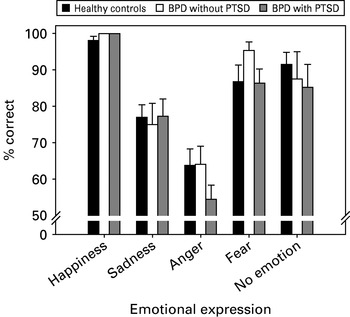
For means and standard deviations, refer to Table 2. The covariates PTSD [F(1, 34)=1.96, p=0.17] and medication [F(1, 34)=1.36, p=0.25] were not significantly related to performance within the ER Test. Therefore, ANOVA results are reported. Regarding between-group differences in response accuracy, no significant main effect of group was found [F(1, 36)=0.304, p=0.58] and no significant group×emotion interaction [F(3.15, 113.5)=0.69, p=0.57]. Hence, participants with BPD did not differ from control subjects in their response accuracy for any emotional category (happy, sad, anger, fear or neutral; see Fig. 2). However, there was a significant main effect of emotion [F(3.15, 113.5)=36.2, p<0.001], with happiness being the emotion that was significantly recognized best, followed by no emotion and fear. Sadness and anger were the emotions that were recognized worst.
Group differences in percentage of correct answers (% correct) with the Emotion Recognition (ER) Test. BPD, Borderline personality disorder; PTSD, post-traumatic stress disorder.

For RTs, neither a significant main effect of group [F(1, 36)=0.094, p=0.76] nor a significant interaction of group×emotion [F (2.61, 94.18)=1.3, p=0.28] was detected. However, there was again a significant main effect of emotion. Subjects' RTs were fastest for happiness and slowest for fear. Spearman's correlations between response accuracy and RT indicated a speed–accuracy trade-off for the expressions displaying fear in healthy subjects (r s=−0.58, p=0.009) and for no emotion in both healthy subjects and patients (controls: r s=–0.65, p=0.003; patients: r s=−0.68, p=0.001).
The FAN Test versus the ER Test: sensitivity and specificity
For both experimental groups the sensitivity was significantly lower in the ER Test than in the FAN Test [BPD: t(18)=6.28, p<0.001; controls: t(18)=10.95, p<0.001]. Accordingly, both groups recognized facial emotions less accurately in the ER Test. No significant differences between the FAN Test and the ER Test were found for the specificity [BPD: t(18)=1.01, p=0.33, n.s.; controls: t(18)=1.85, p=0.081, n.s.]. For both groups, overall mean RTs were significantly slower in the ER Test than in the FAN Test [BPD: t(18)=12.58, p<0.001; controls: t(18)=10.97, p<0.001].
Correlations between task performance and state/trait measures of affect as well as cognitive tests
Significant negative correlations were found between accuracy measures for negative facial expressions within the FAN Test and the BSL subscore ‘intrusions’ (r s=−0.61, p=0.005), indicating better performance of patients with less intrusions. There were no further significant correlations between state and trait measures of affect (BDI, HAMD, PANAS and STAI), cognitive tests and performance in the two emotion recognition tasks.
Discussion
The aim of the present study was to specify facial emotion recognition deficits in patients with BPD. This was realized by applying two facial emotion recognition tasks: (1) the FAN Test, in which subjects were asked to make a rapid decision between two emotion categories; and (2) the ER Test, in which subjects had to choose one out of five emotions without a distinct time limit. With respect to the FAN Test, the BPD group showed a negative bias in the recognition of facial expressions. More specifically, participants with BPD were less accurate in the recognition of neutral facial expressions, misinterpreting them as negative. This tendency to misinterpret neutral facial expressions supports the general view that BPD patients see the world and other people more negatively than non-affected subjects (Arntz & Veen, Reference Arntz and Veen2001; Giessen-Bloo & Arntz, Reference Giessen-Bloo and Arntz2005). This negative bias is accompanied by the finding that BPD subjects reported significantly less positive and more negative affect than healthy subjects in the PANAS. It has been postulated that more negative and less positive affect could bias information processing towards a faulty perception of others' emotional expressions (Coupland et al. Reference Coupland, Sustrik, Ting, Li, Hartfeil, Singh and Blair2004). However, a negative perceptional bias can also influence the affective state in a negative direction. This influence is probably mutual, in that affect perception can affect mood and vice versa.
Our findings are in line with the results from an imaging study (Donegan et al. Reference Donegan, Sanislow, Blumberg, Fulbright, Lacadie, Skudlarski, Gore, Olson, McGlashan and Wexler2003) that examined amygdala activity of 15 BPD and 15 control subjects during passive viewing of facial emotional expressions. Patients demonstrated stronger left amygdala activation than healthy controls. For neutral facial expressions BPD patients and healthy subjects showed the least overlap in brain activation level, indicating a strong dysfunction. Post-hoc debriefing further revealed that BPD patients consistently ascribed negative attributes to neutral expressions.
With regard to the ER Test the groups did not differ in their performance level, neither for emotional nor for neutral facial expressions. There are four possible explanations for this discrepancy between the results of the FAN Test and the ER Test. First, it could be that task difficulty differed between the two tests. The FAN Test might be more difficult and therefore explain the exclusive deficits of patients in this test. When comparing the sensitivity and specificity of both tests, the opposite seems to be the case; in both experimental groups sensitivity was generally lower in the ER Test whereas specificity did not differ between the tests. This suggests that, regarding sensitivity, the ER Test is more difficult. With the ER Test being more difficult but BPD subjects still performing as well as healthy controls, we can rule out the possibility that task difficulty accounted for differences in performance between both emotion tasks. A second possible explanation for the absence of a group difference in the ER Test could be a training effect. Within the current study, the order of task administration was not counterbalanced; administration of the FAN Test preceded the ER Test. Therefore, better performance within the ER Test might be due to training effects. This, however, seems unreasonable within the present study because: (a) different facial stimuli of the same set were used within the tests, and (b) the ER Test was completed at least 30 min after the FAN Test. In the meantime neuropsychological tests were performed, coinciding with a direct learning effect through active remembrance. A third explanation for the discrepancy between the two tests is that no feedback was given during any of the emotion discrimination tasks, making learning very difficult. We consider that the fourth and most reasonable explanation for the absence of any recognition deficits of BPD patients within the ER Test is the difference in the response format. The response format of the FAN Test required a rapid response within 2 s. For the ER Test, subjects were instructed to react spontaneously but stimuli remained on the screen until an answer was given. Consequently, subjects were under less time pressure when performing the ER Test. Therefore, the worse performance of the BPD patients within the FAN Test might demonstrate that they needed more time to process neutral facial expressions accurately. This has been postulated previously in a study by Minzenberg et al. (Reference Minzenberg, Poole and Vinogradov2006), where the response format equaled that of the ER Test, and the authors also did not find a deficit in emotion recognition without time pressure. This finding is further supported by the fact that the RTs in the ER Test were higher than in the FAN Test. This might be partly because the ER Test contains more options. In addition, there was no need to respond quickly, which might have led to subjects responding slower. Under higher time strain, however, only healthy subjects were still able to perform accurately. The deficit further seems to be emotion specific because patients' performance within the TMT, a task assessing visuospatial and executive functioning under time pressure, did not differ from that of control subjects. Hence, it seems that BPD patients are able to function adequately under time pressure when cognitive but not emotional functions are investigated. This emotion-specific deficit may explain the functional impairment of BPD patients in daily-life social interactions where fast decisions are typically required. To determine the influence of time on emotion processing more precisely and specifically, future studies should parametrically vary the response time available to subjects. Furthermore, neuroimaging studies should investigate the underlying neural mechanisms responsible for these performance differences, comparing activation patterns for the ER Test and the FAN Test as well as early and late neural activations during emotion recognition.
Along with the negative bias, the ability of BPD patients to recognize negative facial expressions was associated with BPD symptomatology. Co-morbid diagnosis of PTSD had a profound influence on emotion discrimination in BPD; BPD patients with a co-morbid diagnosis of PTSD did not show a negative bias in emotion recognition. They were generally worse than healthy controls in the recognition of both negative and neutral facial expressions. This is in line with the association found between the degree of intrusiveness reported by all BPD patients in the BSL and the accuracy in recognizing negative facial expressions in the FAN Test. The more intrusions patients report, the worse they recognize negative facial expressions. Because intrusiveness is a hallmark of PTSD (APA, 2000), this result strengthens the association between PTSD co-morbidity and emotion recognition. This finding is in accordance with several studies showing that PTSD patients exhibit difficulties with the processing of negative and threatening visual input, showing abnormal neural responses to negative facial emotion expressions (Felmingham et al. Reference Felmingham, Bryant and Gordon2003; Shin et al. Reference Shin, Wright, Cannistraro, Wedig, McMullin, Martis, Macklin, Lasko, Cavanagh, Krangel, Orr, Pitman, Whalen and Rauch2005). For a better understanding of the association between PTSD and BPD, future studies should compare emotion perception in a larger sample of BPD patients with and without PTSD and subjects who are exclusively diagnosed with PTSD. In general, this association between PTSD co-morbidity and emotion perception indicates the experimental impact of BPD heterogeneity. The rate of co-existing Axis I disorders found in the present study was similar to that found in other clinical samples (Zanarini et al. Reference Zanarini, Frankenburg, Dubo, Sickel, Trikha, Levin and Reynolds1998; Donegan et al. Reference Donegan, Sanislow, Blumberg, Fulbright, Lacadie, Skudlarski, Gore, Olson, McGlashan and Wexler2003) and BPD samples without additional Axis I disorders are highly atypical, and cannot be considered representative of BPD patients (Skodol et al. Reference Skodol, Gunderson, Pfohl, Widiger, Livesley and Siever2002). Hence, any clinical research in BPD always presents a conflict; although the co-existence of other psychiatric disorders makes findings far more generalizable, it also increases diagnostic noise. As our findings show, subgroups of BPD show different characteristics and different symptomatology. Because those can influence the test results, they need to be considered in experimental studies.
Methodological considerations
Some confounding factors might limit the generalizability of the current study. First, sample sizes were small, especially with respect to the comparison between BPD patients with and without PTSD. This might increase the possibility that individual scores had a disproportionate influence, decreasing the detectability of group differences. We accounted for this potential influence by excluding outliers. Nevertheless, the findings should be replicated with larger sample sizes. Second, medication might have confounded the effects because all except one of the BPD patients were taking psychotropic medication at the time of the study. We controlled for this possible influence by taking medication as a covariate in the analyses. In the present study medication status (no medication, antidepressive medication, neuroleptic medication, combination of antidepressive and neuroleptic medication) did not influence the results. Nevertheless, future studies should focus on drug-naïve BPD patients. Third, it is not possible to conclude that the effects found are unique to pure BPD symptomatology because it was the only clinical group studied. Similar deficits in facial affect recognition are also commonly reported among patients with depression, social phobia and schizophrenia (Suslow et al. Reference Suslow, Junghanns and Arolt2001; Cooney et al. Reference Cooney, Atlas, Joormann, Eugène and Gotlib2006; Schneider et al. Reference Schneider, Gur, Koch, Backes, Amunts, Shah, Bilker, Gur and Habel2006). In the present study, however, self-reported level of depressiveness and anxiety did not significantly correlate with emotion recognition performance. Nevertheless, replication of these results including a second patient comparison group is recommended. Fourth, the FAN Test and the ER Test required different decisions: emotional categorization for the FAN Test and a differentiated labeling task for the ER Test. Follow-up studies should create two parallel versions of a facial emotion recognition task and only manipulate the time limit available for subjects.
Conclusions
To summarize, the present study provides evidence for the presence of a specific deficit of BPD patients' ability to rapidly discriminate between negative and neutral facial expressions. When BPD patients discriminated facial expressions under time pressure, they demonstrated a negative bias in the recognition of neutral facial expressions. This negative bias may explain BPD patients' difficulties and misunderstandings in social interactions, where particularly fast responses are required. Moreover, BPD symptomatology, especially PTSD co-morbidity and intrusiveness, negatively influenced the ability to recognize emotion in BPD, indicating the need to consider these variables more intensely in further studies.
Acknowledgments
We thank T. Kellermann and S. Shama for their support in developing the FAN Test and for statistical support (T. K.). We also acknowledge the support of T. Kircher and K. Mathiak. This study was supported by grants from the German Research Foundation (DFG, IRTG 1328).
Declaration of Interest
None.