Introduction
Vestibular rehabilitation has been shown to be an effective strategy for improving balance in older people with instability. It was initially used in patients with residual instability as a result of vestibular disorders,Reference Black, Angel, Pesznecker and Gianna 1 – Reference McDonnell and Hillier 4 but it is also useful for treating lack of balance in Parkinson's disease,Reference Rossi-Izquierdo, Soto-Varela, Santos-Pérez, Sesar-Ignacio and Labella-Caballero 5 , Reference Rossi-Izquierdo, Ernst, Soto-Varela, Santos-Pérez, Faraldo-García and Sesar-Ignacio 6 visual vertigo and presbivertigo.Reference Kao, Chen, Chern, Hsu, Chen and Hwang 7 – Reference Johansson, Akerlund, Larsen and Andersson 9 Particularly in older people with dizziness, it has proven useful for increasing stability, and consequently reducing the risk of falls, and improving gait,Reference Johansson, Akerlund, Larsen and Andersson 9 body balance controlReference Kammerlind, Håkansson and Skogsberg 10 and daily living activities.
Vestibular rehabilitation protocols consist of a series of exercises and interventions (developed at home and/or in the hospital) designed to improve an individual's ability to stabilise their centre of gravity. These interventions are performed over extended periods of time (weeks or months). The resources required, in terms of both equipment (e.g. dynamic posturography) and health professionals’ time, are very expensive.
Patient adherence is one of the main problems in vestibular rehabilitation programmes.Reference Yardley and Kirby 11 – Reference Ricci, Aratani, Caovilla and Ganança 13 It has been reported that adherence to the full programme of exercises is less than 50 per cent.Reference Yardley, Barker, Muller, Turner, Kirby and Mullee 14 Obstacles related to vestibular rehabilitation protocol adherence include the numerous visits that are required and difficulties in accessibility.Reference Schlenk, Ross, Stilley, Dunbar-Jacob and Olshansky 15 Treatment dropout is relatively common, especially in the elderly. This has at least two consequences. First, it represents poor utilisation of healthcare resources, as time and effort are dedicated to developing an expensive treatment that will not be completed. Second, in these patients, the desired objective (improved balance) is not achieved: there remains a high risk of falls and their possible consequences.
If it were possible to predict which older people with instability were more likely to abandon the vestibular rehabilitation programme, we could act accordingly to optimise the use of healthcare resources. This study aimed to determine whether patient demographics, or clinical and instrumental balance examination findings, can predict the adherence of older people with instability to a vestibular rehabilitation programme.
Materials and methods
This study was funded by the project PI11/01328, integrated into the Spanish State Plan for research, development and innovation 2008–2011, and the Instituto de Salud Carlos III (Subdirección General de Evaluación y Fomento de la Investigación) and the Fondo Europeo de Desarrollo regional (FEDER), under the project title ‘Reduction of falls in the elderly by improving balance through vestibular rehabilitation’. The study was conducted in a tertiary level university hospital. The complete protocol of this research project has been published previously.Reference Soto-Varela, Gayoso-Diz, Rossi-Izquierdo, Faraldo-García, Vaamonde-Sánchez-Andrade and del-Río-Valeiras 16
Study design
A prospective case–control study was conducted, with two study groups classified according to patients’ adherence with the follow-up post-rehabilitation protocol (i.e. their presence at the second visit post-rehabilitation, six months after the initiation of vestibular rehabilitation).
Inclusion and exclusion criteria
The study comprised patients aged 65 years or more, with instability associated with age, who met at least 1 of the following inclusion criteria: they presented after at least 1 accidental fall in the previous 12 months; they took more than 15 seconds, or required support, during the Timed Up and Go test; they scored less than 68 per cent on mean balance in the computerised dynamic posturography sensory organisation test; and they fell at least once in the computerised dynamic posturography sensory organisation test.
The following exclusion criteria were applied: cognitive decline or reduced cultural level that may prevent the patient from understanding the examinations and prevent informed consent from being obtained; organic diseases that prevent standing, which is necessary for balance assessment; and balance disorders caused by diseases other than age (e.g. neurological and vestibular disorders).
Sample
The sample comprised 120 people, aged 65 years or more and who met the above criteria, who were seen for balance disorders in the neurotology department of a tertiary level hospital. Mean patient age was 77.3 ± 6.33 years (median of 77.6 years), with a maximum of 92.3 years. Twenty-five patients (20.8 per cent) were male and 95 (79.2 per cent) were female.
Methodology
In order to rule out a pathological cause of the balance problems, all the participants underwent a full otoneurological clinical history, including a neurological examination, and verification of absence of nystagmus (spontaneous or induced by the head-shaking test), absence of saccades in Halmagyi's head impulse test and absence of nystagmus induced by the Dix–Hallpike positional tests. When necessary, they also underwent videonystagmography with caloric testing, vestibular-evoked myogenic potential testing and/or magnetic resonance imaging of the brain.
The equilibriometric tests described below were performed to assess balance and to determine whether the patients met the inclusion criteria.
The Modified Timed Up and Go test begins with the patient sitting on a chair; the individual stands up (without support), walks 3 yards (2.74 metres), turns 180 degrees, walks another 3 yards, walks around the back of the chair and sits down again (without support).
The computerised dynamic posturography sensory organisation test (using the NeuroCom® Smart EquiTest posturographic platform) includes quantification of displacements from the patient's centre of gravity in six different sensory information conditions: (1) fixed support and visual surround, with eyes open; (2) fixed support with eyes closed; (3) fixed support, with eyes open and moving visual surround; (4) moving support, with eyes open and fixed visual surround; (5) moving support with eyes closed; and (6) moving support, with eyes open and moving visual surround. Each of the 6 conditions was repeated 3 times consecutively, with the patients completing a total of 18 tests. The time allocated for each test was 20 seconds.
In the dynamic posturography centre of gravity balancing test, following visual feedback (movement of a pictogram that represents the subject's centre of gravity on a television screen), the patient has to voluntarily move their centre of gravity on the posturographic platform without moving their feet. They have to follow the pictogram's movements with anteroposterior and laterolateral swaying. The duration of each test is 20 seconds and it is repeated at 3 different speeds (slow, medium and fast).
In the dynamic posturography limits of stability test, again, following the pictogram's visual feedback, the patient has to voluntarily move their centre of gravity, without moving their feet, on the posturographic platform, to reach eight points around them. These points represent 100 per cent of the subject's limit of displacement from their centre of gravity, according to height and age.
Questionnaires completed by the patient (alone or with help), after a previous explanation given by the investigator, included the Dizziness Handicap Inventory and the Short Falls Efficacy Scale – International. The Dizziness Handicap Inventory, validated in Spanish,Reference Pérez, Garmendia, Martín and García-Tapia 17 evaluates the disability perceived by the patient in relation to instability. It comprises 25 items divided into 3 groups (9 on the functional scale, 9 on the emotional scale and 7 on the physical scale), with 3 possible answers: ‘yes’ (4 points), ‘sometimes’ (2 points) and ‘no’ (0 points). The maximum perception of disability is 100 points and the minimum is 0. A shortened version of the Short Falls Efficacy Scale – International was utilised to assess fear of falling.Reference Kempen, Yardley, van Haastregt, Zijlstra, Beyer and Hauer 18 It assesses fear of falling during seven everyday activities. There are four possible answers: ‘no concern at all’ (0 points), ‘some concern’ (1 point), ‘considerable concern’ (2 points) and ‘great concern’ (3 points). The highest score (greatest fear of falls) is 21 and the lowest is 0.
The patients were also asked about their number of falls in the last 12 months and the number of related hospital admissions.
Once this equilibriometric evaluation had been completed, patients included in the study were randomised to one of four vestibular rehabilitation treatment groups (30 patients per group), as described below.
The intervention in group one was dynamic posturography exercises. Exercises were tailored to each patient in an attempt to enhance the use of strategies to remain stable and improve limits of stability. There were 10 exercises per session, performed over 10 sessions, with each session lasting 15 minutes. One session was conducted per day, with five sessions per week over a period of two weeks.
The intervention in group two was exposure to optokinetic stimuli. There were a total of 10 sessions (1 session per day, with 5 per week over 2 weeks). The sessions involved the progressive increase of: stimulus speed, from 30 degrees per second on the 1st day to 100 degrees per second on the last day; session duration, from 5 minutes on the 1st day to 15 minutes on the last day; stimulus complexity, using horizontal stimuli in the first sessions, with the progressive addition of vertical and rotating stimuli; and support surface difficulty, starting with an initially hard surface and conducting the last sessions on foam.
The intervention in group three was exercises performed at home. Each patient was given a list of exercises (and informed how to do them) to stabilise eye position and improve postural control. The exercises were to be performed twice a day for two weeks. Each session was to last approximately 15 minutes. A family member was asked to supervise the exercises in order to verify adherence to the programme.
Group four was the control group, for which there was no vestibular rehabilitation intervention. Assessments were conducted at the same times as in the other groups.
The balance assessment performed at the first visit was repeated, along with all other assessments (questionnaires, Timed Up and Go test, dynamic posturography sensory organisation test and computerised dynamic posturography limits of stability test), on 3 occasions: immediately after completion of vestibular rehabilitation (3 weeks after the baseline record in group four) (visit 2), and at 6 months (visit 3), and 12 months (visit 4) after vestibular rehabilitation.
In order to evaluate patients’ adherence to the vestibular rehabilitation programme, we analysed patients’ presence or absence at visit three (six months after vestibular rehabilitation) (all patients had been previously evaluated at the end of the rehabilitation programme (visit two)). Two groups were defined on this basis: a group of adherents, comprising patients who followed the vestibular rehabilitation programme and were present at visit three; and a group of non-adherents, comprising patients who interrupted the vestibular rehabilitation programme and were absent at visit three.
Analysed variables
The following data were collected and analysed: (1) age, sex and body mass index (BMI); (2) Timed Up and Go test parameters, including number of steps, time taken (in seconds) and number of supports needed; (3) dynamic posturography sensory organisation test measures, including the percentage score obtained for each condition, average balance, number of falls during the 18 sensory organisation tests, percentage use of somatosensory, visual and vestibular inputs, and a measure of patients’ reliance on visual information even when that information was incorrect (Appendix 1); (4) dynamic posturography centre of gravity balancing test parameters, including speed of movement in anteroposterior swaying, directional control of anteroposterior swaying, speed of movement of lateral displacements and directional control of lateral displacements (Appendix 1); (5) dynamic posturography limits of stability test measures, including reaction time, speed of movement, maximum displacement, final displacement point and directional control (Appendix 1); (6) Dizziness Handicap Inventory scores, in total and for each scale (emotional, functional and physical), and Short Falls Efficacy Scale – International scores; (7) number of falls in the last year; (8) number of fall-related hospitalisations in the last 12 months; and (8) presence or absence of the patient at visit 3.
Statistical analyses
The Kolmogorov–Smirnoff test was used to evaluate whether the different quantitative variables were normally distributed. Fisher's exact test was used to evaluate whether the adherence groups (adherents and non-adherents) were comparable regarding sex. The chi-square test was used to evaluate the relationship between adherence and inclusion in one of the four vestibular rehabilitation programmes. The student's t-test or Mann–Whitney U test were used to analyse the possible association between adherence group and equilibriometric examination characteristics, depending on whether distribution was normal. The Mann–Whitney U test was used to assess the relation between adherence and previous falls and hospitalisations. The level of statistical significance in all these tests was p < 0.05. The SPSS® 15.0 software package for Windows was used for the statistical analyses.
Ethical aspects
The authors assert that all procedures contributing to this work complied with the ethical standards of the relevant national and institutional guidelines on human experimentation, and with the Helsinki Declaration of 1975, as revised in 2008. The Independent Ethics Committee of Galicia approved the study and all the patients gave their informed consent for participation.
Results
The patients (n = 120) were allocated to 1 of 2 groups based on adherence: (1) group of adherents, comprising 99 individuals (82 women and 17 men), with a mean age of 76.6 years (standard deviation (SD) = 6.35); and (2) group of non-adherents, comprising 21 individuals (13 women and 8 men), with a mean age of 80.7 years (SD = 5.10).
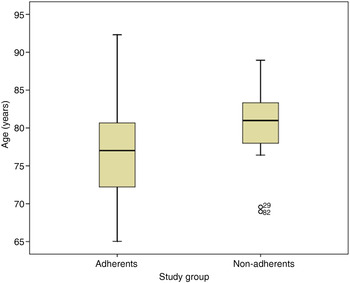
The two analysed groups were not comparable regarding sex (Fisher's exact test, p = 0.037; odds ratio = 2.968, 95 per cent confidence interval = 1.066–8.264). The female-to-male ratio was 4.8:1 in adherents and 1.63:1 in non-adherents. Age was higher in non-adherents (average age of 80.7 years) than in adherents (average of 76.6 years) (student's t-test, p = 0.003), as shown in Figure 1. There were no significant differences between groups regarding: BMI (student's t-test, p = 0.694), number of falls in the last year (Mann–Whitney U test, p = 0.164) or fall-related hospitalisations in the same period (Mann–Whitney U test, p = 0.442).
Age distribution of vestibular rehabilitation programme adherents versus non-adherents.

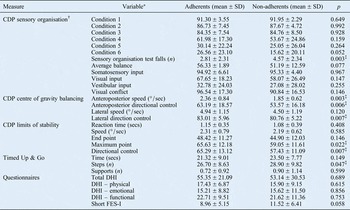
Table I shows the means (with SDs) of the different equilibriometric variables (posturographic, Timed Up and Go test and questionnaires) analysed for each of the two adherence groups; it also shows the level of statistical significance of the differences between them.
Summary of variables analysed for vestibular rehabilitation programme adherents and non-adherents

*The variables were measured in terms of scores unless indicated otherwise. †The six different sensory information conditions were: (1) fixed support and visual surround, with eyes open; (2) fixed support with eyes closed; (3) fixed support, with eyes open and moving visual surround; (4) moving support, with eyes open and fixed visual surround; (5) moving support with eyes closed; and (6) moving support, with eyes open and moving visual surround. ‡Indicates statistical significance (p < 0.05). SD = standard deviation; CDP = computerised dynamic posturography; sec = second; DHI = Dizziness Handicap Inventory; FES-I = Falls Efficacy Scale – International
Overall, non-adherent patients had poorer scores in voluntary movement posturographic tests (centre of gravity balancing and limits of stability), but not in sensory organisation tests (although falls were more common during the sensory organisation test). There were no differences between the groups in Timed Up and Go test scores, but non-adherents required more steps. Regarding the questionnaires, there were no differences in Dizziness Handicap Inventory scores (either globally or in any of the subscales) or Short Falls Efficacy Scale – International scores.
Finally, regarding the four vestibular rehabilitation groups, patients who underwent vestibular rehabilitation with optokinetic stimuli showed higher adherence compared with the other three vestibular rehabilitation groups (Table II), but the differences were not significant (chi-square test, p = 0.056). There were no significant differences (Fisher's exact test, p = 0.074) when hospital-based vestibular rehabilitation interventions (posturographic training and optokinetic stimuli) were compared to non-hospital vestibular rehabilitation interventions (home exercises and control group).
Type of vestibular rehabilitation received by programme adherents and non-adherents

Data represent numbers of patients.
Discussion
To the best of our knowledge, no previous studies have analysed balance test variables as predictors of non-adherence in vestibular rehabilitation programmes. The lack of adherence to treatment, especially when this extends over long periods of time, is costly for healthcare systems.Reference Yardley, Barker, Muller, Turner, Kirby and Mullee 14 The identification of individuals with a higher probability of non-adherence to a treatment programme (in this case, a vestibular rehabilitation programme), prior to initiation of the programme, would allow optimisation of resources. Several reports analysing different parameters that can influence adherence have been published, but they refer mainly to psychological factors, expectations and perception of self-efficacy.Reference Brassington, Atienza, Perczek, DiLorenzo and King 19
In elderly patients, factors that may influence non-adherence are diverse, and include the presence of co-morbidities, which can lead to unstable conditions and the development of other illnesses, resulting in non-attendance,Reference Cassidy, Baird and Sheikh 20 or even the death of the patients. Our research project comprised a large sample of patients with instability aged over 65 years, who were followed up over medium- and long-term durations (6 and 12 months, respectively). We decided to evaluate adherence to the programme at six months, as the duration must be long enough to achieve some of the vestibular rehabilitation objectives; to evaluate results after a year in elderly patients may be an unrealistic goal.
There was a high level of patient adherence in our sample: 99 out of 120 patients (82.5 per cent) remained within the programme, attending sessions 6 months after inclusion. Some studies have reported not reaching the 50 per cent treatment protocol adherence rate;Reference Yardley, Barker, Muller, Turner, Kirby and Mullee 14 however, Ricci et al. found similar rates of adherence to ours, with a dropout rate of 14 per cent.Reference Ricci, Aratani, Caovilla and Ganança 13 Regarding sex, adherence was substantially higher in women than in men (odds ratio = 2.968). Hence, the inclusion of elderly males in vestibular rehabilitation programmes will require closer monitoring, to reduce dropouts as much as possible.
The relationship between lack of adherence and age was expected; specifically, the older the patient was, the higher the probability of them leaving the vestibular rehabilitation programme. However, although the difference between the two groups is statistically significant, the clinical relevance is limited, as the age difference between the two groups is small (76.6 vs 80.7 years). Thus, the inclusion of very elderly patients in these treatment protocols continues to be justified.
When comparing the posturographic results, we found a higher incidence of dropouts in patients with poorer scores for centre of gravity balancing and limits of stability. However, there was no difference between the two groups (adherents and non-adherents) in terms of sensory organisation test scores. This is an important finding. Low scores on limits of stability correlate with increased risk of falls,Reference Soto-Varela, Faraldo-García, Rossi-Izquierdo, Lirola-Delgado, Vaamonde-Sánchez-Andrade and del-Río-Valeiras 21 as voluntary displacement of centre of gravity reproduces common situations in daily life (bending over, sitting up, leaning forward and backward, and so on). Thus, the elderly with a greater need to improve their balance are precisely those individuals with lower adherence. Consequently, low scores in these tests should be regarded as warning signs for risk of abandonment; it is therefore necessary to pay special attention to these patients and have regular follow-up appointments to encourage adherence.
It is interesting that neither questionnaire scores (for perception of disability and fear of falling) nor the Timed Up and Go test parameters were related to the dropout rate. It seems that the subjective perception of instability limitations does not affect motivation for vestibular rehabilitation. It has been reported that the perception of self-efficacy is an important factor for adherence to vestibular rehabilitation programmes;Reference Geraghty, Kirby, Essery, Little, Bronstein and Turner 12 because vestibular rehabilitation exercises deliberately provoke temporary dizziness, the tolerance of symptoms helps an individual to adhere to exercises and complete the rehabilitation programme.
-
• One can establish a risk profile of elderly patients with instability most likely to abandon a vestibular rehabilitation programme
-
• Very elderly males with low scores for centre of gravity balancing and limits of stability were more likely to drop out of rehabilitation
-
• Motivation and follow-up efforts should focus on this group to ensure that patients complete their training programmes
Finally, it is noteworthy that there was no relationship between the type of vestibular rehabilitation intervention and adherence. One might expect that patients who undergo vestibular rehabilitation in the hospital (and therefore experience closer monitoring by the medical staff) would have a lower dropout rate than those who perform rehabilitation at home (with specific exercises or just walking). Although the vestibular rehabilitation group exposed to optokinetic stimuli had a lower dropout rate, the differences were not statistically significant. Therefore, at least in terms of adherence, vestibular rehabilitation undertaken at home has the same consistency as that received in the hospital.
Acknowledgements
This study was funded by the project PI11/01328, integrated into the Spanish State Plan for research, development and innovation 2008–2011, and funded by the Instituto de Salud Carlos III (Subdirección General de Evaluación y Fomento de la Investigación) and the Fondo Europeo de Desarrollo regional (FEDER), under the project title ‘Reduction of falls in the elderly by improving balance through vestibular rehabilitation’.
Appendix 1. Description of analysed dynamic posturography variables
Sensory organisation test:
-
• The percentage score obtained for each condition (the arithmetic mean of the three tests in each condition).
-
• Average balance, obtained by calculating the arithmetic mean of the scores obtained on the 18 sensory organisation tests.
-
• The number of falls during the 18 sensory organisation tests.
-
• Percentage use of somatosensory information, which results from applying the following formula: (condition 2 mean score / condition 1 mean score) × 100.
-
• Efficacy in the use of visual information, resulting from the formula: (condition 4 mean score / condition 1 mean score) × 100.
-
• The use of vestibular information, from calculating: (condition 5 mean score / condition 1 mean score) × 100.
-
• A measure of patients’ reliance on visual information even when that information is incorrect, resulting from the following calculation with the mean values obtained in the different conditions: ((2 + 5) / (3 + 6)) × 100.
Centre of gravity balancing:
-
• Speed of movement: mean speed of displacement from centre of gravity expressed as degrees per second.
-
• Directional control: comparison between movement in the direction of the target versus movement away from that direction, as a percentage.
Limits of stability:
-
• Reaction time: time from the onset of a visual signal showing movement to its actual beginning (in seconds).
-
• Speed of movement: mean speed of displacement from the centre of gravity expressed as degrees per second.
-
• Maximum displacement: measure of maximum displacement from the centre of gravity relative to the theoretical 100 per cent limit of stability (as a percentage).
-
• Final displacement point: measure of the point reached at the end of the displacement of the centre of gravity, relative to the theoretical 100 per cent limit of stability (as a percentage).
-
• Directional control: comparison between movement in the direction of the target versus movement away from that direction, as a percentage.