Introduction
People with dementia are generally cared for in their community by family members for a large portion of the duration of their illness (Ryan and Scullion, Reference Ryan and Scullion2000; McClendon et al., Reference McClendon, Smyth and Neundorfer2006). However, when the burden of care exceeds the resources of the caregiver (Butcher et al., Reference Butcher, Holkup, Park and Maas2001), or causes deficits in the life of the caregiver, nursing home placement commonly ensues (Nikzad-Terhune et al., Reference Nikzad-Terhune, Anderson, Newcomer and Gaugler2010). In Western societies, between 75% and 90% of people with dementia will be placed in a nursing home as a result of dementia severity, behavioral disturbances, and inability of caregivers to cope with their complex needs (Knopman et al., Reference Knopman, Berg, Thomas, Grundman, Thal and Sano1999; Yaffe et al., Reference Yaffe2002).
The decision to place a relative in a nursing home can be complex, long, and agonizing for family caregivers (Ryan and Scullion, Reference Ryan and Scullion2000; Butcher et al., Reference Butcher, Holkup, Park and Maas2001; Yaffe et al., Reference Yaffe2002), and is frequently delayed as long as possible often in response to caregivers’ feelings of responsibility and guilt (Almberg et al., Reference Almberg, Grafstrom, Krichbaum and Winblad2000; Ryan and Scullion, Reference Ryan and Scullion2000; Aggarwal et al., Reference Aggarwal, Vass, Minardi, Ward, Garfield and Cybyk2003; Brown, Reference Brown2012). Based on thematic analysis of 30 caregivers of those with dementia, Butcher et al. (Reference Butcher, Holkup, Park and Maas2001) proposed four patterns in the decision-making process: moving toward the unavoidable decision, struggling with the decision, seeking reassurance, and remaining connected. Although not specific to dementia, Davies and Nolan (Reference Davies and Nolan2003; Reference Davies and Nolan2004) in an excellent study of caregivers’ experiences around the transition to residential care, reported that caregivers must balance negative perceptions of nursing home placement against their inability to provide the level of care and expertise needed.
Sometimes nursing home placement follows an unexpected, acute event such as hospitalization or severe illness in the person with dementia or the caregiver. When this occurs, the time for decision making is limited, with little information and support offered to caregivers (Gaugler et al., Reference Gaugler, Pearlin, Leitsch and Davey2001; Brown, Reference Brown2012). In the absence of an acute event, gradual deterioration in the condition of the person with dementia, and the strain this puts on the caregiver can precipitate nursing home placement. Factors triggering the move include behaviors such as wandering, agitation, and aggression, decline in memory and function such as incontinence, inability to leave the person with dementia alone, and safety issues (Butcher et al., Reference Butcher, Holkup, Park and Maas2001; Hebert et al., Reference Hebert, Dubois, Wolfson, Chambers and Cohen2001; Aggarwal et al., Reference Aggarwal, Vass, Minardi, Ward, Garfield and Cybyk2003; Brindle and Holmes, Reference Brindle and Holmes2005; Gaugler et al., Reference Gaugler2010a) as well as caregiver illness (Ryan and Scullion, Reference Ryan and Scullion2000) and depressive mood (Hebert et al., Reference Hebert, Dubois, Wolfson, Chambers and Cohen2001).
A lack of resources available to the caregiver and a need to balance paid employment against caregiving can also result in nursing home placement (Tsuji et al., Reference Tsuji, Whalen and Finucane1995). Nursing home placement reflects more than just dementia severity. People with dementia are more likely to be placed in a nursing home if they live alone, are over 80 years old, have a low functional status, have a low Mini-Mental State Examination score or have depression, or if their caregiver is older, married, or has a high-burden score (Hebert et al., Reference Hebert, Dubois, Wolfson, Chambers and Cohen2001; Yaffe et al., Reference Yaffe2002). Davies and Nolan (Reference Davies and Nolan2003) report that over half the decisions made to place older relatives in nursing homes are made by caregivers.
The adjustment to this new caring environment by both residents and their family caregivers and the factors that influence this are the focus of this review. For the purposes of this review, transition is defined as the process or period of changing from one state or condition to another and adjustment as the process of adapting or becoming used to a new situation (Oxford Dictionaries Online, 2010).
Method
A systematic review of Embase, Scopus, and Medline databases from 1990 to 2011 was performed, using the following MeSH terms; “dementia” or “Alzheimer*” or “Alzheimer disease,” “Family Caregiver” or “caregiver,” “nursing home” or “residential aged care” or “skilled nursing facilities,” “institutionalization,” “longitudinal studies,” “psychological adaptation” or “social adjustment,” “patient admission,” “depression,” “quality of life,” “behavioral symptoms,” “behavioural symptoms,” and “health facility environment” and “environment design.” Free text searches of the terms “carer,” “adjustment,” “trajectory,” “transition,” and “adjustment” were also used. English language restrictions were applied.
Abstracts of 174 results, excluding matches found in multiple databases, were reviewed for relevance, yielding 81 relevant articles. A search of citations within articles, and a Web of Science search to find articles citing especially relevant literature returned a further five articles. Letters, editorials, articles that did not separate residents with dementia from those without dementia, and/or that discussed group homes were excluded. The remaining 30 papers discussed dementia, examined nursing homes or equivalent, employed qualitative as well as quantitative methods, were longitudinal and/or cross-sectional in design, and were the focus of this review. Additional hand searching produced a further 19 papers. Papers for inclusion and those where there was doubt about exclusion were checked by two of the three authors.
Of the 49 included studies, 28 emanated from the USA, 6 from the United Kingdom, 3 from Australia, and 12 from other countries. While the challenges arising from growing numbers of elderly (Burns et al., Reference Burns2010) as well as the proportion of people with dementia living in the community and nursing homes in the USA, UK, and Australia are similar (approximately 1/3 and 2/3, respectively (Grant Thornton Australia Limited, 2011; Alzheimer's Association, 2012; Alzheimer's Society UK, 2012;)), systems and financing of care differ.
Results
Resident adjustment to nursing home admission
The transition to a nursing home is a challenging life experience, representing a loss of home, neighborhood, and time with family and friends (Reinardy, Reference Reinardy1992). Entry into a nursing home often follows an acute hospitalization, and as such potential residents have little control over decisions related to their admission (Brindle and Holmes, Reference Brindle and Holmes2005; Thein et al., Reference Thein, D'Souza and Sheehan2011; Brown, Reference Brown2012). Due to the sensitive and often distressing nature of the subject, the approaching move to nursing home is rarely discussed with the potential resident as the need for placement becomes increasingly apparent (McAuley et al., Reference McAuley, Travis and Safewright1997; Davies and Nolan, Reference Davies and Nolan2003). Additionally, for persons with dementia, the presence of a caregiver may mean that their views are overlooked during the decision-making process (Davies and Nolan, Reference Davies and Nolan2003; Tyrrell et al., Reference Tyrrell, Genin and Myslinski2006).
For those living in residential care, a perceived lack of control and the associated anxiety, may impact negatively on well-being (Mitchell and Koch, Reference Mitchell and Koch1997) and quality of life (Scocco et al., Reference Scocco, Rapattoni and Fantoni2006) as well as lead to depression (Boyle, Reference Boyle2005) and/or poorer physical health (Keister, Reference Keister2006; Scocco et al., Reference Scocco, Rapattoni and Fantoni2006) in the person with dementia. However, depressive symptoms evident in newly admitted residents have been reported to be in remission at six months follow-up, putatively because the nursing home environment facilitates adjustment and leads to a decrease in depressive symptoms (Smalbrugge et al., Reference Smalbrugge, Jongenelis, Pot, Eefsting, Ribbe and Beekman2006).
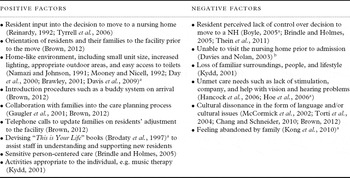
By contrast, residents who have some input into the decision to move to a nursing home (Reinardy, Reference Reinardy1992; Thein et al., Reference Thein, D'Souza and Sheehan2011; Brown, Reference Brown2012) as well as family support and prior visits to the nursing home (Kellett, Reference Kellett1999; Thein et al., Reference Thein, D'Souza and Sheehan2011) are more likely to be satisfied with the decision (Tyrrell et al., Reference Tyrrell, Genin and Myslinski2006). Some short-term positive impact on physical health has also been shown (Reinardy, Reference Reinardy1992).
Little is known about the quality of life of people with dementia in the period following admission to a nursing home. Reports on the quality of life of those with dementia living in nursing homes indicate that it may be influenced by a variety of factors, including how well their needs are met (Hancock et al., Reference Hancock, Woods, Challis and Orrell2006; Hoe et al., Reference Hoe, Hancock, Livingston and Orrell2006), their levels of depression and anxiety (Hoe et al., Reference Hoe, Hancock, Livingston and Orrell2006) as well as family involvement (Penrod et al., Reference Penrod, Kane and Kane2000). However, many reports of quality of life in residents with dementia rely on proxy ratings, which may be inconsistent with residents’ own ratings and raise questions about their validity. Quality of life tends to be rated lower by caregivers and staff than by residents themselves. Resident ratings are negatively associated with depressed mood, anxiety, and number of unmet needs (Hoe et al., Reference Hoe, Hancock, Livingston and Orrell2006). High staff ratings of quality of life are associated with less physical disability, milder cognitive impairment, fewer neuropsychiatric symptoms, and fewer unmet needs (Hoe et al., Reference Hoe, Hancock, Livingston and Orrell2006).
A loss of familiar surroundings and people as well as a change in lifestyle may be associated with the newly admitted resident becoming angry, depressed, or reclusive (Kydd, Reference Kydd2001). For people living in residential care, strong links are reported between quality of life and behavioral disturbances in general and with depression in particular (Koopmans et al., Reference Koopmans, Zuidema, Leontjevas and Gerritsen2010). Behavioral and neuropsychiatric symptoms occur in as many as 90% of nursing home residents with dementia (Brodaty et al., Reference Brodaty2001), and are associated with lower quality of life (Achterberg et al., Reference Achterberg, Pot, Kerkstra and Ribbe2006; Koopmans et al., Reference Koopmans, Zuidema, Leontjevas and Gerritsen2010). Depression occurs in over 30% of nursing home residents with dementia (Brodaty et al., Reference Brodaty2001; Hoover et al., Reference Hoover2010), with many cases going unnoticed and untreated. While cross-sectional correlations do not explain causality, there is a strong link between levels of depression and anxiety, and quality of life in nursing home residents with dementia, with depression being associated with a lower quality of life (Hoe et al., Reference Hoe, Hancock, Livingston and Orrell2006; Hoover et al., Reference Hoover2010).
Quality of life has also been linked to how well nursing home residents’ needs are fulfilled, which can be difficult to determine as people with dementia may have limited capacity to express their needs (Potkins et al., Reference Potkins2003). Unmet needs, such as lack of stimulating activity (Train et al., Reference Train, Nurock, Manela, Kitchen and Livingston2005), and company as well as lack of support for memory and/or sensory impairment are associated with lower quality of life, poorer mental health, and/or increased behavioral problems (Hancock et al., Reference Hancock, Woods, Challis and Orrell2006). Although this study did not focus on new admissions (average length of stay of 33.5 months (SD 30, range 1–180)), unmet needs were more likely in those who had lived in residential care for a shorter time (Hancock et al., Reference Hancock, Woods, Challis and Orrell2006).
People with dementia are highly sensitive to their surroundings and as such the living environment and design of a nursing home may have a significant impact on their health and well-being (Day et al., Reference Day, Carreon and Stump2000; Davis et al., Reference Davis, Byers, Nay and Koch2009). People with dementia still have a need to express their feelings, make choices, and continue with a familiar lifestyle when they are admitted to nursing homes. Quality of life for those living in residential care may be improved by creating a more home-like environment within small units which include increased levels of light (Brawley, Reference Brawley2001), outdoor areas (Mooney and Nicell, Reference Mooney and Nicell1992; Brawley, Reference Brawley2001), and easy access to toilets (Namazi and Johnson, Reference Namazi and Johnson1991). Improving the quality of life of people with dementia through a supportive environment may help ease the transition from home to residential aged care. However, these data are largely anecdotal and/or cross-sectional. Comparative and longitudinal studies are required to examine the impact of environmental design on the adjustment of people with dementia to the residential aged care environment.
The adjustment of people with dementia to nursing homes may also be influenced by cultural background. Cultural dissonance, in the form of language (Brown, Reference Brown2012) or a lack of access to traditional ethnic foods or celebrations of significance, may hinder the process of adaptation to residential care for both the residents and their families. Literature relevant to the cultural aspects of adjustment to nursing home admission is limited and that regarding issues pertinent to dementia, even more so. The decision-making process and the ensuing period of adjustment around nursing home placement for a person – not necessarily someone with dementia – varies with cultural differences in how the caregiving role is perceived, particularly in individualist versus collectivist cultures (Fitzgerald et al., Reference Fitzgerald, Mullavey-O'Byrne and Clemson2001). Perceptions of caregiver role include an obligation and a personal responsibility. To neglect this duty has been described as a source of “public social shame” (Fitzgerald et al., Reference Fitzgerald, Mullavey-O'Byrne and Clemson2001), cultural stigma (Suleiman and Walter-Ginzburg, Reference Suleiman and Walter-Ginzburg2005), and a violation of a “traditional virtue” and a “revered belief” (Chang and Schneider, Reference Chang and Schneider2010).
Cross-cultural distinctions are reported around predictors of and triggers for institutionalization of a family member with dementia (Yaffe et al., Reference Yaffe2002; Gaugler et al., Reference Gaugler, Leach, Clay and Newcomer2004a; Gaugler et al., Reference Gaugler, Kane, Kane and Newcomer2006), time to nursing home admission (Torti et al., Reference Torti, Gwyther, Reed, Friedman and Schulman2004; Gaugler et al., Reference Gaugler, Kane, Kane and Newcomer2006), the decision-making process around admission (Chang and Schneider, Reference Chang and Schneider2010), utilization of nursing home accommodation (McCormick et al., Reference McCormick2002; Suleiman and Walter-Ginzburg, Reference Suleiman and Walter-Ginzburg2005) as well as emotional responses and caregiver burden during the postadmission transition period (Chang and Schneider, Reference Chang and Schneider2010; Nikzad-Terhune et al., Reference Nikzad-Terhune, Anderson, Newcomer and Gaugler2010).
Traditional social mores, values, cultural norms, and expectations are changing for many cultural groups (Torti et al., Reference Torti, Gwyther, Reed, Friedman and Schulman2004). Cross-cultural changes influencing dementia care include those related to traditional social, economic, and kinship structures (Torti et al., Reference Torti, Gwyther, Reed, Friedman and Schulman2004; Suleiman and Walter-Ginzburg, Reference Suleiman and Walter-Ginzburg2005; Chang and Schneider, Reference Chang and Schneider2010); increased work demands on younger caregivers; assimilation into majority cultures; increasing longevity (McCormick et al., Reference McCormick2002) as well as access to medical care, pharmacological treatment, and resources to support caregivers (Torti et al., Reference Torti, Gwyther, Reed, Friedman and Schulman2004).
Kong et al. (Reference Kong, Deatrick and Evans2010) found that non-English speaking, Korean immigrants living in American nursing homes were more vulnerable to a lack of care and exhibited more problematic behaviors, due to difficulties in communicating with staff. Further, past experiences may have an additional impact on the transition of people with dementia to nursing homes. Dementia may trigger suppressed memories, with some Holocaust survivors feeling they are being locked up, and mistaking staff for guards or torturers, resulting in increased levels of distress and challenging behaviors (Joffe et al., Reference Joffe, Joffe and Brodaty1996).
Family adjustment
Substantially more research has been reported on how families adjust to a person with dementia moving into a nursing home, than how people with dementia themselves adjust. When individuals (including those with dementia) are admitted to a nursing home, family caregivers enter a new but potentially still involved role and experience varying emotions, influenced by the care that their relative receives, interactions with staff, support, as well as the deterioration in their relative's condition (Davies and Nolan, Reference Davies and Nolan2003; Reference Davies and Nolan2004). With advancing disease the person with dementia will likely exhibit increased frailty, problematic behaviors, and memory loss (Majerovitz, Reference Majerovitz1995). The severity with which these symptoms occurred prior to admission influences the potential relief for the caregiver at the time of nursing home placement (Almberg et al., Reference Almberg, Grafstrom, Krichbaum and Winblad2000). Caregivers may experience loss, regret, sadness, a sense of failure, guilt, and a need to justify their decision to others (Ryan and Scullion, Reference Ryan and Scullion2000; Brown, Reference Brown2012). Family caregivers relinquish day to day duties such as bathing, feeding, and managing challenging behaviors when their relative enters a nursing home, but they take on new roles, such as interacting with the staff on behalf of the resident and making the resident as comfortable and happy as possible (Nikzad-Terhune et al., Reference Nikzad-Terhune, Anderson, Newcomer and Gaugler2010). Care becomes less motivated by the constant need for assistance and supervision and more about preserving the identity and quality of life of the resident.
The shift from primary caregiver to advocate and friend for the resident can make visits satisfying and empowering, with many caregivers welcoming the chance just to spend time with their relative; yet stresses remain (Zarit and Whitlatch, Reference Zarit and Whitlatch1992; Almberg et al., Reference Almberg, Grafstrom, Krichbaum and Winblad2000; Gaugler et al., Reference Gaugler, Anderson, Zarit and Pearlin2004b). The initial task for many caregivers, time permitting, is to make the nursing home feel as familiar as possible to a new resident by organizing for familiar mementos and furniture to be placed in the room, displaying photographs, and providing the staff with as much information as possible about the resident (Davies and Nolan, Reference Davies and Nolan2004).
The decision to place their spouse or relative in a nursing home has negative emotional effects on caregivers who experience a variety of emotions during the transition period following the admission (Gaugler et al., Reference Gaugler, Pearlin, Leitsch and Davey2001; Bond et al., Reference Bond, Clark and Davies2003). Spouses, in particular wives, may undergo a second period of anticipatory grieving, the first associated with the loss of their partner through dementia and the second through nursing home admission (Bond et al., Reference Bond, Clark and Davies2003). Emotional responses include guilt, loss, a sense of failure, and sadness, as well as relief (Kellett, Reference Kellett1999; Butcher et al., Reference Butcher, Holkup, Park and Maas2001; Brown, Reference Brown2012).
In many cases where individuals (including those with dementia) are admitted to a nursing home, guilt and anxiety are more related to whether the caregiver was living with the resident preadmission than the relationship between the caregiver and resident (Davies and Nolan, Reference Davies and Nolan2004). Guilt is especially strong when a promise had been made that the caregiver would never place the care recipient in a nursing home (Davies and Nolan, Reference Davies and Nolan2004). Even though guilt levels are similar, the process of adjustment differs between caregivers who were living with the resident prior to admission and those who were not (Davies and Nolan, Reference Davies and Nolan2004). Those who were living with the resident are more inclined to find the loss of their loved one leaves a void, and often feel the need to visit daily, the result being that their own psychological and physical well-being may not benefit greatly from the nursing home placement. In contrast, those who were not living with their family member prior to admission may experience different stresses such as those associated with family conflict and the sale of their relative's house and possessions (Butcher et al., Reference Butcher, Holkup, Park and Maas2001; Davies and Nolan, Reference Davies and Nolan2004).
The trajectory of caregiver stress and depression after nursing home placement is debated (Gaugler et al., Reference Gaugler, Pearlin, Leitsch and Davey2001; Reference Gaugler, Mittelman, Hepburn and Newcomer2010b). Some report a steady level or increase due to dissatisfaction with care (Almberg et al., Reference Almberg, Grafstrom, Krichbaum and Winblad2000; Schulz et al., Reference Schulz, Belle, Czaja, McGinnis, Stevens and Zhang2004; Nikzad-Terhune et al., Reference Nikzad-Terhune, Anderson, Newcomer and Gaugler2010); others report improved mental health as well as a decrease in burden, stress, and depression associated with relinquishing care (Bond et al., Reference Bond, Clark and Davies2003; Gaugler et al., Reference Gaugler, Roth, Haley and Mittelman2008; Reference Gaugler, Mittelman, Hepburn and Newcomer2010b). A further trajectory indicates that burden increases prior to placement due to care demands, especially when the resident is hospitalized prior to admission, and decreases later (Gaugler et al., Reference Gaugler, Mittelman, Hepburn and Newcomer2009). Spouses, in particular, struggle with nursing home placement (Schulz et al., Reference Schulz, Belle, Czaja, McGinnis, Stevens and Zhang2004; Gaugler et al., Reference Gaugler, Mittelman, Hepburn and Newcomer2010b). Wives, the largest group of caregivers, suffer from increased burden following placement, as they continue to provide a high level of care to their husband, and remain emotionally involved. Husbands are more likely to suffer from persistent postplacement depression, possibly due to the emotional loss of their partner and a lower likelihood of receiving social support (Gaugler et al., Reference Gaugler, Mittelman, Hepburn and Newcomer2010b).
Family caregivers reportedly continue to experience burden after nursing home placement (Zarit and Whitlatch, Reference Zarit and Whitlatch1992; Almberg et al., Reference Almberg, Grafstrom, Krichbaum and Winblad2000). Visiting regularly can be time consuming and demanding, especially where caregivers feel the need to visit at least daily (Butcher et al., Reference Butcher, Holkup, Park and Maas2001) or the nursing home is far from home. Hours spent visiting may also decrease caregivers’ opportunities for a social life. Cognitive problems, such as increased memory loss and the inability to recognize others, can impose considerable burden, which can worsen as caregivers see a steady decline in their relative with dementia (Levesque et al., Reference Levesque, Ducharme and Lachance1999; Tornatore and Grant, Reference Tornatore and Grant2004). Other causes of burden include guilt, lack of satisfaction with the care the resident is receiving, behavioral problems in the resident, financial worries, and conflict with staff and other family members (Almberg et al., Reference Almberg, Grafstrom, Krichbaum and Winblad2000; Schulz et al., Reference Schulz, Belle, Czaja, McGinnis, Stevens and Zhang2004; McClendon et al., Reference McClendon, Smyth and Neundorfer2006; Gaugler et al., Reference Gaugler, Mittelman, Hepburn and Newcomer2010b; Nikzad-Terhune et al., Reference Nikzad-Terhune, Anderson, Newcomer and Gaugler2010).
Although caregiver guilt and burden may continue after placement (Ryan and Scullion, Reference Ryan and Scullion2000), with time caregivers may come to view the move to a nursing home as positive, for both themselves and the person with dementia (Train et al., Reference Train, Nurock, Manela, Kitchen and Livingston2005). Once adapted to the structure and convention of nursing home life, family caregivers become an important link to the outside world, and have the ability to contribute to a sense of community within the nursing home, potentially easing the transition for the new resident (Davies and Nolan, Reference Davies and Nolan2004).
Successful adjustment to nursing home for caregivers
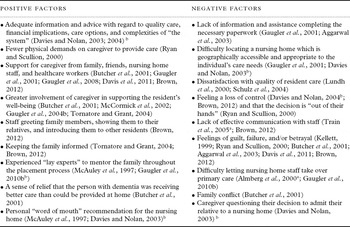
Key to successful adjustment to nursing home for primary family caregivers of persons with dementia is support for their decision and advice from staff, health care workers, family, and friends (Kellett, Reference Kellett1999; Gaugler et al., Reference Gaugler, Roth, Haley and Mittelman2008; Brown, Reference Brown2012). Caregivers with stronger socioemotional support networks experience fewer problems with the adjustment to nursing home care (Gaugler et al., Reference Gaugler, Pearlin, Leitsch and Davey2001). Davis et al. (Reference Davis, Tremont, Bishop and Fortinsky2011) found that a series of telephone calls to caregivers following resident admission, addressing common psychosocial issues, and discussing other support options improved caregiver adjustment following nursing home entry (Davis et al., Reference Davis, Tremont, Bishop and Fortinsky2011). Despite this, many caregivers report a lack of support and information provided by staff and health care workers as regards to what to expect from nursing home placement (Gaugler et al., Reference Gaugler, Pearlin, Leitsch and Davey2001), such as deterioration in their relative's condition, potentially increasing their stress during the transition period (Almberg et al., Reference Almberg, Grafstrom, Krichbaum and Winblad2000).
Nursing home staff can play an important role in helping residents and their families adjust to the nursing home setting. Families can be reassured with regard to the quality of their relatives’ care by actions such as meeting them at the door, showing them to their relatives, and introducing them to other residents (Brown, Reference Brown2012). However, families may feel that staff fail to draw upon their knowledge of the resident and that they are expected to play a background part, rather than an integral role, in their family member's care (Almberg et al., Reference Almberg, Grafstrom, Krichbaum and Winblad2000). This feeling of working apart from staff can result in dissatisfaction with the care provided and conflict with staff, which may increase caregiver burden (Almberg et al., Reference Almberg, Grafstrom, Krichbaum and Winblad2000). Early, strong collaboration between staff and family in the care of a nursing home resident can help ease the transition for caregivers, as well as improve quality of life for the resident with dementia (Gaugler et al., Reference Gaugler, Pearlin, Leitsch and Davey2001).
Training staff to communicate better with persons with dementia and their families can improve outcomes for all involved (McCallion et al., Reference McCallion, Toseland, Lacey and Banks1999; Pillemer et al., Reference Pillemer2003; Robison et al., Reference Robison, Curry, Gruman, Porter, Henderson and Pillemer2007). These studies did not report specifically on newly admitted residents; mean length of stay, where reported, was around three years. Teaching staff and family members’ methods of effective communication and/or conflict resolution decreased disagreements between staff and families as well as improving resident well-being, reducing dissatisfaction with care in caregivers and reducing stress in nursing staff (Pillemer et al., Reference Pillemer2003; Robison et al., Reference Robison, Curry, Gruman, Porter, Henderson and Pillemer2007).
Discussion
The period of adjustment to a nursing home is a difficult time for new residents and their family caregivers. This review summarises positive and negative factors influencing outcomes for residents and family members when people with dementia move into a nursing home. We found that for residents, their perceived level of control over the decision had an impact on how well they adjusted. Levels of behavioral and psychological symptoms of dementia, including agitation and depression tend to be higher in new residents of nursing homes, and are linked to residents’ quality of life (Tables 1 and 2).
Factors potentially influencing resident adjustment to moving to a nursing home

Note: aReferences not specific to new admissions.
bReferences not specific to dementia.
Factors potentially influencing family adjustment to the person entering a nursing home

Note: aReferences not specific to new admissions.
bReferences not specific to dementia.
The adjustment process is better understood for family members than for the resident with dementia. Family caregivers undergo a changing role following admission, in which they become less involved in the physical care of the resident, and more involved in their emotional well-being and in liaising with staff. Caregivers often experience guilt and anxiety around the decision to place their family member in a nursing home. While burden continues postplacement, its trajectory is unclear. Support for family caregivers from friends, other family members, and healthcare professionals appears to be important to a successful transition. Likewise, when a person with dementia is receiving a level of care, which is satisfactory to the family, the transition will be perceived as more positive.
Research on the adjustment to nursing home admission of people with dementia and their family caregivers has a number of limitations. First, the majority of studies examine the adjustment process from the family caregiver's perspective only. These are likely to be biased as caregivers partaking in research tend to be those who visit more often, and are more physically and emotionally involved in the care of the older relative. Secondly, several studies, based on the Medicare Alzheimer's Disease Demonstration Evaluation data (Yaffe et al., Reference Yaffe2002; Gaugler et al., Reference Gaugler2010a; Reference Gaugler, Mittelman, Hepburn and Newcomer2010b; Nikzad-Terhune et al., Reference Nikzad-Terhune, Anderson, Newcomer and Gaugler2010), are limited by the age of the data set, which was collected in the early 1990s, and a lack of minority group participants. Thirdly, although not all studies cited were specific to dementia and to new admissions, we consider the findings reported to be relevant to this review. Fourthly, qualitative research employed small sample sizes and/or frequently examined the views of family caregivers only. Finally, fewer than half of the studies examined in this review were longitudinal, with duration periods ranging from one week to three years.
Reports of levels of burden and distress following placement, the quality of life of residents with dementia, and which relatives experience the most difficulty with the transition are inconsistent. Most studies discuss the negative impacts of nursing home placement for people with dementia, yet for caregivers, placement can have positive effects on their physical and mental well-being (Zarit and Whitlatch, Reference Zarit and Whitlatch1992; Lundh et al., Reference Lundh, Sandberg and Nolan2000; Bond et al., Reference Bond, Clark and Davies2003). Limited reports are available on the potentially positive effects of nursing home admission for residents, the time course of their adjustment, or the factors influencing positive and negative outcomes subsequent to admission (Thein et al., Reference Thein, D'Souza and Sheehan2011). Nor is it clear if there are differences in the adjustment process for those admitted from the community when compared to those admitted directly from hospital. There is also more to be learnt about the influences of resident variables such as past psychiatric history, personality, cognitive impairment, and prior behavioral disturbance; family variables such as relationship to the resident, subsequent support, and visiting patterns as well as facility variables such as introduction procedures (e.g. buddy systems), nurse–resident ratios, socioeconomic status of nursing home population, and management policies.
One implication from this review is the need to develop interventions that could enhance the transition for residents into nursing homes and so improve their and their families’ subsequent quality of lives and reduce the rates of behavioral disturbances and other complications. Strategies include orientation of residents and their families to the new environment, a buddy system on arrival (Brown, Reference Brown2012), collaboration with families in the care planning process (Gaugler et al., Reference Gaugler, Pearlin, Leitsch and Davey2001), telephone calls to families, devising “This is Your Life” books (Brodaty et al., Reference Brodaty, Gresham and Luscombe1997) to help staff understand the people who are moving in and sensitive person-centered care. Effectiveness of interventions would be convincing if confirmed by randomized controlled trials. It is recommended that such trials include the following data:
1. Resident – demographics including age, sex, marital status, prior occupation, past psychiatric history, physical health.
2. Dementia – type, duration, severity (cognition and function), behaviors.
3. Caregiver – demographics including age, sex, relationship to resident, quality of relationship prior to admission, cohabitation prior to nursing home admission, marital status, education, occupation, past psychiatric history, physical health.
4. Context – emergency versus elective admission, from home or from hospital, prior respite and if so was it in the same facility, wider family consensus or conflict, financial strain imposed by admission.
5. The nursing home – policies and practices for admission, cultural and language congruity with resident, size, staff ratios, activity programs, visiting patterns.
6. Nature and quantification of intervention.
7. Longitudinal resident data – over at least three months (but preferably longer, say up to 12 months) including measures of cognition, function, behaviors, depression, and quality of life, as well as rates of hospitalization, discharge home, death, and health economic data.
8. Caregiver – visit frequency, increase in socialization and/or quality of life activities following the move and age as well as measures of function, guilt, depression, grief, and anxiety.
Conclusion
Admission to a nursing home is a huge step in any person's life. For most, it will be their final home. Yet for many, it is a time of anguish for the residents and guilt for their families. An understanding of the factors influencing positive and negative outcomes for residents and for their families is important in order to devise strategies to make this transition more positive.
Conflict of interest
None.
Description of author's roles
All authors were involved in the design of the research and the formulation of the research question for the review. Laura Sury undertook the literature review and wrote the report. Kim Burns assisted with the conceptualization of the project, checking and reviewing references, and writing the manuscript. Henry Brodaty conceptualized the project, added to the review, and assisted with writing the manuscript.